L. D. COLLEGE OF
ENGINEERING
RUBBER TECHNOLOGY
Sub:- THERMODYNAMICS OF
ELASTOMERS & POLYMERS
Some basic concepts
• Phase
– A homogeneous region with distinct structure
and physical properties
– In principle, can be isolated
– Can be solid, liquid or gas
• Phase Diagram
– Representation of phases present under a set
of conditions (P, T, Composition etc.)
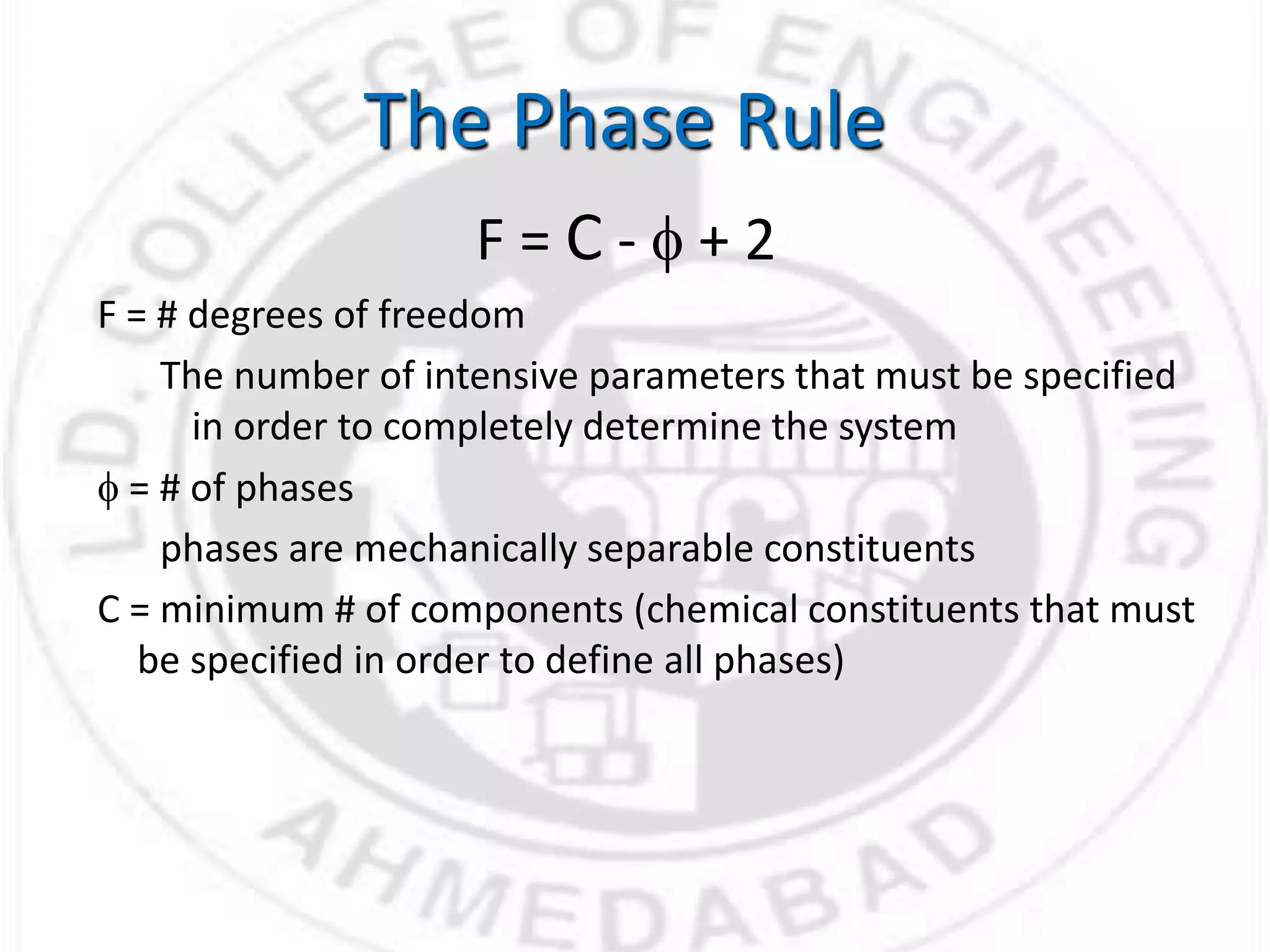
F = C - f + 2
F = # degrees of freedom
The number of intensive parameters that must be specified
in order to completely determine the system
f = # of phases
phases are mechanically separable constituents
C = minimum # of components (chemical constituents that must
be specified in order to define all phases)
The Phase Rule
Gibbs Phase Rule
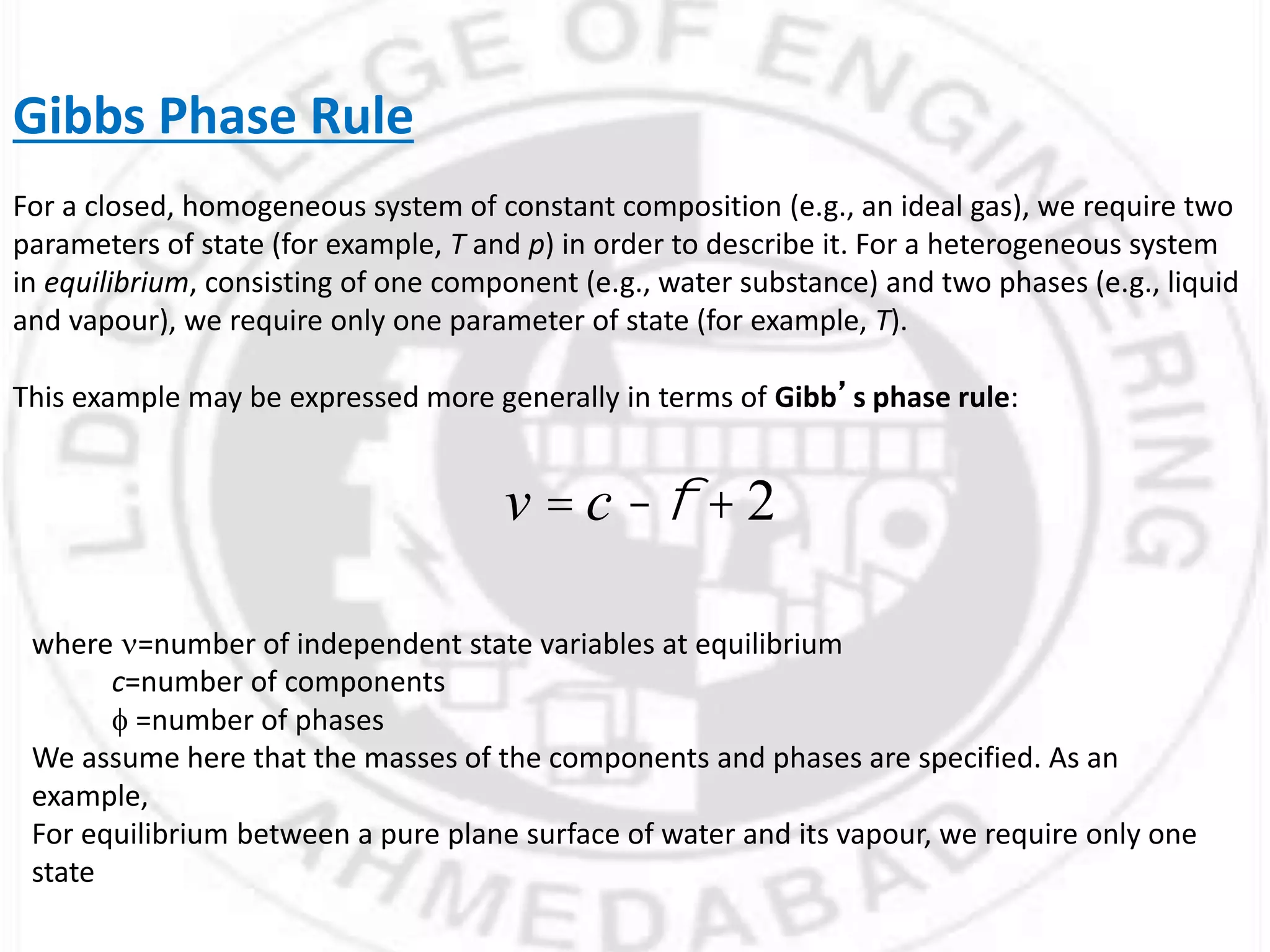
For a closed, homogeneous system of constant composition (e.g., an ideal gas), we require two
parameters of state (for example, T and p) in order to describe it. For a heterogeneous system
in equilibrium, consisting of one component (e.g., water substance) and two phases (e.g., liquid
and vapour), we require only one parameter of state (for example, T).
This example may be expressed more generally in terms of Gibb’s phase rule:
v = c -f + 2
where =number of independent state variables at equilibrium
c=number of components
f =number of phases
We assume here that the masses of the components and phases are specified. As an
example,
For equilibrium between a pure plane surface of water and its vapour, we require only one
state
Gibb’s Phase Rule
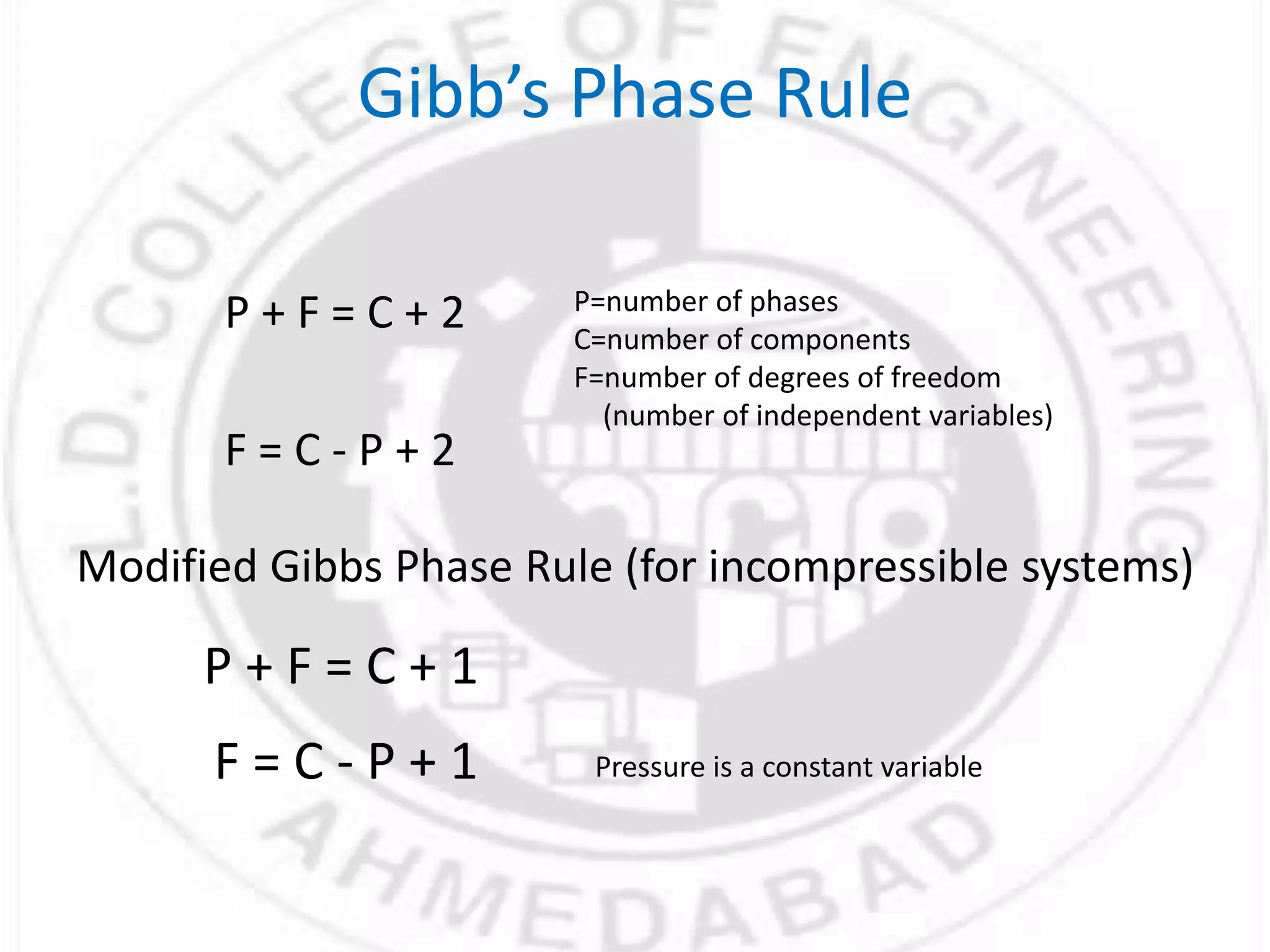
P + F = C + 2 P=number of phases
C=number of components
F=number of degrees of freedom
(number of independent variables)
Modified Gibbs Phase Rule (for incompressible systems)
P + F = C + 1
Pressure is a constant variable
F = C - P + 2
F = C - P + 1
Application of the phase rule
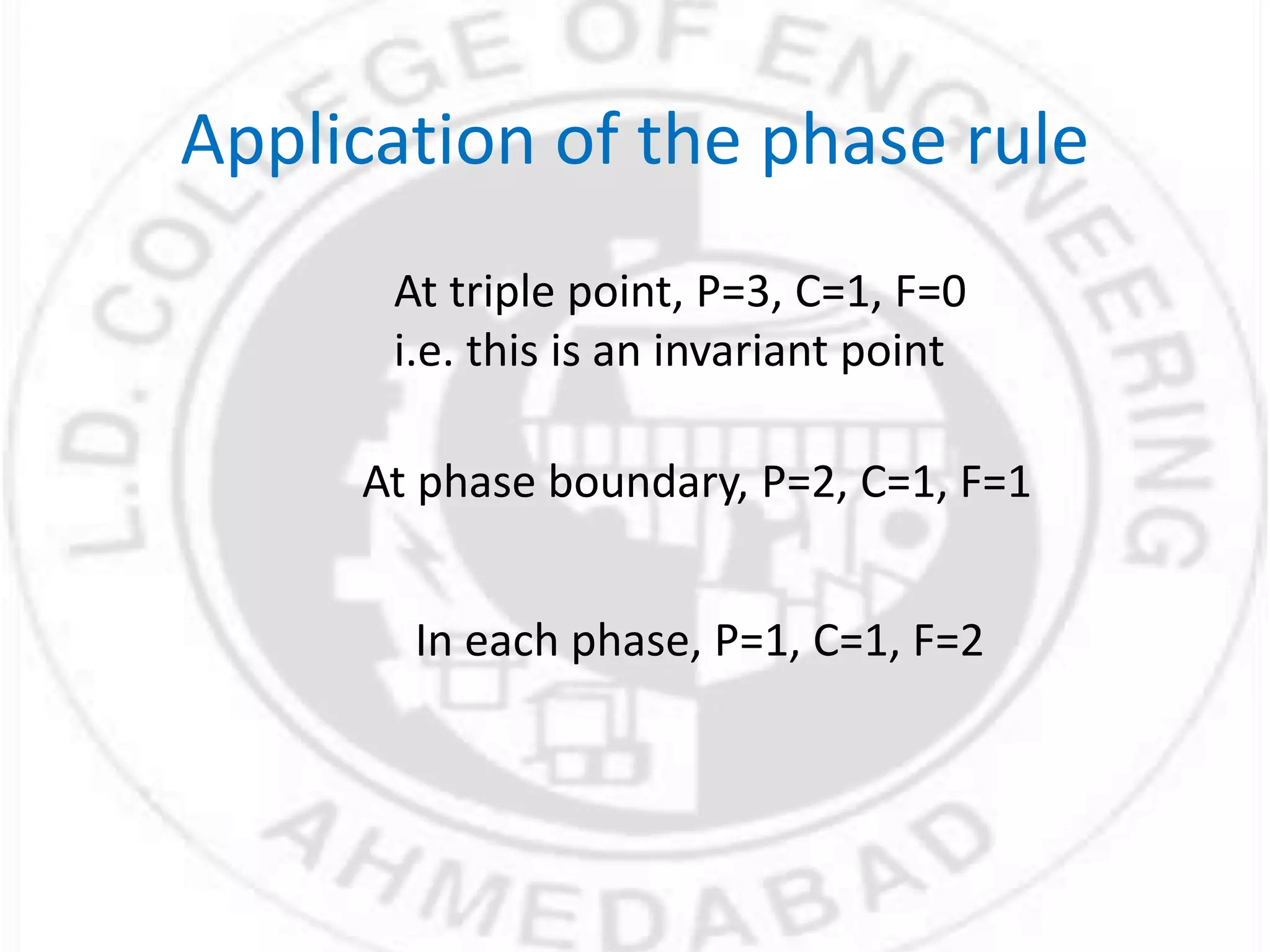
At triple point, P=3, C=1, F=0
i.e. this is an invariant point
At phase boundary, P=2, C=1, F=1
In each phase, P=1, C=1, F=2
The Phase Rule
There are two types of phase
components as per below;
=> One Component Systems
=> Two Component Systems
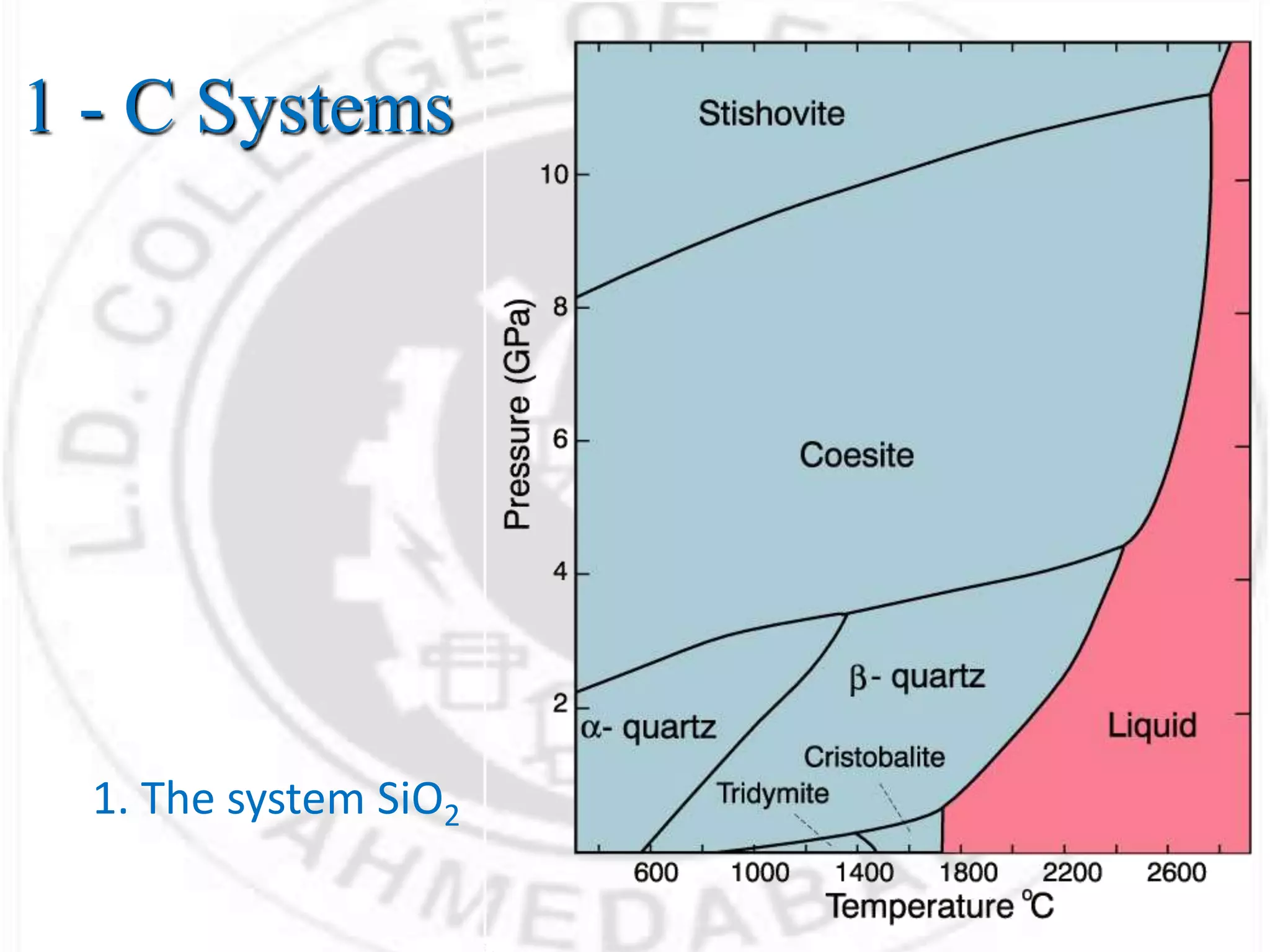
1 - C Systems
1. The system SiO2
1 - C Systems
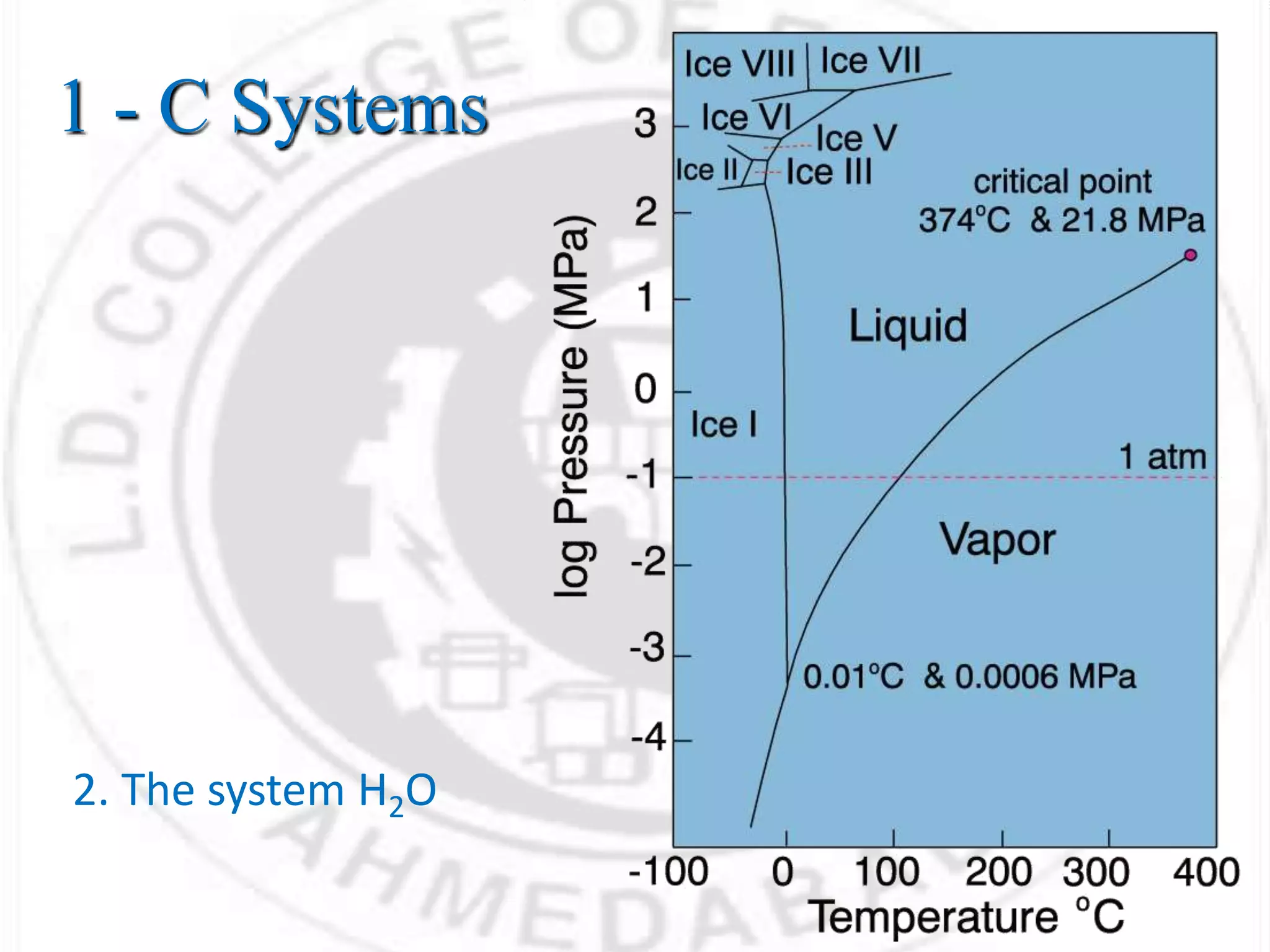
2. The system H2O
2 - C Systems
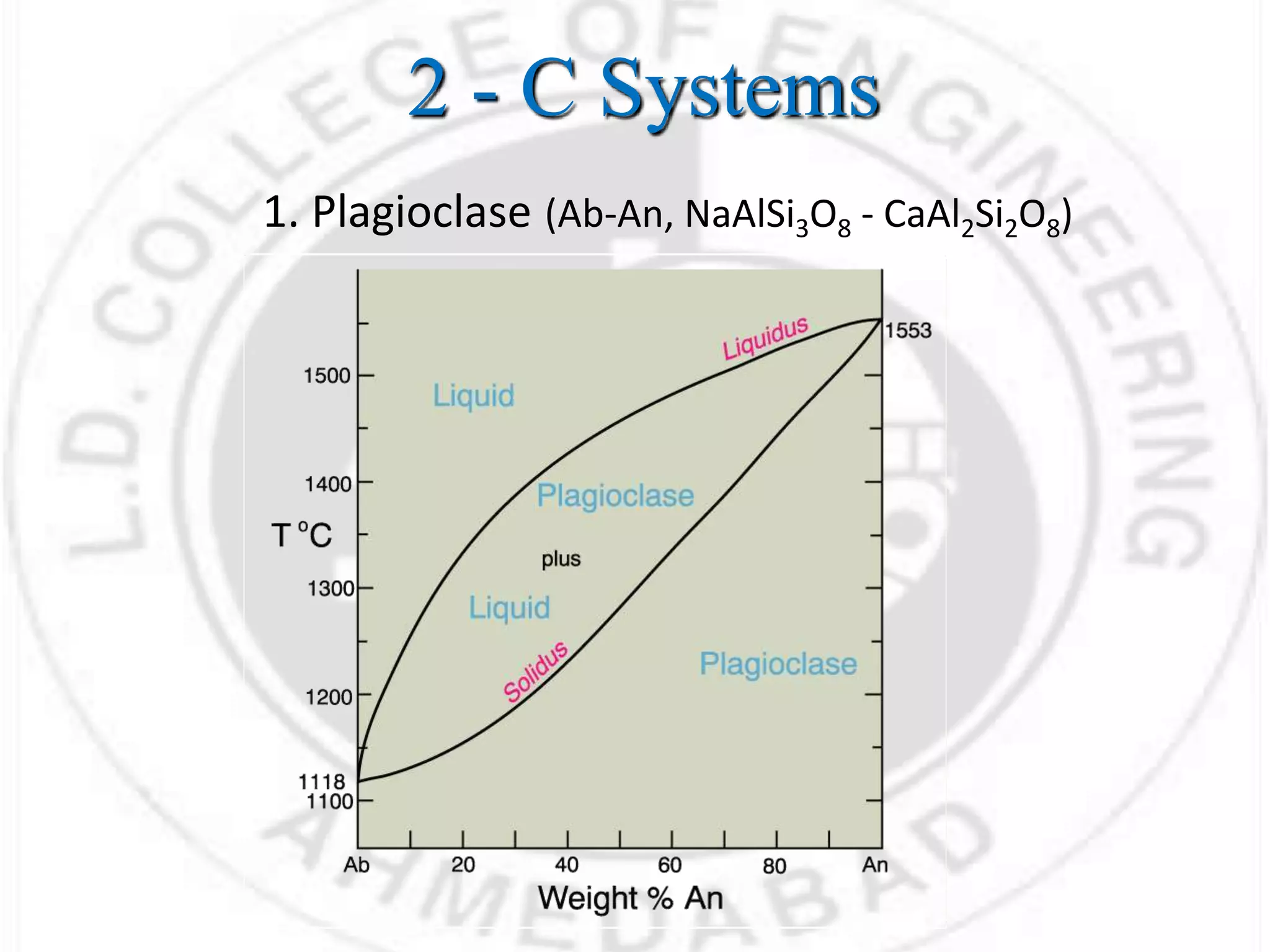
1. Plagioclase (Ab-An, NaAlSi3O8 - CaAl2Si2O8)
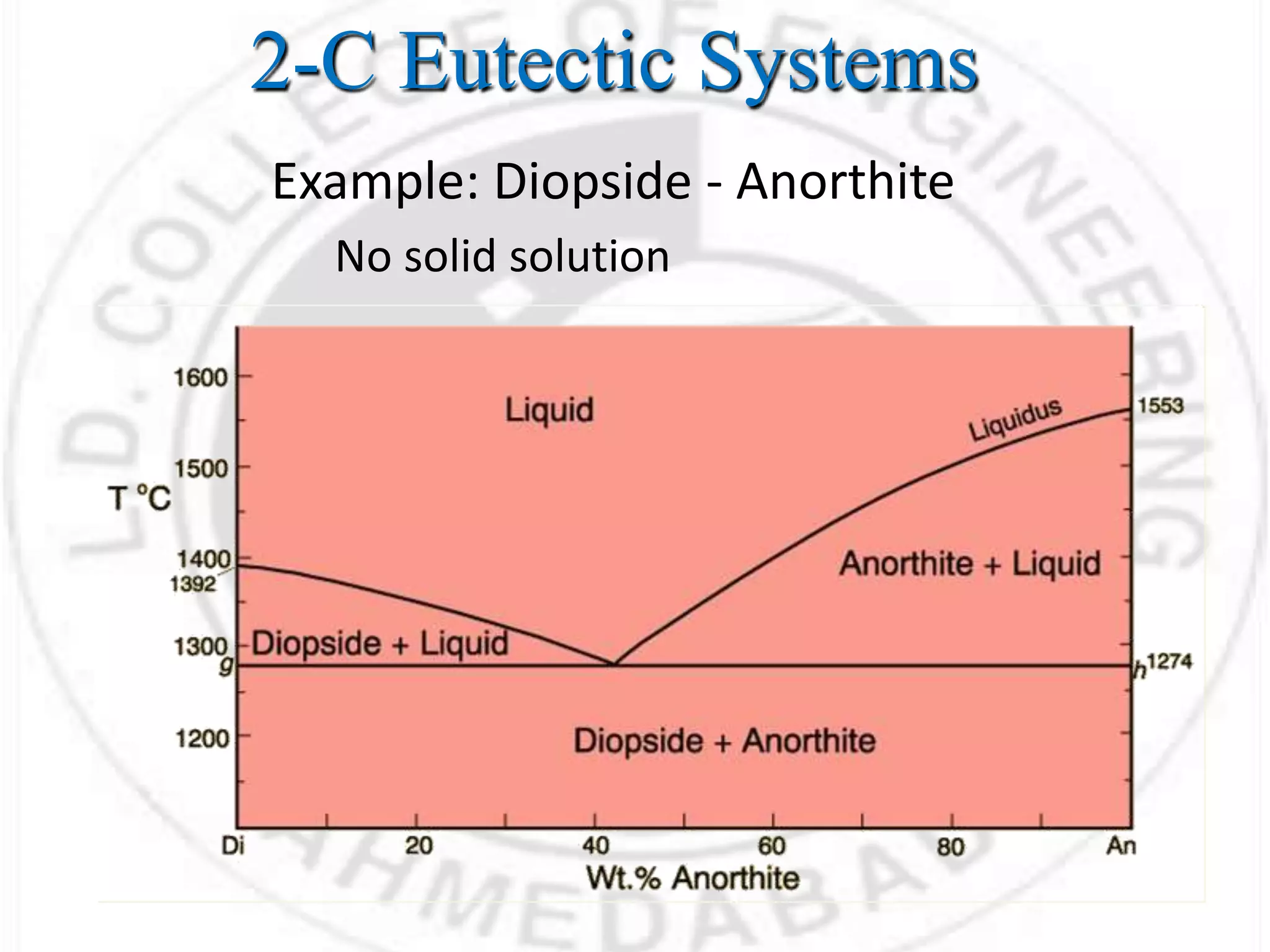
2-C Eutectic Systems
Example: Diopside - Anorthite
No solid solution
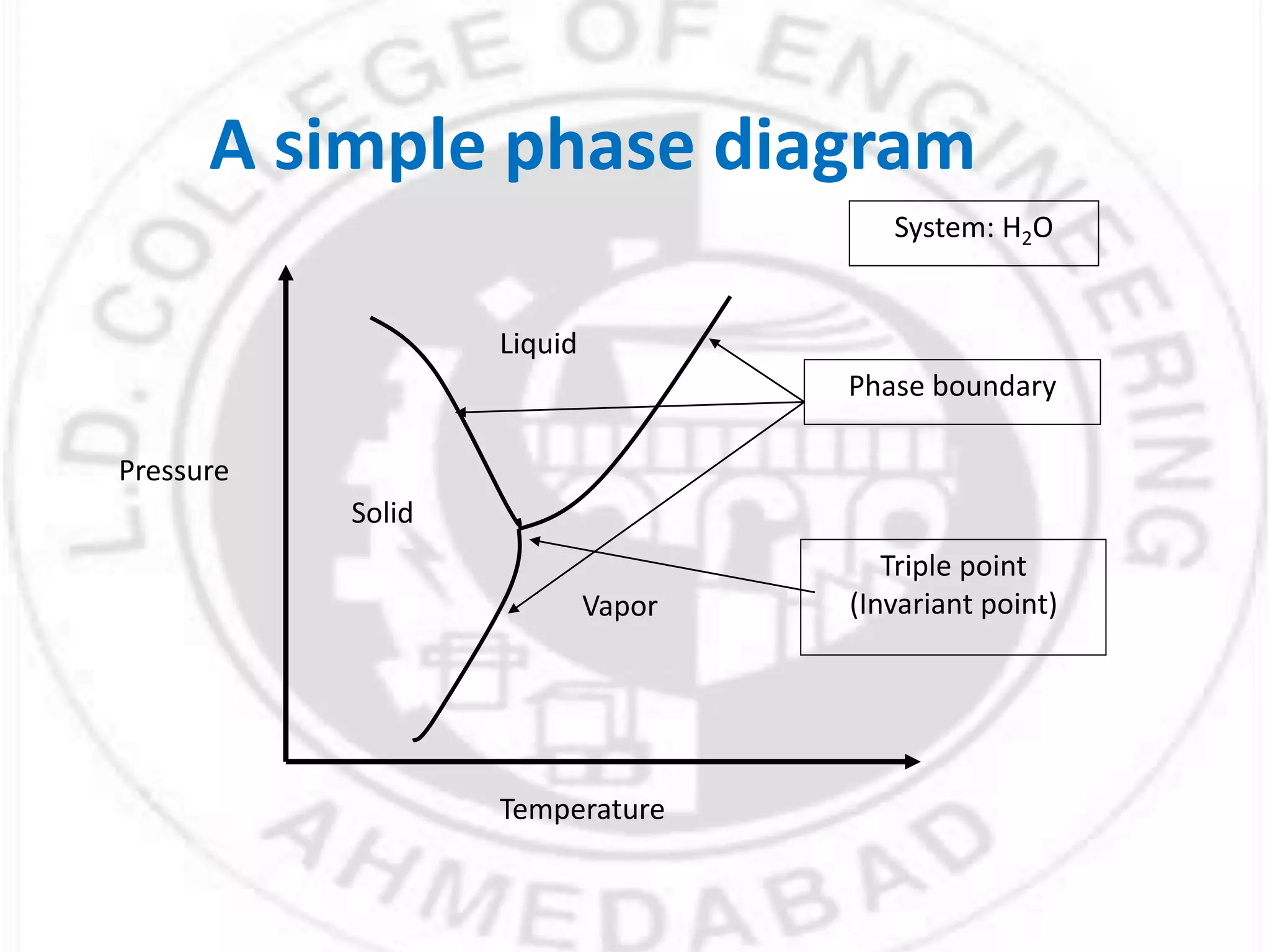
A simple phase diagram
Triple point
(Invariant point)
Solid
Liquid
Vapor
Pressure
Temperature
Phase boundary
System: H2O
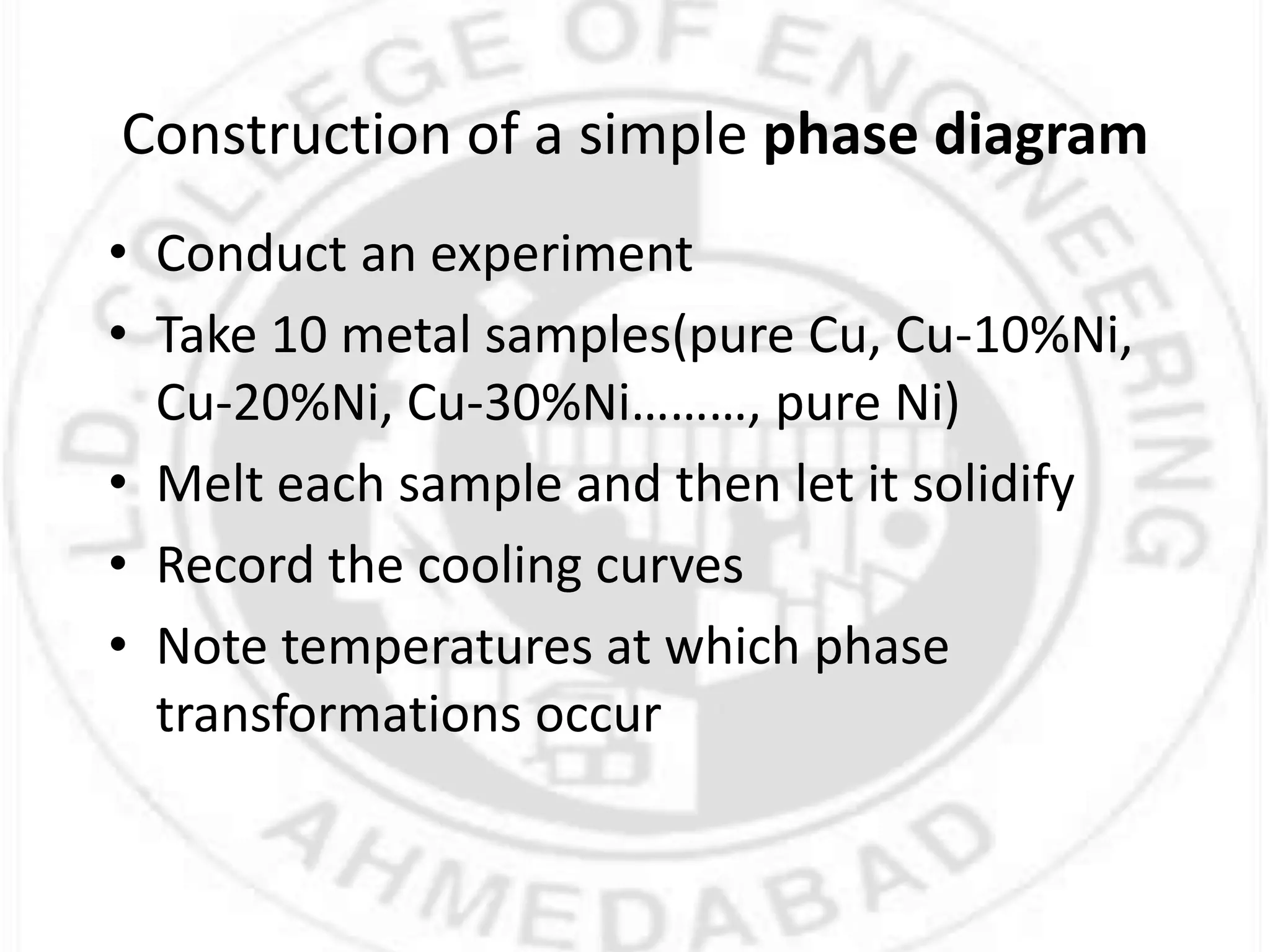
Construction of a simple phase diagram
• Conduct an experiment
• Take 10 metal samples(pure Cu, Cu-10%Ni,
Cu-20%Ni, Cu-30%Ni………, pure Ni)
• Melt each sample and then let it solidify
• Record the cooling curves
• Note temperatures at which phase
transformations occur
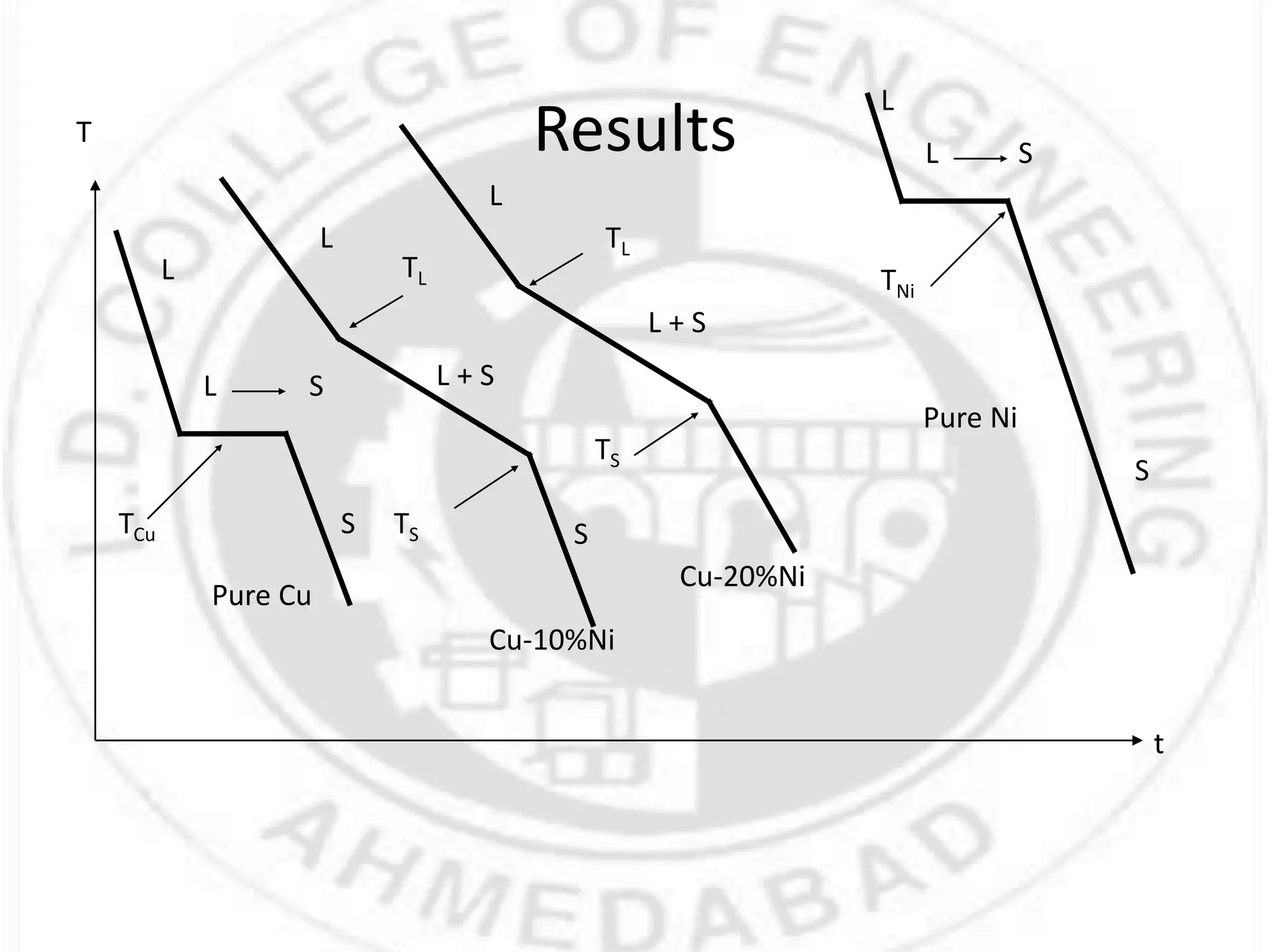
Results
L
S
L S
t
T
L
L + S
TL
TS S
L
L + S
TL
TS
Pure Cu
Cu-10%Ni
Cu-20%Ni
L
L S
Pure Ni
S
TNi
TCu
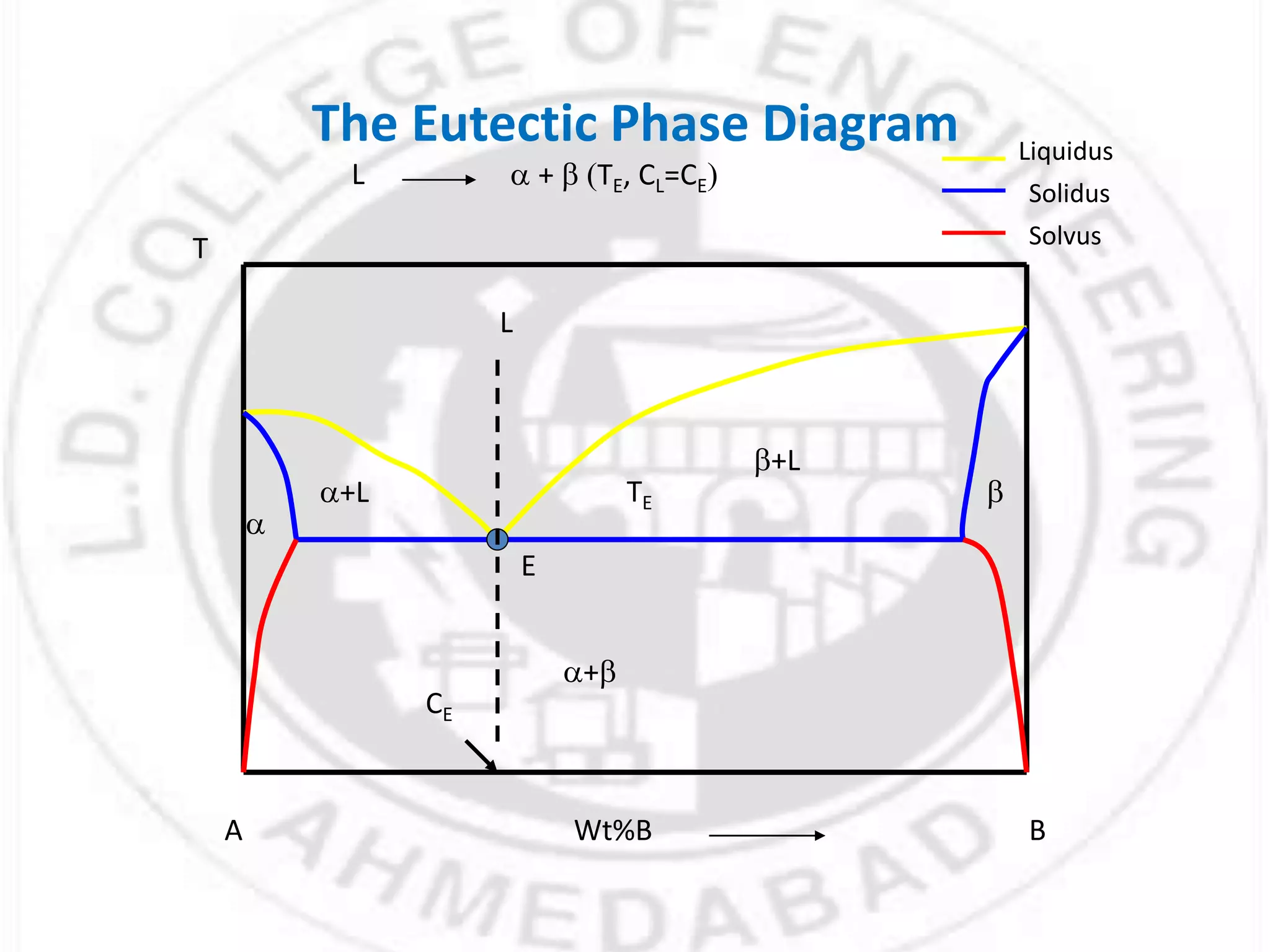
The Eutectic Phase Diagram
T
A BWt%B
L
a+L
b+L
a+b
E
TE
CE
a
b
Liquidus
Solidus
Solvus
L a + b (TE, CL=CE)
phase rule & phase diagram

phase rule & phase diagram

  • 1.
    L. D. COLLEGEOF ENGINEERING RUBBER TECHNOLOGY Sub:- THERMODYNAMICS OF ELASTOMERS & POLYMERS
  • 3.
    Some basic concepts •Phase – A homogeneous region with distinct structure and physical properties – In principle, can be isolated – Can be solid, liquid or gas • Phase Diagram – Representation of phases present under a set of conditions (P, T, Composition etc.)
  • 4.
    F = C- f + 2 F = # degrees of freedom The number of intensive parameters that must be specified in order to completely determine the system f = # of phases phases are mechanically separable constituents C = minimum # of components (chemical constituents that must be specified in order to define all phases) The Phase Rule
  • 5.
    Gibbs Phase Rule Fora closed, homogeneous system of constant composition (e.g., an ideal gas), we require two parameters of state (for example, T and p) in order to describe it. For a heterogeneous system in equilibrium, consisting of one component (e.g., water substance) and two phases (e.g., liquid and vapour), we require only one parameter of state (for example, T). This example may be expressed more generally in terms of Gibb’s phase rule: v = c -f + 2 where =number of independent state variables at equilibrium c=number of components f =number of phases We assume here that the masses of the components and phases are specified. As an example, For equilibrium between a pure plane surface of water and its vapour, we require only one state
  • 6.
    Gibb’s Phase Rule P+ F = C + 2 P=number of phases C=number of components F=number of degrees of freedom (number of independent variables) Modified Gibbs Phase Rule (for incompressible systems) P + F = C + 1 Pressure is a constant variable F = C - P + 2 F = C - P + 1
  • 7.
    Application of thephase rule At triple point, P=3, C=1, F=0 i.e. this is an invariant point At phase boundary, P=2, C=1, F=1 In each phase, P=1, C=1, F=2
  • 8.
    The Phase Rule Thereare two types of phase components as per below; => One Component Systems => Two Component Systems
  • 9.
    1 - CSystems 1. The system SiO2
  • 10.
    1 - CSystems 2. The system H2O
  • 11.
    2 - CSystems 1. Plagioclase (Ab-An, NaAlSi3O8 - CaAl2Si2O8)
  • 12.
    2-C Eutectic Systems Example:Diopside - Anorthite No solid solution
  • 13.
    A simple phasediagram Triple point (Invariant point) Solid Liquid Vapor Pressure Temperature Phase boundary System: H2O
  • 14.
    Construction of asimple phase diagram • Conduct an experiment • Take 10 metal samples(pure Cu, Cu-10%Ni, Cu-20%Ni, Cu-30%Ni………, pure Ni) • Melt each sample and then let it solidify • Record the cooling curves • Note temperatures at which phase transformations occur
  • 15.
    Results L S L S t T L L +S TL TS S L L + S TL TS Pure Cu Cu-10%Ni Cu-20%Ni L L S Pure Ni S TNi TCu
  • 16.
    The Eutectic PhaseDiagram T A BWt%B L a+L b+L a+b E TE CE a b Liquidus Solidus Solvus L a + b (TE, CL=CE)