The Periodic Table of Elements Red - Write it Blue - Highlight it
1.  History of the Periodic Table Early Civilizations knew of elements, such as iron, gold and silver. 1669: 1 st  scientific discovery of an element: phosphorus 1700: 12 elements were known and named. 1830: 55 different elements had been isolated and named.
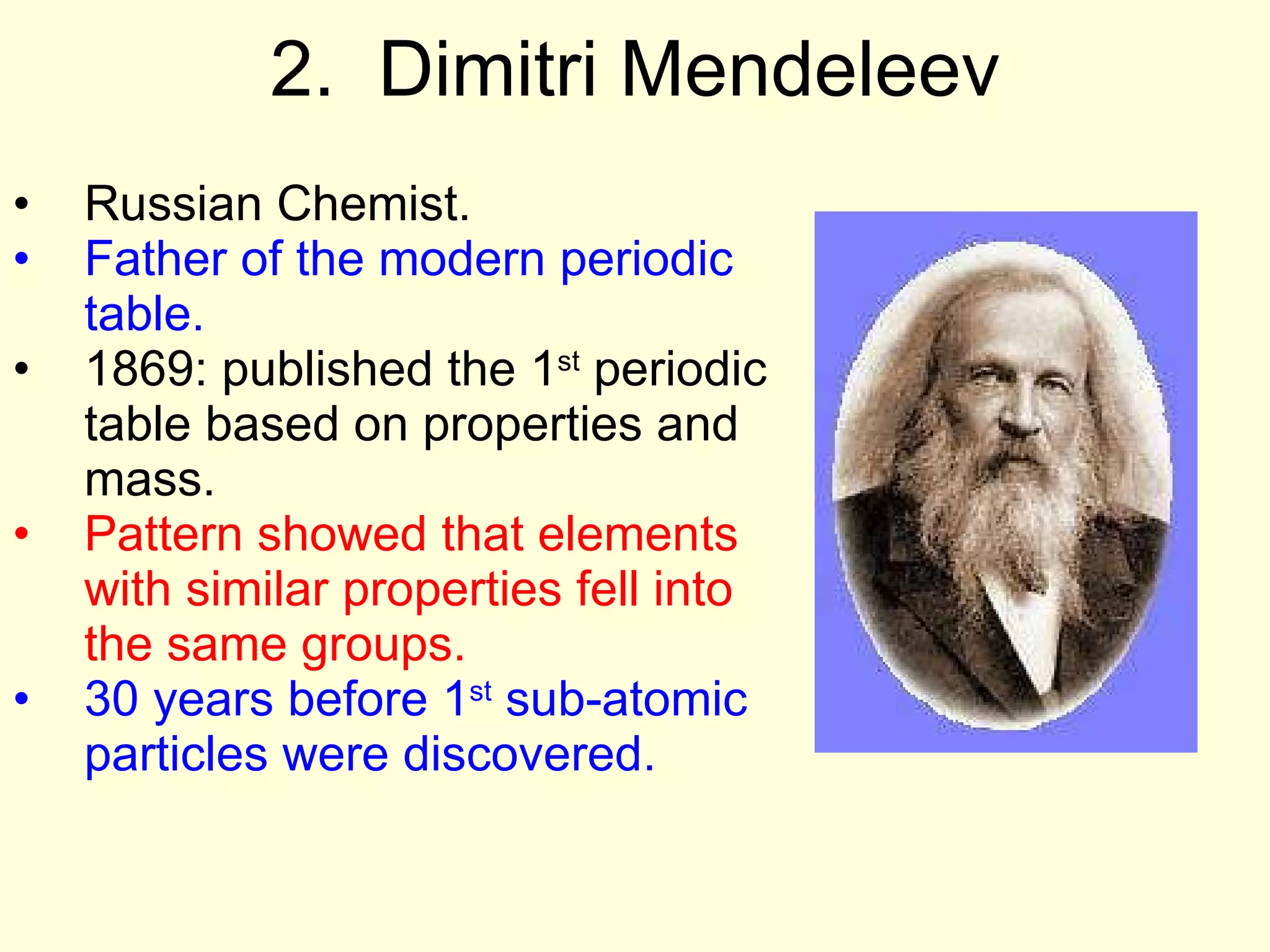
2.  Dimitri Mendeleev Russian Chemist. Father of the modern periodic table. 1869: published the 1 st  periodic table based on properties and mass.  Pattern showed that elements with similar properties fell into the same groups. 30 years before 1 st  sub-atomic particles were discovered.
2.  Dimitri Mendeleev Even left space for elements he knew should exist (due to patterns he found) but not yet discovered. Within 15 years, 3 elements he predicted (gallium, scandium, germanium), were found. Remember: The #s are  mass , not protons. Notice the ? @ 45, 68, 70 Look at the columns as if they were rows – what do they resemble? *Europeans use commas as decimals
3.  Henry Moseley Worked under Rutherford. 1914: Redesigned Mendeleev’s table according to atomic number. This redesign solved the discrepancies of Mendeleev’s table. Left many spaces for missing (undiscovered) elements . Killed in action during World War I.
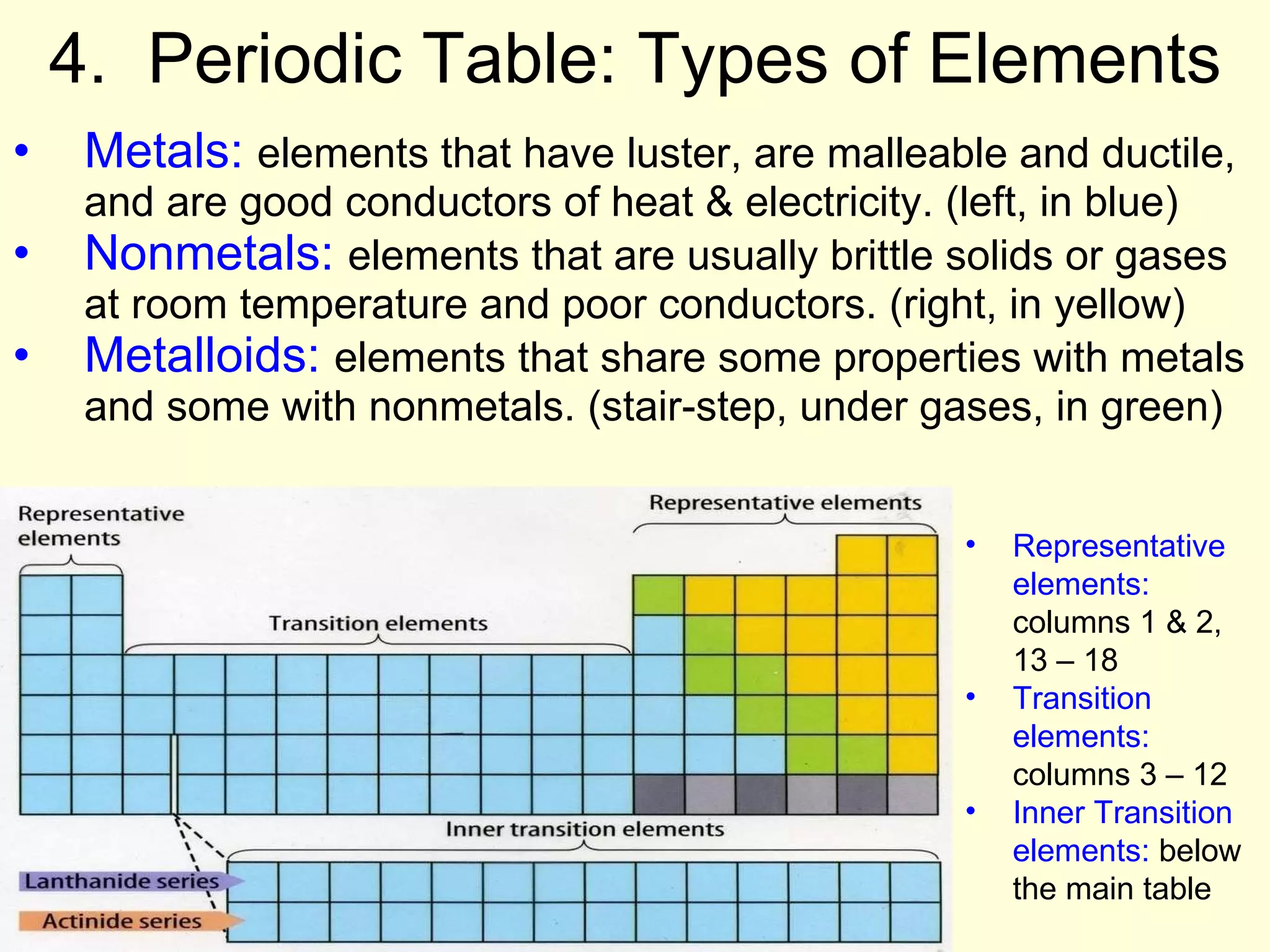
4.  Periodic Table: Types of Elements Metals:   elements that have luster, are malleable and ductile, and are good conductors of heat & electricity. (left, in blue) Nonmetals:   elements that are usually brittle solids or gases at room temperature and poor conductors. (right, in yellow) Metalloids:   elements that share some properties with metals and some with nonmetals. (stair-step, under gases, in green) Representative elements:  columns 1 & 2, 13 – 18  Transition elements:  columns 3 – 12  Inner Transition elements:  below the main table
5.  Alkali Metals: Group 1 (1a) Silvery solid; soft compared to other metals Low density and low melting point Extremely reactive; especially in water 1 valence electron  Very easy to lose 1 electron Reactivity  INCREASES  as you go  down  the family. Francium is much more reactive than Lithium. Hydrogen is not a metal but is grouped here because of its number of valence electrons.
6.  Alkaline Earth Metals: Group 2 (2a) Denser, harder, higher melting point than group 1 Conducts electricity well Very reactive but not as much as group 1 2 valence electrons  Easy to lose 2 electrons Reactivity  INCREASES  as you go  down  the family. Radium is much more reactive than Beryllium.
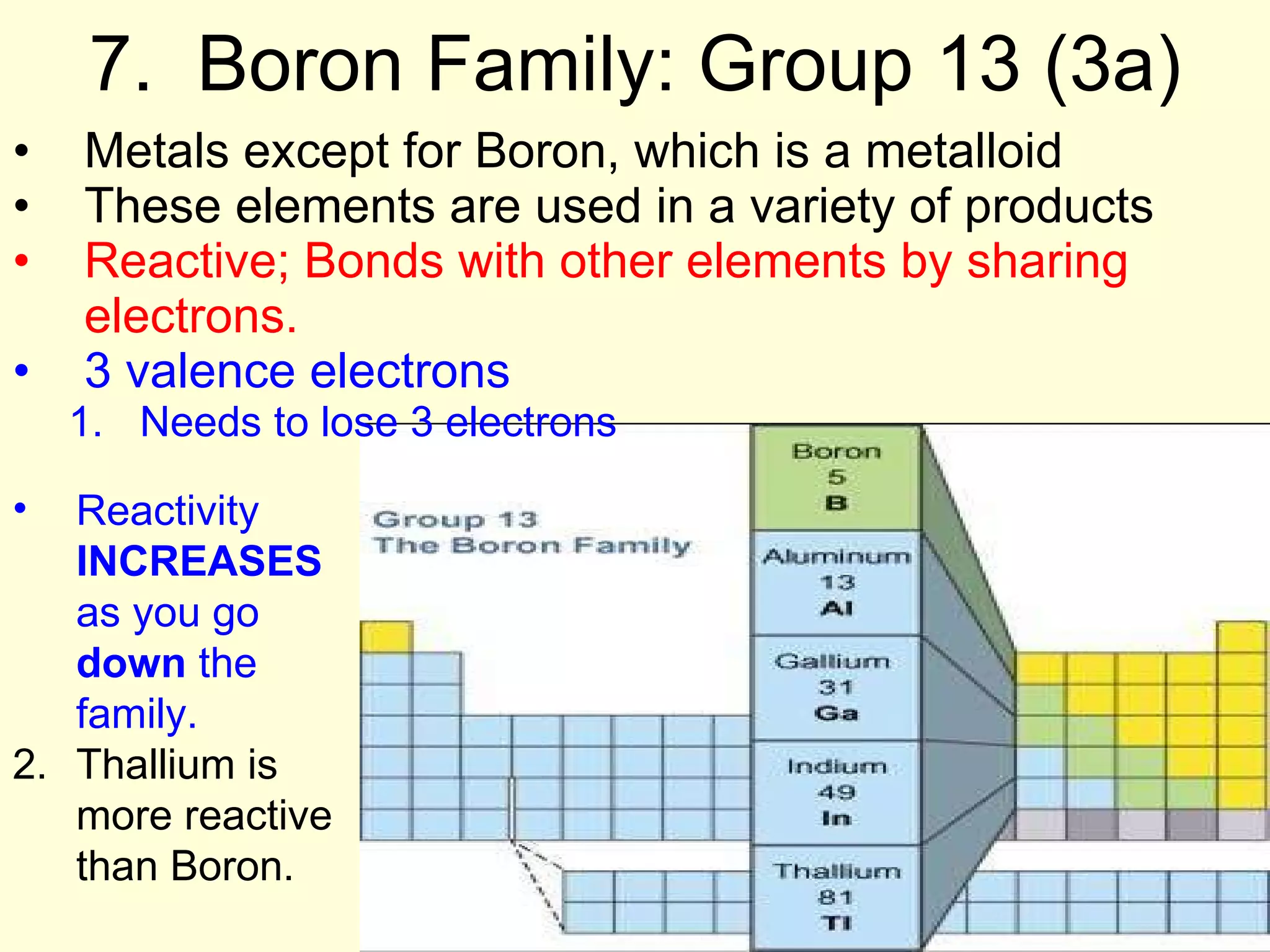
7.  Boron Family: Group 13 (3a) Metals except for Boron, which is a metalloid These elements are used in a variety of products Reactive; Bonds with other elements by sharing electrons. 3 valence electrons  Needs to lose 3 electrons Reactivity  INCREASES  as you go  down  the family. Thallium is more reactive than Boron.
8.  Carbon Family: Group 14 (4a) Metals, nonmetals, and metalloids Bond with many elements by sharing electrons Silicon is a semiconductor: Extremely abundant metalloid Used in computer chip manufacturing – “Silicon Valley” 4 valence electrons Lose 4 or gain 4; same difference
9.  Nitrogen Family: Group 15 (5a) Metals, Nonmetals, and Metalloids Reactive: Bonds with other elements by sharing electrons Useful to living things in small amounts; deadly in large amounts 5 valence electrons Needs to gain 3 electrons Reactivity  DECREASES  as you go down the family. Nitrogen is more reactive than Bismuth.
10.  Oxygen Family: Group 16 (6a) Nonmetals and Metalloids Oxygen & Sulfur are essential for life; Selenium conducts electricity when exposed to light Very reactive 6 valence electrons  Easy to gain 2 electrons Reactivity  DECREASES  as you go down the family. Oxygen is more reactive than Polonium.
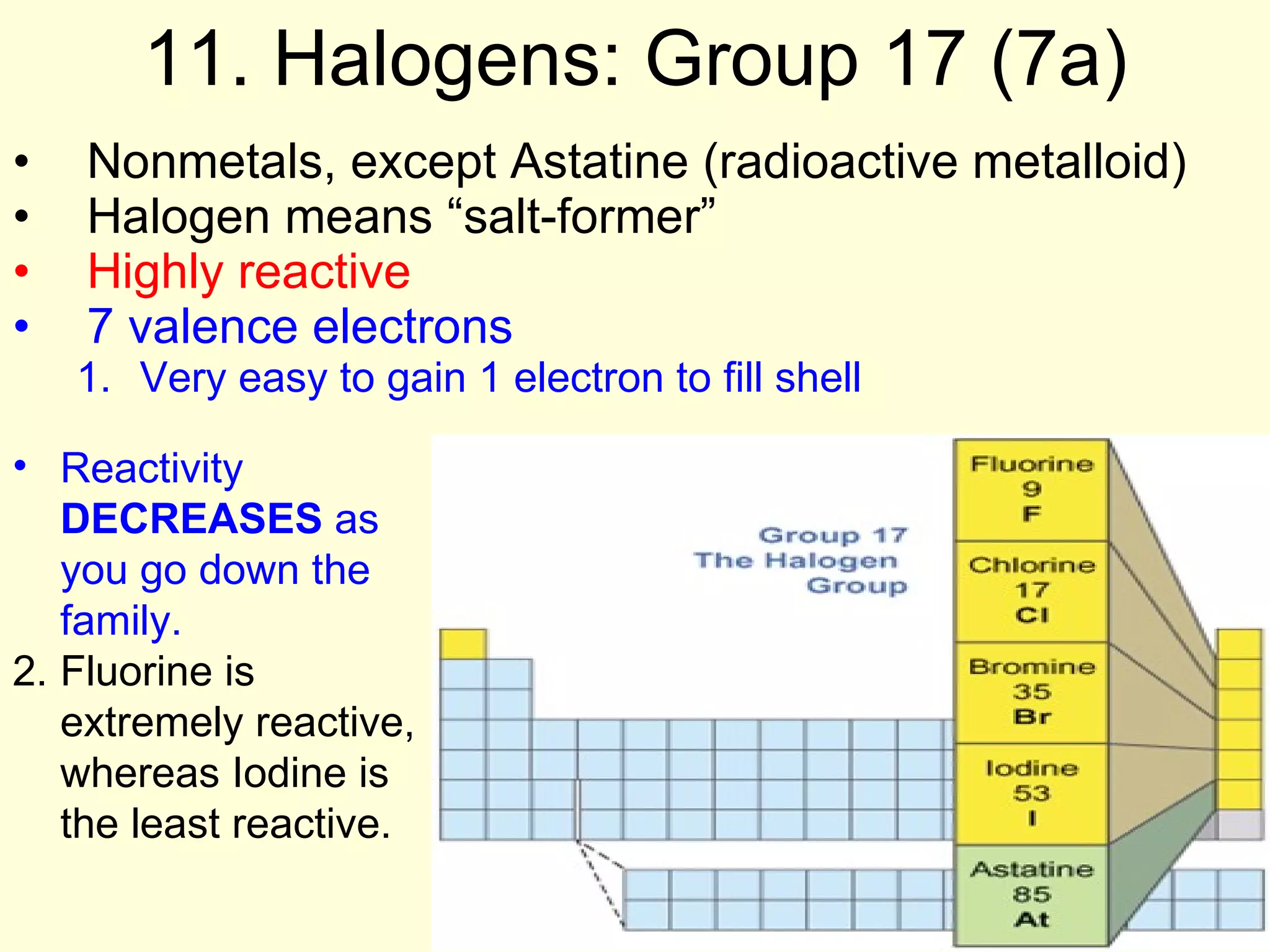
11. Halogens: Group 17 (7a) Nonmetals, except Astatine (radioactive metalloid) Halogen means “salt-former” Highly reactive 7 valence electrons  Very easy to gain 1 electron to fill shell Reactivity  DECREASES  as you go down the family. Fluorine is extremely reactive, whereas Iodine is the least reactive.
12.  Noble Gases: Group 18 (8a) Nonmetals Inert; they do not react with other elements Used in various types of lighting 8 valence electrons (orbital is full) Helium is less dense than air and is used in all types of balloons. Helium is safer than hydrogen, because Hydrogen catches fire.
13. Transition Elements: Groups 3 – 12 All are metals; shiny, hard, lustrous Most are found combined with other elements in ores Most have higher melting pts than Representative E Mercury is the only liquid at room temperature Transition Elements  (in yellow) Special groups:  (‘group’ does not refer to a column.) Iron Triad :  Iron, Cobalt, Nickel Platinum Group : Ruthenium, Rhodium, Palladium, Osmium, Iridium, Platinum
14.  Inner Transition Elements Found below the main table. Lanthanides:  naturally occurring except Promethium Soft metals; can be cut w/a knife Very similar; hard to separate when together as an ore Actinides:  synthetic (except Thorium, Protactinium, Uranium) Radioactive Unstable nuclei; decay to form other elements

Periodic table of elements

  • 1.
    The Periodic Tableof Elements Red - Write it Blue - Highlight it
  • 2.
    1. Historyof the Periodic Table Early Civilizations knew of elements, such as iron, gold and silver. 1669: 1 st scientific discovery of an element: phosphorus 1700: 12 elements were known and named. 1830: 55 different elements had been isolated and named.
  • 3.
    2. DimitriMendeleev Russian Chemist. Father of the modern periodic table. 1869: published the 1 st periodic table based on properties and mass. Pattern showed that elements with similar properties fell into the same groups. 30 years before 1 st sub-atomic particles were discovered.
  • 4.
    2. DimitriMendeleev Even left space for elements he knew should exist (due to patterns he found) but not yet discovered. Within 15 years, 3 elements he predicted (gallium, scandium, germanium), were found. Remember: The #s are mass , not protons. Notice the ? @ 45, 68, 70 Look at the columns as if they were rows – what do they resemble? *Europeans use commas as decimals
  • 5.
    3. HenryMoseley Worked under Rutherford. 1914: Redesigned Mendeleev’s table according to atomic number. This redesign solved the discrepancies of Mendeleev’s table. Left many spaces for missing (undiscovered) elements . Killed in action during World War I.
  • 6.
    4. PeriodicTable: Types of Elements Metals: elements that have luster, are malleable and ductile, and are good conductors of heat & electricity. (left, in blue) Nonmetals: elements that are usually brittle solids or gases at room temperature and poor conductors. (right, in yellow) Metalloids: elements that share some properties with metals and some with nonmetals. (stair-step, under gases, in green) Representative elements: columns 1 & 2, 13 – 18 Transition elements: columns 3 – 12 Inner Transition elements: below the main table
  • 7.
    5. AlkaliMetals: Group 1 (1a) Silvery solid; soft compared to other metals Low density and low melting point Extremely reactive; especially in water 1 valence electron Very easy to lose 1 electron Reactivity INCREASES as you go down the family. Francium is much more reactive than Lithium. Hydrogen is not a metal but is grouped here because of its number of valence electrons.
  • 8.
    6. AlkalineEarth Metals: Group 2 (2a) Denser, harder, higher melting point than group 1 Conducts electricity well Very reactive but not as much as group 1 2 valence electrons Easy to lose 2 electrons Reactivity INCREASES as you go down the family. Radium is much more reactive than Beryllium.
  • 9.
    7. BoronFamily: Group 13 (3a) Metals except for Boron, which is a metalloid These elements are used in a variety of products Reactive; Bonds with other elements by sharing electrons. 3 valence electrons Needs to lose 3 electrons Reactivity INCREASES as you go down the family. Thallium is more reactive than Boron.
  • 10.
    8. CarbonFamily: Group 14 (4a) Metals, nonmetals, and metalloids Bond with many elements by sharing electrons Silicon is a semiconductor: Extremely abundant metalloid Used in computer chip manufacturing – “Silicon Valley” 4 valence electrons Lose 4 or gain 4; same difference
  • 11.
    9. NitrogenFamily: Group 15 (5a) Metals, Nonmetals, and Metalloids Reactive: Bonds with other elements by sharing electrons Useful to living things in small amounts; deadly in large amounts 5 valence electrons Needs to gain 3 electrons Reactivity DECREASES as you go down the family. Nitrogen is more reactive than Bismuth.
  • 12.
    10. OxygenFamily: Group 16 (6a) Nonmetals and Metalloids Oxygen & Sulfur are essential for life; Selenium conducts electricity when exposed to light Very reactive 6 valence electrons Easy to gain 2 electrons Reactivity DECREASES as you go down the family. Oxygen is more reactive than Polonium.
  • 13.
    11. Halogens: Group17 (7a) Nonmetals, except Astatine (radioactive metalloid) Halogen means “salt-former” Highly reactive 7 valence electrons Very easy to gain 1 electron to fill shell Reactivity DECREASES as you go down the family. Fluorine is extremely reactive, whereas Iodine is the least reactive.
  • 14.
    12. NobleGases: Group 18 (8a) Nonmetals Inert; they do not react with other elements Used in various types of lighting 8 valence electrons (orbital is full) Helium is less dense than air and is used in all types of balloons. Helium is safer than hydrogen, because Hydrogen catches fire.
  • 15.
    13. Transition Elements:Groups 3 – 12 All are metals; shiny, hard, lustrous Most are found combined with other elements in ores Most have higher melting pts than Representative E Mercury is the only liquid at room temperature Transition Elements (in yellow) Special groups: (‘group’ does not refer to a column.) Iron Triad : Iron, Cobalt, Nickel Platinum Group : Ruthenium, Rhodium, Palladium, Osmium, Iridium, Platinum
  • 16.
    14. InnerTransition Elements Found below the main table. Lanthanides: naturally occurring except Promethium Soft metals; can be cut w/a knife Very similar; hard to separate when together as an ore Actinides: synthetic (except Thorium, Protactinium, Uranium) Radioactive Unstable nuclei; decay to form other elements