What’s the matter with Matter? Matter, its properties, and the changes it undergoes
Definitions Chemical Properties   those which the substance shows as it interacts with, or transforms into, other substances such as flammability, corrosiveness  Physical Properties   those which the substance shows by itself without interacting with another substance such as color, melting point, boiling point, density Matter anything that has mass and volume -the “stuff” of the universe: books, planets, trees, professors, students Composition the types and amounts of simpler substances that make up a sample of matter Properties the characteristics that give each substance a unique identity
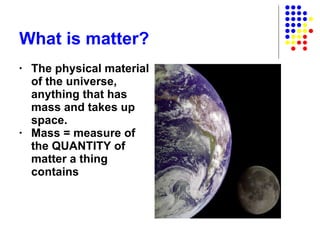
What is matter? The physical material of the universe, anything that has mass and takes up space. Mass = measure of the QUANTITY of matter a thing contains
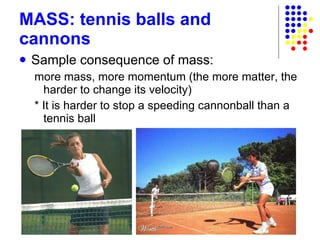
MASS: tennis balls and cannons Sample consequence of mass: more mass, more momentum (the more matter, the harder to change its velocity) * It is harder to stop a speeding cannonball than a tennis ball
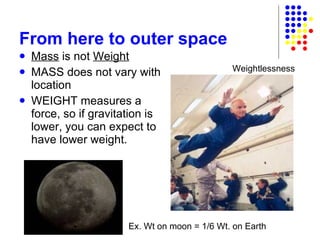
From here to outer space Mass  is not  Weight MASS does not vary with location WEIGHT measures a force, so if gravitation is lower, you can expect to have lower weight. Ex. Wt on moon = 1/6 Wt. on Earth  Weightlessness
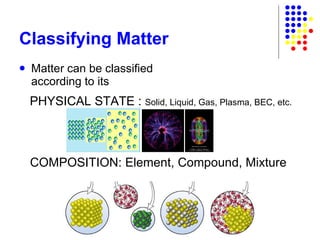
Classifying Matter Matter can be classified according to its PHYSICAL STATE :  Solid, Liquid, Gas, Plasma, BEC, etc. COMPOSITION: Element, Compound, Mixture
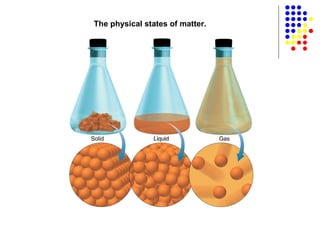
The physical states of matter.
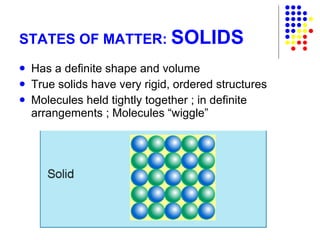
STATES OF MATTER:  SOLIDS Has a definite shape and volume True solids have very rigid, ordered structures Molecules held tightly together ; in definite arrangements ; Molecules “wiggle”
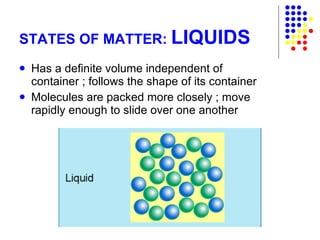
STATES OF MATTER:  LIQUIDS Has a definite volume independent of container ; follows the shape of its container Molecules are packed more closely ; move rapidly enough to slide over one another
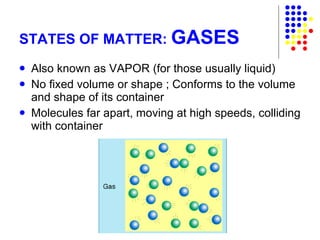
STATES OF MATTER:  GASES Also known as VAPOR (for those usually liquid) No fixed volume or shape ; Conforms to the volume and shape of its container Molecules far apart, moving at high speeds, colliding with container
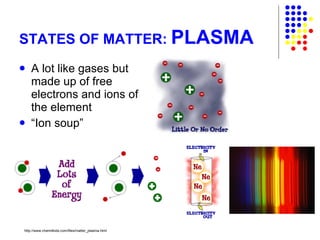
STATES OF MATTER:  PLASMA A lot like gases but made up of free electrons and ions of the element “ Ion soup” http://www.chem4kids.com/files/matter_plasma.html
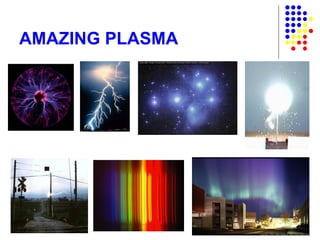
AMAZING PLASMA
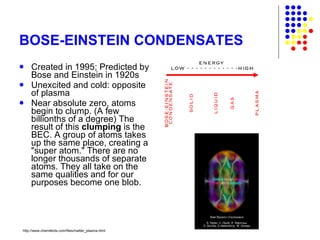
BOSE-EINSTEIN CONDENSATES Created in 1995; Predicted by Bose and Einstein in 1920s Unexcited and cold: opposite of plasma  Near absolute zero, atoms begin to clump. (A few billionths of a degree) The result of this  clumping  is the BEC. A group of atoms takes up the same place, creating a "super atom." There are no longer thousands of separate atoms. They all take on the same qualities and for our purposes become one blob.  http://www.chem4kids.com/files/matter_plasma.html
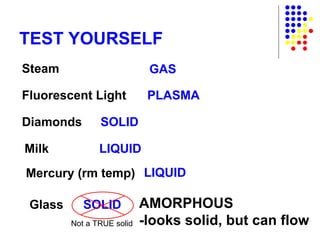
TEST YOURSELF Steam Milk Diamonds Fluorescent Light Glass AMORPHOUS -looks solid, but can flow GAS PLASMA SOLID LIQUID Mercury (rm temp) LIQUID SOLID Not a TRUE solid
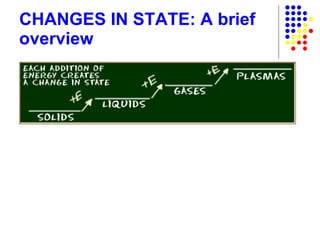
CHANGES IN STATE: A brief overview
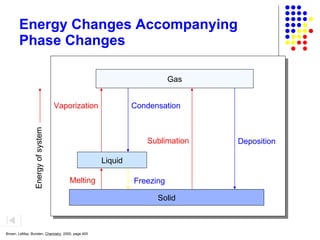
Energy Changes Accompanying Phase Changes Solid Liquid Gas Melting Freezing Deposition Condensation Vaporization Sublimation Energy of system Brown, LeMay, Bursten,  Chemistry    2000, page 405
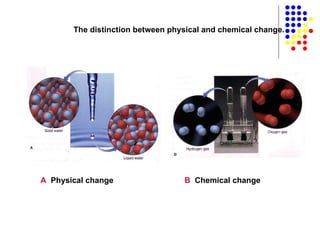
The distinction between physical and chemical change. A   Physical change B   Chemical change
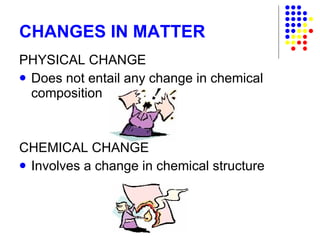
CHANGES IN MATTER PHYSICAL CHANGE Does not entail any change in chemical composition CHEMICAL CHANGE Involves a change in chemical structure
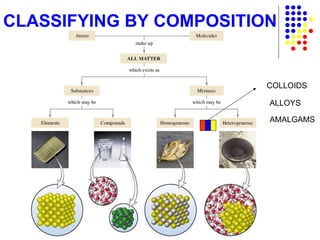
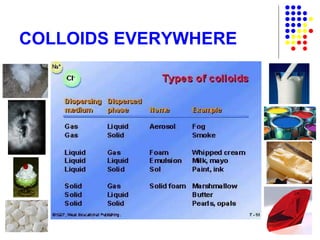
CLASSIFYING BY COMPOSITION COLLOIDS ALLOYS AMALGAMS
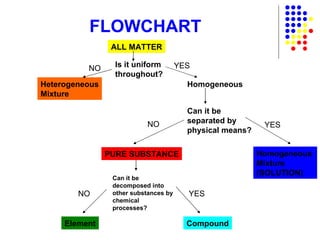
FLOWCHART ALL MATTER Homogeneous Mixture (SOLUTION) Can it be separated by physical means? PURE SUBSTANCE Heterogeneous Mixture Homogeneous Can it be decomposed into other substances by chemical processes? Element Compound Is it uniform throughout? YES YES YES NO NO NO
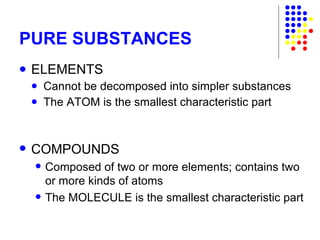
PURE SUBSTANCES ELEMENTS Cannot be decomposed into simpler substances The ATOM is the smallest characteristic part COMPOUNDS Composed of two or more elements; contains two or more kinds of atoms The MOLECULE is the smallest characteristic part
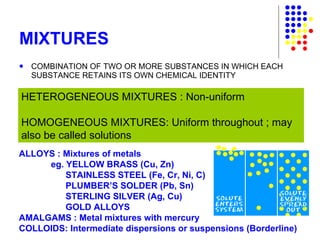
MIXTURES COMBINATION OF TWO OR MORE SUBSTANCES IN WHICH EACH SUBSTANCE RETAINS ITS OWN CHEMICAL IDENTITY HETEROGENEOUS MIXTURES : Non-uniform HOMOGENEOUS MIXTURES: Uniform throughout ; may also be called solutions ALLOYS : Mixtures of metals eg. YELLOW BRASS (Cu, Zn) STAINLESS STEEL (Fe, Cr, Ni, C) PLUMBER’S SOLDER (Pb, Sn) STERLING SILVER (Ag, Cu) GOLD ALLOYS AMALGAMS : Metal mixtures with mercury COLLOIDS: Intermediate dispersions or suspensions (Borderline)
COLLOIDS EVERYWHERE
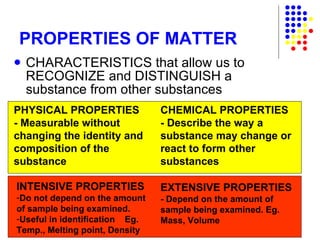
PROPERTIES OF MATTER CHARACTERISTICS that allow us to RECOGNIZE and DISTINGUISH a substance from other substances  PHYSICAL PROPERTIES - Measurable without changing the identity and composition of the substance CHEMICAL PROPERTIES - Describe the way a substance may change or react to form other substances INTENSIVE PROPERTIES Do not depend on the amount of sample being examined. Useful in identification  Eg. Temp., Melting point, Density EXTENSIVE PROPERTIES - Depend on the amount of sample being examined. Eg. Mass, Volume
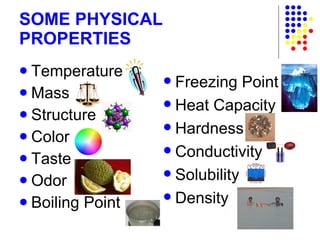
SOME PHYSICAL PROPERTIES Temperature Mass Structure Color Taste Odor Boiling Point Freezing Point Heat Capacity Hardness Conductivity Solubility Density
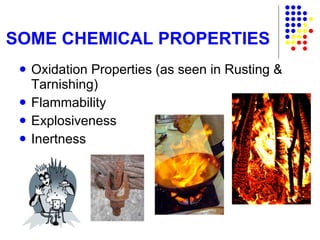
SOME CHEMICAL PROPERTIES Oxidation Properties (as seen in Rusting & Tarnishing) Flammability Explosiveness Inertness
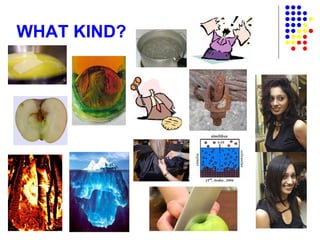
WHAT KIND?

Whats The Matter With Matter

  • 1.
    What’s the matterwith Matter? Matter, its properties, and the changes it undergoes
  • 2.
    Definitions Chemical Properties those which the substance shows as it interacts with, or transforms into, other substances such as flammability, corrosiveness Physical Properties those which the substance shows by itself without interacting with another substance such as color, melting point, boiling point, density Matter anything that has mass and volume -the “stuff” of the universe: books, planets, trees, professors, students Composition the types and amounts of simpler substances that make up a sample of matter Properties the characteristics that give each substance a unique identity
  • 3.
    What is matter?The physical material of the universe, anything that has mass and takes up space. Mass = measure of the QUANTITY of matter a thing contains
  • 4.
    MASS: tennis ballsand cannons Sample consequence of mass: more mass, more momentum (the more matter, the harder to change its velocity) * It is harder to stop a speeding cannonball than a tennis ball
  • 5.
    From here toouter space Mass is not Weight MASS does not vary with location WEIGHT measures a force, so if gravitation is lower, you can expect to have lower weight. Ex. Wt on moon = 1/6 Wt. on Earth Weightlessness
  • 6.
    Classifying Matter Mattercan be classified according to its PHYSICAL STATE : Solid, Liquid, Gas, Plasma, BEC, etc. COMPOSITION: Element, Compound, Mixture
  • 7.
  • 8.
    STATES OF MATTER: SOLIDS Has a definite shape and volume True solids have very rigid, ordered structures Molecules held tightly together ; in definite arrangements ; Molecules “wiggle”
  • 9.
    STATES OF MATTER: LIQUIDS Has a definite volume independent of container ; follows the shape of its container Molecules are packed more closely ; move rapidly enough to slide over one another
  • 10.
    STATES OF MATTER: GASES Also known as VAPOR (for those usually liquid) No fixed volume or shape ; Conforms to the volume and shape of its container Molecules far apart, moving at high speeds, colliding with container
  • 11.
    STATES OF MATTER: PLASMA A lot like gases but made up of free electrons and ions of the element “ Ion soup” http://www.chem4kids.com/files/matter_plasma.html
  • 12.
  • 13.
    BOSE-EINSTEIN CONDENSATES Createdin 1995; Predicted by Bose and Einstein in 1920s Unexcited and cold: opposite of plasma Near absolute zero, atoms begin to clump. (A few billionths of a degree) The result of this clumping is the BEC. A group of atoms takes up the same place, creating a "super atom." There are no longer thousands of separate atoms. They all take on the same qualities and for our purposes become one blob. http://www.chem4kids.com/files/matter_plasma.html
  • 14.
    TEST YOURSELF SteamMilk Diamonds Fluorescent Light Glass AMORPHOUS -looks solid, but can flow GAS PLASMA SOLID LIQUID Mercury (rm temp) LIQUID SOLID Not a TRUE solid
  • 15.
    CHANGES IN STATE:A brief overview
  • 16.
    Energy Changes AccompanyingPhase Changes Solid Liquid Gas Melting Freezing Deposition Condensation Vaporization Sublimation Energy of system Brown, LeMay, Bursten, Chemistry  2000, page 405
  • 17.
    The distinction betweenphysical and chemical change. A Physical change B Chemical change
  • 18.
    CHANGES IN MATTERPHYSICAL CHANGE Does not entail any change in chemical composition CHEMICAL CHANGE Involves a change in chemical structure
  • 19.
    CLASSIFYING BY COMPOSITIONCOLLOIDS ALLOYS AMALGAMS
  • 20.
    FLOWCHART ALL MATTERHomogeneous Mixture (SOLUTION) Can it be separated by physical means? PURE SUBSTANCE Heterogeneous Mixture Homogeneous Can it be decomposed into other substances by chemical processes? Element Compound Is it uniform throughout? YES YES YES NO NO NO
  • 21.
    PURE SUBSTANCES ELEMENTSCannot be decomposed into simpler substances The ATOM is the smallest characteristic part COMPOUNDS Composed of two or more elements; contains two or more kinds of atoms The MOLECULE is the smallest characteristic part
  • 22.
    MIXTURES COMBINATION OFTWO OR MORE SUBSTANCES IN WHICH EACH SUBSTANCE RETAINS ITS OWN CHEMICAL IDENTITY HETEROGENEOUS MIXTURES : Non-uniform HOMOGENEOUS MIXTURES: Uniform throughout ; may also be called solutions ALLOYS : Mixtures of metals eg. YELLOW BRASS (Cu, Zn) STAINLESS STEEL (Fe, Cr, Ni, C) PLUMBER’S SOLDER (Pb, Sn) STERLING SILVER (Ag, Cu) GOLD ALLOYS AMALGAMS : Metal mixtures with mercury COLLOIDS: Intermediate dispersions or suspensions (Borderline)
  • 23.
  • 24.
    PROPERTIES OF MATTERCHARACTERISTICS that allow us to RECOGNIZE and DISTINGUISH a substance from other substances PHYSICAL PROPERTIES - Measurable without changing the identity and composition of the substance CHEMICAL PROPERTIES - Describe the way a substance may change or react to form other substances INTENSIVE PROPERTIES Do not depend on the amount of sample being examined. Useful in identification Eg. Temp., Melting point, Density EXTENSIVE PROPERTIES - Depend on the amount of sample being examined. Eg. Mass, Volume
  • 25.
    SOME PHYSICAL PROPERTIESTemperature Mass Structure Color Taste Odor Boiling Point Freezing Point Heat Capacity Hardness Conductivity Solubility Density
  • 26.
    SOME CHEMICAL PROPERTIESOxidation Properties (as seen in Rusting & Tarnishing) Flammability Explosiveness Inertness
  • 27.