Modern Periodic Table 
Mrs. Coyle
Part I 
 Introduction. 
 Periods and groups. 
 Metals, nonmetals and metalloids.
The Modern Periodic Table 
 The Periodic Table is a listing of all the 
known elements. 
 The elements are organized by: 
 Atomic number 
 Chemical Properties
Groups and Periods 
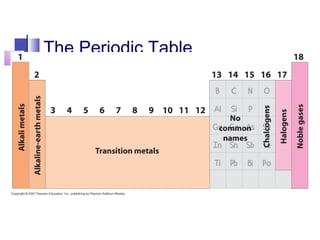
 Group( or Family): a vertical column. 
Elements in groups have similar 
chemical properties. 
 Period: a horizontal row.
Groups and Periods are 
numbered. 
 There are 7 periods. 
 There are 18 numbered columns.
IUPAC 
 International Union of Pure and Applied 
Chemistry 
 1985 new system for labeling groups.
Metals, Nonmetals and 
Metalloids 
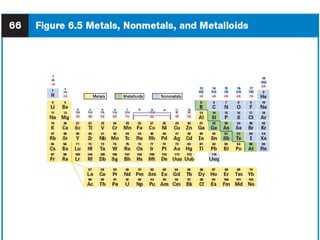
 Elements can be classified into: 
 Metals 
 Nonmetals 
 Metalloids (semimetals)
Metals 
Nonmetals 
Metalloids
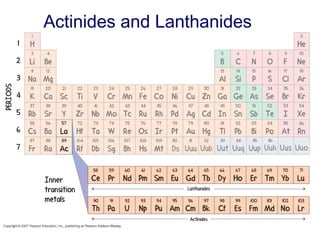
Actinides and Lanthanides
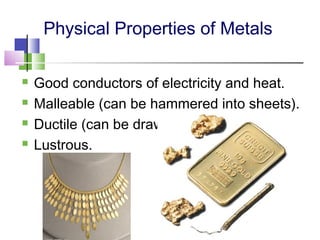
Physical Properties of Metals 
 Good conductors of electricity and heat. 
 Malleable (can be hammered into sheets). 
 Ductile (can be drawn into wires). 
 Lustrous.
Chemical Properties of Metals 
 Easily lose electrons. 
 Form positive (+) ions.
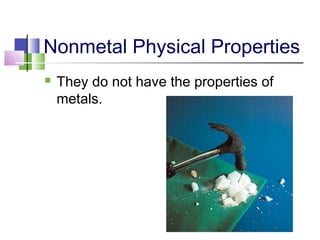
Nonmetal Physical Properties 
 They do not have the properties of 
metals.
Nonmetal Chemical Properties 
 Gain electrons. 
 Form negative ions.
Part II 
 Valence Electrons 
 Group 1 
 Group 2
-Niels Bohr’s Model – 
Distinct Energy Levels
Periods 
 The periods (rows) of the periodic table 
indicate the highest energy level 
occupied by one or more electrons.
Valence Electrons 
 The electrons the occupy the highest 
energy level of an atom. 
 Valence electrons play a key role in the 
chemical properties of an element.
“A” Groups (Old System) 
 The “A” groups are numbered 18. 
 The number of the “A” groups 
correspond to the number of valence 
electrons.
Group 1- Alkali Metals 
 1 valence electron (ns1) 
 Form a 1+ ion. 
 Note: Hydrogen, a nonmetal, is located 
in the first column because it has one 
valence electron.
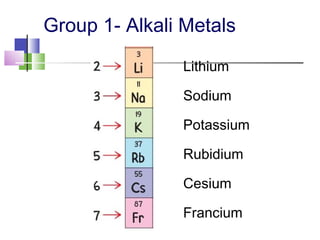
Group 1- Alkali Metals 
Lithium 
Sodium 
Potassium 
Rubidium 
Cesium 
Francium
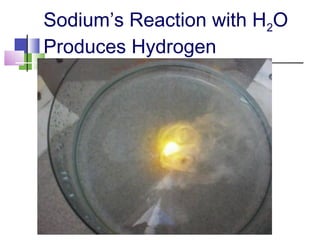
Sodium’s Reaction with H2O 
Produces Hydrogen
Reactivity of Alkali Metals 
 Increases from top to bottom of the 
group. 
 Which is more reactive Cesium or 
Sodium?
Note: 
 Sodium and Potassium are stored in oil 
to keep them from reacting with oxygen 
and water in the air. 
 Cesium is stored in glass tubes of 
argon gas( an inert gas).
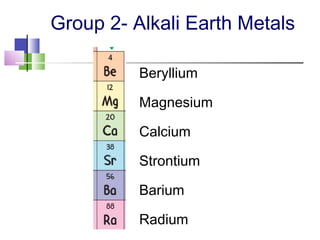
Group 2- Alkali Earth Metals 
Beryllium 
Magnesium 
Calcium 
Strontium 
Barium 
Radium
Group 2- Alkali Earth Metals 
 Have 2 valence electrons. 
 Form 2+ ions.
Group 2- Alkali Earth Metals 
Reactions with Water 
 Be does not react with water. 
 Mg reacts with hot water. 
 Ca, Sr, Ba react easily with cold water. 
 Which way along the group does 
reactivity increase?
Notes: 
 There is Mg in chrolophyll 
C55H72O5N4Mg 
 Calcium is in your bones, 
chalk, limestone, 
toothpaste, pearl (all as 
calcium carbonate).
The Periodic Table

modern periodic table

  • 1.
  • 2.
    Part I Introduction.  Periods and groups.  Metals, nonmetals and metalloids.
  • 3.
    The Modern PeriodicTable  The Periodic Table is a listing of all the known elements.  The elements are organized by:  Atomic number  Chemical Properties
  • 4.
    Groups and Periods  Group( or Family): a vertical column. Elements in groups have similar chemical properties.  Period: a horizontal row.
  • 5.
    Groups and Periodsare numbered.  There are 7 periods.  There are 18 numbered columns.
  • 7.
    IUPAC  InternationalUnion of Pure and Applied Chemistry  1985 new system for labeling groups.
  • 8.
    Metals, Nonmetals and Metalloids  Elements can be classified into:  Metals  Nonmetals  Metalloids (semimetals)
  • 9.
  • 11.
  • 12.
    Physical Properties ofMetals  Good conductors of electricity and heat.  Malleable (can be hammered into sheets).  Ductile (can be drawn into wires).  Lustrous.
  • 13.
    Chemical Properties ofMetals  Easily lose electrons.  Form positive (+) ions.
  • 14.
    Nonmetal Physical Properties  They do not have the properties of metals.
  • 15.
    Nonmetal Chemical Properties  Gain electrons.  Form negative ions.
  • 16.
    Part II Valence Electrons  Group 1  Group 2
  • 17.
    -Niels Bohr’s Model– Distinct Energy Levels
  • 18.
    Periods  Theperiods (rows) of the periodic table indicate the highest energy level occupied by one or more electrons.
  • 19.
    Valence Electrons The electrons the occupy the highest energy level of an atom.  Valence electrons play a key role in the chemical properties of an element.
  • 20.
    “A” Groups (OldSystem)  The “A” groups are numbered 18.  The number of the “A” groups correspond to the number of valence electrons.
  • 21.
    Group 1- AlkaliMetals  1 valence electron (ns1)  Form a 1+ ion.  Note: Hydrogen, a nonmetal, is located in the first column because it has one valence electron.
  • 22.
    Group 1- AlkaliMetals Lithium Sodium Potassium Rubidium Cesium Francium
  • 23.
    Sodium’s Reaction withH2O Produces Hydrogen
  • 24.
    Reactivity of AlkaliMetals  Increases from top to bottom of the group.  Which is more reactive Cesium or Sodium?
  • 25.
    Note:  Sodiumand Potassium are stored in oil to keep them from reacting with oxygen and water in the air.  Cesium is stored in glass tubes of argon gas( an inert gas).
  • 26.
    Group 2- AlkaliEarth Metals Beryllium Magnesium Calcium Strontium Barium Radium
  • 27.
    Group 2- AlkaliEarth Metals  Have 2 valence electrons.  Form 2+ ions.
  • 28.
    Group 2- AlkaliEarth Metals Reactions with Water  Be does not react with water.  Mg reacts with hot water.  Ca, Sr, Ba react easily with cold water.  Which way along the group does reactivity increase?
  • 29.
    Notes:  Thereis Mg in chrolophyll C55H72O5N4Mg  Calcium is in your bones, chalk, limestone, toothpaste, pearl (all as calcium carbonate).
  • 30.