
Chemistry INTRO
Atoms & the Periodic Table
Robin D. Seamon
ATOMSS
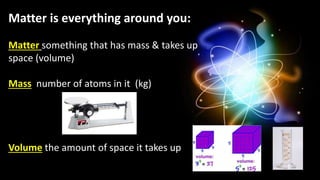
Matter is everything around you:
Matter something that has mass & takes up
space (volume)
Mass number of atoms in it (kg)
Volume the amount of space it takes up
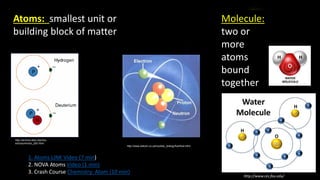
Atoms: smallest unit or
building block of matter
1. Atoms LINK Video (7 min)
2. NOVA Atoms Video (1 min)
3. Crash Course Chemistry: Atom (10 min)
http://archive.stsci.edu/fus
e/scisumm/sci_d2h.html
http://www.eskom.co.za/nuclear_energy/fuel/fuel.html
Molecule:
two or
more
atoms
bound
together
http://www.ces.fau.edu/
LAB:
Make Molecule
Models
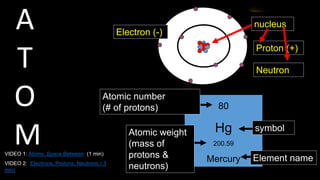
Electron (-)
nucleus
Proton (+)
Neutron
80
Hg
200.59
Mercury
Atomic number
(# of protons)
Atomic weight
(mass of
protons &
neutrons)
symbol
Element name
VIDEO 1: Atoms: Space Between (1 min)
VIDEO 2: Electrons, Protons, Neutrons ( 3
min)
A
T
O
M
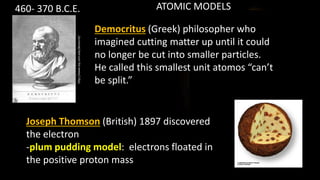
Democritus (Greek) philosopher who
imagined cutting matter up until it could
no longer be cut into smaller particles.
He called this smallest unit atomos “can’t
be split.”
ATOMIC MODELS
http://www.iep.utm.edu/democrit/
460- 370 B.C.E.
Joseph Thomson (British) 1897 discovered
the electron
-plum pudding model: electrons floated in
the positive proton mass
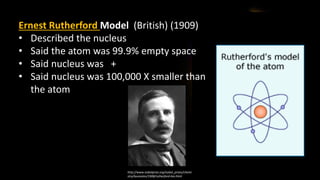
Ernest Rutherford Model (British) (1909)
• Described the nucleus
• Said the atom was 99.9% empty space
• Said nucleus was +
• Said nucleus was 100,000 X smaller than
the atom
http://www.nobelprize.org/nobel_prizes/chemi
stry/laureates/1908/rutherford-bio.html
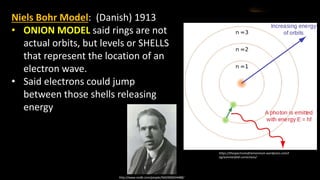
Niels Bohr Model: (Danish) 1913
• ONION MODEL said rings are not
actual orbits, but levels or SHELLS
that represent the location of an
electron wave.
• Said electrons could jump
between those shells releasing
energy
https://thespectrumofriemannium.wordpress.com/t
ag/sommerfeld-corrections/
http://www.nndb.com/people/560/000024488/
VIDEO Crash Course Atomic Model Theory (9 min)
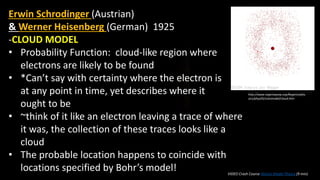
Erwin Schrodinger (Austrian)
& Werner Heisenberg (German) 1925
-CLOUD MODEL
• Probability Function: cloud-like region where
electrons are likely to be found
• *Can’t say with certainty where the electron is
at any point in time, yet describes where it
ought to be
• ~think of it like an electron leaving a trace of where
it was, the collection of these traces looks like a
cloud
• The probable location happens to coincide with
locations specified by Bohr’s model!
http://www.regentsprep.org/Regents/phy
sics/phys05/catomodel/cloud.htm
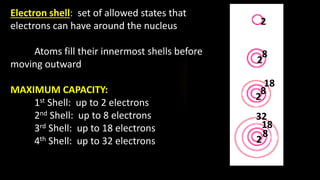
Electron shell: set of allowed states that
electrons can have around the nucleus
Atoms fill their innermost shells before
moving outward
MAXIMUM CAPACITY:
1st Shell: up to 2 electrons
2nd Shell: up to 8 electrons
3rd Shell: up to 18 electrons
4th Shell: up to 32 electrons
2
2
8
2
8
2
8
18
18
32
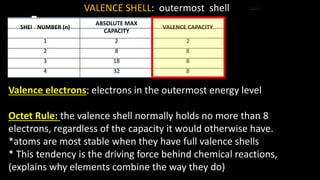
SHELL NUMBER (n)
ABSOLUTE MAX
CAPACITY
VALENCE CAPACITY
1 2 2
2 8 8
3 18 8
4 32 8
n 2n2 8
Valence electrons: electrons in the outermost energy level
Octet Rule: the valence shell normally holds no more than 8
electrons, regardless of the capacity it would otherwise have.
*atoms are most stable when they have full valence shells
* This tendency is the driving force behind chemical reactions,
(explains why elements combine the way they do)
VALENCE SHELL: outermost shell
LAB:
Atom
Diagram:
RESOURCE: LINK
http://www.dlrgenchem.com/LECTURES/electstruct.html
PERIODIC
TABLES
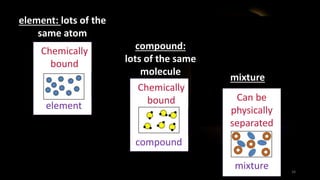
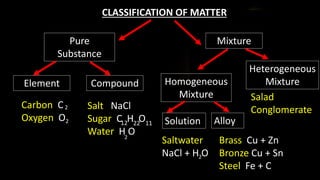
Pure Substance: all of the
particles are the same
Element: all the atoms are
the same
Compound: elements are
the same- in a repeating
pattern
mixture
Can be
physically
separated
compound
Chemically
boundelement
Chemically
bound
16
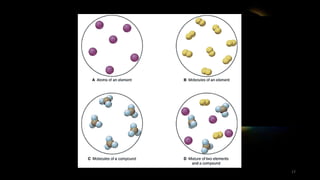
element: lots of the
same atom
compound:
lots of the same
molecule
mixture
17
Pure
Substance
Element Compound
Mixture
Homogeneous
Mixture
Heterogeneous
Mixture
Carbon C
Oxygen O
Salt NaCl
Sugar C H O
Water H O2
2
2 12 22 11 Solution Alloy
Saltwater
NaCl + H O
Brass Cu + Zn
Bronze Cu + Sn
Steel Fe + C
Salad
Conglomerate
CLASSIFICATION OF MATTER
2
LAB
Leggo Lab
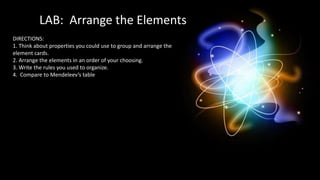
LAB: Arrange the Elements
DIRECTIONS:
1. Think about properties you could use to group and arrange the
element cards.
2. Arrange the elements in an order of your choosing.
3. Write the rules you used to organize.
4. Compare to Mendeleev’s table
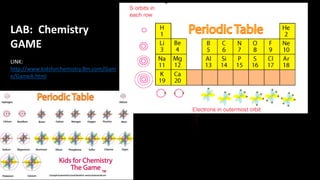
LAB: Chemistry
GAME
LINK:
http://www.kidsforchemistry.8m.com/Gam
e/GameA.html
CONCLUSIONS:
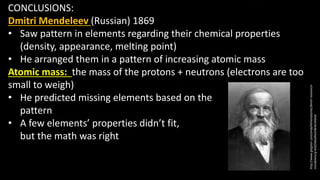
Dmitri Mendeleev (Russian) 1869
• Saw pattern in elements regarding their chemical properties
(density, appearance, melting point)
• He arranged them in a pattern of increasing atomic mass
Atomic mass: the mass of the protons + neutrons (electrons are too
small to weigh)
• He predicted missing elements based on the
pattern
• A few elements’ properties didn’t fit,
but the math was right
http://www.glogster.com/andythehandsome/dmitri-ivanovich-
mendeleev/g-6mf34dudha5i9e4oi3ttea0
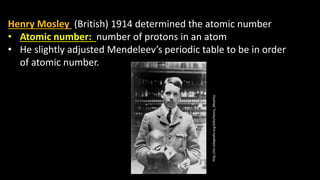
Henry Mosley (British) 1914 determined the atomic number
• Atomic number: number of protons in an atom
• He slightly adjusted Mendeleev’s periodic table to be in order
of atomic number.
http://en.wikipedia.org/wiki/Henry_Moseley
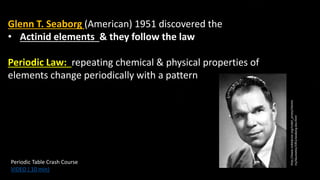
Glenn T. Seaborg (American) 1951 discovered the
• Actinid elements & they follow the law
Periodic Law: repeating chemical & physical properties of
elements change periodically with a pattern
http://www.nobelprize.org/nobel_prizes/chemis
try/laureates/1951/seaborg-bio.html
Periodic Table Crash Course
VIDEO ( 10 min)
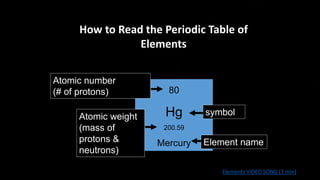
80
Hg
200.59
Mercury
Atomic number
(# of protons)
Atomic weight
(mass of
protons &
neutrons)
symbol
Element name
How to Read the Periodic Table of
Elements
Elements VIDEO SONG (3 min)
1
1
2
3 4 5 6 7 8 9 10 11 12
13 14 15 16 17
18
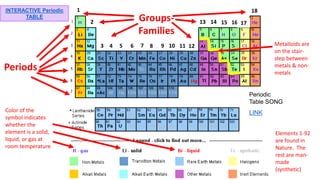
Groups-
Families
Color of the
symbol indicates
whether the
element is a solid,
liquid, or gas at
room temperature
Periodic
Table SONG
LINK
INTERACTIVE Periodic
TABLE
Metalloids are
on the stair-
step between
metals & non-
metals
Elements 1-92
are found in
Nature. The
rest are man-
made
(synthetic)
Periods
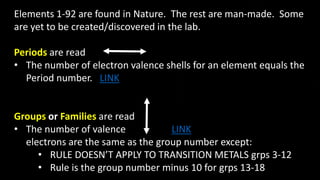
Elements 1-92 are found in Nature. The rest are man-made. Some
are yet to be created/discovered in the lab.
Periods are read
• The number of electron valence shells for an element equals the
Period number. LINK
Groups or Families are read
• The number of valence LINK
electrons are the same as the group number except:
• RULE DOESN’T APPLY TO TRANSITION METALS grps 3-12
• Rule is the group number minus 10 for grps 13-18
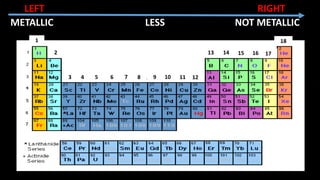
Metals
• LEFT side of the zig-zag line
• Few electrons in the outer Energy level
• Most are solid at room temperature (not Mercury)
• Shiny
• Ductile (good conductors of electrical current)
• Malleable (can be flattened with a hammer)
• Conductors of thermal energy
Nonmetals
• RIGHT side of the zig-zag line
• Almost a complete set of electrons in outer level
• (Group 18 are Noble Gases: have a complete set of electrons &
are stable)
• ½ are gases at room temperature
• NOT malleable
• NOT shiny
• POOR conductors of thermal energy & electric current
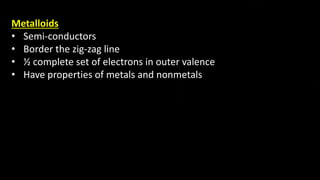
Metalloids
• Semi-conductors
• Border the zig-zag line
• ½ complete set of electrons in outer valence
• Have properties of metals and nonmetals
METALLIC LESS NOT METALLIC
LEFT RIGHT
1
2
3 4 5 6 7 8 9 10 11 12
13 14 15 16 17
18
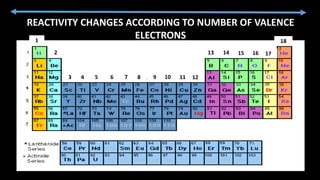
REACTIVITY CHANGES ACCORDING TO NUMBER OF VALENCE
ELECTRONS1
2
3 4 5 6 7 8 9 10 11 12
13 14 15 16 17
18
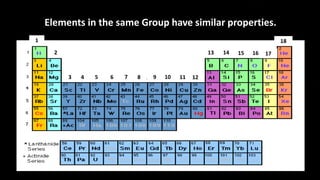
Elements in the same Group have similar properties.
1
2
3 4 5 6 7 8 9 10 11 12
13 14 15 16 17
18
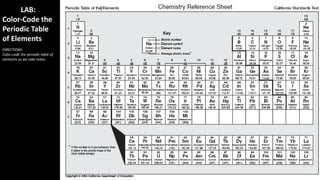
LAB:
Color-Code the
Periodic Table
of Elements
DIRECTIONS:
Color-code the periodic table of
elements as we take notes.
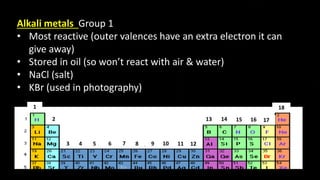
Alkali metals Group 1
• Most reactive (outer valences have an extra electron it can
give away)
• Stored in oil (so won’t react with air & water)
• NaCl (salt)
• KBr (used in photography)
1
2
3 4 5 6 7 8 9 10 11 12
13 14 15 16 17
18
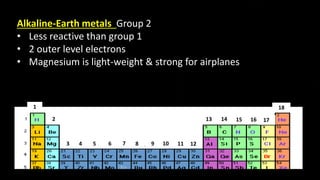
Alkaline-Earth metals Group 2
• Less reactive than group 1
• 2 outer level electrons
• Magnesium is light-weight & strong for airplanes
1
2
3 4 5 6 7 8 9 10 11 12
13 14 15 16 17
18
1
2
3 4 5 6 7 8 9 10 11 12
13 14 15 16 17
18
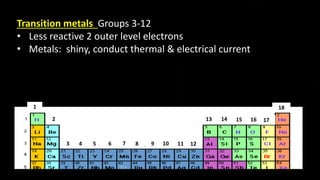
Transition metals Groups 3-12
• Less reactive 2 outer level electrons
• Metals: shiny, conduct thermal & electrical current
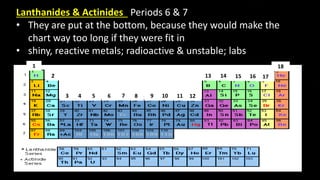
Lanthanides & Actinides Periods 6 & 7
• They are put at the bottom, because they would make the
chart way too long if they were fit in
• shiny, reactive metals; radioactive & unstable; labs
1
2
3 4 5 6 7 8 9 10 11 12
13 14 15 16 17
18
1
2
3 4 5 6 7 8 9 10 11 12
13 14 15 16 17
18
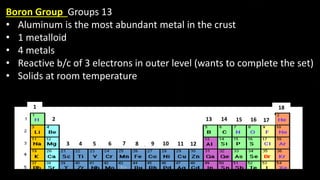
Boron Group Groups 13
• Aluminum is the most abundant metal in the crust
• 1 metalloid
• 4 metals
• Reactive b/c of 3 electrons in outer level (wants to complete the set)
• Solids at room temperature
1
2
3 4 5 6 7 8 9 10 11 12
13 14 15 16 17
18
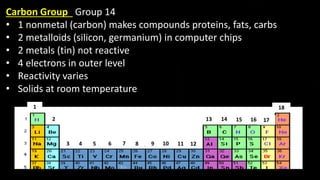
Carbon Group Group 14
• 1 nonmetal (carbon) makes compounds proteins, fats, carbs
• 2 metalloids (silicon, germanium) in computer chips
• 2 metals (tin) not reactive
• 4 electrons in outer level
• Reactivity varies
• Solids at room temperature
1
2
3 4 5 6 7 8 9 10 11 12
13 14 15 16 17
18
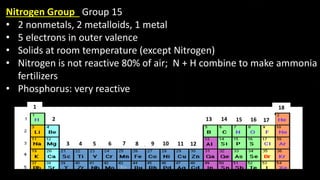
Nitrogen Group Group 15
• 2 nonmetals, 2 metalloids, 1 metal
• 5 electrons in outer valence
• Solids at room temperature (except Nitrogen)
• Nitrogen is not reactive 80% of air; N + H combine to make ammonia
fertilizers
• Phosphorus: very reactive
1
2
3 4 5 6 7 8 9 10 11 12
13 14 15 16 17
18
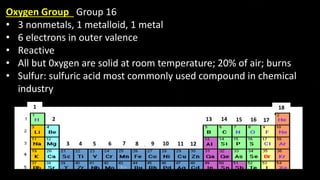
Oxygen Group Group 16
• 3 nonmetals, 1 metalloid, 1 metal
• 6 electrons in outer valence
• Reactive
• All but 0xygen are solid at room temperature; 20% of air; burns
• Sulfur: sulfuric acid most commonly used compound in chemical
industry
1
2
3 4 5 6 7 8 9 10 11 12
13 14 15 16 17
18
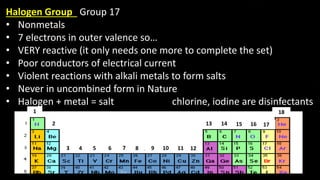
Halogen Group Group 17
• Nonmetals
• 7 electrons in outer valence so…
• VERY reactive (it only needs one more to complete the set)
• Poor conductors of electrical current
• Violent reactions with alkali metals to form salts
• Never in uncombined form in Nature
• Halogen + metal = salt chlorine, iodine are disinfectants
1
2
3 4 5 6 7 8 9 10 11 12
13 14 15 16 17
18
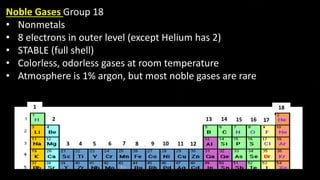
Noble Gases Group 18
• Nonmetals
• 8 electrons in outer level (except Helium has 2)
• STABLE (full shell)
• Colorless, odorless gases at room temperature
• Atmosphere is 1% argon, but most noble gases are rare
1
2
3 4 5 6 7 8 9 10 11 12
13 14 15 16 17
18
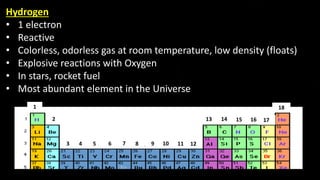
Hydrogen
• 1 electron
• Reactive
• Colorless, odorless gas at room temperature, low density (floats)
• Explosive reactions with Oxygen
• In stars, rocket fuel
• Most abundant element in the Universe
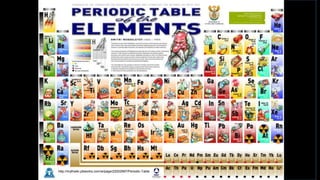
http://mythwiki.pbworks.com/w/page/22002997/Periodic-Table
2. Periodic Table Elements VIDEO
LOOP (9 min)
3. Crash Course Chemistry:
Electron (10 min)
1. Elements VIDEO SONG (3 min)

Chemistry intro

  • 1.
    Chemistry INTRO Atoms &the Periodic Table Robin D. Seamon
  • 2.
  • 3.
    Matter is everythingaround you: Matter something that has mass & takes up space (volume) Mass number of atoms in it (kg) Volume the amount of space it takes up
  • 4.
    Atoms: smallest unitor building block of matter 1. Atoms LINK Video (7 min) 2. NOVA Atoms Video (1 min) 3. Crash Course Chemistry: Atom (10 min) http://archive.stsci.edu/fus e/scisumm/sci_d2h.html http://www.eskom.co.za/nuclear_energy/fuel/fuel.html Molecule: two or more atoms bound together http://www.ces.fau.edu/
  • 5.
  • 6.
    Electron (-) nucleus Proton (+) Neutron 80 Hg 200.59 Mercury Atomicnumber (# of protons) Atomic weight (mass of protons & neutrons) symbol Element name VIDEO 1: Atoms: Space Between (1 min) VIDEO 2: Electrons, Protons, Neutrons ( 3 min) A T O M
  • 7.
    Democritus (Greek) philosopherwho imagined cutting matter up until it could no longer be cut into smaller particles. He called this smallest unit atomos “can’t be split.” ATOMIC MODELS http://www.iep.utm.edu/democrit/ 460- 370 B.C.E. Joseph Thomson (British) 1897 discovered the electron -plum pudding model: electrons floated in the positive proton mass
  • 8.
    Ernest Rutherford Model(British) (1909) • Described the nucleus • Said the atom was 99.9% empty space • Said nucleus was + • Said nucleus was 100,000 X smaller than the atom http://www.nobelprize.org/nobel_prizes/chemi stry/laureates/1908/rutherford-bio.html
  • 9.
    Niels Bohr Model:(Danish) 1913 • ONION MODEL said rings are not actual orbits, but levels or SHELLS that represent the location of an electron wave. • Said electrons could jump between those shells releasing energy https://thespectrumofriemannium.wordpress.com/t ag/sommerfeld-corrections/ http://www.nndb.com/people/560/000024488/
  • 10.
    VIDEO Crash CourseAtomic Model Theory (9 min) Erwin Schrodinger (Austrian) & Werner Heisenberg (German) 1925 -CLOUD MODEL • Probability Function: cloud-like region where electrons are likely to be found • *Can’t say with certainty where the electron is at any point in time, yet describes where it ought to be • ~think of it like an electron leaving a trace of where it was, the collection of these traces looks like a cloud • The probable location happens to coincide with locations specified by Bohr’s model! http://www.regentsprep.org/Regents/phy sics/phys05/catomodel/cloud.htm
  • 11.
    Electron shell: setof allowed states that electrons can have around the nucleus Atoms fill their innermost shells before moving outward MAXIMUM CAPACITY: 1st Shell: up to 2 electrons 2nd Shell: up to 8 electrons 3rd Shell: up to 18 electrons 4th Shell: up to 32 electrons 2 2 8 2 8 2 8 18 18 32
  • 12.
    SHELL NUMBER (n) ABSOLUTEMAX CAPACITY VALENCE CAPACITY 1 2 2 2 8 8 3 18 8 4 32 8 n 2n2 8 Valence electrons: electrons in the outermost energy level Octet Rule: the valence shell normally holds no more than 8 electrons, regardless of the capacity it would otherwise have. *atoms are most stable when they have full valence shells * This tendency is the driving force behind chemical reactions, (explains why elements combine the way they do) VALENCE SHELL: outermost shell
  • 13.
  • 14.
  • 15.
    Pure Substance: allof the particles are the same Element: all the atoms are the same Compound: elements are the same- in a repeating pattern
  • 16.
  • 17.
  • 18.
    Pure Substance Element Compound Mixture Homogeneous Mixture Heterogeneous Mixture Carbon C OxygenO Salt NaCl Sugar C H O Water H O2 2 2 12 22 11 Solution Alloy Saltwater NaCl + H O Brass Cu + Zn Bronze Cu + Sn Steel Fe + C Salad Conglomerate CLASSIFICATION OF MATTER 2
  • 19.
  • 20.
    LAB: Arrange theElements DIRECTIONS: 1. Think about properties you could use to group and arrange the element cards. 2. Arrange the elements in an order of your choosing. 3. Write the rules you used to organize. 4. Compare to Mendeleev’s table
  • 21.
  • 22.
    CONCLUSIONS: Dmitri Mendeleev (Russian)1869 • Saw pattern in elements regarding their chemical properties (density, appearance, melting point) • He arranged them in a pattern of increasing atomic mass Atomic mass: the mass of the protons + neutrons (electrons are too small to weigh) • He predicted missing elements based on the pattern • A few elements’ properties didn’t fit, but the math was right http://www.glogster.com/andythehandsome/dmitri-ivanovich- mendeleev/g-6mf34dudha5i9e4oi3ttea0
  • 23.
    Henry Mosley (British)1914 determined the atomic number • Atomic number: number of protons in an atom • He slightly adjusted Mendeleev’s periodic table to be in order of atomic number. http://en.wikipedia.org/wiki/Henry_Moseley
  • 24.
    Glenn T. Seaborg(American) 1951 discovered the • Actinid elements & they follow the law Periodic Law: repeating chemical & physical properties of elements change periodically with a pattern http://www.nobelprize.org/nobel_prizes/chemis try/laureates/1951/seaborg-bio.html Periodic Table Crash Course VIDEO ( 10 min)
  • 25.
    80 Hg 200.59 Mercury Atomic number (# ofprotons) Atomic weight (mass of protons & neutrons) symbol Element name How to Read the Periodic Table of Elements Elements VIDEO SONG (3 min)
  • 26.
    1 1 2 3 4 56 7 8 9 10 11 12 13 14 15 16 17 18 Groups- Families Color of the symbol indicates whether the element is a solid, liquid, or gas at room temperature Periodic Table SONG LINK INTERACTIVE Periodic TABLE Metalloids are on the stair- step between metals & non- metals Elements 1-92 are found in Nature. The rest are man- made (synthetic) Periods
  • 27.
    Elements 1-92 arefound in Nature. The rest are man-made. Some are yet to be created/discovered in the lab. Periods are read • The number of electron valence shells for an element equals the Period number. LINK Groups or Families are read • The number of valence LINK electrons are the same as the group number except: • RULE DOESN’T APPLY TO TRANSITION METALS grps 3-12 • Rule is the group number minus 10 for grps 13-18
  • 28.
    Metals • LEFT sideof the zig-zag line • Few electrons in the outer Energy level • Most are solid at room temperature (not Mercury) • Shiny • Ductile (good conductors of electrical current) • Malleable (can be flattened with a hammer) • Conductors of thermal energy
  • 29.
    Nonmetals • RIGHT sideof the zig-zag line • Almost a complete set of electrons in outer level • (Group 18 are Noble Gases: have a complete set of electrons & are stable) • ½ are gases at room temperature • NOT malleable • NOT shiny • POOR conductors of thermal energy & electric current
  • 30.
    Metalloids • Semi-conductors • Borderthe zig-zag line • ½ complete set of electrons in outer valence • Have properties of metals and nonmetals
  • 31.
    METALLIC LESS NOTMETALLIC LEFT RIGHT 1 2 3 4 5 6 7 8 9 10 11 12 13 14 15 16 17 18
  • 32.
    REACTIVITY CHANGES ACCORDINGTO NUMBER OF VALENCE ELECTRONS1 2 3 4 5 6 7 8 9 10 11 12 13 14 15 16 17 18
  • 33.
    Elements in thesame Group have similar properties. 1 2 3 4 5 6 7 8 9 10 11 12 13 14 15 16 17 18
  • 34.
    LAB: Color-Code the Periodic Table ofElements DIRECTIONS: Color-code the periodic table of elements as we take notes.
  • 35.
    Alkali metals Group1 • Most reactive (outer valences have an extra electron it can give away) • Stored in oil (so won’t react with air & water) • NaCl (salt) • KBr (used in photography) 1 2 3 4 5 6 7 8 9 10 11 12 13 14 15 16 17 18
  • 36.
    Alkaline-Earth metals Group2 • Less reactive than group 1 • 2 outer level electrons • Magnesium is light-weight & strong for airplanes 1 2 3 4 5 6 7 8 9 10 11 12 13 14 15 16 17 18
  • 37.
    1 2 3 4 56 7 8 9 10 11 12 13 14 15 16 17 18 Transition metals Groups 3-12 • Less reactive 2 outer level electrons • Metals: shiny, conduct thermal & electrical current
  • 38.
    Lanthanides & ActinidesPeriods 6 & 7 • They are put at the bottom, because they would make the chart way too long if they were fit in • shiny, reactive metals; radioactive & unstable; labs 1 2 3 4 5 6 7 8 9 10 11 12 13 14 15 16 17 18
  • 39.
    1 2 3 4 56 7 8 9 10 11 12 13 14 15 16 17 18 Boron Group Groups 13 • Aluminum is the most abundant metal in the crust • 1 metalloid • 4 metals • Reactive b/c of 3 electrons in outer level (wants to complete the set) • Solids at room temperature
  • 40.
    1 2 3 4 56 7 8 9 10 11 12 13 14 15 16 17 18 Carbon Group Group 14 • 1 nonmetal (carbon) makes compounds proteins, fats, carbs • 2 metalloids (silicon, germanium) in computer chips • 2 metals (tin) not reactive • 4 electrons in outer level • Reactivity varies • Solids at room temperature
  • 41.
    1 2 3 4 56 7 8 9 10 11 12 13 14 15 16 17 18 Nitrogen Group Group 15 • 2 nonmetals, 2 metalloids, 1 metal • 5 electrons in outer valence • Solids at room temperature (except Nitrogen) • Nitrogen is not reactive 80% of air; N + H combine to make ammonia fertilizers • Phosphorus: very reactive
  • 42.
    1 2 3 4 56 7 8 9 10 11 12 13 14 15 16 17 18 Oxygen Group Group 16 • 3 nonmetals, 1 metalloid, 1 metal • 6 electrons in outer valence • Reactive • All but 0xygen are solid at room temperature; 20% of air; burns • Sulfur: sulfuric acid most commonly used compound in chemical industry
  • 43.
    1 2 3 4 56 7 8 9 10 11 12 13 14 15 16 17 18 Halogen Group Group 17 • Nonmetals • 7 electrons in outer valence so… • VERY reactive (it only needs one more to complete the set) • Poor conductors of electrical current • Violent reactions with alkali metals to form salts • Never in uncombined form in Nature • Halogen + metal = salt chlorine, iodine are disinfectants
  • 44.
    1 2 3 4 56 7 8 9 10 11 12 13 14 15 16 17 18 Noble Gases Group 18 • Nonmetals • 8 electrons in outer level (except Helium has 2) • STABLE (full shell) • Colorless, odorless gases at room temperature • Atmosphere is 1% argon, but most noble gases are rare
  • 45.
    1 2 3 4 56 7 8 9 10 11 12 13 14 15 16 17 18 Hydrogen • 1 electron • Reactive • Colorless, odorless gas at room temperature, low density (floats) • Explosive reactions with Oxygen • In stars, rocket fuel • Most abundant element in the Universe
  • 46.
  • 47.
    2. Periodic TableElements VIDEO LOOP (9 min) 3. Crash Course Chemistry: Electron (10 min) 1. Elements VIDEO SONG (3 min)