TRENDS IN MODERN
PERIODIC TABLE
- SHREE SHAKTHI
X ‘C’
VALENCY
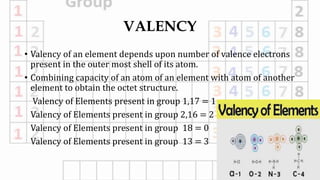
• Valency of an element depends upon number of valence electrons
present in the outer most shell of its atom.
• Combining capacity of an atom of an element with atom of another
element to obtain the octet structure.
Valency of Elements present in group 1,17 = 1
Valency of Elements present in group 2,16 = 2
Valency of Elements present in group 18 = 0
Valency of Elements present in group 13 = 3
VALENCY
• All the elements present in a group have same valency as they
show same electronic configuration of their atom.
Example: Valency of Elements present in group 1 = 1
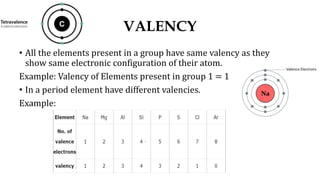
• In a period element have different valencies.
Example:
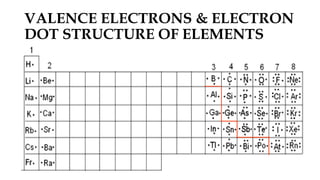
VALENCE ELECTRONS & ELECTRON
DOT STRUCTURE OF ELEMENTS
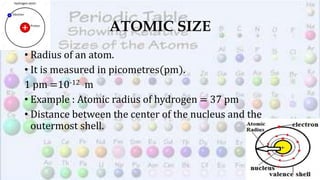
ATOMIC SIZE
• Radius of an atom.
• It is measured in picometres(pm).
1 pm =10-12 m
• Example : Atomic radius of hydrogen = 37 pm
• Distance between the center of the nucleus and the
outermost shell.
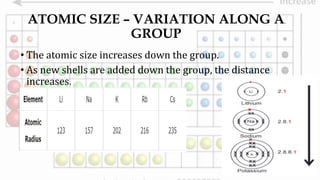
ATOMIC SIZE – VARIATION ALONG A
GROUP
• The atomic size increases down the group.
• As new shells are added down the group, the distance
increases.
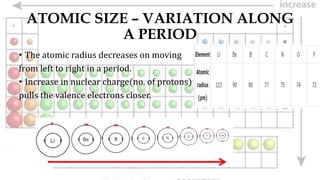
ATOMIC SIZE – VARIATION ALONG
A PERIOD
• The atomic radius decreases on moving
from left to right in a period.
• Increase in nuclear charge(no. of protons)
pulls the valence electrons closer.
METALLIC AND NON-METALLIC
PROPERTIES
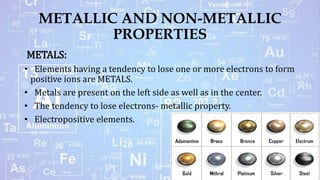
METALS:
• Elements having a tendency to lose one or more electrons to form
positive ions are METALS.
• Metals are present on the left side as well as in the center.
• The tendency to lose electrons- metallic property.
• Electropositive elements.
METALLIC AND NON-METALLIC
PROPERTIES
NON-METALS:
• Elements having a tendency to gain one or more electrons to form
negative ions are NON-METALS.
• Non-Metals are present on the right side.
• The tendency to gain electrons-non-metallic property.
• Electronegative elements.
METALLIC AND NON-METALLIC
PROPERTIES
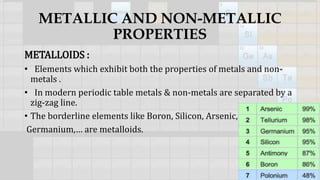
METALLOIDS :
• Elements which exhibit both the properties of metals and non-
metals .
• In modern periodic table metals & non-metals are separated by a
zig-zag line.
• The borderline elements like Boron, Silicon, Arsenic,
Germanium,… are metalloids.
METALLIC AND NON-
METALLIC PROPERTIES
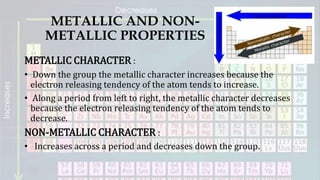
METALLIC CHARACTER :
• Down the group the metallic character increases because the
electron releasing tendency of the atom tends to increase.
• Along a period from left to right, the metallic character decreases
because the electron releasing tendency of the atom tends to
decrease.
NON-METALLIC CHARACTER :
• Increases across a period and decreases down the group.
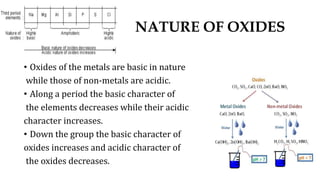
NATURE OF OXIDES
• Oxides of the metals are basic in nature
while those of non-metals are acidic.
• Along a period the basic character of
the elements decreases while their acidic
character increases.
• Down the group the basic character of
oxides increases and acidic character of
the oxides decreases.
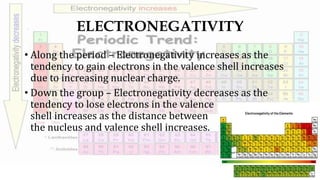
ELECTRONEGATIVITY
• Along the period – Electronegativity increases as the
tendency to gain electrons in the valence shell increases
due to increasing nuclear charge.
• Down the group – Electronegativity decreases as the
tendency to lose electrons in the valence
shell increases as the distance between
the nucleus and valence shell increases.
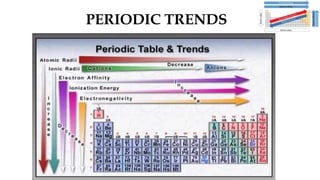
PERIODIC TRENDS
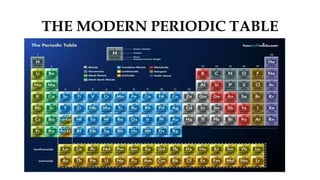
THE MODERN PERIODIC TABLE
Trends in modern periodic table

Trends in modern periodic table

  • 1.
    TRENDS IN MODERN PERIODICTABLE - SHREE SHAKTHI X ‘C’
  • 2.
    VALENCY • Valency ofan element depends upon number of valence electrons present in the outer most shell of its atom. • Combining capacity of an atom of an element with atom of another element to obtain the octet structure. Valency of Elements present in group 1,17 = 1 Valency of Elements present in group 2,16 = 2 Valency of Elements present in group 18 = 0 Valency of Elements present in group 13 = 3
  • 3.
    VALENCY • All theelements present in a group have same valency as they show same electronic configuration of their atom. Example: Valency of Elements present in group 1 = 1 • In a period element have different valencies. Example:
  • 4.
    VALENCE ELECTRONS &ELECTRON DOT STRUCTURE OF ELEMENTS
  • 5.
    ATOMIC SIZE • Radiusof an atom. • It is measured in picometres(pm). 1 pm =10-12 m • Example : Atomic radius of hydrogen = 37 pm • Distance between the center of the nucleus and the outermost shell.
  • 6.
    ATOMIC SIZE –VARIATION ALONG A GROUP • The atomic size increases down the group. • As new shells are added down the group, the distance increases.
  • 7.
    ATOMIC SIZE –VARIATION ALONG A PERIOD • The atomic radius decreases on moving from left to right in a period. • Increase in nuclear charge(no. of protons) pulls the valence electrons closer.
  • 8.
    METALLIC AND NON-METALLIC PROPERTIES METALS: •Elements having a tendency to lose one or more electrons to form positive ions are METALS. • Metals are present on the left side as well as in the center. • The tendency to lose electrons- metallic property. • Electropositive elements.
  • 9.
    METALLIC AND NON-METALLIC PROPERTIES NON-METALS: •Elements having a tendency to gain one or more electrons to form negative ions are NON-METALS. • Non-Metals are present on the right side. • The tendency to gain electrons-non-metallic property. • Electronegative elements.
  • 10.
    METALLIC AND NON-METALLIC PROPERTIES METALLOIDS: • Elements which exhibit both the properties of metals and non- metals . • In modern periodic table metals & non-metals are separated by a zig-zag line. • The borderline elements like Boron, Silicon, Arsenic, Germanium,… are metalloids.
  • 11.
    METALLIC AND NON- METALLICPROPERTIES METALLIC CHARACTER : • Down the group the metallic character increases because the electron releasing tendency of the atom tends to increase. • Along a period from left to right, the metallic character decreases because the electron releasing tendency of the atom tends to decrease. NON-METALLIC CHARACTER : • Increases across a period and decreases down the group.
  • 12.
    NATURE OF OXIDES •Oxides of the metals are basic in nature while those of non-metals are acidic. • Along a period the basic character of the elements decreases while their acidic character increases. • Down the group the basic character of oxides increases and acidic character of the oxides decreases.
  • 13.
    ELECTRONEGATIVITY • Along theperiod – Electronegativity increases as the tendency to gain electrons in the valence shell increases due to increasing nuclear charge. • Down the group – Electronegativity decreases as the tendency to lose electrons in the valence shell increases as the distance between the nucleus and valence shell increases.
  • 14.
  • 15.