Bellwork Answer in complete sentences! What state of matter does most of the periodic table exist in?  What state of matter is the least frequent?  Why did Mendeleev leave room for elements like Germanium on his periodic table?  What subatomic particle do you think has the most impact on the organization of the periodic table?
 
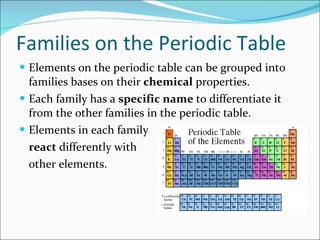
Families on the Periodic Table Elements on the periodic table can be grouped into families bases on their  chemical  properties. Each family has a  specific name  to differentiate it from the other families in the periodic table. Elements in each family  react  differently with  other elements.
The Role of Electrons In a neutral atom, the number of electrons matches the number of protons.  The chemical properties of each element are largely determined by valence electrons.  Valence electrons are electrons in the outermost shell or level.  These electrons are closest to the outside of the atom
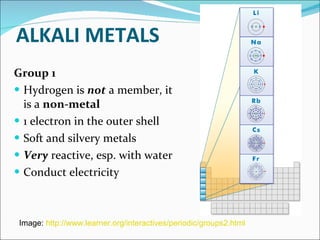
ALKALI METALS Group 1 Hydrogen is  not  a member, it is a  non-metal 1 electron in the outer shell Soft and silvery metals Very  reactive, esp. with water Conduct electricity Image:  http://www.learner.org/interactives/periodic/groups2.html
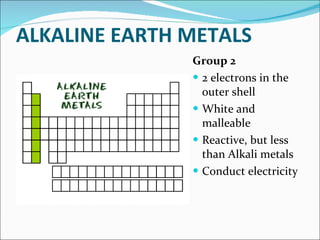
ALKALINE EARTH METALS Group 2 2 electrons in the outer shell White and malleable Reactive, but less than Alkali metals Conduct electricity
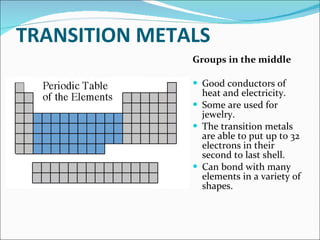
TRANSITION METALS Groups in the middle  Good conductors of heat and electricity. Some are used for jewelry. The transition metals are able to put up to 32 electrons in their second to last shell. Can bond with many elements in a variety of shapes.
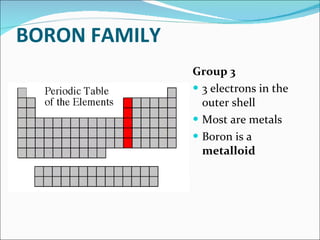
BORON FAMILY  Group 3 3 electrons in the outer shell Most are metals Boron is a  metalloid
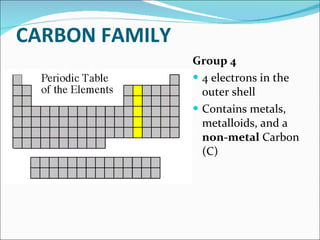
CARBON FAMILY  Group 4 4 electrons in the outer shell Contains metals, metalloids, and a  non-metal  Carbon (C)
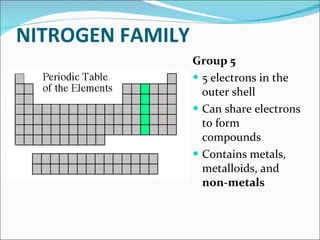
NITROGEN FAMILY  Group 5 5 electrons in the outer shell Can share electrons to form compounds Contains metals, metalloids, and  non-metals
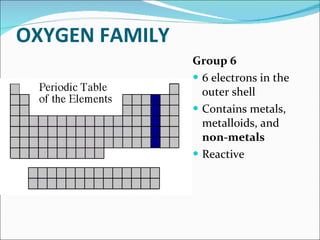
OXYGEN FAMILY  Group 6 6 electrons in the outer shell Contains metals, metalloids, and  non-metals Reactive
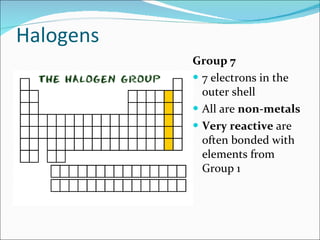
Halogens Group 7 7 electrons in the outer shell All are  non-metals Very reactive  are often bonded with elements from Group 1
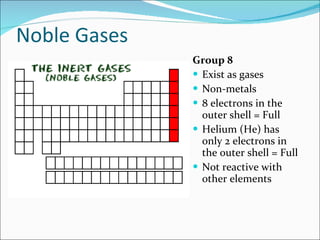
Noble Gases Group 8 Exist as gases Non-metals 8 electrons in the outer shell = Full Helium (He) has only 2 electrons in the outer shell = Full Not reactive with other elements
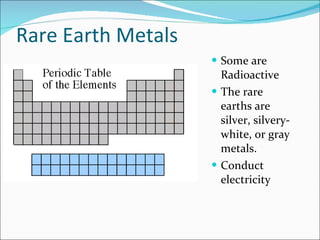
Rare Earth Metals Some are Radioactive The rare earths are silver, silvery-white, or gray metals.  Conduct electricity
The next guide is determining  shells and valence electrons

Periodic table-families

  • 1.
    Bellwork Answer incomplete sentences! What state of matter does most of the periodic table exist in? What state of matter is the least frequent? Why did Mendeleev leave room for elements like Germanium on his periodic table? What subatomic particle do you think has the most impact on the organization of the periodic table?
  • 2.
  • 3.
    Families on thePeriodic Table Elements on the periodic table can be grouped into families bases on their chemical properties. Each family has a specific name to differentiate it from the other families in the periodic table. Elements in each family react differently with other elements.
  • 4.
    The Role ofElectrons In a neutral atom, the number of electrons matches the number of protons. The chemical properties of each element are largely determined by valence electrons. Valence electrons are electrons in the outermost shell or level. These electrons are closest to the outside of the atom
  • 5.
    ALKALI METALS Group1 Hydrogen is not a member, it is a non-metal 1 electron in the outer shell Soft and silvery metals Very reactive, esp. with water Conduct electricity Image: http://www.learner.org/interactives/periodic/groups2.html
  • 6.
    ALKALINE EARTH METALSGroup 2 2 electrons in the outer shell White and malleable Reactive, but less than Alkali metals Conduct electricity
  • 7.
    TRANSITION METALS Groupsin the middle Good conductors of heat and electricity. Some are used for jewelry. The transition metals are able to put up to 32 electrons in their second to last shell. Can bond with many elements in a variety of shapes.
  • 8.
    BORON FAMILY Group 3 3 electrons in the outer shell Most are metals Boron is a metalloid
  • 9.
    CARBON FAMILY Group 4 4 electrons in the outer shell Contains metals, metalloids, and a non-metal Carbon (C)
  • 10.
    NITROGEN FAMILY Group 5 5 electrons in the outer shell Can share electrons to form compounds Contains metals, metalloids, and non-metals
  • 11.
    OXYGEN FAMILY Group 6 6 electrons in the outer shell Contains metals, metalloids, and non-metals Reactive
  • 12.
    Halogens Group 77 electrons in the outer shell All are non-metals Very reactive are often bonded with elements from Group 1
  • 13.
    Noble Gases Group8 Exist as gases Non-metals 8 electrons in the outer shell = Full Helium (He) has only 2 electrons in the outer shell = Full Not reactive with other elements
  • 14.
    Rare Earth MetalsSome are Radioactive The rare earths are silver, silvery-white, or gray metals. Conduct electricity
  • 15.
    The next guideis determining shells and valence electrons