TEACHING 
APPROACHES 
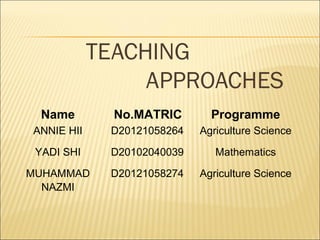
Name No.MATRIC Programme 
ANNIE HII D20121058264 Agriculture Science 
YADI SHI D20102040039 Mathematics 
MUHAMMAD 
NAZMI 
D20121058274 Agriculture Science
INTRODUCTION TO TEACHING 
APPROACHES 
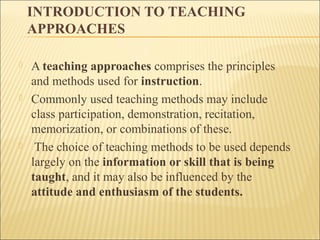
 A teaching approaches comprises the principles 
and methods used for instruction. 
 Commonly used teaching methods may include 
class participation, demonstration, recitation, 
memorization, or combinations of these. 
 The choice of teaching methods to be used depends 
largely on the information or skill that is being 
taught, and it may also be influenced by the 
attitude and enthusiasm of the students.
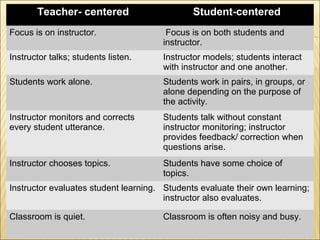
Teacher- centered Student-centered 
Focus is on instructor. Focus is on both students and 
instructor. 
Instructor talks; students listen. Instructor models; students interact 
with instructor and one another. 
Students work alone. Students work in pairs, in groups, or 
alone depending on the purpose of 
the activity. 
Instructor monitors and corrects 
every student utterance. 
Students talk without constant 
instructor monitoring; instructor 
provides feedback/ correction when 
questions arise. 
Instructor chooses topics. Students have some choice of 
topics. 
Instructor evaluates student learning. Students evaluate their own learning; 
instructor also evaluates. 
Classroom is quiet. Classroom is often noisy and busy.
“ TEACHER-CENTERED” AND 
“ STUDENT-CENTERED” 
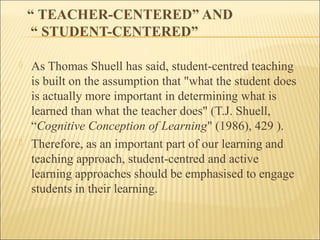
 As Thomas Shuell has said, student-centred teaching 
is built on the assumption that "what the student does 
is actually more important in determining what is 
learned than what the teacher does" (T.J. Shuell, 
“Cognitive Conception of Learning" (1986), 429 ). 
 Therefore, as an important part of our learning and 
teaching approach, student-centred and active 
learning approaches should be emphasised to engage 
students in their learning.
TEACHING STRATEGIES 
 Lecture 
 Active learning 
- Strategies that encourage students to think and learnt. 
 Critical thinking 
- Focusing, information gathering, referencing, organizing, 
analyzing, integrating, and evaluation. 
 Discussion 
- An important element is the use of inquiry questioning to 
stimulate discussion and bring the forum to the highest levels. 
 Cooperative learning 
- encourages small group of students to work together for the 
achievement of a common goal.
TEACHING STRATEGIES 
 Mid-Course Assessment 
- For the purpose of improvement. These range 
from very informal to highly formal. 
 Case-studies 
- Providing an opportunity for students to apply 
what they learnt in the classroom in real-life 
experience. 
- It engages students in active discussion about 
issues and problems inherit in practical 
application. 
 Questioning
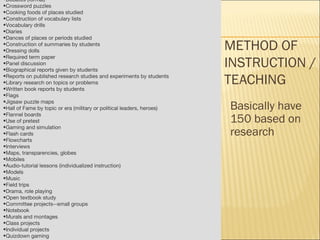
METHOD OF 
INSTRUCTION / 
TEACHING 
Basically have 
150 based on 
research 
•Debates (formal) 
•Crossword puzzles 
•Cooking foods of places studied 
•Construction of vocabulary lists 
•Vocabulary drills 
•Diaries 
•Dances of places or periods studied 
•Construction of summaries by students 
•Dressing dolls 
•Required term paper 
•Panel discussion 
•Biographical reports given by students 
•Reports on published research studies and experiments by students 
•Library research on topics or problems 
•Written book reports by students 
•Flags 
•Jigsaw puzzle maps 
•Hall of Fame by topic or era (military or political leaders, heroes) 
•Flannel boards 
•Use of pretest 
•Gaming and simulation 
•Flash cards 
•Flowcharts 
•Interviews 
•Maps, transparencies, globes 
•Mobiles 
•Audio-tutorial lessons (individualized instruction) 
•Models 
•Music 
•Field trips 
•Drama, role playing 
•Open textbook study 
•Committee projects--small groups 
•Notebook 
•Murals and montages 
•Class projects 
•Individual projects 
•Quizdown gaming 
•Modeling in various media
METHODS OF INSTRUCTION  Explaining 
Explaining, or lecturing, is the process of teaching by giving spoken explanations of the subject that is to 
be learned. Lecturing is often accompanied by visual aids to help students visualize an object or 
problem. Explaining may meet the needs of auditory or visual learning preferences[clarify] but often 
fails to meet the needs of individuals with other learning preferences[clarify], such as kinesthetic or 
social learners[clarify].[citation needed] 
 Demonstrating 
Demonstrating is the process of teaching through examples or experiments. For example, a science 
teacher may teach an idea by performing an experiment for students. A demonstration may be used 
to prove a fact through a combination of visual evidence and associated reasoning. 
 Collaborating 
Collaboration allows students to actively participate in the learning process by talking with each other 
and listening to other points of view. Collaboration establishes a personal connection between 
students and the topic of study and it helps students think in a less personally biased way. Group 
projects and discussions are examples of this teaching method. Teachers may employ collaboration 
to assess student's abilities to work as a team, leadership skills, or presentation abilities.[1] 
 Learning by teaching 
 In this teaching method, students assume the role of teacher and teach their peers. Students who 
teach others as a group or as individuals must study and understand a topic well enough to teach it 
to their peers. By having students participate in the teaching process, they gain self-confidence and 
strengthen their speaking and communication skills
COOPERATIVE LEARNING 
Advantages 
Helps foster mutual responsibility 
Supported by research as an effective technique 
Students learn to be patient, less critical and more compassionate 
Disadvantages 
Some students don't work well this way 
Loners find it hard to share answers 
Aggressive students try to take over 
Bright students tend to act superior 
Preparation 
Decide what skills or knowledge are to be learned 
Requires some time to prepare students to learn how to work in 
groups
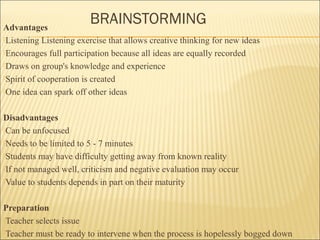
BRAINSTORMING Advantages 
Listening Listening exercise that allows creative thinking for new ideas 
Encourages full participation because all ideas are equally recorded 
Draws on group's knowledge and experience 
Spirit of cooperation is created 
One idea can spark off other ideas 
Disadvantages 
Can be unfocused 
Needs to be limited to 5 - 7 minutes 
Students may have difficulty getting away from known reality 
If not managed well, criticism and negative evaluation may occur 
Value to students depends in part on their maturity 
Preparation 
Teacher selects issue 
Teacher must be ready to intervene when the process is hopelessly bogged down
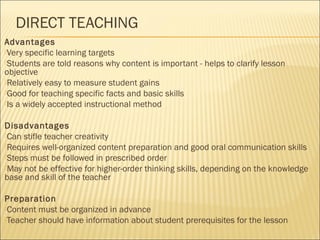
DIRECT TEACHING 
Advantages 
Very specific learning targets 
Students are told reasons why content is important - helps to clarify lesson 
objective 
Relatively easy to measure student gains 
Good for teaching specific facts and basic skills 
Is a widely accepted instructional method 
Disadvantages 
Can stifle teacher creativity 
Requires well-organized content preparation and good oral communication skills 
Steps must be followed in prescribed order 
May not be effective for higher-order thinking skills, depending on the knowledge 
base and skill of the teacher 
Preparation 
Content must be organized in advance 
Teacher should have information about student prerequisites for the lesson
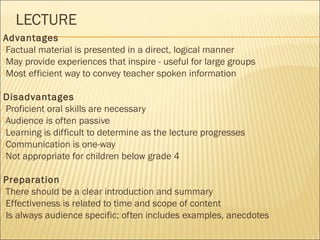
LECTURE 
Advantages 
Factual material is presented in a direct, logical manner 
May provide experiences that inspire - useful for large groups 
Most efficient way to convey teacher spoken information 
Disadvantages 
Proficient oral skills are necessary 
Audience is often passive 
Learning is difficult to determine as the lecture progresses 
Communication is one-way 
Not appropriate for children below grade 4 
Preparation 
There should be a clear introduction and summary 
Effectiveness is related to time and scope of content 
Is always audience specific; often includes examples, anecdotes
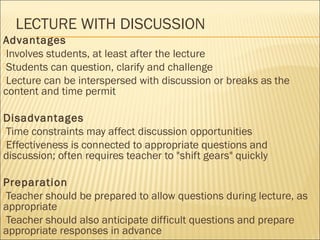
LECTURE WITH DISCUSSION 
Advantages 
Involves students, at least after the lecture 
Students can question, clarify and challenge 
Lecture can be interspersed with discussion or breaks as the 
content and time permit 
Disadvantages 
Time constraints may affect discussion opportunities 
Effectiveness is connected to appropriate questions and 
discussion; often requires teacher to "shift gears" quickly 
Preparation 
Teacher should be prepared to allow questions during lecture, as 
appropriate 
Teacher should also anticipate difficult questions and prepare 
appropriate responses in advance
MULTIMEDIA (COMPUTER, INTERNET, CD, 
DVD, FILM) 
Advantages 
Entertaining way of introducing content and raising issues 
Internet content easily updated 
Usually keeps group's attention 
Cost effective way to obtain and disseminate content 
May provide opportunities for independent student investigation in a wide range of topics 
Disadvantages 
Can raise too many issues to have a focused discussion 
Distractions happen all too easily 
Students working independently can easily lose focus of lesson topic 
Most effective when followed by discussion 
Discussion may not have full participation 
Preparation 
Teacher must formulate rules and communicate them to students 
Need to obtain and set up equipment 
Computing skills required for some applications 
Most effective when teacher prepares for discussion after the presentation or activity
ROLE PLAYING 
Advantages 
Introduces problem situation dramatically 
Provides opportunity for students to assume roles of others and thus appreciate another 
point of view 
Allows for exploration of solutions 
Provides opportunity to practice skills 
Disadvantages 
Some students may be too self-conscious 
Not appropriate for large groups 
Can be time consuming to set up and execute 
Preparation 
Teacher has to define problem situation and roles clearly 
Teacher must give very clear instructions 
Teacher must have back up activities in case of problems
GAMES 
Advantages 
Students are usually interested in and challenged by games 
Can provide opportunities for team member building skills 
Feedback is usually easy to provide and is quick 
When used in direct relationship to a lesson objective, can provide a stimulating experience for 
all 
Disadvantages 
Can create in-group/out-group feelings 
Can demotivate those who are not competitive by nature 
Can create feelings of inadequacy in those not as skilled or forceful 
Can discourage creativity if the format is very rigid and the focus is strongly on winning 
Preparation 
Choose relevant games at an appropriate level that can be reasonably expected to achieve the 
learning objectives 
Introduce the game and make the objectives clear 
Give clear and thorough directions 
Create a friendly versus cut-throat mentality; do not put down losers or allow others to do so 
Do not take sides or show partiality 
Keep a handle on things
SMALL GROUP DISCUSSION 
Advantages 
Allows for participation of everyone 
Students often more comfortable in small groups 
Groups can reach consensus 
Disadvantages 
Needs careful thought as to purpose of group 
Groups may get side tracked 
Preparation 
Needs careful thought as to purpose of group 
Groups may get side tracked
CASE STUDIES 
Advantages 
Develops analytic and problem solving skills 
Allows for exploration of solutions for complex issues 
Allows student to apply new knowledge and skills 
Disadvantages 
Students may not see relevance to own situation 
Insufficient information can lead to inappropriate results 
Not appropriate for elementary level students 
Preparation 
Teacher has to define problem situation and roles clearly 
Teacher must give very clear instructions
DISCUSSION 
Advantages 
Pools ideas and experiences from group 
Effective after a presentation, film or experience that needs to be analyzed 
Allows everyone to participate in an active process 
Disadvantages 
practical Not practicalwith more that 20 students 
A few students can dominate 
Some students may not participate 
Is time consuming 
Can get off the track 
Preparation 
Requires careful planning by the teacher to guide the discussion toward the 
lesson objective 
Requires preparation of a question outline
WORKSHEETS AND SURVEYS 
Advantages 
Allows students to think for themselves without being 
influenced by others 
Individual thoughts can then be shared in large group 
Disadvantages 
Can be used only for short period of time 
Preparation 
Teacher has to prepare handouts
COMPUTER SIMULATIONS 
Advantages 
Students can work independently 
Abundant selection of simulation software in many subjects, especially the 
sciences and social studies 
Effects of decisions can be readily seen and evaluated 
Transfer of learning to different subjects may be facilitated 
Disadvantages 
Computer software for simulations can be expensive 
Some students may be easily distracted by the medium at the expense of the 
subject matter 
Not suitable for some subject matter areas such as mathematics 
Preparation 
Teacher must make sure the simulation relates to a lesson or unit objective 
Teacher must have "plan B" ready in case the simulation is not as expected
INDEPENDENT STUDY 
Advantages 
Learning skills developed have impressive staying power 
Students can learn to increase the rate at which they understand new material 
There is a greater opportunity for transfer of learning to other subjects 
Increased opportunities for students to problem solve what is needed to learn intended content (prerequisites) 
Students may learn how to pace learning and thereby gain self-confidence 
Disadvantages 
Distractions are always a possibility -- requires self-discipline 
Appropriate materials may not be available or accessible 
Not appropriate for certain age groups such as students below grade four, or for highly complex subject 
matter such as physics, which require a good deal of explanation 
Preparation 
Develop plan to monitor and collect feedback about independent study activities for each student 
Provide appropriate resources that are connected to the subject matter in question 
Provide plan to provide feedback to students during the course of independent study
GUEST SPEAKERS 
Advantages 
Can provide a dynamic and engaging presence 
Can personalize a topic to make it more interesting and/or chalenging 
Often breaks down an audience's stereotypes 
Disadvantages 
May not be a good speaker 
Can inadvertently present information not appropriate for the age and 
maturity of the aduience 
Preparation 
Contact speakers and coordinate 
Interview speakers before making commitment 
Inform students about the speaker before the presentation 
Make an appropriate introduction
ICT AS A TOOL IN TEACHING 
ICT defined as information and communication technology 
(ICT) the hardware and software that enables data to be 
digitally processed, stored and communicated. ICT can be 
used to access, process, manage, and present information 
model and control events, construct new understanding and 
communicate with other.
 The use of ICT in teaching mathematics 
can make the teaching process more 
effective as well as enhance the students’ 
capabilities in understanding basic 
concepts.
USING ICT IN TEACHING 
 As a “diverse set of technological tools and 
resources, ICT is used to communicate, and to 
create, disseminate, store, and manage 
information.” 
 These technologies include computers, the 
Internet, broad casting technologies (radio and 
television), and telephony.
THE BENEFIT OF USING ICT 
 to help teachers create more 'learner-centric' learning 
environments 
 can be used to support change and to support/extend existing 
teaching practice. 
 for information presentation is of mixed effectiveness 
 The use of ICTs help improve the quality of education 
 Motivating to learn. 
 Facilitating the acquisition of basic skills. 
 Enhancing teacher training.
TEACHING APPROACHES IN 
MATHEMATICS 
 Discovery Approach 
 Inquiry Approach 
 Demonstration Approach 
 Math-lab Approach 
 Practical Work Approach
DISCOVERY APPROACH 
Discovery Learning is “International Learning”. 
Both the teacher and the learner play active roles 
in discovery learning depending upon on the role 
that the teacher plays, this can range from 
guided discovery (needs strict supervision) to 
free or pure discovery (very little supervision 
needed)
DEMONSTRATION APPROACH 
Demonstration Approach is a teaching strategy in 
which the teacher engages “in a learning task other 
than just talking about it”. The teacher’s role is to 
“know and show” while that of the children is to 
“listen and follow”. This approach is more effective if 
used after a lesson has been presented through 
discovery. It is more useful in strengthening 
computational skills, but NEVER in presenting a new 
concept.
MATH-LAB APPROACH 
The Mathematics Laboratory Approach is a 
method of teaching whereby the learner in small 
groups work through an assignment/task card, 
learn and discover mathematics for themselves. 
The learners work in an informal manner, move 
around, discuss and choose their materials and 
method of attacking a problem, assignment or 
task.

Teaching approaches

  • 1.
    TEACHING APPROACHES NameNo.MATRIC Programme ANNIE HII D20121058264 Agriculture Science YADI SHI D20102040039 Mathematics MUHAMMAD NAZMI D20121058274 Agriculture Science
  • 2.
    INTRODUCTION TO TEACHING APPROACHES  A teaching approaches comprises the principles and methods used for instruction.  Commonly used teaching methods may include class participation, demonstration, recitation, memorization, or combinations of these.  The choice of teaching methods to be used depends largely on the information or skill that is being taught, and it may also be influenced by the attitude and enthusiasm of the students.
  • 3.
    Teacher- centered Student-centered Focus is on instructor. Focus is on both students and instructor. Instructor talks; students listen. Instructor models; students interact with instructor and one another. Students work alone. Students work in pairs, in groups, or alone depending on the purpose of the activity. Instructor monitors and corrects every student utterance. Students talk without constant instructor monitoring; instructor provides feedback/ correction when questions arise. Instructor chooses topics. Students have some choice of topics. Instructor evaluates student learning. Students evaluate their own learning; instructor also evaluates. Classroom is quiet. Classroom is often noisy and busy.
  • 4.
    “ TEACHER-CENTERED” AND “ STUDENT-CENTERED”  As Thomas Shuell has said, student-centred teaching is built on the assumption that "what the student does is actually more important in determining what is learned than what the teacher does" (T.J. Shuell, “Cognitive Conception of Learning" (1986), 429 ).  Therefore, as an important part of our learning and teaching approach, student-centred and active learning approaches should be emphasised to engage students in their learning.
  • 5.
    TEACHING STRATEGIES Lecture  Active learning - Strategies that encourage students to think and learnt.  Critical thinking - Focusing, information gathering, referencing, organizing, analyzing, integrating, and evaluation.  Discussion - An important element is the use of inquiry questioning to stimulate discussion and bring the forum to the highest levels.  Cooperative learning - encourages small group of students to work together for the achievement of a common goal.
  • 6.
    TEACHING STRATEGIES Mid-Course Assessment - For the purpose of improvement. These range from very informal to highly formal.  Case-studies - Providing an opportunity for students to apply what they learnt in the classroom in real-life experience. - It engages students in active discussion about issues and problems inherit in practical application.  Questioning
  • 8.
    METHOD OF INSTRUCTION/ TEACHING Basically have 150 based on research •Debates (formal) •Crossword puzzles •Cooking foods of places studied •Construction of vocabulary lists •Vocabulary drills •Diaries •Dances of places or periods studied •Construction of summaries by students •Dressing dolls •Required term paper •Panel discussion •Biographical reports given by students •Reports on published research studies and experiments by students •Library research on topics or problems •Written book reports by students •Flags •Jigsaw puzzle maps •Hall of Fame by topic or era (military or political leaders, heroes) •Flannel boards •Use of pretest •Gaming and simulation •Flash cards •Flowcharts •Interviews •Maps, transparencies, globes •Mobiles •Audio-tutorial lessons (individualized instruction) •Models •Music •Field trips •Drama, role playing •Open textbook study •Committee projects--small groups •Notebook •Murals and montages •Class projects •Individual projects •Quizdown gaming •Modeling in various media
  • 9.
    METHODS OF INSTRUCTION Explaining Explaining, or lecturing, is the process of teaching by giving spoken explanations of the subject that is to be learned. Lecturing is often accompanied by visual aids to help students visualize an object or problem. Explaining may meet the needs of auditory or visual learning preferences[clarify] but often fails to meet the needs of individuals with other learning preferences[clarify], such as kinesthetic or social learners[clarify].[citation needed]  Demonstrating Demonstrating is the process of teaching through examples or experiments. For example, a science teacher may teach an idea by performing an experiment for students. A demonstration may be used to prove a fact through a combination of visual evidence and associated reasoning.  Collaborating Collaboration allows students to actively participate in the learning process by talking with each other and listening to other points of view. Collaboration establishes a personal connection between students and the topic of study and it helps students think in a less personally biased way. Group projects and discussions are examples of this teaching method. Teachers may employ collaboration to assess student's abilities to work as a team, leadership skills, or presentation abilities.[1]  Learning by teaching  In this teaching method, students assume the role of teacher and teach their peers. Students who teach others as a group or as individuals must study and understand a topic well enough to teach it to their peers. By having students participate in the teaching process, they gain self-confidence and strengthen their speaking and communication skills
  • 11.
    COOPERATIVE LEARNING Advantages Helps foster mutual responsibility Supported by research as an effective technique Students learn to be patient, less critical and more compassionate Disadvantages Some students don't work well this way Loners find it hard to share answers Aggressive students try to take over Bright students tend to act superior Preparation Decide what skills or knowledge are to be learned Requires some time to prepare students to learn how to work in groups
  • 12.
    BRAINSTORMING Advantages ListeningListening exercise that allows creative thinking for new ideas Encourages full participation because all ideas are equally recorded Draws on group's knowledge and experience Spirit of cooperation is created One idea can spark off other ideas Disadvantages Can be unfocused Needs to be limited to 5 - 7 minutes Students may have difficulty getting away from known reality If not managed well, criticism and negative evaluation may occur Value to students depends in part on their maturity Preparation Teacher selects issue Teacher must be ready to intervene when the process is hopelessly bogged down
  • 13.
    DIRECT TEACHING Advantages Very specific learning targets Students are told reasons why content is important - helps to clarify lesson objective Relatively easy to measure student gains Good for teaching specific facts and basic skills Is a widely accepted instructional method Disadvantages Can stifle teacher creativity Requires well-organized content preparation and good oral communication skills Steps must be followed in prescribed order May not be effective for higher-order thinking skills, depending on the knowledge base and skill of the teacher Preparation Content must be organized in advance Teacher should have information about student prerequisites for the lesson
  • 14.
    LECTURE Advantages Factualmaterial is presented in a direct, logical manner May provide experiences that inspire - useful for large groups Most efficient way to convey teacher spoken information Disadvantages Proficient oral skills are necessary Audience is often passive Learning is difficult to determine as the lecture progresses Communication is one-way Not appropriate for children below grade 4 Preparation There should be a clear introduction and summary Effectiveness is related to time and scope of content Is always audience specific; often includes examples, anecdotes
  • 15.
    LECTURE WITH DISCUSSION Advantages Involves students, at least after the lecture Students can question, clarify and challenge Lecture can be interspersed with discussion or breaks as the content and time permit Disadvantages Time constraints may affect discussion opportunities Effectiveness is connected to appropriate questions and discussion; often requires teacher to "shift gears" quickly Preparation Teacher should be prepared to allow questions during lecture, as appropriate Teacher should also anticipate difficult questions and prepare appropriate responses in advance
  • 16.
    MULTIMEDIA (COMPUTER, INTERNET,CD, DVD, FILM) Advantages Entertaining way of introducing content and raising issues Internet content easily updated Usually keeps group's attention Cost effective way to obtain and disseminate content May provide opportunities for independent student investigation in a wide range of topics Disadvantages Can raise too many issues to have a focused discussion Distractions happen all too easily Students working independently can easily lose focus of lesson topic Most effective when followed by discussion Discussion may not have full participation Preparation Teacher must formulate rules and communicate them to students Need to obtain and set up equipment Computing skills required for some applications Most effective when teacher prepares for discussion after the presentation or activity
  • 17.
    ROLE PLAYING Advantages Introduces problem situation dramatically Provides opportunity for students to assume roles of others and thus appreciate another point of view Allows for exploration of solutions Provides opportunity to practice skills Disadvantages Some students may be too self-conscious Not appropriate for large groups Can be time consuming to set up and execute Preparation Teacher has to define problem situation and roles clearly Teacher must give very clear instructions Teacher must have back up activities in case of problems
  • 18.
    GAMES Advantages Studentsare usually interested in and challenged by games Can provide opportunities for team member building skills Feedback is usually easy to provide and is quick When used in direct relationship to a lesson objective, can provide a stimulating experience for all Disadvantages Can create in-group/out-group feelings Can demotivate those who are not competitive by nature Can create feelings of inadequacy in those not as skilled or forceful Can discourage creativity if the format is very rigid and the focus is strongly on winning Preparation Choose relevant games at an appropriate level that can be reasonably expected to achieve the learning objectives Introduce the game and make the objectives clear Give clear and thorough directions Create a friendly versus cut-throat mentality; do not put down losers or allow others to do so Do not take sides or show partiality Keep a handle on things
  • 19.
    SMALL GROUP DISCUSSION Advantages Allows for participation of everyone Students often more comfortable in small groups Groups can reach consensus Disadvantages Needs careful thought as to purpose of group Groups may get side tracked Preparation Needs careful thought as to purpose of group Groups may get side tracked
  • 20.
    CASE STUDIES Advantages Develops analytic and problem solving skills Allows for exploration of solutions for complex issues Allows student to apply new knowledge and skills Disadvantages Students may not see relevance to own situation Insufficient information can lead to inappropriate results Not appropriate for elementary level students Preparation Teacher has to define problem situation and roles clearly Teacher must give very clear instructions
  • 21.
    DISCUSSION Advantages Poolsideas and experiences from group Effective after a presentation, film or experience that needs to be analyzed Allows everyone to participate in an active process Disadvantages practical Not practicalwith more that 20 students A few students can dominate Some students may not participate Is time consuming Can get off the track Preparation Requires careful planning by the teacher to guide the discussion toward the lesson objective Requires preparation of a question outline
  • 22.
    WORKSHEETS AND SURVEYS Advantages Allows students to think for themselves without being influenced by others Individual thoughts can then be shared in large group Disadvantages Can be used only for short period of time Preparation Teacher has to prepare handouts
  • 23.
    COMPUTER SIMULATIONS Advantages Students can work independently Abundant selection of simulation software in many subjects, especially the sciences and social studies Effects of decisions can be readily seen and evaluated Transfer of learning to different subjects may be facilitated Disadvantages Computer software for simulations can be expensive Some students may be easily distracted by the medium at the expense of the subject matter Not suitable for some subject matter areas such as mathematics Preparation Teacher must make sure the simulation relates to a lesson or unit objective Teacher must have "plan B" ready in case the simulation is not as expected
  • 24.
    INDEPENDENT STUDY Advantages Learning skills developed have impressive staying power Students can learn to increase the rate at which they understand new material There is a greater opportunity for transfer of learning to other subjects Increased opportunities for students to problem solve what is needed to learn intended content (prerequisites) Students may learn how to pace learning and thereby gain self-confidence Disadvantages Distractions are always a possibility -- requires self-discipline Appropriate materials may not be available or accessible Not appropriate for certain age groups such as students below grade four, or for highly complex subject matter such as physics, which require a good deal of explanation Preparation Develop plan to monitor and collect feedback about independent study activities for each student Provide appropriate resources that are connected to the subject matter in question Provide plan to provide feedback to students during the course of independent study
  • 25.
    GUEST SPEAKERS Advantages Can provide a dynamic and engaging presence Can personalize a topic to make it more interesting and/or chalenging Often breaks down an audience's stereotypes Disadvantages May not be a good speaker Can inadvertently present information not appropriate for the age and maturity of the aduience Preparation Contact speakers and coordinate Interview speakers before making commitment Inform students about the speaker before the presentation Make an appropriate introduction
  • 26.
    ICT AS ATOOL IN TEACHING ICT defined as information and communication technology (ICT) the hardware and software that enables data to be digitally processed, stored and communicated. ICT can be used to access, process, manage, and present information model and control events, construct new understanding and communicate with other.
  • 27.
     The useof ICT in teaching mathematics can make the teaching process more effective as well as enhance the students’ capabilities in understanding basic concepts.
  • 28.
    USING ICT INTEACHING  As a “diverse set of technological tools and resources, ICT is used to communicate, and to create, disseminate, store, and manage information.”  These technologies include computers, the Internet, broad casting technologies (radio and television), and telephony.
  • 29.
    THE BENEFIT OFUSING ICT  to help teachers create more 'learner-centric' learning environments  can be used to support change and to support/extend existing teaching practice.  for information presentation is of mixed effectiveness  The use of ICTs help improve the quality of education  Motivating to learn.  Facilitating the acquisition of basic skills.  Enhancing teacher training.
  • 30.
    TEACHING APPROACHES IN MATHEMATICS  Discovery Approach  Inquiry Approach  Demonstration Approach  Math-lab Approach  Practical Work Approach
  • 31.
    DISCOVERY APPROACH DiscoveryLearning is “International Learning”. Both the teacher and the learner play active roles in discovery learning depending upon on the role that the teacher plays, this can range from guided discovery (needs strict supervision) to free or pure discovery (very little supervision needed)
  • 32.
    DEMONSTRATION APPROACH DemonstrationApproach is a teaching strategy in which the teacher engages “in a learning task other than just talking about it”. The teacher’s role is to “know and show” while that of the children is to “listen and follow”. This approach is more effective if used after a lesson has been presented through discovery. It is more useful in strengthening computational skills, but NEVER in presenting a new concept.
  • 33.
    MATH-LAB APPROACH TheMathematics Laboratory Approach is a method of teaching whereby the learner in small groups work through an assignment/task card, learn and discover mathematics for themselves. The learners work in an informal manner, move around, discuss and choose their materials and method of attacking a problem, assignment or task.