Eng. Ed. 11
Definition of Assessment
ASSESSMENT
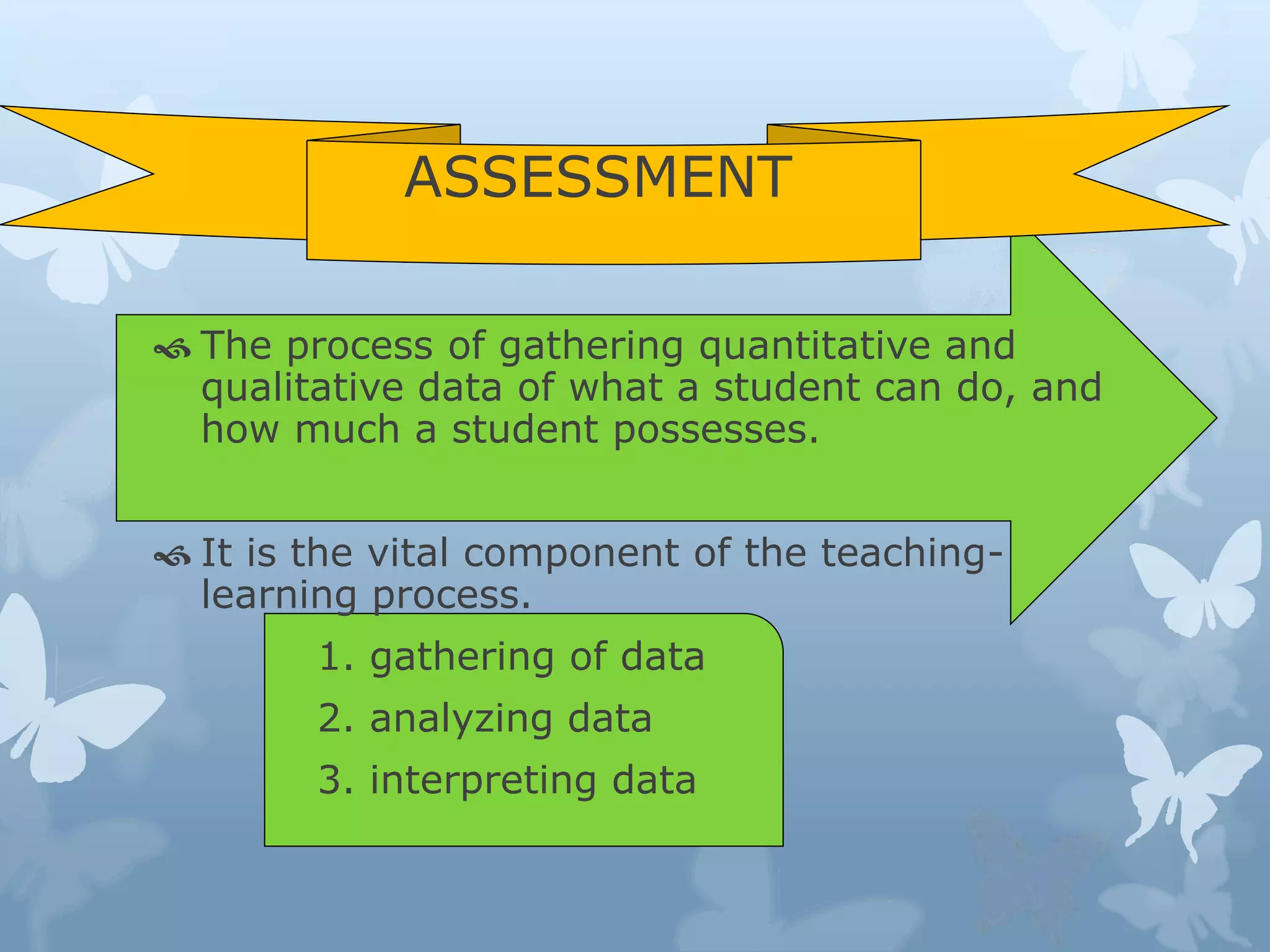
 The process of gathering quantitative and
qualitative data of what a student can do, and
how much a student possesses.
 It is the vital component of the teaching-
learning process.
1. gathering of data
2. analyzing data
3. interpreting data
 In the context of language of teaching and
learning:
a) act of gathering information on a daily basis in
order to understand individual student’s
learning and needs.
b) it also refers to the act of collecting
information and making judgments about a
language learner’s knowledge of the language
and ability to use it.
ASSESSMENT
TEST
 Instrument use to measure the ability and skills
of a student.
 Is a formal and systematic instrument designed
to assess the quality, ability skill and
knowledge of students by giving a set of
question in uniform manner to be answer by
them to gather information about their
performance.
TESTING
 Is the process or method used to measure the
level of achievement of learners. It also refers
to the administration, scoring and interpretation
of the data from the test results.
MEASUREMENT
 Process of obtaining a numeral description of
the degree of which an individual possesses a
particular characteristics.
EVALUATION
 Process of interpreting the evidences and
making judgment and decisions based on the
evidence.
 Process of summing up the results of
measurement of test and giving them meaning
based on the value judgment.
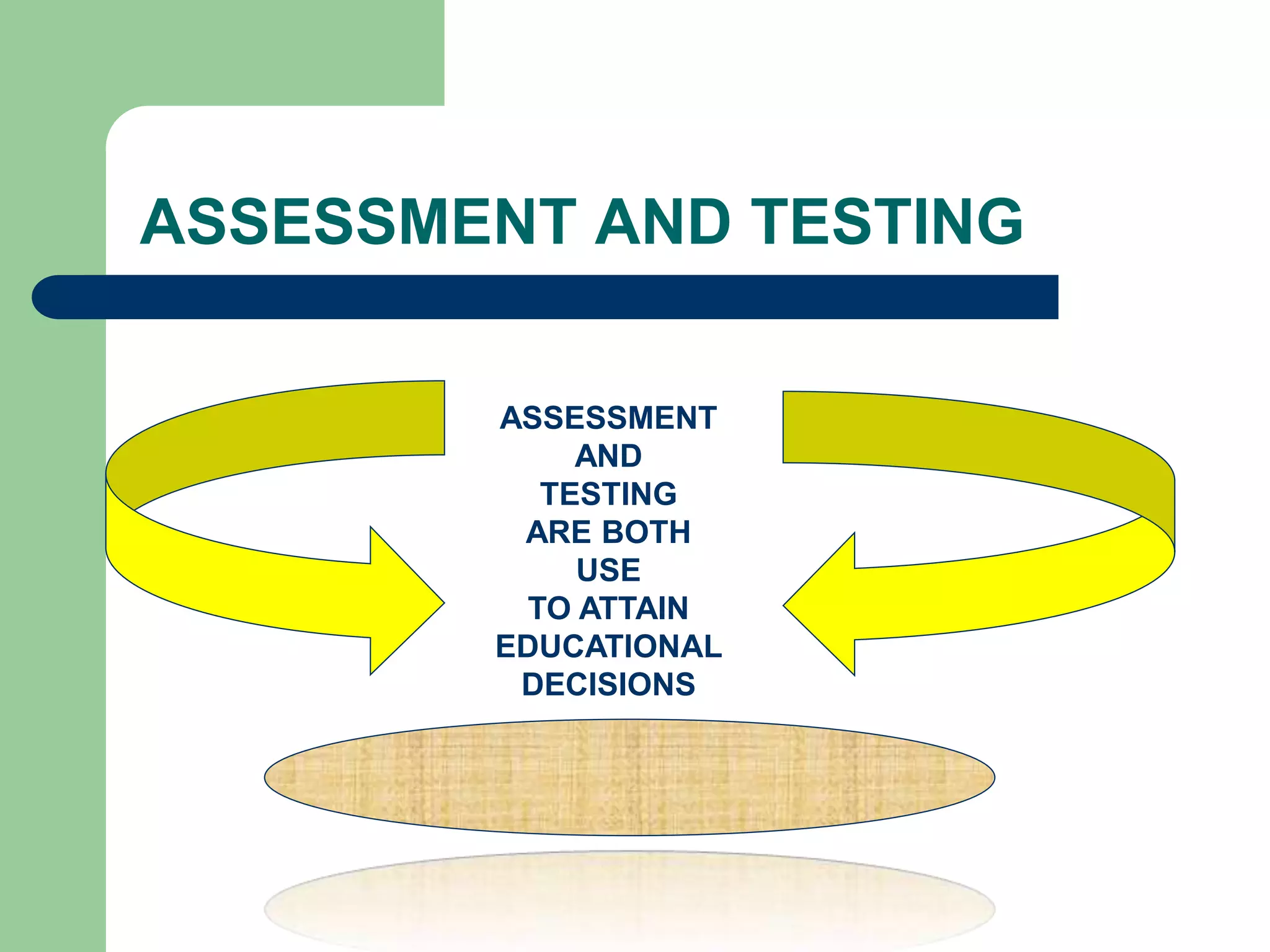
ASSESSMENT AND TESTING
ASSESSMENT
AND
TESTING
ARE BOTH
USE
TO ATTAIN
EDUCATIONAL
DECISIONS
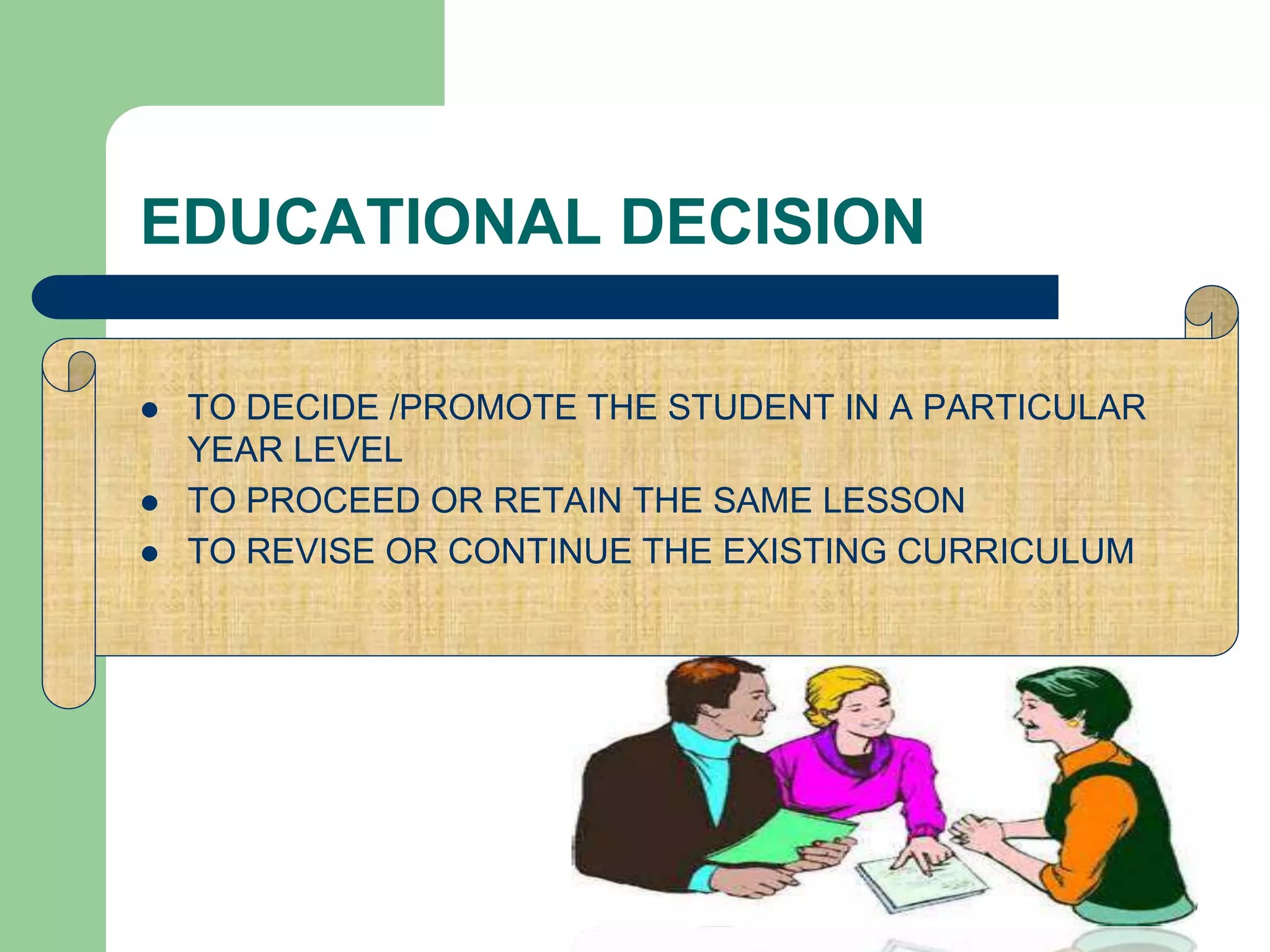
EDUCATIONAL DECISION
 TO DECIDE /PROMOTE THE STUDENT IN A PARTICULAR
YEAR LEVEL
 TO PROCEED OR RETAIN THE SAME LESSON
 TO REVISE OR CONTINUE THE EXISTING CURRICULUM
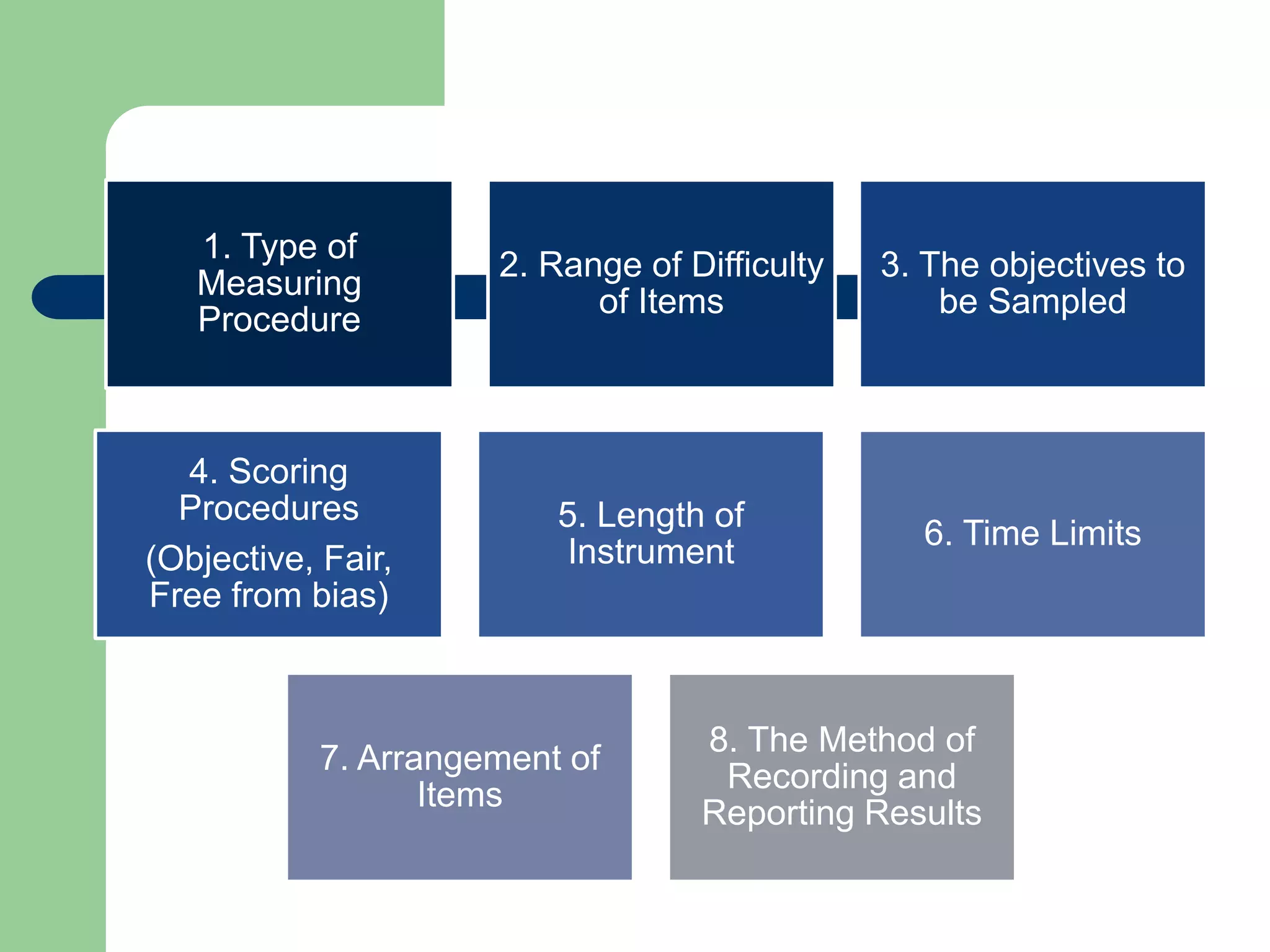
1. Type of
Measuring
Procedure
2. Range of Difficulty
of Items
3. The objectives to
be Sampled
4. Scoring
Procedures
(Objective, Fair,
Free from bias)
5. Length of
Instrument
6. Time Limits
7. Arrangement of
Items
8. The Method of
Recording and
Reporting Results
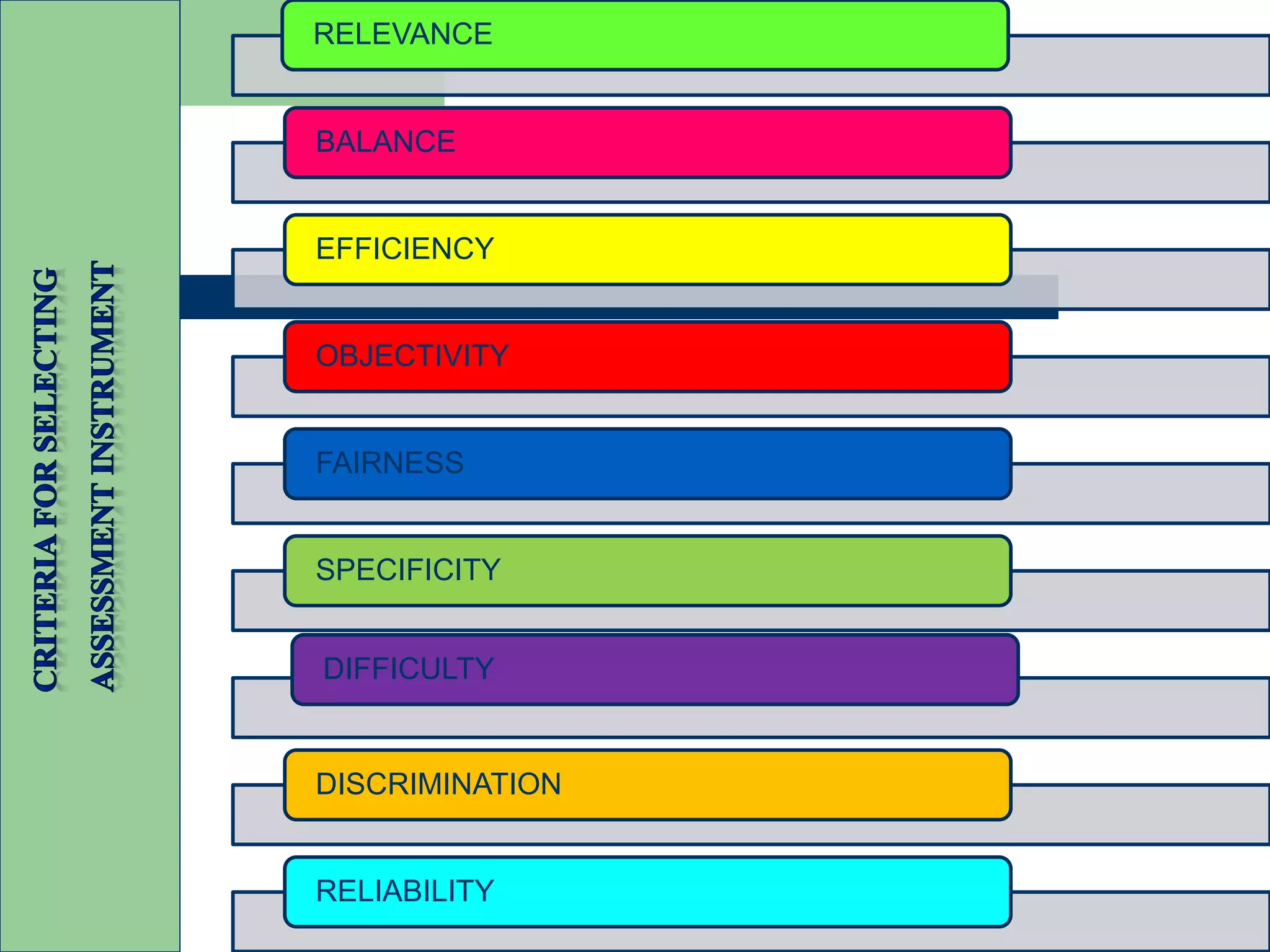
RELEVANCE
BALANCE
EFFICIENCY
OBJECTIVITY
FAIRNESS
SPECIFICITY
DIFFICULTY
DISCRIMINATION
RELIABILITY
PURPOSE
OF
ASSESSMENT
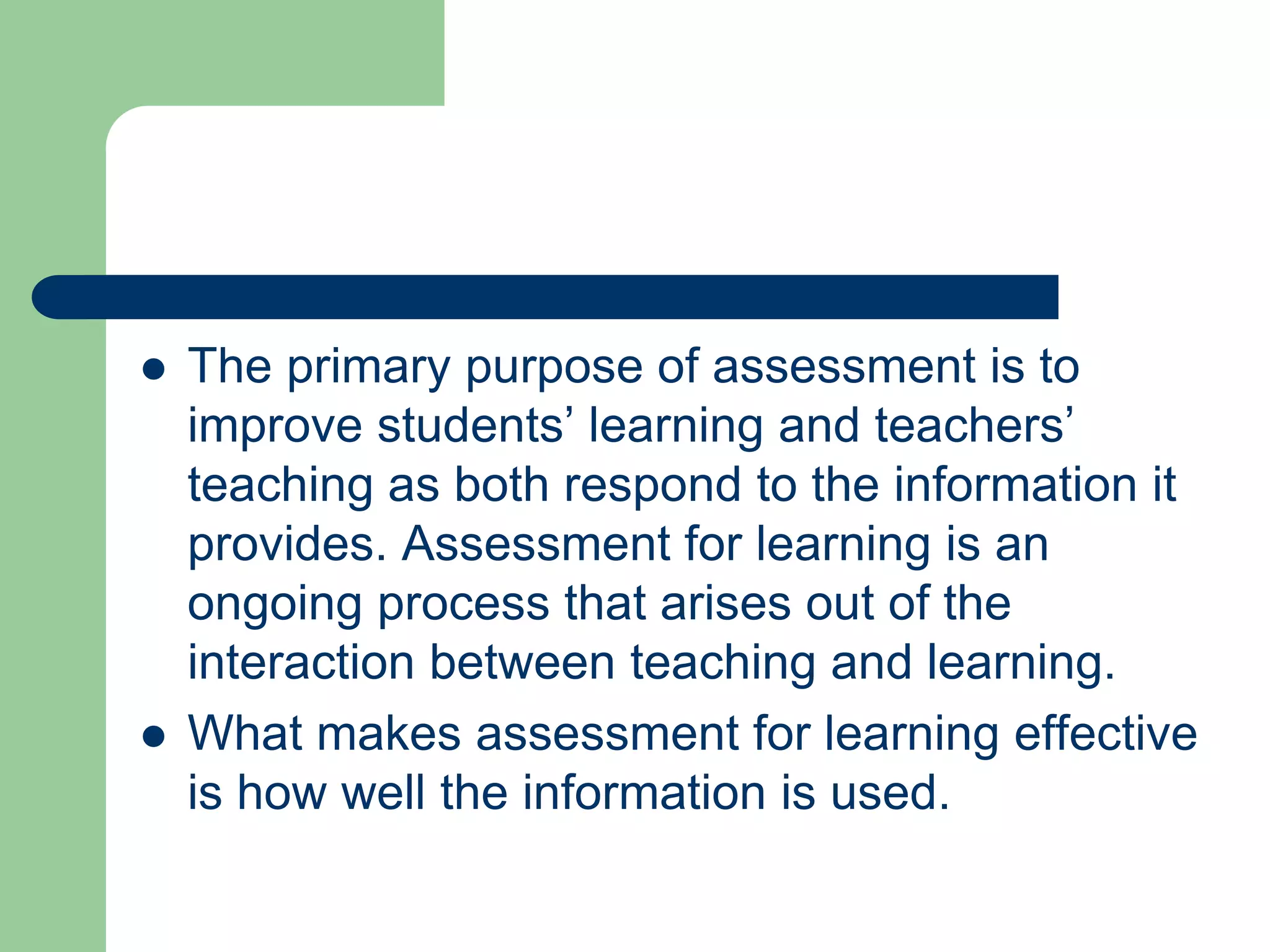
 The primary purpose of assessment is to
improve students’ learning and teachers’
teaching as both respond to the information it
provides. Assessment for learning is an
ongoing process that arises out of the
interaction between teaching and learning.
 What makes assessment for learning effective
is how well the information is used.
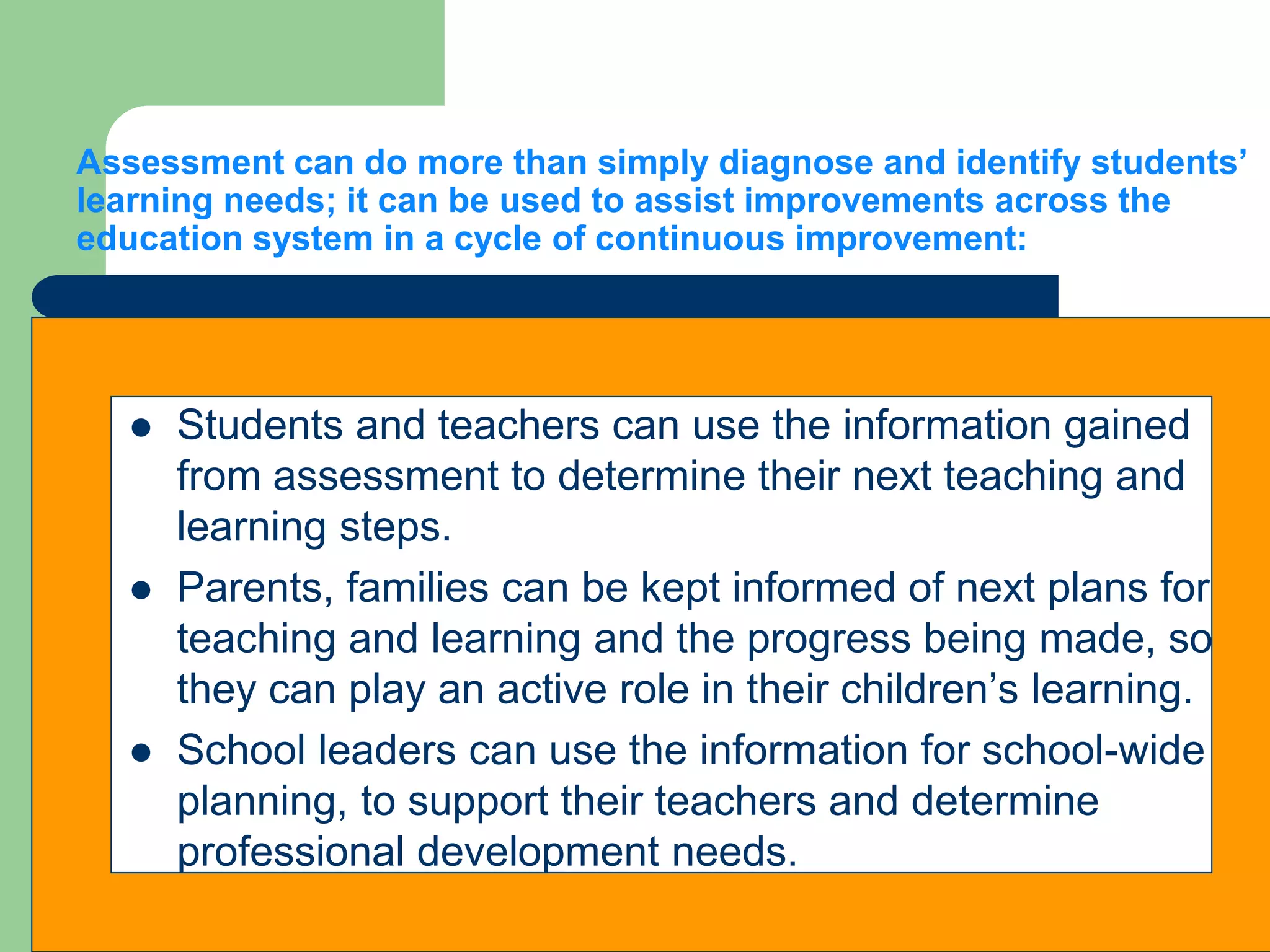
Assessment can do more than simply diagnose and identify students’
learning needs; it can be used to assist improvements across the
education system in a cycle of continuous improvement:
 Students and teachers can use the information gained
from assessment to determine their next teaching and
learning steps.
 Parents, families can be kept informed of next plans for
teaching and learning and the progress being made, so
they can play an active role in their children’s learning.
 School leaders can use the information for school-wide
planning, to support their teachers and determine
professional development needs.
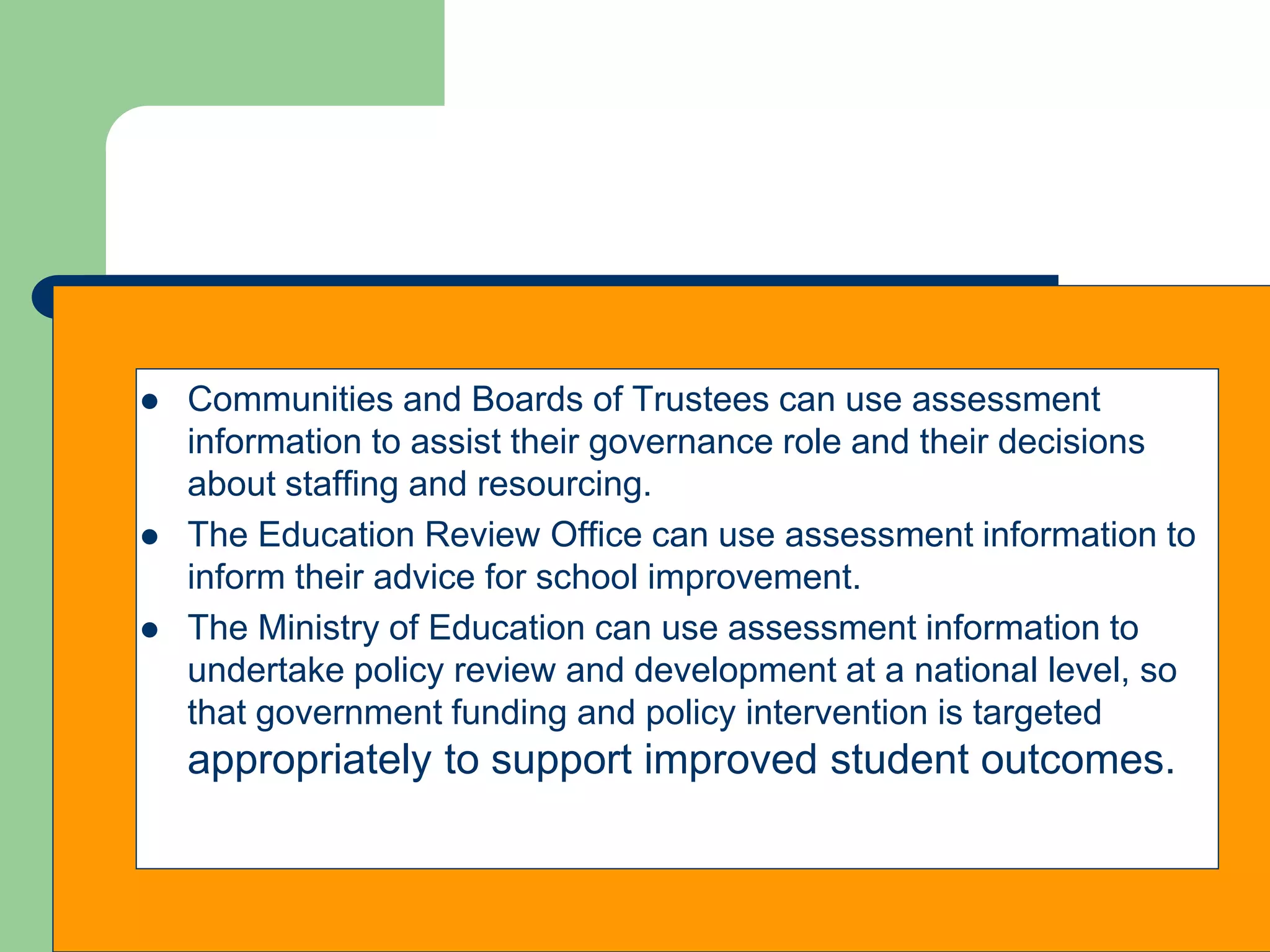
 Communities and Boards of Trustees can use assessment
information to assist their governance role and their decisions
about staffing and resourcing.
 The Education Review Office can use assessment information to
inform their advice for school improvement.
 The Ministry of Education can use assessment information to
undertake policy review and development at a national level, so
that government funding and policy intervention is targeted
appropriately to support improved student outcomes.
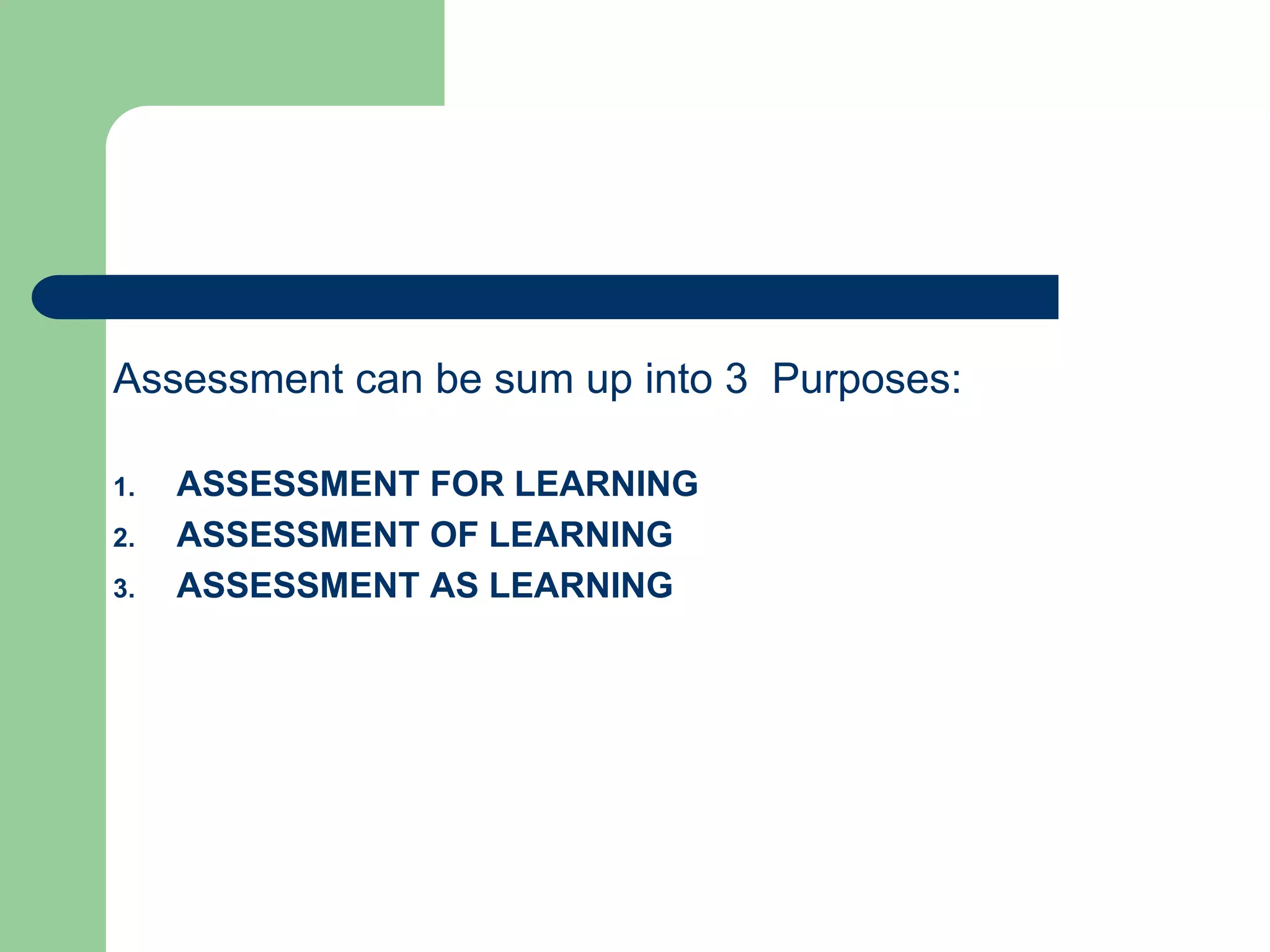
Assessment can be sum up into 3 Purposes:
1. ASSESSMENT FOR LEARNING
2. ASSESSMENT OF LEARNING
3. ASSESSMENT AS LEARNING
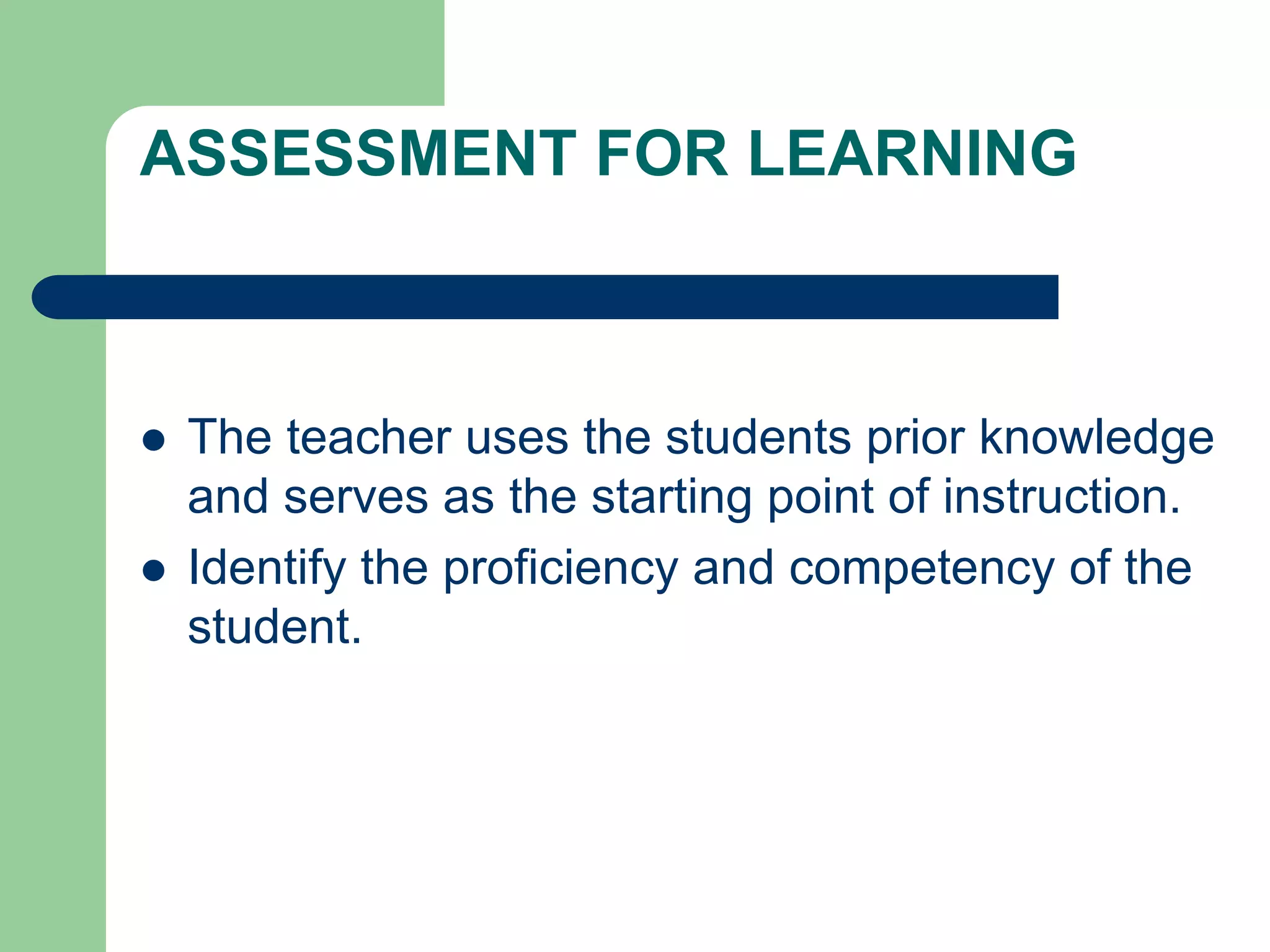
ASSESSMENT FOR LEARNING
 The teacher uses the students prior knowledge
and serves as the starting point of instruction.
 Identify the proficiency and competency of the
student.
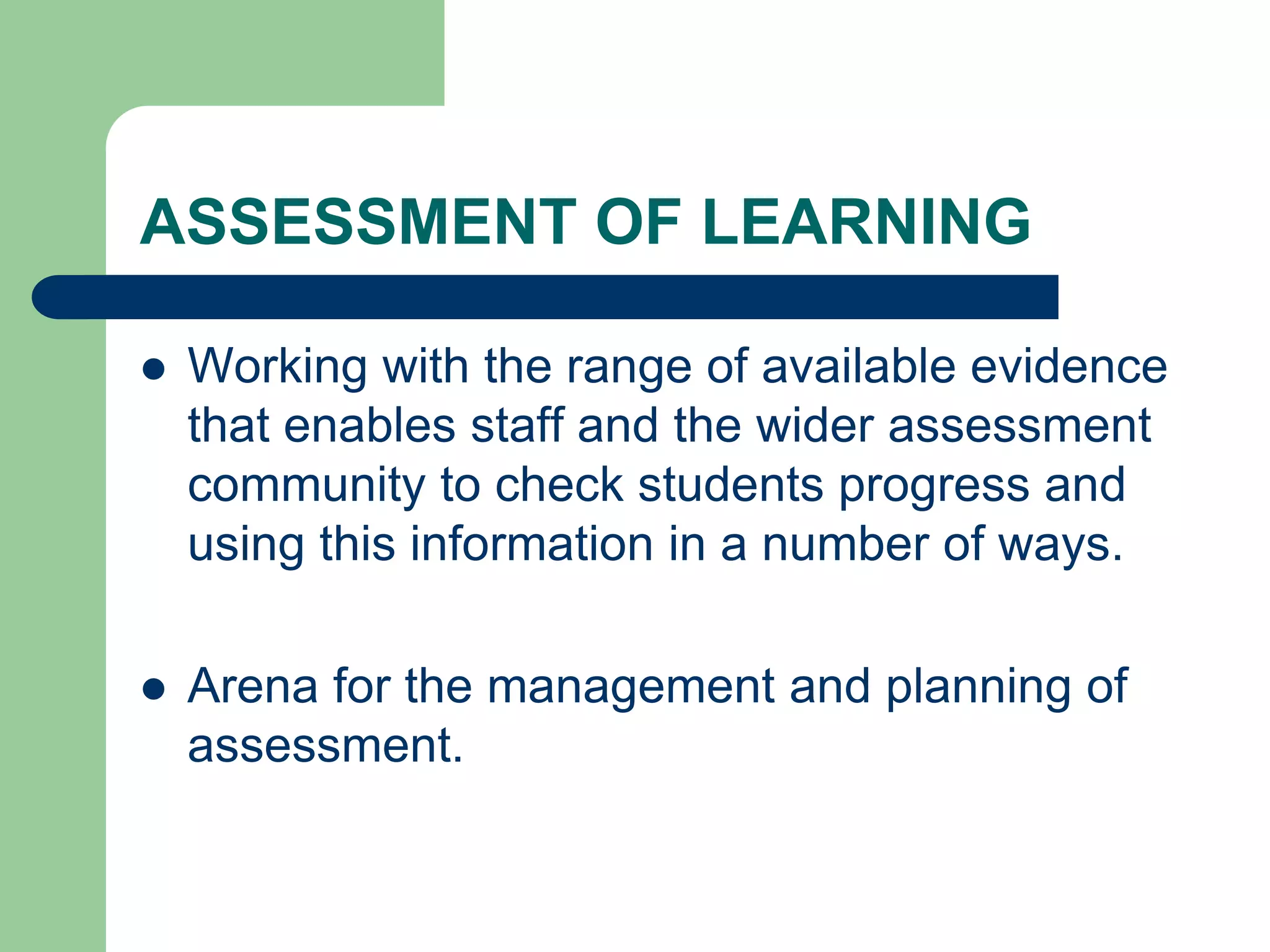
ASSESSMENT OF LEARNING
 Working with the range of available evidence
that enables staff and the wider assessment
community to check students progress and
using this information in a number of ways.
 Arena for the management and planning of
assessment.
ASSESSMENT AS LEARNING
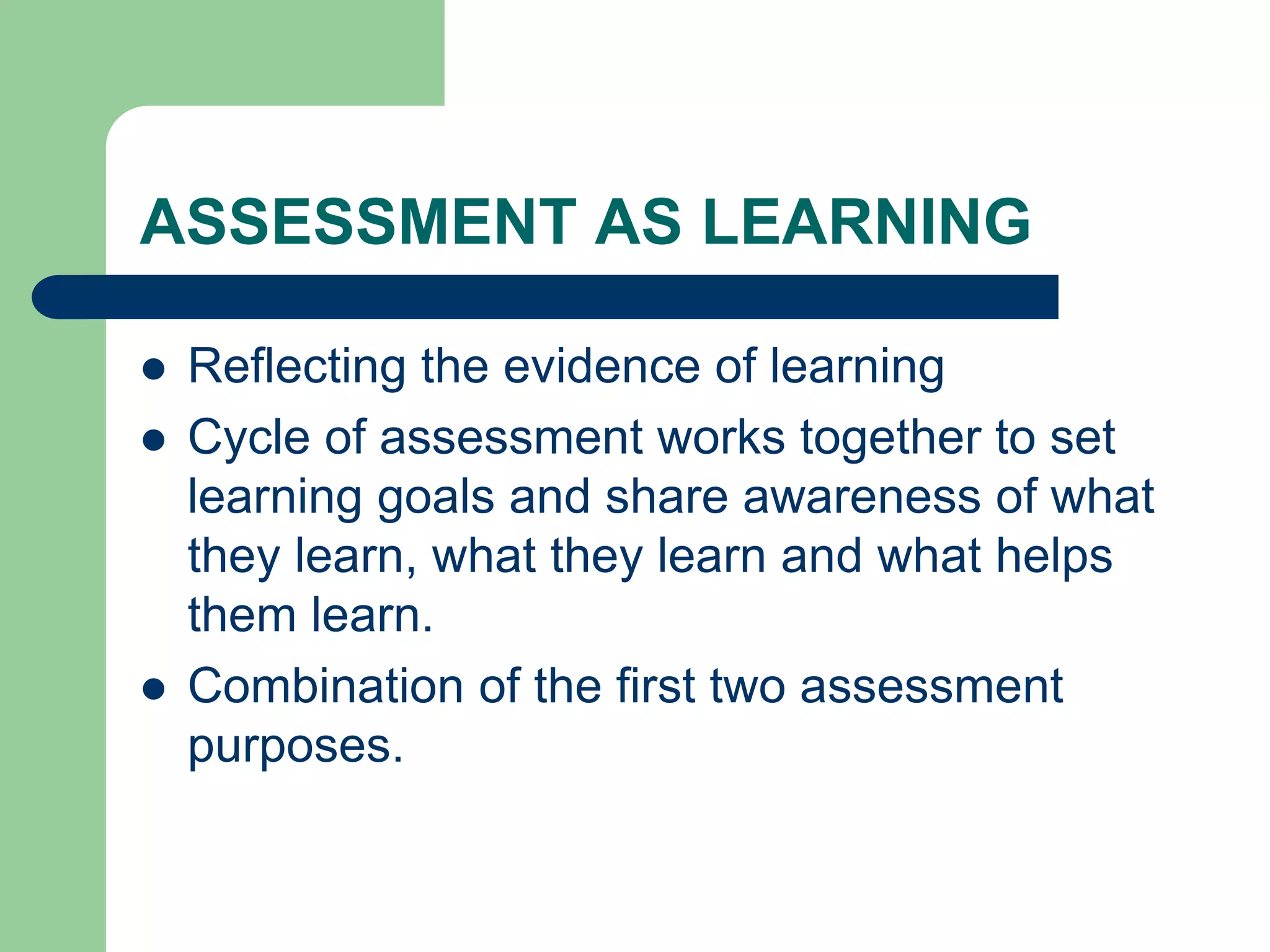
 Reflecting the evidence of learning
 Cycle of assessment works together to set
learning goals and share awareness of what
they learn, what they learn and what helps
them learn.
 Combination of the first two assessment
purposes.
PRINCIPLES OF ASSESSMENT
PRINCIPLES OF
ASSESSMENT
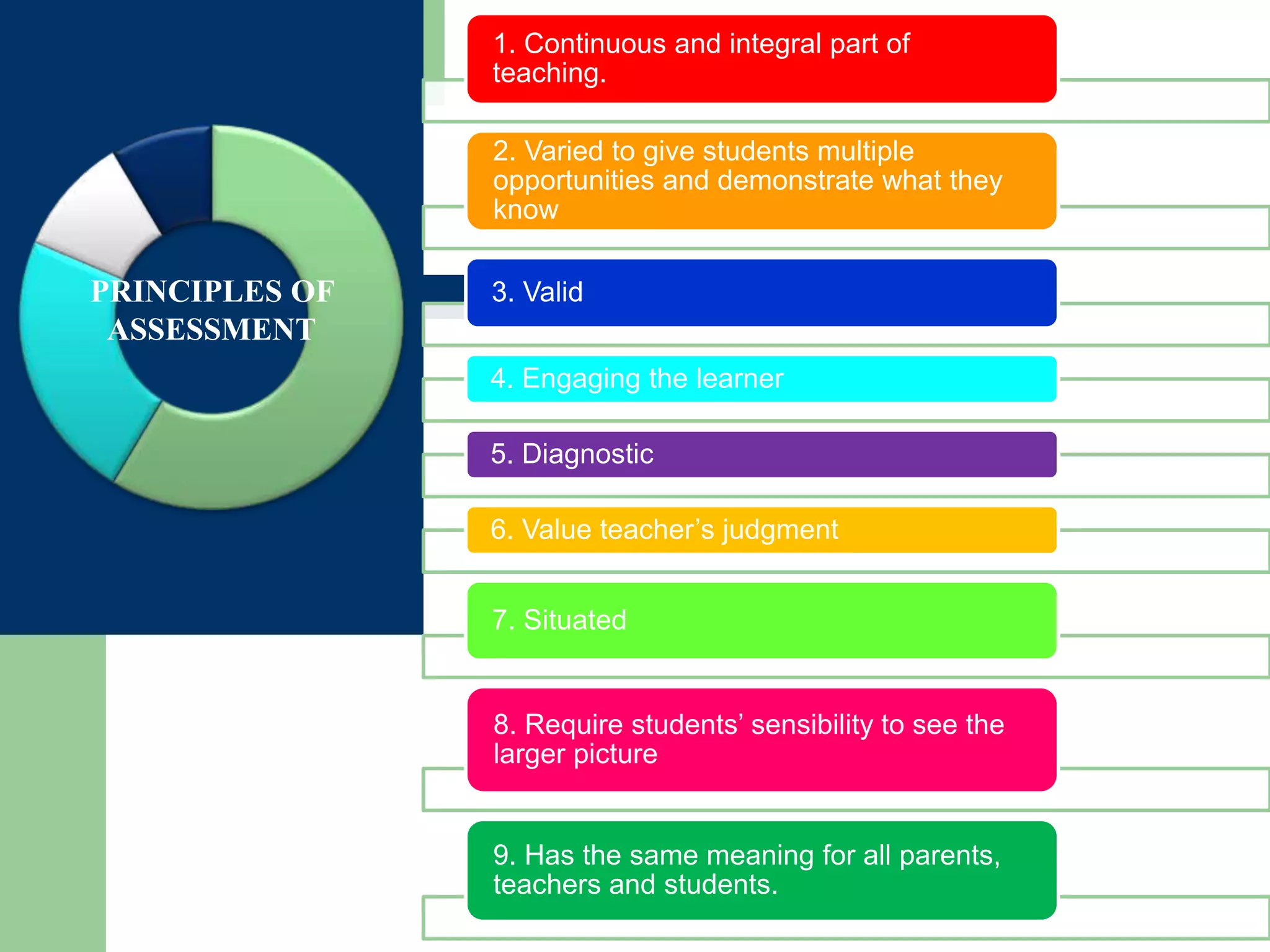
1. Continuous and integral part of
teaching.
2. Varied to give students multiple
opportunities and demonstrate what they
know
3. Valid
4. Engaging the learner
5. Diagnostic
6. Value teacher’s judgment
7. Situated
8. Require students’ sensibility to see the
larger picture
9. Has the same meaning for all parents,
teachers and students.
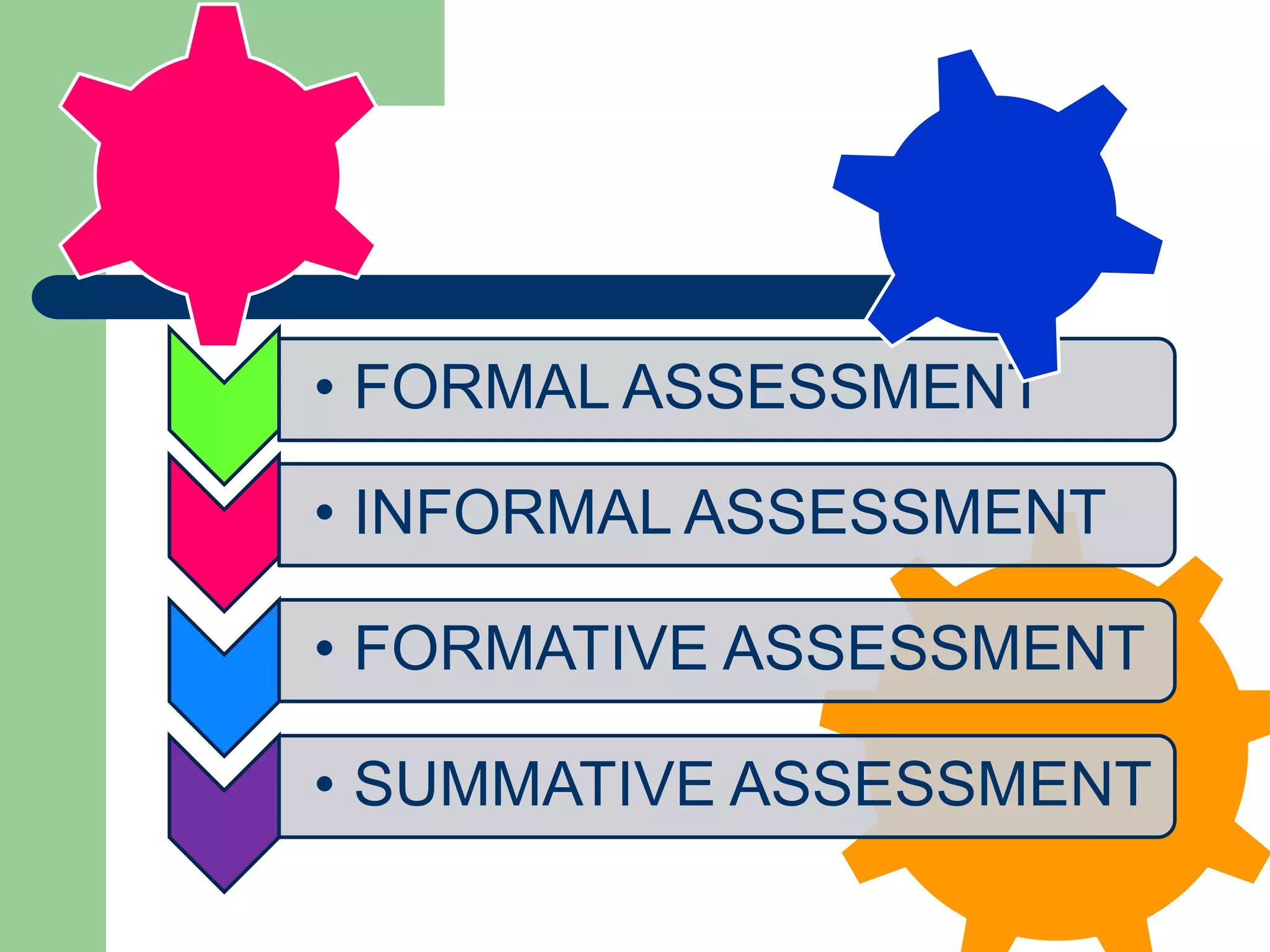
• FORMAL ASSESSMENT
• INFORMAL ASSESSMENT
• FORMATIVE ASSESSMENT
• SUMMATIVE ASSESSMENT
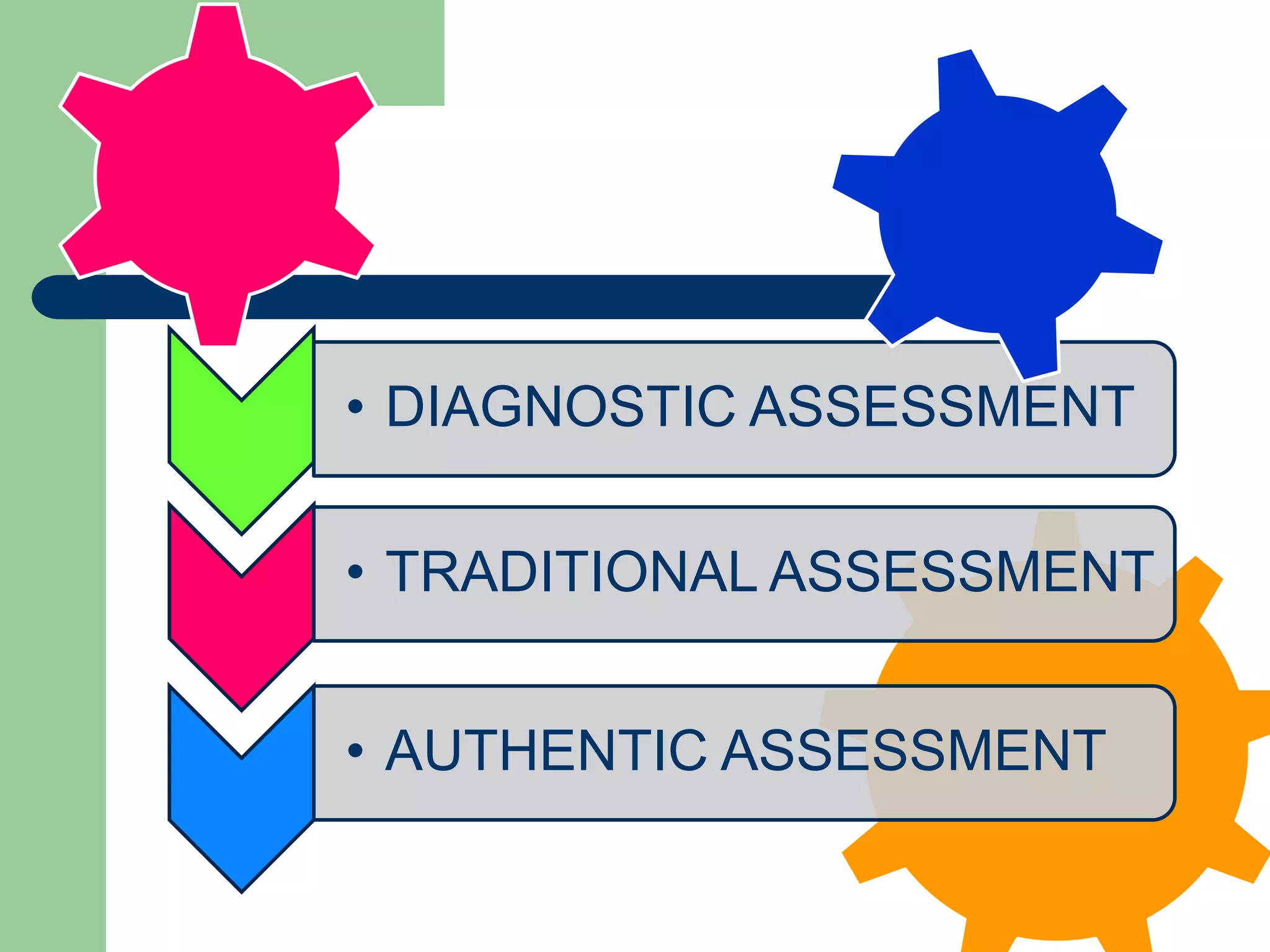
• DIAGNOSTIC ASSESSMENT
• TRADITIONAL ASSESSMENT
• AUTHENTIC ASSESSMENT
• FORMAL ASSESSMENT
 have data which support the conclusions made
from the test
 usually refer to these types of tests as
standardized measures
 These tests have been tried before on students
and have statistics which support the
conclusion such as the student is reading
below average for his age.
• INFORMAL ASSESSMENT
 are not data driven but rather content and
performance driven. For example, running
records are informal assessments because
they indicate how well a student is reading a
specific book. Scores such as 10 correct out of
15, percent of words read correctly, and most
rubric scores; are given from this type of
assessment.
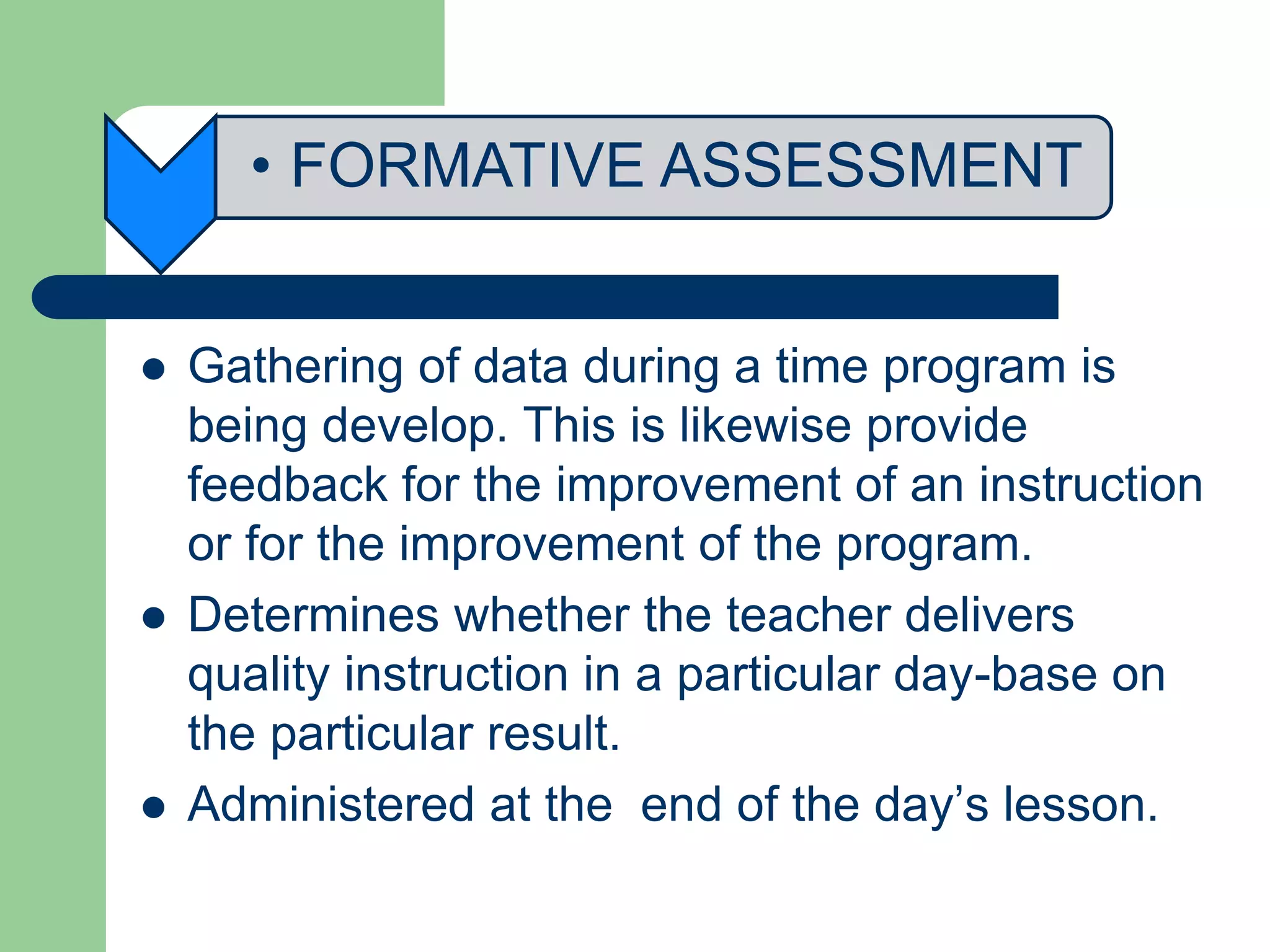
• FORMATIVE ASSESSMENT
 Gathering of data during a time program is
being develop. This is likewise provide
feedback for the improvement of an instruction
or for the improvement of the program.
 Determines whether the teacher delivers
quality instruction in a particular day-base on
the particular result.
 Administered at the end of the day’s lesson.
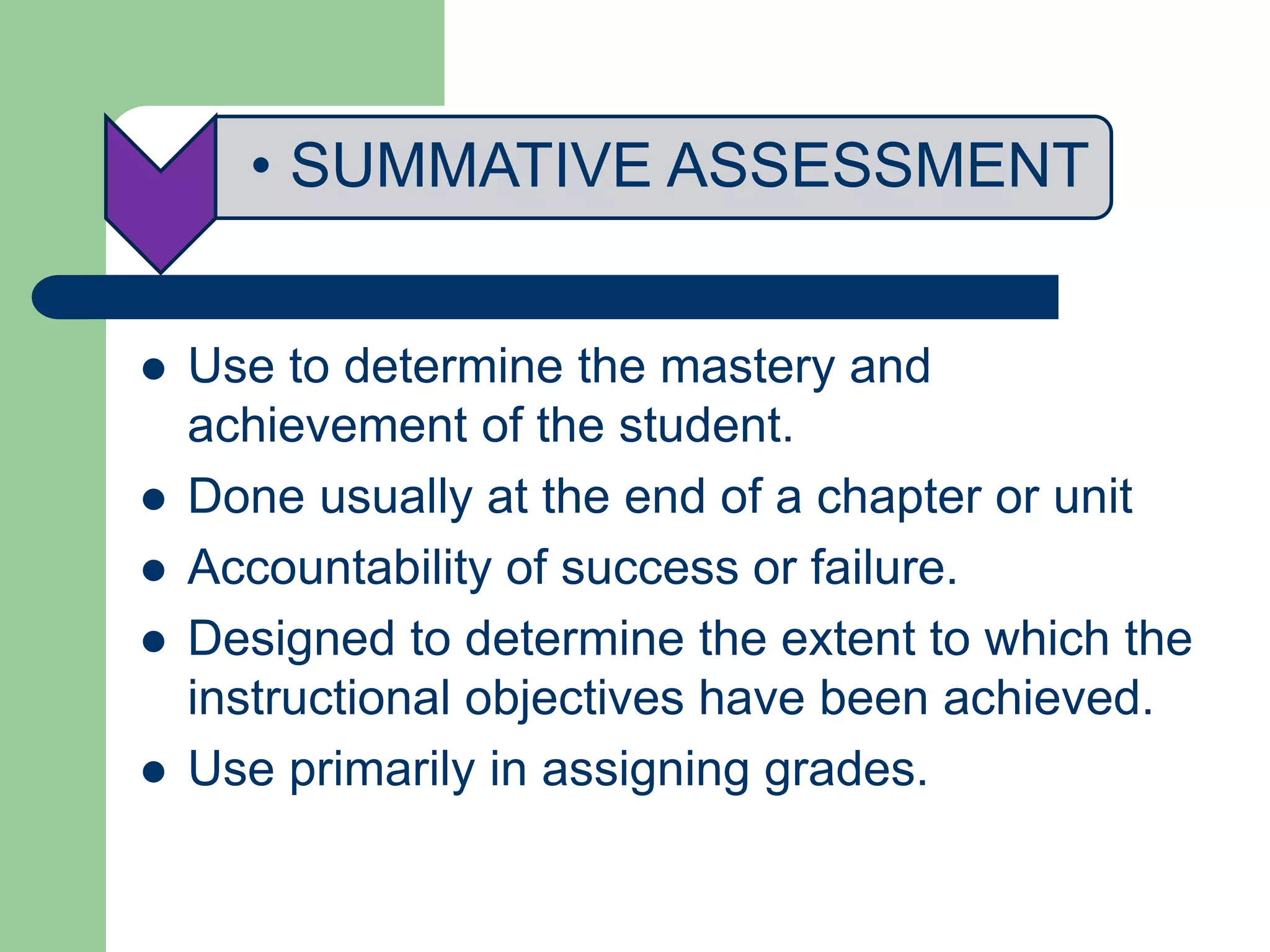
• SUMMATIVE ASSESSMENT
 Use to determine the mastery and
achievement of the student.
 Done usually at the end of a chapter or unit
 Accountability of success or failure.
 Designed to determine the extent to which the
instructional objectives have been achieved.
 Use primarily in assigning grades.
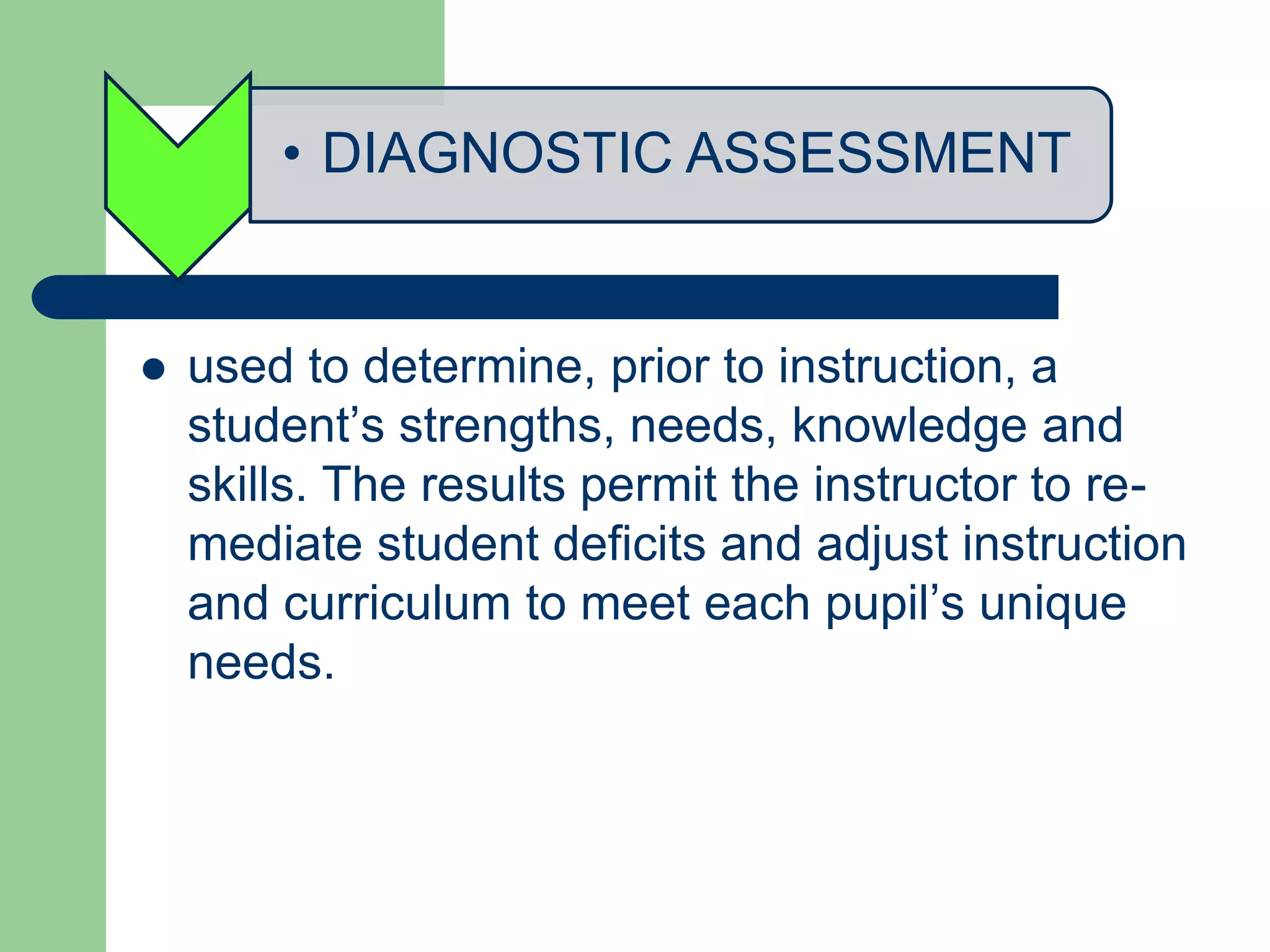
• DIAGNOSTIC ASSESSMENT
 used to determine, prior to instruction, a
student’s strengths, needs, knowledge and
skills. The results permit the instructor to re-
mediate student deficits and adjust instruction
and curriculum to meet each pupil’s unique
needs.
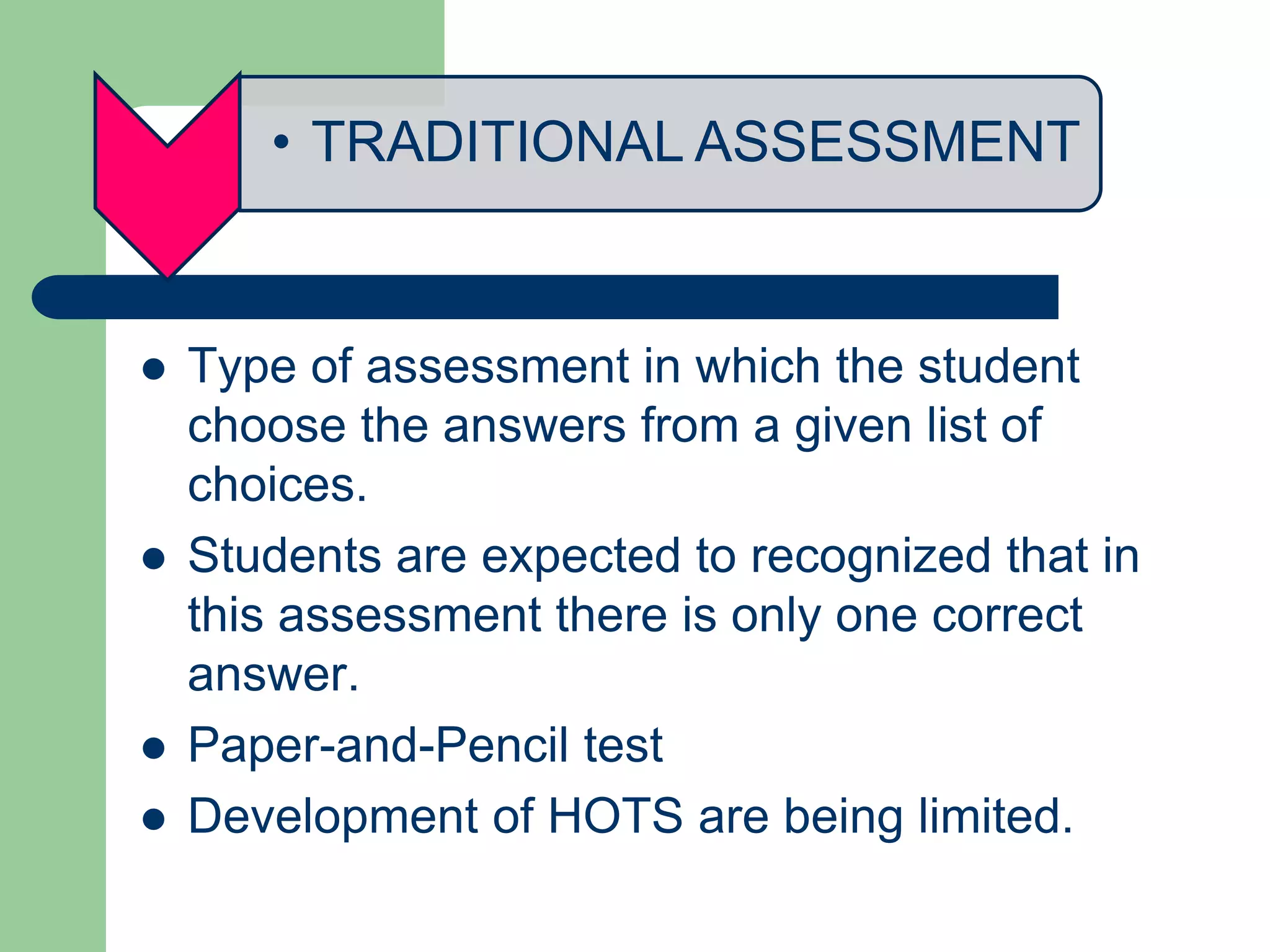
• TRADITIONAL ASSESSMENT
 Type of assessment in which the student
choose the answers from a given list of
choices.
 Students are expected to recognized that in
this assessment there is only one correct
answer.
 Paper-and-Pencil test
 Development of HOTS are being limited.
• AUTHENTIC ASSESSMENT
 Asked to perform a task or construct their ow
response.
 The forms can be devise by the teacher with
the collaboration of the students.
 Variety of tasks and strategies
 Given opportunity to evaluate his or her own
work.
 Development of HOTS is fostered to a great
extent.

Definition of Assessment,

  • 1.
  • 2.
    ASSESSMENT  The processof gathering quantitative and qualitative data of what a student can do, and how much a student possesses.  It is the vital component of the teaching- learning process. 1. gathering of data 2. analyzing data 3. interpreting data
  • 3.
     In thecontext of language of teaching and learning: a) act of gathering information on a daily basis in order to understand individual student’s learning and needs. b) it also refers to the act of collecting information and making judgments about a language learner’s knowledge of the language and ability to use it. ASSESSMENT
  • 4.
    TEST  Instrument useto measure the ability and skills of a student.  Is a formal and systematic instrument designed to assess the quality, ability skill and knowledge of students by giving a set of question in uniform manner to be answer by them to gather information about their performance.
  • 5.
    TESTING  Is theprocess or method used to measure the level of achievement of learners. It also refers to the administration, scoring and interpretation of the data from the test results.
  • 6.
    MEASUREMENT  Process ofobtaining a numeral description of the degree of which an individual possesses a particular characteristics.
  • 7.
    EVALUATION  Process ofinterpreting the evidences and making judgment and decisions based on the evidence.  Process of summing up the results of measurement of test and giving them meaning based on the value judgment.
  • 8.
    ASSESSMENT AND TESTING ASSESSMENT AND TESTING AREBOTH USE TO ATTAIN EDUCATIONAL DECISIONS
  • 9.
    EDUCATIONAL DECISION  TODECIDE /PROMOTE THE STUDENT IN A PARTICULAR YEAR LEVEL  TO PROCEED OR RETAIN THE SAME LESSON  TO REVISE OR CONTINUE THE EXISTING CURRICULUM
  • 11.
    1. Type of Measuring Procedure 2.Range of Difficulty of Items 3. The objectives to be Sampled 4. Scoring Procedures (Objective, Fair, Free from bias) 5. Length of Instrument 6. Time Limits 7. Arrangement of Items 8. The Method of Recording and Reporting Results
  • 13.
  • 14.
  • 15.
     The primarypurpose of assessment is to improve students’ learning and teachers’ teaching as both respond to the information it provides. Assessment for learning is an ongoing process that arises out of the interaction between teaching and learning.  What makes assessment for learning effective is how well the information is used.
  • 16.
    Assessment can domore than simply diagnose and identify students’ learning needs; it can be used to assist improvements across the education system in a cycle of continuous improvement:  Students and teachers can use the information gained from assessment to determine their next teaching and learning steps.  Parents, families can be kept informed of next plans for teaching and learning and the progress being made, so they can play an active role in their children’s learning.  School leaders can use the information for school-wide planning, to support their teachers and determine professional development needs.
  • 17.
     Communities andBoards of Trustees can use assessment information to assist their governance role and their decisions about staffing and resourcing.  The Education Review Office can use assessment information to inform their advice for school improvement.  The Ministry of Education can use assessment information to undertake policy review and development at a national level, so that government funding and policy intervention is targeted appropriately to support improved student outcomes.
  • 18.
    Assessment can besum up into 3 Purposes: 1. ASSESSMENT FOR LEARNING 2. ASSESSMENT OF LEARNING 3. ASSESSMENT AS LEARNING
  • 19.
    ASSESSMENT FOR LEARNING The teacher uses the students prior knowledge and serves as the starting point of instruction.  Identify the proficiency and competency of the student.
  • 20.
    ASSESSMENT OF LEARNING Working with the range of available evidence that enables staff and the wider assessment community to check students progress and using this information in a number of ways.  Arena for the management and planning of assessment.
  • 21.
    ASSESSMENT AS LEARNING Reflecting the evidence of learning  Cycle of assessment works together to set learning goals and share awareness of what they learn, what they learn and what helps them learn.  Combination of the first two assessment purposes.
  • 22.
  • 23.
    PRINCIPLES OF ASSESSMENT 1. Continuousand integral part of teaching. 2. Varied to give students multiple opportunities and demonstrate what they know 3. Valid 4. Engaging the learner 5. Diagnostic 6. Value teacher’s judgment 7. Situated 8. Require students’ sensibility to see the larger picture 9. Has the same meaning for all parents, teachers and students.
  • 25.
    • FORMAL ASSESSMENT •INFORMAL ASSESSMENT • FORMATIVE ASSESSMENT • SUMMATIVE ASSESSMENT
  • 26.
    • DIAGNOSTIC ASSESSMENT •TRADITIONAL ASSESSMENT • AUTHENTIC ASSESSMENT
  • 27.
    • FORMAL ASSESSMENT have data which support the conclusions made from the test  usually refer to these types of tests as standardized measures  These tests have been tried before on students and have statistics which support the conclusion such as the student is reading below average for his age.
  • 28.
    • INFORMAL ASSESSMENT are not data driven but rather content and performance driven. For example, running records are informal assessments because they indicate how well a student is reading a specific book. Scores such as 10 correct out of 15, percent of words read correctly, and most rubric scores; are given from this type of assessment.
  • 29.
    • FORMATIVE ASSESSMENT Gathering of data during a time program is being develop. This is likewise provide feedback for the improvement of an instruction or for the improvement of the program.  Determines whether the teacher delivers quality instruction in a particular day-base on the particular result.  Administered at the end of the day’s lesson.
  • 30.
    • SUMMATIVE ASSESSMENT Use to determine the mastery and achievement of the student.  Done usually at the end of a chapter or unit  Accountability of success or failure.  Designed to determine the extent to which the instructional objectives have been achieved.  Use primarily in assigning grades.
  • 31.
    • DIAGNOSTIC ASSESSMENT used to determine, prior to instruction, a student’s strengths, needs, knowledge and skills. The results permit the instructor to re- mediate student deficits and adjust instruction and curriculum to meet each pupil’s unique needs.
  • 32.
    • TRADITIONAL ASSESSMENT Type of assessment in which the student choose the answers from a given list of choices.  Students are expected to recognized that in this assessment there is only one correct answer.  Paper-and-Pencil test  Development of HOTS are being limited.
  • 33.
    • AUTHENTIC ASSESSMENT Asked to perform a task or construct their ow response.  The forms can be devise by the teacher with the collaboration of the students.  Variety of tasks and strategies  Given opportunity to evaluate his or her own work.  Development of HOTS is fostered to a great extent.