TEFL
APPROACH, METHOD
AND TECHNIQUE
Elih Sutisna Yanto- FKIP PBI Unsika
West-Java Indonesia
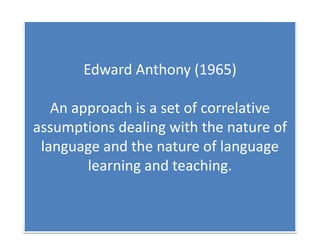
Edward Anthony (1965)
An approach is a set of correlative
assumptions dealing with the nature of
language and the nature of language
learning and teaching.
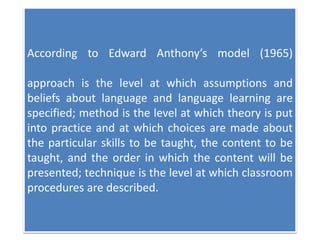
According to Edward Anthony’s model (1965)
approach is the level at which assumptions and
beliefs about language and language learning are
specified; method is the level at which theory is put
into practice and at which choices are made about
the particular skills to be taught, the content to be
taught, and the order in which the content will be
presented; technique is the level at which classroom
procedures are described.
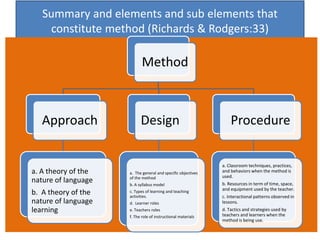
Summary and elements and sub elements that
constitute method (Richards & Rodgers:33)
Method
Approach
a. A theory of the
nature of language
b. A theory of the
nature of language
learning
Design
a. The general and specific objectives
of the method
b. A syllabus model
c. Types of learning and teaching
activities.
d. Learner roles
e. Teachers roles
f. The role of instructional materials
Procedure
a. Classroom techniques, practices,
and behaviors when the method is
used.
b. Resources in term of time, space,
and equipment used by the teacher.
c. Interactional patterns observed in
lessons.
d. Tactics and strategies used by
teachers and learners when the
method is being use.
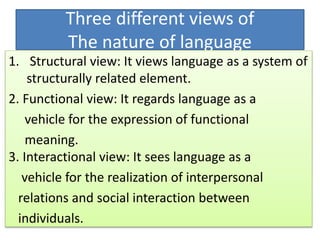
Three different views of
The nature of language
1. Structural view: It views language as a system of
structurally related element.
2. Functional view: It regards language as a
vehicle for the expression of functional
meaning.
3. Interactional view: It sees language as a
vehicle for the realization of interpersonal
relations and social interaction between
individuals.
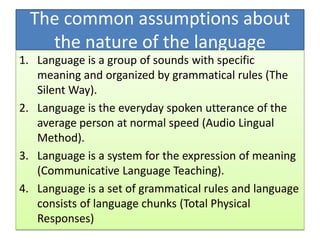
The common assumptions about
the nature of the language
1. Language is a group of sounds with specific
meaning and organized by grammatical rules (The
Silent Way).
2. Language is the everyday spoken utterance of the
average person at normal speed (Audio Lingual
Method).
3. Language is a system for the expression of meaning
(Communicative Language Teaching).
4. Language is a set of grammatical rules and language
consists of language chunks (Total Physical
Responses)
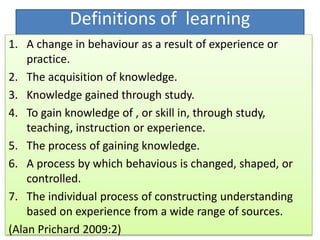
Definitions of learning
1. A change in behaviour as a result of experience or
practice.
2. The acquisition of knowledge.
3. Knowledge gained through study.
4. To gain knowledge of , or skill in, through study,
teaching, instruction or experience.
5. The process of gaining knowledge.
6. A process by which behavious is changed, shaped, or
controlled.
7. The individual process of constructing understanding
based on experience from a wide range of sources.
(Alan Prichard 2009:2)
The nature of language learning:
1. Behaviorism: Stimulus- Response-
Reinforcement.- Drilling, exercise,
repetition.
2. Nativism: A child naturally has a language
acquisition device. (Kodrati).
3. Constructivism: A child acquired a
language through interaction between the
child and environment. (Jean Piaget).
The nature of learning:
1. Behaviorism is a theory of learning
focusing on observable behaviour and
discounting any mental activity. Learning is
defined simply as the acquisition of new
behaviour. (Alan Prichard 2009:6)
Cognitive, constructivist learning
Constructivists view learning as the result of
mental construction. That is, learning take
place when new information is built into and
added onto an individual’s current structure
of knowledge, understanding and skills. We
learn best when we actively construct our
own understanding (Alan Prichard 2009:17)
The following assumptions relate to theories of learning and
teaching
1. Learning is facilitated if language learners discover
rather than repeat and remember without
understanding what is to be learned (Silent Way).
2. Learning involves the unconscious functions, as well as
the conscious functions (Suggestopedia).
3. The norms of the society often block the process of
learning (Suggestopedia)
4. Language learning will take place if language learners
maintain their feeling of security (Community Language
Learning).
5. Language learning is a process of habit formation (Audio
Lingual Method)
Assumption about learning and
teaching, which have been developed
from theories in psychology, seem to
develop faster than those about the
nature of language.
Method
The plan of language teaching which consistent
with the theories. (Edward Anthony-1963)
Method may mean different things to different
people (Mackey, 1975:155) For some , it means a
set of teaching procedures; for others, the
avoidance of teaching procedures. For some, it is
the primary of a language skill; for others, it is the
type and amount of vocabulary and stucture.
Method cont...
The term “method” in the Direct Method may
refer to a single aspect of language teaching:
presentation of material.
Method in the Reading Method refers to the
emphasis of a single language skill: reading, while
In the Grammar Translation Method, method
refers to the emphasis of the teaching material.
Method cont...
According to Mackey (1975:157), all teaching,
whether good or bad, must include some sort of
selection, some sort of gradation, some sort of
presentation, and some sort of repetition.
Therefore, all methods should include the four
steps of teaching a language.
Any method should include the four steps:
selection, gradation, presentation, and repetition.
Method
According to Richards and Rodgers (2001), a
method is theoretically related to an approach,
organized by the design, and practically realized
in procedure.
Technique
Carry out a method. It is
implementational, meaning
that a technique is something
that actually takes place in
language teaching or learning
in the classroom.
Technique cont...
The following are some examples of techniques in error
correction.
1. The teacher does not praise or criticize so that language
learners learn to rely on themselves (Silent Way).
2. The teacher often praises when a student has made a good
thing in learning (Audio Lingual Method).
3. When a student has produced a wrong expression, the
teacher just repeats the right one (Total Physical Response).
4. The teacher does not care when a student make an error as
long as it does not hinder (delay/prevent) communication
(Natural Method)
The Term of Technique
(H.D. Brown 2007:180)
1. Task. Task usually refers to a specialized form
of technique or series of techniques closely
allied with communicative curricula, and as
such must minimally have communicative
goals. It is focuses on the authentic use of
language for meaningful communicative
purpose beyond the language classroom.
The Term of Technique
2. Activity. Activity may refer to virtually anything that learners
do in the classroom.
 We usually refer to a reasonably unified set of student
behaviour, limited in time, preceded by some direction from
the teacher, with a particular objective.
 Activities include role plays, drills, games, peer-editing, small-
group information-gap exercise, and much more.
 Because an activity implies some sort of active performance
on the part of learners, it is generally not used to refer to
certain teacher behaviours like saying “good morning,”
maintaining eye contact with students, explaining a grammar
point, or writing a list of words on the chalkboard.
Such teacher behaviour, however can indeed be referred to as
technique.
The Term of Technique
3. Procedure. Richards and Rodgers (2001) used the
term procedure to encompass “the actual moment-
to-moment techniques, practices, and behaviour
that operate in teaching a language according to a
particular method” (p.26)
 Procedures from this definition, include techniques.
Thus, for Richards and Rodgers, this appears to be a
catchall term, a thing for holding many small objects
or a group or description that includes different
things and that does not state clearly what is
included or not.
The Term of Technique
4. Practice, behaviour, exercise,
strategy...
In the language-teaching
literature, these terms, and
perhaps some others, all appear
to refer , in varying degrees of
intensity, to what is defined as
technique.
The Term of Technique
5. Technique
Even before Anthony (1963) discussed and
defined the term, the language teaching
literature generally accepted technique as a
superordinate term to refer to various
activities that either teachers or learners
perform in the classroom.
In other words, technique include all tasks and
activities.
They almost always planned and deliberate,
done on purpose rather than by accident.
The Term of Technique
Cont...
They are the product of a choice made by the
teacher. And they can, for your purposes as a
language teacher, comfortably refer to the
pedagogical units or components of a classroom
session.
You can think of a lesson as consisting of a
number of techniques, some teacher-centered,
some learner-centered, some production-
centered, some comprehension-centered, some
clustering together to form a task.
Taxonomy of language-teaching Techniques (adapted
from Crookes & Chaudron,1991 pp.52-54)
Controlled Techniques
1. Warm-up: Mimes, dance, songs, jokes, play. This activity gets
the students stimulated, relaxed, motivated, attentive, or
otherwise engage and ready for the lesson. It does not
necessarily involves use of the target language.
2. Setting: Focusing on lesson topic. Teacher directs attention to
the topic by verbal or nonverbal evocation of the context
relevant to the lesson by questioning or miming or picture
presentation, possibly by tape recording of situations and
peole.
3. Organizational: Structuring of lesson or class activities
includes disciplinary action, organization of class furniture
and seating, general procedures for class interaction and
performance, structure and purpose of lesson, ete
Taxonomy of language-teaching Techniques (adapted
from Crookes & Chaudron,1991 pp.52-54)
Controlled Techniques
4. Content Explanation: Grammatical, phonological, lexical
(vocabulary), sociolinguistic, pragmatic, or any other aspect
of language.
5. Role-play demonstration: Selected students or teacher
illustrate the procedure(s) to be applied in the lesson
segment to follow. Includes brief illustration of language or
other content to be incorporated.
6. Dialogue/Narrative presentation: Reading or listening
passage presented for passive reception. No implication of
student production or other identification of specific target
forms or functions (students may be asked to “understand”)
7. Dialogue/Narrative recitation: Reciting a previously known or
prepared text, either in unison or individually.
Taxonomy of language-teaching Techniques (adapted
from Crookes & Chaudron,1991 pp.52-54)
Controlled Techniques
8. Reading aloud: Reading directly from a given text.
9. Checking: Teacher either circulating or guiding the correction
of students’ work, providing feedback as an activity rather
than within another activity.
10. Question-answer display: Activity involving prompting of
students responses by means of display questions (i.e.
teacher or questioner already knows the response or has a
very limited set of expectations for the appropriate
response). Distinguished from referential questions by the
likelihood of the questioner’s knowledge of the response
and the speaker’s awareness of that fact.
Taxonomy of language-teaching Techniques (adapted
from Crookes & Chaudron,1991 pp.52-54)
Controlled Techniques
11. Drill: Typical language activity involving fixed patterns of
teacher prompting and student responding, usually with
repetition, substitution, and other mechanical alterations.
Typically with little meaning attached.
12. Translation: Student or teacher provision of L1 or L2
translation of given text.
13. Dictation: Student writing down orally presented text.
14. Copying: Student writing down text presented visually.
15. Identification: Student picking out and producing/labeling or
otherwise identifying a specific target form, function,
definition, or other lesson-related item.
Taxonomy of language-teaching Techniques (adapted
from Crookes & Chaudron,1991 pp.52-54)
Controlled Techniques
16. Recognition: Student identifying forms, as in identification
(i.e., checking off items, drawing symbols, rearranging
pictures), but without a verbal responses.
17. Review: Teacher-led review of previous week/month/or
other period as a formal summary and type of test of student
recall performance.
18. Testing: Formal testing procedures to evaluate student
progress.
19. Meaningful drill: Drill activity involving responses with
meaningful choices, as in reference to different information.
Distinguished from information exchange by the regulated
sequence and general form of responses.
Taxonomy of language-teaching Techniques (adapted
from Crookes & Chaudron,1991 pp.52-54)
Semicontrolled Techniques
20. Brainstorming: A form of preparation for the lesson, like
Setting, which involves free, undirected contributions by the
students and teacher on a given topic, to generate multiple
associations without linking them; no explicit analysis or
interpretation by the teacher.
21. Storytelling (especially when student-generated): Not
necessarily lesson-based, a lengthy presentation of story by
teacher or student (may overlap with Warm-up or Narrative
recitation), May be used to maintain attention, motivate, or
as lengthy practice.
22. Question-answer, referential: Activity involving prompting of
responses by means of referential questions (i.e., the
questioner does not know beforehand the responses
information). Distinguished from Question-answer, display.
Taxonomy of language-teaching Techniques (adapted
from Crookes & Chaudron,1991 pp.52-54)
Semicontrolled Techniques
23. Cued narrative/Dialogue: Student production of narrative or
dialogue following cues from miming, cue cards, pictures, or
other stimuli related to narrative/dialogue (e.g.,
metalanguage requesting functional acts).
24. Information transfer: Application from one mode (e.g.,
visual) to another (e.g., writing), which involves some
transformation of the information (e.g., student fills out
diagram while listening to description). Distinguished from
Identification in that the student is expected to transform
and reinterpret the language or information.
25. Information exchange: Task involving two-way communication as in
information-gap exercise, when one or both parties (or a larger group)
must share information to achieve some goal. Distinguished from
Question-answer, referential in that sharing of information is critical for
the task.
Taxonomy of language-teaching Techniques (adapted
from Crookes & Chaudron,1991 pp.52-54)
Semicontrolled Techniques
26. Wrap-up: Brief teacher- or student-produced summary of
point and/or items that have been practiced or learned.
27. Narration/Exposition: Presentation of a story or explanation
derived from prior stimuli. Distinguished from Cued narrative
because of lack of immediate stimulus.
28. Preparation: Student study, silent reading, pair planning and
rehearsing, preparing for later activity. Usually a student-
directed or –oriented project.
Taxonomy of language-teaching Techniques (adapted
from Crookes & Chaudron,1991 pp.52-54)
Free Techniques
29. Role play: Relatively free acting out of specified roles and
functions. Distinguished from Cued dialogues by the fact that
cueing is provided only minimally at the beginning , and not
during the activity.
30. Games: Various kinds of language game activity not like other
previously defined activities (e.g., board and dice games
making words).
31. Report: Report of student-prepared exposition on books,
experiences, project work, without immediate stimulus, and
elaborated on according to student interests. Akin to
Composition in writing mode.
Taxonomy of language-teaching Techniques (adapted
from Crookes & Chaudron,1991 pp.52-54)
Free Techniques
32. Problem solving: Activity involving specified problem and
limitations of means to resolve it; requires cooperation on
part of participants in small or large group.
33. Drama: Planned dramatic rendition of play, skit, story, etc.
34. Simulation: Activity involving complex interaction between
groups and individuals based on simulation of real-life
actions and experiences.
35. Interview: A student is directed to get information from
another student or students.
36. Discussion: Debate or other form of grouped discussion of
specified topic, with or without specified sides/positions
prearranged.
Taxonomy of language-teaching Techniques (adapted
from Crookes & Chaudron,1991 pp.52-54)
Free Techniques
37.Composition: As in Report (verbal),
written development of ideas, story, or
other exposition.
38.A propos: Conversation or other socially
oriented interaction/speech by teacher,
students, or even visitors, on general
real-life topics. Typically authentic and
genuine.
Taxonomy of language-teaching Techniques (adapted
from Crookes & Chaudron,1991 pp.52-54)
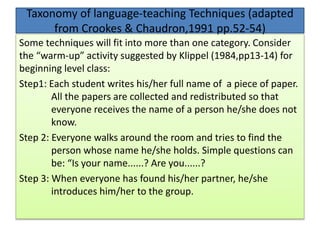
Some techniques will fit into more than one category. Consider
the “warm-up” activity suggested by Klippel (1984,pp13-14) for
beginning level class:
Step1: Each student writes his/her full name of a piece of paper.
All the papers are collected and redistributed so that
everyone receives the name of a person he/she does not
know.
Step 2: Everyone walks around the room and tries to find the
person whose name he/she holds. Simple questions can
be: “Is your name......? Are you......?
Step 3: When everyone has found his/her partner, he/she
introduces him/her to the group.
Taxonomy of language-teaching Techniques (adapted
from Crookes & Chaudron,1991 pp.52-54)
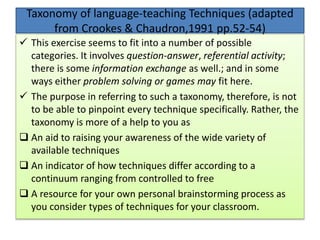
 This exercise seems to fit into a number of possible
categories. It involves question-answer, referential activity;
there is some information exchange as well.; and in some
ways either problem solving or games may fit here.
 The purpose in referring to such a taxonomy, therefore, is not
to be able to pinpoint every technique specifically. Rather, the
taxonomy is more of a help to you as
 An aid to raising your awareness of the wide variety of
available techniques
 An indicator of how techniques differ according to a
continuum ranging from controlled to free
 A resource for your own personal brainstorming process as
you consider types of techniques for your classroom.
References
• Brown, D.H. (2001). Teaching by Principle.Englewood Cliffs,
N.J: Prentice Hall.
• Larsen-Freeman, D. (2000). Techniques and Principles in
Language Teaching. 2nd ed.Oxford: OUP.
• Prichard, Alan.2009. Ways of Learning: Learning theories and
learning styles in the classroom. New York: Routledge.
• Richard, Jack C. , & Rodgers, Theodore S. (2001). Approaches
and Methods in Language Teaching. New York: Cambridge
University Press

Approach, method and Technique in Language Learning and teaching

  • 1.
    TEFL APPROACH, METHOD AND TECHNIQUE ElihSutisna Yanto- FKIP PBI Unsika West-Java Indonesia
  • 2.
    Edward Anthony (1965) Anapproach is a set of correlative assumptions dealing with the nature of language and the nature of language learning and teaching.
  • 3.
    According to EdwardAnthony’s model (1965) approach is the level at which assumptions and beliefs about language and language learning are specified; method is the level at which theory is put into practice and at which choices are made about the particular skills to be taught, the content to be taught, and the order in which the content will be presented; technique is the level at which classroom procedures are described.
  • 4.
    Summary and elementsand sub elements that constitute method (Richards & Rodgers:33) Method Approach a. A theory of the nature of language b. A theory of the nature of language learning Design a. The general and specific objectives of the method b. A syllabus model c. Types of learning and teaching activities. d. Learner roles e. Teachers roles f. The role of instructional materials Procedure a. Classroom techniques, practices, and behaviors when the method is used. b. Resources in term of time, space, and equipment used by the teacher. c. Interactional patterns observed in lessons. d. Tactics and strategies used by teachers and learners when the method is being use.
  • 5.
    Three different viewsof The nature of language 1. Structural view: It views language as a system of structurally related element. 2. Functional view: It regards language as a vehicle for the expression of functional meaning. 3. Interactional view: It sees language as a vehicle for the realization of interpersonal relations and social interaction between individuals.
  • 6.
    The common assumptionsabout the nature of the language 1. Language is a group of sounds with specific meaning and organized by grammatical rules (The Silent Way). 2. Language is the everyday spoken utterance of the average person at normal speed (Audio Lingual Method). 3. Language is a system for the expression of meaning (Communicative Language Teaching). 4. Language is a set of grammatical rules and language consists of language chunks (Total Physical Responses)
  • 7.
    Definitions of learning 1.A change in behaviour as a result of experience or practice. 2. The acquisition of knowledge. 3. Knowledge gained through study. 4. To gain knowledge of , or skill in, through study, teaching, instruction or experience. 5. The process of gaining knowledge. 6. A process by which behavious is changed, shaped, or controlled. 7. The individual process of constructing understanding based on experience from a wide range of sources. (Alan Prichard 2009:2)
  • 8.
    The nature oflanguage learning: 1. Behaviorism: Stimulus- Response- Reinforcement.- Drilling, exercise, repetition. 2. Nativism: A child naturally has a language acquisition device. (Kodrati). 3. Constructivism: A child acquired a language through interaction between the child and environment. (Jean Piaget).
  • 9.
    The nature oflearning: 1. Behaviorism is a theory of learning focusing on observable behaviour and discounting any mental activity. Learning is defined simply as the acquisition of new behaviour. (Alan Prichard 2009:6)
  • 10.
    Cognitive, constructivist learning Constructivistsview learning as the result of mental construction. That is, learning take place when new information is built into and added onto an individual’s current structure of knowledge, understanding and skills. We learn best when we actively construct our own understanding (Alan Prichard 2009:17)
  • 11.
    The following assumptionsrelate to theories of learning and teaching 1. Learning is facilitated if language learners discover rather than repeat and remember without understanding what is to be learned (Silent Way). 2. Learning involves the unconscious functions, as well as the conscious functions (Suggestopedia). 3. The norms of the society often block the process of learning (Suggestopedia) 4. Language learning will take place if language learners maintain their feeling of security (Community Language Learning). 5. Language learning is a process of habit formation (Audio Lingual Method)
  • 12.
    Assumption about learningand teaching, which have been developed from theories in psychology, seem to develop faster than those about the nature of language.
  • 13.
    Method The plan oflanguage teaching which consistent with the theories. (Edward Anthony-1963) Method may mean different things to different people (Mackey, 1975:155) For some , it means a set of teaching procedures; for others, the avoidance of teaching procedures. For some, it is the primary of a language skill; for others, it is the type and amount of vocabulary and stucture.
  • 14.
    Method cont... The term“method” in the Direct Method may refer to a single aspect of language teaching: presentation of material. Method in the Reading Method refers to the emphasis of a single language skill: reading, while In the Grammar Translation Method, method refers to the emphasis of the teaching material.
  • 15.
    Method cont... According toMackey (1975:157), all teaching, whether good or bad, must include some sort of selection, some sort of gradation, some sort of presentation, and some sort of repetition. Therefore, all methods should include the four steps of teaching a language. Any method should include the four steps: selection, gradation, presentation, and repetition.
  • 16.
    Method According to Richardsand Rodgers (2001), a method is theoretically related to an approach, organized by the design, and practically realized in procedure.
  • 17.
    Technique Carry out amethod. It is implementational, meaning that a technique is something that actually takes place in language teaching or learning in the classroom.
  • 18.
    Technique cont... The followingare some examples of techniques in error correction. 1. The teacher does not praise or criticize so that language learners learn to rely on themselves (Silent Way). 2. The teacher often praises when a student has made a good thing in learning (Audio Lingual Method). 3. When a student has produced a wrong expression, the teacher just repeats the right one (Total Physical Response). 4. The teacher does not care when a student make an error as long as it does not hinder (delay/prevent) communication (Natural Method)
  • 19.
    The Term ofTechnique (H.D. Brown 2007:180) 1. Task. Task usually refers to a specialized form of technique or series of techniques closely allied with communicative curricula, and as such must minimally have communicative goals. It is focuses on the authentic use of language for meaningful communicative purpose beyond the language classroom.
  • 20.
    The Term ofTechnique 2. Activity. Activity may refer to virtually anything that learners do in the classroom.  We usually refer to a reasonably unified set of student behaviour, limited in time, preceded by some direction from the teacher, with a particular objective.  Activities include role plays, drills, games, peer-editing, small- group information-gap exercise, and much more.  Because an activity implies some sort of active performance on the part of learners, it is generally not used to refer to certain teacher behaviours like saying “good morning,” maintaining eye contact with students, explaining a grammar point, or writing a list of words on the chalkboard. Such teacher behaviour, however can indeed be referred to as technique.
  • 21.
    The Term ofTechnique 3. Procedure. Richards and Rodgers (2001) used the term procedure to encompass “the actual moment- to-moment techniques, practices, and behaviour that operate in teaching a language according to a particular method” (p.26)  Procedures from this definition, include techniques. Thus, for Richards and Rodgers, this appears to be a catchall term, a thing for holding many small objects or a group or description that includes different things and that does not state clearly what is included or not.
  • 22.
    The Term ofTechnique 4. Practice, behaviour, exercise, strategy... In the language-teaching literature, these terms, and perhaps some others, all appear to refer , in varying degrees of intensity, to what is defined as technique.
  • 23.
    The Term ofTechnique 5. Technique Even before Anthony (1963) discussed and defined the term, the language teaching literature generally accepted technique as a superordinate term to refer to various activities that either teachers or learners perform in the classroom. In other words, technique include all tasks and activities. They almost always planned and deliberate, done on purpose rather than by accident.
  • 24.
    The Term ofTechnique Cont... They are the product of a choice made by the teacher. And they can, for your purposes as a language teacher, comfortably refer to the pedagogical units or components of a classroom session. You can think of a lesson as consisting of a number of techniques, some teacher-centered, some learner-centered, some production- centered, some comprehension-centered, some clustering together to form a task.
  • 25.
    Taxonomy of language-teachingTechniques (adapted from Crookes & Chaudron,1991 pp.52-54) Controlled Techniques 1. Warm-up: Mimes, dance, songs, jokes, play. This activity gets the students stimulated, relaxed, motivated, attentive, or otherwise engage and ready for the lesson. It does not necessarily involves use of the target language. 2. Setting: Focusing on lesson topic. Teacher directs attention to the topic by verbal or nonverbal evocation of the context relevant to the lesson by questioning or miming or picture presentation, possibly by tape recording of situations and peole. 3. Organizational: Structuring of lesson or class activities includes disciplinary action, organization of class furniture and seating, general procedures for class interaction and performance, structure and purpose of lesson, ete
  • 26.
    Taxonomy of language-teachingTechniques (adapted from Crookes & Chaudron,1991 pp.52-54) Controlled Techniques 4. Content Explanation: Grammatical, phonological, lexical (vocabulary), sociolinguistic, pragmatic, or any other aspect of language. 5. Role-play demonstration: Selected students or teacher illustrate the procedure(s) to be applied in the lesson segment to follow. Includes brief illustration of language or other content to be incorporated. 6. Dialogue/Narrative presentation: Reading or listening passage presented for passive reception. No implication of student production or other identification of specific target forms or functions (students may be asked to “understand”) 7. Dialogue/Narrative recitation: Reciting a previously known or prepared text, either in unison or individually.
  • 27.
    Taxonomy of language-teachingTechniques (adapted from Crookes & Chaudron,1991 pp.52-54) Controlled Techniques 8. Reading aloud: Reading directly from a given text. 9. Checking: Teacher either circulating or guiding the correction of students’ work, providing feedback as an activity rather than within another activity. 10. Question-answer display: Activity involving prompting of students responses by means of display questions (i.e. teacher or questioner already knows the response or has a very limited set of expectations for the appropriate response). Distinguished from referential questions by the likelihood of the questioner’s knowledge of the response and the speaker’s awareness of that fact.
  • 28.
    Taxonomy of language-teachingTechniques (adapted from Crookes & Chaudron,1991 pp.52-54) Controlled Techniques 11. Drill: Typical language activity involving fixed patterns of teacher prompting and student responding, usually with repetition, substitution, and other mechanical alterations. Typically with little meaning attached. 12. Translation: Student or teacher provision of L1 or L2 translation of given text. 13. Dictation: Student writing down orally presented text. 14. Copying: Student writing down text presented visually. 15. Identification: Student picking out and producing/labeling or otherwise identifying a specific target form, function, definition, or other lesson-related item.
  • 29.
    Taxonomy of language-teachingTechniques (adapted from Crookes & Chaudron,1991 pp.52-54) Controlled Techniques 16. Recognition: Student identifying forms, as in identification (i.e., checking off items, drawing symbols, rearranging pictures), but without a verbal responses. 17. Review: Teacher-led review of previous week/month/or other period as a formal summary and type of test of student recall performance. 18. Testing: Formal testing procedures to evaluate student progress. 19. Meaningful drill: Drill activity involving responses with meaningful choices, as in reference to different information. Distinguished from information exchange by the regulated sequence and general form of responses.
  • 30.
    Taxonomy of language-teachingTechniques (adapted from Crookes & Chaudron,1991 pp.52-54) Semicontrolled Techniques 20. Brainstorming: A form of preparation for the lesson, like Setting, which involves free, undirected contributions by the students and teacher on a given topic, to generate multiple associations without linking them; no explicit analysis or interpretation by the teacher. 21. Storytelling (especially when student-generated): Not necessarily lesson-based, a lengthy presentation of story by teacher or student (may overlap with Warm-up or Narrative recitation), May be used to maintain attention, motivate, or as lengthy practice. 22. Question-answer, referential: Activity involving prompting of responses by means of referential questions (i.e., the questioner does not know beforehand the responses information). Distinguished from Question-answer, display.
  • 31.
    Taxonomy of language-teachingTechniques (adapted from Crookes & Chaudron,1991 pp.52-54) Semicontrolled Techniques 23. Cued narrative/Dialogue: Student production of narrative or dialogue following cues from miming, cue cards, pictures, or other stimuli related to narrative/dialogue (e.g., metalanguage requesting functional acts). 24. Information transfer: Application from one mode (e.g., visual) to another (e.g., writing), which involves some transformation of the information (e.g., student fills out diagram while listening to description). Distinguished from Identification in that the student is expected to transform and reinterpret the language or information. 25. Information exchange: Task involving two-way communication as in information-gap exercise, when one or both parties (or a larger group) must share information to achieve some goal. Distinguished from Question-answer, referential in that sharing of information is critical for the task.
  • 32.
    Taxonomy of language-teachingTechniques (adapted from Crookes & Chaudron,1991 pp.52-54) Semicontrolled Techniques 26. Wrap-up: Brief teacher- or student-produced summary of point and/or items that have been practiced or learned. 27. Narration/Exposition: Presentation of a story or explanation derived from prior stimuli. Distinguished from Cued narrative because of lack of immediate stimulus. 28. Preparation: Student study, silent reading, pair planning and rehearsing, preparing for later activity. Usually a student- directed or –oriented project.
  • 33.
    Taxonomy of language-teachingTechniques (adapted from Crookes & Chaudron,1991 pp.52-54) Free Techniques 29. Role play: Relatively free acting out of specified roles and functions. Distinguished from Cued dialogues by the fact that cueing is provided only minimally at the beginning , and not during the activity. 30. Games: Various kinds of language game activity not like other previously defined activities (e.g., board and dice games making words). 31. Report: Report of student-prepared exposition on books, experiences, project work, without immediate stimulus, and elaborated on according to student interests. Akin to Composition in writing mode.
  • 34.
    Taxonomy of language-teachingTechniques (adapted from Crookes & Chaudron,1991 pp.52-54) Free Techniques 32. Problem solving: Activity involving specified problem and limitations of means to resolve it; requires cooperation on part of participants in small or large group. 33. Drama: Planned dramatic rendition of play, skit, story, etc. 34. Simulation: Activity involving complex interaction between groups and individuals based on simulation of real-life actions and experiences. 35. Interview: A student is directed to get information from another student or students. 36. Discussion: Debate or other form of grouped discussion of specified topic, with or without specified sides/positions prearranged.
  • 35.
    Taxonomy of language-teachingTechniques (adapted from Crookes & Chaudron,1991 pp.52-54) Free Techniques 37.Composition: As in Report (verbal), written development of ideas, story, or other exposition. 38.A propos: Conversation or other socially oriented interaction/speech by teacher, students, or even visitors, on general real-life topics. Typically authentic and genuine.
  • 36.
    Taxonomy of language-teachingTechniques (adapted from Crookes & Chaudron,1991 pp.52-54) Some techniques will fit into more than one category. Consider the “warm-up” activity suggested by Klippel (1984,pp13-14) for beginning level class: Step1: Each student writes his/her full name of a piece of paper. All the papers are collected and redistributed so that everyone receives the name of a person he/she does not know. Step 2: Everyone walks around the room and tries to find the person whose name he/she holds. Simple questions can be: “Is your name......? Are you......? Step 3: When everyone has found his/her partner, he/she introduces him/her to the group.
  • 37.
    Taxonomy of language-teachingTechniques (adapted from Crookes & Chaudron,1991 pp.52-54)  This exercise seems to fit into a number of possible categories. It involves question-answer, referential activity; there is some information exchange as well.; and in some ways either problem solving or games may fit here.  The purpose in referring to such a taxonomy, therefore, is not to be able to pinpoint every technique specifically. Rather, the taxonomy is more of a help to you as  An aid to raising your awareness of the wide variety of available techniques  An indicator of how techniques differ according to a continuum ranging from controlled to free  A resource for your own personal brainstorming process as you consider types of techniques for your classroom.
  • 38.
    References • Brown, D.H.(2001). Teaching by Principle.Englewood Cliffs, N.J: Prentice Hall. • Larsen-Freeman, D. (2000). Techniques and Principles in Language Teaching. 2nd ed.Oxford: OUP. • Prichard, Alan.2009. Ways of Learning: Learning theories and learning styles in the classroom. New York: Routledge. • Richard, Jack C. , & Rodgers, Theodore S. (2001). Approaches and Methods in Language Teaching. New York: Cambridge University Press