MEU WORKSHOP
Teaching Learning Methods
 Learning is an highly individualized process
that depends on multiple factors.
 Efficient learning may therefore be facilitated
 The role of teachers is to facilitate learning.
Intrinsic
• student driven
• Past experiences,
• relevance of learning to their future
Extrinsic
• Assessment – important impetus to learn
• Many modifiable factors may have a negative
influence and include distractions, physical
discomfort and attitude of teachers
 The teacher or facilitator is one of the most
important variables in the educational
environment
 It is easy to learn attitudes including poor
attitudes
 Attitudes are learnt thro’ observation of those
in relative seniority or power
 Transmitting- lectures, reading materials,
memory devices ( pass on)
 Instructing- active learning, mini-lecturing,
collaborative teams (train, teach)
 Coaching- mentorship, job shadowing, demos,
role plays
 Facilitate problem based learning, project based
learning (make possible or make easy)
 Large group teaching
 Small group teaching
 Individualized teaching
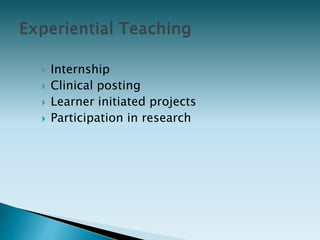
 Experiential Teaching
 Lecturing is one of the oldest forms of large
group teaching
 They are efficient means of transferring
knowledge, explain concepts to a large group
 Can be used to stimulate interest and direct
student learning
 Lecture can be properly prepared and
organized to meet the needs of the audience
 Teachers can assimilate a large amount of
information and can present it concisely
 Faculty who are interested, with good
language and communication skills can make
lectures very interesting and a good learning
experience
 Preparation for the lecture is very important
 Objective of the lecture should be clearly
defined
 In beginning it is a good idea to summarise
the previous lecture
 Indicate the major themes of the present
lecture
 Wrap up the lecture by summarizing the
salient points
 Getting feedback is an useful exercise
 During the lecture encourage students to
interact
 Give clinical examples
 Ask questions
 Get students to ask questions
 Break monotony
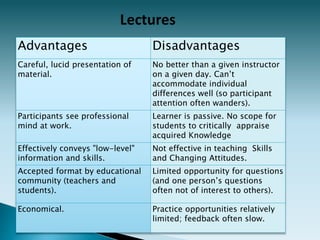
Advantages Disadvantages
Careful, lucid presentation of
material.
No better than a given instructor
on a given day. Can’t
accommodate individual
differences well (so participant
attention often wanders).
Participants see professional
mind at work.
Learner is passive. No scope for
students to critically appraise
acquired Knowledge
Effectively conveys "low-level"
information and skills.
Not effective in teaching Skills
and Changing Attitudes.
Accepted format by educational
community (teachers and
students).
Limited opportunity for questions
(and one person’s questions
often not of interest to others).
Economical. Practice opportunities relatively
limited; feedback often slow.
Lectures
 Small group discussions plays a valuable role
in the all-round education of students
 Includes
◦ Problem based learning
◦ Tutorial
◦ Seminar
• Small group teaching
• Improves presentation skills
• Improves listening skills
• Working as a team
• Chance to monitor their own learning
• This requires active participation of all group
members
• Tutors have a tendency to become prime
talkers
 It consists of a small group of students and a
tutor who discuss, interact and clarify
regarding a previously prepared topic
 Ideal for groups of 10-15 students
 A clinical case or a problem can be used as a
starting point
 All aspects are discussed in detail by the
students among themselves and with the
tutor
 Preparation: Students must be informed
about the topic
 Reading prior to the tutorial
 Participation in the tutorial – active by
contributing and passively by listening,
observation etc
 Allows instructor to be responsive to each
participant.
 Learner interacts and participates.
 Tutoring one’s peers results in greater
learning for the tutor.
 Inefficient, takes much time.
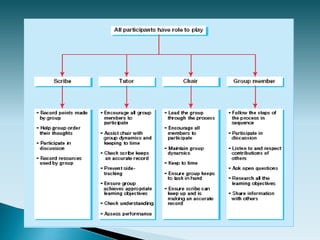
 Facilitator or tutor with a group of 10-15 well
read students
 Presentations are breifly made by each
participant or some participants which is pre-
determined
 Further active learning occurs during the
discussions that follow
•
Advantages
•
Easy to implement, good compromise with
many of advantages of large groups, small
groups, and individualized instruction.
•
Makes for congenial learner-learner
interaction without need for facilitator
trained in group activities.
•
Learners are often active participants,
making presentations on specific topics.
•
Especially useful for workshops or groups
meeting informally or infrequently.
Disadvantages

Not as cost-effective as small groups,
individualized instruction, or lectures in
situations for which these formats are best
suited.

Groups must be small for effectiveness.

Requires motivated, interested participants
for lively sessions.
 PBL is a learning process that is centred
around the discussion and learning that
emanates from a clinically-based problemPBL
is a
 It uses a clinical problem to stimulate
discussion and identify learning issues by a
small group of students
 It facilitates self directed learning based on
the educational needs of an individual
Presentation of clinical material as the
stimulus for learning
enables students to understand the relevance
of underlying scientific knowledge and
principles in clinical practice.
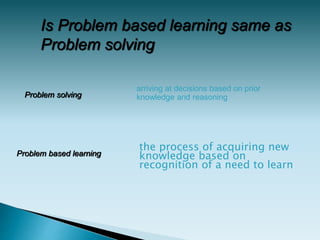
the process of acquiring new
knowledge based on
recognition of a need to learn
arriving at decisions based on prior
knowledge and reasoning
Is Problem based learning same as
Problem solving
Problem based learning
Problem solving
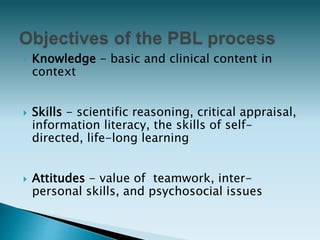
 Knowledge - basic and clinical content in
context
 Skills - scientific reasoning, critical appraisal,
information literacy, the skills of self-
directed, life-long learning
 Attitudes - value of teamwork, inter-
personal skills, and psychosocial issues
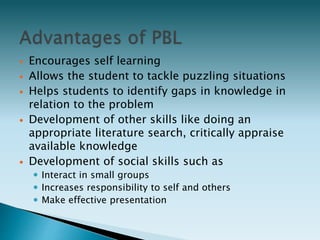
 Encourages self learning
 Allows the student to tackle puzzling situations
 Helps students to identify gaps in knowledge in
relation to the problem
 Development of other skills like doing an
appropriate literature search, critically appraise
available knowledge
 Development of social skills such as
 Interact in small groups
 Increases responsibility to self and others
 Make effective presentation
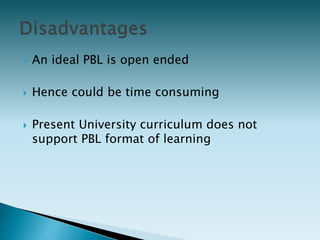
 An ideal PBL is open ended
 Hence could be time consuming
 Present University curriculum does not
support PBL format of learning
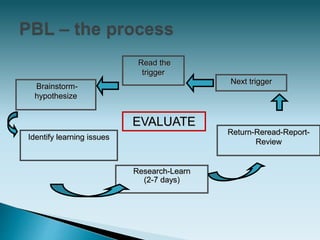
Read the
trigger
Identify learning issues
Research-Learn
(2-7 days)
Return-Reread-Report-
Review
Brainstorm-
hypothesize
Next trigger
EVALUATE
 Internship
 Clinical posting
 Learner initiated projects
 Participation in research
THANK YOU

MEU WORKSHOP Teaching learning methods

  • 1.
  • 3.
     Learning isan highly individualized process that depends on multiple factors.  Efficient learning may therefore be facilitated  The role of teachers is to facilitate learning.
  • 4.
    Intrinsic • student driven •Past experiences, • relevance of learning to their future Extrinsic • Assessment – important impetus to learn • Many modifiable factors may have a negative influence and include distractions, physical discomfort and attitude of teachers
  • 5.
     The teacheror facilitator is one of the most important variables in the educational environment  It is easy to learn attitudes including poor attitudes  Attitudes are learnt thro’ observation of those in relative seniority or power
  • 6.
     Transmitting- lectures,reading materials, memory devices ( pass on)  Instructing- active learning, mini-lecturing, collaborative teams (train, teach)  Coaching- mentorship, job shadowing, demos, role plays  Facilitate problem based learning, project based learning (make possible or make easy)
  • 7.
     Large groupteaching  Small group teaching  Individualized teaching  Experiential Teaching
  • 8.
     Lecturing isone of the oldest forms of large group teaching  They are efficient means of transferring knowledge, explain concepts to a large group  Can be used to stimulate interest and direct student learning  Lecture can be properly prepared and organized to meet the needs of the audience
  • 9.
     Teachers canassimilate a large amount of information and can present it concisely  Faculty who are interested, with good language and communication skills can make lectures very interesting and a good learning experience
  • 10.
     Preparation forthe lecture is very important  Objective of the lecture should be clearly defined  In beginning it is a good idea to summarise the previous lecture  Indicate the major themes of the present lecture
  • 11.
     Wrap upthe lecture by summarizing the salient points  Getting feedback is an useful exercise  During the lecture encourage students to interact  Give clinical examples  Ask questions  Get students to ask questions  Break monotony
  • 12.
    Advantages Disadvantages Careful, lucidpresentation of material. No better than a given instructor on a given day. Can’t accommodate individual differences well (so participant attention often wanders). Participants see professional mind at work. Learner is passive. No scope for students to critically appraise acquired Knowledge Effectively conveys "low-level" information and skills. Not effective in teaching Skills and Changing Attitudes. Accepted format by educational community (teachers and students). Limited opportunity for questions (and one person’s questions often not of interest to others). Economical. Practice opportunities relatively limited; feedback often slow. Lectures
  • 13.
     Small groupdiscussions plays a valuable role in the all-round education of students  Includes ◦ Problem based learning ◦ Tutorial ◦ Seminar
  • 14.
    • Small groupteaching • Improves presentation skills • Improves listening skills • Working as a team • Chance to monitor their own learning • This requires active participation of all group members • Tutors have a tendency to become prime talkers
  • 15.
     It consistsof a small group of students and a tutor who discuss, interact and clarify regarding a previously prepared topic  Ideal for groups of 10-15 students  A clinical case or a problem can be used as a starting point  All aspects are discussed in detail by the students among themselves and with the tutor
  • 16.
     Preparation: Studentsmust be informed about the topic  Reading prior to the tutorial  Participation in the tutorial – active by contributing and passively by listening, observation etc
  • 17.
     Allows instructorto be responsive to each participant.  Learner interacts and participates.  Tutoring one’s peers results in greater learning for the tutor.  Inefficient, takes much time.
  • 18.
     Facilitator ortutor with a group of 10-15 well read students  Presentations are breifly made by each participant or some participants which is pre- determined  Further active learning occurs during the discussions that follow
  • 19.
    • Advantages • Easy to implement,good compromise with many of advantages of large groups, small groups, and individualized instruction. • Makes for congenial learner-learner interaction without need for facilitator trained in group activities. • Learners are often active participants, making presentations on specific topics. • Especially useful for workshops or groups meeting informally or infrequently.
  • 20.
    Disadvantages  Not as cost-effectiveas small groups, individualized instruction, or lectures in situations for which these formats are best suited.  Groups must be small for effectiveness.  Requires motivated, interested participants for lively sessions.
  • 22.
     PBL isa learning process that is centred around the discussion and learning that emanates from a clinically-based problemPBL is a  It uses a clinical problem to stimulate discussion and identify learning issues by a small group of students
  • 23.
     It facilitatesself directed learning based on the educational needs of an individual Presentation of clinical material as the stimulus for learning enables students to understand the relevance of underlying scientific knowledge and principles in clinical practice.
  • 24.
    the process ofacquiring new knowledge based on recognition of a need to learn arriving at decisions based on prior knowledge and reasoning Is Problem based learning same as Problem solving Problem based learning Problem solving
  • 25.
     Knowledge -basic and clinical content in context  Skills - scientific reasoning, critical appraisal, information literacy, the skills of self- directed, life-long learning  Attitudes - value of teamwork, inter- personal skills, and psychosocial issues
  • 26.
     Encourages selflearning  Allows the student to tackle puzzling situations  Helps students to identify gaps in knowledge in relation to the problem  Development of other skills like doing an appropriate literature search, critically appraise available knowledge  Development of social skills such as  Interact in small groups  Increases responsibility to self and others  Make effective presentation
  • 27.
     An idealPBL is open ended  Hence could be time consuming  Present University curriculum does not support PBL format of learning
  • 28.
    Read the trigger Identify learningissues Research-Learn (2-7 days) Return-Reread-Report- Review Brainstorm- hypothesize Next trigger EVALUATE
  • 30.
     Internship  Clinicalposting  Learner initiated projects  Participation in research
  • 31.