DIFFERENT
APPROACHES &
METHODS OF
PR INCIPLES O F TEACHING
1
Teaching
“A thousand
teachers, a thousand
methods”
- Chinese Proverb
2
TEACHING APPROACH,
STRATEGY, METHOD &
TECHNIQUES
CARLO SAN JUAN ROBERTO
Certificate in Professional Teaching Program
Learning Objectives:
To identify & compare different
teaching approaches.
4
It is a set of principles,
beliefs, or ideas about the
nature of learning which is
translated into the
classroom.
TEACHING APPROACH
5
It is a long term plan of
action designed to achieve a
particular goal.
TEACHING STRATEGY
6
It is a systematic way of doing
something. It implies an orderly
logical arrangement of steps. It
is more procedural
TEACHING METHOD
7
It is a well-defined procedure
used to accomplish a specific
activity or task.
TEACHING TECHNIQUE
8
9
TechniqueMethodStrategyApproach
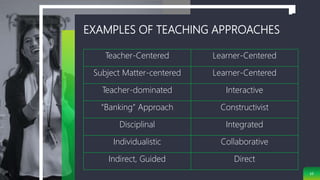
EXAMPLES OF TEACHING APPROACHES
10
Teacher-Centered Learner-Centered
Subject Matter-centered Learner-Centered
Teacher-dominated Interactive
“Banking” Approach Constructivist
Disciplinal Integrated
Individualistic Collaborative
Indirect, Guided Direct
TEACHER-CENTERED
The teacher is
perceived to be the
only reliable source of
information in contrast
to the learner-centered
approach.
11
LEARNER-CENTERED
The learner is also an
important resource
because he/she too
knows something and
is therefore capable of
sharing something.
SUBJECT MATTER-
CENTERED
Subject matter gains
primacy over that of
the learner.
The teacher does what
he/she planned without
necessarily considering
learners’ interest,
concerns and situation.
12
LEARNER-CENTERED
The teacher makes
adjustments in his/her
lesson plan to
accommodate learners’
interest and concerns.
TEACHER
DOMINATED-
APPROACH
only the teacher’s voice
is heard. He/she is the
sole dispenser of
information.
13
INTERACTIVE-
CLASSROOM
More student talk and
less teacher talk.
Students have the
opportunity to interact
with the teacher and
with other students.
BANKING-APPROACH
Teacher deposits
knowledge into the
“empty minds” of the
students for the
students to commit to
memory.
14
CONSTRUCTIVIST-
APPROACH
Students are expected
to construct knowledge
and meaning out of
what they taught by
connecting them to a
prior experience.
DICIPLINAL-APPROACH
This approach limits the
teacher to discuss
his/her lesson within
the boundary of his/her
subject.
15
INTEGRATED-APPROACH
Teacher connects what
he/she teaches to the
other lesson of the
same subject.
COLLABORATIVE-
APPROACH
This approach welcome
group work, team,
partnership, group
discussion.
16
INDIVIDUALISTIC-
APPROACH
This approach will
want the student to
work/learn
individually by
themselves.
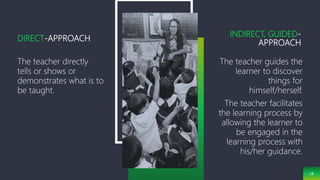
DIRECT-APPROACH
The teacher directly
tells or shows or
demonstrates what is to
be taught.
17
INDIRECT, GUIDED-
APPROACH
The teacher guides the
learner to discover
things for
himself/herself.
The teacher facilitates
the learning process by
allowing the learner to
be engaged in the
learning process with
his/her guidance.
DIRECT-APPROACH
The teacher directly
tells or shows or
demonstrates what is to
be taught.
18
INDIRECT, GUIDED-
APPROACH
The teacher guides the
learner to discover
things for
himself/herself.
The teacher facilitates
the learning process by
allowing the learner to
be engaged in the
learning process with
his/her guidance.
REASEARCH BASED -
APPROACH
Teaching and learning
are anchored on
research finding.
19
WHOLE CHILD APPROACH
Not only academic
needs of the learners
but also their
emotional, creative,
psychological, spiritual,
and developmental
needs.
Other teaching approach cited in
education literature;
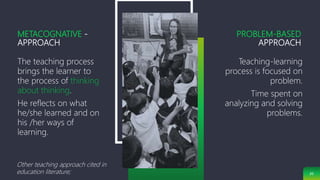
METACOGNATIVE -
APPROACH
The teaching process
brings the learner to
the process of thinking
about thinking.
He reflects on what
he/she learned and on
his /her ways of
learning.
20
PROBLEM-BASED
APPROACH
Teaching-learning
process is focused on
problem.
Time spent on
analyzing and solving
problems.
Other teaching approach cited in
education literature;
APPROACHES VARIES IN
21
Teacher Learner
Engagement
Subject Matter Learner
Focus
Individual Group
Number
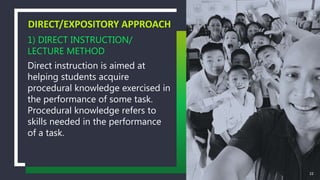
1) DIRECT INSTRUCTION/
LECTURE METHOD
Direct instruction is aimed at
helping students acquire
procedural knowledge exercised in
the performance of some task.
Procedural knowledge refers to
skills needed in the performance
of a task.
DIRECT/EXPOSITORY APPROACH
22
DIRECT/EXPOSITORY APPROACH
23
To employ this methodology in teaching skill/s, follow these
steps:
a. Provide the rationale,
b. Demonstrate the skill,
c. Provide guided practice until mastery,
d. Check for understanding and provide
feedback,
e. Provide extended practice and transfer, and
f. Assess learning at the end.
Steps of the Direct Method or Lecture
Method
+
+
DIRECT/EXPOSITORY APPROACH
24
If you teach facts, principles, or laws, your steps are similar with
those of teaching a skill.
a. Give a short introduction by providing the
rationale,
b. Present your lesson,
c. Develop the lesson by explaining,
illustrating, it with diagrams if appropriate
and/or giving concrete examples,
d. Give application of the lesson, and
e. Check for understanding and provide
feedback.
Steps of the Direct Method or Lecture
Method
+
+
DIRECT INSTRUCTION/ LECTURE METHOD
25
1. The strategy is teacher-directed.
2. The emphasis is on the teaching of skill.
3. Each step must be mastered, hence the students gain “how”
rather than “what”. It is termed procedural knowledge.
4. Taught in a step-by-step fashion, it ensures the learning of
the entire procedure with no step missed.
5. Lesson objectives include easily observed behaviors that can
be measured accurately.
6. This is a form of learning through imitation, sometimes
termed “behavioral modeling”.
7. This can also be used to teach facts, principles, and laws.
INSTRUCTIONAL CHARACTERISTICS
DIRECT INSTRUCTION/ LECTURE METHOD
26
1. The students must be given ample time for practice.
2. They must be included in the planning stage since this
technique is highly task-oriented and aimed at mastery of
every step. The lesson objectives are student-based.
3. Describe the testing situation and specify the level of
performance expected.
4. Divide complex skills and understanding into subskills or into
its component steps so they can be taught easily and with
precision.
5. Design own strategy in teaching each skill which will
eventually contribute to the learning of the entire skill.
Guidelines for Its Effective Use | Teaching Skill
DIRECT INSTRUCTION/ LECTURE METHOD
27
6. Before the demonstration, carefully rehearse all steps. The
steps should be observed and followed.
7. Assign practice for short periods of time, then continue
learning by imitating others.
8. Provide feedback and encouragement through praises.
Positively motivated, the students will never get tired
practicing.
9. Be able to construct good performance based tests.
Guidelines for Its Effective Use | Teaching Skill
DIRECT INSTRUCTION/ LECTURE METHOD
28
1. Be sure the facts, principles, and laws are correctly, clearly,
and adequately explained.
2. Use visual aids to concretize abstract principles and laws.
3. Illustrate laws and principles with concrete examples.
4. Present facts meaningfully by citing their significance and by
connecting them with everyday life..
Teaching Declarative Knowledge – Facts, Principles and Laws
2) DEMONSTRATION METHOD
The teacher or an assigned
student or group shows how a
process is done while the students
become observers.
DIRECT/EXPOSITORY APPROACH
29
DEMONSTRATION METHOD
30
1. Demonstrator/s must be well selected.
2. Plan/prepare the materials to be used.
3. Ready the equipment/tools.
4. Demonstrator/s must try the activity several times before real
demonstration for smooth sequencing & accurate result.
5. Observers must be motivated & prepared.
6. Demonstrators must be ready with on the spot revision/s.
7. Arrange observers around the demonstration area.
8. Pointers or questions may be given to focus students
attention and avoid irrelevant observations.
BEFORE | Guidelines for Its Effective Use
DEMONSTRATION METHOD
31
1. Place must be quiet.
2. Extreme care must be taken in performing some delicate
steps. Precision, Timing for every step, measuring, using
instruments must be observed.
3. Activity must not be interrupted.
4. They allowed to take down notes or record data.
DURING | Guidelines for Its Effective Use
DEMONSTRATION METHOD
32
1. Allow some questions which bothered them during the
demonstration. (Post Demo Discussion)
2. An examination of observed data and all information
recorder follows.
3. Have an analysis to formulate a conclusion.
4. The conclusion or summary must be cooperatively undertaken
by the whole class.
5. Assess the learnings.
AFTER | Guidelines for Its Effective Use
DEMONSTRATION METHOD
33
1. Systematic procedure.
2. Used of expensive equipment and machines will be
maximized.
3. Avoid wastage of time and effort.
4. Will not result to trial & error.
5. Findings are reliable and accurate.
6. Value of confidence is developed.
7. Curiosity and keen observing are instilled among observers.
Advantages | Guidelines for Its Effective Use
Indirect instruction method is best
used when the learning process is
inquiry-based, the result is
discovery and the learning context
is a problem. This can come as
1. Inquiry /Discovery method;
2. Problem solving method;
3. Project method.
INDIRECT/GUIDED / EXPLORATORY
APPROACH
34
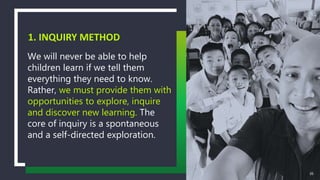
We will never be able to help
children learn if we tell them
everything they need to know.
Rather, we must provide them with
opportunities to explore, inquire
and discover new learning. The
core of inquiry is a spontaneous
and a self-directed exploration.
1. INQUIRY METHOD
35
INDIRECT/GUIDED / EXPLORATORY APPROACH
36
To employ this methodology in teaching skill/s, follow these
steps:
a. Define the topic or introduce the question.
b. Guide students plan where and how to
gather data, information.
c. Students present findings.
Steps in the Inquiry Method
+
+
INDIRECT/GUIDED / EXPLORATORY APPROACH
37
1. Investigative processes such as inferring, hypothesizing, measuring,
predicting, classifying, analyzing, and experimenting, formulating
conclusions and generalizations are employed.
2. The procedure in gathering information is not prescribed by the
teachers.
3. The children are highly motivated to search, hence active
participation is the best indicator of inquisitiveness.
4. The answers arrived at are genuine products of their own efforts.
5. Focused questions before, during and after are critical ingredients
that provide direction and sustain action.
INQUIRY METHOD | INSTRUCTIONAL CHARACTERISTICS
OUTCOMES OF INQUIRY TEACHING
38
1. Its emphasis is on the processes of gathering and processing of information
2. Its dependence on firsthand experience with objects and phenomena occurring in the
environment is certainly in agreement with the most often cited theory of Piaget on intellectual
development.
3. The inquiry approach which predominantly allows some degree of freedom develops initiative
and divergent thinking.
4. A deep sense of responsibility is developed when learners are left to manage their own
learning, be it in pursuit of answers, mastery of content or simply solving a problem that
confronts them instantly.
5. Educators strongly believes that facts and concepts that learners discover by themselves
become stored as part of their permanent learning.
6. Experiencing success in inquiry based/discovery lessons builds up the learners’ feeling of
confidence.
7. Participation in inquiry activities strengthens learners’ intellectual capabilities.
HOW TO FACILITATE INQUIRY TEACHING?
39
1. Arrange for an ideal room setting.
2. Choose tools and equipment that can easily be manipulated.
3. The materials to be used or examine must lend themselves easily to the
processes to be employed and the end product desired.
4. The questions/problems to be answered should originate from the learners,
followed by the formulation of hypothesis.
5. The procedure should likewise be planned by them.
6. At the completion of the activity, require an evaluation of the steps
undertaken as to its effectiveness and the clarity of the results.
7. Above all, the teacher himself/herself should internalize his/her changed role
to that of a guide, facilitator, and counselor rather than the traditional
authority who not only determines the material to be learned but also dictates
how it should be learned.
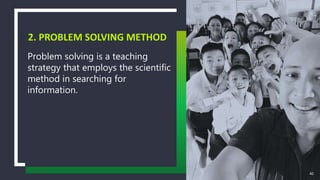
Problem solving is a teaching
strategy that employs the scientific
method in searching for
information.
2. PROBLEM SOLVING METHOD
40
INDIRECT/GUIDED / EXPLORATORY APPROACH
41
The five basic steps of scientific method or investigatory process are:
Sensing and defining the problem
1. Formulating hypothesis
2. Testing the likely hypothesis
3. Analysis, interpretation and evaluation of
evidence
4. Formulating conclusion
Steps in the Problem solving method
+
+
ADVANTEGES OF PROBLEM SOLVING METHOD
42
1. This method is most effective in developing skill in employing the science
processes.
2. The scientific method can likewise be used effectively in other non-science
objects.
3. The student’s active involvement resulting in meaningful experiences serves as a
strong motivation to follow the scientific procedure in future undertakings.
4. Problem solving develops higher level thinking skills.
5. A keen sense of responsibility, originality and resourcefulness are developed,
which are much needed ingredients for independent study.
6. The students become appreciative and grateful for the achievement of scientists.
7. Critical thinking, open-mindedness and wise judgment are among scientific
attitudes and values inculcated through competence in the scientific method.
8. The student learn to accept the opinions and evidence shared by others
PROBLEM SOLVING METHOD
43
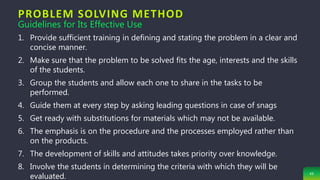
1. Provide sufficient training in defining and stating the problem in a clear and
concise manner.
2. Make sure that the problem to be solved fits the age, interests and the skills
of the students.
3. Group the students and allow each one to share in the tasks to be
performed.
4. Guide them at every step by asking leading questions in case of snags
5. Get ready with substitutions for materials which may not be available.
6. The emphasis is on the procedure and the processes employed rather than
on the products.
7. The development of skills and attitudes takes priority over knowledge.
8. Involve the students in determining the criteria with which they will be
evaluated.
Guidelines for Its Effective Use
Learner solved practical problems
over a period of several days of
weeks. Project work focuses on
applying rather than imparting
specific knowledge or skills.
3.PROJECT METHOD
44
ADVANTEGES OF PROJECT METHOD
45
1. Learning by doing.
2. Develops students ‘ manipulative skills.
3. Originality, resourcefulness and innovativeness.
4. Served as evidence of learning achievement among students who are
weak in oral discussion.
5. Completing project adds to one’s feeling of accomplishment and
satisfaction.
6. It instills the values of initiative, industry and creativity.
7. Working in groups develops cooperation and sharing of ideas.
8. Students become productive and enterprising.
PROJECT METHOD
46
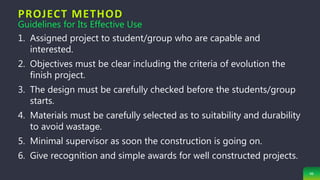
1. Assigned project to student/group who are capable and
interested.
2. Objectives must be clear including the criteria of evolution the
finish project.
3. The design must be carefully checked before the students/group
starts.
4. Materials must be carefully selected as to suitability and durability
to avoid wastage.
5. Minimal supervisor as soon the construction is going on.
6. Give recognition and simple awards for well constructed projects.
Guidelines for Its Effective Use
THANK YOU
FOR LISTENING
“I may know many things
but I do not know everything.”
CARLO SANJUAN ROBERTO 47

Teaching approach, strategy, method and techniques

  • 1.
    DIFFERENT APPROACHES & METHODS OF PRINCIPLES O F TEACHING 1 Teaching
  • 2.
    “A thousand teachers, athousand methods” - Chinese Proverb 2
  • 3.
    TEACHING APPROACH, STRATEGY, METHOD& TECHNIQUES CARLO SAN JUAN ROBERTO Certificate in Professional Teaching Program
  • 4.
    Learning Objectives: To identify& compare different teaching approaches. 4
  • 5.
    It is aset of principles, beliefs, or ideas about the nature of learning which is translated into the classroom. TEACHING APPROACH 5
  • 6.
    It is along term plan of action designed to achieve a particular goal. TEACHING STRATEGY 6
  • 7.
    It is asystematic way of doing something. It implies an orderly logical arrangement of steps. It is more procedural TEACHING METHOD 7
  • 8.
    It is awell-defined procedure used to accomplish a specific activity or task. TEACHING TECHNIQUE 8
  • 9.
  • 10.
    EXAMPLES OF TEACHINGAPPROACHES 10 Teacher-Centered Learner-Centered Subject Matter-centered Learner-Centered Teacher-dominated Interactive “Banking” Approach Constructivist Disciplinal Integrated Individualistic Collaborative Indirect, Guided Direct
  • 11.
    TEACHER-CENTERED The teacher is perceivedto be the only reliable source of information in contrast to the learner-centered approach. 11 LEARNER-CENTERED The learner is also an important resource because he/she too knows something and is therefore capable of sharing something.
  • 12.
    SUBJECT MATTER- CENTERED Subject mattergains primacy over that of the learner. The teacher does what he/she planned without necessarily considering learners’ interest, concerns and situation. 12 LEARNER-CENTERED The teacher makes adjustments in his/her lesson plan to accommodate learners’ interest and concerns.
  • 13.
    TEACHER DOMINATED- APPROACH only the teacher’svoice is heard. He/she is the sole dispenser of information. 13 INTERACTIVE- CLASSROOM More student talk and less teacher talk. Students have the opportunity to interact with the teacher and with other students.
  • 14.
    BANKING-APPROACH Teacher deposits knowledge intothe “empty minds” of the students for the students to commit to memory. 14 CONSTRUCTIVIST- APPROACH Students are expected to construct knowledge and meaning out of what they taught by connecting them to a prior experience.
  • 15.
    DICIPLINAL-APPROACH This approach limitsthe teacher to discuss his/her lesson within the boundary of his/her subject. 15 INTEGRATED-APPROACH Teacher connects what he/she teaches to the other lesson of the same subject.
  • 16.
    COLLABORATIVE- APPROACH This approach welcome groupwork, team, partnership, group discussion. 16 INDIVIDUALISTIC- APPROACH This approach will want the student to work/learn individually by themselves.
  • 17.
    DIRECT-APPROACH The teacher directly tellsor shows or demonstrates what is to be taught. 17 INDIRECT, GUIDED- APPROACH The teacher guides the learner to discover things for himself/herself. The teacher facilitates the learning process by allowing the learner to be engaged in the learning process with his/her guidance.
  • 18.
    DIRECT-APPROACH The teacher directly tellsor shows or demonstrates what is to be taught. 18 INDIRECT, GUIDED- APPROACH The teacher guides the learner to discover things for himself/herself. The teacher facilitates the learning process by allowing the learner to be engaged in the learning process with his/her guidance.
  • 19.
    REASEARCH BASED - APPROACH Teachingand learning are anchored on research finding. 19 WHOLE CHILD APPROACH Not only academic needs of the learners but also their emotional, creative, psychological, spiritual, and developmental needs. Other teaching approach cited in education literature;
  • 20.
    METACOGNATIVE - APPROACH The teachingprocess brings the learner to the process of thinking about thinking. He reflects on what he/she learned and on his /her ways of learning. 20 PROBLEM-BASED APPROACH Teaching-learning process is focused on problem. Time spent on analyzing and solving problems. Other teaching approach cited in education literature;
  • 21.
    APPROACHES VARIES IN 21 TeacherLearner Engagement Subject Matter Learner Focus Individual Group Number
  • 22.
    1) DIRECT INSTRUCTION/ LECTUREMETHOD Direct instruction is aimed at helping students acquire procedural knowledge exercised in the performance of some task. Procedural knowledge refers to skills needed in the performance of a task. DIRECT/EXPOSITORY APPROACH 22
  • 23.
    DIRECT/EXPOSITORY APPROACH 23 To employthis methodology in teaching skill/s, follow these steps: a. Provide the rationale, b. Demonstrate the skill, c. Provide guided practice until mastery, d. Check for understanding and provide feedback, e. Provide extended practice and transfer, and f. Assess learning at the end. Steps of the Direct Method or Lecture Method + +
  • 24.
    DIRECT/EXPOSITORY APPROACH 24 If youteach facts, principles, or laws, your steps are similar with those of teaching a skill. a. Give a short introduction by providing the rationale, b. Present your lesson, c. Develop the lesson by explaining, illustrating, it with diagrams if appropriate and/or giving concrete examples, d. Give application of the lesson, and e. Check for understanding and provide feedback. Steps of the Direct Method or Lecture Method + +
  • 25.
    DIRECT INSTRUCTION/ LECTUREMETHOD 25 1. The strategy is teacher-directed. 2. The emphasis is on the teaching of skill. 3. Each step must be mastered, hence the students gain “how” rather than “what”. It is termed procedural knowledge. 4. Taught in a step-by-step fashion, it ensures the learning of the entire procedure with no step missed. 5. Lesson objectives include easily observed behaviors that can be measured accurately. 6. This is a form of learning through imitation, sometimes termed “behavioral modeling”. 7. This can also be used to teach facts, principles, and laws. INSTRUCTIONAL CHARACTERISTICS
  • 26.
    DIRECT INSTRUCTION/ LECTUREMETHOD 26 1. The students must be given ample time for practice. 2. They must be included in the planning stage since this technique is highly task-oriented and aimed at mastery of every step. The lesson objectives are student-based. 3. Describe the testing situation and specify the level of performance expected. 4. Divide complex skills and understanding into subskills or into its component steps so they can be taught easily and with precision. 5. Design own strategy in teaching each skill which will eventually contribute to the learning of the entire skill. Guidelines for Its Effective Use | Teaching Skill
  • 27.
    DIRECT INSTRUCTION/ LECTUREMETHOD 27 6. Before the demonstration, carefully rehearse all steps. The steps should be observed and followed. 7. Assign practice for short periods of time, then continue learning by imitating others. 8. Provide feedback and encouragement through praises. Positively motivated, the students will never get tired practicing. 9. Be able to construct good performance based tests. Guidelines for Its Effective Use | Teaching Skill
  • 28.
    DIRECT INSTRUCTION/ LECTUREMETHOD 28 1. Be sure the facts, principles, and laws are correctly, clearly, and adequately explained. 2. Use visual aids to concretize abstract principles and laws. 3. Illustrate laws and principles with concrete examples. 4. Present facts meaningfully by citing their significance and by connecting them with everyday life.. Teaching Declarative Knowledge – Facts, Principles and Laws
  • 29.
    2) DEMONSTRATION METHOD Theteacher or an assigned student or group shows how a process is done while the students become observers. DIRECT/EXPOSITORY APPROACH 29
  • 30.
    DEMONSTRATION METHOD 30 1. Demonstrator/smust be well selected. 2. Plan/prepare the materials to be used. 3. Ready the equipment/tools. 4. Demonstrator/s must try the activity several times before real demonstration for smooth sequencing & accurate result. 5. Observers must be motivated & prepared. 6. Demonstrators must be ready with on the spot revision/s. 7. Arrange observers around the demonstration area. 8. Pointers or questions may be given to focus students attention and avoid irrelevant observations. BEFORE | Guidelines for Its Effective Use
  • 31.
    DEMONSTRATION METHOD 31 1. Placemust be quiet. 2. Extreme care must be taken in performing some delicate steps. Precision, Timing for every step, measuring, using instruments must be observed. 3. Activity must not be interrupted. 4. They allowed to take down notes or record data. DURING | Guidelines for Its Effective Use
  • 32.
    DEMONSTRATION METHOD 32 1. Allowsome questions which bothered them during the demonstration. (Post Demo Discussion) 2. An examination of observed data and all information recorder follows. 3. Have an analysis to formulate a conclusion. 4. The conclusion or summary must be cooperatively undertaken by the whole class. 5. Assess the learnings. AFTER | Guidelines for Its Effective Use
  • 33.
    DEMONSTRATION METHOD 33 1. Systematicprocedure. 2. Used of expensive equipment and machines will be maximized. 3. Avoid wastage of time and effort. 4. Will not result to trial & error. 5. Findings are reliable and accurate. 6. Value of confidence is developed. 7. Curiosity and keen observing are instilled among observers. Advantages | Guidelines for Its Effective Use
  • 34.
    Indirect instruction methodis best used when the learning process is inquiry-based, the result is discovery and the learning context is a problem. This can come as 1. Inquiry /Discovery method; 2. Problem solving method; 3. Project method. INDIRECT/GUIDED / EXPLORATORY APPROACH 34
  • 35.
    We will neverbe able to help children learn if we tell them everything they need to know. Rather, we must provide them with opportunities to explore, inquire and discover new learning. The core of inquiry is a spontaneous and a self-directed exploration. 1. INQUIRY METHOD 35
  • 36.
    INDIRECT/GUIDED / EXPLORATORYAPPROACH 36 To employ this methodology in teaching skill/s, follow these steps: a. Define the topic or introduce the question. b. Guide students plan where and how to gather data, information. c. Students present findings. Steps in the Inquiry Method + +
  • 37.
    INDIRECT/GUIDED / EXPLORATORYAPPROACH 37 1. Investigative processes such as inferring, hypothesizing, measuring, predicting, classifying, analyzing, and experimenting, formulating conclusions and generalizations are employed. 2. The procedure in gathering information is not prescribed by the teachers. 3. The children are highly motivated to search, hence active participation is the best indicator of inquisitiveness. 4. The answers arrived at are genuine products of their own efforts. 5. Focused questions before, during and after are critical ingredients that provide direction and sustain action. INQUIRY METHOD | INSTRUCTIONAL CHARACTERISTICS
  • 38.
    OUTCOMES OF INQUIRYTEACHING 38 1. Its emphasis is on the processes of gathering and processing of information 2. Its dependence on firsthand experience with objects and phenomena occurring in the environment is certainly in agreement with the most often cited theory of Piaget on intellectual development. 3. The inquiry approach which predominantly allows some degree of freedom develops initiative and divergent thinking. 4. A deep sense of responsibility is developed when learners are left to manage their own learning, be it in pursuit of answers, mastery of content or simply solving a problem that confronts them instantly. 5. Educators strongly believes that facts and concepts that learners discover by themselves become stored as part of their permanent learning. 6. Experiencing success in inquiry based/discovery lessons builds up the learners’ feeling of confidence. 7. Participation in inquiry activities strengthens learners’ intellectual capabilities.
  • 39.
    HOW TO FACILITATEINQUIRY TEACHING? 39 1. Arrange for an ideal room setting. 2. Choose tools and equipment that can easily be manipulated. 3. The materials to be used or examine must lend themselves easily to the processes to be employed and the end product desired. 4. The questions/problems to be answered should originate from the learners, followed by the formulation of hypothesis. 5. The procedure should likewise be planned by them. 6. At the completion of the activity, require an evaluation of the steps undertaken as to its effectiveness and the clarity of the results. 7. Above all, the teacher himself/herself should internalize his/her changed role to that of a guide, facilitator, and counselor rather than the traditional authority who not only determines the material to be learned but also dictates how it should be learned.
  • 40.
    Problem solving isa teaching strategy that employs the scientific method in searching for information. 2. PROBLEM SOLVING METHOD 40
  • 41.
    INDIRECT/GUIDED / EXPLORATORYAPPROACH 41 The five basic steps of scientific method or investigatory process are: Sensing and defining the problem 1. Formulating hypothesis 2. Testing the likely hypothesis 3. Analysis, interpretation and evaluation of evidence 4. Formulating conclusion Steps in the Problem solving method + +
  • 42.
    ADVANTEGES OF PROBLEMSOLVING METHOD 42 1. This method is most effective in developing skill in employing the science processes. 2. The scientific method can likewise be used effectively in other non-science objects. 3. The student’s active involvement resulting in meaningful experiences serves as a strong motivation to follow the scientific procedure in future undertakings. 4. Problem solving develops higher level thinking skills. 5. A keen sense of responsibility, originality and resourcefulness are developed, which are much needed ingredients for independent study. 6. The students become appreciative and grateful for the achievement of scientists. 7. Critical thinking, open-mindedness and wise judgment are among scientific attitudes and values inculcated through competence in the scientific method. 8. The student learn to accept the opinions and evidence shared by others
  • 43.
    PROBLEM SOLVING METHOD 43 1.Provide sufficient training in defining and stating the problem in a clear and concise manner. 2. Make sure that the problem to be solved fits the age, interests and the skills of the students. 3. Group the students and allow each one to share in the tasks to be performed. 4. Guide them at every step by asking leading questions in case of snags 5. Get ready with substitutions for materials which may not be available. 6. The emphasis is on the procedure and the processes employed rather than on the products. 7. The development of skills and attitudes takes priority over knowledge. 8. Involve the students in determining the criteria with which they will be evaluated. Guidelines for Its Effective Use
  • 44.
    Learner solved practicalproblems over a period of several days of weeks. Project work focuses on applying rather than imparting specific knowledge or skills. 3.PROJECT METHOD 44
  • 45.
    ADVANTEGES OF PROJECTMETHOD 45 1. Learning by doing. 2. Develops students ‘ manipulative skills. 3. Originality, resourcefulness and innovativeness. 4. Served as evidence of learning achievement among students who are weak in oral discussion. 5. Completing project adds to one’s feeling of accomplishment and satisfaction. 6. It instills the values of initiative, industry and creativity. 7. Working in groups develops cooperation and sharing of ideas. 8. Students become productive and enterprising.
  • 46.
    PROJECT METHOD 46 1. Assignedproject to student/group who are capable and interested. 2. Objectives must be clear including the criteria of evolution the finish project. 3. The design must be carefully checked before the students/group starts. 4. Materials must be carefully selected as to suitability and durability to avoid wastage. 5. Minimal supervisor as soon the construction is going on. 6. Give recognition and simple awards for well constructed projects. Guidelines for Its Effective Use
  • 47.
    THANK YOU FOR LISTENING “Imay know many things but I do not know everything.” CARLO SANJUAN ROBERTO 47

Editor's Notes

  • #3 Every teacher has his/her own way of teaching. May I say that every teacher is unique. But there are a wide variety of approaches and methods can a teacher use or possessed.
  • #4 Every teacher has her or his own style of teaching. And as traditional teaching styles evolve with the advent of differentiated instruction, more and more teachers are adjusting their approach depending on their students’ learning needs. But there are a few fundamental teaching styles most educators tend to use. Which one is yours? Lets find out.
  • #6 Teachers own philosophy of education, the nature of education, the role of the teacher and that of the student.
  • #7 Strategy applies to may disparate fields such as military, economic strategy, teaching strategy and the like.
  • #9 More than one technique may be available for accomplishing a specific activity or a task.
  • #10 An approach gives rise to a strategy with may use more than one method of teaching. One teaching method may be employed differently by two different teachers whose teaching style may lead to the used of different techniques. Techniques has something to do with teachers personal style of teaching. At first glance, all four terms appear synonymous, but upon a closer look at each of them, there is actually a subtle difference among them. If I were to line them up, say on a time continuum from left to right, they appear as follows: strategy ---> approach ---> method ---> technique To me, "strategy" is a mental model in our head, with an end in mind; "approach" is like a game plan, with start point, endpoint and transition points in between, all clearly laid out as a process or procedure; "method" is the definitely executable process or procedure, with all the specific and prioritized tasks, which anyone can be assigned to get the process or procedure to work, according to the game plan, and in tune with the envisaged "strategy"; "technique" is the final skillful execution, on a point to point basis, from startpoint to endpoint, which everybody can see as a concrete deliverable or productive outcome;  My two cents! 25k Views · View 13 Upvoters Related Questions nature of education, the role of the teacher and that of the student.
  • #12 Teaching consist in teacher telling and prescribing what learners should do. The learner is passive recipient of instruction. The teacher centered approach is also teacher dominated.
  • #13  The subject matter-approach is also teacher dominated.
  • #14 Examples: current issues in the Philippines. Do debate.
  • #15 In backing approach, the knowledge is withdrawn gradually every time there are quizzes/test and empty again for the next school year. Paulo Freire Banking education follows the transmission model of education. This model views education as a specific body of knowledge that is transmitted from the teacher to the student. It emphasizes teacher-centric learning where students are passive absorbers of information and that the purpose of learning is memorization of facts.[4] Freire argued that this model reinforces a lack of critical thinking and knowledge ownership in students, which in turn reinforces oppression, in contrast to Freire's understanding of knowledge as the result of a human, creative process.[1]
  • #21 METACOGNATIVE –APPROACH – He reflects on why he/she succeeded one time but failed the other time.
  • #22 In summary, approaches vary in the degree of teacher and learner engagement, focus, number of learners involved in teaching-learning process as shown in this diagram.
  • #25 You may also check for understanding while you are in the process of teaching. - FORMATIVE ASSESSMENT Checking understanding again at the end of the lesson is called SUMMATIVE ASSESSMENT
  • #29 Declarative Knowledge refers to facts or information stored in the memory, that is considered static in nature.Declarative Knowledge, also referred to as conceptual, propositional or descriptive knowledge, describes things, events, or processes, their attributes, and their relation to each other.
  • #30 The demonstrator is knowledgeable in preparing the apparatus needed according to the steps to be followed. The rest of the class becomes focused on the activity and concentration on the subject is assured.
  • #31 2. Prepared for possible substitute.
  • #32 2. Prepared for possible substitute.
  • #41 Most often used in science and mathematics.
  • #45 It improved student involvement and motivation in order to foster independent thinking, self confidence and social responsibility.