Teacher-Centered Lesson
Planning and Instruction
Group No. 2
Members
Isra Ashraf (F16-BSAP-010)
Muhmmad Salman (F16-BSAP-012)
Sania Kausar (F16-BSAP-014)
Toshiba Shehbaz (F16-BSAP-021)
Shehla Aslam (F16-BSAP-025)
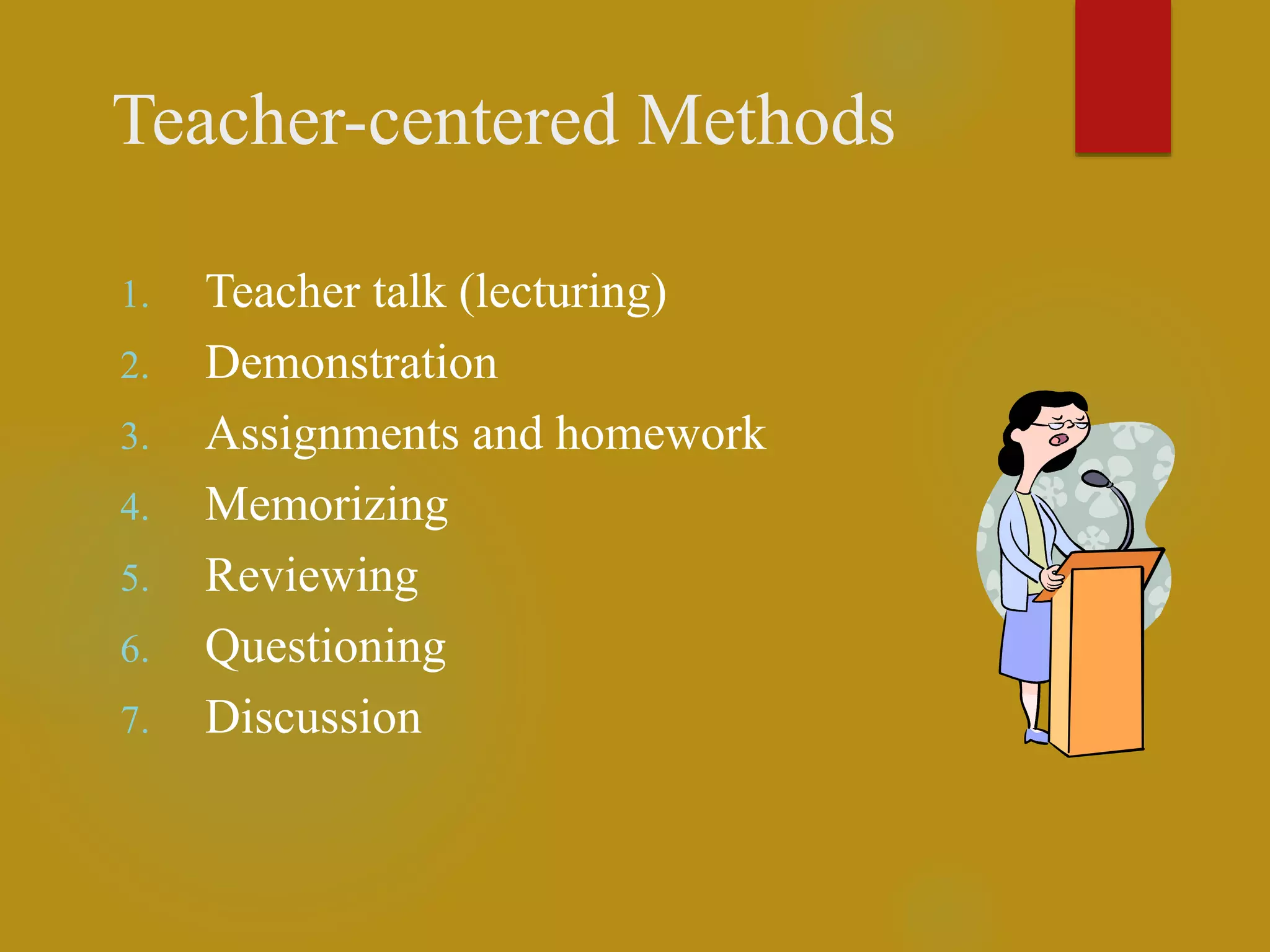
Teacher-centered Methods
1. Teacher talk (lecturing)
2. Demonstration
3. Assignments and homework
4. Memorizing
5. Reviewing
6. Questioning
7. Discussion
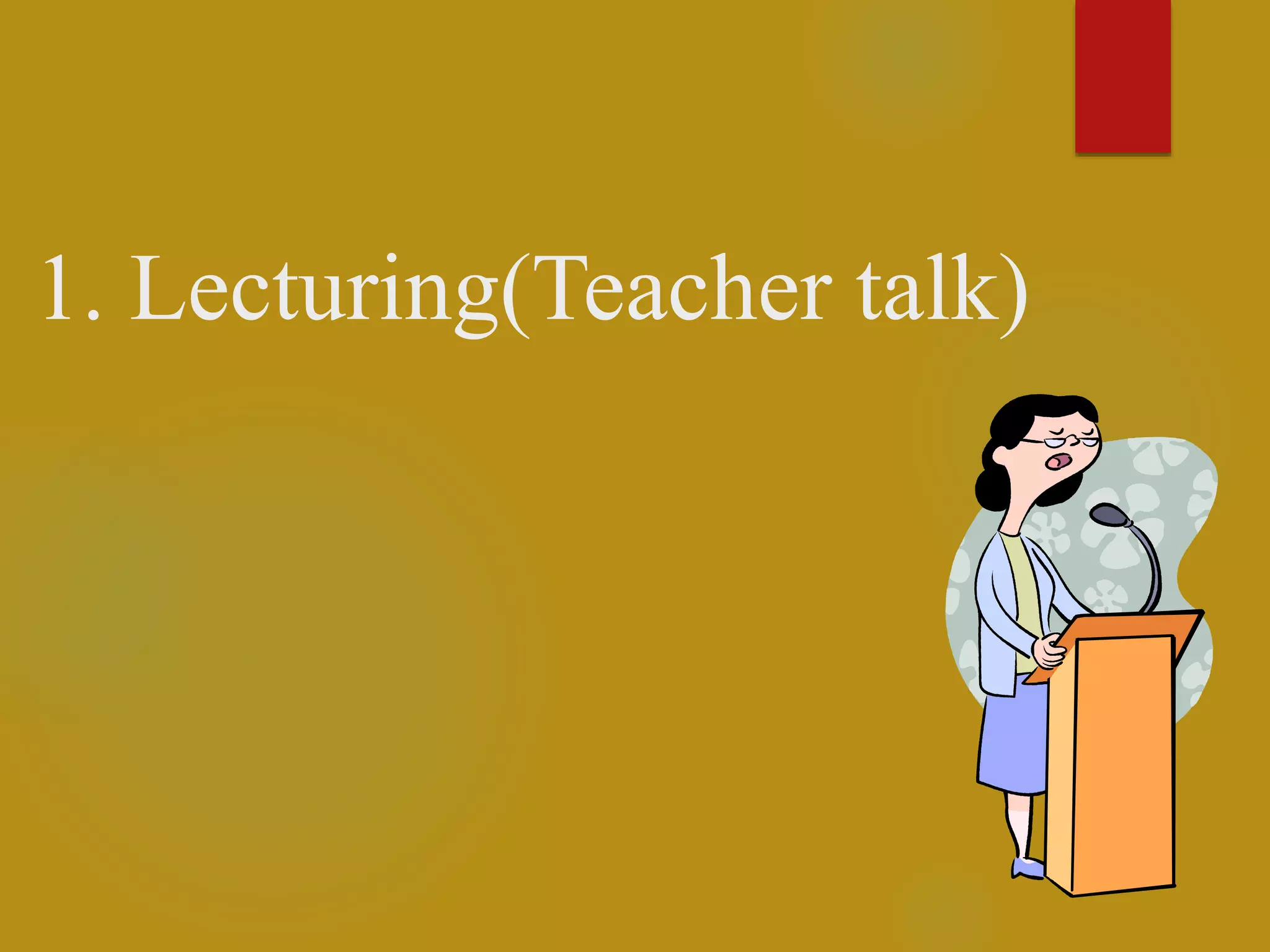
1. Lecturing(Teacher talk)
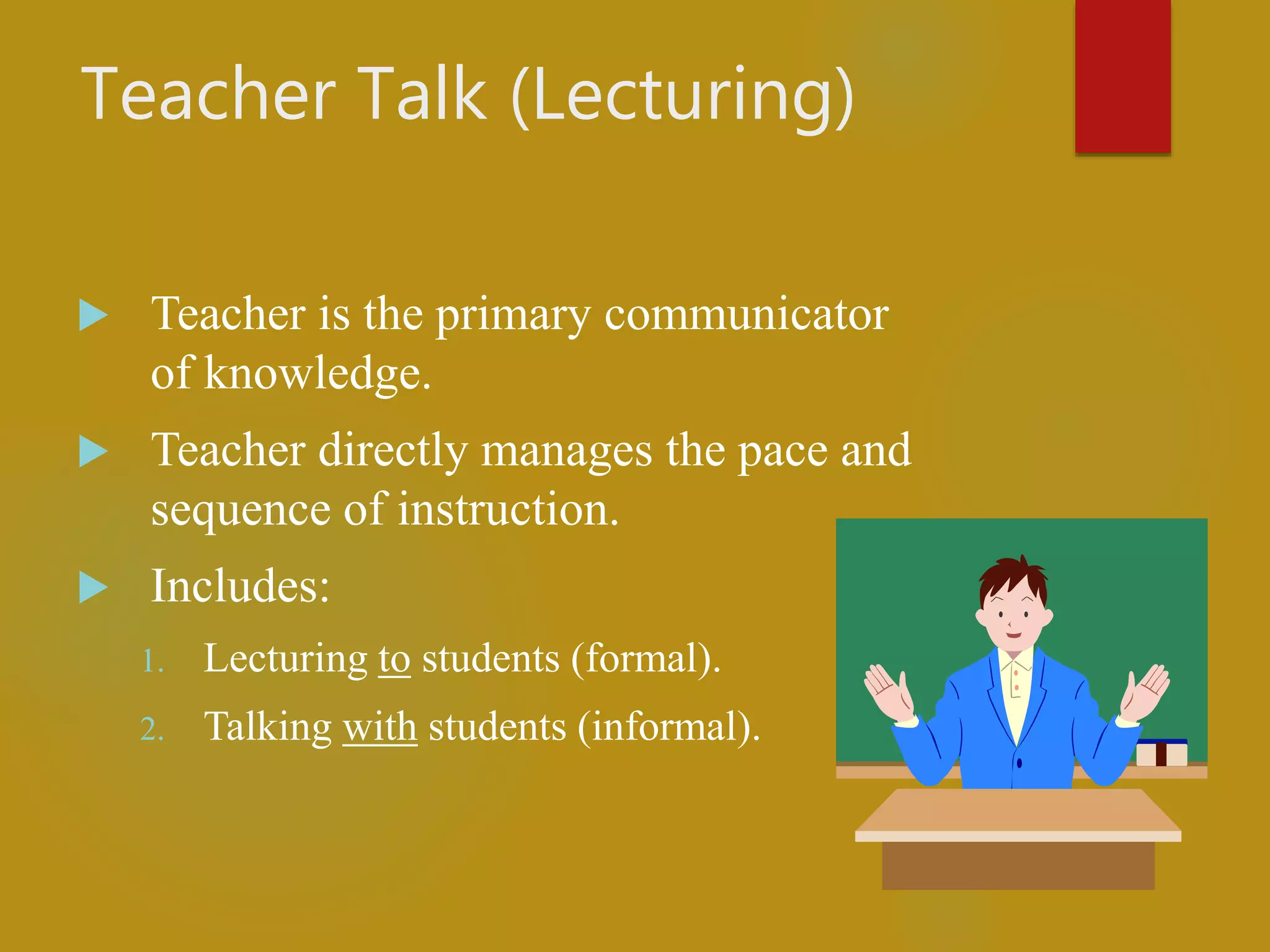
Teacher Talk (Lecturing)
 Teacher is the primary communicator
of knowledge.
 Teacher directly manages the pace and
sequence of instruction.
 Includes:
1. Lecturing to students (formal).
2. Talking with students (informal).
Teacher Talk (Lecturing)
 Remember that:
 You can “teach at” students, but this does not ensure
students have learned the material.
 You must monitor students to ensure that you have not
lectured too long.
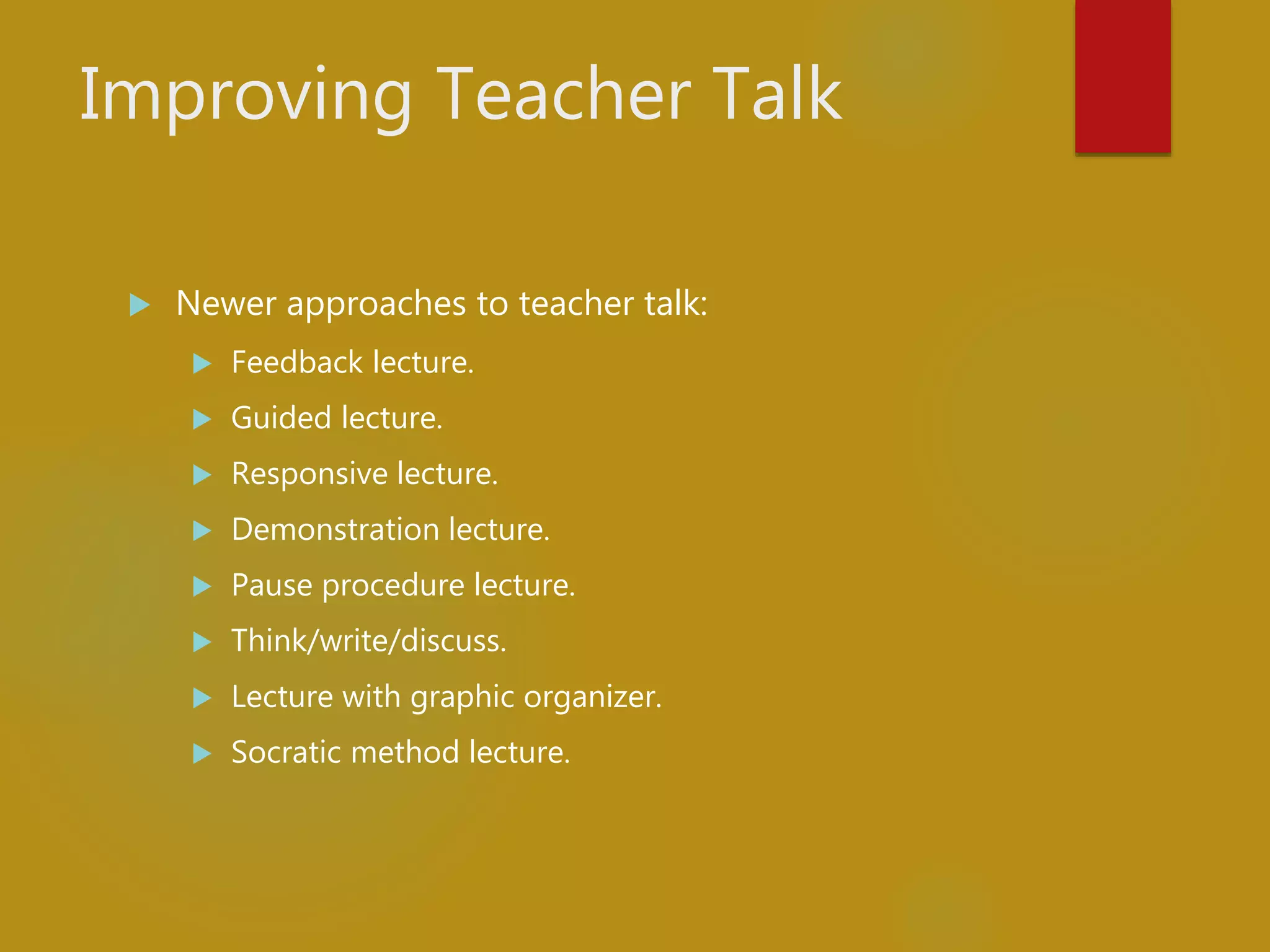
Improving Teacher Talk
 Newer approaches to teacher talk:
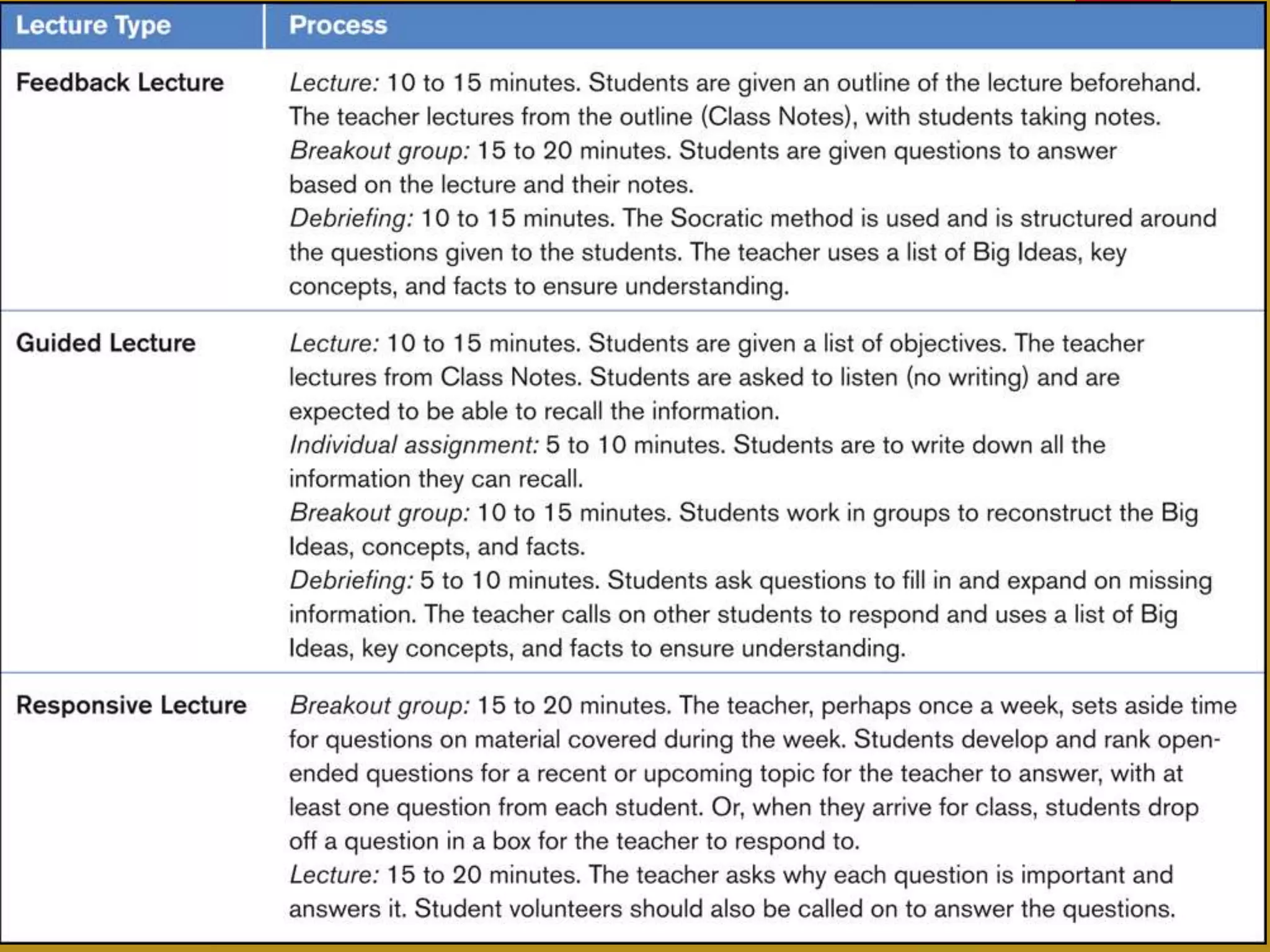
 Feedback lecture.
 Guided lecture.
 Responsive lecture.
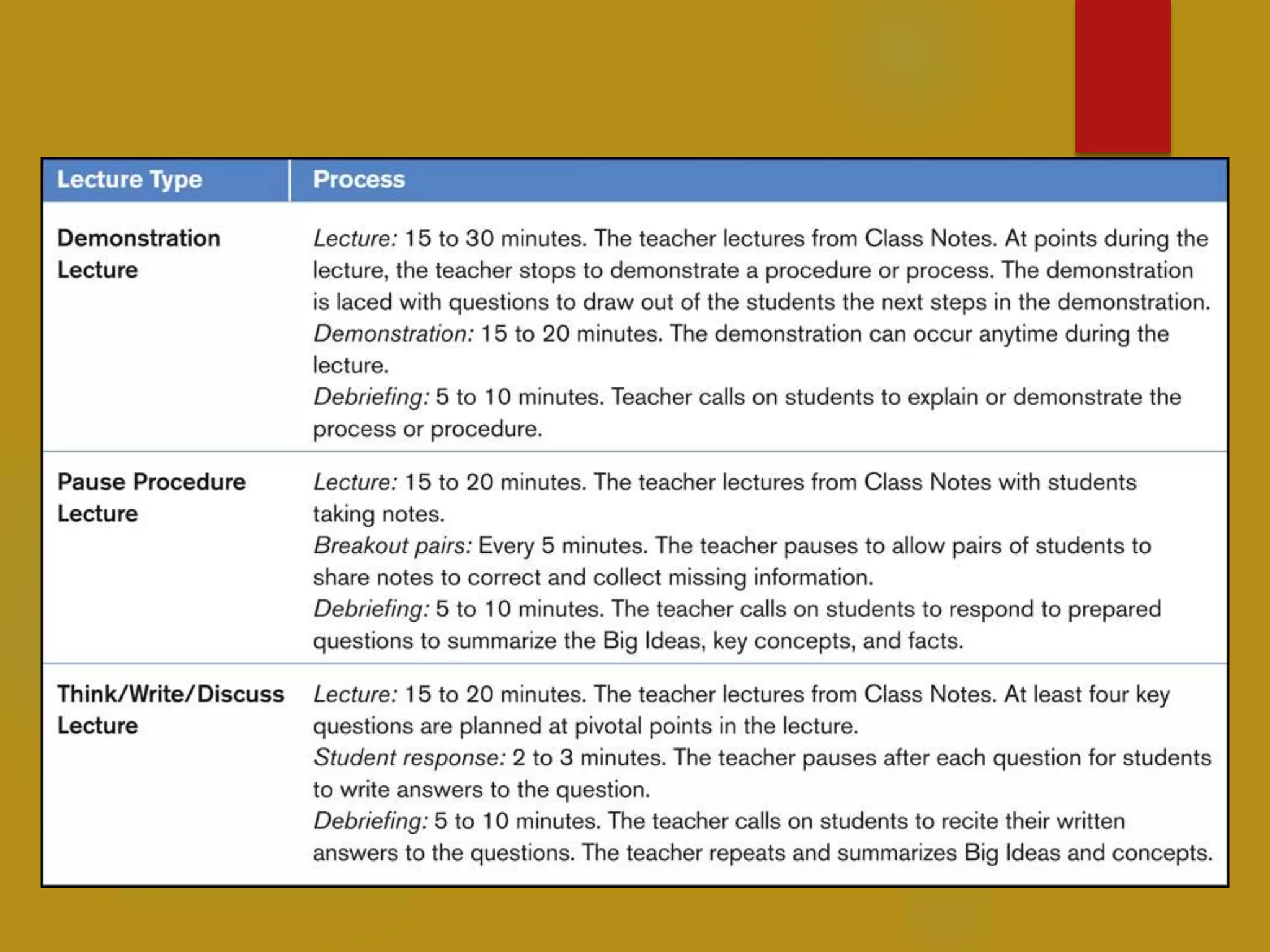
 Demonstration lecture.
 Pause procedure lecture.
 Think/write/discuss.
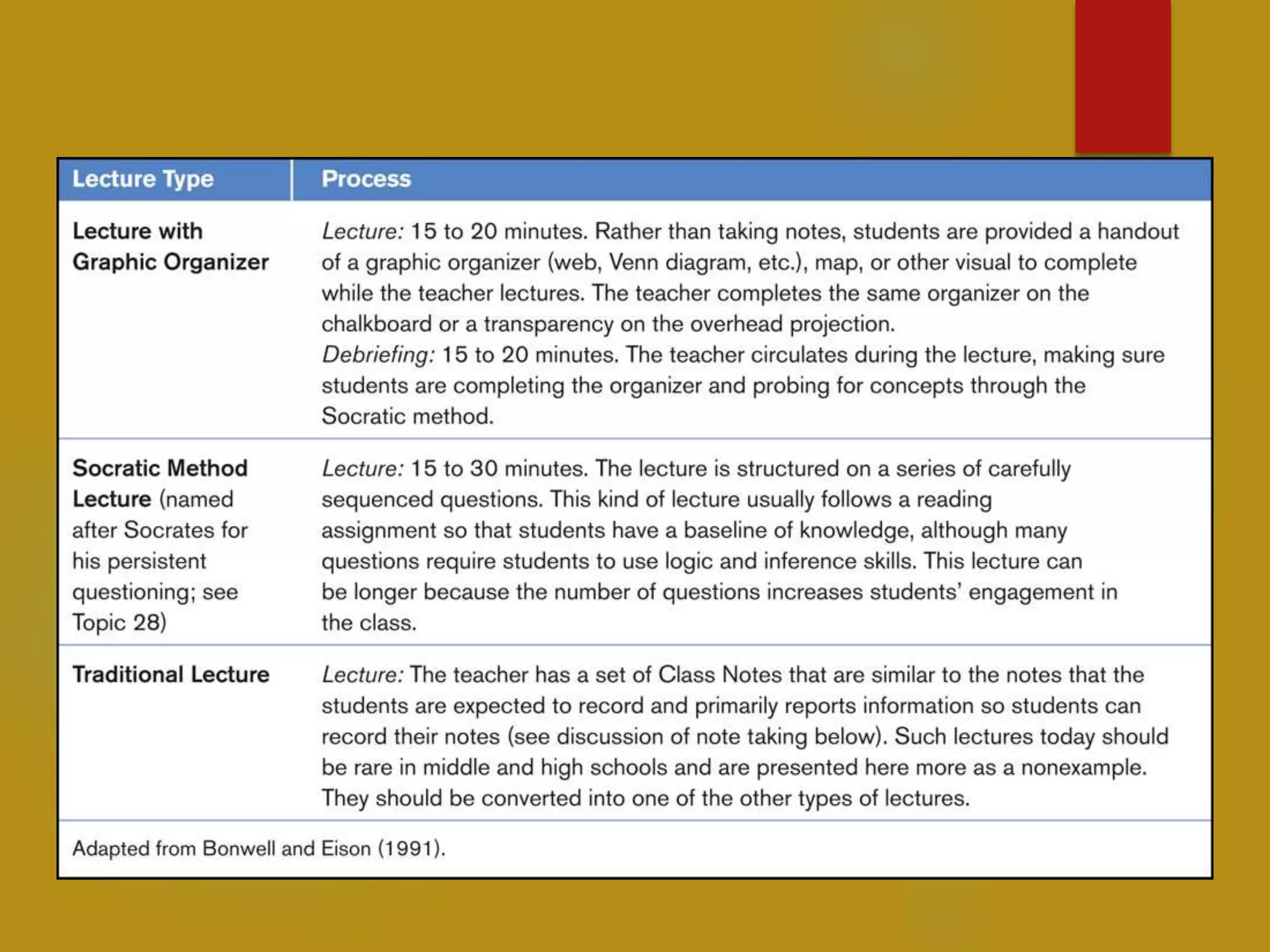
 Lecture with graphic organizer.
 Socratic method lecture.
Improving Lectures
 Conduct lectures more as discussions.
 Integrate different types of lectures and organizing
patterns.
 Integrate visuals and manipulatives into the lecture.
Guidelines When Lecturing
 Have a beginning, end, and logical order.
 Reinforce with visuals.
 Encourage student participation.
 Have a clear ending, followed by activity.
 Keep teacher talk short.
 Keep pace relatively quick.
Guidelines When Lecturing
 Prepare notes/outline. Do not read lecture!
 Guide students in note-taking (what is important?).
 Don’t just summarize textbook, or students will not
read it. Augment and supplement.
 Move about the room when lecturing.
 Explain vocabulary as you go (prefix, root word, suffix).
Remember that all teachers are language arts teachers!
Guidelines When Lecturing
 Use examples and analogies to bridge
knowledge.
 Establish and maintain eye contact.
 Develops rapport and help with classroom
management.
 Don’t talk too fast.
 Make sure you can be heard and understood.
 Avoid monotone.
2.Demonstration
Demonstration
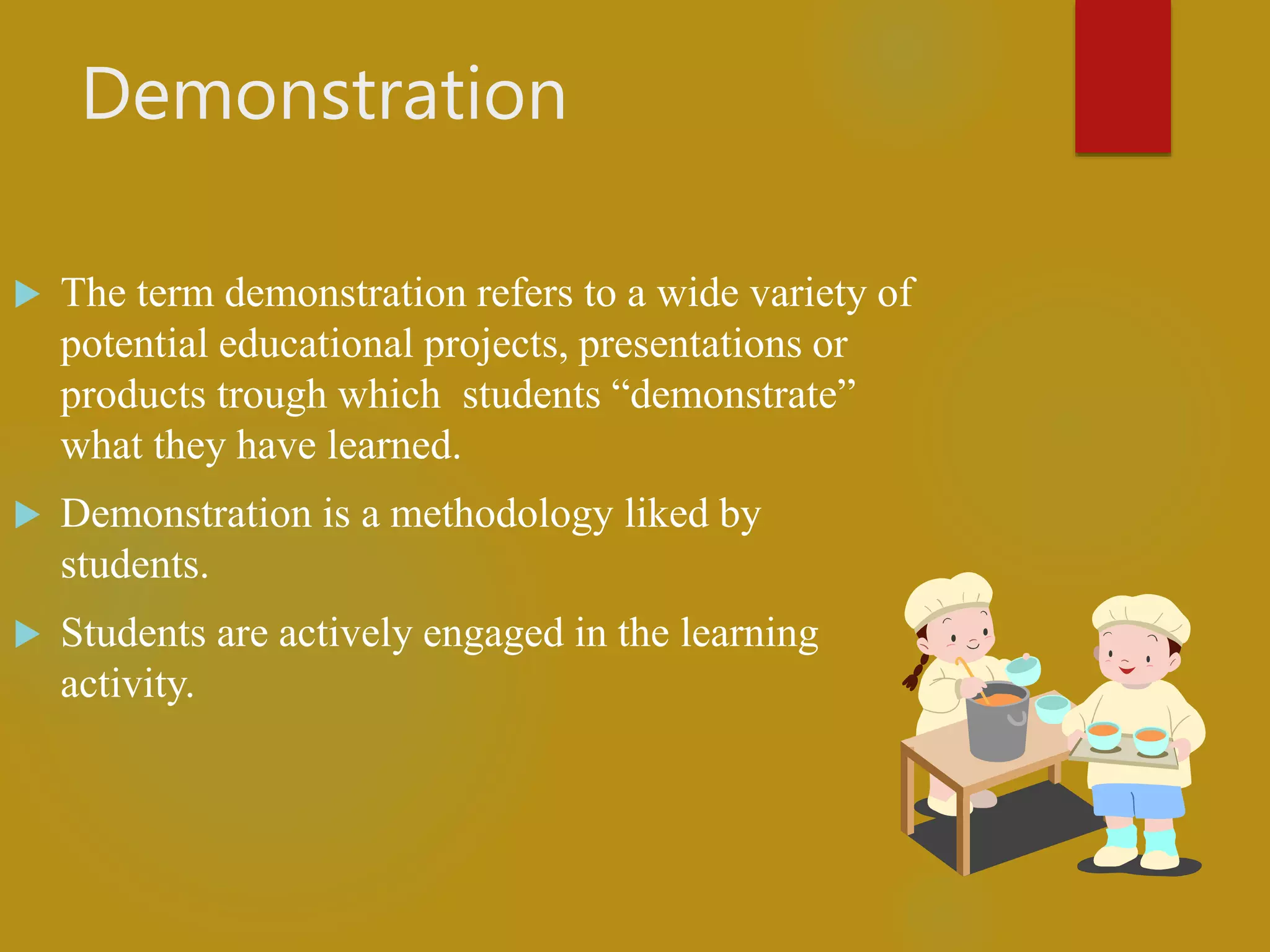
 The term demonstration refers to a wide variety of
potential educational projects, presentations or
products trough which students “demonstrate”
what they have learned.
 Demonstration is a methodology liked by
students.
 Students are actively engaged in the learning
activity.
Guidelines when
Demonstrating
 Decide the most effective way to conduct the demo:
 Teacher.
 Teacher with student helper.
 Student.
 Entire class OR small groups.
 Teacher first, then small groups repeat.
Guidelines when
Demonstrating
 Make sure the demonstration is visible to all students.
 Have a plan B.
 Model proper safety precautions.
Assignments and
Homework
Assignments and Homework
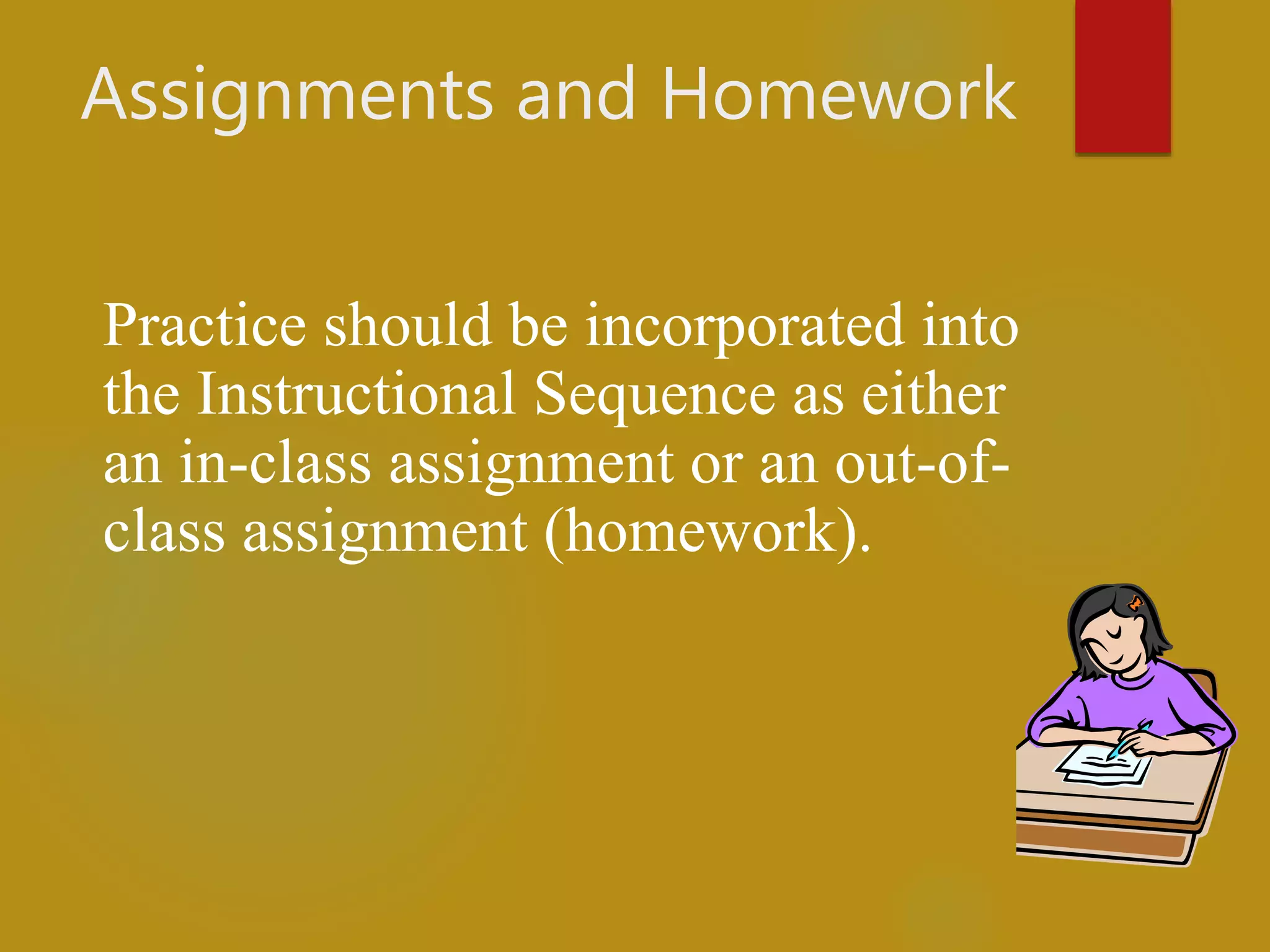
Practice should be incorporated into
the Instructional Sequence as either
an in-class assignment or an out-of-
class assignment (homework).
Types of Practice
 Independent Practice can take place in school or as homework.
 The student is expected to complete the task without (or with very
little) assistance from the teacher, other students, or anyone else.
 Independent Practice is also graded.
 Guided Practice ALWAYS takes place at school in a classroom,
library, studio, laboratory, or computer room, where the teacher can
observe and give feedback.
 The teacher actively interacts with students, providing “over-the-
shoulder instruction” to an individual or group.
 Tasks are graded.
Benefits of Homework
 Improves academic performance & study habits.
 Develops autonomy and self-discipline.
 Promotes efficiency by effectively using both the
classroom and the home for learning.
 Facilitates parental involvement in children’s
education.
Memorizing
Memorizing
 Sometimes students must memorize things,
even without much understanding.
Language  alphabet
Math  numbering system
Chemistry  common element symbols
Play trumpet  fingerings
Guidelines for Memorizing
 Avoid overuse of memorizing.
 If possible, have students understand meaning
before memorizing.
 Use mnemonics to aid students in
memorization.
Reviewing
Reviewing
In general, reviewing is a positive and
necessary practice.
Recall is improved.
Understanding is improved by
strengthening semantic networks.
Alternative Review Techniques
 Student summaries
 Quiz games (Jeopardy)
 Discussion
 Broad questioning
 Dramatizations
 Application problems
Questioning
Questioning
 It is an interrogative expression often used to test
knowledge.
 Well-formed questions help students develop their critical
thinking skills.
 Provides an opportunity for students to elaborate and adjust
their responses based on their interaction with the teacher
and other students, as well as to put forth unique insights.
 It is one of the easiest way to convert instructions from
passive to active learning experience, but it must be
planned
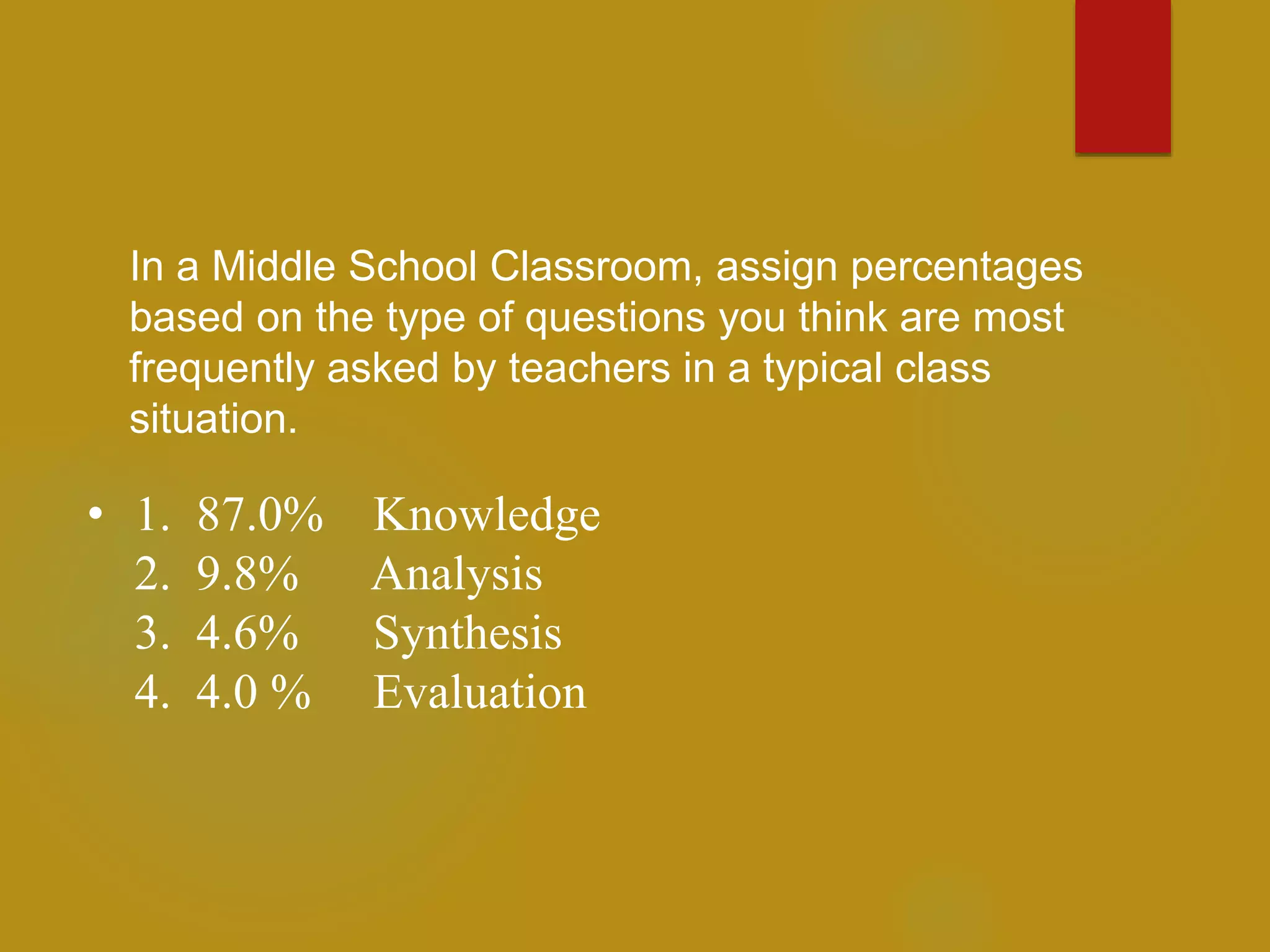
• 1. 87.0% Knowledge
2. 9.8% Analysis
3. 4.6% Synthesis
4. 4.0 % Evaluation
In a Middle School Classroom, assign percentages
based on the type of questions you think are most
frequently asked by teachers in a typical class
situation.
Best Practices for
Questioning
1. Create and announce your questioning Framework
at the first class.
2. Use wait time. If a student doesn’t answer, then:
a) Repeat the question.
b) Rephrase the question.
c) Simplify the question.
d) Ask a student to attempt to rephrase your question.
e) Break the question down into its component parts.
f) Make your question more specific.
g) Ask students what it is about the question that they are
finding difficult. Try to elicit some kind of a answer; don’t
just move on to another student.
Best Practices for Questioning
8. Encourage students to answer to the class, not just to you.
9. Form questions that are precise and definite, not ambiguous.
10. Encourage students to ask qualifying questions.
11. Keep questions short and to the point.
12. Do not ask for trivial information.
13. Hold students accountable by expecting, requiring, and facilitating
their participation and contributions.
14. Never answer your own questions! If the students know you will
give them the answers after a few seconds of silence anyway, there
isn’t an incentive.
Discussion
Discussion
 Leading an effective discussion can be one of the most
difficult tasks of teaching.
 It requires a commitment to a shared dialogue with the
students and great restraint by the teacher, who naturally
wants to work through his or her planned lesson.
Best Practices in Discussion
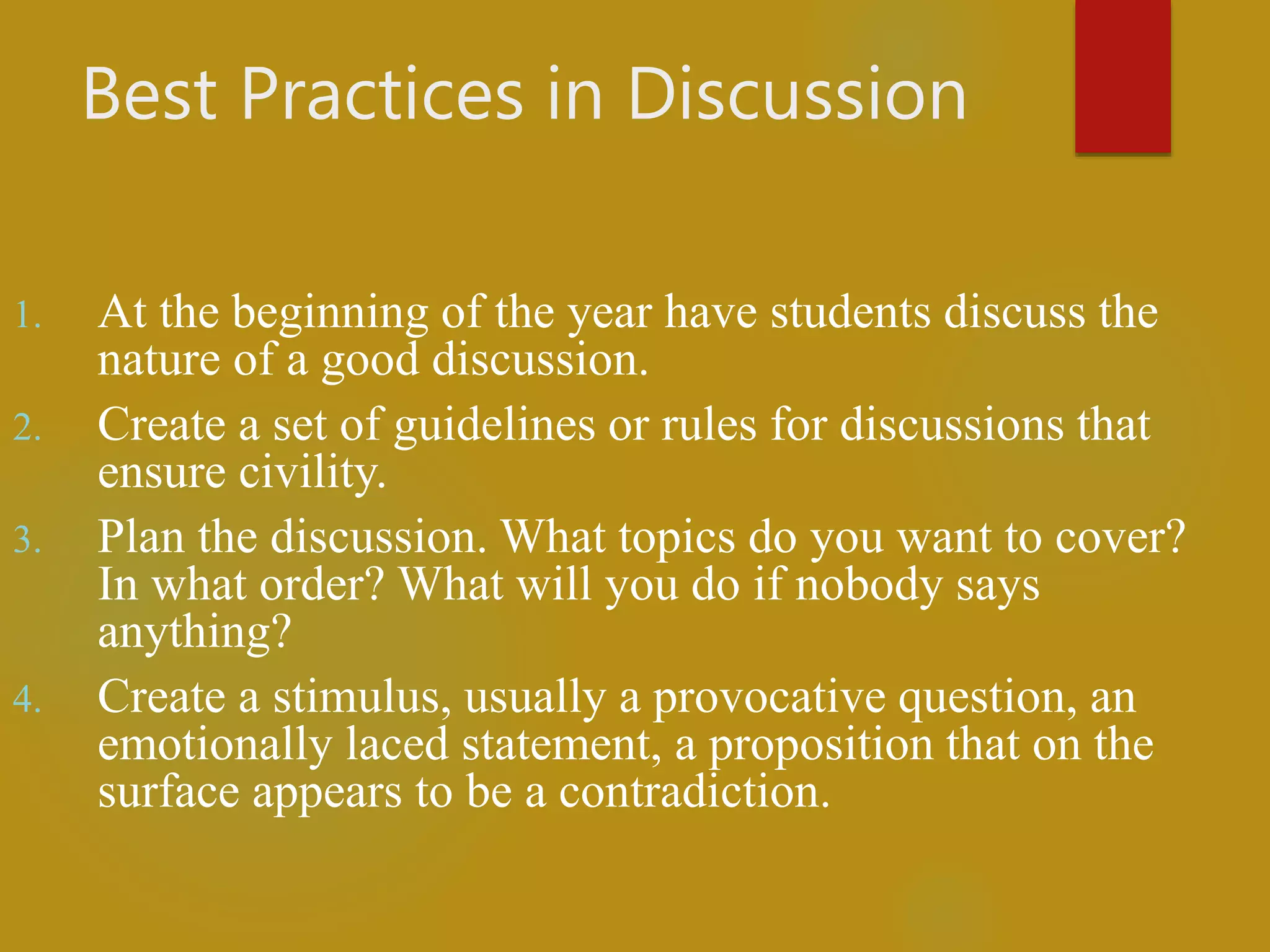
1. At the beginning of the year have students discuss the
nature of a good discussion.
2. Create a set of guidelines or rules for discussions that
ensure civility.
3. Plan the discussion. What topics do you want to cover?
In what order? What will you do if nobody says
anything?
4. Create a stimulus, usually a provocative question, an
emotionally laced statement, a proposition that on the
surface appears to be a contradiction.
Best Practices in Discussion
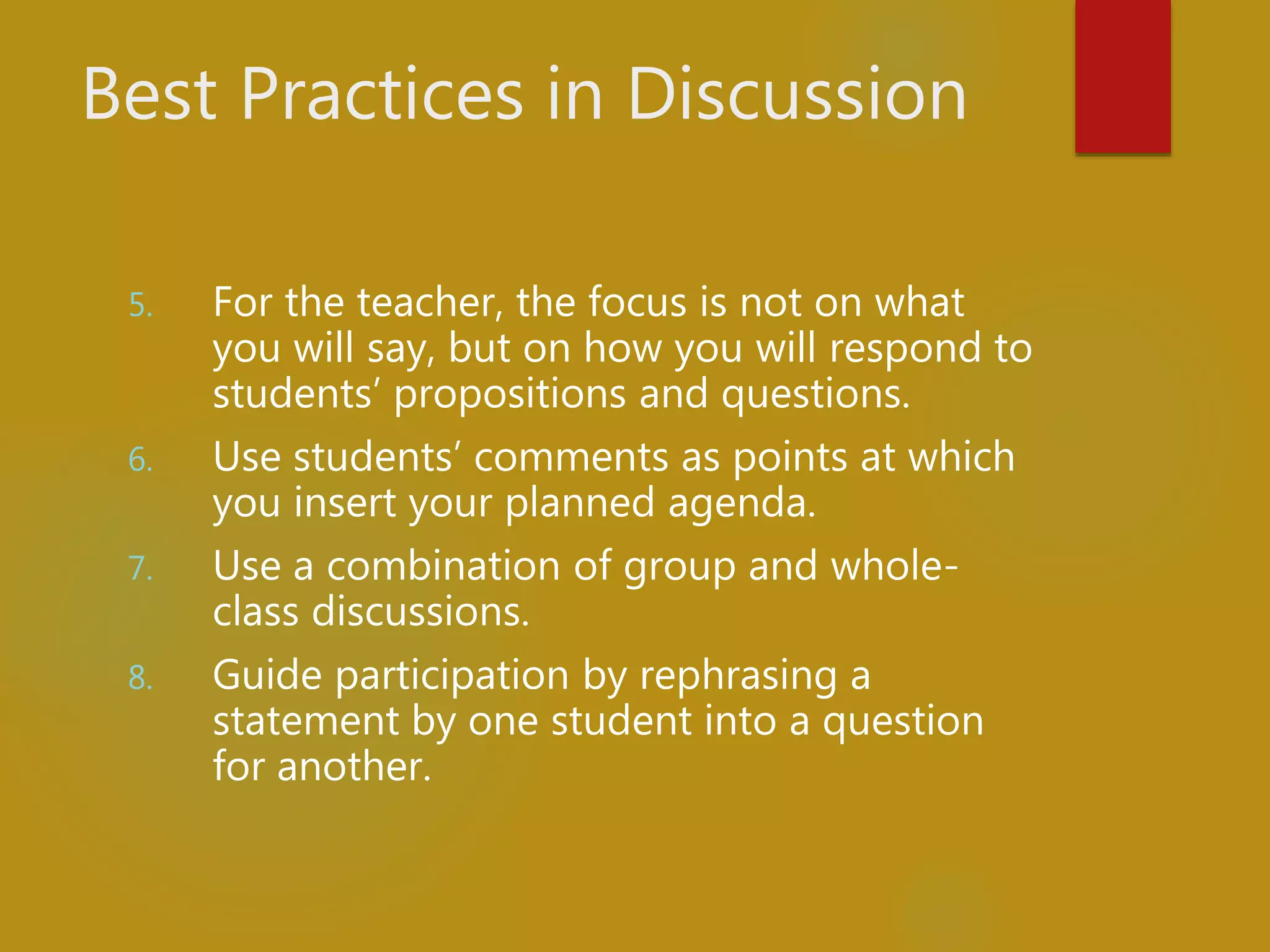
5. For the teacher, the focus is not on what
you will say, but on how you will respond to
students’ propositions and questions.
6. Use students’ comments as points at which
you insert your planned agenda.
7. Use a combination of group and whole-
class discussions.
8. Guide participation by rephrasing a
statement by one student into a question
for another.
Best Practices in Discussion
9. If a class discussion is not going well
due to lack of energy or enthusiasm,
stop and discuss the situation with
the students.
10. Discussion must be based on
substantial knowledge.
11. Rather than respond, ask another
student what he or she thinks.
Tips
Teacher’s Tip
Don’t assume because it is a
whole-class activity that you must
lead the discussion. As an
alternative, consider having one or
two students lead the discussion
while you join the class by taking a
seat in one of the students’ desks.
Teacher’s Tip
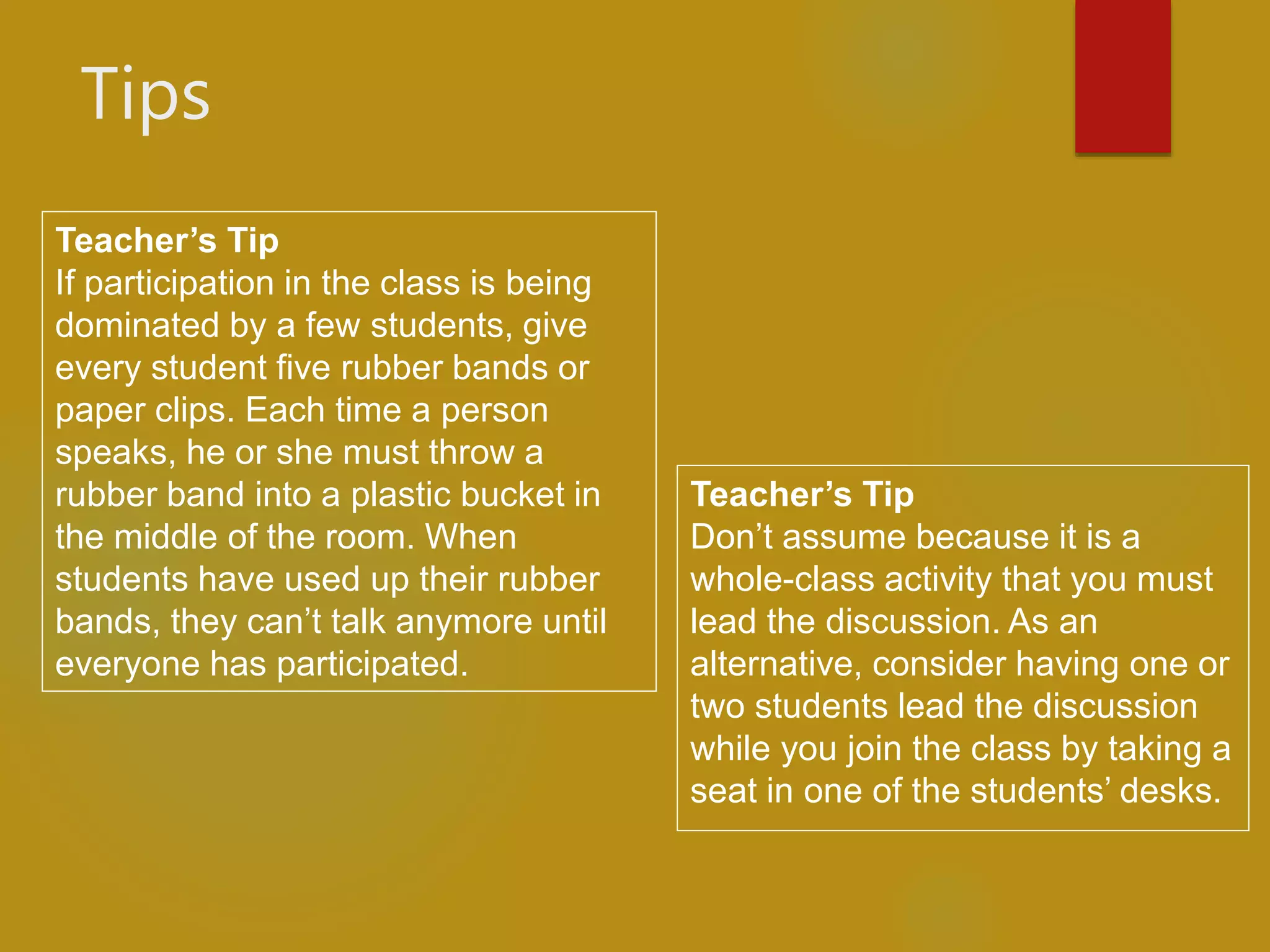
If participation in the class is being
dominated by a few students, give
every student five rubber bands or
paper clips. Each time a person
speaks, he or she must throw a
rubber band into a plastic bucket in
the middle of the room. When
students have used up their rubber
bands, they can’t talk anymore until
everyone has participated.

Teacher centered instructional methodsstrategies

  • 1.
  • 3.
    Group No. 2 Members IsraAshraf (F16-BSAP-010) Muhmmad Salman (F16-BSAP-012) Sania Kausar (F16-BSAP-014) Toshiba Shehbaz (F16-BSAP-021) Shehla Aslam (F16-BSAP-025)
  • 4.
    Teacher-centered Methods 1. Teachertalk (lecturing) 2. Demonstration 3. Assignments and homework 4. Memorizing 5. Reviewing 6. Questioning 7. Discussion
  • 5.
  • 6.
    Teacher Talk (Lecturing) Teacher is the primary communicator of knowledge.  Teacher directly manages the pace and sequence of instruction.  Includes: 1. Lecturing to students (formal). 2. Talking with students (informal).
  • 7.
    Teacher Talk (Lecturing) Remember that:  You can “teach at” students, but this does not ensure students have learned the material.  You must monitor students to ensure that you have not lectured too long.
  • 8.
    Improving Teacher Talk Newer approaches to teacher talk:  Feedback lecture.  Guided lecture.  Responsive lecture.  Demonstration lecture.  Pause procedure lecture.  Think/write/discuss.  Lecture with graphic organizer.  Socratic method lecture.
  • 12.
    Improving Lectures  Conductlectures more as discussions.  Integrate different types of lectures and organizing patterns.  Integrate visuals and manipulatives into the lecture.
  • 13.
    Guidelines When Lecturing Have a beginning, end, and logical order.  Reinforce with visuals.  Encourage student participation.  Have a clear ending, followed by activity.  Keep teacher talk short.  Keep pace relatively quick.
  • 14.
    Guidelines When Lecturing Prepare notes/outline. Do not read lecture!  Guide students in note-taking (what is important?).  Don’t just summarize textbook, or students will not read it. Augment and supplement.  Move about the room when lecturing.  Explain vocabulary as you go (prefix, root word, suffix). Remember that all teachers are language arts teachers!
  • 15.
    Guidelines When Lecturing Use examples and analogies to bridge knowledge.  Establish and maintain eye contact.  Develops rapport and help with classroom management.  Don’t talk too fast.  Make sure you can be heard and understood.  Avoid monotone.
  • 16.
  • 17.
    Demonstration  The termdemonstration refers to a wide variety of potential educational projects, presentations or products trough which students “demonstrate” what they have learned.  Demonstration is a methodology liked by students.  Students are actively engaged in the learning activity.
  • 18.
    Guidelines when Demonstrating  Decidethe most effective way to conduct the demo:  Teacher.  Teacher with student helper.  Student.  Entire class OR small groups.  Teacher first, then small groups repeat.
  • 19.
    Guidelines when Demonstrating  Makesure the demonstration is visible to all students.  Have a plan B.  Model proper safety precautions.
  • 20.
  • 21.
    Assignments and Homework Practiceshould be incorporated into the Instructional Sequence as either an in-class assignment or an out-of- class assignment (homework).
  • 22.
    Types of Practice Independent Practice can take place in school or as homework.  The student is expected to complete the task without (or with very little) assistance from the teacher, other students, or anyone else.  Independent Practice is also graded.  Guided Practice ALWAYS takes place at school in a classroom, library, studio, laboratory, or computer room, where the teacher can observe and give feedback.  The teacher actively interacts with students, providing “over-the- shoulder instruction” to an individual or group.  Tasks are graded.
  • 23.
    Benefits of Homework Improves academic performance & study habits.  Develops autonomy and self-discipline.  Promotes efficiency by effectively using both the classroom and the home for learning.  Facilitates parental involvement in children’s education.
  • 24.
  • 25.
    Memorizing  Sometimes studentsmust memorize things, even without much understanding. Language  alphabet Math  numbering system Chemistry  common element symbols Play trumpet  fingerings
  • 26.
    Guidelines for Memorizing Avoid overuse of memorizing.  If possible, have students understand meaning before memorizing.  Use mnemonics to aid students in memorization.
  • 27.
  • 28.
    Reviewing In general, reviewingis a positive and necessary practice. Recall is improved. Understanding is improved by strengthening semantic networks.
  • 29.
    Alternative Review Techniques Student summaries  Quiz games (Jeopardy)  Discussion  Broad questioning  Dramatizations  Application problems
  • 30.
  • 31.
    Questioning  It isan interrogative expression often used to test knowledge.  Well-formed questions help students develop their critical thinking skills.  Provides an opportunity for students to elaborate and adjust their responses based on their interaction with the teacher and other students, as well as to put forth unique insights.  It is one of the easiest way to convert instructions from passive to active learning experience, but it must be planned
  • 32.
    • 1. 87.0%Knowledge 2. 9.8% Analysis 3. 4.6% Synthesis 4. 4.0 % Evaluation In a Middle School Classroom, assign percentages based on the type of questions you think are most frequently asked by teachers in a typical class situation.
  • 33.
    Best Practices for Questioning 1.Create and announce your questioning Framework at the first class. 2. Use wait time. If a student doesn’t answer, then: a) Repeat the question. b) Rephrase the question. c) Simplify the question. d) Ask a student to attempt to rephrase your question. e) Break the question down into its component parts. f) Make your question more specific. g) Ask students what it is about the question that they are finding difficult. Try to elicit some kind of a answer; don’t just move on to another student.
  • 34.
    Best Practices forQuestioning 8. Encourage students to answer to the class, not just to you. 9. Form questions that are precise and definite, not ambiguous. 10. Encourage students to ask qualifying questions. 11. Keep questions short and to the point. 12. Do not ask for trivial information. 13. Hold students accountable by expecting, requiring, and facilitating their participation and contributions. 14. Never answer your own questions! If the students know you will give them the answers after a few seconds of silence anyway, there isn’t an incentive.
  • 35.
  • 36.
    Discussion  Leading aneffective discussion can be one of the most difficult tasks of teaching.  It requires a commitment to a shared dialogue with the students and great restraint by the teacher, who naturally wants to work through his or her planned lesson.
  • 37.
    Best Practices inDiscussion 1. At the beginning of the year have students discuss the nature of a good discussion. 2. Create a set of guidelines or rules for discussions that ensure civility. 3. Plan the discussion. What topics do you want to cover? In what order? What will you do if nobody says anything? 4. Create a stimulus, usually a provocative question, an emotionally laced statement, a proposition that on the surface appears to be a contradiction.
  • 38.
    Best Practices inDiscussion 5. For the teacher, the focus is not on what you will say, but on how you will respond to students’ propositions and questions. 6. Use students’ comments as points at which you insert your planned agenda. 7. Use a combination of group and whole- class discussions. 8. Guide participation by rephrasing a statement by one student into a question for another.
  • 39.
    Best Practices inDiscussion 9. If a class discussion is not going well due to lack of energy or enthusiasm, stop and discuss the situation with the students. 10. Discussion must be based on substantial knowledge. 11. Rather than respond, ask another student what he or she thinks.
  • 40.
    Tips Teacher’s Tip Don’t assumebecause it is a whole-class activity that you must lead the discussion. As an alternative, consider having one or two students lead the discussion while you join the class by taking a seat in one of the students’ desks. Teacher’s Tip If participation in the class is being dominated by a few students, give every student five rubber bands or paper clips. Each time a person speaks, he or she must throw a rubber band into a plastic bucket in the middle of the room. When students have used up their rubber bands, they can’t talk anymore until everyone has participated.