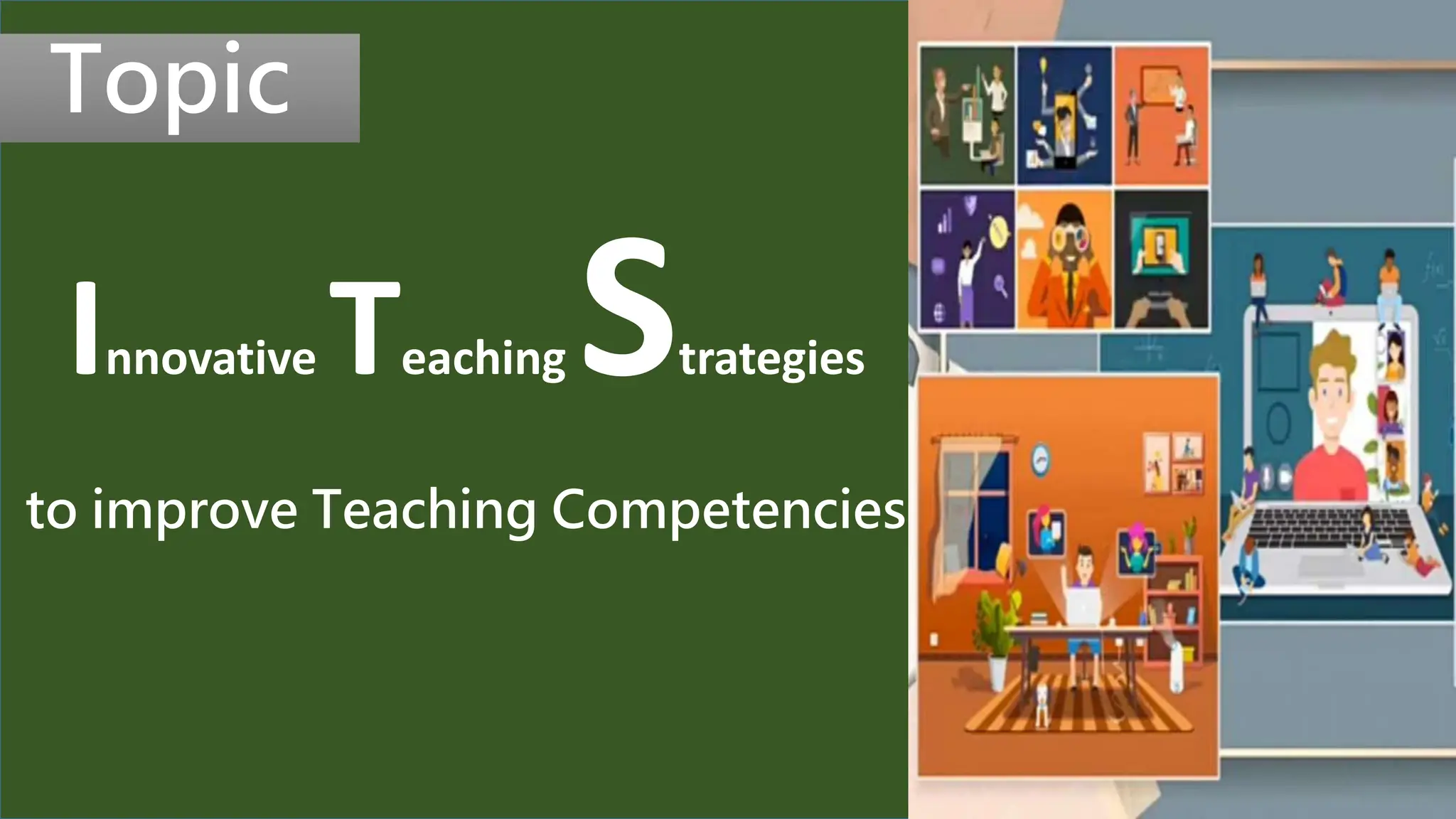
Innovative Teaching Strategies
to improve Teaching Competencies
Topic
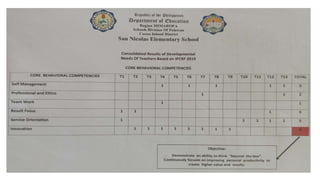
To enhance teaching strategies through
innovative way to improve teaching
competencies.
Objective
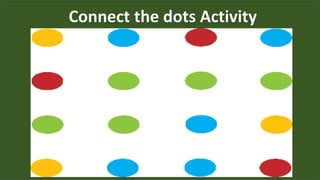
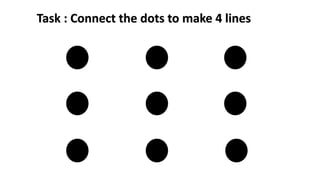
Connect the dots Activity
Task : Connect the dots to make 4 lines
Is the process of proactively
introducing new teaching strategies
and methods in classroom.
What is Innovative Teaching?
Develops Globally competitive Learners .
Creates Life long Learners.
Helps maintain the motivation to learn.
Encourage deeper learning compared to
surface learning.
Benefits of Innovative Teaching
 Innovative teachers is lifelong learners
 Innovative teachers are willing to go out and learn new tricks
,expanding their own toolkit.
 Innovative teachers inspire others.
 Innovative teacher learns for the sake of learning
 Innovative teacher are responsible for instilling innovative
thinking in the children they teach.
 Innovative teachers think of how to do things better and they
practice.
How to become Innovative Teacher?
If a child can’t learn the way we teach , may be
should teach the way they learn”.
-Ignacio Nacho Estrada
Innovative Teaching Techniques/Strategies
Partners have to get
untangled, without removing
tapes manually or cutting the
tape or removing the knots of
the tape or removing each
others tape.
Rope trick Activity
Rope trick Activity
There’s solution
to
a problem.
Rope trick Activity
Innovative Teaching
Techniques/Strategies to
improve competencies
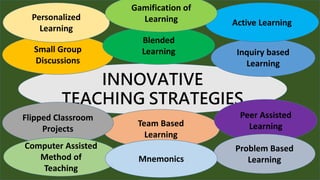
INNOVATIVE
TEACHING STRATEGIES
Team Based
Learning
Small Group
Discussions
Flipped Classroom
Projects
Computer Assisted
Method of
Teaching
Personalized
Learning
Inquiry based
Learning
Peer Assisted
Learning
Blended
Learning
Active Learning
Problem Based
Learning
Mnemonics
Gamification of
Learning
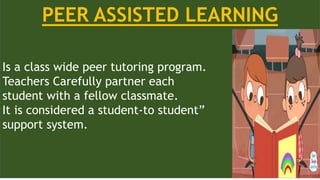
Is a class wide peer tutoring program.
Teachers Carefully partner each
student with a fellow classmate.
It is considered a student-to student”
support system.
PEER ASSISTED LEARNING
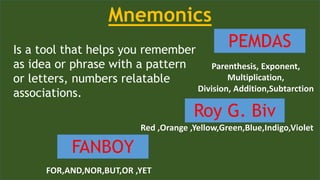
Is a tool that helps you remember
as idea or phrase with a pattern
or letters, numbers relatable
associations.
Mnemonics
PEMDAS
Roy G. Biv
FANBOY
Parenthesis, Exponent,
Multiplication,
Division, Addition,Subtarction
Red ,Orange ,Yellow,Green,Blue,Indigo,Violet
FOR,AND,NOR,BUT,OR ,YET
A total education strategy based on the principle of
using the real- world problems as a starting point for
the acquisition and integration of new knowledge.
It can promote the development of critical thinking
skills ,problem solving abilities and communication
skills
PROJECT –BASED LEARNING
It can also provide opportunities for working in
groups ,finding and evaluating research materials and
life-long learning.
During the process each student takes on a role within
the group that may be formal or informal and the role
often alternates. It focused on the student’s reflection
and reasoning to construct their own learning.
PROJECT –BASED LEARNING
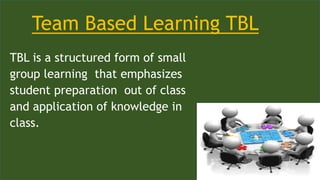
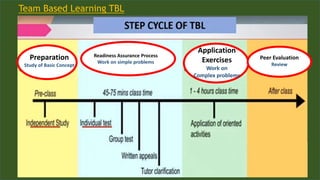
Team Based Learning TBL
TBL is a structured form of small
group learning that emphasizes
student preparation out of class
and application of knowledge in
class.
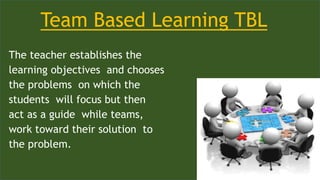
Team Based Learning TBL
The teacher establishes the
learning objectives and chooses
the problems on which the
students will focus but then
act as a guide while teams,
work toward their solution to
the problem.
Team Based Learning TBL
Preparation
Study of Basic Concept
Readiness Assurance Process
Work on simple problems
Application
Exercises
Work on
Complex problems
Peer Evaluation
Review
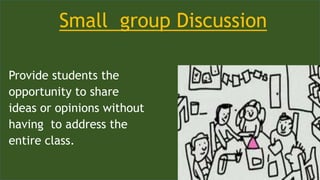
Small group Discussion
Provide students the
opportunity to share
ideas or opinions without
having to address the
entire class.
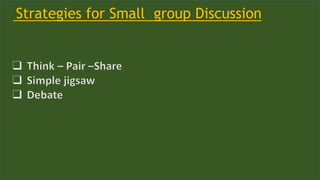
Strategies for Small group Discussion
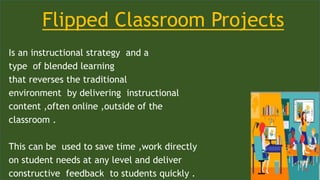
Flipped Classroom Projects
Is an instructional strategy and a
type of blended learning
that reverses the traditional
environment by delivering instructional
content ,often online ,outside of the
classroom .
This can be used to save time ,work directly
on student needs at any level and deliver
constructive feedback to students quickly .
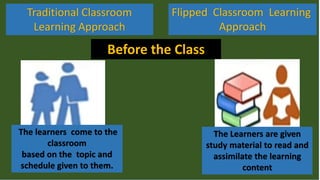
Traditional Classroom
Learning Approach
Flipped Classroom Learning
Approach
Before the Class
The learners come to the
classroom
based on the topic and
schedule given to them.
The Learners are given
study material to read and
assimilate the learning
content
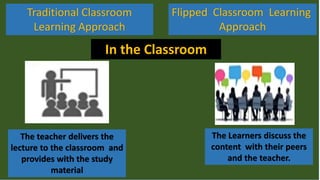
Traditional Classroom
Learning Approach
Flipped Classroom Learning
Approach
In the Classroom
The teacher delivers the
lecture to the classroom and
provides with the study
material
The Learners discuss the
content with their peers
and the teacher.
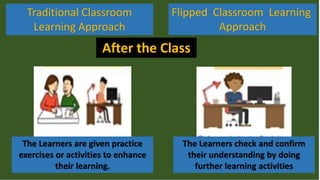
Traditional Classroom
Learning Approach
Flipped Classroom Learning
Approach
After the Class
The Learners are given practice
exercises or activities to enhance
their learning.
The Learners check and confirm
their understanding by doing
further learning activities
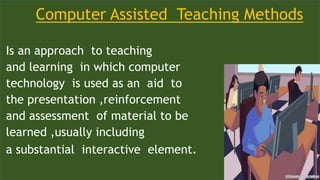
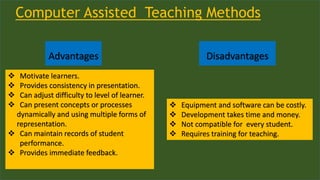
Computer Assisted Teaching Methods
Is an approach to teaching
and learning in which computer
technology is used as an aid to
the presentation ,reinforcement
and assessment of material to be
learned ,usually including
a substantial interactive element.
Computer Assisted Teaching Methods
Advantages Disadvantages
 Motivate learners.
 Provides consistency in presentation.
 Can adjust difficulty to level of learner.
 Can present concepts or processes
dynamically and using multiple forms of
representation.
 Can maintain records of student
performance.
 Provides immediate feedback.
 Equipment and software can be costly.
 Development takes time and money.
 Not compatible for every student.
 Requires training for teaching.
PERSONALIZED LEARNING
Adapts what, when and how we are teaching each
student. Instead of selecting a singular method or
strategy to teach the whole class, teachers adapt to the
strengths of each student to help them succeed.
Inquiry – Based Learning
Develops thinking and problem- solving skills. Instead
of driving the class through a lecture- style format,
the teacher poses questions, scenarios and problems.
Students then research these topics individually or in
groups to formulate their answer.
BLENDED LEARNING
Blended learning combines physical and online
learning experiences that give students more
control over the time , place, path ,and pace of
instruction
ACTIVE LEARNING
Active learning methods encourage students to
discuss ,contribute ,participate ,investigate and create
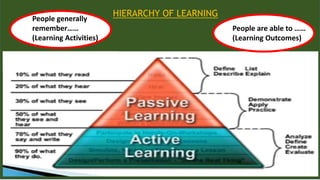
HIERARCHY OF LEARNING
People generally
remember……
(Learning Activities)
People are able to ……
(Learning Outcomes)
Application of game design elements to an educational
setting.
GAMIFICATION OF LEARNING
Board work
Choose and Answer
Pass the ball
Lean or Dab
Gestures Spills
Innovative Educational Activities
Puzzles
Pictionary
The crazyball games
Innovative Educational Activities
Scattergories
Making Sentences
Charades
Hedbanz/Pinoy Henyo
Whiteboard Bullseye
Puzzles
Paperball
In conclusion ,teacher should demonstrate the following competencies:
 Effective Classroom Management ,maximizing efficiency, maintaining
discipline and morale, promoting teamwork, planning, communicating,
focusing on results, evaluating progress, and making constant
adjustments. A range of strategies should be employed to promote
positive relationships, cooperation, and purposeful learning. Organizing ,
assigning, and managing time, space and activities should ensure the
active and equitable engagement of students in productive tasks.
 Effective Teaching Practices ,Multiple teaching and learning strategies
should help engage students in active learning opportunities that promote
the development of critical thinking, problem solving ,and performance
capabilities while helping them assume responsibility for identifying and
using learning resources.
 Effective assessment ,incorporating formal test ;responses to quizzes;
evaluation of classroom assignments, student performances and projects
,and standardized achievement tests to understand what students have
learned. Assessment strategies should be developed that involve
learners in self-assessment activities to help them become aware of
their strengths and needs and encourage them to set personal goals for
learning.
 Technology Skills, knowing when and how to use current educational
technology, as well as the most appropriate type and level of technology
to maximize student learning.
In conclusion ,teacher should demonstrate the following competencies:
Innovative Teaching strategies..........

Innovative Teaching strategies..........

  • 1.
    Innovative Teaching Strategies toimprove Teaching Competencies Topic
  • 3.
    To enhance teachingstrategies through innovative way to improve teaching competencies. Objective
  • 4.
  • 5.
    Task : Connectthe dots to make 4 lines
  • 6.
    Task : Connectthe dots to make 4 lines
  • 8.
    Is the processof proactively introducing new teaching strategies and methods in classroom. What is Innovative Teaching?
  • 9.
    Develops Globally competitiveLearners . Creates Life long Learners. Helps maintain the motivation to learn. Encourage deeper learning compared to surface learning. Benefits of Innovative Teaching
  • 11.
     Innovative teachersis lifelong learners  Innovative teachers are willing to go out and learn new tricks ,expanding their own toolkit.  Innovative teachers inspire others.  Innovative teacher learns for the sake of learning  Innovative teacher are responsible for instilling innovative thinking in the children they teach.  Innovative teachers think of how to do things better and they practice. How to become Innovative Teacher?
  • 12.
    If a childcan’t learn the way we teach , may be should teach the way they learn”. -Ignacio Nacho Estrada Innovative Teaching Techniques/Strategies
  • 13.
    Partners have toget untangled, without removing tapes manually or cutting the tape or removing the knots of the tape or removing each others tape. Rope trick Activity
  • 14.
  • 15.
  • 16.
  • 17.
    INNOVATIVE TEACHING STRATEGIES Team Based Learning SmallGroup Discussions Flipped Classroom Projects Computer Assisted Method of Teaching Personalized Learning Inquiry based Learning Peer Assisted Learning Blended Learning Active Learning Problem Based Learning Mnemonics Gamification of Learning
  • 18.
    Is a classwide peer tutoring program. Teachers Carefully partner each student with a fellow classmate. It is considered a student-to student” support system. PEER ASSISTED LEARNING
  • 19.
    Is a toolthat helps you remember as idea or phrase with a pattern or letters, numbers relatable associations. Mnemonics PEMDAS Roy G. Biv FANBOY Parenthesis, Exponent, Multiplication, Division, Addition,Subtarction Red ,Orange ,Yellow,Green,Blue,Indigo,Violet FOR,AND,NOR,BUT,OR ,YET
  • 20.
    A total educationstrategy based on the principle of using the real- world problems as a starting point for the acquisition and integration of new knowledge. It can promote the development of critical thinking skills ,problem solving abilities and communication skills PROJECT –BASED LEARNING
  • 21.
    It can alsoprovide opportunities for working in groups ,finding and evaluating research materials and life-long learning. During the process each student takes on a role within the group that may be formal or informal and the role often alternates. It focused on the student’s reflection and reasoning to construct their own learning. PROJECT –BASED LEARNING
  • 22.
    Team Based LearningTBL TBL is a structured form of small group learning that emphasizes student preparation out of class and application of knowledge in class.
  • 23.
    Team Based LearningTBL The teacher establishes the learning objectives and chooses the problems on which the students will focus but then act as a guide while teams, work toward their solution to the problem.
  • 24.
    Team Based LearningTBL Preparation Study of Basic Concept Readiness Assurance Process Work on simple problems Application Exercises Work on Complex problems Peer Evaluation Review
  • 25.
    Small group Discussion Providestudents the opportunity to share ideas or opinions without having to address the entire class.
  • 26.
    Strategies for Smallgroup Discussion
  • 27.
    Flipped Classroom Projects Isan instructional strategy and a type of blended learning that reverses the traditional environment by delivering instructional content ,often online ,outside of the classroom . This can be used to save time ,work directly on student needs at any level and deliver constructive feedback to students quickly .
  • 28.
    Traditional Classroom Learning Approach FlippedClassroom Learning Approach Before the Class The learners come to the classroom based on the topic and schedule given to them. The Learners are given study material to read and assimilate the learning content
  • 29.
    Traditional Classroom Learning Approach FlippedClassroom Learning Approach In the Classroom The teacher delivers the lecture to the classroom and provides with the study material The Learners discuss the content with their peers and the teacher.
  • 30.
    Traditional Classroom Learning Approach FlippedClassroom Learning Approach After the Class The Learners are given practice exercises or activities to enhance their learning. The Learners check and confirm their understanding by doing further learning activities
  • 31.
    Computer Assisted TeachingMethods Is an approach to teaching and learning in which computer technology is used as an aid to the presentation ,reinforcement and assessment of material to be learned ,usually including a substantial interactive element.
  • 32.
    Computer Assisted TeachingMethods Advantages Disadvantages  Motivate learners.  Provides consistency in presentation.  Can adjust difficulty to level of learner.  Can present concepts or processes dynamically and using multiple forms of representation.  Can maintain records of student performance.  Provides immediate feedback.  Equipment and software can be costly.  Development takes time and money.  Not compatible for every student.  Requires training for teaching.
  • 33.
    PERSONALIZED LEARNING Adapts what,when and how we are teaching each student. Instead of selecting a singular method or strategy to teach the whole class, teachers adapt to the strengths of each student to help them succeed.
  • 34.
    Inquiry – BasedLearning Develops thinking and problem- solving skills. Instead of driving the class through a lecture- style format, the teacher poses questions, scenarios and problems. Students then research these topics individually or in groups to formulate their answer.
  • 35.
    BLENDED LEARNING Blended learningcombines physical and online learning experiences that give students more control over the time , place, path ,and pace of instruction
  • 36.
    ACTIVE LEARNING Active learningmethods encourage students to discuss ,contribute ,participate ,investigate and create
  • 37.
    HIERARCHY OF LEARNING Peoplegenerally remember…… (Learning Activities) People are able to …… (Learning Outcomes)
  • 38.
    Application of gamedesign elements to an educational setting. GAMIFICATION OF LEARNING
  • 39.
    Board work Choose andAnswer Pass the ball Lean or Dab Gestures Spills Innovative Educational Activities
  • 40.
    Puzzles Pictionary The crazyball games InnovativeEducational Activities Scattergories Making Sentences Charades Hedbanz/Pinoy Henyo Whiteboard Bullseye Puzzles Paperball
  • 42.
    In conclusion ,teachershould demonstrate the following competencies:  Effective Classroom Management ,maximizing efficiency, maintaining discipline and morale, promoting teamwork, planning, communicating, focusing on results, evaluating progress, and making constant adjustments. A range of strategies should be employed to promote positive relationships, cooperation, and purposeful learning. Organizing , assigning, and managing time, space and activities should ensure the active and equitable engagement of students in productive tasks.  Effective Teaching Practices ,Multiple teaching and learning strategies should help engage students in active learning opportunities that promote the development of critical thinking, problem solving ,and performance capabilities while helping them assume responsibility for identifying and using learning resources.
  • 43.
     Effective assessment,incorporating formal test ;responses to quizzes; evaluation of classroom assignments, student performances and projects ,and standardized achievement tests to understand what students have learned. Assessment strategies should be developed that involve learners in self-assessment activities to help them become aware of their strengths and needs and encourage them to set personal goals for learning.  Technology Skills, knowing when and how to use current educational technology, as well as the most appropriate type and level of technology to maximize student learning. In conclusion ,teacher should demonstrate the following competencies: