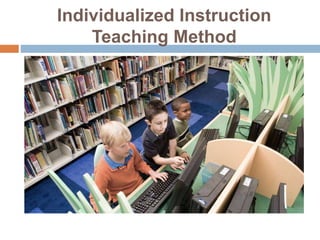
Individualized Instruction
Teaching Method
INTRODUCTION
 Learners' today are very diverse in their
academic needs, backgrounds and
abilities.
 It is imperative that we meet them where
they are so that we can maximize their
learning potential.
 One way to do this is to utilize
DEFINITION
 Individualized learning, or individualized
instruction, is a method of teaching in which
content, instructional technology, and pace of
learning are based upon the abilities and interest
of each learner.
 Individualized instruction refers
to the use of strategies
,resources and assessments to
meet the needs of one
particular learner.
Requirements of individualize
Instructions
1. Each students learn differently
2. All students are talented in different ways.
3. Educating children with special needs.
4. It is to meet the unique educational needs
of the child
5. Teaching requires differentiated and
individualized instruction in order to reach all
students
6. Careful and continuous assessment of
individual progress can be carried out.
Principles of Individualized
Instruction Strategy
 Make the students clear about the key points
and generalization to make sure that all
learners gain a powerful and strong
understanding so that they can have a good
foundation for their future learning.
 Use assessment as a teaching tool
 Emphasize and stress more on critical and
 Engaging all learners is essential. We
should engage and make the
students participate in class
activities. For that teachers should
develop their lesson to engage and
 Provide a balance between teacher-
assigned and student-selected tasks. If
there is a balance between the task and
activities that are assigned by the
teachers and the tasks selected by the
students, the learning will be most
favorable and desirable.
STEPS:
 Assessment of the student’s background,
needs and interests.
 Selection of appropriate subject matter.
 Determining the teaching strategies to meet
the needs and interests.
 Constant monitoring of progress
 Undertaking revisions/alternatives
wherever needed.
 Comprehensive education including
qualitative and quatitave records.
Advantages
 Student-Centric
 Meeting the needs and interests of diverse
learners.
 Provides the opportunity for students to learn
at their own pace, in their own way, and be
successful.
 Recognizes students’ varying background
knowledge, readiness, language,
preferences in learning, interests, and to
react responsively.
 Maximizes each student’s growth and
individual success by meeting each student
where he or she is, and assisting in the
learning process.
 Helps in providing for the uniqueness of
each child in terms of his/her particular
learning style, talents and potential,
Disadvantages
 Time constraints and chopped-
up schedules are an obstacle.
 Class size and teaching load are
two of the biggest constraints.
 Teacher Preparedness.
3/3/2018
13

Individualized instruction teaching method

  • 1.
  • 2.
    INTRODUCTION  Learners' todayare very diverse in their academic needs, backgrounds and abilities.  It is imperative that we meet them where they are so that we can maximize their learning potential.  One way to do this is to utilize
  • 3.
    DEFINITION  Individualized learning,or individualized instruction, is a method of teaching in which content, instructional technology, and pace of learning are based upon the abilities and interest of each learner.
  • 4.
     Individualized instructionrefers to the use of strategies ,resources and assessments to meet the needs of one particular learner.
  • 5.
    Requirements of individualize Instructions 1.Each students learn differently 2. All students are talented in different ways. 3. Educating children with special needs. 4. It is to meet the unique educational needs of the child 5. Teaching requires differentiated and individualized instruction in order to reach all students 6. Careful and continuous assessment of individual progress can be carried out.
  • 6.
    Principles of Individualized InstructionStrategy  Make the students clear about the key points and generalization to make sure that all learners gain a powerful and strong understanding so that they can have a good foundation for their future learning.  Use assessment as a teaching tool  Emphasize and stress more on critical and
  • 7.
     Engaging alllearners is essential. We should engage and make the students participate in class activities. For that teachers should develop their lesson to engage and
  • 8.
     Provide abalance between teacher- assigned and student-selected tasks. If there is a balance between the task and activities that are assigned by the teachers and the tasks selected by the students, the learning will be most favorable and desirable.
  • 9.
    STEPS:  Assessment ofthe student’s background, needs and interests.  Selection of appropriate subject matter.  Determining the teaching strategies to meet the needs and interests.  Constant monitoring of progress  Undertaking revisions/alternatives wherever needed.  Comprehensive education including qualitative and quatitave records.
  • 10.
    Advantages  Student-Centric  Meetingthe needs and interests of diverse learners.  Provides the opportunity for students to learn at their own pace, in their own way, and be successful.  Recognizes students’ varying background knowledge, readiness, language, preferences in learning, interests, and to react responsively.
  • 11.
     Maximizes eachstudent’s growth and individual success by meeting each student where he or she is, and assisting in the learning process.  Helps in providing for the uniqueness of each child in terms of his/her particular learning style, talents and potential,
  • 12.
    Disadvantages  Time constraintsand chopped- up schedules are an obstacle.  Class size and teaching load are two of the biggest constraints.  Teacher Preparedness.
  • 13.