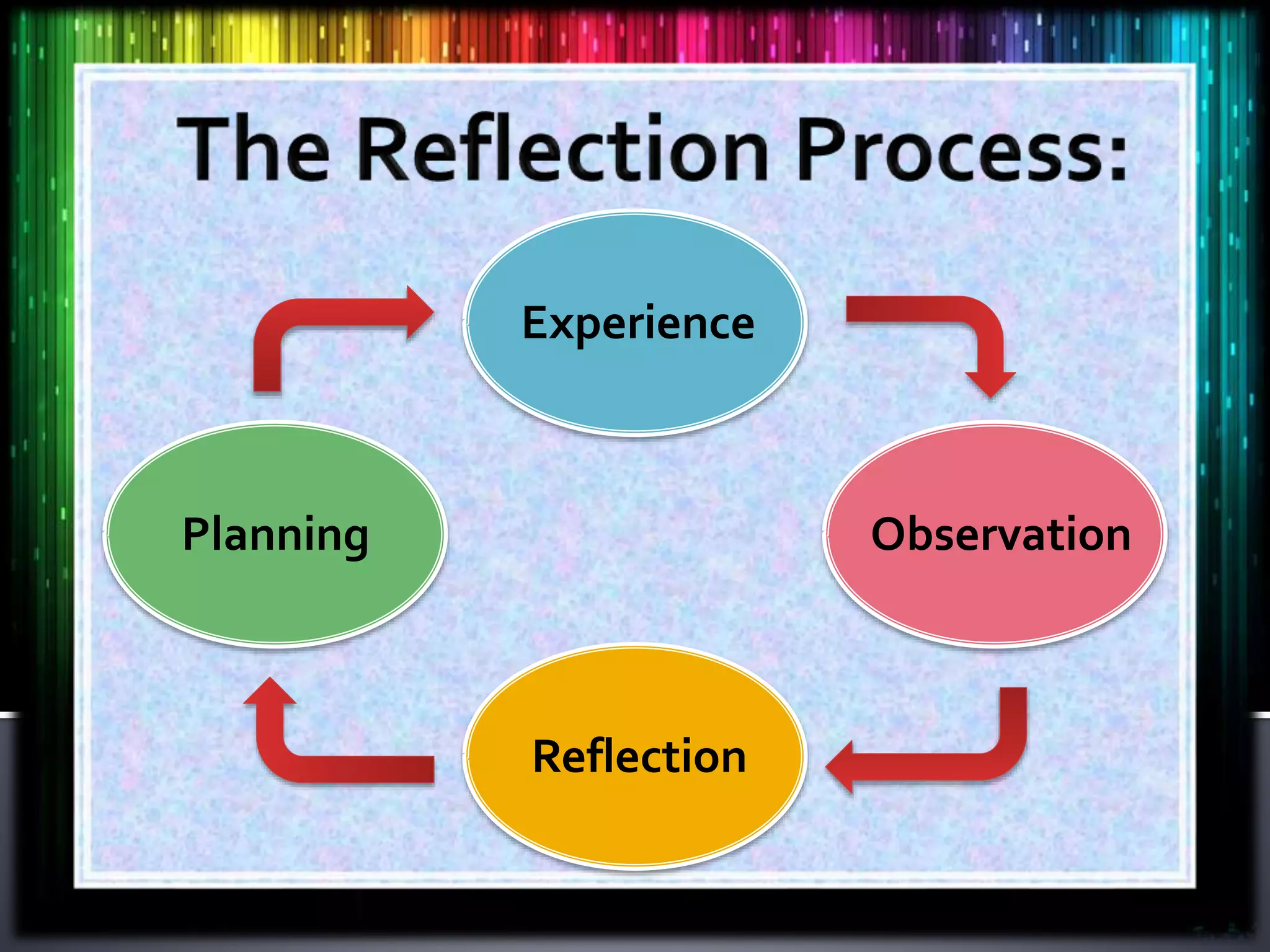
Reflective teaching is a cyclical process that involves teachers reflecting on their observations, knowledge, and experience in order to effectively guide students. It involves self-observation, evaluation, and using reflections to plan future lessons. Key aspects of reflective teaching include taking time for reflection, encouraging students to recount their experiences, and using tools like journals, portfolios, and student feedback to guide reflections. Reflective teaching distinguishes teachers as educated professionals who can thoughtfully problem-solve and foster student learning.
-Is anchored onthe ability of the teacher to guide
students to reflect their own experiences in order
to arrive at new understandings and meanings.
-process of self-observation and self-evaluation.
-is a cyclical process.
John Dewey -believedthat teachers
should take time to reflect on their
observations, knowledge, and
experience so that they can effectively
nurture each child's learning.
Donald Schön- developed the notion of
reflection in action and refection on
action.
5.
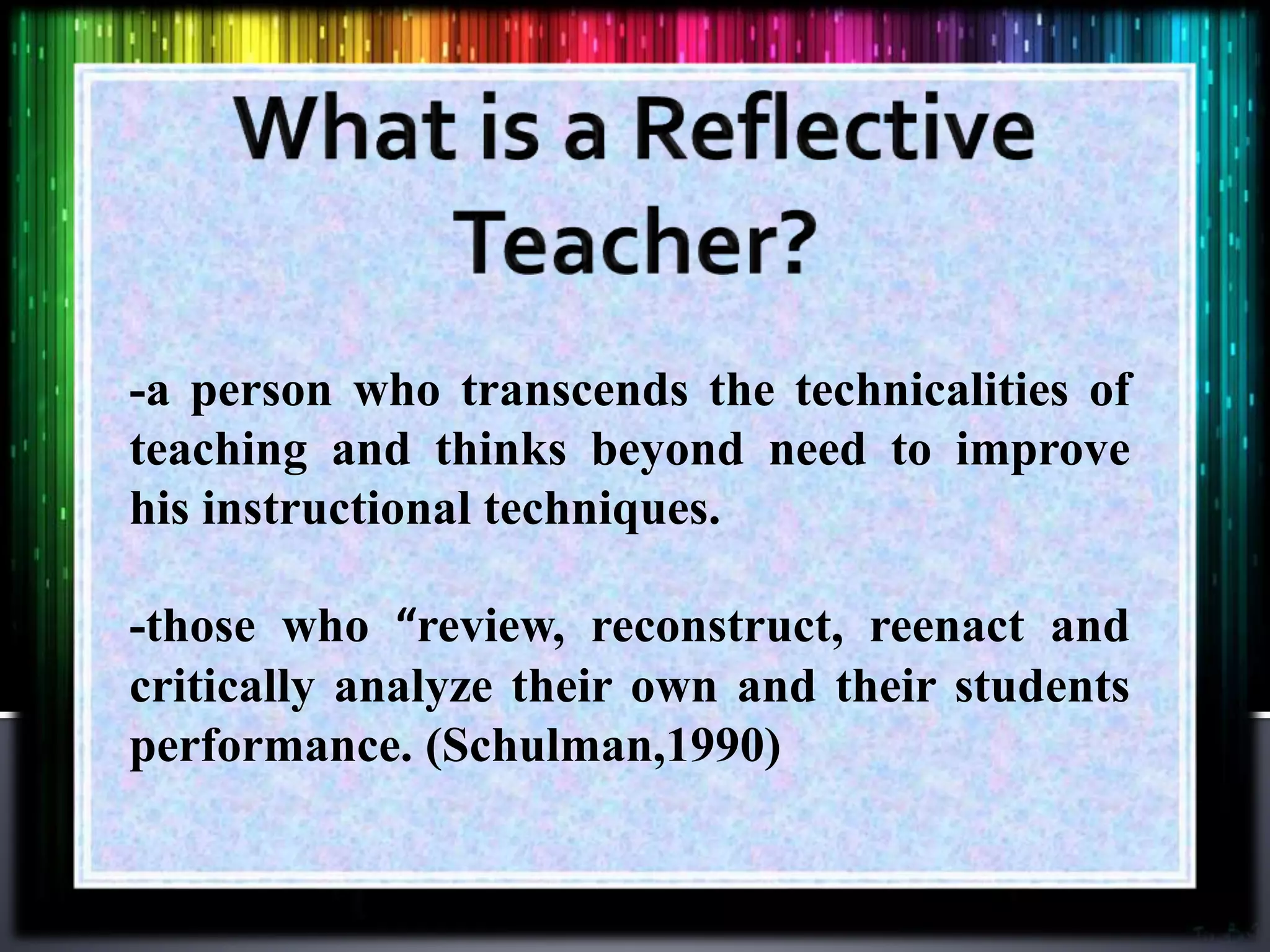
-a person whotranscends the technicalities of
teaching and thinks beyond need to improve
his instructional techniques.
-those who “review, reconstruct, reenact and
critically analyze their own and their students
performance. (Schulman,1990)
6.
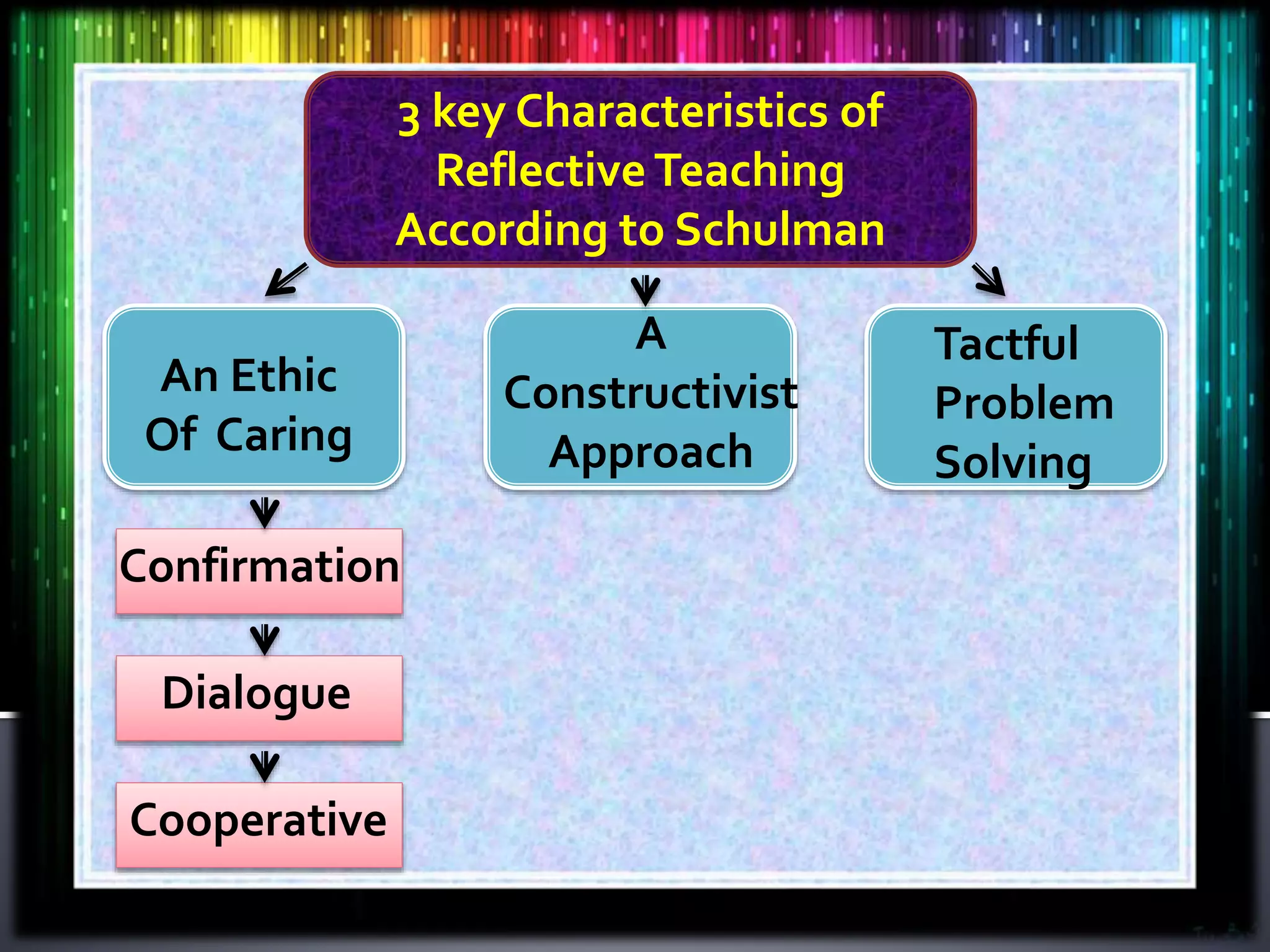
3 key Characteristicsof
Reflective Teaching
According to Schulman
An Ethic
Of Caring
Tactful
Problem
Solving
Confirmation
Dialogue
Cooperative
A
Constructivist
Approach
7.
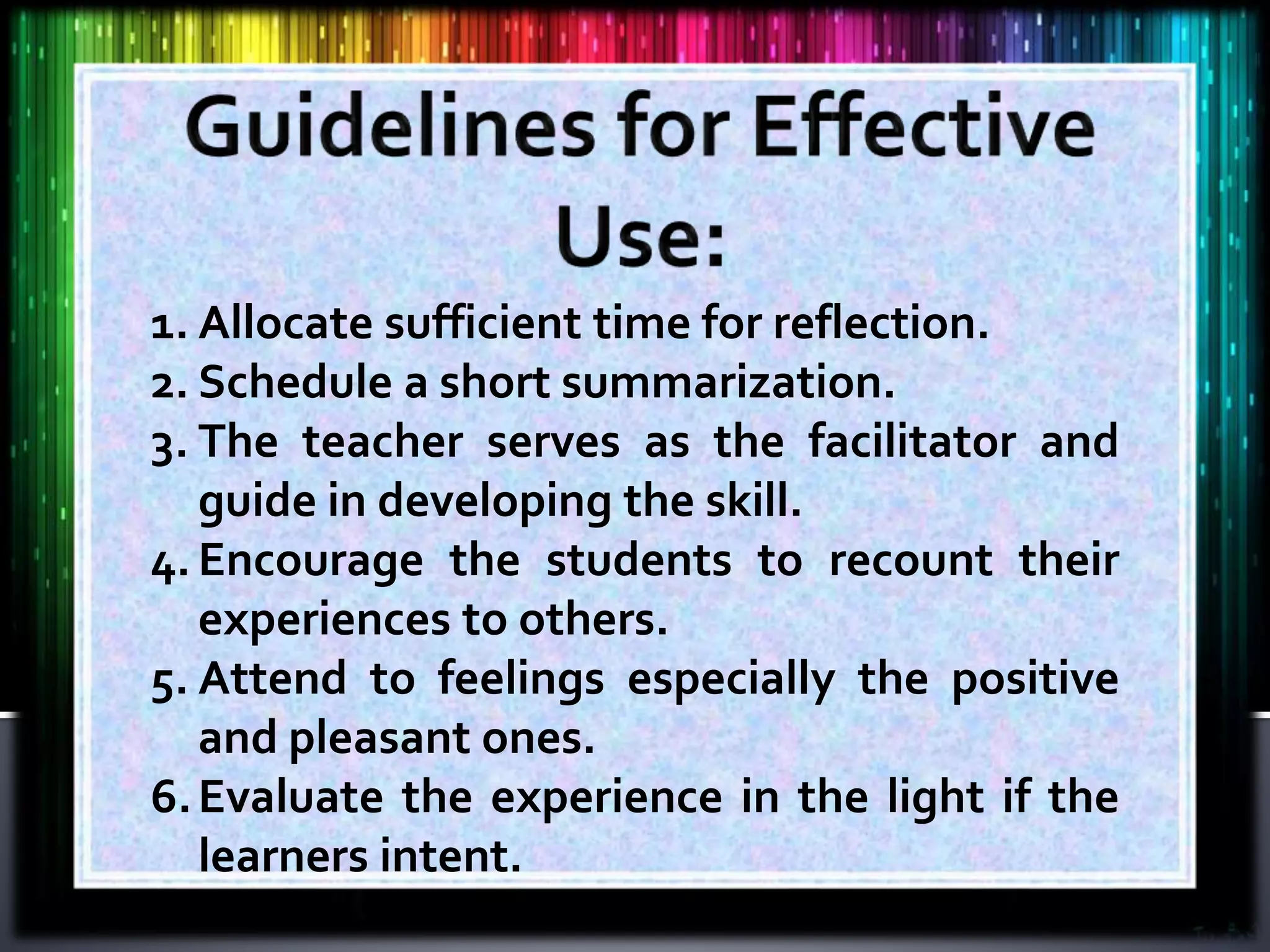
1. Allocate sufficienttime for reflection.
2. Schedule a short summarization.
3. The teacher serves as the facilitator and
guide in developing the skill.
4.Encourage the students to recount their
experiences to others.
5. Attend to feelings especially the positive
and pleasant ones.
6.Evaluate the experience in the light if the
learners intent.
8.
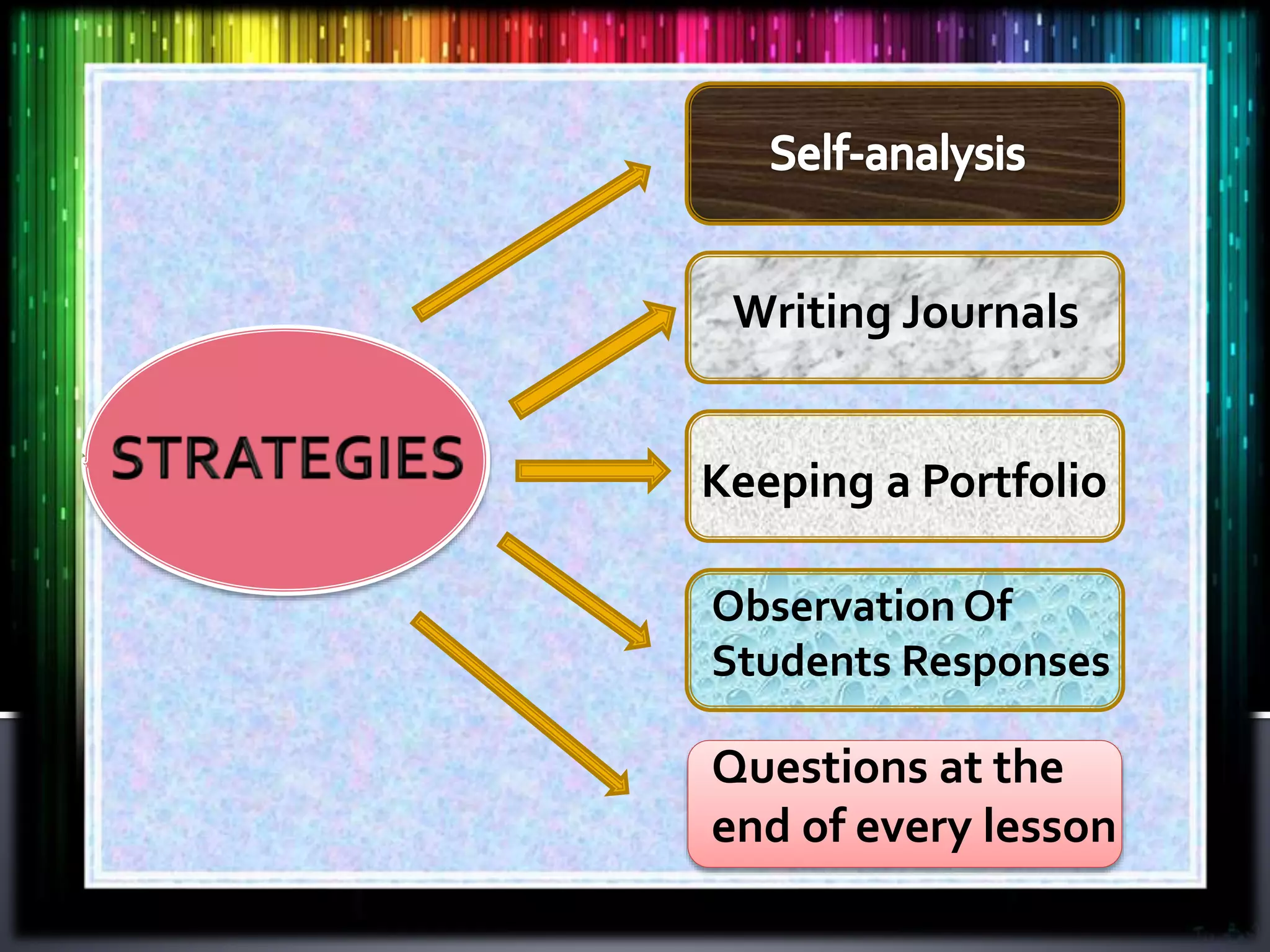
Writing Journals
Keeping aPortfolio
Observation Of
Students Responses
Questions at the
end of every lesson
9.
1. Her reflectionswould take form of an
evaluation of the learning activities.
2. Involve the students as early as the
planning stage in order to gain a
complete “start-to-finish experience”.
3. Reflections through journals must be
keeping confidential and must not be
graded nor taken against the writer.
10.
4. Include awide variety of real life
situations in planning.
5. Encourage students to keep a diary,
daybook or chronicle.
6. The teacher must likewise reflection the
incidents, problems and issues that might
be brought about in the learning
environment.
11.
1. Reflective teachinghelps free the
teachers from impulse and routine
behavior.
2. Reflective teaching allows the teacher
to act in a deliberate, intentional
manner and avoid the “I don’t know
what will I do today” syndrome.
3. Reflective teaching distinguishes
teachers as educated human beings.
12.
1. That unlessgiven clear pointers, the
reflection can be formulaic with a
tendency for “boast statements”.
2. some staff may not be comfortable with
assigning marks to a reflective process.