Teaching methods.
BM LEBEA
202000721
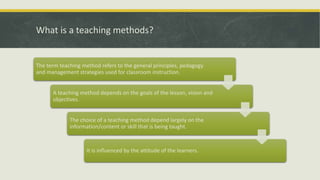
What is a teaching methods?
The term teaching method refers to the general principles, pedagogy
and management strategies used for classroom instruction.
A teaching method depends on the goals of the lesson, vision and
objectives.
The choice of a teaching method depend largely on the
information/content or skill that is being taught.
It is influenced by the attitude of the learners.
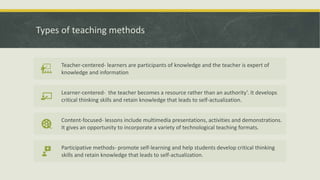
Types of teaching methods
Teacher-centered- learners are participants of knowledge and the teacher is expert of
knowledge and information
Learner-centered- the teacher becomes a resource rather than an authority’. It develops
critical thinking skills and retain knowledge that leads to self-actualization.
Content-focused- lessons include multimedia presentations, activities and demonstrations.
It gives an opportunity to incorporate a variety of technological teaching formats.
Participative methods- promote self-learning and help students develop critical thinking
skills and retain knowledge that leads to self-actualization.
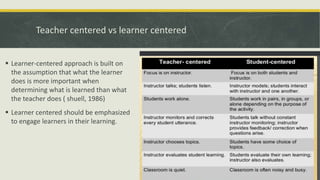
Teacher centered vs learner centered
 Learner-centered approach is built on
the assumption that what the learner
does is more important when
determining what is learned than what
the teacher does ( shuell, 1986)
 Learner centered should be emphasized
to engage learners in their learning.
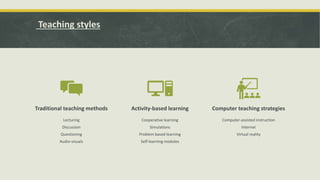
Teaching styles
Traditional teaching methods
Lecturing
Discussion
Questioning
Audio-visuals
Activity-based learning
Cooperative learning
Simulations
Problem based learning
Self-learning modules
Computer teaching strategies
Computer-assisted instruction
Internet
Virtual reality
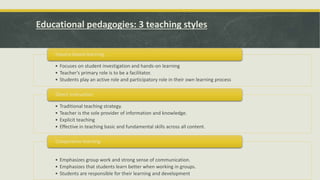
Educational pedagogies: 3 teaching styles
• Focuses on student investigation and hands-on learning
• Teacher’s primary role is to be a facilitator.
• Students play an active role and participatory role in their own learning process
Inquiry-based learning.
• Traditional teaching strategy.
• Teacher is the sole provider of information and knowledge.
• Explicit teaching
• Effective in teaching basic and fundamental skills across all content.
Direct instruction
• Emphasizes group work and strong sense of communication.
• Emphasizes that students learn better when working in groups.
• Students are responsible for their learning and development
Cooperative learning
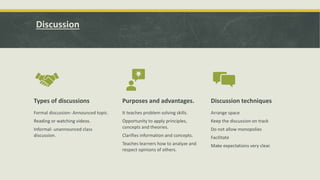
Discussion
Types of discussions
Formal discussion- Announced topic.
Reading or watching videos.
Informal- unannounced class
discussion.
Purposes and advantages.
It teaches problem solving skills.
Opportunity to apply principles,
concepts and theories.
Clarifies information and concepts.
Teaches learners how to analyze and
respect opinions of others.
Discussion techniques
Arrange space
Keep the discussion on track
Do not allow monopolies
Facilitate
Make expectations very clear.
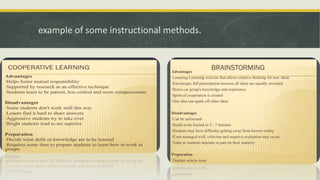
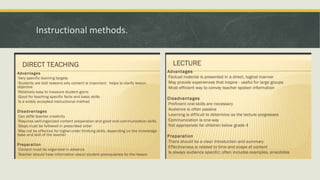
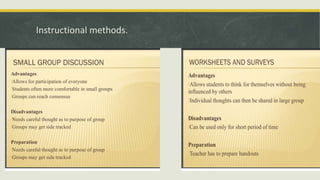
example of some instructional methods.
Instructional methods.
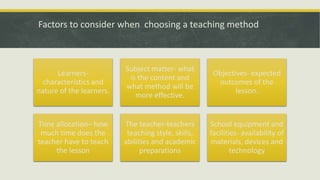
Factors to consider when choosing a teaching method
Learners-
characteristics and
nature of the learners.
Subject matter- what
is the content and
what method will be
more effective.
Objectives- expected
outcomes of the
lesson.
Time allocation– how
much time does the
teacher have to teach
the lesson
The teacher-teachers
teaching style, skills,
abilities and academic
preparations
School equipment and
facilities- availability of
materials, devices and
technology
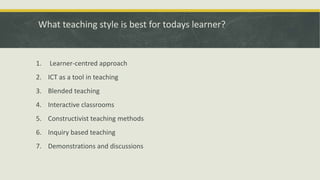
What teaching style is best for todays learner?
1. Learner-centred approach
2. ICT as a tool in teaching
3. Blended teaching
4. Interactive classrooms
5. Constructivist teaching methods
6. Inquiry based teaching
7. Demonstrations and discussions
REFERENCES
 MG, M. (2018). Teaching strategies and methodologies for teaching and learning. Available
from slideshare at :https://www.slideshare.net/graziemartin/teaching-strategies-and-
methodologies-for-teaching-and-learning ( accessed 15 august 2022)
 Nor, A. (2014).Teaching approaches. Available from slideshare
at:https://www.slideshare.net/aznanymseh1/teaching-approaches-42393964 ( accessed 15
august 2022)
 Satyender, K. (2018). Effectiveness of teaching methodologies. Available from slideshare
at:https://www.slideshare.net/satyenderk2/effectiveness-of-teaching-methodology ( accessed 15
august 2022)
 Christian, L.S. (2018). Factors and Principles in Choosing Teaching Method. Available from
slideshare at:https://www.slideshare.net/ChristianSabadisto1/factors-and-principles-in-choosing-
teaching-method ( accessed 15 august 2022)
 Khanyago, A. (2020). Teaching strategies. Available from slideshare at
:https://www.slideshare.net/AnethaKhanyayo/teaching-strategies-237953009

teaching methods

  • 1.
  • 2.
    What is ateaching methods? The term teaching method refers to the general principles, pedagogy and management strategies used for classroom instruction. A teaching method depends on the goals of the lesson, vision and objectives. The choice of a teaching method depend largely on the information/content or skill that is being taught. It is influenced by the attitude of the learners.
  • 3.
    Types of teachingmethods Teacher-centered- learners are participants of knowledge and the teacher is expert of knowledge and information Learner-centered- the teacher becomes a resource rather than an authority’. It develops critical thinking skills and retain knowledge that leads to self-actualization. Content-focused- lessons include multimedia presentations, activities and demonstrations. It gives an opportunity to incorporate a variety of technological teaching formats. Participative methods- promote self-learning and help students develop critical thinking skills and retain knowledge that leads to self-actualization.
  • 4.
    Teacher centered vslearner centered  Learner-centered approach is built on the assumption that what the learner does is more important when determining what is learned than what the teacher does ( shuell, 1986)  Learner centered should be emphasized to engage learners in their learning.
  • 5.
    Teaching styles Traditional teachingmethods Lecturing Discussion Questioning Audio-visuals Activity-based learning Cooperative learning Simulations Problem based learning Self-learning modules Computer teaching strategies Computer-assisted instruction Internet Virtual reality
  • 6.
    Educational pedagogies: 3teaching styles • Focuses on student investigation and hands-on learning • Teacher’s primary role is to be a facilitator. • Students play an active role and participatory role in their own learning process Inquiry-based learning. • Traditional teaching strategy. • Teacher is the sole provider of information and knowledge. • Explicit teaching • Effective in teaching basic and fundamental skills across all content. Direct instruction • Emphasizes group work and strong sense of communication. • Emphasizes that students learn better when working in groups. • Students are responsible for their learning and development Cooperative learning
  • 7.
    Discussion Types of discussions Formaldiscussion- Announced topic. Reading or watching videos. Informal- unannounced class discussion. Purposes and advantages. It teaches problem solving skills. Opportunity to apply principles, concepts and theories. Clarifies information and concepts. Teaches learners how to analyze and respect opinions of others. Discussion techniques Arrange space Keep the discussion on track Do not allow monopolies Facilitate Make expectations very clear.
  • 8.
    example of someinstructional methods.
  • 9.
  • 10.
  • 11.
    Factors to considerwhen choosing a teaching method Learners- characteristics and nature of the learners. Subject matter- what is the content and what method will be more effective. Objectives- expected outcomes of the lesson. Time allocation– how much time does the teacher have to teach the lesson The teacher-teachers teaching style, skills, abilities and academic preparations School equipment and facilities- availability of materials, devices and technology
  • 12.
    What teaching styleis best for todays learner? 1. Learner-centred approach 2. ICT as a tool in teaching 3. Blended teaching 4. Interactive classrooms 5. Constructivist teaching methods 6. Inquiry based teaching 7. Demonstrations and discussions
  • 13.
    REFERENCES  MG, M.(2018). Teaching strategies and methodologies for teaching and learning. Available from slideshare at :https://www.slideshare.net/graziemartin/teaching-strategies-and- methodologies-for-teaching-and-learning ( accessed 15 august 2022)  Nor, A. (2014).Teaching approaches. Available from slideshare at:https://www.slideshare.net/aznanymseh1/teaching-approaches-42393964 ( accessed 15 august 2022)  Satyender, K. (2018). Effectiveness of teaching methodologies. Available from slideshare at:https://www.slideshare.net/satyenderk2/effectiveness-of-teaching-methodology ( accessed 15 august 2022)  Christian, L.S. (2018). Factors and Principles in Choosing Teaching Method. Available from slideshare at:https://www.slideshare.net/ChristianSabadisto1/factors-and-principles-in-choosing- teaching-method ( accessed 15 august 2022)  Khanyago, A. (2020). Teaching strategies. Available from slideshare at :https://www.slideshare.net/AnethaKhanyayo/teaching-strategies-237953009