Constructivism in Teaching
Introduction:
 The 21st century classroom is filled with a vibrant assortment of learners.
 Students come from different types of socio economic backgrounds, with
culturally experience, and learning styles.
 These dynamics create a challenge for teachers.
 Teaching most always be adjusted to the level of the pupils .So
constructivist way of teaching be promoted in the class room.
Meaning of constructivism:
Constructivism is a rather heterogeneous idea .We invents our own
concept and ideas, linked to what we already know. This meaning making
theory of learning is called constructivism, knowledge is constructed by
learners through an active, mental process of development; learners are the
builders and reactors of meaning and knowledge.
Definition:
According to Brader - Araje and Jones (2002), Constructivism can be
defined as “the idea that development of understanding requires the learner
to actively engage in meaning –making”.
Varieties of constructivism:
 Educational constructivism
 Philosophical constructivism
 Sociological constructivism
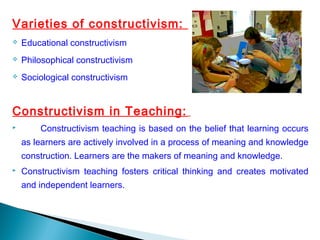
Constructivism in Teaching:
 Constructivism teaching is based on the belief that learning occurs
as learners are actively involved in a process of meaning and knowledge
construction. Learners are the makers of meaning and knowledge.
 Constructivism teaching fosters critical thinking and creates motivated
and independent learners.
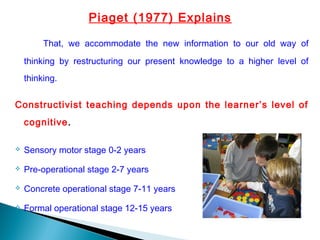
Piaget (1977) Explains
That, we accommodate the new information to our old way of
thinking by restructuring our present knowledge to a higher level of
thinking.
Constructivist teaching depends upon the learner’s level of
cognitive.
 Sensory motor stage 0-2 years
 Pre-operational stage 2-7 years
 Concrete operational stage 7-11 years
 Formal operational stage 12-15 years
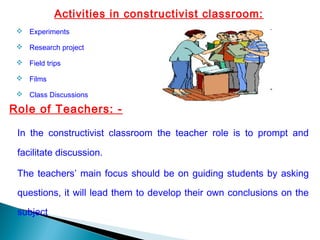
Activities in constructivist classroom:
 Experiments
 Research project
 Field trips
 Films
 Class Discussions
Role of Teachers: -
In the constructivist classroom the teacher role is to prompt and
facilitate discussion.
The teachers’ main focus should be on guiding students by asking
questions, it will lead them to develop their own conclusions on the
subject
The constructivist classroom
Three major roles for facilitators to support students in constructivist
learning environments are:
- Modeling
- Coaching
- Scaffolding
 A constructivist classroom environment provides opportunities for students
to question the material being presented and explore various topics as their
interests.
 The goal is to produce a democratic classroom environment that provides
meaningful learning experiences for autonomous learners.
 In a constructivist classroom, by contrast the teacher and the student share
responsibility and decision making and demonstrate mutual respect.
English Teaching the constructivist way
 For every concept introduced there should be multiple ways of
demonstrating the learning to the students
 The classroom environment should be democratic, providing each student
an opportunity to participate in the discussion.
 Aids like colorfully illustrated children’s dictionaries, student –Created
serial post cards, visual responses to poetry and an abundance of student
work should be encouraged and displayed throughout the classroom.
Benefits of constructivism in Teaching:
Children learn more and enjoy learning
Promote divergent thinking
Education works best when it concentrates on thinking and Understanding
rather than on rote memorization.
Boost the confidence of learners
Constructivism concentrates on how to think and Understand
Promote collaborative learning
Constructivism gives students ownership of what they learn, Since learning is
based on students.
Engaging the creative instincts develops student’s abilities to Express
knowledge through a variety of ways.
Constructivism promotes social and communication skills By creating a
classroom environment that emphasizes.
Characteristics of constructivist Teaching :
 According to Audrey Gray, the characteristics of a
Constructivist classroom are as follows:
 The learners are actively involved
 The environment is democratic
 The activities are interactive and student centered
 The teacher facilitates a process of learning in which students are
encouraged to be responsible and autonomous
Principles of constructivist
Teaching:
 Pose problems that are or will be relevant to the students.
 Structure learning around essential concepts.
Strategies:
 The teacher has to work on the mind, on the feeling of the child we have to
provide opportunities to success the child.
 Child rearing practices are very important.
The teacher’s task is to train the pupil to perceive
the object accurately to the mind. we cannot neglect the
imaging and intuitive side of the child this is important for
promoting creativity in children.
Implications of Education:
A constructivist teaching Sequence:
1. Elicitation of ideas
2. Orientation
3. Restructuring of ideas
4. Clarification and exchange
5. Exposure to conflict situations
6. Construction of new ideas
Evaluation
7. Application of ideas
8. Review change in ideas
Research Suggest that constructivist teaching is an effective way
to teach. It encourages active and meaningful learning and Promotes
responsibility and autonomy.
Because constructivist teaching is beneficial in achieving desirable
educational goals for students. It is important for teachers to grow
professionally towards a constructivist Practice.
The teacher acts on the mind and conscience of the students in
such a manner that they are able to unfold their hidden Potentials
including regard.
Brighter side of constructivism:
Constructivism concentrates learning how to think and understand.
Constructivist teacher develop skills and abilities to empower
students and to make them feel competent and significant. Constructivist
teaching also requires intelligence, creativity, patience, responsiveness
and the ability to live. Some of the tenets of constructivist in pedagogical
team are:
Students come to the class with an established world view, for
students to change their world view requires work. Students learn from
each other as well as from the teacher. Students learn better by doing,
allowing and creating opportunities for all to promotes new ideas.
Conclusion:
Constructivist teaching fosters critical
thinking and creates active and motivated learners a
constructivist approach free teachers to make
decisions. Constructivist teaching and learning is a
beautiful experience if done with the right attitude and
happy mind.
CONSTRUCTIVISM IN TEACHING - PPT

CONSTRUCTIVISM IN TEACHING - PPT

  • 2.
    Constructivism in Teaching Introduction: The 21st century classroom is filled with a vibrant assortment of learners.  Students come from different types of socio economic backgrounds, with culturally experience, and learning styles.  These dynamics create a challenge for teachers.  Teaching most always be adjusted to the level of the pupils .So constructivist way of teaching be promoted in the class room.
  • 3.
    Meaning of constructivism: Constructivismis a rather heterogeneous idea .We invents our own concept and ideas, linked to what we already know. This meaning making theory of learning is called constructivism, knowledge is constructed by learners through an active, mental process of development; learners are the builders and reactors of meaning and knowledge. Definition: According to Brader - Araje and Jones (2002), Constructivism can be defined as “the idea that development of understanding requires the learner to actively engage in meaning –making”.
  • 4.
    Varieties of constructivism: Educational constructivism  Philosophical constructivism  Sociological constructivism Constructivism in Teaching:  Constructivism teaching is based on the belief that learning occurs as learners are actively involved in a process of meaning and knowledge construction. Learners are the makers of meaning and knowledge.  Constructivism teaching fosters critical thinking and creates motivated and independent learners.
  • 5.
    Piaget (1977) Explains That,we accommodate the new information to our old way of thinking by restructuring our present knowledge to a higher level of thinking. Constructivist teaching depends upon the learner’s level of cognitive.  Sensory motor stage 0-2 years  Pre-operational stage 2-7 years  Concrete operational stage 7-11 years  Formal operational stage 12-15 years
  • 6.
    Activities in constructivistclassroom:  Experiments  Research project  Field trips  Films  Class Discussions Role of Teachers: - In the constructivist classroom the teacher role is to prompt and facilitate discussion. The teachers’ main focus should be on guiding students by asking questions, it will lead them to develop their own conclusions on the subject
  • 7.
    The constructivist classroom Threemajor roles for facilitators to support students in constructivist learning environments are: - Modeling - Coaching - Scaffolding  A constructivist classroom environment provides opportunities for students to question the material being presented and explore various topics as their interests.  The goal is to produce a democratic classroom environment that provides meaningful learning experiences for autonomous learners.  In a constructivist classroom, by contrast the teacher and the student share responsibility and decision making and demonstrate mutual respect.
  • 8.
    English Teaching theconstructivist way  For every concept introduced there should be multiple ways of demonstrating the learning to the students  The classroom environment should be democratic, providing each student an opportunity to participate in the discussion.  Aids like colorfully illustrated children’s dictionaries, student –Created serial post cards, visual responses to poetry and an abundance of student work should be encouraged and displayed throughout the classroom.
  • 9.
    Benefits of constructivismin Teaching: Children learn more and enjoy learning Promote divergent thinking Education works best when it concentrates on thinking and Understanding rather than on rote memorization. Boost the confidence of learners Constructivism concentrates on how to think and Understand Promote collaborative learning Constructivism gives students ownership of what they learn, Since learning is based on students. Engaging the creative instincts develops student’s abilities to Express knowledge through a variety of ways. Constructivism promotes social and communication skills By creating a classroom environment that emphasizes.
  • 10.
    Characteristics of constructivistTeaching :  According to Audrey Gray, the characteristics of a Constructivist classroom are as follows:  The learners are actively involved  The environment is democratic  The activities are interactive and student centered  The teacher facilitates a process of learning in which students are encouraged to be responsible and autonomous
  • 11.
    Principles of constructivist Teaching: Pose problems that are or will be relevant to the students.  Structure learning around essential concepts. Strategies:  The teacher has to work on the mind, on the feeling of the child we have to provide opportunities to success the child.  Child rearing practices are very important. The teacher’s task is to train the pupil to perceive the object accurately to the mind. we cannot neglect the imaging and intuitive side of the child this is important for promoting creativity in children.
  • 12.
    Implications of Education: Aconstructivist teaching Sequence: 1. Elicitation of ideas 2. Orientation 3. Restructuring of ideas 4. Clarification and exchange 5. Exposure to conflict situations 6. Construction of new ideas Evaluation 7. Application of ideas 8. Review change in ideas
  • 13.
    Research Suggest thatconstructivist teaching is an effective way to teach. It encourages active and meaningful learning and Promotes responsibility and autonomy. Because constructivist teaching is beneficial in achieving desirable educational goals for students. It is important for teachers to grow professionally towards a constructivist Practice. The teacher acts on the mind and conscience of the students in such a manner that they are able to unfold their hidden Potentials including regard.
  • 14.
    Brighter side ofconstructivism: Constructivism concentrates learning how to think and understand. Constructivist teacher develop skills and abilities to empower students and to make them feel competent and significant. Constructivist teaching also requires intelligence, creativity, patience, responsiveness and the ability to live. Some of the tenets of constructivist in pedagogical team are: Students come to the class with an established world view, for students to change their world view requires work. Students learn from each other as well as from the teacher. Students learn better by doing, allowing and creating opportunities for all to promotes new ideas.
  • 15.
    Conclusion: Constructivist teaching fosterscritical thinking and creates active and motivated learners a constructivist approach free teachers to make decisions. Constructivist teaching and learning is a beautiful experience if done with the right attitude and happy mind.