SYSTEMATIC APPROACH TO
TEACHING


           Reporter: Aris L. Villanueva
According to C. West Churchman

“ A plan that emphasizes the parts may pay
  the cost of failing to consider the whole,
  and a plan that emphasizes the whole may
  pay the cost of failing to get down to the
  real depth with respect to the parts.”
SYSTEMATIC APPROACH TO
TEACHING
   The system approach views the entire
    educational program as a system of interrelated
    parts. It is an orchestrated learning pattern with
    all parts harmoniously integrated into the
    whole: the school, the teacher, the students,
    the objectives, the media, the materials, and
    assessment tools and procedures. Such an
    approach integrates the older, more familiar
    methods and tools of instruction with the new
    ones such as the computer
Define objectives
   Considers the student’s need, interest
    and readiness.
Choose appropriate method

   To be unutilized and used by the teacher
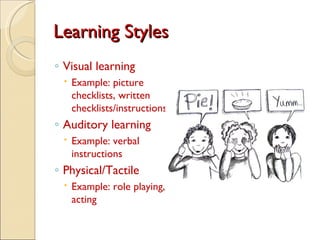
Learning Styles
◦ Visual learning
  Example: picture
   checklists, written
   checklists/instructions
◦ Auditory learning
  Example: verbal
   instructions
◦ Physical/Tactile
  Example: role playing,
   acting
Choose appropriate experiences

   Learning Activities that could spell out
    the instructional objectives
Assigning personnel role
   Who are the persons involved in the
    instruction and their tasks
Implement the instruction

   Actual mode of instruction in which all
    plans are being utilized
Evaluate Outcomes
   Examining if the instructional objective
    was attained or not
Refine the process
   Getting the system fixed before entering
    to other cycle.

Systematic approach to teaching

  • 1.
    SYSTEMATIC APPROACH TO TEACHING Reporter: Aris L. Villanueva
  • 2.
    According to C.West Churchman “ A plan that emphasizes the parts may pay the cost of failing to consider the whole, and a plan that emphasizes the whole may pay the cost of failing to get down to the real depth with respect to the parts.”
  • 3.
    SYSTEMATIC APPROACH TO TEACHING  The system approach views the entire educational program as a system of interrelated parts. It is an orchestrated learning pattern with all parts harmoniously integrated into the whole: the school, the teacher, the students, the objectives, the media, the materials, and assessment tools and procedures. Such an approach integrates the older, more familiar methods and tools of instruction with the new ones such as the computer
  • 4.
    Define objectives  Considers the student’s need, interest and readiness.
  • 5.
    Choose appropriate method  To be unutilized and used by the teacher
  • 6.
    Learning Styles ◦ Visuallearning  Example: picture checklists, written checklists/instructions ◦ Auditory learning  Example: verbal instructions ◦ Physical/Tactile  Example: role playing, acting
  • 7.
    Choose appropriate experiences  Learning Activities that could spell out the instructional objectives
  • 8.
    Assigning personnel role  Who are the persons involved in the instruction and their tasks
  • 9.
    Implement the instruction  Actual mode of instruction in which all plans are being utilized
  • 10.
    Evaluate Outcomes  Examining if the instructional objective was attained or not
  • 11.
    Refine the process  Getting the system fixed before entering to other cycle.