STEPS FOR ACTION RESEARCH
RESEARCH
It is a search for knowledge.
It is a scientific and systematic search for
pertinent/relevant/suitable information on a specific area.
It is to discover answers to questions through the
application of scientific procedures.
It is to findout the truth which is hidden and which has
not discovered as yet.
It is directed towards the solution of a problem.
It is based on observable experience or empirical evidence.
It involves gathering new data from primary or first hand
sources or using existing data for a new purpose
Classifications of Research
Fundamental or Basic Research
It is the formal and systematic process of deductive-
inductive analysis, leading to the development of
theories.
It is usually carried on in a laboratory or some times
into animals.
It has no immediate or planned application, may later
result in further research on an applied nature.
Applied Research
It adapts the theories developed through fundamental
research to the solution of problems.
It has most of the characteristics of fundamental
research including the use of sampling techniques and
the subsequent inferences about the target population.
Action Research
It is focused on immediate application, not in the
development of theory or on general application.
It is to remedy problems diagnosed in specific solution.
It is applicable to a particular situation for which the
solution has been found
It aims at improving personal or institutional efficiency.
It emphasizes more on understanding and solving the
problem rather than theory building
It is to improve school practices and to improve those
who try to improve the practices.
Main Features
• Action researches are small scale and narrowly focused researches
undertaken by teachers in a given context. It has also been referred to as
“research into practice by practitioners, for practitioners”.
• In action research, teachers, the classroom practitioners, feel and solve the
problem.
• Its findings are to be evaluated in terms of local applicability not universal
validity.
• The problems of action research are felt needs of practitioners, hence there
are greater chances of the results of the action research influencing the
existing practices in the field.
• Since the practitioner himself is involved in the process of research, the
findings are his own and not thrust upon him by outsider; hence he is more
likely to implement them.
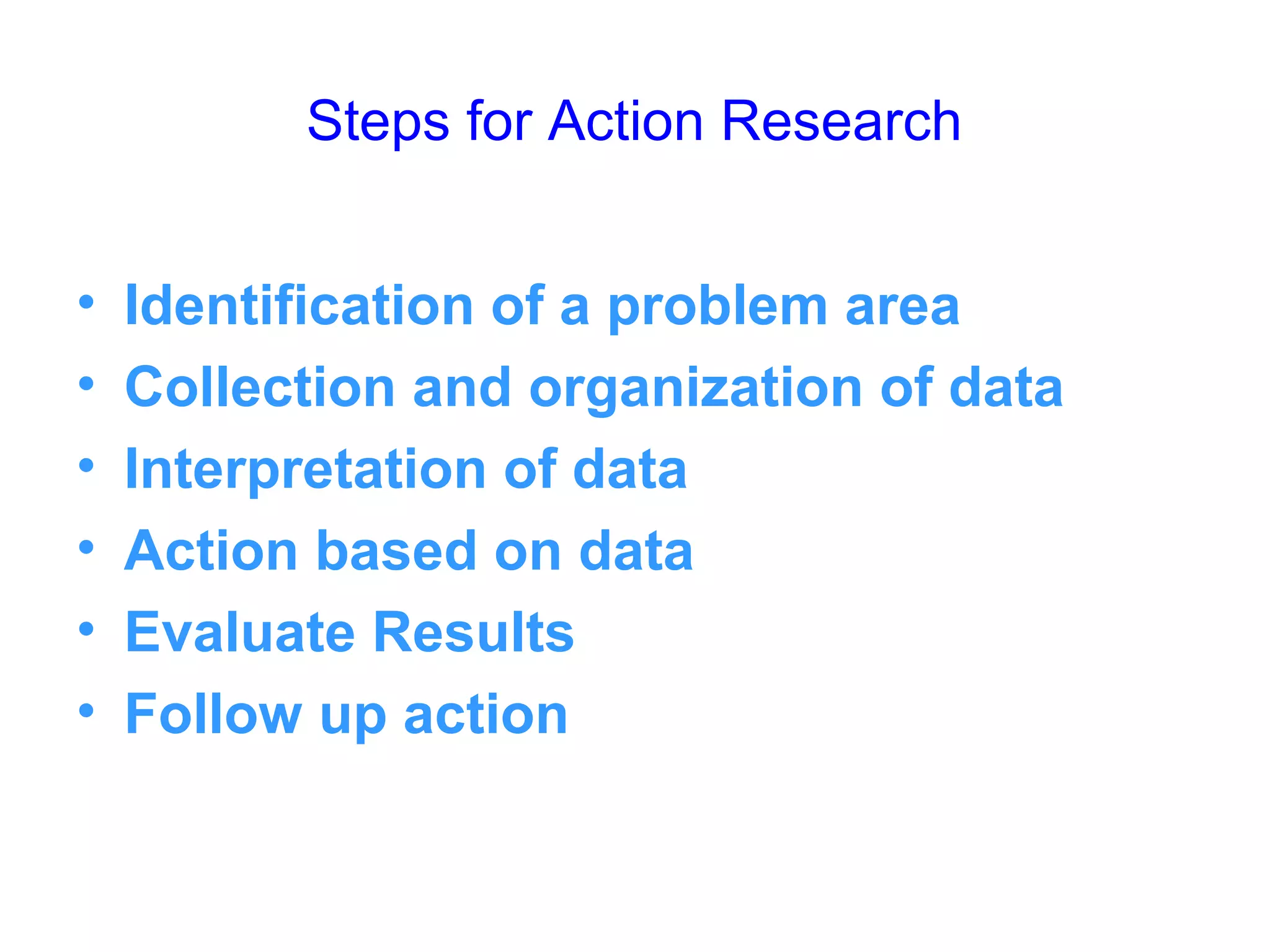
Steps for Action Research
• Identification of a problem area
• Collection and organization of data
• Interpretation of data
• Action based on data
• Evaluate Results
• Follow up action
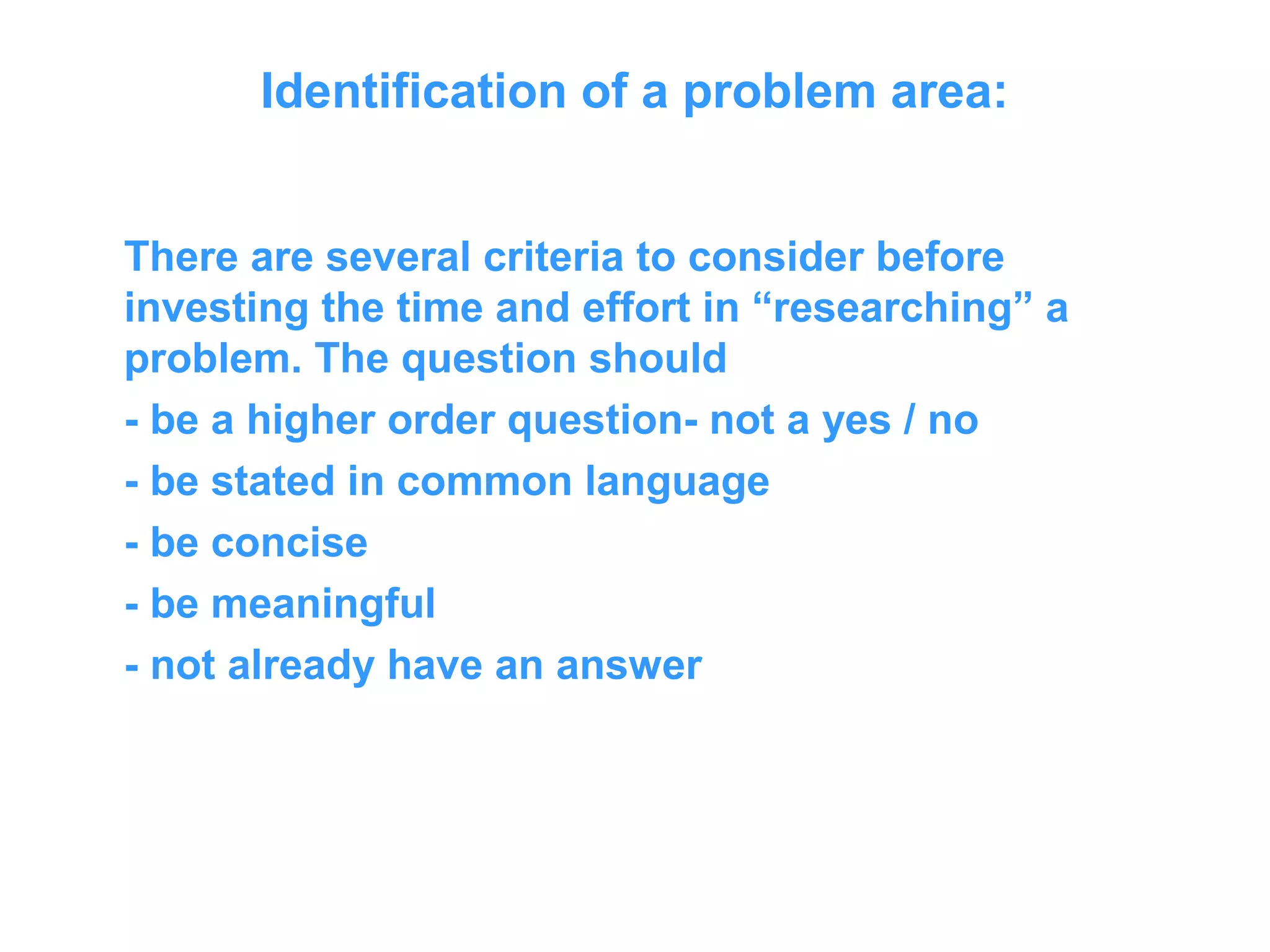
Identification of a problem area:
There are several criteria to consider before
investing the time and effort in “researching” a
problem. The question should
- be a higher order question- not a yes / no
- be stated in common language
- be concise
- be meaningful
- not already have an answer
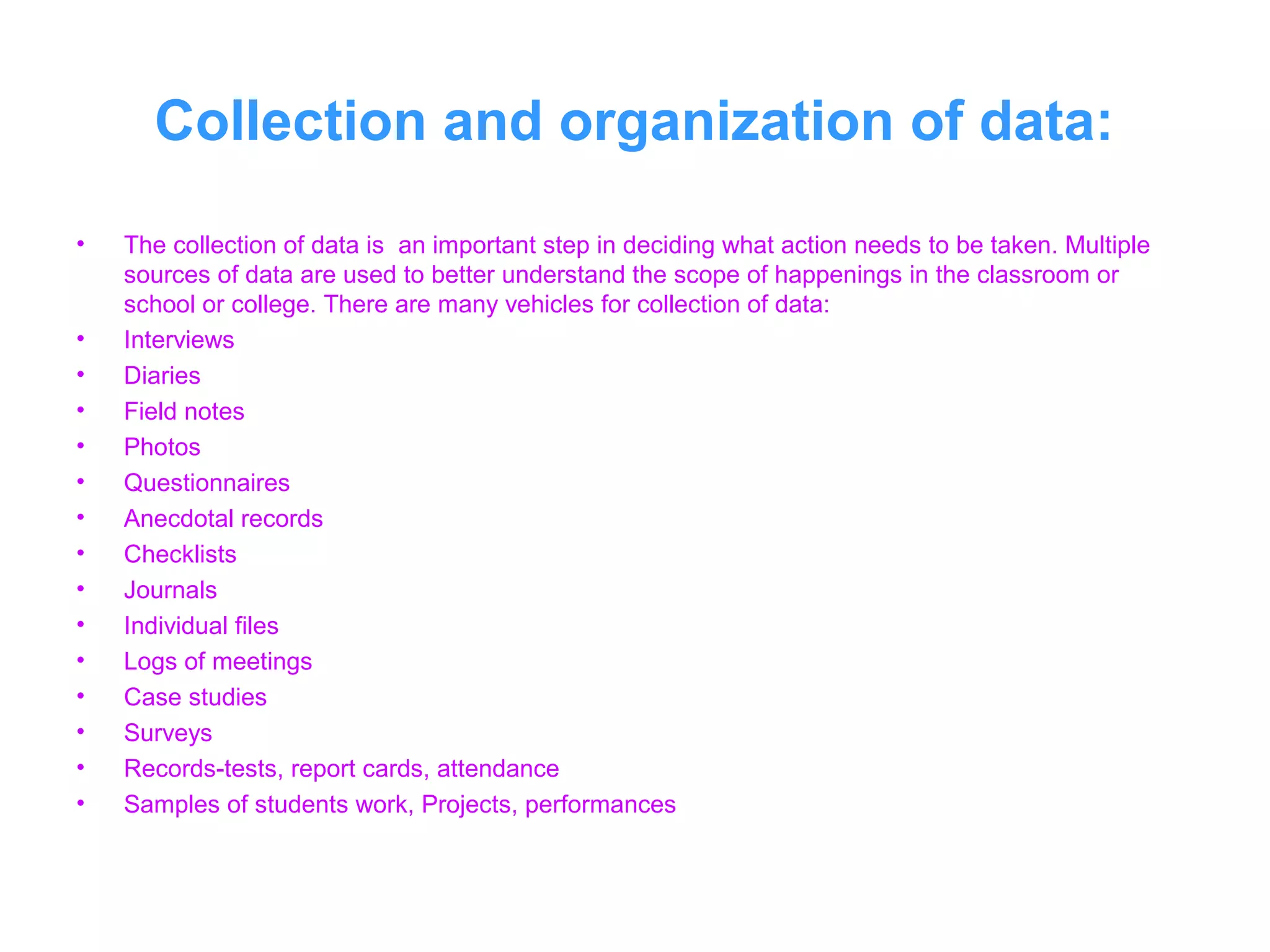
Collection and organization of data:
• The collection of data is an important step in deciding what action needs to be taken. Multiple
sources of data are used to better understand the scope of happenings in the classroom or
school or college. There are many vehicles for collection of data:
• Interviews
• Diaries
• Field notes
• Photos
• Questionnaires
• Anecdotal records
• Checklists
• Journals
• Individual files
• Logs of meetings
• Case studies
• Surveys
• Records-tests, report cards, attendance
• Samples of students work, Projects, performances
Interpretation of data
• Analyze and identify major themes. Depending
upon the question, teachers may wish to use
classroom data, individual data, or subgroup
data. Some of the data are quantifiable and can
be analyzed without the use of statistics or
technical assistance. Other data, such as
opinions, attitudes, or checklists, may be
summarized in table form.
Action based on data
• Using the information from the data collection
and review of current literature, design a plan of
action that will allow us make a change and to
study that change.
Evaluate Results
• Assess the effects of the intervention to determine if
improvement has occurred. If there is improvement, do
the data clearly provide the supporting evidence? If no,
what changes can be made to the actions to elicit better
results?
Follow-up action
• As a result of the action research project, identify
additional questions raised by the data and plan
for additional improvements, revisions, and next
steps.

Steps for Action Research

  • 1.
  • 2.
    RESEARCH It is asearch for knowledge. It is a scientific and systematic search for pertinent/relevant/suitable information on a specific area. It is to discover answers to questions through the application of scientific procedures. It is to findout the truth which is hidden and which has not discovered as yet. It is directed towards the solution of a problem. It is based on observable experience or empirical evidence. It involves gathering new data from primary or first hand sources or using existing data for a new purpose
  • 3.
    Classifications of Research Fundamentalor Basic Research It is the formal and systematic process of deductive- inductive analysis, leading to the development of theories. It is usually carried on in a laboratory or some times into animals. It has no immediate or planned application, may later result in further research on an applied nature.
  • 4.
    Applied Research It adaptsthe theories developed through fundamental research to the solution of problems. It has most of the characteristics of fundamental research including the use of sampling techniques and the subsequent inferences about the target population.
  • 5.
    Action Research It isfocused on immediate application, not in the development of theory or on general application. It is to remedy problems diagnosed in specific solution. It is applicable to a particular situation for which the solution has been found It aims at improving personal or institutional efficiency. It emphasizes more on understanding and solving the problem rather than theory building It is to improve school practices and to improve those who try to improve the practices.
  • 6.
    Main Features • Actionresearches are small scale and narrowly focused researches undertaken by teachers in a given context. It has also been referred to as “research into practice by practitioners, for practitioners”. • In action research, teachers, the classroom practitioners, feel and solve the problem. • Its findings are to be evaluated in terms of local applicability not universal validity. • The problems of action research are felt needs of practitioners, hence there are greater chances of the results of the action research influencing the existing practices in the field. • Since the practitioner himself is involved in the process of research, the findings are his own and not thrust upon him by outsider; hence he is more likely to implement them.
  • 7.
    Steps for ActionResearch • Identification of a problem area • Collection and organization of data • Interpretation of data • Action based on data • Evaluate Results • Follow up action
  • 8.
    Identification of aproblem area: There are several criteria to consider before investing the time and effort in “researching” a problem. The question should - be a higher order question- not a yes / no - be stated in common language - be concise - be meaningful - not already have an answer
  • 9.
    Collection and organizationof data: • The collection of data is an important step in deciding what action needs to be taken. Multiple sources of data are used to better understand the scope of happenings in the classroom or school or college. There are many vehicles for collection of data: • Interviews • Diaries • Field notes • Photos • Questionnaires • Anecdotal records • Checklists • Journals • Individual files • Logs of meetings • Case studies • Surveys • Records-tests, report cards, attendance • Samples of students work, Projects, performances
  • 10.
    Interpretation of data •Analyze and identify major themes. Depending upon the question, teachers may wish to use classroom data, individual data, or subgroup data. Some of the data are quantifiable and can be analyzed without the use of statistics or technical assistance. Other data, such as opinions, attitudes, or checklists, may be summarized in table form.
  • 11.
    Action based ondata • Using the information from the data collection and review of current literature, design a plan of action that will allow us make a change and to study that change.
  • 12.
    Evaluate Results • Assessthe effects of the intervention to determine if improvement has occurred. If there is improvement, do the data clearly provide the supporting evidence? If no, what changes can be made to the actions to elicit better results?
  • 13.
    Follow-up action • Asa result of the action research project, identify additional questions raised by the data and plan for additional improvements, revisions, and next steps.