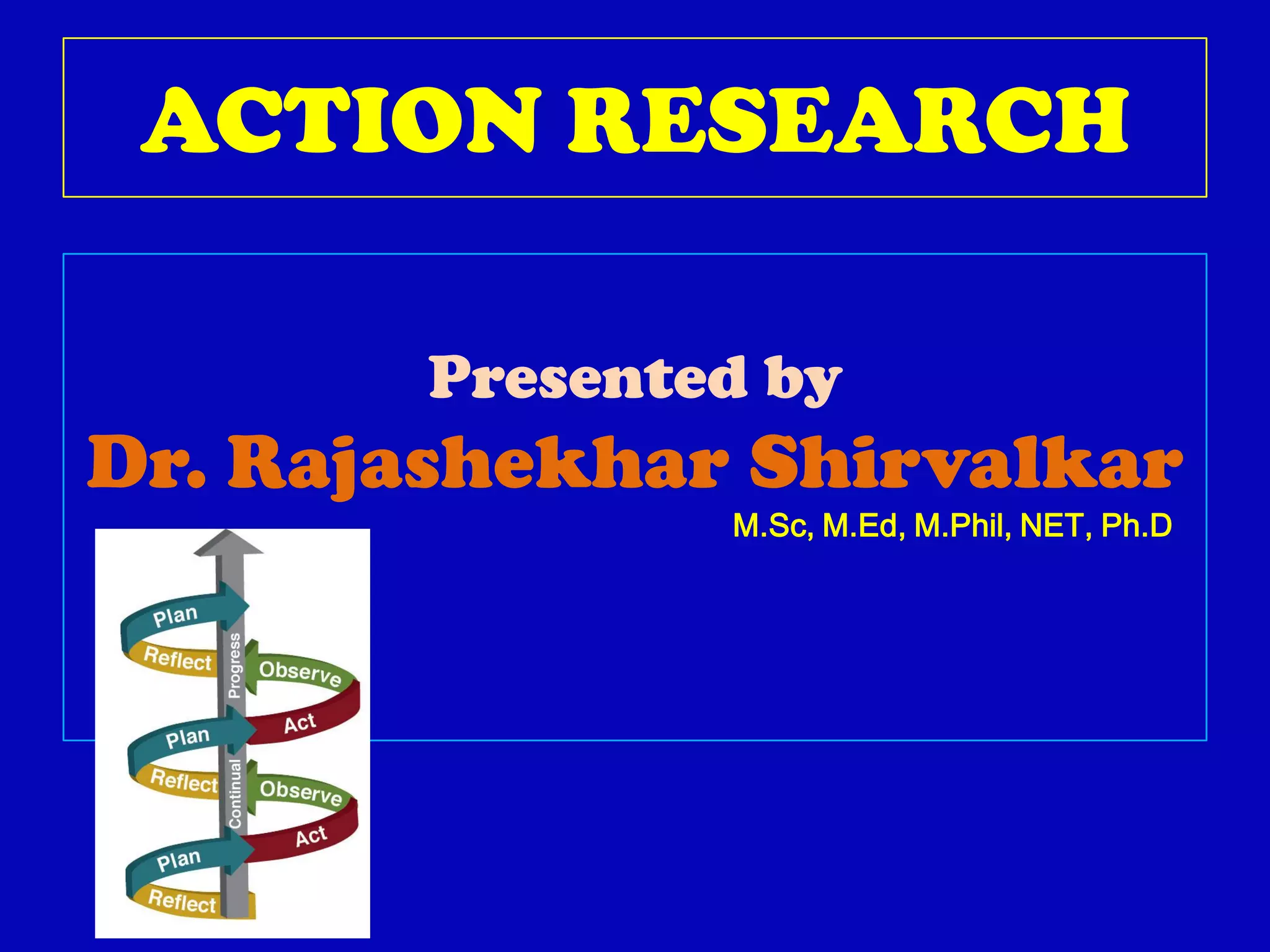
ACTION RESEARCH
Presented by
Dr. Rajashekhar Shirvalkar
M.Sc, M.Ed, M.Phil, NET, Ph.D
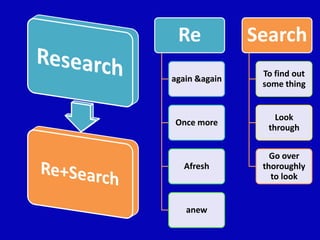
Re
again &again
Once more
Afresh
anew
Search
To find out
some thing
Look
through
Go over
thoroughly
to look
Research means,
A fact which is observe again and again in different
dimensions is called research.
Research is a careful and detailed study into a specific
problem, concern, or issue using the scientific method.
Research is a careful and detailed study into a specific
problem, concern, or issue using the scientific method.
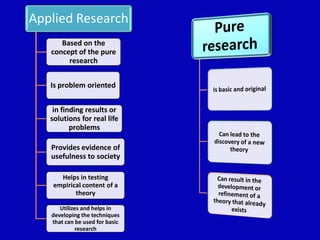
Applied Research
Based on the
concept of the pure
research
Is problem oriented
in finding results or
solutions for real life
problems
Provides evidence of
usefulness to society
Helps in testing
empirical content of a
theory
Utilizes and helps in
developing the techniques
that can be used for basic
research
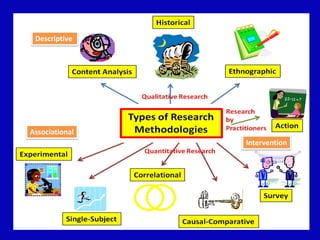
Descriptive
Associational
Intervention
E
D
U
C
ReseArch
T
I
ONAL
Educational research refers to the
systematic collection and analysis of
data related to the field of
education.
Research may involve a variety of
methods.
Research may involve various
aspects of education including
student learning, teaching methods,
teacher training, and classroom
dynamics
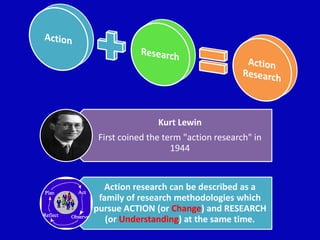
Kurt Lewin
First coined the term "action research" in
1944
Action research can be described as a
family of research methodologies which
pursue ACTION (or Change) and RESEARCH
(or Understanding) at the same time.
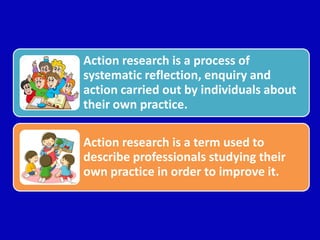
Action research is a process of
systematic reflection, enquiry and
action carried out by individuals about
their own practice.
Action research is a term used to
describe professionals studying their
own practice in order to improve it.
The process by which practitioners attempt to study their
problems scientifically in order to guide, correct and
evaluate their decisions and actions in what number of
people have called action research -Corey Stephen (1962)
“Action research is research used by teachers,
supervisors and administrators to improve the quality of
their decisions and actions”
-C.V.Good (1959)
"On the spot research aimed at the solution of an
immediate problem is generally known in education as
Action Research“
Mouly (1964)
"Action Research is focused on the immediate application,
not on the development of theory. It has placed its
emphasis on a real problem, here and now, in a local
setting“-Best(1963)
Definitions of Action Research
1) To improve the practice going on presently in the school.
2) To remove the notion that educational research is the job of specialists only
3) To make the teacher and school administrators research minded
4) To develop in the practitioners the required confidence and ability to carry out
research for solving their own problems
5) To make the student, teachers and educational administrators more conscious
about their problems and immediate solution.
6) To make the school or educational personnel more cooperative and democratic in
their world of work.
7) To inculcate the desire and attitude among school personnel for bringing
excellence in their work.
8) To make the environments of the school more conductive for effective teaching
and learning.
Aims and Objectives of Action research
1 • It is participant-driven and reflective;
2 • A practical focus
3 • It is collaborative
4 • It leads to change and the improvement of practice
5 • It is context-specific
6 • A dynamic process
7 • A plan of action
8 • Sharing research
Characteristics of Action Research
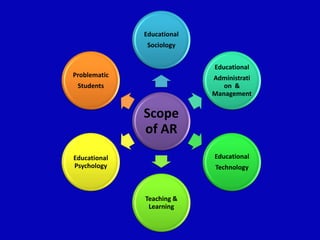
Scope
of AR
Educational
Sociology
Educational
Administrati
on &
Management
Educational
Technology
Teaching &
Learning
Educational
Psychology
Problematic
Students
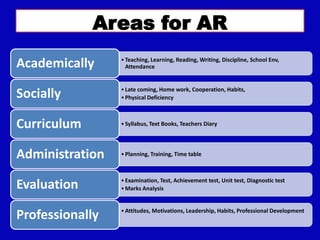
Areas for AR
•Teaching, Learning, Reading, Writing, Discipline, School Env,
AttendanceAcademically
•Late coming, Home work, Cooperation, Habits,
•Physical DeficiencySocially
•Syllabus, Text Books, Teachers DiaryCurriculum
•Planning, Training, Time tableAdministration
•Examination, Test, Achievement test, Unit test, Diagnostic test
•Marks AnalysisEvaluation
•Attitudes, Motivations, Leadership, Habits, Professional Development
Professionally
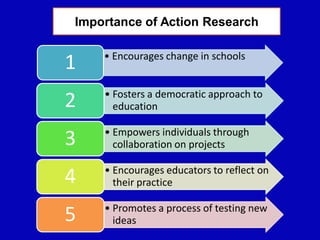
• Encourages change in schools
1
• Fosters a democratic approach to
education2
• Empowers individuals through
collaboration on projects3
• Encourages educators to reflect on
their practice4
• Promotes a process of testing new
ideas5
Importance of Action Research
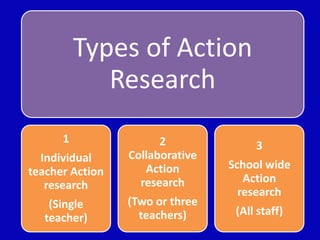
Types of Action
Research
1
Individual
teacher Action
research
(Single
teacher)
2
Collaborative
Action
research
(Two or three
teachers)
3
School wide
Action
research
(All staff)
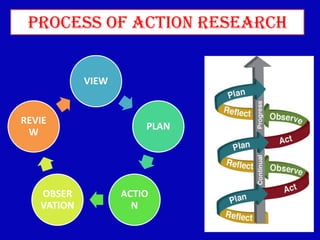
VIEW
PLAN
ACTIO
N
OBSER
VATION
REVIE
W
Process of Action research
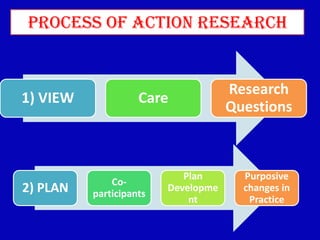
2) PLAN Co-
participants
Plan
Developme
nt
Purposive
changes in
Practice
1) VIEW Care
Research
Questions
Process of Action research
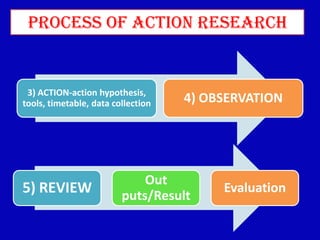
5) REVIEW
Out
puts/Result
Evaluation
3) ACTION-action hypothesis,
tools, timetable, data collection 4) OBSERVATION
Process of Action research
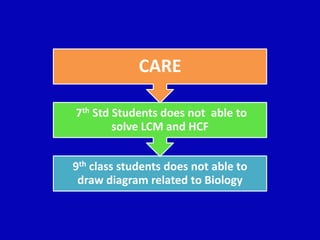
9th class students does not able to
draw diagram related to Biology
7th Std Students does not able to
solve LCM and HCF
CARE
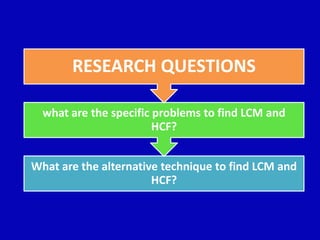
What are the alternative technique to find LCM and
HCF?
what are the specific problems to find LCM and
HCF?
RESEARCH QUESTIONS
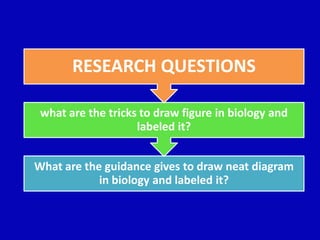
What are the guidance gives to draw neat diagram
in biology and labeled it?
what are the tricks to draw figure in biology and
labeled it?
RESEARCH QUESTIONS
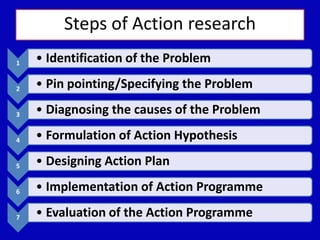
1 • Identification of the Problem
2 • Pin pointing/Specifying the Problem
3 • Diagnosing the causes of the Problem
4 • Formulation of Action Hypothesis
5 • Designing Action Plan
6 • Implementation of Action Programme
7 • Evaluation of the Action Programme
Steps of Action research
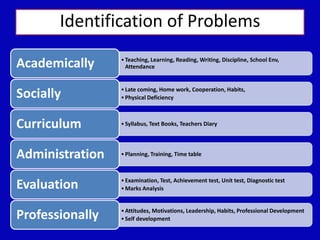
•Teaching, Learning, Reading, Writing, Discipline, School Env,
AttendanceAcademically
•Late coming, Home work, Cooperation, Habits,
•Physical DeficiencySocially
•Syllabus, Text Books, Teachers DiaryCurriculum
•Planning, Training, Time tableAdministration
•Examination, Test, Achievement test, Unit test, Diagnostic test
•Marks AnalysisEvaluation
•Attitudes, Motivations, Leadership, Habits, Professional Development
•Self developmentProfessionally
Identification of Problems
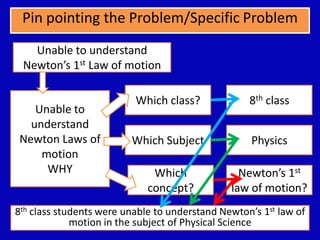
Unable to understand
Newton’s 1st Law of motion
Pin pointing the Problem/Specific Problem
Unable to
understand
Newton Laws of
motion
WHY
Which class?
Which Subject
Which
concept?
8th class
Physics
Newton’s 1st
law of motion?
8th class students were unable to understand Newton’s 1st law of
motion in the subject of Physical Science
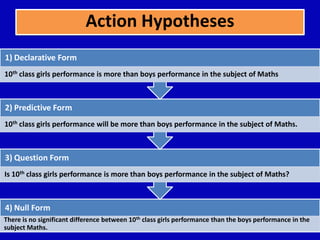
Action Hypotheses
4) Null Form
There is no significant difference between 10th class girls performance than the boys performance in the
subject Maths.
3) Question Form
Is 10th class girls performance is more than boys performance in the subject of Maths?
2) Predictive Form
10th class girls performance will be more than boys performance in the subject of Maths.
1) Declarative Form
10th class girls performance is more than boys performance in the subject of Maths
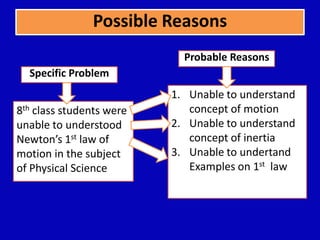
Possible Reasons
8th class students were
unable to understood
Newton’s 1st law of
motion in the subject
of Physical Science
1. Unable to understand
concept of motion
2. Unable to understand
concept of inertia
3. Unable to undertand
Examples on 1st law
Specific Problem
Probable Reasons
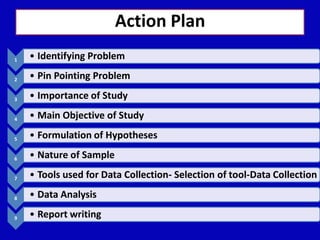
1 • Identifying Problem
2 • Pin Pointing Problem
3 • Importance of Study
4 • Main Objective of Study
5 • Formulation of Hypotheses
6 • Nature of Sample
7 • Tools used for Data Collection- Selection of tool-Data Collection
8 • Data Analysis
9 • Report writing
Action Plan
Action Plan
ACTION PLAN
ENGLISH
FORMAT MATHS
E-mail: drrajshirvalkar@gmail.com
Mobile: 9481638363
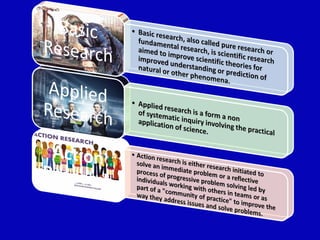
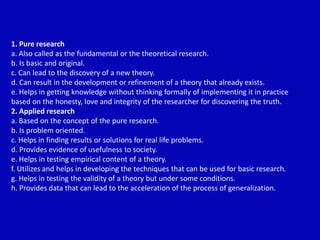
1. Pure research
a. Also called as the fundamental or the theoretical research.
b. Is basic and original.
c. Can lead to the discovery of a new theory.
d. Can result in the development or refinement of a theory that already exists.
e. Helps in getting knowledge without thinking formally of implementing it in practice
based on the honesty, love and integrity of the researcher for discovering the truth.
2. Applied research
a. Based on the concept of the pure research.
b. Is problem oriented.
c. Helps in finding results or solutions for real life problems.
d. Provides evidence of usefulness to society.
e. Helps in testing empirical content of a theory.
f. Utilizes and helps in developing the techniques that can be used for basic research.
g. Helps in testing the validity of a theory but under some conditions.
h. Provides data that can lead to the acceleration of the process of generalization.
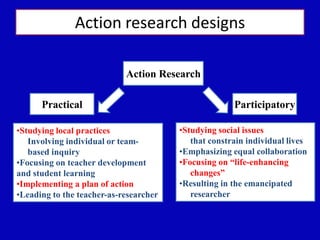
Action research designs
Action Research
ParticipatoryPractical
•Studying local practices
Involving individual or team-
based inquiry
•Focusing on teacher development
and student learning
•Implementing a plan of action
•Leading to the teacher-as-researcher
•Studying social issues
that constrain individual lives
•Emphasizing equal collaboration
•Focusing on “life-enhancing
changes”
•Resulting in the emancipated
researcher
Educational research refers to the systematic collection and analysis of data
related to the field of education.
Research may involve a variety of methods.
Research may involve various aspects of education including
student learning, teaching methods, teacher training, and classroom
dynamics

Action research

  • 1.
    ACTION RESEARCH Presented by Dr.Rajashekhar Shirvalkar M.Sc, M.Ed, M.Phil, NET, Ph.D
  • 2.
    Re again &again Once more Afresh anew Search Tofind out some thing Look through Go over thoroughly to look
  • 3.
    Research means, A factwhich is observe again and again in different dimensions is called research. Research is a careful and detailed study into a specific problem, concern, or issue using the scientific method. Research is a careful and detailed study into a specific problem, concern, or issue using the scientific method.
  • 5.
    Applied Research Based onthe concept of the pure research Is problem oriented in finding results or solutions for real life problems Provides evidence of usefulness to society Helps in testing empirical content of a theory Utilizes and helps in developing the techniques that can be used for basic research
  • 6.
  • 7.
    E D U C ReseArch T I ONAL Educational research refersto the systematic collection and analysis of data related to the field of education. Research may involve a variety of methods. Research may involve various aspects of education including student learning, teaching methods, teacher training, and classroom dynamics
  • 8.
    Kurt Lewin First coinedthe term "action research" in 1944 Action research can be described as a family of research methodologies which pursue ACTION (or Change) and RESEARCH (or Understanding) at the same time.
  • 9.
    Action research isa process of systematic reflection, enquiry and action carried out by individuals about their own practice. Action research is a term used to describe professionals studying their own practice in order to improve it.
  • 10.
    The process bywhich practitioners attempt to study their problems scientifically in order to guide, correct and evaluate their decisions and actions in what number of people have called action research -Corey Stephen (1962) “Action research is research used by teachers, supervisors and administrators to improve the quality of their decisions and actions” -C.V.Good (1959) "On the spot research aimed at the solution of an immediate problem is generally known in education as Action Research“ Mouly (1964) "Action Research is focused on the immediate application, not on the development of theory. It has placed its emphasis on a real problem, here and now, in a local setting“-Best(1963) Definitions of Action Research
  • 11.
    1) To improvethe practice going on presently in the school. 2) To remove the notion that educational research is the job of specialists only 3) To make the teacher and school administrators research minded 4) To develop in the practitioners the required confidence and ability to carry out research for solving their own problems 5) To make the student, teachers and educational administrators more conscious about their problems and immediate solution. 6) To make the school or educational personnel more cooperative and democratic in their world of work. 7) To inculcate the desire and attitude among school personnel for bringing excellence in their work. 8) To make the environments of the school more conductive for effective teaching and learning. Aims and Objectives of Action research
  • 12.
    1 • Itis participant-driven and reflective; 2 • A practical focus 3 • It is collaborative 4 • It leads to change and the improvement of practice 5 • It is context-specific 6 • A dynamic process 7 • A plan of action 8 • Sharing research Characteristics of Action Research
  • 13.
  • 14.
    Areas for AR •Teaching,Learning, Reading, Writing, Discipline, School Env, AttendanceAcademically •Late coming, Home work, Cooperation, Habits, •Physical DeficiencySocially •Syllabus, Text Books, Teachers DiaryCurriculum •Planning, Training, Time tableAdministration •Examination, Test, Achievement test, Unit test, Diagnostic test •Marks AnalysisEvaluation •Attitudes, Motivations, Leadership, Habits, Professional Development Professionally
  • 15.
    • Encourages changein schools 1 • Fosters a democratic approach to education2 • Empowers individuals through collaboration on projects3 • Encourages educators to reflect on their practice4 • Promotes a process of testing new ideas5 Importance of Action Research
  • 16.
    Types of Action Research 1 Individual teacherAction research (Single teacher) 2 Collaborative Action research (Two or three teachers) 3 School wide Action research (All staff)
  • 17.
  • 18.
    2) PLAN Co- participants Plan Developme nt Purposive changesin Practice 1) VIEW Care Research Questions Process of Action research
  • 19.
    5) REVIEW Out puts/Result Evaluation 3) ACTION-actionhypothesis, tools, timetable, data collection 4) OBSERVATION Process of Action research
  • 20.
    9th class studentsdoes not able to draw diagram related to Biology 7th Std Students does not able to solve LCM and HCF CARE
  • 21.
    What are thealternative technique to find LCM and HCF? what are the specific problems to find LCM and HCF? RESEARCH QUESTIONS
  • 22.
    What are theguidance gives to draw neat diagram in biology and labeled it? what are the tricks to draw figure in biology and labeled it? RESEARCH QUESTIONS
  • 23.
    1 • Identificationof the Problem 2 • Pin pointing/Specifying the Problem 3 • Diagnosing the causes of the Problem 4 • Formulation of Action Hypothesis 5 • Designing Action Plan 6 • Implementation of Action Programme 7 • Evaluation of the Action Programme Steps of Action research
  • 24.
    •Teaching, Learning, Reading,Writing, Discipline, School Env, AttendanceAcademically •Late coming, Home work, Cooperation, Habits, •Physical DeficiencySocially •Syllabus, Text Books, Teachers DiaryCurriculum •Planning, Training, Time tableAdministration •Examination, Test, Achievement test, Unit test, Diagnostic test •Marks AnalysisEvaluation •Attitudes, Motivations, Leadership, Habits, Professional Development •Self developmentProfessionally Identification of Problems
  • 25.
    Unable to understand Newton’s1st Law of motion Pin pointing the Problem/Specific Problem Unable to understand Newton Laws of motion WHY Which class? Which Subject Which concept? 8th class Physics Newton’s 1st law of motion? 8th class students were unable to understand Newton’s 1st law of motion in the subject of Physical Science
  • 26.
    Action Hypotheses 4) NullForm There is no significant difference between 10th class girls performance than the boys performance in the subject Maths. 3) Question Form Is 10th class girls performance is more than boys performance in the subject of Maths? 2) Predictive Form 10th class girls performance will be more than boys performance in the subject of Maths. 1) Declarative Form 10th class girls performance is more than boys performance in the subject of Maths
  • 27.
    Possible Reasons 8th classstudents were unable to understood Newton’s 1st law of motion in the subject of Physical Science 1. Unable to understand concept of motion 2. Unable to understand concept of inertia 3. Unable to undertand Examples on 1st law Specific Problem Probable Reasons
  • 28.
    1 • IdentifyingProblem 2 • Pin Pointing Problem 3 • Importance of Study 4 • Main Objective of Study 5 • Formulation of Hypotheses 6 • Nature of Sample 7 • Tools used for Data Collection- Selection of tool-Data Collection 8 • Data Analysis 9 • Report writing Action Plan
  • 29.
  • 30.
  • 31.
  • 32.
  • 37.
    1. Pure research a.Also called as the fundamental or the theoretical research. b. Is basic and original. c. Can lead to the discovery of a new theory. d. Can result in the development or refinement of a theory that already exists. e. Helps in getting knowledge without thinking formally of implementing it in practice based on the honesty, love and integrity of the researcher for discovering the truth. 2. Applied research a. Based on the concept of the pure research. b. Is problem oriented. c. Helps in finding results or solutions for real life problems. d. Provides evidence of usefulness to society. e. Helps in testing empirical content of a theory. f. Utilizes and helps in developing the techniques that can be used for basic research. g. Helps in testing the validity of a theory but under some conditions. h. Provides data that can lead to the acceleration of the process of generalization.
  • 38.
    Action research designs ActionResearch ParticipatoryPractical •Studying local practices Involving individual or team- based inquiry •Focusing on teacher development and student learning •Implementing a plan of action •Leading to the teacher-as-researcher •Studying social issues that constrain individual lives •Emphasizing equal collaboration •Focusing on “life-enhancing changes” •Resulting in the emancipated researcher
  • 39.
    Educational research refersto the systematic collection and analysis of data related to the field of education. Research may involve a variety of methods. Research may involve various aspects of education including student learning, teaching methods, teacher training, and classroom dynamics