1 
ONLINE ASSIGNMENT 
SUBMITTED TO 
MISS UMA JYOTHI 
SOCIAL SCIENCE TEACHER 
SUBMITTED BY 
VINEETHA MOL R. 
OPTIONAL: SOCIAL SCIENCE
2 
TOPIC 
FEATURES OF GOOD SOCIAL SCIENCE 
TEXT BOOK
3 
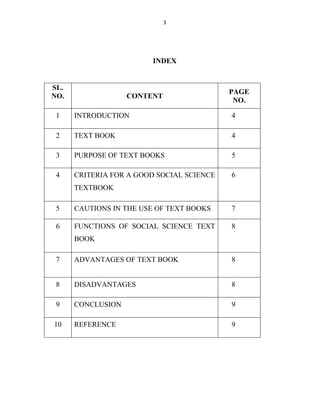
INDEX 
SL. 
NO. 
CONTENT 
PAGE 
NO. 
1 INTRODUCTION 4 
2 TEXT BOOK 4 
3 PURPOSE OF TEXT BOOKS 5 
4 CRITERIA FOR A GOOD SOCIAL SCIENCE 
TEXTBOOK 
6 
5 CAUTIONS IN THE USE OF TEXT BOOKS 7 
6 FUNCTIONS OF SOCIAL SCIENCE TEXT 
BOOK 
8 
7 ADVANTAGES OF TEXT BOOK 8 
8 DISADVANTAGES 8 
9 CONCLUSION 9 
10 REFERENCE 9
4 
INTRODUCTION 
By instructional materials we mean the tools of teaching and learning in and 
out of the class room. Any discussion on instructional material will generally start 
with the text books. A text book is a specially written book which contains selective 
and systematic knowledge regarding the curriculum material prescribed. Every care is 
taken to maintain coherence and sequence in the presentation of information and 
learning activities. It is made simple to the degree that suits the intended learner. It 
would indicate various teaching learning devices and a rich dose of pedagogy with all 
its implications that is why a text book is said to be “the teacher in print”. A text book 
differs from an ordinary book mainly on the basis that it is basically student friendly 
and also reflects the anticipated instructional goals, teaching learning techniques etc. 
TEXT BOOK 
The text book constitutes an inseparable part of any system of education. In a 
developing country like ours where even the minimum essential requirements of class 
room are hardly provided, the necessity of quality text book is evident. 
As far as social science is concerned, the text book is an aid which is 
considered in dispensable in all methods adopted for its Institution for the study of the 
subject the role played by textbook is second only to that of the teacher. It acts as the 
learners’ chief aid and support. Generally speaking, textbook play a more important 
role in high school instruction than in the elementary grades.
5 
PURPOSE OF TEXT BOOKS 
The following are the major purposes served by text books: 
1) To help the teachers:- It provides useful guidelines for day to day teaching, 
suggestions for and serve as a reference book for the teachers time companion. 
2) To help the pupil:-For pupil, textbooks are must accessible guide, reference 
books and all time companion. 
3) To give minimum essential knowledge at one place: A textbook can be constant 
standby of social studies teacher, as it gives the minimum knowledge at one 
place. 
4) To help in self teaching: The efficacy of the textbook lies in making self 
teaching a possible proposition through printed materials. 
5) To provide logical and comprehensive materials: A good text book provides 
material in a logical systematic and comprehensive form. 
6) To provide both confirmation and sustenance: Text books can confirm 
knowledge obtained elsewhere. 
7) To ensure intellectual rapprochement of learners: It can co-ordinate the 
activities and bring about the intellectual rapprochement of pupils.
6 
CRITERIA FOR A GOOD SOCIAL SCIENCE TEXTBOOK 
To be an effective aid, it must contain all the qualities of an instructional 
material. A good social science text book must satisfy the following criteria: 
1) Textbook should help in achieving the purpose of learning social science 
2) It should be child-centered. 
3) It should contain fluent narration. 
4) Textbook should have a clear and self explanatory arrangement. 
5) It should open up various avenues of thought and study. 
6) The language of the text book should be suitable for the “reading age” of the 
pupils. 
7) It should be well-illustrated. 
8) It should be simple, interesting and attractive enough to take the form of a self 
study material. 
9) It should be free from indoctrination. 
10) It should provide proper and adequate exercises and suggestions for activities 
at the end of each chapter. 
11) It must be up-to- date.
7 
12) It should help in developing international understanding 
13) It should contain references for further study and references for collateral 
reading. 
14) It should also cater to the needs of backward people 
15) It should promote group effort. 
16) It should contain a subject index at the end. 
CAUTIONS IN THE USE OF TEXT BOOKS 
Some cautions are to be taken while using the text books. 
1) Text books to be subsidiary and supplementary, not primary and fundamental. 
2) Reading a unit of the text book in the class is not desirable 
3) The teacher should not be a mere uncritical mouth piece for what is contained in 
the text-book. 
4) Do not expect pupils to know how to get the most out of texts with-out help. 
5) Do not use text book as a means of avoiding hard work. 
FUNCTIONS OF SOCIAL SCIENCE TEXT BOOK 
The social science text book serves the following functions:
8 
1) In the primary classes, it can be relied up on the essential information, so 
organized as to show order and continuity and so presented as to be lucid, 
interesting and attractive. 
2) In the secondary classes, it should contain well-arranged comprehensive 
knowledge required to enable them prepare for their successful adult life. The 
text book should expand its scope and size to meet the changing conception of 
what is considered educationally sound and desirable. 
ADVANTAGES OF TEXT BOOK 
1) Text book can be grate planning of courses, units and lessons. 
2) They provide an organization or structure for the course. 
3) They provide selection of content that can be used as a basis for selecting 
course content and determining emphasis. 
4) They provide a certain number of activities and suggestions for training 
strategies and tactics. 
DISADVANTAGES 
 They are usually dull. 
 They tend to discourage real reading and studying.
9 
 They are liable to be superficial, because authors try to include something 
about everything and so say too little about too much. 
 They do not provide for differences in pupil ability or interest. 
CONCLUSION 
A properly evaluated, a wisely selected and correctly prescribed text book is an 
asset- both for the students and teachers. Text book serve as the core of instruction in 
many social studies programme and they are used in several different ways. Some 
teachers use the adopted text books as the basis of instruction, employee teaching 
procedures similar to those used in the reading programme. Other teachers use a basic 
text book as a general guide but supplement various chapters of the text with other 
reading materials and Audio visual aids. This approach, a step beyond the sole 
reliance on a single text book gives children opportunities to use materials on 
different readability levels and to gather data from various sources. All instructional 
media including text books are resources of information that must be geared to the 
capability of the students and the nature of topics under study. 
REFERENCE 
1. “Social studies in the class room – Trends and Methods”-P.K Sudheesh 
kumar and P.P Noushad, Scorpio Publishers and distributors, Kerala,Inidia. 
2. “The teaching of Social Studies”- H.S. Sidhu, Tandon Publications, Ludhiana.

FEATURES OF GOOD SOCIAL SCIENCE TEXT BOOK

  • 1.
    1 ONLINE ASSIGNMENT SUBMITTED TO MISS UMA JYOTHI SOCIAL SCIENCE TEACHER SUBMITTED BY VINEETHA MOL R. OPTIONAL: SOCIAL SCIENCE
  • 2.
    2 TOPIC FEATURESOF GOOD SOCIAL SCIENCE TEXT BOOK
  • 3.
    3 INDEX SL. NO. CONTENT PAGE NO. 1 INTRODUCTION 4 2 TEXT BOOK 4 3 PURPOSE OF TEXT BOOKS 5 4 CRITERIA FOR A GOOD SOCIAL SCIENCE TEXTBOOK 6 5 CAUTIONS IN THE USE OF TEXT BOOKS 7 6 FUNCTIONS OF SOCIAL SCIENCE TEXT BOOK 8 7 ADVANTAGES OF TEXT BOOK 8 8 DISADVANTAGES 8 9 CONCLUSION 9 10 REFERENCE 9
  • 4.
    4 INTRODUCTION Byinstructional materials we mean the tools of teaching and learning in and out of the class room. Any discussion on instructional material will generally start with the text books. A text book is a specially written book which contains selective and systematic knowledge regarding the curriculum material prescribed. Every care is taken to maintain coherence and sequence in the presentation of information and learning activities. It is made simple to the degree that suits the intended learner. It would indicate various teaching learning devices and a rich dose of pedagogy with all its implications that is why a text book is said to be “the teacher in print”. A text book differs from an ordinary book mainly on the basis that it is basically student friendly and also reflects the anticipated instructional goals, teaching learning techniques etc. TEXT BOOK The text book constitutes an inseparable part of any system of education. In a developing country like ours where even the minimum essential requirements of class room are hardly provided, the necessity of quality text book is evident. As far as social science is concerned, the text book is an aid which is considered in dispensable in all methods adopted for its Institution for the study of the subject the role played by textbook is second only to that of the teacher. It acts as the learners’ chief aid and support. Generally speaking, textbook play a more important role in high school instruction than in the elementary grades.
  • 5.
    5 PURPOSE OFTEXT BOOKS The following are the major purposes served by text books: 1) To help the teachers:- It provides useful guidelines for day to day teaching, suggestions for and serve as a reference book for the teachers time companion. 2) To help the pupil:-For pupil, textbooks are must accessible guide, reference books and all time companion. 3) To give minimum essential knowledge at one place: A textbook can be constant standby of social studies teacher, as it gives the minimum knowledge at one place. 4) To help in self teaching: The efficacy of the textbook lies in making self teaching a possible proposition through printed materials. 5) To provide logical and comprehensive materials: A good text book provides material in a logical systematic and comprehensive form. 6) To provide both confirmation and sustenance: Text books can confirm knowledge obtained elsewhere. 7) To ensure intellectual rapprochement of learners: It can co-ordinate the activities and bring about the intellectual rapprochement of pupils.
  • 6.
    6 CRITERIA FORA GOOD SOCIAL SCIENCE TEXTBOOK To be an effective aid, it must contain all the qualities of an instructional material. A good social science text book must satisfy the following criteria: 1) Textbook should help in achieving the purpose of learning social science 2) It should be child-centered. 3) It should contain fluent narration. 4) Textbook should have a clear and self explanatory arrangement. 5) It should open up various avenues of thought and study. 6) The language of the text book should be suitable for the “reading age” of the pupils. 7) It should be well-illustrated. 8) It should be simple, interesting and attractive enough to take the form of a self study material. 9) It should be free from indoctrination. 10) It should provide proper and adequate exercises and suggestions for activities at the end of each chapter. 11) It must be up-to- date.
  • 7.
    7 12) Itshould help in developing international understanding 13) It should contain references for further study and references for collateral reading. 14) It should also cater to the needs of backward people 15) It should promote group effort. 16) It should contain a subject index at the end. CAUTIONS IN THE USE OF TEXT BOOKS Some cautions are to be taken while using the text books. 1) Text books to be subsidiary and supplementary, not primary and fundamental. 2) Reading a unit of the text book in the class is not desirable 3) The teacher should not be a mere uncritical mouth piece for what is contained in the text-book. 4) Do not expect pupils to know how to get the most out of texts with-out help. 5) Do not use text book as a means of avoiding hard work. FUNCTIONS OF SOCIAL SCIENCE TEXT BOOK The social science text book serves the following functions:
  • 8.
    8 1) Inthe primary classes, it can be relied up on the essential information, so organized as to show order and continuity and so presented as to be lucid, interesting and attractive. 2) In the secondary classes, it should contain well-arranged comprehensive knowledge required to enable them prepare for their successful adult life. The text book should expand its scope and size to meet the changing conception of what is considered educationally sound and desirable. ADVANTAGES OF TEXT BOOK 1) Text book can be grate planning of courses, units and lessons. 2) They provide an organization or structure for the course. 3) They provide selection of content that can be used as a basis for selecting course content and determining emphasis. 4) They provide a certain number of activities and suggestions for training strategies and tactics. DISADVANTAGES  They are usually dull.  They tend to discourage real reading and studying.
  • 9.
    9  Theyare liable to be superficial, because authors try to include something about everything and so say too little about too much.  They do not provide for differences in pupil ability or interest. CONCLUSION A properly evaluated, a wisely selected and correctly prescribed text book is an asset- both for the students and teachers. Text book serve as the core of instruction in many social studies programme and they are used in several different ways. Some teachers use the adopted text books as the basis of instruction, employee teaching procedures similar to those used in the reading programme. Other teachers use a basic text book as a general guide but supplement various chapters of the text with other reading materials and Audio visual aids. This approach, a step beyond the sole reliance on a single text book gives children opportunities to use materials on different readability levels and to gather data from various sources. All instructional media including text books are resources of information that must be geared to the capability of the students and the nature of topics under study. REFERENCE 1. “Social studies in the class room – Trends and Methods”-P.K Sudheesh kumar and P.P Noushad, Scorpio Publishers and distributors, Kerala,Inidia. 2. “The teaching of Social Studies”- H.S. Sidhu, Tandon Publications, Ludhiana.