BLUEPRINT
PRESENTED BY
KIRAN KUSHWAHA
B.Ed
D.M.P.G
MEANING
MEANING
A blueprint is generally something intended as a
guide when making something else.
MEANING
A blueprint is generally something intended as a
guide when making something else.
It is a detailed plan of action or outline in a
technical form.
WHO WILL USE THE BLUEPRINT
 It was first used at construction and industry
WHO WILL USE THE BLUEPRINT
 It was first used at construction and industry
 Later it was used in car modeling, animation story
boarding, etc.
WHO WILL USE THE BLUEPRINT
 It was first used at construction and industry
 Later it was used in car modeling, animation story
boarding, etc.
 Basically, it is used at those areas where we want a
detailed plan of action before executing finally.
WHO WILL USE THE BLUEPRINT
 It was first used at construction and industry
 Later it was used in car modeling, animation story
boarding, etc.
 Basically, it is used at those areas where we want a
detailed plan of action before executing finally.
 in education, by the teachers, researchers,
administrators,etc
MEANING OF BLUEPRINT IN EDUCATION
 It provide students an interactive approach for
education planning to meet the curriculum
expectations and learning objectives.
BLUEPRINT FOR TEST
BLUEPRINT FOR TEST
 A blueprint for test or examination is also known as
the test specification provides examination strategy

of an institution at a glance
BLUEPRINT FOR TEST
 A blueprint for test or examination is also known as
the test specification provides examination strategy
of an institution at a glance
 It is in the form of matrices ie., tabular form
“specifies all the elements of performance relevant to
the assessment so that appropriate samples of
activity and corresponding methods can be
selected according to their relative importance to
the overall assessment process”
Newble and Dawson, 1994
“specifies all the elements of performance relevant to
the assessment so that appropriate samples of
activity and corresponding methods can be
selected according to their relative importance to
the overall assessment process”
Newble and Dawson, 1994
“when the test items of a test are judged to
adequately represent well defined domains of
content…. Generalizable samples……
Cronback,1971
USES OF BLUEPRINT IN EDUCATION
 For the assessment of test specification i.e., in
examination.
USES OF BLUEPRINT IN EDUCATION
 For the assessment of test specification i.e., in
examination.
 Evaluating time management and strategy to
achieve the desired outcome
USES OF BLUEPRINT IN EDUCATION
 For the assessment of test specification i.e., in
examination.
 Evaluating time management and strategy to
achieve the desired outcome
 Education administrators for curriculum
development
USES OF BLUEPRINT IN EDUCATION
 For the assessment of test specification i.e., in
examination.
 Evaluating time management and strategy to
achieve the desired outcome
 Education administrators for curriculum
development
 Curriculum developers to design comprehensive,
sequenced career development learning
opportunities
USES OF BLUEPRINT IN EDUCATION
 For the assessment of test specification i.e., in
examination.
 Evaluating time management and strategy to
achieve the desired outcome
 Education administrators for curriculum
development
 Curriculum developers to design comprehensive,
sequenced career development learning
opportunities
 Research and evaluators to design learning plans
USES OF BLUEPRINT IN EDUCATION
 For the assessment of test specification i.e., in
examination.
 Evaluating time management and strategy to
achieve the desired outcome
 Education administrators for curriculum
development
 Curriculum developers to design comprehensive,
sequenced career development learning
opportunities
 Research and evaluators to design learning plans
 Parents / guardians for helping young people to
develop their career from early age
FEATURES
FEATURES
 It is a matrix or chart reporting the number and type
of test questions
FEATURES
 It is a matrix or chart reporting the number and type
of test questions
 The questions represent the topics in the content
area
FEATURES
 It is a matrix or chart reporting the number and type
of test questions
 The questions represent the topics in the content
area
 The questions are based on the learning objective
from each topic
FEATURES
 It is a matrix or chart reporting the number and type
of test questions
 The questions represent the topics in the content
area
 The questions are based on the learning objective
from each topic
 It also identifies the percentage(%) weighting of
cognitive dimensions
PURPOSE OF BLUE PRINT
 Provide conceptual map of examination format and
the content area
 Type of measurement tool for assessing the items
weighting the respective column of learning
objectives
PURPOSE OF BLUE PRINT
 Provide conceptual map of examination format and
the content area
 Type of measurement tool for assessing the items
weighting the respective column of learning
objectives
 Blueprint is seen as readily available document,
which contains the list of topics covered under each
module with its identified learning objectives
 Content validity of assessment
PURPOSE OF BLUE PRINT CONTD.….
 It guides item collection and development
 It provides a clear framework for the researchers to
design items which assess the important concept or
thinking skill listed in the test blueprint.
PURPOSE OF BLUE PRINT CONTD…..
 It guides item collection and development
 It provides a clear framework for the researchers to
design items which assess the important concept or
thinking skill listed in the test blueprint.
 It also provide sources for the formative use of the
summative assessment
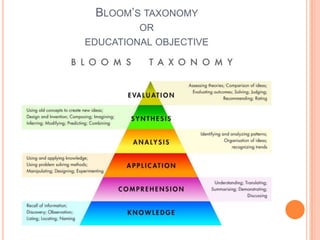
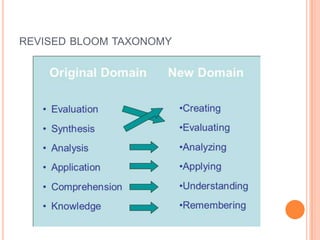
 to satisfy the bloom’s taxonomy of educational
objective
BLOOM’S TAXONOMY
OR
EDUCATIONAL OBJECTIVE
REVISED BLOOM TAXONOMY
GUIDELINE / STEPS TO PREPARE BLUE PRINT
 Content analysis
GUIDELINE / STEPS TO PREPARE BLUE PRINT
 Content analysis
 Determination of learning objectives
GUIDELINE / STEPS TO PREPARE BLUE PRINT
 Content analysis
 Determination of learning objectives
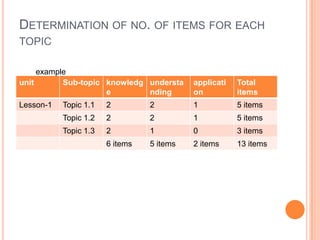
 Determination of no. of items for each topic based
on learning objectives
GUIDELINE / STEPS TO PREPARE BLUE PRINT
 Content analysis
 Determination of learning objectives
 Determination of no. of items for each topic based
on learning objectives
 Determining the types of questions
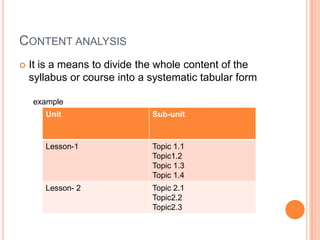
CONTENT ANALYSIS
CONTENT ANALYSIS
 It is a means to divide the whole content of the
syllabus or course into a systematic tabular form
CONTENT ANALYSIS
 It is a means to divide the whole content of the
syllabus or course into a systematic tabular form
Unit Sub-unit
Lesson-1 Topic 1.1
Topic1.2
Topic 1.3
Topic 1.4
Lesson- 2 Topic 2.1
Topic2.2
Topic2.3
example
DETERMINATION OF LEARNING OBJECTIVE
 Learning objective is based on bloom’s taxonomy
 Knowledge level
 Understanding level
 Application level
DETERMINATION OF LEARNING OBJECTIVE
 Learning objective is based on bloom’s taxonomy
 Knowledge level
 Understanding level
 Application level
Sub-topic knowledge understanding application
Topic 1.1 2 1 1
Topic 1.2 2 2 1
Topic 1.3 2 1 0
example
DETERMINATION OF NO. OF ITEMS FOR EACH
TOPIC
DETERMINATION OF NO. OF ITEMS FOR EACH
TOPIC
unit Sub-topic knowledg
e
understa
nding
applicati
on
Total
items
Lesson-1 Topic 1.1 2 2 1 5 items
Topic 1.2 2 2 1 5 items
Topic 1.3 2 1 0 3 items
6 items 5 items 2 items 13 items
example
DETERMINATION OF NO. OF ITEMS FOR EACH
TOPIC
unit Sub-topic knowledg
e
understa
nding
applicati
on
Total
items
Lesson-1 Topic 1.1 2 2 1 5 items
Topic 1.2 2 2 1 5 items
Topic 1.3 2 1 0 3 items
6 items 5 items 2 items 13 items
Hence, total13 items were constructed from lesson 1, from
which each level of objective have their own weightage
example
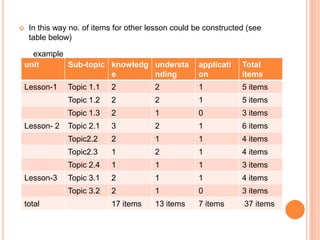
 In this way no. of items for other lesson could be constructed (see
table below)
 In this way no. of items for other lesson could be constructed (see
table below)
unit Sub-topic knowledg
e
understa
nding
applicati
on
Total
items
Lesson-1 Topic 1.1 2 2 1 5 items
Topic 1.2 2 2 1 5 items
Topic 1.3 2 1 0 3 items
Lesson- 2 Topic 2.1 3 2 1 6 items
Topic2.2 2 1 1 4 items
Topic2.3 1 2 1 4 items
Topic 2.4 1 1 1 3 items
Lesson-3 Topic 3.1 2 1 1 4 items
Topic 3.2 2 1 0 3 items
total 17 items 13 items 7 items 37 items
example
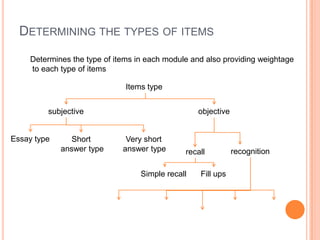
DETERMINING THE TYPES OF ITEMS
Determines the type of items in each module and also providing weightage
to each type of items
DETERMINING THE TYPES OF ITEMS
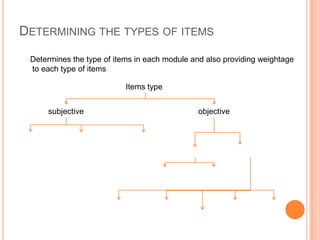
Items type
Determines the type of items in each module and also providing weightage
to each type of items
DETERMINING THE TYPES OF ITEMS
Items type
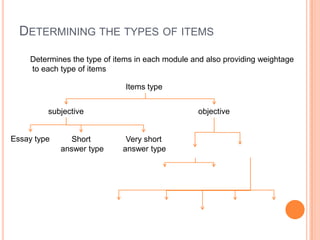
subjective objective
Determines the type of items in each module and also providing weightage
to each type of items
DETERMINING THE TYPES OF ITEMS
Items type
subjective objective
Essay type Short
answer type
Very short
answer type
Determines the type of items in each module and also providing weightage
to each type of items
DETERMINING THE TYPES OF ITEMS
Items type
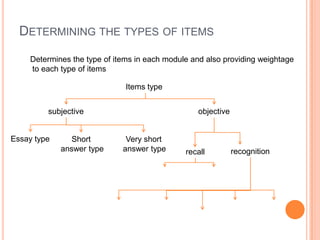
subjective objective
Essay type Short
answer type
Very short
answer type recall recognition
Determines the type of items in each module and also providing weightage
to each type of items
DETERMINING THE TYPES OF ITEMS
Items type
subjective objective
Essay type Short
answer type
Very short
answer type recall recognition
Simple recall Fill ups
Determines the type of items in each module and also providing weightage
to each type of items
DETERMINING THE TYPES OF ITEMS
Items type
subjective objective
Essay type Short
answer type
Very short
answer type recall recognition
Simple recall Fill ups
Recognition
test Multiple
choice test
True/falseclassify analogy
Determines the type of items in each module and also providing weightage
to each type of items
BENEFITS OF BLUE PRINT
 Give feedback on student’s progress and teachers
delivering the curriculum
BENEFITS OF BLUE PRINT
 Give feedback on student’s progress and teachers
delivering the curriculum
 From student’s point, how well they attain the
objectives
BENEFITS OF BLUE PRINT
 Give feedback on student’s progress and teachers
delivering the curriculum
 From student’s point, how well they attain the
objectives
 Provides a guide to both to students and teachers
BENEFITS OF BLUE PRINT
 Give feedback on student’s progress and teachers
delivering the curriculum
 From student’s point, how well they attain the
objectives
 Provides a guide to both to students and teachers
 Determines the reliability and validity of the
examination
BENEFITS OF BLUE PRINT
 Give feedback on student’s progress and teachers
delivering the curriculum
 From student’s point, how well they attain the
objectives
 Provides a guide to both to students and teachers
 Determines the reliability and validity of the
examination
 Bloom’s taxonomy helps in developing the entire
written and some aspect of practical questions
Every time the
question will change,
not the blue print
THANK
YOU

Blueprint in education

  • 1.
  • 2.
  • 3.
    MEANING A blueprint isgenerally something intended as a guide when making something else.
  • 4.
    MEANING A blueprint isgenerally something intended as a guide when making something else. It is a detailed plan of action or outline in a technical form.
  • 7.
    WHO WILL USETHE BLUEPRINT
  • 8.
    WHO WILL USETHE BLUEPRINT  It was first used at construction and industry
  • 9.
    WHO WILL USETHE BLUEPRINT  It was first used at construction and industry  Later it was used in car modeling, animation story boarding, etc.
  • 10.
    WHO WILL USETHE BLUEPRINT  It was first used at construction and industry  Later it was used in car modeling, animation story boarding, etc.  Basically, it is used at those areas where we want a detailed plan of action before executing finally.
  • 11.
    WHO WILL USETHE BLUEPRINT  It was first used at construction and industry  Later it was used in car modeling, animation story boarding, etc.  Basically, it is used at those areas where we want a detailed plan of action before executing finally.  in education, by the teachers, researchers, administrators,etc
  • 12.
  • 13.
    MEANING OF BLUEPRINTIN EDUCATION  It provide students an interactive approach for education planning to meet the curriculum expectations and learning objectives.
  • 14.
  • 15.
    BLUEPRINT FOR TEST A blueprint for test or examination is also known as the test specification provides examination strategy of an institution at a glance
  • 16.
    BLUEPRINT FOR TEST A blueprint for test or examination is also known as the test specification provides examination strategy of an institution at a glance  It is in the form of matrices ie., tabular form
  • 17.
    “specifies all theelements of performance relevant to the assessment so that appropriate samples of activity and corresponding methods can be selected according to their relative importance to the overall assessment process” Newble and Dawson, 1994
  • 18.
    “specifies all theelements of performance relevant to the assessment so that appropriate samples of activity and corresponding methods can be selected according to their relative importance to the overall assessment process” Newble and Dawson, 1994 “when the test items of a test are judged to adequately represent well defined domains of content…. Generalizable samples…… Cronback,1971
  • 19.
    USES OF BLUEPRINTIN EDUCATION
  • 20.
    USES OF BLUEPRINTIN EDUCATION  For the assessment of test specification i.e., in examination.
  • 21.
    USES OF BLUEPRINTIN EDUCATION  For the assessment of test specification i.e., in examination.  Evaluating time management and strategy to achieve the desired outcome
  • 22.
    USES OF BLUEPRINTIN EDUCATION  For the assessment of test specification i.e., in examination.  Evaluating time management and strategy to achieve the desired outcome  Education administrators for curriculum development
  • 23.
    USES OF BLUEPRINTIN EDUCATION  For the assessment of test specification i.e., in examination.  Evaluating time management and strategy to achieve the desired outcome  Education administrators for curriculum development  Curriculum developers to design comprehensive, sequenced career development learning opportunities
  • 24.
    USES OF BLUEPRINTIN EDUCATION  For the assessment of test specification i.e., in examination.  Evaluating time management and strategy to achieve the desired outcome  Education administrators for curriculum development  Curriculum developers to design comprehensive, sequenced career development learning opportunities  Research and evaluators to design learning plans
  • 25.
    USES OF BLUEPRINTIN EDUCATION  For the assessment of test specification i.e., in examination.  Evaluating time management and strategy to achieve the desired outcome  Education administrators for curriculum development  Curriculum developers to design comprehensive, sequenced career development learning opportunities  Research and evaluators to design learning plans  Parents / guardians for helping young people to develop their career from early age
  • 26.
  • 27.
    FEATURES  It isa matrix or chart reporting the number and type of test questions
  • 28.
    FEATURES  It isa matrix or chart reporting the number and type of test questions  The questions represent the topics in the content area
  • 29.
    FEATURES  It isa matrix or chart reporting the number and type of test questions  The questions represent the topics in the content area  The questions are based on the learning objective from each topic
  • 30.
    FEATURES  It isa matrix or chart reporting the number and type of test questions  The questions represent the topics in the content area  The questions are based on the learning objective from each topic  It also identifies the percentage(%) weighting of cognitive dimensions
  • 31.
  • 32.
    PURPOSE OF BLUEPRINT  Provide conceptual map of examination format and the content area  Type of measurement tool for assessing the items weighting the respective column of learning objectives
  • 33.
    PURPOSE OF BLUEPRINT  Provide conceptual map of examination format and the content area  Type of measurement tool for assessing the items weighting the respective column of learning objectives  Blueprint is seen as readily available document, which contains the list of topics covered under each module with its identified learning objectives  Content validity of assessment
  • 34.
    PURPOSE OF BLUEPRINT CONTD.….  It guides item collection and development  It provides a clear framework for the researchers to design items which assess the important concept or thinking skill listed in the test blueprint.
  • 35.
    PURPOSE OF BLUEPRINT CONTD…..  It guides item collection and development  It provides a clear framework for the researchers to design items which assess the important concept or thinking skill listed in the test blueprint.  It also provide sources for the formative use of the summative assessment  to satisfy the bloom’s taxonomy of educational objective
  • 36.
  • 37.
  • 38.
    GUIDELINE / STEPSTO PREPARE BLUE PRINT
  • 39.
    GUIDELINE / STEPSTO PREPARE BLUE PRINT  Content analysis
  • 40.
    GUIDELINE / STEPSTO PREPARE BLUE PRINT  Content analysis  Determination of learning objectives
  • 41.
    GUIDELINE / STEPSTO PREPARE BLUE PRINT  Content analysis  Determination of learning objectives  Determination of no. of items for each topic based on learning objectives
  • 42.
    GUIDELINE / STEPSTO PREPARE BLUE PRINT  Content analysis  Determination of learning objectives  Determination of no. of items for each topic based on learning objectives  Determining the types of questions
  • 43.
  • 44.
    CONTENT ANALYSIS  Itis a means to divide the whole content of the syllabus or course into a systematic tabular form
  • 45.
    CONTENT ANALYSIS  Itis a means to divide the whole content of the syllabus or course into a systematic tabular form Unit Sub-unit Lesson-1 Topic 1.1 Topic1.2 Topic 1.3 Topic 1.4 Lesson- 2 Topic 2.1 Topic2.2 Topic2.3 example
  • 46.
  • 47.
    DETERMINATION OF LEARNINGOBJECTIVE  Learning objective is based on bloom’s taxonomy  Knowledge level  Understanding level  Application level
  • 48.
    DETERMINATION OF LEARNINGOBJECTIVE  Learning objective is based on bloom’s taxonomy  Knowledge level  Understanding level  Application level Sub-topic knowledge understanding application Topic 1.1 2 1 1 Topic 1.2 2 2 1 Topic 1.3 2 1 0 example
  • 49.
    DETERMINATION OF NO.OF ITEMS FOR EACH TOPIC
  • 50.
    DETERMINATION OF NO.OF ITEMS FOR EACH TOPIC unit Sub-topic knowledg e understa nding applicati on Total items Lesson-1 Topic 1.1 2 2 1 5 items Topic 1.2 2 2 1 5 items Topic 1.3 2 1 0 3 items 6 items 5 items 2 items 13 items example
  • 51.
    DETERMINATION OF NO.OF ITEMS FOR EACH TOPIC unit Sub-topic knowledg e understa nding applicati on Total items Lesson-1 Topic 1.1 2 2 1 5 items Topic 1.2 2 2 1 5 items Topic 1.3 2 1 0 3 items 6 items 5 items 2 items 13 items Hence, total13 items were constructed from lesson 1, from which each level of objective have their own weightage example
  • 52.
     In thisway no. of items for other lesson could be constructed (see table below)
  • 53.
     In thisway no. of items for other lesson could be constructed (see table below) unit Sub-topic knowledg e understa nding applicati on Total items Lesson-1 Topic 1.1 2 2 1 5 items Topic 1.2 2 2 1 5 items Topic 1.3 2 1 0 3 items Lesson- 2 Topic 2.1 3 2 1 6 items Topic2.2 2 1 1 4 items Topic2.3 1 2 1 4 items Topic 2.4 1 1 1 3 items Lesson-3 Topic 3.1 2 1 1 4 items Topic 3.2 2 1 0 3 items total 17 items 13 items 7 items 37 items example
  • 54.
  • 55.
    DETERMINING THE TYPESOF ITEMS Determines the type of items in each module and also providing weightage to each type of items
  • 56.
    DETERMINING THE TYPESOF ITEMS Items type Determines the type of items in each module and also providing weightage to each type of items
  • 57.
    DETERMINING THE TYPESOF ITEMS Items type subjective objective Determines the type of items in each module and also providing weightage to each type of items
  • 58.
    DETERMINING THE TYPESOF ITEMS Items type subjective objective Essay type Short answer type Very short answer type Determines the type of items in each module and also providing weightage to each type of items
  • 59.
    DETERMINING THE TYPESOF ITEMS Items type subjective objective Essay type Short answer type Very short answer type recall recognition Determines the type of items in each module and also providing weightage to each type of items
  • 60.
    DETERMINING THE TYPESOF ITEMS Items type subjective objective Essay type Short answer type Very short answer type recall recognition Simple recall Fill ups Determines the type of items in each module and also providing weightage to each type of items
  • 61.
    DETERMINING THE TYPESOF ITEMS Items type subjective objective Essay type Short answer type Very short answer type recall recognition Simple recall Fill ups Recognition test Multiple choice test True/falseclassify analogy Determines the type of items in each module and also providing weightage to each type of items
  • 62.
  • 63.
    BENEFITS OF BLUEPRINT  Give feedback on student’s progress and teachers delivering the curriculum
  • 64.
    BENEFITS OF BLUEPRINT  Give feedback on student’s progress and teachers delivering the curriculum  From student’s point, how well they attain the objectives
  • 65.
    BENEFITS OF BLUEPRINT  Give feedback on student’s progress and teachers delivering the curriculum  From student’s point, how well they attain the objectives  Provides a guide to both to students and teachers
  • 66.
    BENEFITS OF BLUEPRINT  Give feedback on student’s progress and teachers delivering the curriculum  From student’s point, how well they attain the objectives  Provides a guide to both to students and teachers  Determines the reliability and validity of the examination
  • 67.
    BENEFITS OF BLUEPRINT  Give feedback on student’s progress and teachers delivering the curriculum  From student’s point, how well they attain the objectives  Provides a guide to both to students and teachers  Determines the reliability and validity of the examination  Bloom’s taxonomy helps in developing the entire written and some aspect of practical questions
  • 68.
    Every time the questionwill change, not the blue print
  • 69.

Editor's Notes

  • #13 Curriculum expectation means those goals which are meant to be achieved while teaching and learning.Learning objective means a detailed description about what should a student learn at the end of the lesson.
  • #14 Curriculum expectation means those goals which are meant to be achieved while teaching and learning.Learning objective means a detailed description about what should a student learn at the end of the lesson.
  • #15 Test specification – an overall details of the characteristics of a test i.e, total number and proportion of test items for each content domain.
  • #16 Test specification – an overall details of the characteristics of a test i.e, total number and proportion of test items for each content domain.
  • #17 Test specification – an overall details of the characteristics of a test i.e, total number and proportion of test items for each content domain.
  • #27 Content area - based on the lesson / chapters included in the courseCognitive dimensions – knowledge, understanding, application, etc.
  • #28 Content area - based on the lesson / chapters included in the courseCognitive dimensions – knowledge, understanding, application, etc.
  • #29 Content area - based on the lesson / chapters included in the courseCognitive dimensions – knowledge, understanding, application, etc.
  • #30 Content area - based on the lesson / chapters included in the courseCognitive dimensions – knowledge, understanding, application, etc.
  • #31 Content area - based on the lesson / chapters included in the courseCognitive dimensions – knowledge, understanding, application, etc.
  • #32 It also provide sources for the formative use of the summative assessment as suggested by Black and Wiliam (2001).Its ultimate goal is to make sound and appropriate judgement.
  • #33 It also provide sources for the formative use of the summative assessment as suggested by Black and Wiliam (2001).Its ultimate goal is to make sound and appropriate judgement.
  • #34 It also provide sources for the formative use of the summative assessment as suggested by Black and Wiliam (2001).Its ultimate goal is to make sound and appropriate judgement.
  • #35 It also provide sources for the formative use of the summative assessment as suggested by Black and Wiliam (2001).Its ultimate goal is to make sound and appropriate judgement.
  • #36 It also provide sources for the formative use of the summative assessment as suggested by Black and Wiliam (2001).Its ultimate goal is to make sound and appropriate judgement.
  • #47 Since at secondary and higer secondary section of the school only these three objectives of the bloom’s taxonomy are achieved
  • #48 Since at secondary and higer secondary section of the school only these three objectives of the bloom’s taxonomy are achieved
  • #49 Since at secondary and higer secondary section of the school only these three objectives of the bloom’s taxonomy are achieved
  • #55 It means deciding which question is to be selected for fulfilling which learning objective, if to test knowledge level objective then select objective type test.
  • #56 It means deciding which question is to be selected for fulfilling which learning objective, if to test knowledge level objective then select objective type test.
  • #57 It means deciding which question is to be selected for fulfilling which learning objective, if to test knowledge level objective then select objective type test.
  • #58 It means deciding which question is to be selected for fulfilling which learning objective, if to test knowledge level objective then select objective type test.
  • #59 It means deciding which question is to be selected for fulfilling which learning objective, if to test knowledge level objective then select objective type test.
  • #60 It means deciding which question is to be selected for fulfilling which learning objective, if to test knowledge level objective then select objective type test.
  • #61 It means deciding which question is to be selected for fulfilling which learning objective, if to test knowledge level objective then select objective type test.
  • #62 It means deciding which question is to be selected for fulfilling which learning objective, if to test knowledge level objective then select objective type test.