RESEARCH METHODOLOGY
PRESENTATION ON
“ACTION RESEARCH & FUNDAMENTAL RESEARCH”
PRESENTED TO:
DR. NANDAN VELANKAR
PRESENTED BY :
SHUBHAM NANDI(55)
PRESTIGE INSTITUTE OF MANAGEMENT
AND RESEARCH, GWALIOR
WHAT IS RESEARCH?
Research is "creative and systematic work undertaken to increase the stock of
knowledge".
It involves the collection, organization, and analysis of information to
increase understanding of a topic or issue.
A research project may be an expansion on past work in the field.
RESEARCH GENERATES KNOWLEDGE IN THE
FOLLOWING WAYS:
Research is defined as the creation of new knowledge and/or the use of
existing knowledge in a new and creative way so as to generate new concepts,
methodologies and understandings.
This could include synthesis and analysis of previous research to the extent that it leads
to new and creative outcomes.
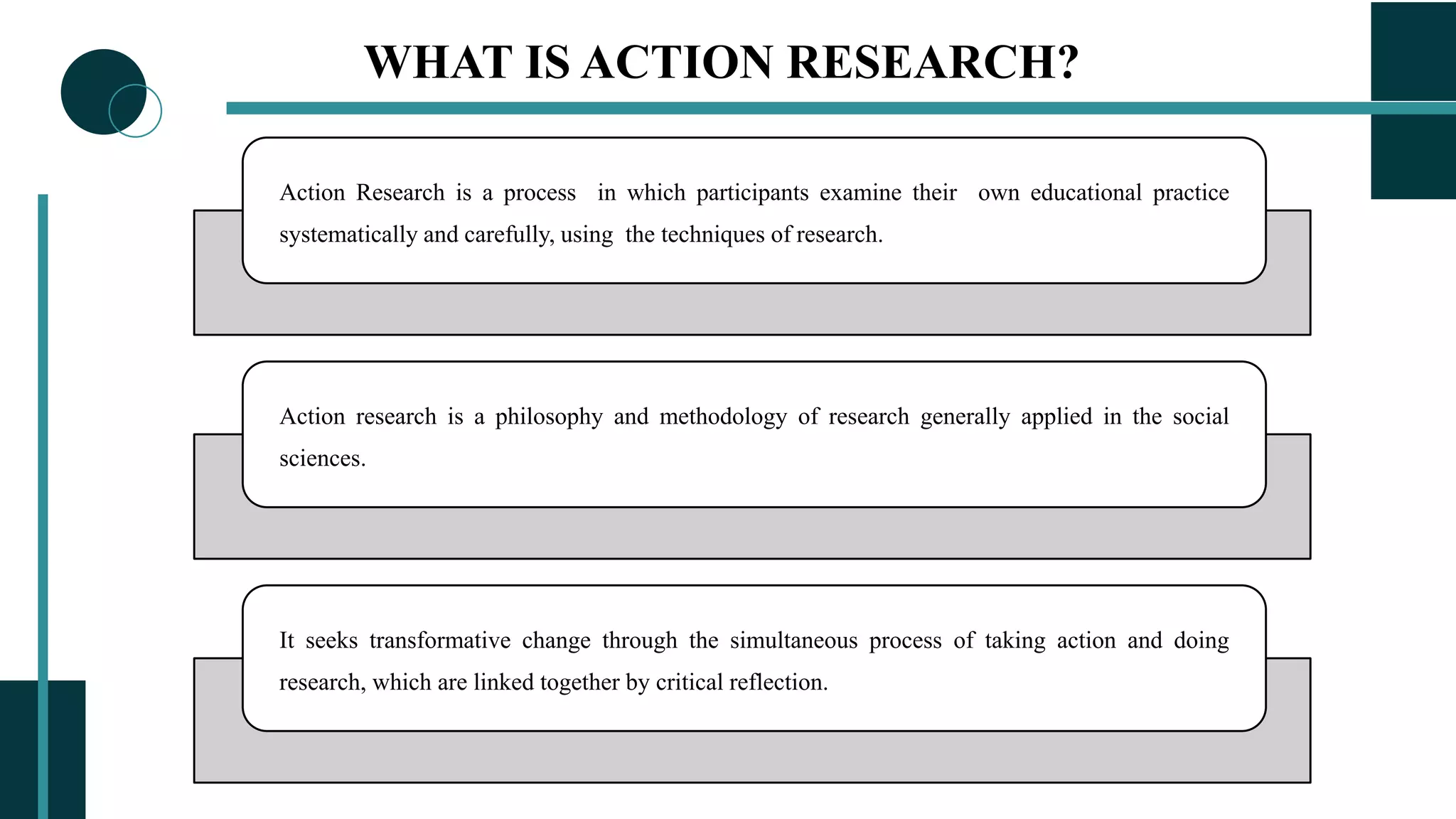
WHAT IS ACTION RESEARCH?
Action Research is a process in which participants examine their own educational practice
systematically and carefully, using the techniques of research.
Action research is a philosophy and methodology of research generally applied in the social
sciences.
It seeks transformative change through the simultaneous process of taking action and doing
research, which are linked together by critical reflection.
TYPES OF ACTION RESEARCH
 Individual Teacher Research – usually focuses on a single issue in the classroom.
 Collaborative Action Research – may include as few as two teachers or a group of several teachers
and others interested in addressing in a classroom or department issue.
 School-wide Research – focuses on issue common to all.
 District-wide Research – far more complex and utilizes more resources, but the rewards can be
great. Issues can be organizational, community- based, performance-based or processes for decision
making.
ACTION RESEARCH PROCESS
Selecting a
focus
Clarifying
theories
Identifying
research
questions
Collecting
data
Analyzing
data
Reporting
results
Taking
informed
action
These seven steps, which become an endless cycle for the inquiring teacher, are the following:
THREE PURPOSES FOR ACTION RESEARCH
As stated earlier, action research can be engaged in by an individual teacher, a collaborative group of
colleagues sharing a common concern, or an entire school faculty. These three different approaches to
organizing for research serve three compatible, yet distinct, purposes:
•Building the reflective practitioner
•Making progress on school wide priorities
•Building professional cultures
BUILDING THE REFLECTIVE PRACTITIONER
When individual teachers make a personal commitment to systematically collect data on their work,
they are embarking on a process that will foster continuous growth and development.
The individual teachers conducting action research are making continuous progress in developing
their strengths as reflective practitioners.
MAKING PROGRESS ON SCHOOL WIDE PRIORITIES
Increasingly, schools are focusing on strengthening themselves and their programs through the development
of common focuses and a strong sense of esprit de corps.
As a result, when a faculty chooses to focus on one issue and all the teachers elect to enthusiastically
participate in action research on that issue, significant progress on the schoolwide priorities cannot help but
occur.
BUILDING PROFESSIONAL CULTURES
Often an entire faculty will share a commitment to student development, yet the group finds itself unable to
adopt a single common focus for action research. This should not be viewed as indicative of a problem
Just as the medical practitioners working at a “quality” medical center will hold a shared vision of a healthy
adult, it is common for all the faculty members at a school to share a similar perspective on what constitutes a
well-educated student.
However, like the doctors at the medical center, the teachers in a “quality” school may well differ on which
specific aspects of the shared vision they are most motivated to pursue at any point in time.
BENEFITS OF ACTION RESEARCH
1. Focus on school issue, problem or area of collective interest.
2. Form of teacher professional development.
3. Collegial interactions.
4. Potential to impact school change.
5. Reflect on own practice.
6. Improved communications.
WHAT IS FUNDAMENTAL RESEARCH?
Fundamental research, also known as basic research or pure research does not usually generate findings that
have immediate applications in a practical level.
Fundamental research is driven by curiosity and the desire to expand knowledge in specific research area.
This type of research makes a specific contribution to the academic body of knowledge in the research area
FIVE BASIC TYPES OF RESEARCH STUDIES
1. CASE
STUDIES
2.
CORRELATIO
NAL STUDIES
3.
LONGITUDIN
AL STUDIES
4.
EXPERIMENT
AL STUDIES
5. CLINICAL
TRIAL
STUDIES
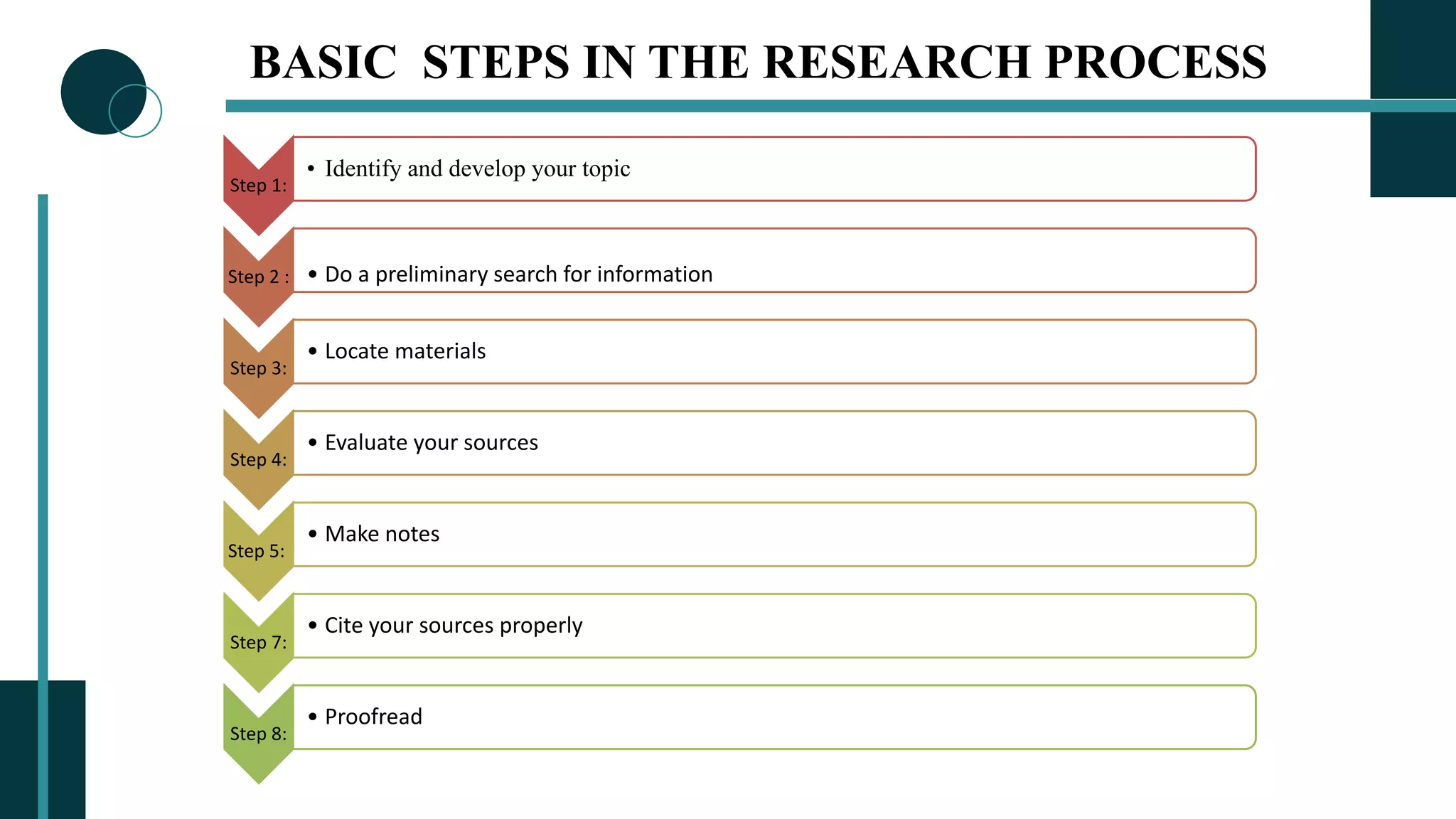
BASIC STEPS IN THE RESEARCH PROCESS
Step 1:
• Identify and develop your topic
Step 2 : • Do a preliminary search for information
Step 3:
• Locate materials
Step 4:
• Evaluate your sources
Step 5:
• Make notes
Step 7:
• Cite your sources properly
Step 8:
• Proofread
ADVANTAGES & DISADVANTAGES
ADVANTAGES
• The people individual studied are unaware so
they act naturally or as they usually do in
everyday situation.
• It is less expensive and time consuming than
quantitative experiments.
• Collects a large amount of notes for detailed
studying.
• As it is used to describe and not make any
conclusions it is to start the research with it;
DISADVANTAGES
• Descriptive research requires more skills.
• Does not identify cause behind a phenomenon
• Response rate is low in this research.
• Results of this research can change over the
period of time.
DIFFERENCES BETWEEN FUNDAMENTAL
RESEARCH & ACTION RESEARCH
To better understand the concept of Action Research, it would be better to differentiate between fundamental and
action research. These differences can be summarized as under:
1. Objectives: Develop & test educational
theories.
Find solutions to specific
problems in a situation
2.Training: Superior training is required in
Research Methodology.
Limited training is required.
3.Selection of a Problem: Wide study is done to select a
problem
Problems are identified by
teachers in teaching learning
process.
Basis Fundamental Research Action Research
4.Hypothesis: Highly specific hypotheses is
formed
Action Hypotheses are developed
DIFFERENCES BETWEEN FUNDAMENTAL
RESEARCH & ACTION RESEARCH
Basis Fundamental Research Action Research
5.Review of Literature: Extensive & thorough study of
literature.
No such thorough review is
needed.
6.Sample: Large sample size is required. Teacher takes the students of a
class as sample.
7.Analysis of Data: Complex analysis is done. Very simple analysis is done.
8.Conclusions: In form of developing theories or
generalizations.
In form of specific results.
9.Application of Results: Generalizations have broad
applicability.
Results are implemented in
classroom situations to see the
outcome
THANK YOU!!

ACTION RESEARCH & FUNDAMENTAL RESEARCH

  • 1.
    RESEARCH METHODOLOGY PRESENTATION ON “ACTIONRESEARCH & FUNDAMENTAL RESEARCH” PRESENTED TO: DR. NANDAN VELANKAR PRESENTED BY : SHUBHAM NANDI(55) PRESTIGE INSTITUTE OF MANAGEMENT AND RESEARCH, GWALIOR
  • 2.
    WHAT IS RESEARCH? Researchis "creative and systematic work undertaken to increase the stock of knowledge". It involves the collection, organization, and analysis of information to increase understanding of a topic or issue. A research project may be an expansion on past work in the field.
  • 3.
    RESEARCH GENERATES KNOWLEDGEIN THE FOLLOWING WAYS: Research is defined as the creation of new knowledge and/or the use of existing knowledge in a new and creative way so as to generate new concepts, methodologies and understandings. This could include synthesis and analysis of previous research to the extent that it leads to new and creative outcomes.
  • 4.
    WHAT IS ACTIONRESEARCH? Action Research is a process in which participants examine their own educational practice systematically and carefully, using the techniques of research. Action research is a philosophy and methodology of research generally applied in the social sciences. It seeks transformative change through the simultaneous process of taking action and doing research, which are linked together by critical reflection.
  • 5.
    TYPES OF ACTIONRESEARCH  Individual Teacher Research – usually focuses on a single issue in the classroom.  Collaborative Action Research – may include as few as two teachers or a group of several teachers and others interested in addressing in a classroom or department issue.  School-wide Research – focuses on issue common to all.  District-wide Research – far more complex and utilizes more resources, but the rewards can be great. Issues can be organizational, community- based, performance-based or processes for decision making.
  • 6.
    ACTION RESEARCH PROCESS Selectinga focus Clarifying theories Identifying research questions Collecting data Analyzing data Reporting results Taking informed action These seven steps, which become an endless cycle for the inquiring teacher, are the following:
  • 7.
    THREE PURPOSES FORACTION RESEARCH As stated earlier, action research can be engaged in by an individual teacher, a collaborative group of colleagues sharing a common concern, or an entire school faculty. These three different approaches to organizing for research serve three compatible, yet distinct, purposes: •Building the reflective practitioner •Making progress on school wide priorities •Building professional cultures
  • 8.
    BUILDING THE REFLECTIVEPRACTITIONER When individual teachers make a personal commitment to systematically collect data on their work, they are embarking on a process that will foster continuous growth and development. The individual teachers conducting action research are making continuous progress in developing their strengths as reflective practitioners.
  • 9.
    MAKING PROGRESS ONSCHOOL WIDE PRIORITIES Increasingly, schools are focusing on strengthening themselves and their programs through the development of common focuses and a strong sense of esprit de corps. As a result, when a faculty chooses to focus on one issue and all the teachers elect to enthusiastically participate in action research on that issue, significant progress on the schoolwide priorities cannot help but occur.
  • 10.
    BUILDING PROFESSIONAL CULTURES Oftenan entire faculty will share a commitment to student development, yet the group finds itself unable to adopt a single common focus for action research. This should not be viewed as indicative of a problem Just as the medical practitioners working at a “quality” medical center will hold a shared vision of a healthy adult, it is common for all the faculty members at a school to share a similar perspective on what constitutes a well-educated student. However, like the doctors at the medical center, the teachers in a “quality” school may well differ on which specific aspects of the shared vision they are most motivated to pursue at any point in time.
  • 11.
    BENEFITS OF ACTIONRESEARCH 1. Focus on school issue, problem or area of collective interest. 2. Form of teacher professional development. 3. Collegial interactions. 4. Potential to impact school change. 5. Reflect on own practice. 6. Improved communications.
  • 12.
    WHAT IS FUNDAMENTALRESEARCH? Fundamental research, also known as basic research or pure research does not usually generate findings that have immediate applications in a practical level. Fundamental research is driven by curiosity and the desire to expand knowledge in specific research area. This type of research makes a specific contribution to the academic body of knowledge in the research area
  • 13.
    FIVE BASIC TYPESOF RESEARCH STUDIES 1. CASE STUDIES 2. CORRELATIO NAL STUDIES 3. LONGITUDIN AL STUDIES 4. EXPERIMENT AL STUDIES 5. CLINICAL TRIAL STUDIES
  • 14.
    BASIC STEPS INTHE RESEARCH PROCESS Step 1: • Identify and develop your topic Step 2 : • Do a preliminary search for information Step 3: • Locate materials Step 4: • Evaluate your sources Step 5: • Make notes Step 7: • Cite your sources properly Step 8: • Proofread
  • 15.
    ADVANTAGES & DISADVANTAGES ADVANTAGES •The people individual studied are unaware so they act naturally or as they usually do in everyday situation. • It is less expensive and time consuming than quantitative experiments. • Collects a large amount of notes for detailed studying. • As it is used to describe and not make any conclusions it is to start the research with it; DISADVANTAGES • Descriptive research requires more skills. • Does not identify cause behind a phenomenon • Response rate is low in this research. • Results of this research can change over the period of time.
  • 16.
    DIFFERENCES BETWEEN FUNDAMENTAL RESEARCH& ACTION RESEARCH To better understand the concept of Action Research, it would be better to differentiate between fundamental and action research. These differences can be summarized as under: 1. Objectives: Develop & test educational theories. Find solutions to specific problems in a situation 2.Training: Superior training is required in Research Methodology. Limited training is required. 3.Selection of a Problem: Wide study is done to select a problem Problems are identified by teachers in teaching learning process. Basis Fundamental Research Action Research 4.Hypothesis: Highly specific hypotheses is formed Action Hypotheses are developed
  • 17.
    DIFFERENCES BETWEEN FUNDAMENTAL RESEARCH& ACTION RESEARCH Basis Fundamental Research Action Research 5.Review of Literature: Extensive & thorough study of literature. No such thorough review is needed. 6.Sample: Large sample size is required. Teacher takes the students of a class as sample. 7.Analysis of Data: Complex analysis is done. Very simple analysis is done. 8.Conclusions: In form of developing theories or generalizations. In form of specific results. 9.Application of Results: Generalizations have broad applicability. Results are implemented in classroom situations to see the outcome
  • 18.