A C T I O N R E S E A R C H
Unit 6
Research
 “Research is defined as the creation of new
knowledge and/or the use of existing knowledge in
a new and creative way so as to generate new
concepts, methodologies and understandings.”
• Western Sydney University 2020
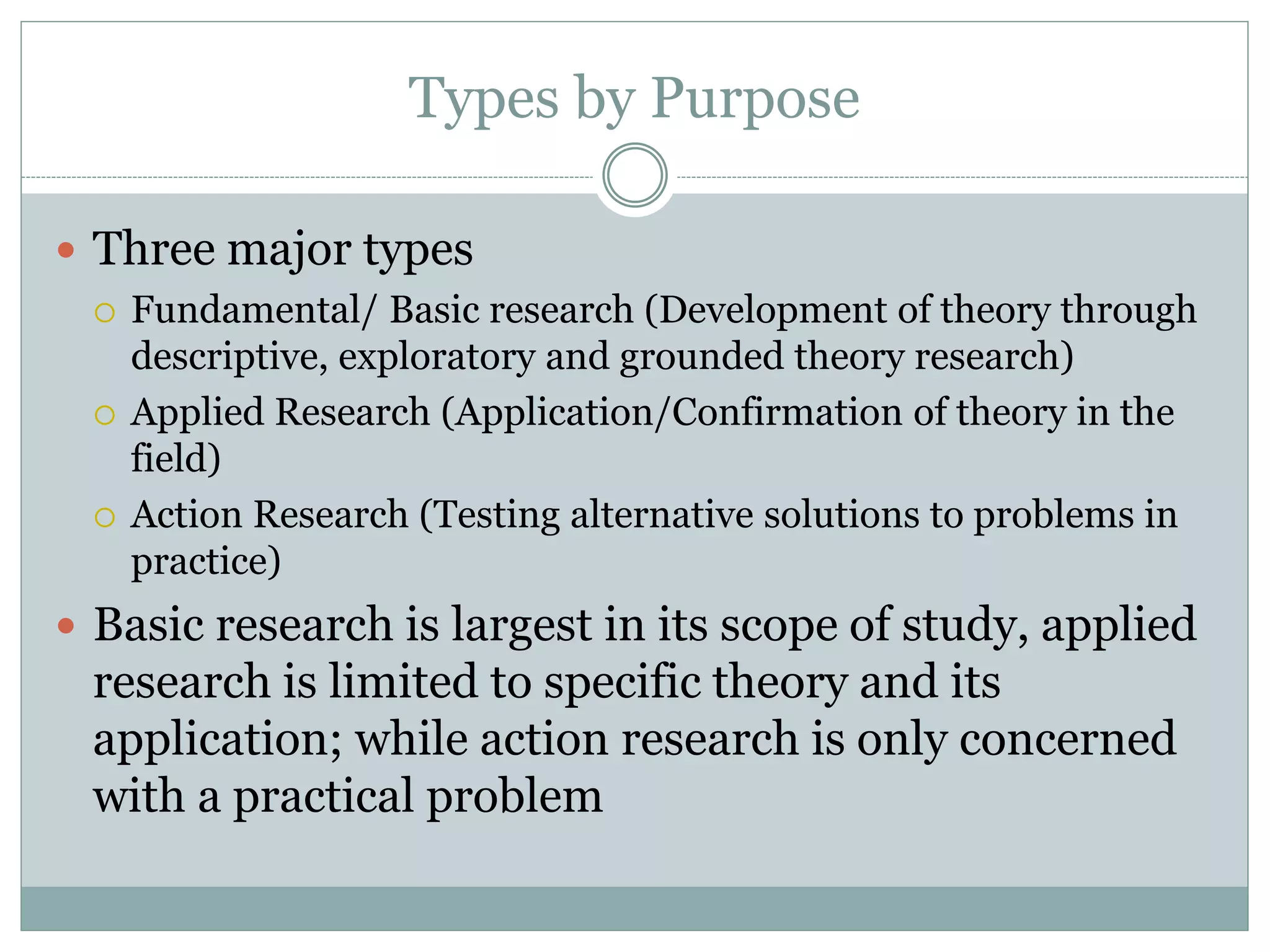
Types by Purpose
 Three major types
 Fundamental/ Basic research (Development of theory through
descriptive, exploratory and grounded theory research)
 Applied Research (Application/Confirmation of theory in the
field)
 Action Research (Testing alternative solutions to problems in
practice)
 Basic research is largest in its scope of study, applied
research is limited to specific theory and its
application; while action research is only concerned
with a practical problem
Action Research
 Kurt Lewin- German-American social psychologist,
who is considered to be the founder of "Action
Research", first used this term in 1940's.
 Action Research is the process of finding the solution
through problem solving technique. The expected
outcome of the action research, which addresses the
issues, improves the practices. It is done in groups,
during the activity is in progress.
 Action Research is a process of inquiry or
investigation carried out by and for those taking the
action in practical work
Teachers as Researchers
 As a critical thinker and reflective practitioner one
tends to identify problems and propose solutions
 As a Critical thinker you tend to identify problems
 As a reflective practitioner you develop action plans
 As a researcher you apply those action plans and
collect data to reflect further
Importance of Teachers Research
 It is necessary for teachers to be much more deliberate in
documenting and evaluating their efforts. Action research is
one means to that end.
 Action research assists practitioners and other stakeholders in
identifying the needs, assessing the development processes,
and evaluating the outcomes of the changes they define,
design, and implement.
 The self-evaluation aspect of action research (by educators
and/or students) is congruent with the philosophies contained
in the Total Quality Education and Outcomes Based
Education in the world is moving towards.
 Professional knowledge comes from practitioners’ research
more than theoretical research
Designing Action Research
Step 1
Identification of Problem (Identify a problem to
be studied)
What element(s) of your practice or what aspect of student
learning do you wish to investigate?
What in real sense do you want to improve?
What is the matter of concern that is not up to your
expectations?
Three major problem areas of teachers’ research can be
1. Instructional Challenges
2. Student Learning Issues
3. Classroom Management
Collect Data on the Problem
 Once the problem is identified, the next important step is
the collection of data.
 This job can be done in many ways.
 It can be done through observation with check list
 You can collect more information through discussion
with other teachers
 Information for student related problems can be
collected through parents feedback on a questionnaire
 Data for classroom management can be derived from
recoding a classroom day/lesson
Verification and Analysis
 Right tool i.e. valid and reliable information must be
used before developing the implementable action
plan.
 Triangulation in research makes it reliable and
valid. So once the data from multiple sources has
been gathered, it is organized in a form easy to
interpret
 Third step is to analyze qualitatively or
quantitatively
Reflection
 Once the problem and its relevant data is analyzed
the researcher reflects with the lenses of
 Personal Experience
 Consultation with experts
 Literature review
Action Plan
 Now is the time to have the action plan.
(a strategic plan of days or weeks or months)
 Not just to have a plan but to implement revise and
repeat.
 While implementing we will again start observing
the process of implementation and record the
applied technique or whatsoever to bring further
improvement in the process of learning.
 In case of success or failure recollect the data, do the
analysis, implement the change and again observe
the applied technique.
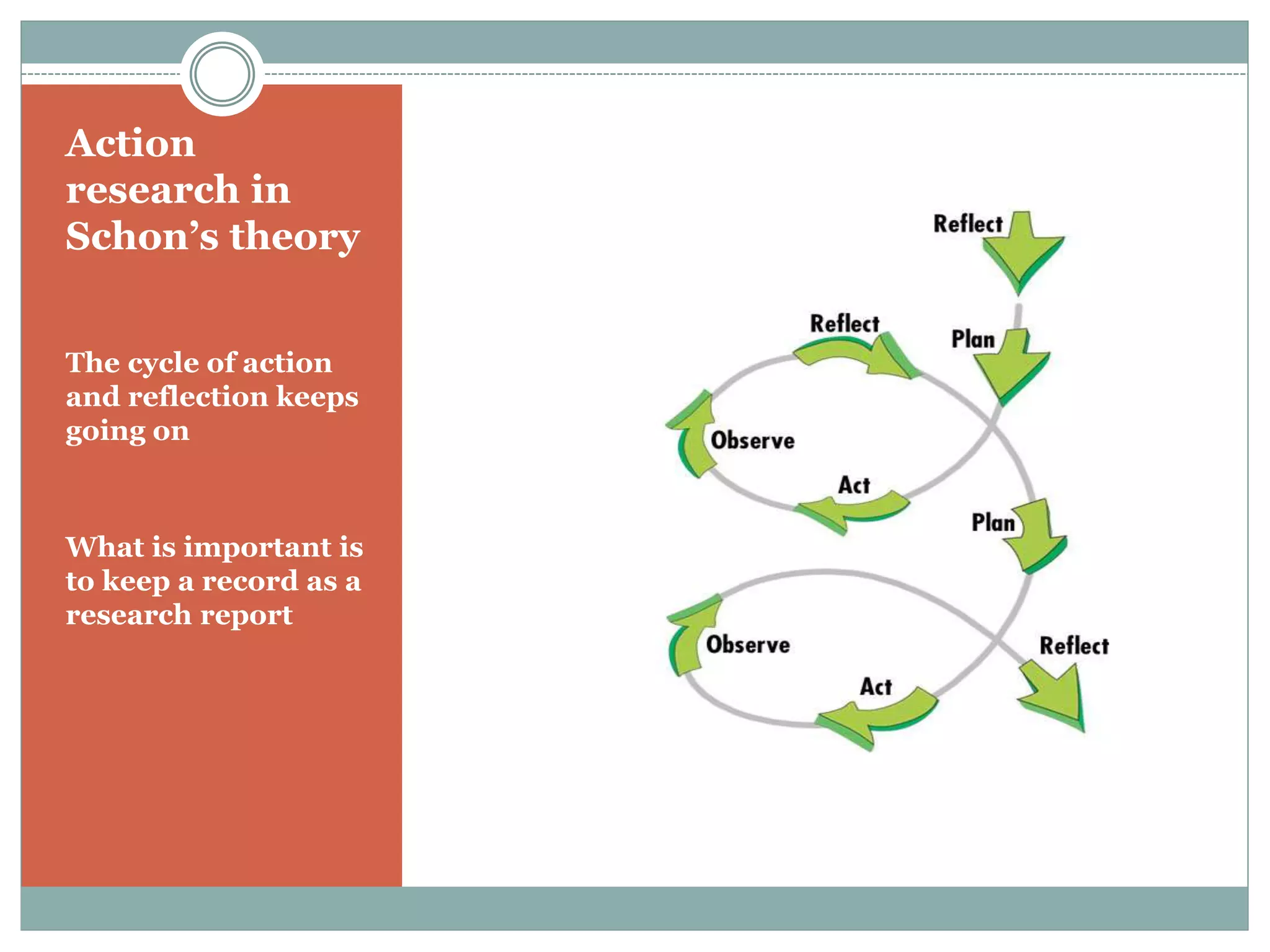
Action
research in
Schon’s theory
The cycle of action
and reflection keeps
going on
What is important is
to keep a record as a
research report
Types of Action Research
 Type 1: The Scientific - Technical View of Problem
Solving:
 The goal of the researcher in this approach is to test a
particular intervention based on a pre-specified theoretical
framework, the nature of the collaboration between the
researcher and the practitioner is technical and facilitator.
 The researcher identifies the problem and a specific
intervention, then the practitioner is involved and they agree
to facilitate with the implementation of the intervention.
 The communication flow within this type of research is
primarily between the facilitator and the group, so that the
ideas may be communicated to the group.
Type 2: Practical - Deliberative Action
Research
 According to McKernan the practical model of action
research trades off some measurement and control for
human interpretation, interactive communication,
deliberation, negotiation and detailed description.
"The goal of practical action researchers is understanding
practice and solving immediate problems".
 "Practical action research fosters the development of
professionalism by emphasising the part played by
personal judgement in decisions to act for the good of the
client".
 This mode of action research "promotes autonomous,
deliberative action which was given the name of Praxis".
TYPE 3: Enhancement approach/Critical
Action research
In this type of action research there are two goals for
the researcher using this approach
 One is to increase the closeness between the actual
problems encountered by practitioners in a specific
setting and the theory used to explain and resolve
the problem.
 The second goal, which goes beyond the previous two
types, is to assist practitioners in identifying and
making fundamental problems explicit by raising
their collective consciousness.
DO NOT FORGET!
 Continuous improvement in teaching and learning
like any other profession is the need of all times.
Action research is very important for the teachers as
they are dealing with the future of the country. It
asks such question like -What do I want to
improve?, Why am I concerned about it?, What can
I do to improve it?, Who can help me and how? How
will I know it has improved?
THANKS
ANY QUESTIONS?

CRITICAL THINKING AND REFLECTIVE PRACTICES-Unit 6-Action Research-AIOU-8611

  • 1.
    A C TI O N R E S E A R C H Unit 6
  • 2.
    Research  “Research isdefined as the creation of new knowledge and/or the use of existing knowledge in a new and creative way so as to generate new concepts, methodologies and understandings.” • Western Sydney University 2020
  • 3.
    Types by Purpose Three major types  Fundamental/ Basic research (Development of theory through descriptive, exploratory and grounded theory research)  Applied Research (Application/Confirmation of theory in the field)  Action Research (Testing alternative solutions to problems in practice)  Basic research is largest in its scope of study, applied research is limited to specific theory and its application; while action research is only concerned with a practical problem
  • 4.
    Action Research  KurtLewin- German-American social psychologist, who is considered to be the founder of "Action Research", first used this term in 1940's.  Action Research is the process of finding the solution through problem solving technique. The expected outcome of the action research, which addresses the issues, improves the practices. It is done in groups, during the activity is in progress.  Action Research is a process of inquiry or investigation carried out by and for those taking the action in practical work
  • 5.
    Teachers as Researchers As a critical thinker and reflective practitioner one tends to identify problems and propose solutions  As a Critical thinker you tend to identify problems  As a reflective practitioner you develop action plans  As a researcher you apply those action plans and collect data to reflect further
  • 6.
    Importance of TeachersResearch  It is necessary for teachers to be much more deliberate in documenting and evaluating their efforts. Action research is one means to that end.  Action research assists practitioners and other stakeholders in identifying the needs, assessing the development processes, and evaluating the outcomes of the changes they define, design, and implement.  The self-evaluation aspect of action research (by educators and/or students) is congruent with the philosophies contained in the Total Quality Education and Outcomes Based Education in the world is moving towards.  Professional knowledge comes from practitioners’ research more than theoretical research
  • 7.
    Designing Action Research Step1 Identification of Problem (Identify a problem to be studied) What element(s) of your practice or what aspect of student learning do you wish to investigate? What in real sense do you want to improve? What is the matter of concern that is not up to your expectations? Three major problem areas of teachers’ research can be 1. Instructional Challenges 2. Student Learning Issues 3. Classroom Management
  • 8.
    Collect Data onthe Problem  Once the problem is identified, the next important step is the collection of data.  This job can be done in many ways.  It can be done through observation with check list  You can collect more information through discussion with other teachers  Information for student related problems can be collected through parents feedback on a questionnaire  Data for classroom management can be derived from recoding a classroom day/lesson
  • 9.
    Verification and Analysis Right tool i.e. valid and reliable information must be used before developing the implementable action plan.  Triangulation in research makes it reliable and valid. So once the data from multiple sources has been gathered, it is organized in a form easy to interpret  Third step is to analyze qualitatively or quantitatively
  • 10.
    Reflection  Once theproblem and its relevant data is analyzed the researcher reflects with the lenses of  Personal Experience  Consultation with experts  Literature review
  • 11.
    Action Plan  Nowis the time to have the action plan. (a strategic plan of days or weeks or months)  Not just to have a plan but to implement revise and repeat.  While implementing we will again start observing the process of implementation and record the applied technique or whatsoever to bring further improvement in the process of learning.  In case of success or failure recollect the data, do the analysis, implement the change and again observe the applied technique.
  • 12.
    Action research in Schon’s theory Thecycle of action and reflection keeps going on What is important is to keep a record as a research report
  • 13.
    Types of ActionResearch  Type 1: The Scientific - Technical View of Problem Solving:  The goal of the researcher in this approach is to test a particular intervention based on a pre-specified theoretical framework, the nature of the collaboration between the researcher and the practitioner is technical and facilitator.  The researcher identifies the problem and a specific intervention, then the practitioner is involved and they agree to facilitate with the implementation of the intervention.  The communication flow within this type of research is primarily between the facilitator and the group, so that the ideas may be communicated to the group.
  • 14.
    Type 2: Practical- Deliberative Action Research  According to McKernan the practical model of action research trades off some measurement and control for human interpretation, interactive communication, deliberation, negotiation and detailed description. "The goal of practical action researchers is understanding practice and solving immediate problems".  "Practical action research fosters the development of professionalism by emphasising the part played by personal judgement in decisions to act for the good of the client".  This mode of action research "promotes autonomous, deliberative action which was given the name of Praxis".
  • 15.
    TYPE 3: Enhancementapproach/Critical Action research In this type of action research there are two goals for the researcher using this approach  One is to increase the closeness between the actual problems encountered by practitioners in a specific setting and the theory used to explain and resolve the problem.  The second goal, which goes beyond the previous two types, is to assist practitioners in identifying and making fundamental problems explicit by raising their collective consciousness.
  • 16.
    DO NOT FORGET! Continuous improvement in teaching and learning like any other profession is the need of all times. Action research is very important for the teachers as they are dealing with the future of the country. It asks such question like -What do I want to improve?, Why am I concerned about it?, What can I do to improve it?, Who can help me and how? How will I know it has improved?
  • 17.