ACTION RESEARCH
What is Action Research?What is Action Research?
• a three-step spiral process ofa three-step spiral process of
planning, which involvesplanning, which involves
(1)(1)surveys/investigations/explorationssurveys/investigations/explorations
(2)(2)taking actions, andtaking actions, and
(3)(3)fact-finding about the results of thefact-finding about the results of the
action.action.
--Kurt Lewin (1947)--Kurt Lewin (1947)
What Is Action Research?What Is Action Research?
• Systematic process of studying a realSystematic process of studying a real
school or classroom situationschool or classroom situation
• Goal is to understand and improve theGoal is to understand and improve the
quality of actions or instructionquality of actions or instruction
• Allows for teachers to observe theirAllows for teachers to observe their
practice or a problem and plan apractice or a problem and plan a
course of actioncourse of action
Johnson, 2005, p. 21
What is Action Research?What is Action Research?
• process by which practitionersprocess by which practitioners
attempt to study their problemsattempt to study their problems
scientifically in order to guide, correct,scientifically in order to guide, correct,
and evaluate their decisions andand evaluate their decisions and
actions.actions.
--Stephen Corey (1953)--Stephen Corey (1953)
**a fancy way of saying: leta fancy way of saying: let’’s studys study
whatwhat’’s happening at our school ands happening at our school and
decide how to make it a better place.decide how to make it a better place.
-- Emily Calhoun-- Emily Calhoun
Describing Action ResearchDescribing Action Research
Action
Research
Does not have to
be complicated to
be effective
Must plan
before
collecting data
Is not
necessarily
quantitative
Is sometimes
grounded in
theory
Starts with no
answers
Is limited in
results
Varies in
length
Can be formal or
informal, simple or
detailed
Is systematic
Uses consistent
observations
Johnson, 2005, pp. 22-25
Why Is Action Research Important?Why Is Action Research Important?
1.1. A gap exists between theory andA gap exists between theory and
practice. Action research bridges thispractice. Action research bridges this
gap. (See Moses Effect.)gap. (See Moses Effect.)
2.2. empowers teachers to understand theirempowers teachers to understand their
teaching environments and maketeaching environments and make
informed decisions.informed decisions.
3.3. can replace traditional in-service orcan replace traditional in-service or
professional growth activities.professional growth activities.Johnson, 2005, p. 27
Steps in Action ResearchSteps in Action Research
1) Decide
upon topic
3) Review
literature
4) Generate
hypotheses
2) Define
problem or
questions
5) Plan data
collection
6) Collect
data
7) Analyze
data
8) Interpret
results and/or
create action
plan
9) Share your
findings
Johnson,
2005, Fig. 3.1,
p. 22
Action Research ProcessAction Research Process
1. Identify a problem1. Identify a problem
2. Review what is known about the problem2. Review what is known about the problem
3. Develop research hypotheses or questions3. Develop research hypotheses or questions
about the problem and plan the researchabout the problem and plan the research
process accordinglyprocess accordingly
4. Gather the data4. Gather the data
5. Analyze the data5. Analyze the data
6. Interpret results; disseminate and use6. Interpret results; disseminate and use
findingsfindings
7. Evaluate the research process7. Evaluate the research process
Identify the ProblemIdentify the Problem
1.1. Identify the problem and determineIdentify the problem and determine
the purpose of the research. Askthe purpose of the research. Ask
yourself:yourself:
– What is the problem I want toWhat is the problem I want to
solve?solve?
– What is the question I want toWhat is the question I want to
answer?answer?
– What do I wish was different?What do I wish was different?
Identify the ProblemIdentify the Problem
• Define the problem/question in clear,Define the problem/question in clear,
specific language. The question may bespecific language. The question may be
general or specific.general or specific.
– ““Does the new Math Lab increase math grades orDoes the new Math Lab increase math grades or
math test scores?”math test scores?”
– ““Does a study skills intervention impact first yearDoes a study skills intervention impact first year
failure rates?”failure rates?”
– ““Does bullying affect the academic performance ofDoes bullying affect the academic performance of
Grade 7 students?Grade 7 students?
– ““What is the impact of technology on studentWhat is the impact of technology on student
achievement?”achievement?”
– ““What is the impact of social media on student’s studyWhat is the impact of social media on student’s study
habits?habits?
* “* “
What is the impact of leveling on the grade school pupils
academic performance ?
What are the reasons for students’ non-performance in
summativeTests?
What are the grade school pupils’ favorite teaching
strateg(y/ies) in Mathematics?
What are the factors that motivate the students to
perform in PEHM?
What are the causes of tardiness among grade 4 pupils?
Identify the ProblemIdentify the Problem
• Purpose of the study:Purpose of the study:
• keep the goal in mindkeep the goal in mind
• what do you hope to achieve?what do you hope to achieve?
• Ex. The main purpose of the study is toEx. The main purpose of the study is to
know the effect of a study skills programknow the effect of a study skills program
on student achievement or academicon student achievement or academic
performance.performance.
Review
of LiteratureWhat is Already Known?What is Already Known?
2. Review what is known about the problem.2. Review what is known about the problem.
– Has anyone in the school asked thisHas anyone in the school asked this
question before?question before?
– Who might have information?Who might have information?
– What is the relevant research inWhat is the relevant research in
professional journals?professional journals?
– What does an internet search find onWhat does an internet search find on
this topic?this topic?
What is already known?What is already known?
• Evaluating findings from researchEvaluating findings from research
literature and internet searches:literature and internet searches:
– What is the source? How reliable is it?What is the source? How reliable is it?
– What are the strengths/weaknesses ofWhat are the strengths/weaknesses of
the research design, sampling, effectthe research design, sampling, effect
size, measures used, treatment fidelity,size, measures used, treatment fidelity,
researcher bias, instrument reliabilityresearcher bias, instrument reliability
and validity?and validity?
Develop HypothesesDevelop Hypotheses
3. Develop research hypotheses or3. Develop research hypotheses or
questions about the problems and planquestions about the problems and plan
the research process accordingly.the research process accordingly.
– Ask yourself what you think the answer(s) toAsk yourself what you think the answer(s) to
your question(s) will be.your question(s) will be.
– Identifying your hypotheses helps you identifyIdentifying your hypotheses helps you identify
your biases, which may influence youryour biases, which may influence your
process.process.
– What is the opposite of your hypothesis (theWhat is the opposite of your hypothesis (the
“null hypothesis”)? What would the data look“null hypothesis”)? What would the data look
like if you were wrong?like if you were wrong?
Gather the DataGather the Data
4. Gather the data.4. Gather the data.
– What information do you need in order toWhat information do you need in order to
answer your question or solve your problem?answer your question or solve your problem?
– Use multiple sources of data, or multipleUse multiple sources of data, or multiple
outcome measures, wherever possible.outcome measures, wherever possible.
– Decide whether you need to consider studentDecide whether you need to consider student
achievement data, psychosocial data, careerachievement data, psychosocial data, career
data, school data...data, school data...
Gather the DataGather the Data
• Where is the data?Where is the data?
– Does it already exist?Does it already exist?
•School records, Teacher recordsSchool records, Teacher records
– Will you generate your own data?Will you generate your own data?
•SurveysSurveys
•InterviewsInterviews
•ObservationsObservations
Gather the DataGather the Data
• How accurate is the data you’veHow accurate is the data you’ve
chosen to use? What’s missing?chosen to use? What’s missing?
• Multiple data sources help you moreMultiple data sources help you more
accurately get at the complexity of aaccurately get at the complexity of a
situation, whereas one measure orsituation, whereas one measure or
data source will give you a snapshotdata source will give you a snapshot
view.view.
Gather the DataGather the Data
• Select and/or develop the instruments youSelect and/or develop the instruments you
will use to gather the data. Possibilitieswill use to gather the data. Possibilities
include:include:
– SurveysSurveys
– Tests (of achievement, aptitude,Tests (of achievement, aptitude,
attitude, etc.)attitude, etc.)
– Behavioral checklists or observationsBehavioral checklists or observations
– Performance assessmentsPerformance assessments
– interviewsinterviews
Gather the DataGather the Data
• Reliability and validity need to beReliability and validity need to be
considered when selecting instruments.considered when selecting instruments.
• Does it measure what it’s supposed to?Does it measure what it’s supposed to?
• Have others used the instrument andHave others used the instrument and
found it to be reliable and valid?found it to be reliable and valid?
Gather the dataGather the data
• Identify and follow ethical and legalIdentify and follow ethical and legal
standards:standards:
– No participant should be exposed to physicalNo participant should be exposed to physical
or psychological harm.or psychological harm.
– Permission to use confidential data must bePermission to use confidential data must be
obtained.obtained.
– Participation in a study is always voluntary.Participation in a study is always voluntary.
– Participants may withdraw from the study atParticipants may withdraw from the study at
any time.any time.
– Participants’ privacy/rights must be respected.Participants’ privacy/rights must be respected.
Gather the DataGather the Data
• Identify the group/Identify the group/samplesample to be studied:to be studied:
– Ideally either the entire sample is involved inIdeally either the entire sample is involved in
the study (the class, year level, or school) orthe study (the class, year level, or school) or
the group studied is a random sample of thethe group studied is a random sample of the
population.population.
– Stratified samplingStratified sampling uses a smaller sampleuses a smaller sample
which has the same proportions as the largerwhich has the same proportions as the larger
sample.sample.
– Systematic random samplingSystematic random sampling is whenis when
every x number of students is chosen fromevery x number of students is chosen from
the whole population (every 3the whole population (every 3rdrd
, or every 4, or every 4thth
forfor
example).example).
Gather the DataGather the Data
• One way to strengthen the findings isOne way to strengthen the findings is
to compare the group who receivedto compare the group who received
the intervention with a comparablethe intervention with a comparable
group who didn’t receive thegroup who didn’t receive the
intervention.intervention.
• Once data sources and measures areOnce data sources and measures are
identified, ethical standards areidentified, ethical standards are
considered, and the sample isconsidered, and the sample is
identified, data can be gathered!identified, data can be gathered!
Analyze the DataAnalyze the Data
5. Analyze the data:5. Analyze the data:
– Before data can be analyzed it mayBefore data can be analyzed it may
need to be edited, encoded andneed to be edited, encoded and
organized for analysis.organized for analysis.
– Data is often entered into aData is often entered into a
software program such as Excel orsoftware program such as Excel or
SPSS.SPSS.
Analyze the DataAnalyze the Data
• Descriptive statistics describe the dataDescriptive statistics describe the data
and can provide information about how aand can provide information about how a
group has changed over time:group has changed over time:
– Measures of central tendencyMeasures of central tendency
• Mean, median, modeMean, median, mode
– Measures of variabilityMeasures of variability
• Variance, standard variation, rangeVariance, standard variation, range
– Measures of relative standingMeasures of relative standing
• Percentile rankPercentile rank
Analyze the DataAnalyze the Data
• Inferential statistics provide additionalInferential statistics provide additional
information:information:
– Looking carefully at how a group changesLooking carefully at how a group changes
over timeover time
• Use t-tests or Chi-SquareUse t-tests or Chi-Square
– Looking at differences between control andLooking at differences between control and
intervention groupsintervention groups
• Use t-tests or Chi-SquareUse t-tests or Chi-Square
– Looking at differences among more than 2Looking at differences among more than 2
groupsgroups
• Use Analysis of Variance (ANOVA)Use Analysis of Variance (ANOVA)
Analyze the DataAnalyze the Data
• Finding parent, colleague, orFinding parent, colleague, or
teacher(s) who already know how toteacher(s) who already know how to
input and analyze data can make thisinput and analyze data can make this
part of the research process easier.part of the research process easier.
Interpret Research ResultsInterpret Research Results
6. Interpret research results, disseminate,6. Interpret research results, disseminate,
and use findings to inform practice.and use findings to inform practice.
Develop an action plan.Develop an action plan.
– What do the results of your analysisWhat do the results of your analysis
mean?mean?
– What did you find out?What did you find out?
– Were your hypotheses correct?Were your hypotheses correct?
Interpret Research ResultsInterpret Research Results
• How can the results beHow can the results be
communicated?communicated?
– Decide what’s relevant to eachDecide what’s relevant to each
audience.audience.
– Present all relevant results even if theyPresent all relevant results even if they
don’t support your hypotheses.don’t support your hypotheses.
– Relate your findings to the purpose ofRelate your findings to the purpose of
the study, your hypotheses andthe study, your hypotheses and
previous research.previous research.
Interpret Research ResultsInterpret Research Results
• One of the distinguishing features ofOne of the distinguishing features of
Action Research is that its primary goal isAction Research is that its primary goal is
to take action based on the researchto take action based on the research
findings. Some options include:findings. Some options include:
– Make recommendations that will resolve theMake recommendations that will resolve the
problem.problem.
– Make plans and decisions about interventionsMake plans and decisions about interventions
based on the findings.based on the findings.
– Make program plans based on the findings.Make program plans based on the findings.
– Develop action plans based on the findings.Develop action plans based on the findings.
Evaluate the Research ProcessEvaluate the Research Process
Evaluate the Research Process with allEvaluate the Research Process with all
involved:involved:
– What would we do differently next time?What would we do differently next time?
– Does the instrument need revising?Does the instrument need revising?
– Did the research generate theDid the research generate the
information we wanted?information we wanted?
– What new questions did the researchWhat new questions did the research
generate?generate?
Evaluate the Research ProcessEvaluate the Research Process
• Mills (2000) and Kemmis and WilkinsonMills (2000) and Kemmis and Wilkinson
(1998) suggest the following questions:(1998) suggest the following questions:
– Does the project clearly address aDoes the project clearly address a
problem or issue in practice that needsproblem or issue in practice that needs
to be solved?to be solved?
– Did the researcher collect sufficient dataDid the researcher collect sufficient data
to help address the problem?to help address the problem?
– Did the plan of action build logically fromDid the plan of action build logically from
the data?the data?
– Did the action research actually lead toDid the action research actually lead to
a change or did a solution to a problema change or did a solution to a problem
make a difference?make a difference?
Sample Research QuestionsSample Research Questions
• How can I motivate my students to fall in love inHow can I motivate my students to fall in love in
mathematics?mathematics?
• How can I motivate my students to increase theirHow can I motivate my students to increase their
time spent on reading?time spent on reading?
• How does the teacher’s teaching style affect theHow does the teacher’s teaching style affect the
learner’s learning outcomes or performance?learner’s learning outcomes or performance?
• How do the students view the Science enrichedHow do the students view the Science enriched
class?class?
• Are any of my students doing very littleAre any of my students doing very little
reading/writing or not reading/writing at allreading/writing or not reading/writing at all
and it remained unnoticed during ourand it remained unnoticed during our
reading/writing time or session?reading/writing time or session?
• How do students view the Student ActivityHow do students view the Student Activity
Program?Program?
• What is the impact of the Career ProgramWhat is the impact of the Career Program
on the student’s career decision-making?on the student’s career decision-making?
1.Identification/formulati1.Identification/formulati
on/approval of theon/approval of the
problemproblem
22ndnd
to 4to 4thth
week ofweek of
SeptemberSeptember
22. Doing the review of. Doing the review of
rel literature and studiesrel literature and studies
OctoberOctober
33. Gathering/collecting. Gathering/collecting
the datathe data
NovemberNovember
44. Analyzing/interpreting. Analyzing/interpreting
the resultsthe results
DecemberDecember
55. Presenting the. Presenting the
researchresearch ((ResearchResearch
Forum)Forum)
JanuaryJanuary
6. Publishing the6. Publishing the February to MarchFebruary to March
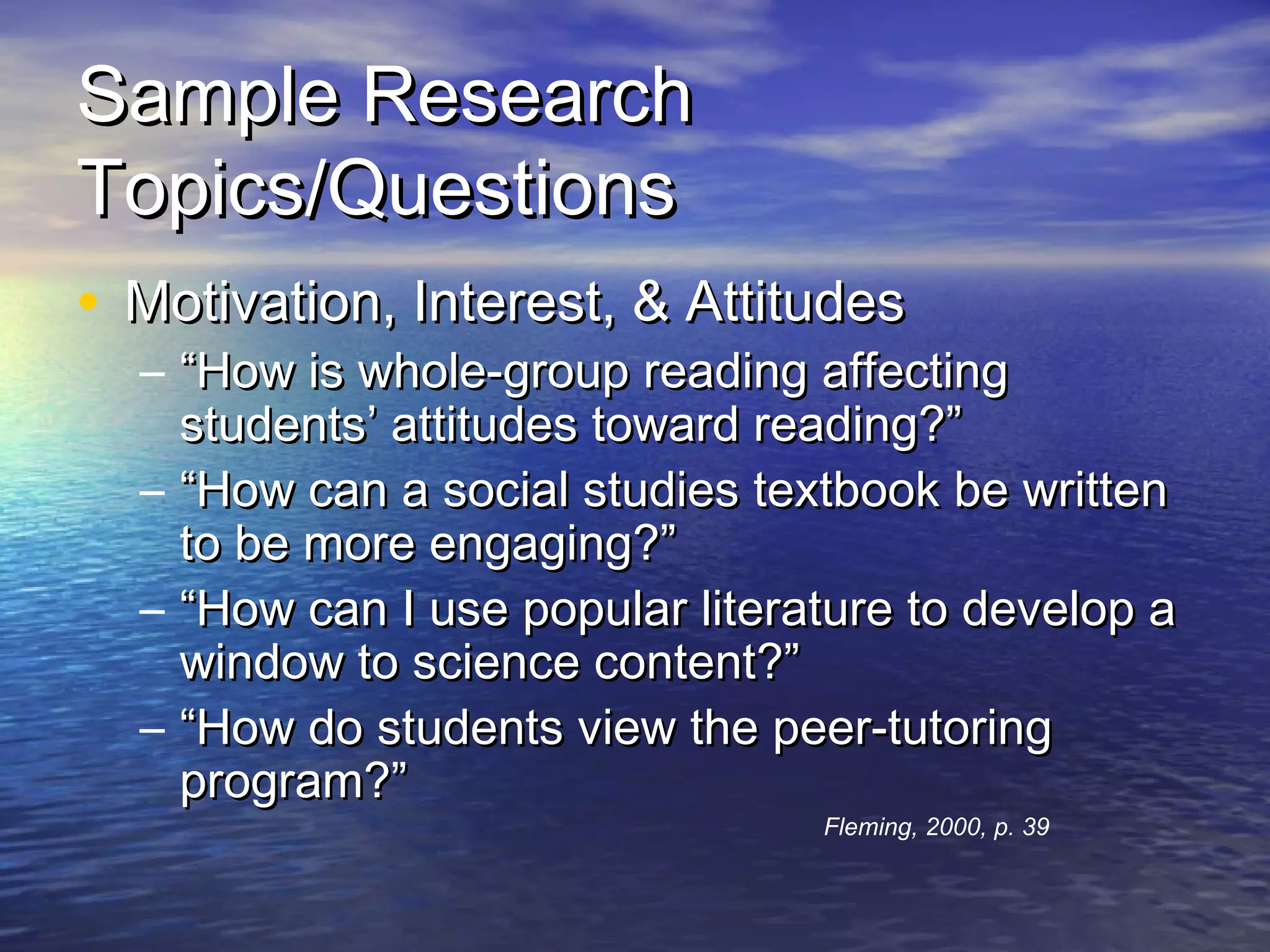
Sample ResearchSample Research
Topics/QuestionsTopics/Questions
• Motivation, Interest, & AttitudesMotivation, Interest, & Attitudes
– ““How is whole-group reading affectingHow is whole-group reading affecting
students’ attitudes toward reading?”students’ attitudes toward reading?”
– ““How can a social studies textbook be writtenHow can a social studies textbook be written
to be more engaging?”to be more engaging?”
– ““How can I use popular literature to develop aHow can I use popular literature to develop a
window to science content?”window to science content?”
– ““How do students view the peer-tutoringHow do students view the peer-tutoring
program?”program?”
Fleming, 2000, p. 39
Sample Research ProjectsSample Research Projects
Researcher Topic Subject(s) Data/Methods
12.1) Alison
Reynolds: 5th-gr.
resource teacher
Her goal was to understand
her student’s motivations
and behaviors in light of his
radical personality
changes.
Former student,
Sammy, during
5th-6th grades at
“treatment
school”
Observations &
interactions
12.2) Kay Dicke:
6th-gr. classroom
teacher
How can I motivate my 6th-
grade students to increase
their time spent reading?
27 6th-grade
students in her
class
Reading survey,
observations, field
notes (1 week), &
independent reading
checklist (2 weeks)
12.3) LouAnn
Strachota: EBD
paraprofessional
She wanted to examine the
relationship and cause for
differences between on-
task and off-task behaviors.
Her 4 EBD
students during
high school
health class
On-task/Off-task
behavioral
checklists,
observations, & field
notes
Sample Research ProjectsSample Research Projects
Researcher Topic Subject(s) Methodologies
12.4) Georgina
Pete: elementary
TAG teacher
She was trying to assist her
student and his classroom
teacher in making him
more successful in school
Brandon, her
4th-grade TAG
student
Conferences,
interviews,
observations, & field
notes
12.5) Teresa Van
Batavia: 1st-gr.
classroom
teacher
Are any of my students
doing little or no writing and
not being noticed during
our Writer’s Workshop
time?
All of her 1st-
grade students
Writing checklist,
individual
conferences, &
conference notes
12.6) Linda Roth:
gifted ed.
coordinator
Her study investigated the
social emotional, and
writing development of the
grade acceleration of her
TAG student.
Bill, an 11-yr-old
4th-grader, who
skipped 5th
grade
Social and academic
behavioral
checklists,
standardized test
scores, writing
samples, &
interviews
Sample research problemsSample research problemsMath teachers
CLE teachers
EPP teacher
They wanted to find
out why students
are not performing
well in summative
tests
They investigated
the reasons that
motivated the
students to involve
in parish activities
Why are the pupils
almost always late
in submitting their
projects in EPP
120 grade
8 and
grade 9
students
109 grade
8 & 9
students
Grade 6
pupils
Researcher-
made survey
questionnaire
Random
interview
Researcher-
made survey
questionnaire
Random
interview
Researcher-
made survey
questionnaire
Random
interview
•
Enjoy the exciting work ahead.
Thank you.
Enjoy the exciting work ahead. Thank you.

Action research 2013 (2)

  • 1.
  • 2.
    What is ActionResearch?What is Action Research? • a three-step spiral process ofa three-step spiral process of planning, which involvesplanning, which involves (1)(1)surveys/investigations/explorationssurveys/investigations/explorations (2)(2)taking actions, andtaking actions, and (3)(3)fact-finding about the results of thefact-finding about the results of the action.action. --Kurt Lewin (1947)--Kurt Lewin (1947)
  • 3.
    What Is ActionResearch?What Is Action Research? • Systematic process of studying a realSystematic process of studying a real school or classroom situationschool or classroom situation • Goal is to understand and improve theGoal is to understand and improve the quality of actions or instructionquality of actions or instruction • Allows for teachers to observe theirAllows for teachers to observe their practice or a problem and plan apractice or a problem and plan a course of actioncourse of action Johnson, 2005, p. 21
  • 4.
    What is ActionResearch?What is Action Research? • process by which practitionersprocess by which practitioners attempt to study their problemsattempt to study their problems scientifically in order to guide, correct,scientifically in order to guide, correct, and evaluate their decisions andand evaluate their decisions and actions.actions. --Stephen Corey (1953)--Stephen Corey (1953) **a fancy way of saying: leta fancy way of saying: let’’s studys study whatwhat’’s happening at our school ands happening at our school and decide how to make it a better place.decide how to make it a better place. -- Emily Calhoun-- Emily Calhoun
  • 5.
    Describing Action ResearchDescribingAction Research Action Research Does not have to be complicated to be effective Must plan before collecting data Is not necessarily quantitative Is sometimes grounded in theory Starts with no answers Is limited in results Varies in length Can be formal or informal, simple or detailed Is systematic Uses consistent observations Johnson, 2005, pp. 22-25
  • 6.
    Why Is ActionResearch Important?Why Is Action Research Important? 1.1. A gap exists between theory andA gap exists between theory and practice. Action research bridges thispractice. Action research bridges this gap. (See Moses Effect.)gap. (See Moses Effect.) 2.2. empowers teachers to understand theirempowers teachers to understand their teaching environments and maketeaching environments and make informed decisions.informed decisions. 3.3. can replace traditional in-service orcan replace traditional in-service or professional growth activities.professional growth activities.Johnson, 2005, p. 27
  • 7.
    Steps in ActionResearchSteps in Action Research 1) Decide upon topic 3) Review literature 4) Generate hypotheses 2) Define problem or questions 5) Plan data collection 6) Collect data 7) Analyze data 8) Interpret results and/or create action plan 9) Share your findings Johnson, 2005, Fig. 3.1, p. 22
  • 8.
    Action Research ProcessActionResearch Process 1. Identify a problem1. Identify a problem 2. Review what is known about the problem2. Review what is known about the problem 3. Develop research hypotheses or questions3. Develop research hypotheses or questions about the problem and plan the researchabout the problem and plan the research process accordinglyprocess accordingly 4. Gather the data4. Gather the data 5. Analyze the data5. Analyze the data 6. Interpret results; disseminate and use6. Interpret results; disseminate and use findingsfindings 7. Evaluate the research process7. Evaluate the research process
  • 9.
    Identify the ProblemIdentifythe Problem 1.1. Identify the problem and determineIdentify the problem and determine the purpose of the research. Askthe purpose of the research. Ask yourself:yourself: – What is the problem I want toWhat is the problem I want to solve?solve? – What is the question I want toWhat is the question I want to answer?answer? – What do I wish was different?What do I wish was different?
  • 10.
    Identify the ProblemIdentifythe Problem • Define the problem/question in clear,Define the problem/question in clear, specific language. The question may bespecific language. The question may be general or specific.general or specific. – ““Does the new Math Lab increase math grades orDoes the new Math Lab increase math grades or math test scores?”math test scores?” – ““Does a study skills intervention impact first yearDoes a study skills intervention impact first year failure rates?”failure rates?” – ““Does bullying affect the academic performance ofDoes bullying affect the academic performance of Grade 7 students?Grade 7 students? – ““What is the impact of technology on studentWhat is the impact of technology on student achievement?”achievement?” – ““What is the impact of social media on student’s studyWhat is the impact of social media on student’s study habits?habits? * “* “
  • 11.
    What is theimpact of leveling on the grade school pupils academic performance ? What are the reasons for students’ non-performance in summativeTests? What are the grade school pupils’ favorite teaching strateg(y/ies) in Mathematics? What are the factors that motivate the students to perform in PEHM? What are the causes of tardiness among grade 4 pupils?
  • 12.
    Identify the ProblemIdentifythe Problem • Purpose of the study:Purpose of the study: • keep the goal in mindkeep the goal in mind • what do you hope to achieve?what do you hope to achieve? • Ex. The main purpose of the study is toEx. The main purpose of the study is to know the effect of a study skills programknow the effect of a study skills program on student achievement or academicon student achievement or academic performance.performance.
  • 13.
    Review of LiteratureWhat isAlready Known?What is Already Known? 2. Review what is known about the problem.2. Review what is known about the problem. – Has anyone in the school asked thisHas anyone in the school asked this question before?question before? – Who might have information?Who might have information? – What is the relevant research inWhat is the relevant research in professional journals?professional journals? – What does an internet search find onWhat does an internet search find on this topic?this topic?
  • 14.
    What is alreadyknown?What is already known? • Evaluating findings from researchEvaluating findings from research literature and internet searches:literature and internet searches: – What is the source? How reliable is it?What is the source? How reliable is it? – What are the strengths/weaknesses ofWhat are the strengths/weaknesses of the research design, sampling, effectthe research design, sampling, effect size, measures used, treatment fidelity,size, measures used, treatment fidelity, researcher bias, instrument reliabilityresearcher bias, instrument reliability and validity?and validity?
  • 15.
    Develop HypothesesDevelop Hypotheses 3.Develop research hypotheses or3. Develop research hypotheses or questions about the problems and planquestions about the problems and plan the research process accordingly.the research process accordingly. – Ask yourself what you think the answer(s) toAsk yourself what you think the answer(s) to your question(s) will be.your question(s) will be. – Identifying your hypotheses helps you identifyIdentifying your hypotheses helps you identify your biases, which may influence youryour biases, which may influence your process.process. – What is the opposite of your hypothesis (theWhat is the opposite of your hypothesis (the “null hypothesis”)? What would the data look“null hypothesis”)? What would the data look like if you were wrong?like if you were wrong?
  • 16.
    Gather the DataGatherthe Data 4. Gather the data.4. Gather the data. – What information do you need in order toWhat information do you need in order to answer your question or solve your problem?answer your question or solve your problem? – Use multiple sources of data, or multipleUse multiple sources of data, or multiple outcome measures, wherever possible.outcome measures, wherever possible. – Decide whether you need to consider studentDecide whether you need to consider student achievement data, psychosocial data, careerachievement data, psychosocial data, career data, school data...data, school data...
  • 17.
    Gather the DataGatherthe Data • Where is the data?Where is the data? – Does it already exist?Does it already exist? •School records, Teacher recordsSchool records, Teacher records – Will you generate your own data?Will you generate your own data? •SurveysSurveys •InterviewsInterviews •ObservationsObservations
  • 18.
    Gather the DataGatherthe Data • How accurate is the data you’veHow accurate is the data you’ve chosen to use? What’s missing?chosen to use? What’s missing? • Multiple data sources help you moreMultiple data sources help you more accurately get at the complexity of aaccurately get at the complexity of a situation, whereas one measure orsituation, whereas one measure or data source will give you a snapshotdata source will give you a snapshot view.view.
  • 19.
    Gather the DataGatherthe Data • Select and/or develop the instruments youSelect and/or develop the instruments you will use to gather the data. Possibilitieswill use to gather the data. Possibilities include:include: – SurveysSurveys – Tests (of achievement, aptitude,Tests (of achievement, aptitude, attitude, etc.)attitude, etc.) – Behavioral checklists or observationsBehavioral checklists or observations – Performance assessmentsPerformance assessments – interviewsinterviews
  • 20.
    Gather the DataGatherthe Data • Reliability and validity need to beReliability and validity need to be considered when selecting instruments.considered when selecting instruments. • Does it measure what it’s supposed to?Does it measure what it’s supposed to? • Have others used the instrument andHave others used the instrument and found it to be reliable and valid?found it to be reliable and valid?
  • 21.
    Gather the dataGatherthe data • Identify and follow ethical and legalIdentify and follow ethical and legal standards:standards: – No participant should be exposed to physicalNo participant should be exposed to physical or psychological harm.or psychological harm. – Permission to use confidential data must bePermission to use confidential data must be obtained.obtained. – Participation in a study is always voluntary.Participation in a study is always voluntary. – Participants may withdraw from the study atParticipants may withdraw from the study at any time.any time. – Participants’ privacy/rights must be respected.Participants’ privacy/rights must be respected.
  • 22.
    Gather the DataGatherthe Data • Identify the group/Identify the group/samplesample to be studied:to be studied: – Ideally either the entire sample is involved inIdeally either the entire sample is involved in the study (the class, year level, or school) orthe study (the class, year level, or school) or the group studied is a random sample of thethe group studied is a random sample of the population.population. – Stratified samplingStratified sampling uses a smaller sampleuses a smaller sample which has the same proportions as the largerwhich has the same proportions as the larger sample.sample. – Systematic random samplingSystematic random sampling is whenis when every x number of students is chosen fromevery x number of students is chosen from the whole population (every 3the whole population (every 3rdrd , or every 4, or every 4thth forfor example).example).
  • 23.
    Gather the DataGatherthe Data • One way to strengthen the findings isOne way to strengthen the findings is to compare the group who receivedto compare the group who received the intervention with a comparablethe intervention with a comparable group who didn’t receive thegroup who didn’t receive the intervention.intervention. • Once data sources and measures areOnce data sources and measures are identified, ethical standards areidentified, ethical standards are considered, and the sample isconsidered, and the sample is identified, data can be gathered!identified, data can be gathered!
  • 24.
    Analyze the DataAnalyzethe Data 5. Analyze the data:5. Analyze the data: – Before data can be analyzed it mayBefore data can be analyzed it may need to be edited, encoded andneed to be edited, encoded and organized for analysis.organized for analysis. – Data is often entered into aData is often entered into a software program such as Excel orsoftware program such as Excel or SPSS.SPSS.
  • 25.
    Analyze the DataAnalyzethe Data • Descriptive statistics describe the dataDescriptive statistics describe the data and can provide information about how aand can provide information about how a group has changed over time:group has changed over time: – Measures of central tendencyMeasures of central tendency • Mean, median, modeMean, median, mode – Measures of variabilityMeasures of variability • Variance, standard variation, rangeVariance, standard variation, range – Measures of relative standingMeasures of relative standing • Percentile rankPercentile rank
  • 26.
    Analyze the DataAnalyzethe Data • Inferential statistics provide additionalInferential statistics provide additional information:information: – Looking carefully at how a group changesLooking carefully at how a group changes over timeover time • Use t-tests or Chi-SquareUse t-tests or Chi-Square – Looking at differences between control andLooking at differences between control and intervention groupsintervention groups • Use t-tests or Chi-SquareUse t-tests or Chi-Square – Looking at differences among more than 2Looking at differences among more than 2 groupsgroups • Use Analysis of Variance (ANOVA)Use Analysis of Variance (ANOVA)
  • 27.
    Analyze the DataAnalyzethe Data • Finding parent, colleague, orFinding parent, colleague, or teacher(s) who already know how toteacher(s) who already know how to input and analyze data can make thisinput and analyze data can make this part of the research process easier.part of the research process easier.
  • 28.
    Interpret Research ResultsInterpretResearch Results 6. Interpret research results, disseminate,6. Interpret research results, disseminate, and use findings to inform practice.and use findings to inform practice. Develop an action plan.Develop an action plan. – What do the results of your analysisWhat do the results of your analysis mean?mean? – What did you find out?What did you find out? – Were your hypotheses correct?Were your hypotheses correct?
  • 29.
    Interpret Research ResultsInterpretResearch Results • How can the results beHow can the results be communicated?communicated? – Decide what’s relevant to eachDecide what’s relevant to each audience.audience. – Present all relevant results even if theyPresent all relevant results even if they don’t support your hypotheses.don’t support your hypotheses. – Relate your findings to the purpose ofRelate your findings to the purpose of the study, your hypotheses andthe study, your hypotheses and previous research.previous research.
  • 30.
    Interpret Research ResultsInterpretResearch Results • One of the distinguishing features ofOne of the distinguishing features of Action Research is that its primary goal isAction Research is that its primary goal is to take action based on the researchto take action based on the research findings. Some options include:findings. Some options include: – Make recommendations that will resolve theMake recommendations that will resolve the problem.problem. – Make plans and decisions about interventionsMake plans and decisions about interventions based on the findings.based on the findings. – Make program plans based on the findings.Make program plans based on the findings. – Develop action plans based on the findings.Develop action plans based on the findings.
  • 31.
    Evaluate the ResearchProcessEvaluate the Research Process Evaluate the Research Process with allEvaluate the Research Process with all involved:involved: – What would we do differently next time?What would we do differently next time? – Does the instrument need revising?Does the instrument need revising? – Did the research generate theDid the research generate the information we wanted?information we wanted? – What new questions did the researchWhat new questions did the research generate?generate?
  • 32.
    Evaluate the ResearchProcessEvaluate the Research Process • Mills (2000) and Kemmis and WilkinsonMills (2000) and Kemmis and Wilkinson (1998) suggest the following questions:(1998) suggest the following questions: – Does the project clearly address aDoes the project clearly address a problem or issue in practice that needsproblem or issue in practice that needs to be solved?to be solved? – Did the researcher collect sufficient dataDid the researcher collect sufficient data to help address the problem?to help address the problem? – Did the plan of action build logically fromDid the plan of action build logically from the data?the data? – Did the action research actually lead toDid the action research actually lead to a change or did a solution to a problema change or did a solution to a problem make a difference?make a difference?
  • 33.
    Sample Research QuestionsSampleResearch Questions • How can I motivate my students to fall in love inHow can I motivate my students to fall in love in mathematics?mathematics? • How can I motivate my students to increase theirHow can I motivate my students to increase their time spent on reading?time spent on reading? • How does the teacher’s teaching style affect theHow does the teacher’s teaching style affect the learner’s learning outcomes or performance?learner’s learning outcomes or performance? • How do the students view the Science enrichedHow do the students view the Science enriched class?class?
  • 34.
    • Are anyof my students doing very littleAre any of my students doing very little reading/writing or not reading/writing at allreading/writing or not reading/writing at all and it remained unnoticed during ourand it remained unnoticed during our reading/writing time or session?reading/writing time or session? • How do students view the Student ActivityHow do students view the Student Activity Program?Program? • What is the impact of the Career ProgramWhat is the impact of the Career Program on the student’s career decision-making?on the student’s career decision-making?
  • 35.
    1.Identification/formulati1.Identification/formulati on/approval of theon/approvalof the problemproblem 22ndnd to 4to 4thth week ofweek of SeptemberSeptember 22. Doing the review of. Doing the review of rel literature and studiesrel literature and studies OctoberOctober 33. Gathering/collecting. Gathering/collecting the datathe data NovemberNovember 44. Analyzing/interpreting. Analyzing/interpreting the resultsthe results DecemberDecember 55. Presenting the. Presenting the researchresearch ((ResearchResearch Forum)Forum) JanuaryJanuary 6. Publishing the6. Publishing the February to MarchFebruary to March
  • 36.
    Sample ResearchSample Research Topics/QuestionsTopics/Questions •Motivation, Interest, & AttitudesMotivation, Interest, & Attitudes – ““How is whole-group reading affectingHow is whole-group reading affecting students’ attitudes toward reading?”students’ attitudes toward reading?” – ““How can a social studies textbook be writtenHow can a social studies textbook be written to be more engaging?”to be more engaging?” – ““How can I use popular literature to develop aHow can I use popular literature to develop a window to science content?”window to science content?” – ““How do students view the peer-tutoringHow do students view the peer-tutoring program?”program?” Fleming, 2000, p. 39
  • 37.
    Sample Research ProjectsSampleResearch Projects Researcher Topic Subject(s) Data/Methods 12.1) Alison Reynolds: 5th-gr. resource teacher Her goal was to understand her student’s motivations and behaviors in light of his radical personality changes. Former student, Sammy, during 5th-6th grades at “treatment school” Observations & interactions 12.2) Kay Dicke: 6th-gr. classroom teacher How can I motivate my 6th- grade students to increase their time spent reading? 27 6th-grade students in her class Reading survey, observations, field notes (1 week), & independent reading checklist (2 weeks) 12.3) LouAnn Strachota: EBD paraprofessional She wanted to examine the relationship and cause for differences between on- task and off-task behaviors. Her 4 EBD students during high school health class On-task/Off-task behavioral checklists, observations, & field notes
  • 38.
    Sample Research ProjectsSampleResearch Projects Researcher Topic Subject(s) Methodologies 12.4) Georgina Pete: elementary TAG teacher She was trying to assist her student and his classroom teacher in making him more successful in school Brandon, her 4th-grade TAG student Conferences, interviews, observations, & field notes 12.5) Teresa Van Batavia: 1st-gr. classroom teacher Are any of my students doing little or no writing and not being noticed during our Writer’s Workshop time? All of her 1st- grade students Writing checklist, individual conferences, & conference notes 12.6) Linda Roth: gifted ed. coordinator Her study investigated the social emotional, and writing development of the grade acceleration of her TAG student. Bill, an 11-yr-old 4th-grader, who skipped 5th grade Social and academic behavioral checklists, standardized test scores, writing samples, & interviews
  • 39.
    Sample research problemsSampleresearch problemsMath teachers CLE teachers EPP teacher They wanted to find out why students are not performing well in summative tests They investigated the reasons that motivated the students to involve in parish activities Why are the pupils almost always late in submitting their projects in EPP 120 grade 8 and grade 9 students 109 grade 8 & 9 students Grade 6 pupils Researcher- made survey questionnaire Random interview Researcher- made survey questionnaire Random interview Researcher- made survey questionnaire Random interview
  • 40.
    • Enjoy the excitingwork ahead. Thank you.
  • 41.
    Enjoy the excitingwork ahead. Thank you.