ACTION RESEARCHACTION RESEARCH
Some common problemsSome common problems
 How can I get the students to enjoy learning?
 What can I do to make handicapped children feel part of my class?
 How can I make my classroom more interesting for students?
 How might we conduct teacher evaluation processes in this school
in ways that will improve teaching and learning?
 How can I encourage more parental support for what does on in
the classroom?
 How can I adapt an already demanding curriculum to better meet
the specific needs of the students in my class?
 How might we work together better as a staff to establish such
Meaning of Action Research
A comparative research on the conditions and effects of
various forms of social action and research leading to social
action that uses a spiral of steps, each of which is composed
of a circle of planning, action, and fact-finding about the result
of the action.”
Kurt Lewin
It is a reflective process of progressive problem solving led by
individuals working with others in teams to improve the
situation or to solve problems. It can also be undertaken by
larger organizations or institutions, assisted or guided by
professional researchers, with the aim of improving their
strategies, practices, and knowledge of the environments
within which they practice.
Wikipedia
What is Action Research?
Action: Teachers act with children, colleagues; and
parents. With experience, we fall prey to habits. We
do things in a certain way and rarely explore new
possibilities, better ways of teaching learning
situation.
Research: Classroom teachers conduct research
all of the time. We do on the job research such as
diagnose new students, prepare for a parent-
teacher interview, go over the student's work, test
results, and standardized test scores, etc.
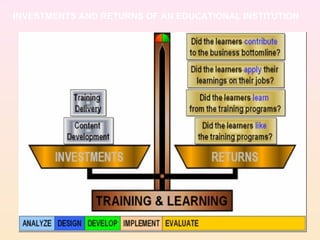
INVESTMENTS AND RETURNS OF AN EDUCATIONAL INSTITUTION
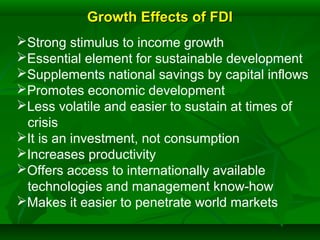
Growth Effects of FDIGrowth Effects of FDI
Strong stimulus to income growth
Essential element for sustainable development
Supplements national savings by capital inflows
Promotes economic development
Less volatile and easier to sustain at times of
crisis
It is an investment, not consumption
Increases productivity
Offers access to internationally available
technologies and management know-how
Makes it easier to penetrate world markets
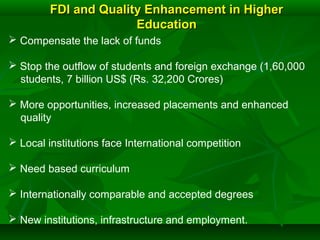
FDI and Quality Enhancement in HigherFDI and Quality Enhancement in Higher
EducationEducation
 Compensate the lack of funds
 Stop the outflow of students and foreign exchange (1,60,000
students, 7 billion US$ (Rs. 32,200 Crores)
 More opportunities, increased placements and enhanced
quality
 Local institutions face International competition
 Need based curriculum
 Internationally comparable and accepted degrees
 New institutions, infrastructure and employment.
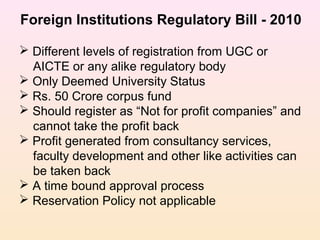
Foreign Institutions Regulatory Bill - 2010
 Different levels of registration from UGC or
AICTE or any alike regulatory body
 Only Deemed University Status
 Rs. 50 Crore corpus fund
 Should register as “Not for profit companies” and
cannot take the profit back
 Profit generated from consultancy services,
faculty development and other like activities can
be taken back
 A time bound approval process
 Reservation Policy not applicable
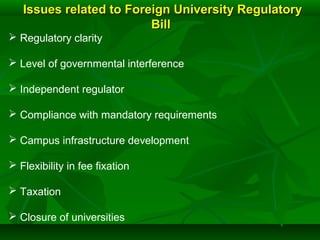
Issues related to Foreign University RegulatoryIssues related to Foreign University Regulatory
BillBill
 Regulatory clarity
 Level of governmental interference
 Independent regulator
 Compliance with mandatory requirements
 Campus infrastructure development
 Flexibility in fee fixation
 Taxation
 Closure of universities
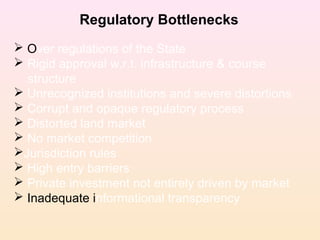
Regulatory Bottlenecks
 Over regulations of the State
 Rigid approval w.r.t. infrastructure & course
structure
 Unrecognized institutions and severe distortions
 Corrupt and opaque regulatory process
 Distorted land market
 No market competition
Jurisdiction rules
 High entry barriers
 Private investment not entirely driven by market
 Inadequate informational transparency
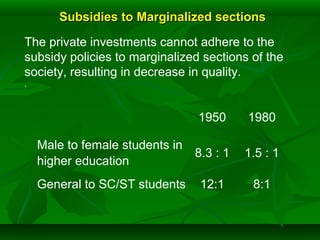
Subsidies to Marginalized sectionsSubsidies to Marginalized sections
1950 1980
Male to female students in
higher education
8.3 : 1 1.5 : 1
General to SC/ST students 12:1 8:1
The private investments cannot adhere to the
subsidy policies to marginalized sections of the
society, resulting in decrease in quality.
.
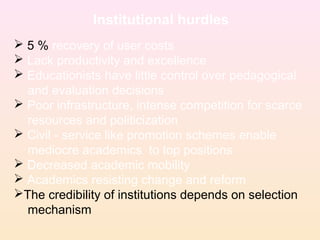
Institutional hurdles
 5 % recovery of user costs
 Lack productivity and excellence
 Educationists have little control over pedagogical
and evaluation decisions
 Poor infrastructure, intense competition for scarce
resources and politicization
 Civil - service like promotion schemes enable
mediocre academics to top positions
 Decreased academic mobility
 Academics resisting change and reform
The credibility of institutions depends on selection
mechanism

Action Research

  • 1.
  • 2.
    Some common problemsSomecommon problems  How can I get the students to enjoy learning?  What can I do to make handicapped children feel part of my class?  How can I make my classroom more interesting for students?  How might we conduct teacher evaluation processes in this school in ways that will improve teaching and learning?  How can I encourage more parental support for what does on in the classroom?  How can I adapt an already demanding curriculum to better meet the specific needs of the students in my class?  How might we work together better as a staff to establish such
  • 3.
    Meaning of ActionResearch A comparative research on the conditions and effects of various forms of social action and research leading to social action that uses a spiral of steps, each of which is composed of a circle of planning, action, and fact-finding about the result of the action.” Kurt Lewin It is a reflective process of progressive problem solving led by individuals working with others in teams to improve the situation or to solve problems. It can also be undertaken by larger organizations or institutions, assisted or guided by professional researchers, with the aim of improving their strategies, practices, and knowledge of the environments within which they practice. Wikipedia
  • 4.
    What is ActionResearch? Action: Teachers act with children, colleagues; and parents. With experience, we fall prey to habits. We do things in a certain way and rarely explore new possibilities, better ways of teaching learning situation. Research: Classroom teachers conduct research all of the time. We do on the job research such as diagnose new students, prepare for a parent- teacher interview, go over the student's work, test results, and standardized test scores, etc.
  • 5.
    INVESTMENTS AND RETURNSOF AN EDUCATIONAL INSTITUTION
  • 6.
    Growth Effects ofFDIGrowth Effects of FDI Strong stimulus to income growth Essential element for sustainable development Supplements national savings by capital inflows Promotes economic development Less volatile and easier to sustain at times of crisis It is an investment, not consumption Increases productivity Offers access to internationally available technologies and management know-how Makes it easier to penetrate world markets
  • 7.
    FDI and QualityEnhancement in HigherFDI and Quality Enhancement in Higher EducationEducation  Compensate the lack of funds  Stop the outflow of students and foreign exchange (1,60,000 students, 7 billion US$ (Rs. 32,200 Crores)  More opportunities, increased placements and enhanced quality  Local institutions face International competition  Need based curriculum  Internationally comparable and accepted degrees  New institutions, infrastructure and employment.
  • 8.
    Foreign Institutions RegulatoryBill - 2010  Different levels of registration from UGC or AICTE or any alike regulatory body  Only Deemed University Status  Rs. 50 Crore corpus fund  Should register as “Not for profit companies” and cannot take the profit back  Profit generated from consultancy services, faculty development and other like activities can be taken back  A time bound approval process  Reservation Policy not applicable
  • 9.
    Issues related toForeign University RegulatoryIssues related to Foreign University Regulatory BillBill  Regulatory clarity  Level of governmental interference  Independent regulator  Compliance with mandatory requirements  Campus infrastructure development  Flexibility in fee fixation  Taxation  Closure of universities
  • 10.
    Regulatory Bottlenecks  Overregulations of the State  Rigid approval w.r.t. infrastructure & course structure  Unrecognized institutions and severe distortions  Corrupt and opaque regulatory process  Distorted land market  No market competition Jurisdiction rules  High entry barriers  Private investment not entirely driven by market  Inadequate informational transparency
  • 11.
    Subsidies to MarginalizedsectionsSubsidies to Marginalized sections 1950 1980 Male to female students in higher education 8.3 : 1 1.5 : 1 General to SC/ST students 12:1 8:1 The private investments cannot adhere to the subsidy policies to marginalized sections of the society, resulting in decrease in quality. .
  • 12.
    Institutional hurdles  5% recovery of user costs  Lack productivity and excellence  Educationists have little control over pedagogical and evaluation decisions  Poor infrastructure, intense competition for scarce resources and politicization  Civil - service like promotion schemes enable mediocre academics to top positions  Decreased academic mobility  Academics resisting change and reform The credibility of institutions depends on selection mechanism