Program Outline
Started by the Government of India in 1975, the Integrated Child
Development Scheme (ICDS) has been instrumental in improving the
health and wellbeing of mothers and children under 6 by providing
health and nutrition education, health services, supplementary food,
and pre-school education. The ICDS national development program is
one of the largest in the world. It reaches more than 34 million
children aged 0-6 years and 7 million pregnant and lactating mothers.
Other programs impacting on under-nutrition include the National
Mid-day Meal Scheme, the National Rural Health Mission, and
the Public Distribution System (PDS). The challenge for all these
programs and schemes is how to increase efficiency, impact and
coverage
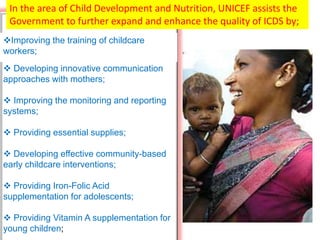
 Developing innovative communication
approaches with mothers;
 Improving the monitoring and reporting
systems;
 Providing essential supplies;
 Developing effective community-based
early childcare interventions;
 Providing Iron-Folic Acid
supplementation for adolescents;
 Providing Vitamin A supplementation for
young children;
Improving the training of childcare
workers;
In the area of Child Development and Nutrition, UNICEF assists the
Government to further expand and enhance the quality of ICDS by;
Integrated Child Development Services is India's primary social welfare
scheme to tackle malnutrition and health problems in children below 6
years of age and their mothers. The main beneficiaries of the programme
were aimed to be the girl child up to her adolescence, all children below
6 years of age, pregnant and lactating mothers. The gender promotion of
the girl child by trying to bring her at par with the male child is a key
component of the scheme.
ICDS -sponsored by Indian Government
Objectives
•To raise the health and nutritional level of poor Indian children
below 6 years of age
•To create a base for proper mental, physical and social development
of children in India
•To reduce instances of mortality, malnutrition and school dropouts
among Indian Children
•To coordinate activities of policy formulation and implementation
among all departments of various ministries involved in the different
government programmes and schemes aimed at child development
across India.
•To provide health and nutritional information and education to
mothers of young children to enhance child rearing capabilities of
mothers in India
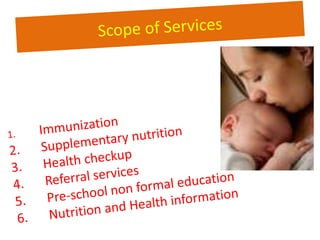
IMMUNIZATION
SUPPLEMENTARY NUTRITION
REFERRAL
SERVICES
NON-FORMAL PRE SCHOOL EDUCATION
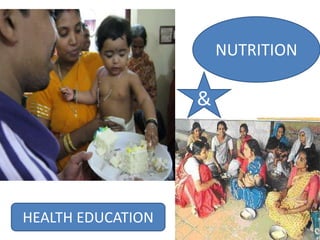
NUTRITION
HEALTH EDUCATION
&
Services Target Group Service Provided by
Supplementary Nutrition Children below 6 years:
Pregnant & Lactating
Mother (P&LM)
Anganwadi Worker and
Anganwadi Helper
Immunization* Children below 6 years:
Pregnant & Lactating
Mother (P&LM)
ANM/MO
Health Check-up* Children below 6 years:
Pregnant & Lactating
Mother (P&LM)
ANM/MO/AWW
Referral Services Children below 6 years:
Pregnant & Lactating
Mother (P&LM)
AWW/ANM/MO
Pre-School Education Children 3-6 years AWW
Nutrition & Health
Education
Women (15-45 years) AWW/ANM/MO
Type of Supplementary Nutrition
CHILDREN IN
THE AGE
GROUP 0-6
MONTHS
CHILDREN IN
THE AGE
GROUP 0-6
MONTHS
THE ICDS TEAM
Anganwadi Workers
Anganwadi Helpers
 Supervisors
 Child Development Project Officers (CDPOs) &
 District Programme Officers (DPOs).
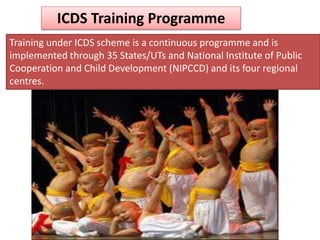
ICDS Training Programme
Training under ICDS scheme is a continuous programme and is
implemented through 35 States/UTs and National Institute of Public
Cooperation and Child Development (NIPCCD) and its four regional
centres.
During the 11th Five Year Plan,
the Government of India has laid
much emphasis on strengthening the
training component of ICDS in order
to improve the service delivery
mechanism and accelerate better
programme outcomes. An allocation
of Rs. 500 crore has been kept for
the ICDS Training Programme during
the 11th Five Year Plan.
Existing Monitoring System under ICDS Scheme
State Level
Block Level
Village Level (Anganwadi Level)
Evaluation of ICDS Scheme
Accessible distance
Infrastructure
Matriculate
functionaries
Need of training (pre-service and
in-service training)
Assessment
(observations, record reviews & personal interviews)
Positive out-look of community leaders
Less participation of women and adolescent girls
INTRODUCTION OF WHO GROWTH STANDARDS IN ICDS
The World Health Organization (WHO) based on the
results of an intensive study initiated in 1997 in six
countries including India has developed New
International Standards for assessing the physical
growth, nutritional status and motor development of
children from birth to 5 years age. The Ministry of
Women and Child Development and Ministry of
Health have adopted the New WHO Child Growth
Standard in India on 15th of August, 2008 for
monitoring the Growth of Children through ICDS and
NRHM.
Implications
1.Change in current estimates
•increase in total of normal weight children
•increase in severely underweight children
•increase in underweight children (mild/moderate and severe) in age group of
0-6 months.
2. The Anganwadi Worker with the help of New Growth Chart would be able to
assess correctly severely underweight children and number of such children
would increase in each Anganwadi Centres. The number of normal children
would also increase in all the Anganwadi Centres.
3. The new charts would now help us in comparing growth of our children within
projects, districts, states & also other countries.

Integrated Child Development Scheme

  • 1.
    Program Outline Started bythe Government of India in 1975, the Integrated Child Development Scheme (ICDS) has been instrumental in improving the health and wellbeing of mothers and children under 6 by providing health and nutrition education, health services, supplementary food, and pre-school education. The ICDS national development program is one of the largest in the world. It reaches more than 34 million children aged 0-6 years and 7 million pregnant and lactating mothers. Other programs impacting on under-nutrition include the National Mid-day Meal Scheme, the National Rural Health Mission, and the Public Distribution System (PDS). The challenge for all these programs and schemes is how to increase efficiency, impact and coverage
  • 2.
     Developing innovativecommunication approaches with mothers;  Improving the monitoring and reporting systems;  Providing essential supplies;  Developing effective community-based early childcare interventions;  Providing Iron-Folic Acid supplementation for adolescents;  Providing Vitamin A supplementation for young children; Improving the training of childcare workers; In the area of Child Development and Nutrition, UNICEF assists the Government to further expand and enhance the quality of ICDS by;
  • 3.
    Integrated Child DevelopmentServices is India's primary social welfare scheme to tackle malnutrition and health problems in children below 6 years of age and their mothers. The main beneficiaries of the programme were aimed to be the girl child up to her adolescence, all children below 6 years of age, pregnant and lactating mothers. The gender promotion of the girl child by trying to bring her at par with the male child is a key component of the scheme. ICDS -sponsored by Indian Government
  • 4.
    Objectives •To raise thehealth and nutritional level of poor Indian children below 6 years of age •To create a base for proper mental, physical and social development of children in India •To reduce instances of mortality, malnutrition and school dropouts among Indian Children •To coordinate activities of policy formulation and implementation among all departments of various ministries involved in the different government programmes and schemes aimed at child development across India. •To provide health and nutritional information and education to mothers of young children to enhance child rearing capabilities of mothers in India
  • 6.
  • 7.
  • 9.
  • 10.
  • 11.
  • 12.
    Services Target GroupService Provided by Supplementary Nutrition Children below 6 years: Pregnant & Lactating Mother (P&LM) Anganwadi Worker and Anganwadi Helper Immunization* Children below 6 years: Pregnant & Lactating Mother (P&LM) ANM/MO Health Check-up* Children below 6 years: Pregnant & Lactating Mother (P&LM) ANM/MO/AWW Referral Services Children below 6 years: Pregnant & Lactating Mother (P&LM) AWW/ANM/MO Pre-School Education Children 3-6 years AWW Nutrition & Health Education Women (15-45 years) AWW/ANM/MO
  • 13.
    Type of SupplementaryNutrition CHILDREN IN THE AGE GROUP 0-6 MONTHS CHILDREN IN THE AGE GROUP 0-6 MONTHS
  • 14.
    THE ICDS TEAM AnganwadiWorkers Anganwadi Helpers  Supervisors  Child Development Project Officers (CDPOs) &  District Programme Officers (DPOs).
  • 15.
    ICDS Training Programme Trainingunder ICDS scheme is a continuous programme and is implemented through 35 States/UTs and National Institute of Public Cooperation and Child Development (NIPCCD) and its four regional centres.
  • 16.
    During the 11thFive Year Plan, the Government of India has laid much emphasis on strengthening the training component of ICDS in order to improve the service delivery mechanism and accelerate better programme outcomes. An allocation of Rs. 500 crore has been kept for the ICDS Training Programme during the 11th Five Year Plan.
  • 17.
    Existing Monitoring Systemunder ICDS Scheme
  • 18.
  • 19.
  • 20.
  • 21.
    Evaluation of ICDSScheme Accessible distance Infrastructure Matriculate functionaries Need of training (pre-service and in-service training) Assessment (observations, record reviews & personal interviews) Positive out-look of community leaders Less participation of women and adolescent girls
  • 22.
    INTRODUCTION OF WHOGROWTH STANDARDS IN ICDS The World Health Organization (WHO) based on the results of an intensive study initiated in 1997 in six countries including India has developed New International Standards for assessing the physical growth, nutritional status and motor development of children from birth to 5 years age. The Ministry of Women and Child Development and Ministry of Health have adopted the New WHO Child Growth Standard in India on 15th of August, 2008 for monitoring the Growth of Children through ICDS and NRHM.
  • 23.
    Implications 1.Change in currentestimates •increase in total of normal weight children •increase in severely underweight children •increase in underweight children (mild/moderate and severe) in age group of 0-6 months. 2. The Anganwadi Worker with the help of New Growth Chart would be able to assess correctly severely underweight children and number of such children would increase in each Anganwadi Centres. The number of normal children would also increase in all the Anganwadi Centres. 3. The new charts would now help us in comparing growth of our children within projects, districts, states & also other countries.