The Teacher
Researcher
Action Research Explained
Thanks to Fiona Grant for a lot of the content in this
presentation
Taking the time to reflect
critically on the things we are
doing in our classrooms is
perhaps the most effective thing
we can do to ensure that what
we are doing is having the
desired outcomes, and is
changing our practice in the
ways we want it to."
(Wenmoth, 2007)
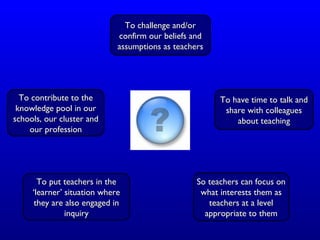
So teachers can focus onSo teachers can focus on
what interests them aswhat interests them as
teachers at a levelteachers at a level
appropriate to themappropriate to them
To put teachers in theTo put teachers in the
‘learner’ situation where‘learner’ situation where
they are also engaged inthey are also engaged in
inquiryinquiry
To challenge and/orTo challenge and/or
confirm our beliefs andconfirm our beliefs and
assumptions as teachersassumptions as teachers
To have time to talk andTo have time to talk and
share with colleaguesshare with colleagues
about teachingabout teaching
To contribute to theTo contribute to the
knowledge pool in ourknowledge pool in our
schools, our cluster andschools, our cluster and
our professionour profession
Teacher professional development
The Traditional View
Workshops
and meetings Focus on Teaching
not Learning
Assumes transition
of knowledge from
Teacher professional development
Through Action Research
Class based
research
Learner has knowledge to build on.
Based on learner’s point of view
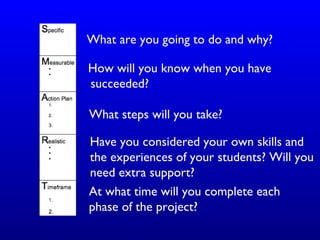
What are you going to do and why?
How will you know when you have
succeeded?
What steps will you take?
Have you considered your own skills and
the experiences of your students? Will you
need extra support?
At what time will you complete each
phase of the project?
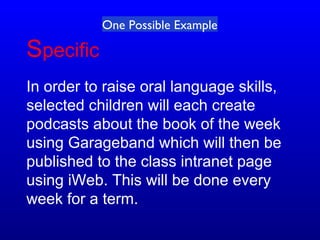
Specific
In order to raise oral language skills,
selected children will each create
podcasts about the book of the week
using Garageband which will then be
published to the class intranet page
using iWeb. This will be done every
week for a term.
One Possible Example
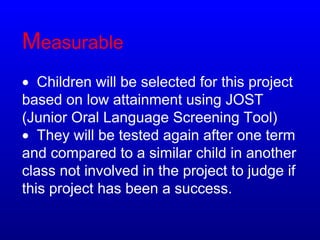
Measurable
• Children will be selected for this project
based on low attainment using JOST
(Junior Oral Language Screening Tool)
• They will be tested again after one term
and compared to a similar child in another
class not involved in the project to judge if
this project has been a success.
Action Plan
1. Test children considered at risk using JOST. Take
the lowest achieving five children to be part of this
project. This is mirrored in a class not involved in the
project.
2. Children are given time to discuss the book of the
week in class and the project children are
encouraged to answer key questions about the book
and develop vocabulary appropriate for the book.
These sessions are recorded as podcasts with
children able to re-record as necessary in order to
have a good model of themselves to listen back to.
3. Project children listen back to the podcasts and are
asked to comment on how well they responded and
how clearly you could hear them. Other children are
asked to listen and provide feedback.
4. At the end of the term, the children are asked to
listen to their very first podcast and their last one and
focus in on how they have improved. Their comments
are recorded as a podcast (digital assessment object)
5. At the end of the term, the five children involved in
the project and the five similar children not involved in
the other class are tested using JOST and
comparisons made.
Realistic
• Only five children involved (though if successful,
this could be widened.)
• School has agreed to some release time for the
testing and analysis
• Access to the laptop pod means that more than
one podcast can be completed at a time.
• This project may be changed to span two terms if it
is deemed that one term is not a large enough
sample period.
Timeframe
1. JOSH testing completed at end of previous term and
children chosen.
2. Podcasts to be completed between Monday and
Thursday each week with children asked to self-assess and
choose a peer to assess on a Friday.
3. JOSH testing at the end of the term to be completed by
the end of the Week 9. Final child analysis of how they think
they have improved over the term to be completed during the
last week of term and recorded as a podcast as part of the
project.
4. Results shared at staff meeting at the beginning of the
following term with other classes deciding whether or not to
begin similar programmes.
How can internet resources via a data
projector, be used to enhance
learning within the Visual Arts
curriculum areas?
To view a variety of painting styles including
realism, impressionism, expressionism and
abstraction.
To provide a suitable range of vocabulary to
enable children to communicate their ideas
about what has been observed.
To extend their learning through the physical
means of painting.
F ocus
What are effective strategies for using
learning objects to enhance my
numeracy programme?
Seeking out appropriate and relevant learning
objects at Digistore. Building an organized list
of learning objects in the eResources section
of the school intranet. Developing effective
management strategies to make the learning
objects an integral part of learning in maths.
Supporting children to locate and navigate the
right learning objects.
F ocus
How can I provide an extension
Mathematics programme for a gifted
group of children through with the
support of ICT?
Set up a computer enhanced mathematics
programme for children working at level 4.
Work alongside children to create individual
Wikis and links to online resources
Each child will reflect on their learning and
use teacher-monitored links though their
personal Wiki.
F ocus
How can I provide an extension
writing programme for a gifted group
of children through the use of a wiki?
Set up a computer enhanced writing
programme for children working at Level 4.
Work alongside children to create individual
wikis and links.
Each child will reflect on their learning and
will use teacher monitored links through their
personal wiki
F ocus
How can the digital learning objects
be utilised more effectively by
students for independent activities
during reading time?
To organise the reading digital learning
objects so that they can be easily integrated
into reading times for groups to use
independently and also that they are being
used to support the specific learning and
teaching.
F ocus
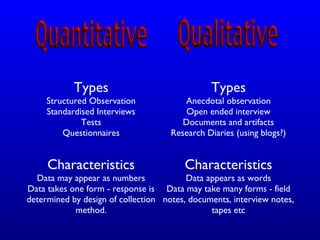
Types
Structured Observation
Standardised Interviews
Tests
Questionnaires
Types
Anecdotal observation
Open ended interview
Documents and artifacts
Research Diaries (using blogs?)
Characteristics
Data may appear as numbers
Data takes one form - response is
determined by design of collection
method.
Characteristics
Data appears as words
Data may take many forms - field
notes, documents, interview notes,
tapes etc
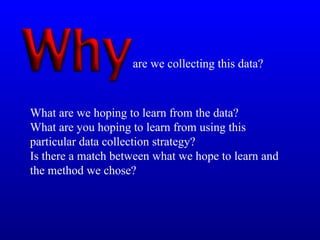
What are we hoping to learn from the data?
What are you hoping to learn from using this
particular data collection strategy?
Is there a match between what we hope to learn and
the method we chose?
are we collecting this data?
What different sources of data will allow us to learn best
about this topic?
What previously existing data can we use?
How much data do we need to really learn about this
topic?
exactly are we collecting?
Are there any limitations to collecting the data?
What support systems need to be in place to allow for the
data collection to occur?
Are there ways to build data collection into the normal
activities of the classroom?
are we going to collect the data
and for how long?
Have we built into the plan collecting data at more than
one point in time?
Are there strategies we can use to easily observe and
record data during class?
Can you afford the time to gather and record data using the
strategies you have selected?
are we going to collect the data
and for how long?
Are there data which can be generated by students?
Is there a colleague who can observe in your room or
a student teacher who can assist with data collection?
What can you do yourself without it being too
overwhelming?
is going to collect the data?
How will you collect and display the qualitative
data/the quantitative data?
What plan do you have for analysing the data?
To whom will you present what you have
learned?
will data be collected and displayed?
Name and background information, school, level
Your question and why you selected it. You might include
a statement about why this is important to you and your
educational philosophy if relative.
How you collected and organised data and the results.
Dates, themes etc
List of references if you used any.
Feedback on challenges at any stage of the process
Guidelines
Some ideas to include in your report:
Guidelines
Some ideas to include in your report:
Changes you've gone through during the process
including insights.
Conclusions – what have you found out and your
interpretations
Reflections on assumptions that you might have
made prior to or during the study
Feelings, intuitions not encountered in the study
Guidelines
Some ideas to include in your report:
Future directions:
What recommendations would you make to
colleagues?
Have you formulated new questions?
Do you have any ideas for implementing change in
your practice?
Reflection on the action research process that is
separate from the topic
Post presentations online to Slideshare
or Authorstream for others to view
Make a video of the process and post to
TeacherTube
Use a blog for reflection during the
project and to share results.
Perhaps have ‘Cluster Shares’
afternoons at different schools.
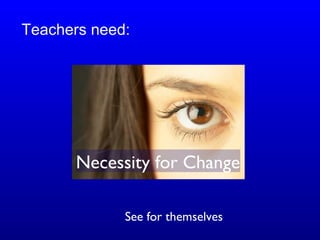
Necessity for Change
Teachers need:
See for themselves
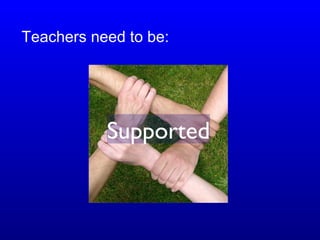
Supported
Teachers need to be:
Teachers need:
that things work
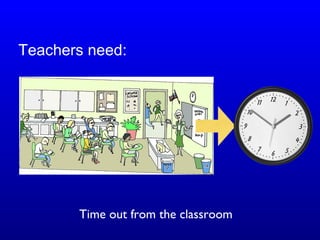
Teachers need:
Time out from the classroom
Teachers need:
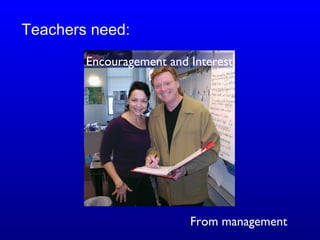
Encouragement and Interest
From management
Teachers need:
QuickTime™ and a
TIFF (Uncompressed) decompressor
are needed to see this picture.
Advice for schools includes using:
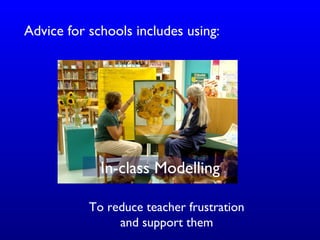
In-class Modelling
To reduce teacher frustration
and support them
Advice for schools includes to have:
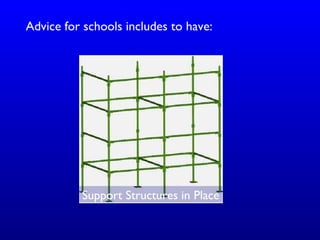
Support Structures in Place
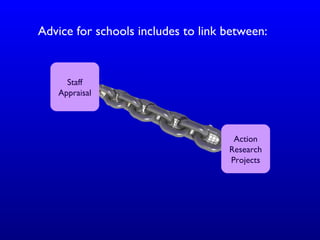
Advice for schools includes to link between:
Action
Research
Projects
Staff
Appraisal
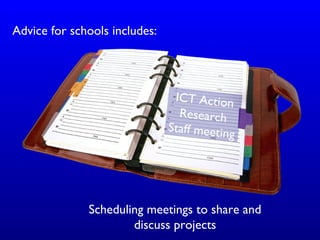
Advice for schools includes:
For staff to read materials related
to their project
Advice for schools includes:
ICT Action
Research
Staff meeting
Scheduling meetings to share and
discuss projects
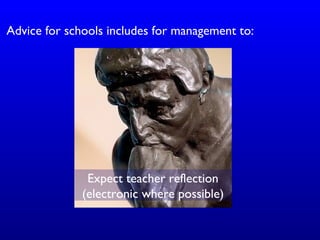
Advice for schools includes for management to:
Expect teacher reflection
(electronic where possible)
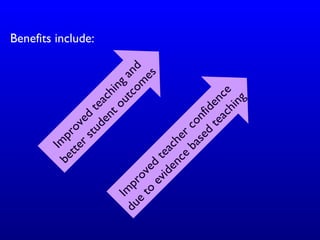
Benefits include:
Im
proved
teaching
and
betterstudentoutcom
es
Im
proved
teacherconfidence
due
to
evidence
based
teaching
While teachers hold initial
concerns about additional work
involved in action research
projects, these tend to dissolve as
teachers realise the benefits these
projects have on their practice and
the enjoyment of their profession.

Action research-for-teachers

  • 1.
    The Teacher Researcher Action ResearchExplained Thanks to Fiona Grant for a lot of the content in this presentation
  • 2.
    Taking the timeto reflect critically on the things we are doing in our classrooms is perhaps the most effective thing we can do to ensure that what we are doing is having the desired outcomes, and is changing our practice in the ways we want it to." (Wenmoth, 2007)
  • 3.
    So teachers canfocus onSo teachers can focus on what interests them aswhat interests them as teachers at a levelteachers at a level appropriate to themappropriate to them To put teachers in theTo put teachers in the ‘learner’ situation where‘learner’ situation where they are also engaged inthey are also engaged in inquiryinquiry To challenge and/orTo challenge and/or confirm our beliefs andconfirm our beliefs and assumptions as teachersassumptions as teachers To have time to talk andTo have time to talk and share with colleaguesshare with colleagues about teachingabout teaching To contribute to theTo contribute to the knowledge pool in ourknowledge pool in our schools, our cluster andschools, our cluster and our professionour profession
  • 4.
    Teacher professional development TheTraditional View Workshops and meetings Focus on Teaching not Learning Assumes transition of knowledge from
  • 5.
    Teacher professional development ThroughAction Research Class based research Learner has knowledge to build on. Based on learner’s point of view
  • 6.
    What are yougoing to do and why? How will you know when you have succeeded? What steps will you take? Have you considered your own skills and the experiences of your students? Will you need extra support? At what time will you complete each phase of the project?
  • 7.
    Specific In order toraise oral language skills, selected children will each create podcasts about the book of the week using Garageband which will then be published to the class intranet page using iWeb. This will be done every week for a term. One Possible Example
  • 8.
    Measurable • Children willbe selected for this project based on low attainment using JOST (Junior Oral Language Screening Tool) • They will be tested again after one term and compared to a similar child in another class not involved in the project to judge if this project has been a success.
  • 9.
    Action Plan 1. Testchildren considered at risk using JOST. Take the lowest achieving five children to be part of this project. This is mirrored in a class not involved in the project. 2. Children are given time to discuss the book of the week in class and the project children are encouraged to answer key questions about the book and develop vocabulary appropriate for the book. These sessions are recorded as podcasts with children able to re-record as necessary in order to have a good model of themselves to listen back to.
  • 10.
    3. Project childrenlisten back to the podcasts and are asked to comment on how well they responded and how clearly you could hear them. Other children are asked to listen and provide feedback. 4. At the end of the term, the children are asked to listen to their very first podcast and their last one and focus in on how they have improved. Their comments are recorded as a podcast (digital assessment object) 5. At the end of the term, the five children involved in the project and the five similar children not involved in the other class are tested using JOST and comparisons made.
  • 11.
    Realistic • Only fivechildren involved (though if successful, this could be widened.) • School has agreed to some release time for the testing and analysis • Access to the laptop pod means that more than one podcast can be completed at a time. • This project may be changed to span two terms if it is deemed that one term is not a large enough sample period.
  • 12.
    Timeframe 1. JOSH testingcompleted at end of previous term and children chosen. 2. Podcasts to be completed between Monday and Thursday each week with children asked to self-assess and choose a peer to assess on a Friday. 3. JOSH testing at the end of the term to be completed by the end of the Week 9. Final child analysis of how they think they have improved over the term to be completed during the last week of term and recorded as a podcast as part of the project. 4. Results shared at staff meeting at the beginning of the following term with other classes deciding whether or not to begin similar programmes.
  • 14.
    How can internetresources via a data projector, be used to enhance learning within the Visual Arts curriculum areas?
  • 15.
    To view avariety of painting styles including realism, impressionism, expressionism and abstraction. To provide a suitable range of vocabulary to enable children to communicate their ideas about what has been observed. To extend their learning through the physical means of painting. F ocus
  • 16.
    What are effectivestrategies for using learning objects to enhance my numeracy programme?
  • 17.
    Seeking out appropriateand relevant learning objects at Digistore. Building an organized list of learning objects in the eResources section of the school intranet. Developing effective management strategies to make the learning objects an integral part of learning in maths. Supporting children to locate and navigate the right learning objects. F ocus
  • 18.
    How can Iprovide an extension Mathematics programme for a gifted group of children through with the support of ICT?
  • 19.
    Set up acomputer enhanced mathematics programme for children working at level 4. Work alongside children to create individual Wikis and links to online resources Each child will reflect on their learning and use teacher-monitored links though their personal Wiki. F ocus
  • 20.
    How can Iprovide an extension writing programme for a gifted group of children through the use of a wiki?
  • 21.
    Set up acomputer enhanced writing programme for children working at Level 4. Work alongside children to create individual wikis and links. Each child will reflect on their learning and will use teacher monitored links through their personal wiki F ocus
  • 22.
    How can thedigital learning objects be utilised more effectively by students for independent activities during reading time?
  • 23.
    To organise thereading digital learning objects so that they can be easily integrated into reading times for groups to use independently and also that they are being used to support the specific learning and teaching. F ocus
  • 25.
    Types Structured Observation Standardised Interviews Tests Questionnaires Types Anecdotalobservation Open ended interview Documents and artifacts Research Diaries (using blogs?) Characteristics Data may appear as numbers Data takes one form - response is determined by design of collection method. Characteristics Data appears as words Data may take many forms - field notes, documents, interview notes, tapes etc
  • 26.
    What are wehoping to learn from the data? What are you hoping to learn from using this particular data collection strategy? Is there a match between what we hope to learn and the method we chose? are we collecting this data?
  • 27.
    What different sourcesof data will allow us to learn best about this topic? What previously existing data can we use? How much data do we need to really learn about this topic? exactly are we collecting?
  • 28.
    Are there anylimitations to collecting the data? What support systems need to be in place to allow for the data collection to occur? Are there ways to build data collection into the normal activities of the classroom? are we going to collect the data and for how long?
  • 29.
    Have we builtinto the plan collecting data at more than one point in time? Are there strategies we can use to easily observe and record data during class? Can you afford the time to gather and record data using the strategies you have selected? are we going to collect the data and for how long?
  • 30.
    Are there datawhich can be generated by students? Is there a colleague who can observe in your room or a student teacher who can assist with data collection? What can you do yourself without it being too overwhelming? is going to collect the data?
  • 31.
    How will youcollect and display the qualitative data/the quantitative data? What plan do you have for analysing the data? To whom will you present what you have learned? will data be collected and displayed?
  • 33.
    Name and backgroundinformation, school, level Your question and why you selected it. You might include a statement about why this is important to you and your educational philosophy if relative. How you collected and organised data and the results. Dates, themes etc List of references if you used any. Feedback on challenges at any stage of the process Guidelines Some ideas to include in your report:
  • 34.
    Guidelines Some ideas toinclude in your report: Changes you've gone through during the process including insights. Conclusions – what have you found out and your interpretations Reflections on assumptions that you might have made prior to or during the study Feelings, intuitions not encountered in the study
  • 35.
    Guidelines Some ideas toinclude in your report: Future directions: What recommendations would you make to colleagues? Have you formulated new questions? Do you have any ideas for implementing change in your practice? Reflection on the action research process that is separate from the topic
  • 36.
    Post presentations onlineto Slideshare or Authorstream for others to view Make a video of the process and post to TeacherTube Use a blog for reflection during the project and to share results. Perhaps have ‘Cluster Shares’ afternoons at different schools.
  • 38.
    Necessity for Change Teachersneed: See for themselves
  • 39.
  • 40.
  • 41.
    Teachers need: Time outfrom the classroom
  • 42.
    Teachers need: Encouragement andInterest From management
  • 43.
    Teachers need: QuickTime™ anda TIFF (Uncompressed) decompressor are needed to see this picture.
  • 44.
    Advice for schoolsincludes using: In-class Modelling To reduce teacher frustration and support them
  • 45.
    Advice for schoolsincludes to have: Support Structures in Place
  • 46.
    Advice for schoolsincludes to link between: Action Research Projects Staff Appraisal
  • 47.
    Advice for schoolsincludes: For staff to read materials related to their project
  • 48.
    Advice for schoolsincludes: ICT Action Research Staff meeting Scheduling meetings to share and discuss projects
  • 49.
    Advice for schoolsincludes for management to: Expect teacher reflection (electronic where possible)
  • 50.
  • 51.
    While teachers holdinitial concerns about additional work involved in action research projects, these tend to dissolve as teachers realise the benefits these projects have on their practice and the enjoyment of their profession.