State Space Representation
Lec-07
outline
• How to find mathematical model, called a state-
space representation, for a linear, time-invariant
system
• How to convert between transfer function and
state space models
3
State-Space Modeling
• Alternative method of modeling a system than
▫ Differential / difference equations
▫ Transfer functions
• Uses matrices and vectors to represent the system
parameters and variables
• In control engineering, a state space
representation is a mathematical model of a
physical system as a set of input, output and state
variables related by first-order differential equations.
To abstract from the number of inputs, outputs and
states, the variables are expressed as vectors.
4
Motivation for State-Space Modeling
• Easier for computers to perform matrix algebra
▫ e.g. MATLAB does all computations as matrix math
• Handles multiple inputs and outputs
• Provides more information about the system
▫ Provides knowledge of internal variables (states)
Primarily used in complicated, large-scale
systems
Definitions
• State- The state of a dynamic system is the
smallest set of variables (called state variables)
such that knowledge of these variables at t=t0 ,
together with knowledge of the input for t ≥ t0 ,
completely determines the behavior of the
system for any time t to t0 .
• Note that the concept of state is by no means
limited to physical systems. It is applicable to
biological systems, economic systems, social
systems, and others.
State Variables:
• The state variables of a dynamic system are the
variables making up the smallest set of variables
that determine the state of the dynamic system.
• If at least n variables x1, x2, …… , xn are needed
to completely describe the behavior of a
dynamic system (so that once the input is given
for t ≥ t0 and the initial state at t=t0 is specified,
the future state of the system is completely
determined), then such n variables are a set of
state variables.
State Vector:
• A vector whose elements are the state variables.
• If n state variables are needed to completely
describe the behavior of a given system, then
these n state variables can be considered the n
components of a vector x. Such a vector is called
a state vector.
• A state vector is thus a vector that determines
uniquely the system state x(t) for any time t≥ t0,
once the state at t=t0 is given and the input u(t)
for t ≥ t0 is specified.
State Space:
• The n-dimensional space whose coordinate axes
consist of the x1 axis, x2 axis, ….., xn axis, where
x1, x2,…… , xn are state variables, is called a
state space.
• "State space" refers to the space whose axes are
the state variables. The state of the system can
be represented as a vector within that space.
• State-Space Equations. In state-space analysis
we are concerned with three types of variables
that are involved in the modeling of dynamic
systems: input variables, output variables, and
state variables.
• The number of state variables to completely
define the dynamics of the system is equal to the
number of integrators involved in the system.
• Assume that a multiple-input, multiple-output
system involves n integrators. Assume also that
there are r inputs u1(t), u2(t),……. ur(t) and m
outputs y1(t), y2(t), …….. ym(t).
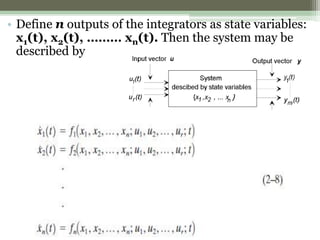
• Define n outputs of the integrators as state variables:
x1(t), x2(t), ……… xn(t). Then the system may be
described by
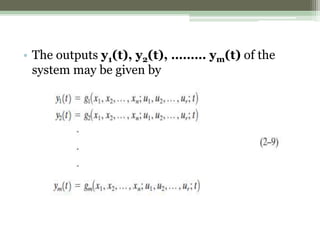
• The outputs y1(t), y2(t), ……… ym(t) of the
system may be given by
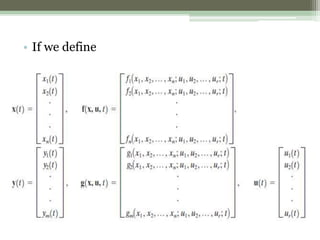
• If we define
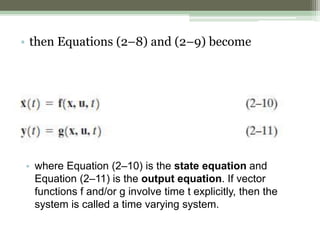
• then Equations (2–8) and (2–9) become
• where Equation (2–10) is the state equation and
Equation (2–11) is the output equation. If vector
functions f and/or g involve time t explicitly, then the
system is called a time varying system.
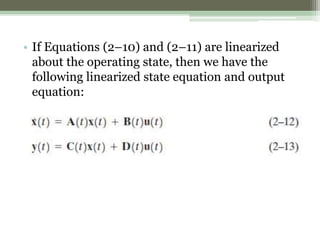
• If Equations (2–10) and (2–11) are linearized
about the operating state, then we have the
following linearized state equation and output
equation:
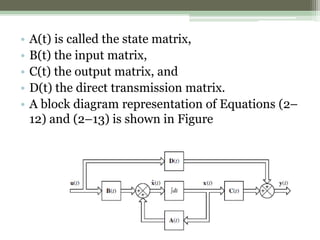
• A(t) is called the state matrix,
• B(t) the input matrix,
• C(t) the output matrix, and
• D(t) the direct transmission matrix.
• A block diagram representation of Equations (2–
12) and (2–13) is shown in Figure
• If vector functions f and g do not involve time t
explicitly then the system is called a time-
invariant system. In this case, Equations (2–12)
and (2–13) can be simplified to
•Equation (2–14) is the state equation of the
linear, time-invariant system and
•Equation (2–15) is the output equation for the
same system.
Correlation Between Transfer
Functions and State-Space Equations
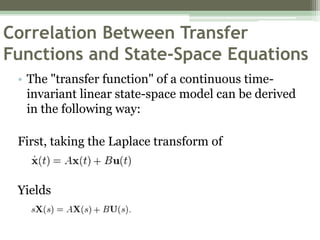
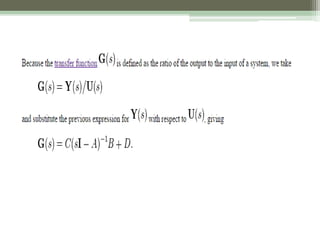
• The "transfer function" of a continuous time-
invariant linear state-space model can be derived
in the following way:
First, taking the Laplace transform of
Yields
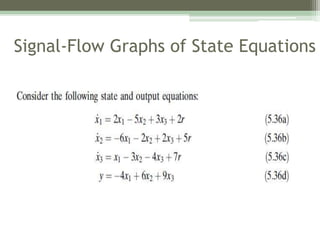
Signal-Flow Graphs of State Equations
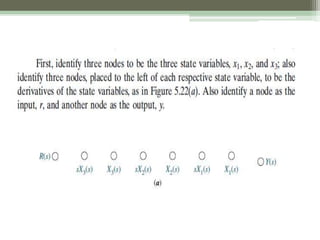
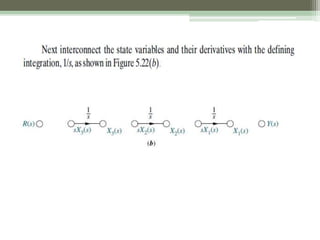
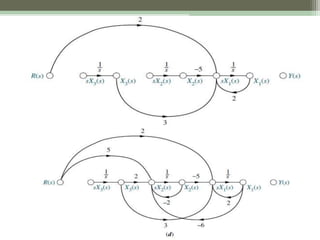
• Then using Eqs. (5.36), feed to each node the
indicated signals.
• For example, from Eq. (5.36a),
as shown in Figure 5.22(c).
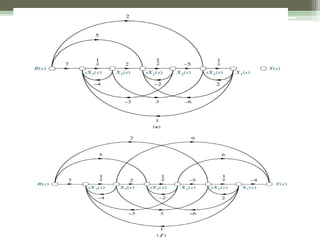
• Similarly, as shown in
Figure 5.22(d),
• as shown in Figure 5.22(e).
• Finally, using Eq. (5.36d), the output,
as shown in Figure
5.19(f ), the final phase-variable representation,
where the state variables are the outputs of the
integrators.
State Space Representation of Mechanical System

State Space Representation of Mechanical System

  • 1.
  • 2.
    outline • How tofind mathematical model, called a state- space representation, for a linear, time-invariant system • How to convert between transfer function and state space models
  • 3.
    3 State-Space Modeling • Alternativemethod of modeling a system than ▫ Differential / difference equations ▫ Transfer functions • Uses matrices and vectors to represent the system parameters and variables • In control engineering, a state space representation is a mathematical model of a physical system as a set of input, output and state variables related by first-order differential equations. To abstract from the number of inputs, outputs and states, the variables are expressed as vectors.
  • 4.
    4 Motivation for State-SpaceModeling • Easier for computers to perform matrix algebra ▫ e.g. MATLAB does all computations as matrix math • Handles multiple inputs and outputs • Provides more information about the system ▫ Provides knowledge of internal variables (states) Primarily used in complicated, large-scale systems
  • 5.
    Definitions • State- Thestate of a dynamic system is the smallest set of variables (called state variables) such that knowledge of these variables at t=t0 , together with knowledge of the input for t ≥ t0 , completely determines the behavior of the system for any time t to t0 . • Note that the concept of state is by no means limited to physical systems. It is applicable to biological systems, economic systems, social systems, and others.
  • 6.
    State Variables: • Thestate variables of a dynamic system are the variables making up the smallest set of variables that determine the state of the dynamic system. • If at least n variables x1, x2, …… , xn are needed to completely describe the behavior of a dynamic system (so that once the input is given for t ≥ t0 and the initial state at t=t0 is specified, the future state of the system is completely determined), then such n variables are a set of state variables.
  • 7.
    State Vector: • Avector whose elements are the state variables. • If n state variables are needed to completely describe the behavior of a given system, then these n state variables can be considered the n components of a vector x. Such a vector is called a state vector. • A state vector is thus a vector that determines uniquely the system state x(t) for any time t≥ t0, once the state at t=t0 is given and the input u(t) for t ≥ t0 is specified.
  • 8.
    State Space: • Then-dimensional space whose coordinate axes consist of the x1 axis, x2 axis, ….., xn axis, where x1, x2,…… , xn are state variables, is called a state space. • "State space" refers to the space whose axes are the state variables. The state of the system can be represented as a vector within that space.
  • 9.
    • State-Space Equations.In state-space analysis we are concerned with three types of variables that are involved in the modeling of dynamic systems: input variables, output variables, and state variables. • The number of state variables to completely define the dynamics of the system is equal to the number of integrators involved in the system. • Assume that a multiple-input, multiple-output system involves n integrators. Assume also that there are r inputs u1(t), u2(t),……. ur(t) and m outputs y1(t), y2(t), …….. ym(t).
  • 10.
    • Define noutputs of the integrators as state variables: x1(t), x2(t), ……… xn(t). Then the system may be described by
  • 11.
    • The outputsy1(t), y2(t), ……… ym(t) of the system may be given by
  • 12.
    • If wedefine
  • 13.
    • then Equations(2–8) and (2–9) become • where Equation (2–10) is the state equation and Equation (2–11) is the output equation. If vector functions f and/or g involve time t explicitly, then the system is called a time varying system.
  • 14.
    • If Equations(2–10) and (2–11) are linearized about the operating state, then we have the following linearized state equation and output equation:
  • 15.
    • A(t) iscalled the state matrix, • B(t) the input matrix, • C(t) the output matrix, and • D(t) the direct transmission matrix. • A block diagram representation of Equations (2– 12) and (2–13) is shown in Figure
  • 16.
    • If vectorfunctions f and g do not involve time t explicitly then the system is called a time- invariant system. In this case, Equations (2–12) and (2–13) can be simplified to •Equation (2–14) is the state equation of the linear, time-invariant system and •Equation (2–15) is the output equation for the same system.
  • 17.
    Correlation Between Transfer Functionsand State-Space Equations • The "transfer function" of a continuous time- invariant linear state-space model can be derived in the following way: First, taking the Laplace transform of Yields
  • 20.
    Signal-Flow Graphs ofState Equations
  • 23.
    • Then usingEqs. (5.36), feed to each node the indicated signals. • For example, from Eq. (5.36a), as shown in Figure 5.22(c). • Similarly, as shown in Figure 5.22(d), • as shown in Figure 5.22(e). • Finally, using Eq. (5.36d), the output, as shown in Figure 5.19(f ), the final phase-variable representation, where the state variables are the outputs of the integrators.