Modern Control Systems (MCS)
Dr. Imtiaz Hussain
Assistant Professor
email: imtiaz.hussain@faculty.muet.edu.pk
URL :http://imtiazhussainkalwar.weebly.com/
Lecture-18-19
Design of Control Systems in Sate Space
Observer Based Approach
1
Lecture Outline
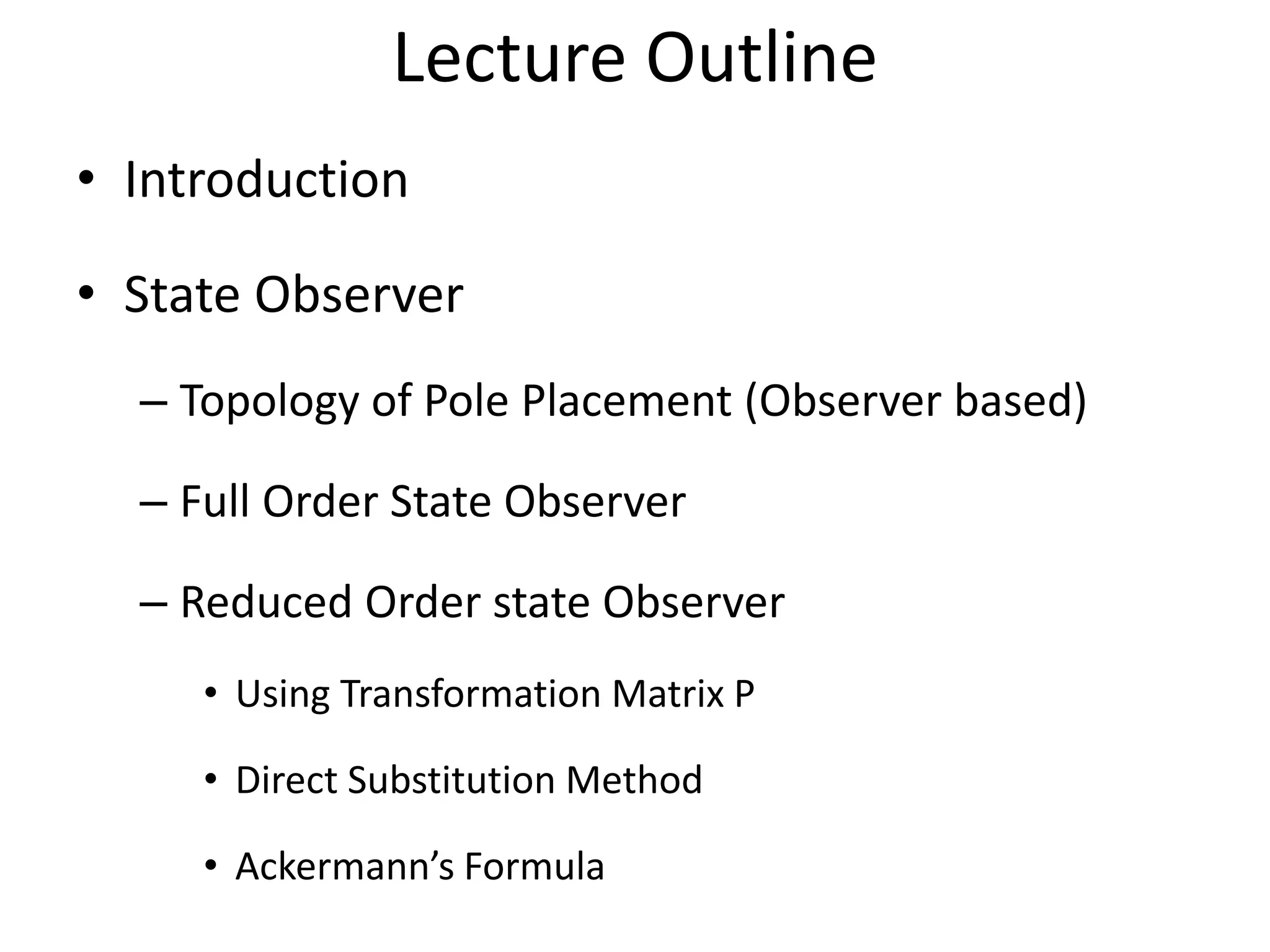
• Introduction
• State Observer
– Topology of Pole Placement (Observer based)
– Full Order State Observer
– Reduced Order state Observer
• Using Transformation Matrix P
• Direct Substitution Method
• Ackermann’s Formula
Introduction
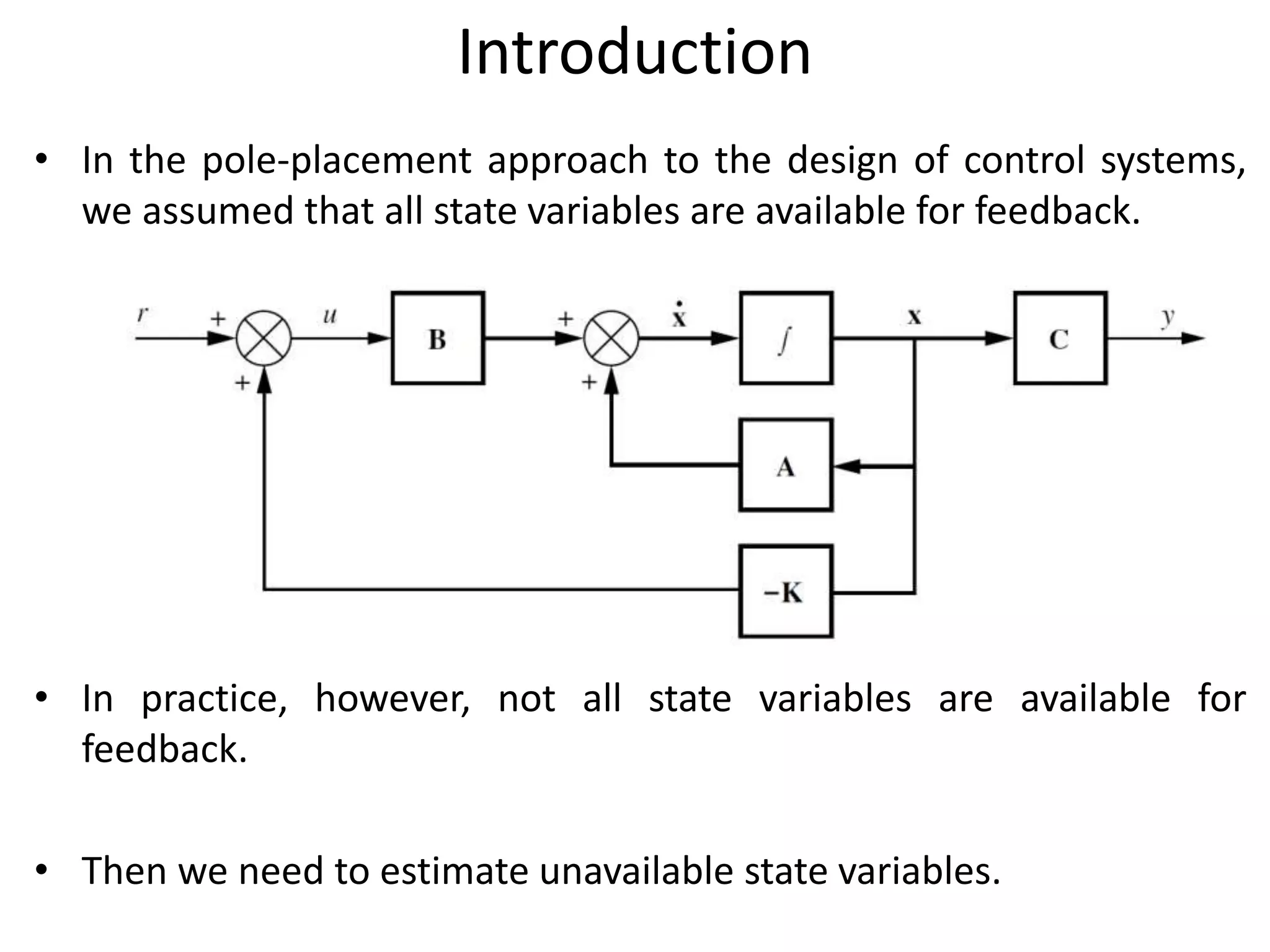
• In the pole-placement approach to the design of control systems,
we assumed that all state variables are available for feedback.
• In practice, however, not all state variables are available for
feedback.
• Then we need to estimate unavailable state variables.
Introduction
• Estimation of unmeasurable state variables is commonly called
observation.
• A device (or a computer program) that estimates or observes
the state variables is called a state estimator, state observer, or
simply an observer.
• There are two types of state observers
– Full Order State Observer
• If the state observer observes all state variables of the system,
regardless of whether some state variables are available for direct
measurement, it is called a full-order state observer.
– Reduced Order State Observer
• If the state observer observes only those state variables which are not
available for direct measurement, it is called a reduced-order state
observer.
Topology of State Feedback Control with Observer
Based Approach
• State feedback with state observer
Topology of State Feedback Control with Observer
Based Approach
• State feedback Control
Topology of State Feedback Control with Observer
Based Approach
• State Feedback with observer
State Observer
• A state observer estimates the state variables based on
the measurements of the output and control variables.
• Here the concept of observability plays an important
role.
• State observers can be designed if and only if the
observability condition is satisfied.
State Observer
• Consider the plant defined by
• The mathematical model of the observer is basically the same
as that of the plant, except that we include an additional term
that includes the estimation error to compensate for
inaccuracies in matrices A and B and the lack of the initial
error.
• The estimation error or observation error is the difference
between the measured output and the estimated output.
• The initial error is the difference between the initial state
and the initial estimated state.
𝒙 = 𝑨𝒙 + 𝑩𝑢
𝑦 = 𝑪𝒙
State Observer
• Thus we define the mathematical model of observer to be
• Where 𝒙 is estimated state vector, 𝑪𝒙 is estimated output and
𝑲𝒆 is observer gain matrix.
𝒙 = 𝑨𝒙 + 𝑩𝑢 + 𝑲𝒆(𝑦 − 𝑪𝒙)
Full Order State Observer
• The order of the state observer that will be discussed here is
the same as that of the plant.
• Consider the plant define by following equations
• Equation of state observer is given as
• To obtain the observer error equation, let us subtract
Equation (2) from Equation (1):
𝑦 = 𝑪𝒙
𝒙 = 𝑨𝒙 + 𝑩𝑢 (1)
𝒙 = 𝑨𝒙 + 𝑩𝑢 + 𝑲𝑒(𝑦 − 𝑪𝒙) (2)
𝒙 − 𝒙 = 𝑨𝒙 + 𝑩𝑢 − [𝑨𝒙 + 𝑩𝑢 + 𝑲𝑒 𝑦 − 𝑪𝒙 ]
𝒙 − 𝒙 = 𝑨𝒙 + 𝑩𝑢 − 𝑨𝒙 − 𝑩𝑢 − 𝑲𝑒 𝑪𝒙 − 𝑪𝒙
Full Order State Observer
• Simplifications in above equation yields
• Define the difference between 𝒙 and 𝒙 as the error vector
e.
• Equation (3) can now be written as
𝒙 − 𝒙 = 𝑨𝒙 + 𝑩𝑢 − 𝑨𝒙 − 𝑩𝑢 − 𝑲𝑒 𝑪𝒙 − 𝑪𝒙
𝒙 − 𝒙 = 𝑨(𝒙 − 𝒙) − 𝑲𝑒𝑪 𝒙 − 𝒙 (3)
𝒆 = 𝒙 − 𝒙
𝒆 = 𝑨𝒆 − 𝑲𝑒𝑪𝒆
𝒆 = (𝑨 − 𝑲𝑒𝑪)𝒆
Full Order State Observer
• From above we see that the dynamic behavior of the error
vector is determined by the eigenvalues of matrix A-KeC.
• If matrix A-KeC is a stable matrix, the error vector will
converge to zero for any initial error vector e(0).
• That is, 𝒙(𝒕) will converge to 𝒙(𝒕) regardless of the values of
x(0).
• And if the eigenvalues of matrix A-KeC are chosen in such a
way that the dynamic behavior of the error vector is
asymptotically stable and is adequately fast, then any error
vector will tend to zero (the origin) with an adequate speed.
𝒆 = (𝑨 − 𝑲𝒆𝑪)𝒆
Full Order State Observer
• If the plant is completely observable, then it can be proved
that it is possible to choose matrix Ke such that A-KeC has
arbitrarily desired eigenvalues.
• That is, the observer gain matrix Ke can be determined to yield
the desired matrix A-KeC.
𝒆 = (𝑨 − 𝑲𝒆𝑪)𝒆
Duality Property
• The design of the full-order observer becomes that of
determining an appropriate Ke such that A-KeC has
desired eigenvalues.
• Thus, the problem here becomes the same as the pole-
placement problem.
• In fact, the two problems are mathematically the same.
• This property is called duality.
Duality Property
• Consider the system defined by
• In designing the full-order state observer, we may solve
the dual problem, that is, solve the pole-placement
problem for the dual system.
• Assuming the control signal 𝑣 to be
𝒙 = 𝑨𝒙 + 𝑩𝑢
𝑦 = 𝑪𝒙
𝒛 = 𝑨∗𝒛 + 𝑪∗𝑣
𝑛 = 𝑩∗𝒛
𝑣 = −𝑲𝒛
Duality Property
• If the dual system is completely state controllable, then the
state feedback gain matrix K can be determined such that
matrix A*-C*K will yield a set of the desired eigenvalues.
• If 𝜇1 , 𝜇2 ,…, 𝜇𝑛 , are the desired eigenvalues of the state
observer matrix, then by taking the same 𝜇𝑖
′
𝑠 as the
desired eigenvalues of the state-feedback gain matrix of
the dual system, we obtain
• Noting that the eigenvalues of A*-C*K and those of A-
K*C are the same, we have
𝑠𝐼 − (𝑨∗ − 𝑪∗𝑲 ) = (𝑠 − 𝜇1)( 𝑠 − 𝜇2) ⋯ 𝑠 − 𝜇𝑛
𝑠𝐼 − (𝑨∗ − 𝑪∗𝑲 ) = 𝑠𝐼 − (𝑨 − 𝑲∗𝑪 )
Duality Property
• Comparing the characteristic polynomial 𝑠𝐼 − (𝑨 − 𝑲∗
𝑪 ) and
the characteristic polynomial for the observer system
𝑠𝐼 − (𝑨 − 𝑲𝑒𝑪 ) , we find that Ke and K* are related by
• Thus, using the matrix K determined by the pole-
placement approach in the dual system, the observer
gain matrix Ke for the original system can be determined
by using the relationship Ke=K*.
𝑠𝐼 − (𝑨∗
− 𝑪∗
𝑲 ) = 𝑠𝐼 − (𝑨 − 𝑲∗
𝑪 )
𝑠𝐼 − (𝑨 − 𝑲∗𝑪 ) = 𝑠𝐼 − (𝑨 − 𝑲𝑒𝑪 )
𝑲∗ = 𝑲𝑒
Observer Gain Matrix
• Using Transformation Matrix Q
• Direct Substitution Method
• Ackermann’s Formula
Observer Gain Matrix
• Using Transformation Matrix Q
• Since
𝑲 = 𝛼𝑛 − 𝑎𝑛 𝛼𝑛−1 − 𝑎𝑛−1 ⋯ 𝛼2 − 𝑎2 𝛼1 − 𝑎1
𝑲𝑒 = 𝑲∗
𝑲𝑒 = 𝑲∗ =
𝛼𝑛 − 𝑎𝑛
𝛼𝑛−1 − 𝑎𝑛−1
⋮
𝛼2 − 𝑎2
𝛼1 − 𝑎1
Observer Gain Matrix
• Direct Substitution Method
𝑲𝒆 =
𝑘1
𝑘2
⋮
𝑘3
𝑘𝑛
Observer Gain Matrix
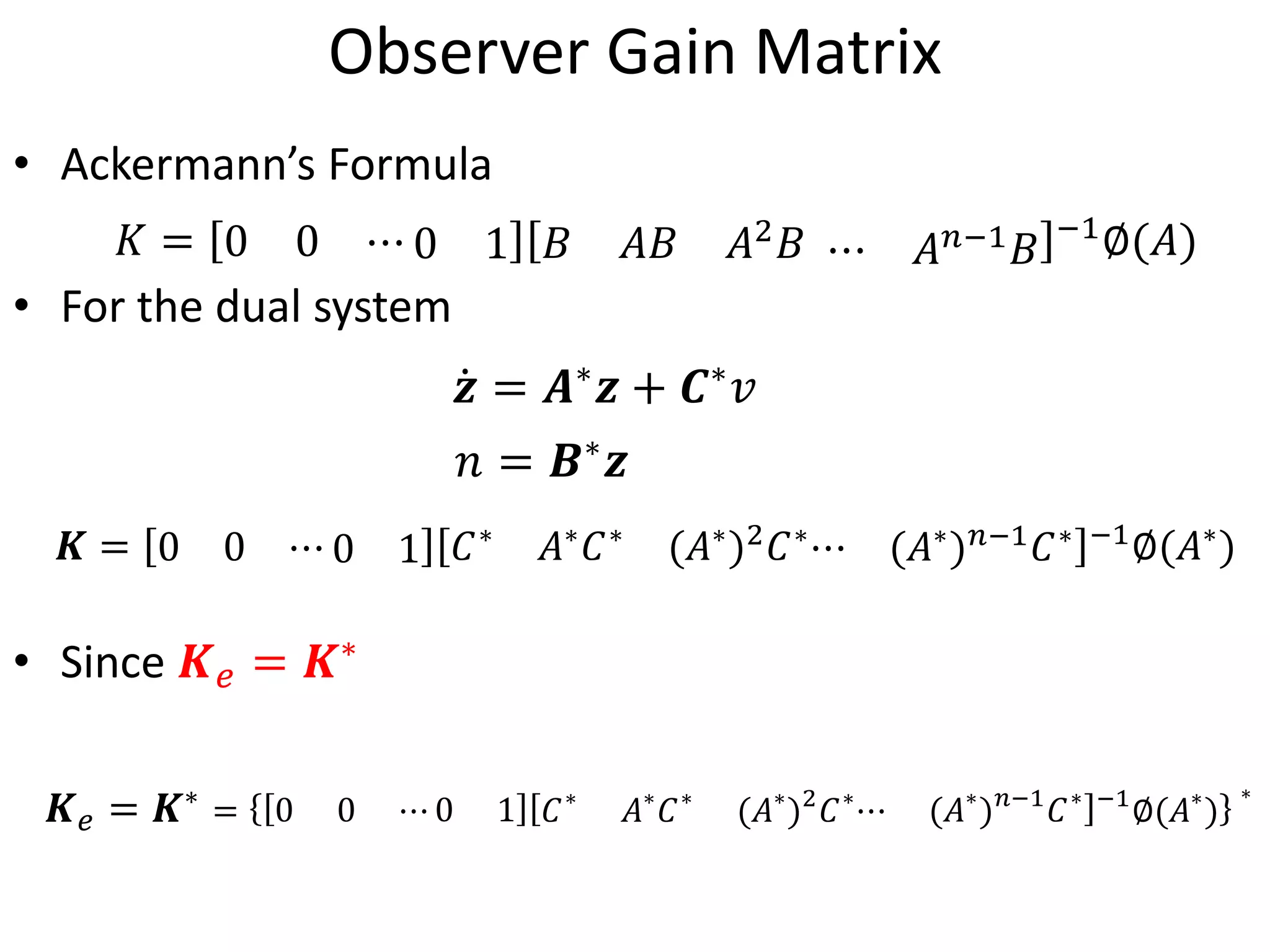
• Ackermann’s Formula
• For the dual system
• Since 𝑲𝑒 = 𝑲∗
𝐾 = 0 0 ⋯ 0 1 𝐵 𝐴𝐵 𝐴2
𝐵 ⋯ 𝐴𝑛−1𝐵
−1
∅(𝐴)
𝑲 = 0 0 ⋯ 0 1 𝐶∗ 𝐴∗𝐶∗ (𝐴∗)2𝐶∗
⋯ (𝐴∗)𝑛−1𝐶∗ −1∅(𝐴∗)
𝒛 = 𝑨∗
𝒛 + 𝑪∗
𝑣
𝑛 = 𝑩∗𝒛
𝑲𝑒 = 𝑲∗ = 0 0 ⋯ 0 1 𝐶∗
𝐴∗
𝐶∗
(𝐴∗
)2
𝐶∗
⋯ (𝐴∗
)𝑛−1
𝐶∗ −1
∅(𝐴∗
)
∗
Observer Gain Matrix
• Simplifying it further
𝑲𝑒 = 𝑲∗ = 0 0 ⋯ 0 1 𝐶∗
𝐴∗
𝐶∗
(𝐴∗
)2
𝐶∗
⋯ (𝐴∗
)𝑛−1
𝐶∗ −1
∅(𝐴∗
)
∗
𝐾𝑒 = ∅(𝐴)
𝐶
𝐶𝐴
⋮
𝐶𝐴𝑛−2
𝐶𝐴𝑛−1
−1
0
0
⋮
0
1
𝐾𝑒 = ∅(𝐴∗
)∗
𝐶∗
𝐴∗
𝐶∗
(𝐴∗
)2
𝐶∗
⋯ (𝐴∗
)𝑛−1
𝐶∗ −1 ∗
0 0 ⋯ 0 1 ∗
Observer Gain Matrix
• The feedback signal through the observer gain matrix Ke serves
as a correction signal to the plant model to account for the
unknowns in the plant.
• If significant unknowns are involved, the feedback signal
through the matrix Ke should be relatively large.
• However, if the output signal is contaminated significantly by
disturbances and measurement noises, then the output y is not
reliable and the feedback signal through the matrix Ke should
be relatively small.
Observer Gain Matrix
• The observer gain matrix Ke depends on the desired
characteristic equation
• The observer poles must be two to five times faster than the
controller poles to make sure the observation error (estimation
error) converges to zero quickly.
• This means that the observer estimation error decays two to
five times faster than does the state vector x.
• Such faster decay of the observer error compared with the
desired dynamics makes the controller poles dominate the
system response.
(𝑠 − 𝛽1)( 𝑠 − 𝛽2) ⋯ 𝑠 − 𝛽𝑛 = 0
Observer Gain Matrix
• It is important to note that if sensor noise is considerable,
we may choose the observer poles to be slower than two
times the controller poles, so that the bandwidth of the
system will become lower and smooth the noise.
• In this case the system response will be strongly influenced
by the observer poles.
• If the observer poles are located to the right of the
controller poles in the left-half s plane, the system
response will be dominated by the observer poles rather
than by the control poles.
Observer Gain Matrix
• In the design of the state observer, it is desirable to determine
several observer gain matrices Ke based on several different
desired characteristic equations.
• For each of the several different matrices Ke , simulation tests
must be run to evaluate the resulting system performance.
• Then we select the best Ke from the viewpoint of overall system
performance.
• In many practical cases, the selection of the best matrix Ke boils
down to a compromise between speedy response and
sensitivity to disturbances and noises.
Example-1
• Consider the system
• We use observer based approach to design state feedback control
such that
𝑥1
𝑥2
=
0 20.6
1 0
𝑥1
𝑥2
+
0
1
𝑢(𝑡)
• Design a full-order state observer assume that the desired eigenvalues of
the observer matrix are 𝛽1 = −10, 𝛽2 = −10.
𝑦 = 0 1
𝑥1
𝑥2
𝑢 = −𝑲𝒙
Example-1
• Let us examine the observability matrix first
𝑥1
𝑥2
=
0 20.6
1 0
𝑥1
𝑥2
+
0
1
𝑢(𝑡)
• Since rank(OM)=2 the given system is completely state observable and the
determination of the desired observer gain matrix is possible.
𝑦 = 0 1
𝑥1
𝑥2
𝑂𝑀 =
𝐶
𝐶𝐴
=
0 1
1 0
Example-1 (Method-1)
• The given system is already in the observable canonical form. Hence,
the transformation matrix Q is I.
𝑥1
𝑥2
=
0 20.6
1 0
𝑥1
𝑥2
+
0
1
𝑢(𝑡)
𝑦 = 0 1
𝑥1
𝑥2
Example-1 (Method-1)
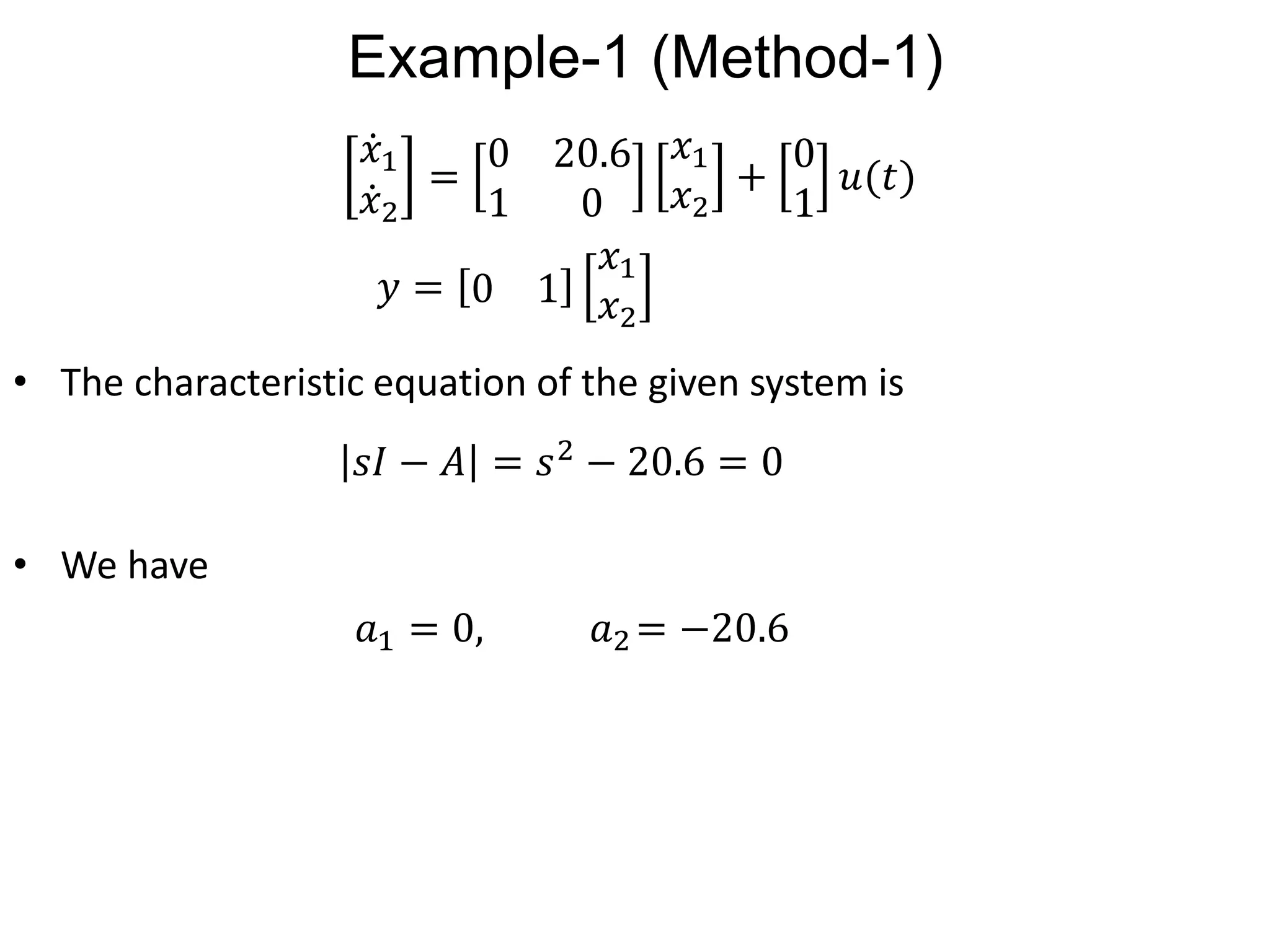
• The characteristic equation of the given system is
• We have
𝑥1
𝑥2
=
0 20.6
1 0
𝑥1
𝑥2
+
0
1
𝑢(𝑡)
𝑦 = 0 1
𝑥1
𝑥2
𝑠𝐼 − 𝐴 = 𝑠2 − 20.6 = 0
𝑎1 = 0, 𝑎2 = −20.6
Example-1 (Method-1)
• The desired characteristic equation of the system is
• We have
𝑥1
𝑥2
=
0 20.6
1 0
𝑥1
𝑥2
+
0
1
𝑢(𝑡)
𝑦 = 0 1
𝑥1
𝑥2
𝛼1 = 20, 𝛼2 = 100
(𝑠 − 𝛽1)( 𝑠 − 𝛽2) = (𝑠 + 10) 𝑠 + 10
(𝑠 − 𝛽1)( 𝑠 − 𝛽2) = 𝑠2
+ 20𝑠 + 100
Example-1 (Method-1)
• Observer gain matrix Ke can be calculated using following formula
• Where
𝛼1 = 20, 𝛼2 = 100
𝑲𝑒 =
𝛼2 − 𝑎2
𝛼1 − 𝑎1
𝑎1 = 0, 𝑎2 = −20.6
𝑲𝑒 =
100 − (−20.6)
20 − 0
𝑲𝑒 =
120.6
20
Example-1 (Method-2)
• The characteristic equation of observer error matric is
• Assuming
𝑥1
𝑥2
=
0 20.6
1 0
𝑥1
𝑥2
+
0
1
𝑢(𝑡)
𝑦 = 0 1
𝑥1
𝑥2
𝑠𝑰 − 𝑨 + 𝑲𝑒𝑪 = 0
𝑲𝑒 =
𝑘𝑒1
𝑘𝑒2
𝑠𝑰 − 𝑨 + 𝑲𝑒𝑪 =
𝑠 0
0 𝑠
−
0 20.6
1 0
+
𝑘𝑒1
𝑘𝑒2
0 1
= 𝑠2
+𝑘𝑒2𝑠 − 20.6 + 𝑘𝑒1
Example-1 (Method-2)
• The desired characteristic polynomial is
• Comparing coefficients of different powers of s
𝑠2
+ 20𝑠 + 100 = 𝑠2
+𝑘𝑒2𝑠 − 20.6 + 𝑘𝑒1
(𝑠 − 𝛽1)( 𝑠 − 𝛽2) = 𝑠2 + 20𝑠 + 100
𝑲𝑒 =
120.6
20
Example-1 (Method-3)
• Using Ackermann’s formula
• Where
𝑥1
𝑥2
=
0 20.6
1 0
𝑥1
𝑥2
+
0
1
𝑢(𝑡)
𝑦 = 0 1
𝑥1
𝑥2
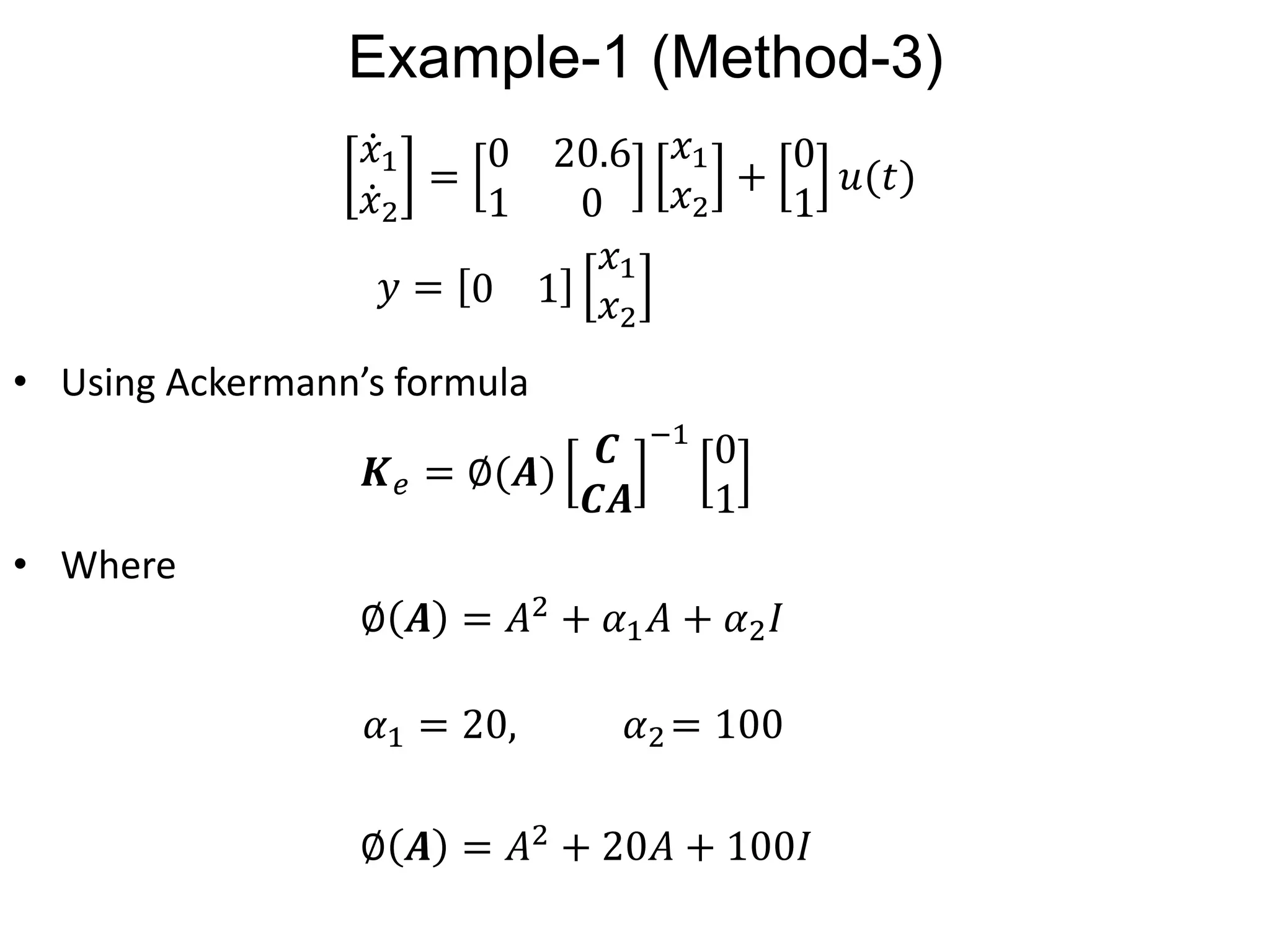
𝑲𝑒 = ∅(𝑨)
𝑪
𝑪𝑨
−1
0
1
∅ 𝑨 = 𝐴2 + 𝛼1𝐴 + 𝛼2𝐼
𝛼1 = 20, 𝛼2 = 100
∅ 𝑨 = 𝐴2 + 20𝐴 + 100𝐼
Example-1 (Method-3)
∅ 𝑨 = 𝑨2 + 20𝑨 + 100𝑰
∅ 𝑨 =
0 20.6
1 0
2
+ 20
0 20.6
1 0
+ 100
1 0
0 1
∅ 𝑨 =
120.6 412
20 120.6
Example-1 (Method-3)
• Using Ackermann’s formula
𝑲𝑒 = ∅(𝑨)
𝑪
𝑪𝑨
−1
0
1
𝑲𝑒 =
120.6 412
20 120.6
0 1
1 0
−1
0
1
𝑲𝑒 =
120.6
20
Example-1
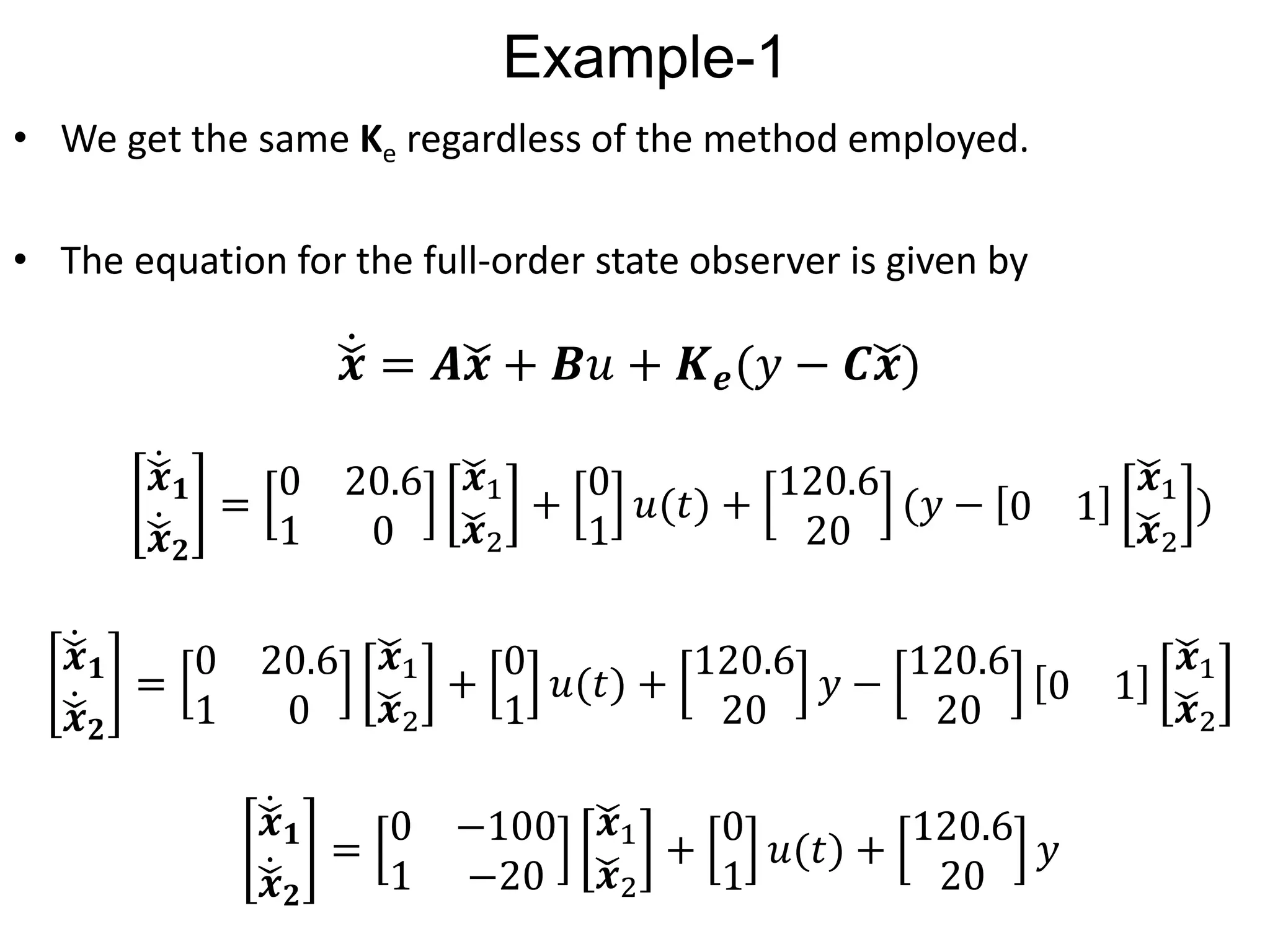
• We get the same Ke regardless of the method employed.
• The equation for the full-order state observer is given by
𝒙 = 𝑨𝒙 + 𝑩𝑢 + 𝑲𝒆(𝑦 − 𝑪𝒙)
𝒙𝟏
𝒙𝟐
=
0 20.6
1 0
𝒙1
𝒙2
+
0
1
𝑢(𝑡) +
120.6
20
(𝑦 − 0 1
𝒙1
𝒙2
)
𝒙𝟏
𝒙𝟐
=
0 20.6
1 0
𝒙1
𝒙2
+
0
1
𝑢(𝑡) +
120.6
20
𝑦 −
120.6
20
0 1
𝒙1
𝒙2
𝒙𝟏
𝒙𝟐
=
0 −100
1 −20
𝒙1
𝒙2
+
0
1
𝑢(𝑡) +
120.6
20
𝑦
Example-2
• Design a regulator system for the following plant:
• The desired closed-loop poles for this system are at 𝜇1 = −1.8 +
𝑗2.4, 𝜇2 = −1.8 − 𝑗2.4. Compute the state feedback gain matrix K to
place the poles of the system at desired location.
• Suppose that we use the observed-state feedback control instead of
the actual-state feedback. The desired eigenvalues of the observer
matrix are 𝛽1 = −8, 𝛽2 = −8.
• Obtain the observer gain matrix Ke and draw a block diagram for the
observed-state feedback control system.
𝑥1
𝑥2
=
0 20.6
1 0
𝑥1
𝑥2
+
0
1
𝑢(𝑡)
𝑦 = 1 0
𝑥1
𝑥2
END OF LECTURES-18-19
To download this lecture visit
http://imtiazhussainkalwar.weebly.com/

lecture_18-19_state_observer_design.pptx

  • 1.
    Modern Control Systems(MCS) Dr. Imtiaz Hussain Assistant Professor email: imtiaz.hussain@faculty.muet.edu.pk URL :http://imtiazhussainkalwar.weebly.com/ Lecture-18-19 Design of Control Systems in Sate Space Observer Based Approach 1
  • 2.
    Lecture Outline • Introduction •State Observer – Topology of Pole Placement (Observer based) – Full Order State Observer – Reduced Order state Observer • Using Transformation Matrix P • Direct Substitution Method • Ackermann’s Formula
  • 3.
    Introduction • In thepole-placement approach to the design of control systems, we assumed that all state variables are available for feedback. • In practice, however, not all state variables are available for feedback. • Then we need to estimate unavailable state variables.
  • 4.
    Introduction • Estimation ofunmeasurable state variables is commonly called observation. • A device (or a computer program) that estimates or observes the state variables is called a state estimator, state observer, or simply an observer. • There are two types of state observers – Full Order State Observer • If the state observer observes all state variables of the system, regardless of whether some state variables are available for direct measurement, it is called a full-order state observer. – Reduced Order State Observer • If the state observer observes only those state variables which are not available for direct measurement, it is called a reduced-order state observer.
  • 5.
    Topology of StateFeedback Control with Observer Based Approach • State feedback with state observer
  • 6.
    Topology of StateFeedback Control with Observer Based Approach • State feedback Control
  • 7.
    Topology of StateFeedback Control with Observer Based Approach • State Feedback with observer
  • 8.
    State Observer • Astate observer estimates the state variables based on the measurements of the output and control variables. • Here the concept of observability plays an important role. • State observers can be designed if and only if the observability condition is satisfied.
  • 9.
    State Observer • Considerthe plant defined by • The mathematical model of the observer is basically the same as that of the plant, except that we include an additional term that includes the estimation error to compensate for inaccuracies in matrices A and B and the lack of the initial error. • The estimation error or observation error is the difference between the measured output and the estimated output. • The initial error is the difference between the initial state and the initial estimated state. 𝒙 = 𝑨𝒙 + 𝑩𝑢 𝑦 = 𝑪𝒙
  • 10.
    State Observer • Thuswe define the mathematical model of observer to be • Where 𝒙 is estimated state vector, 𝑪𝒙 is estimated output and 𝑲𝒆 is observer gain matrix. 𝒙 = 𝑨𝒙 + 𝑩𝑢 + 𝑲𝒆(𝑦 − 𝑪𝒙)
  • 11.
    Full Order StateObserver • The order of the state observer that will be discussed here is the same as that of the plant. • Consider the plant define by following equations • Equation of state observer is given as • To obtain the observer error equation, let us subtract Equation (2) from Equation (1): 𝑦 = 𝑪𝒙 𝒙 = 𝑨𝒙 + 𝑩𝑢 (1) 𝒙 = 𝑨𝒙 + 𝑩𝑢 + 𝑲𝑒(𝑦 − 𝑪𝒙) (2) 𝒙 − 𝒙 = 𝑨𝒙 + 𝑩𝑢 − [𝑨𝒙 + 𝑩𝑢 + 𝑲𝑒 𝑦 − 𝑪𝒙 ] 𝒙 − 𝒙 = 𝑨𝒙 + 𝑩𝑢 − 𝑨𝒙 − 𝑩𝑢 − 𝑲𝑒 𝑪𝒙 − 𝑪𝒙
  • 12.
    Full Order StateObserver • Simplifications in above equation yields • Define the difference between 𝒙 and 𝒙 as the error vector e. • Equation (3) can now be written as 𝒙 − 𝒙 = 𝑨𝒙 + 𝑩𝑢 − 𝑨𝒙 − 𝑩𝑢 − 𝑲𝑒 𝑪𝒙 − 𝑪𝒙 𝒙 − 𝒙 = 𝑨(𝒙 − 𝒙) − 𝑲𝑒𝑪 𝒙 − 𝒙 (3) 𝒆 = 𝒙 − 𝒙 𝒆 = 𝑨𝒆 − 𝑲𝑒𝑪𝒆 𝒆 = (𝑨 − 𝑲𝑒𝑪)𝒆
  • 13.
    Full Order StateObserver • From above we see that the dynamic behavior of the error vector is determined by the eigenvalues of matrix A-KeC. • If matrix A-KeC is a stable matrix, the error vector will converge to zero for any initial error vector e(0). • That is, 𝒙(𝒕) will converge to 𝒙(𝒕) regardless of the values of x(0). • And if the eigenvalues of matrix A-KeC are chosen in such a way that the dynamic behavior of the error vector is asymptotically stable and is adequately fast, then any error vector will tend to zero (the origin) with an adequate speed. 𝒆 = (𝑨 − 𝑲𝒆𝑪)𝒆
  • 14.
    Full Order StateObserver • If the plant is completely observable, then it can be proved that it is possible to choose matrix Ke such that A-KeC has arbitrarily desired eigenvalues. • That is, the observer gain matrix Ke can be determined to yield the desired matrix A-KeC. 𝒆 = (𝑨 − 𝑲𝒆𝑪)𝒆
  • 15.
    Duality Property • Thedesign of the full-order observer becomes that of determining an appropriate Ke such that A-KeC has desired eigenvalues. • Thus, the problem here becomes the same as the pole- placement problem. • In fact, the two problems are mathematically the same. • This property is called duality.
  • 16.
    Duality Property • Considerthe system defined by • In designing the full-order state observer, we may solve the dual problem, that is, solve the pole-placement problem for the dual system. • Assuming the control signal 𝑣 to be 𝒙 = 𝑨𝒙 + 𝑩𝑢 𝑦 = 𝑪𝒙 𝒛 = 𝑨∗𝒛 + 𝑪∗𝑣 𝑛 = 𝑩∗𝒛 𝑣 = −𝑲𝒛
  • 17.
    Duality Property • Ifthe dual system is completely state controllable, then the state feedback gain matrix K can be determined such that matrix A*-C*K will yield a set of the desired eigenvalues. • If 𝜇1 , 𝜇2 ,…, 𝜇𝑛 , are the desired eigenvalues of the state observer matrix, then by taking the same 𝜇𝑖 ′ 𝑠 as the desired eigenvalues of the state-feedback gain matrix of the dual system, we obtain • Noting that the eigenvalues of A*-C*K and those of A- K*C are the same, we have 𝑠𝐼 − (𝑨∗ − 𝑪∗𝑲 ) = (𝑠 − 𝜇1)( 𝑠 − 𝜇2) ⋯ 𝑠 − 𝜇𝑛 𝑠𝐼 − (𝑨∗ − 𝑪∗𝑲 ) = 𝑠𝐼 − (𝑨 − 𝑲∗𝑪 )
  • 18.
    Duality Property • Comparingthe characteristic polynomial 𝑠𝐼 − (𝑨 − 𝑲∗ 𝑪 ) and the characteristic polynomial for the observer system 𝑠𝐼 − (𝑨 − 𝑲𝑒𝑪 ) , we find that Ke and K* are related by • Thus, using the matrix K determined by the pole- placement approach in the dual system, the observer gain matrix Ke for the original system can be determined by using the relationship Ke=K*. 𝑠𝐼 − (𝑨∗ − 𝑪∗ 𝑲 ) = 𝑠𝐼 − (𝑨 − 𝑲∗ 𝑪 ) 𝑠𝐼 − (𝑨 − 𝑲∗𝑪 ) = 𝑠𝐼 − (𝑨 − 𝑲𝑒𝑪 ) 𝑲∗ = 𝑲𝑒
  • 19.
    Observer Gain Matrix •Using Transformation Matrix Q • Direct Substitution Method • Ackermann’s Formula
  • 20.
    Observer Gain Matrix •Using Transformation Matrix Q • Since 𝑲 = 𝛼𝑛 − 𝑎𝑛 𝛼𝑛−1 − 𝑎𝑛−1 ⋯ 𝛼2 − 𝑎2 𝛼1 − 𝑎1 𝑲𝑒 = 𝑲∗ 𝑲𝑒 = 𝑲∗ = 𝛼𝑛 − 𝑎𝑛 𝛼𝑛−1 − 𝑎𝑛−1 ⋮ 𝛼2 − 𝑎2 𝛼1 − 𝑎1
  • 21.
    Observer Gain Matrix •Direct Substitution Method 𝑲𝒆 = 𝑘1 𝑘2 ⋮ 𝑘3 𝑘𝑛
  • 22.
    Observer Gain Matrix •Ackermann’s Formula • For the dual system • Since 𝑲𝑒 = 𝑲∗ 𝐾 = 0 0 ⋯ 0 1 𝐵 𝐴𝐵 𝐴2 𝐵 ⋯ 𝐴𝑛−1𝐵 −1 ∅(𝐴) 𝑲 = 0 0 ⋯ 0 1 𝐶∗ 𝐴∗𝐶∗ (𝐴∗)2𝐶∗ ⋯ (𝐴∗)𝑛−1𝐶∗ −1∅(𝐴∗) 𝒛 = 𝑨∗ 𝒛 + 𝑪∗ 𝑣 𝑛 = 𝑩∗𝒛 𝑲𝑒 = 𝑲∗ = 0 0 ⋯ 0 1 𝐶∗ 𝐴∗ 𝐶∗ (𝐴∗ )2 𝐶∗ ⋯ (𝐴∗ )𝑛−1 𝐶∗ −1 ∅(𝐴∗ ) ∗
  • 23.
    Observer Gain Matrix •Simplifying it further 𝑲𝑒 = 𝑲∗ = 0 0 ⋯ 0 1 𝐶∗ 𝐴∗ 𝐶∗ (𝐴∗ )2 𝐶∗ ⋯ (𝐴∗ )𝑛−1 𝐶∗ −1 ∅(𝐴∗ ) ∗ 𝐾𝑒 = ∅(𝐴) 𝐶 𝐶𝐴 ⋮ 𝐶𝐴𝑛−2 𝐶𝐴𝑛−1 −1 0 0 ⋮ 0 1 𝐾𝑒 = ∅(𝐴∗ )∗ 𝐶∗ 𝐴∗ 𝐶∗ (𝐴∗ )2 𝐶∗ ⋯ (𝐴∗ )𝑛−1 𝐶∗ −1 ∗ 0 0 ⋯ 0 1 ∗
  • 24.
    Observer Gain Matrix •The feedback signal through the observer gain matrix Ke serves as a correction signal to the plant model to account for the unknowns in the plant. • If significant unknowns are involved, the feedback signal through the matrix Ke should be relatively large. • However, if the output signal is contaminated significantly by disturbances and measurement noises, then the output y is not reliable and the feedback signal through the matrix Ke should be relatively small.
  • 25.
    Observer Gain Matrix •The observer gain matrix Ke depends on the desired characteristic equation • The observer poles must be two to five times faster than the controller poles to make sure the observation error (estimation error) converges to zero quickly. • This means that the observer estimation error decays two to five times faster than does the state vector x. • Such faster decay of the observer error compared with the desired dynamics makes the controller poles dominate the system response. (𝑠 − 𝛽1)( 𝑠 − 𝛽2) ⋯ 𝑠 − 𝛽𝑛 = 0
  • 26.
    Observer Gain Matrix •It is important to note that if sensor noise is considerable, we may choose the observer poles to be slower than two times the controller poles, so that the bandwidth of the system will become lower and smooth the noise. • In this case the system response will be strongly influenced by the observer poles. • If the observer poles are located to the right of the controller poles in the left-half s plane, the system response will be dominated by the observer poles rather than by the control poles.
  • 27.
    Observer Gain Matrix •In the design of the state observer, it is desirable to determine several observer gain matrices Ke based on several different desired characteristic equations. • For each of the several different matrices Ke , simulation tests must be run to evaluate the resulting system performance. • Then we select the best Ke from the viewpoint of overall system performance. • In many practical cases, the selection of the best matrix Ke boils down to a compromise between speedy response and sensitivity to disturbances and noises.
  • 28.
    Example-1 • Consider thesystem • We use observer based approach to design state feedback control such that 𝑥1 𝑥2 = 0 20.6 1 0 𝑥1 𝑥2 + 0 1 𝑢(𝑡) • Design a full-order state observer assume that the desired eigenvalues of the observer matrix are 𝛽1 = −10, 𝛽2 = −10. 𝑦 = 0 1 𝑥1 𝑥2 𝑢 = −𝑲𝒙
  • 29.
    Example-1 • Let usexamine the observability matrix first 𝑥1 𝑥2 = 0 20.6 1 0 𝑥1 𝑥2 + 0 1 𝑢(𝑡) • Since rank(OM)=2 the given system is completely state observable and the determination of the desired observer gain matrix is possible. 𝑦 = 0 1 𝑥1 𝑥2 𝑂𝑀 = 𝐶 𝐶𝐴 = 0 1 1 0
  • 30.
    Example-1 (Method-1) • Thegiven system is already in the observable canonical form. Hence, the transformation matrix Q is I. 𝑥1 𝑥2 = 0 20.6 1 0 𝑥1 𝑥2 + 0 1 𝑢(𝑡) 𝑦 = 0 1 𝑥1 𝑥2
  • 31.
    Example-1 (Method-1) • Thecharacteristic equation of the given system is • We have 𝑥1 𝑥2 = 0 20.6 1 0 𝑥1 𝑥2 + 0 1 𝑢(𝑡) 𝑦 = 0 1 𝑥1 𝑥2 𝑠𝐼 − 𝐴 = 𝑠2 − 20.6 = 0 𝑎1 = 0, 𝑎2 = −20.6
  • 32.
    Example-1 (Method-1) • Thedesired characteristic equation of the system is • We have 𝑥1 𝑥2 = 0 20.6 1 0 𝑥1 𝑥2 + 0 1 𝑢(𝑡) 𝑦 = 0 1 𝑥1 𝑥2 𝛼1 = 20, 𝛼2 = 100 (𝑠 − 𝛽1)( 𝑠 − 𝛽2) = (𝑠 + 10) 𝑠 + 10 (𝑠 − 𝛽1)( 𝑠 − 𝛽2) = 𝑠2 + 20𝑠 + 100
  • 33.
    Example-1 (Method-1) • Observergain matrix Ke can be calculated using following formula • Where 𝛼1 = 20, 𝛼2 = 100 𝑲𝑒 = 𝛼2 − 𝑎2 𝛼1 − 𝑎1 𝑎1 = 0, 𝑎2 = −20.6 𝑲𝑒 = 100 − (−20.6) 20 − 0 𝑲𝑒 = 120.6 20
  • 34.
    Example-1 (Method-2) • Thecharacteristic equation of observer error matric is • Assuming 𝑥1 𝑥2 = 0 20.6 1 0 𝑥1 𝑥2 + 0 1 𝑢(𝑡) 𝑦 = 0 1 𝑥1 𝑥2 𝑠𝑰 − 𝑨 + 𝑲𝑒𝑪 = 0 𝑲𝑒 = 𝑘𝑒1 𝑘𝑒2 𝑠𝑰 − 𝑨 + 𝑲𝑒𝑪 = 𝑠 0 0 𝑠 − 0 20.6 1 0 + 𝑘𝑒1 𝑘𝑒2 0 1 = 𝑠2 +𝑘𝑒2𝑠 − 20.6 + 𝑘𝑒1
  • 35.
    Example-1 (Method-2) • Thedesired characteristic polynomial is • Comparing coefficients of different powers of s 𝑠2 + 20𝑠 + 100 = 𝑠2 +𝑘𝑒2𝑠 − 20.6 + 𝑘𝑒1 (𝑠 − 𝛽1)( 𝑠 − 𝛽2) = 𝑠2 + 20𝑠 + 100 𝑲𝑒 = 120.6 20
  • 36.
    Example-1 (Method-3) • UsingAckermann’s formula • Where 𝑥1 𝑥2 = 0 20.6 1 0 𝑥1 𝑥2 + 0 1 𝑢(𝑡) 𝑦 = 0 1 𝑥1 𝑥2 𝑲𝑒 = ∅(𝑨) 𝑪 𝑪𝑨 −1 0 1 ∅ 𝑨 = 𝐴2 + 𝛼1𝐴 + 𝛼2𝐼 𝛼1 = 20, 𝛼2 = 100 ∅ 𝑨 = 𝐴2 + 20𝐴 + 100𝐼
  • 37.
    Example-1 (Method-3) ∅ 𝑨= 𝑨2 + 20𝑨 + 100𝑰 ∅ 𝑨 = 0 20.6 1 0 2 + 20 0 20.6 1 0 + 100 1 0 0 1 ∅ 𝑨 = 120.6 412 20 120.6
  • 38.
    Example-1 (Method-3) • UsingAckermann’s formula 𝑲𝑒 = ∅(𝑨) 𝑪 𝑪𝑨 −1 0 1 𝑲𝑒 = 120.6 412 20 120.6 0 1 1 0 −1 0 1 𝑲𝑒 = 120.6 20
  • 39.
    Example-1 • We getthe same Ke regardless of the method employed. • The equation for the full-order state observer is given by 𝒙 = 𝑨𝒙 + 𝑩𝑢 + 𝑲𝒆(𝑦 − 𝑪𝒙) 𝒙𝟏 𝒙𝟐 = 0 20.6 1 0 𝒙1 𝒙2 + 0 1 𝑢(𝑡) + 120.6 20 (𝑦 − 0 1 𝒙1 𝒙2 ) 𝒙𝟏 𝒙𝟐 = 0 20.6 1 0 𝒙1 𝒙2 + 0 1 𝑢(𝑡) + 120.6 20 𝑦 − 120.6 20 0 1 𝒙1 𝒙2 𝒙𝟏 𝒙𝟐 = 0 −100 1 −20 𝒙1 𝒙2 + 0 1 𝑢(𝑡) + 120.6 20 𝑦
  • 40.
    Example-2 • Design aregulator system for the following plant: • The desired closed-loop poles for this system are at 𝜇1 = −1.8 + 𝑗2.4, 𝜇2 = −1.8 − 𝑗2.4. Compute the state feedback gain matrix K to place the poles of the system at desired location. • Suppose that we use the observed-state feedback control instead of the actual-state feedback. The desired eigenvalues of the observer matrix are 𝛽1 = −8, 𝛽2 = −8. • Obtain the observer gain matrix Ke and draw a block diagram for the observed-state feedback control system. 𝑥1 𝑥2 = 0 20.6 1 0 𝑥1 𝑥2 + 0 1 𝑢(𝑡) 𝑦 = 1 0 𝑥1 𝑥2
  • 41.
    END OF LECTURES-18-19 Todownload this lecture visit http://imtiazhussainkalwar.weebly.com/