
Basic elements in control systems
Presented by
Mr. C.S.Satheesh, M.E.,
Assistant Professor, Department of EEE,
Muthayammal Engineering College (Autonomous),
Namakkal (Dt), Rasipuram – 637408
MUTHAYAMMAL ENGINEERING COLLEGE
(An Autonomous Institution)
(Approved by AICTE, New Delhi, Accredited by NAAC, NBA & Affiliated to Anna University),
Rasipuram - 637 408, Namakkal Dist., Tamil Nadu, India.
Why do we study the control system?
 To design controllers for a system based on its own properties.
 It is the basis for ensuring that every automatic system performs its
ordained task accurately, efficiently and quickly(optimally)despite
being subjected to varying environmental conditions.
2
Purpose of control system
 A control system manages, commands, directs, or regulates the
behavior of other devices or systems using control loops.
 It can range from a single home heating controller using a
thermostat controlling a domestic boiler to large Industrial control
systems which are used for controlling processes or machines.
3
System
4
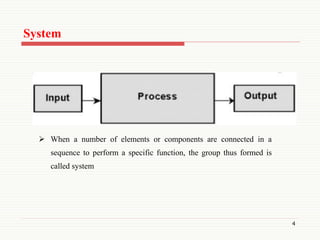
 When a number of elements or components are connected in a
sequence to perform a specific function, the group thus formed is
called system
Control systems
5
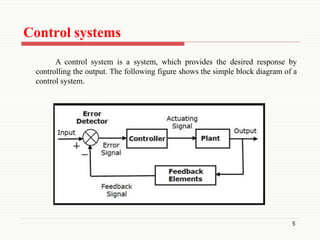
A control system is a system, which provides the desired response by
controlling the output. The following figure shows the simple block diagram of a
control system.
Contd…
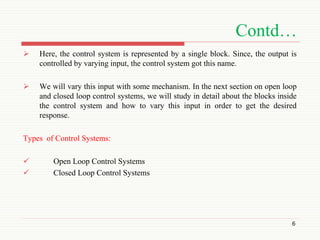
 Here, the control system is represented by a single block. Since, the output is
controlled by varying input, the control system got this name.
 We will vary this input with some mechanism. In the next section on open loop
and closed loop control systems, we will study in detail about the blocks inside
the control system and how to vary this input in order to get the desired
response.
Types of Control Systems:
 Open Loop Control Systems
 Closed Loop Control Systems
6
Open loop control systems
7
The following figure shows the block diagram of the open loop control
system.
In open loop control systems, output is not fed-back to the input. So, the
control action is independent of the desired output.
Here, an input is applied to a controller and it produces an actuating signal
or controlling signal. This signal is given as an input to a plant or process
which is to be controlled. So, the plant produces an output, which is
controlled. The traffic lights control system which we discussed earlier is an
example of an open loop control system.
Closed loop control systems
8
Contd…
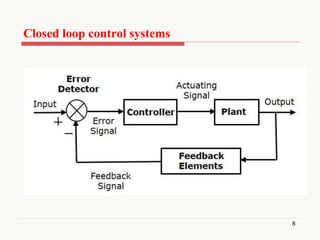
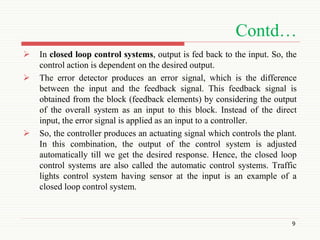
 In closed loop control systems, output is fed back to the input. So, the
control action is dependent on the desired output.
 The error detector produces an error signal, which is the difference
between the input and the feedback signal. This feedback signal is
obtained from the block (feedback elements) by considering the output
of the overall system as an input to this block. Instead of the direct
input, the error signal is applied as an input to a controller.
 So, the controller produces an actuating signal which controls the plant.
In this combination, the output of the control system is adjusted
automatically till we get the desired response. Hence, the closed loop
control systems are also called the automatic control systems. Traffic
lights control system having sensor at the input is an example of a
closed loop control system.
9
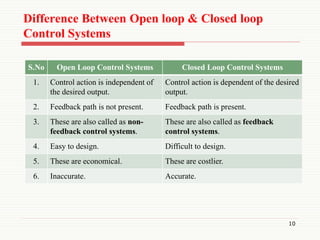
Difference Between Open loop & Closed loop
Control Systems
S.No Open Loop Control Systems Closed Loop Control Systems
1. Control action is independent of
the desired output.
Control action is dependent of the desired
output.
2. Feedback path is not present. Feedback path is present.
3. These are also called as non-
feedback control systems.
These are also called as feedback
control systems.
4. Easy to design. Difficult to design.
5. These are economical. These are costlier.
6. Inaccurate. Accurate.
10
References :
 A.Nagoorkani, Control Systems,
RBA Publications.
11
Thank You
12

Basic elements in control systems

  • 1.
    Basic elements incontrol systems Presented by Mr. C.S.Satheesh, M.E., Assistant Professor, Department of EEE, Muthayammal Engineering College (Autonomous), Namakkal (Dt), Rasipuram – 637408 MUTHAYAMMAL ENGINEERING COLLEGE (An Autonomous Institution) (Approved by AICTE, New Delhi, Accredited by NAAC, NBA & Affiliated to Anna University), Rasipuram - 637 408, Namakkal Dist., Tamil Nadu, India.
  • 2.
    Why do westudy the control system?  To design controllers for a system based on its own properties.  It is the basis for ensuring that every automatic system performs its ordained task accurately, efficiently and quickly(optimally)despite being subjected to varying environmental conditions. 2
  • 3.
    Purpose of controlsystem  A control system manages, commands, directs, or regulates the behavior of other devices or systems using control loops.  It can range from a single home heating controller using a thermostat controlling a domestic boiler to large Industrial control systems which are used for controlling processes or machines. 3
  • 4.
    System 4  When anumber of elements or components are connected in a sequence to perform a specific function, the group thus formed is called system
  • 5.
    Control systems 5 A controlsystem is a system, which provides the desired response by controlling the output. The following figure shows the simple block diagram of a control system.
  • 6.
    Contd…  Here, thecontrol system is represented by a single block. Since, the output is controlled by varying input, the control system got this name.  We will vary this input with some mechanism. In the next section on open loop and closed loop control systems, we will study in detail about the blocks inside the control system and how to vary this input in order to get the desired response. Types of Control Systems:  Open Loop Control Systems  Closed Loop Control Systems 6
  • 7.
    Open loop controlsystems 7 The following figure shows the block diagram of the open loop control system. In open loop control systems, output is not fed-back to the input. So, the control action is independent of the desired output. Here, an input is applied to a controller and it produces an actuating signal or controlling signal. This signal is given as an input to a plant or process which is to be controlled. So, the plant produces an output, which is controlled. The traffic lights control system which we discussed earlier is an example of an open loop control system.
  • 8.
  • 9.
    Contd…  In closedloop control systems, output is fed back to the input. So, the control action is dependent on the desired output.  The error detector produces an error signal, which is the difference between the input and the feedback signal. This feedback signal is obtained from the block (feedback elements) by considering the output of the overall system as an input to this block. Instead of the direct input, the error signal is applied as an input to a controller.  So, the controller produces an actuating signal which controls the plant. In this combination, the output of the control system is adjusted automatically till we get the desired response. Hence, the closed loop control systems are also called the automatic control systems. Traffic lights control system having sensor at the input is an example of a closed loop control system. 9
  • 10.
    Difference Between Openloop & Closed loop Control Systems S.No Open Loop Control Systems Closed Loop Control Systems 1. Control action is independent of the desired output. Control action is dependent of the desired output. 2. Feedback path is not present. Feedback path is present. 3. These are also called as non- feedback control systems. These are also called as feedback control systems. 4. Easy to design. Difficult to design. 5. These are economical. These are costlier. 6. Inaccurate. Accurate. 10
  • 11.
    References :  A.Nagoorkani,Control Systems, RBA Publications. 11
  • 12.