Aalok P Bhat(1rv09ec002)
    Ganesh V Bhat(1rv09ec027)
Sujith Chandra P S(1rv09ec105)
Control system…
 Device or a set of devices that mange, command, direct
  or regulate the behavior of other device or system.
 Control system can be thought of as having four
  functions; Measure, Compare, Compute, and Correct
 These functions are completed by five
  elements: Detector, Transducer, Transmitter,
  Controller, and Final Control Element.
 Practically a control system is implemented in
  embedded system using a microcontroller or a PLD’s
Control theory…
 It is an interdisciplinary branch of engineering and
  mathematics that deals with the behavior of
  dynamical systems.
 Usual objective of control theory is to calculate
  solutions for the proper corrective action from the
  controller that result in system stability.
 Transfer function (also known as the system function
  or network function) is a mathematical tool to define
  the relation between input and the output.
Classification…
  Logical or sequential controls
      usually implemented using logic gates(combinational circuit)
  Feedback or linear controls
      Usually implemented using combinational circuit and flip
       flops(sequential circuit)
  Fuzzy control
      attempts to combine some of the design simplicity
       of logic with the utility of linear control. Some devices or
       systems are inherently not controllable.
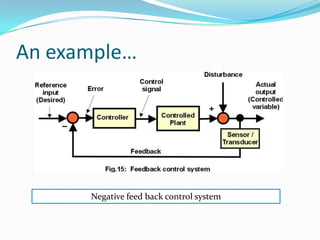
An example…


      Negative feed back control system
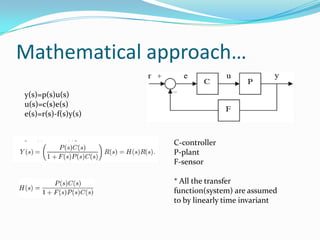
Mathematical approach…
y(s)=p(s)u(s)
u(s)=c(s)e(s)
e(s)=r(s)-f(s)y(s)


                     C-controller
                     P-plant
                     F-sensor

                     * All the transfer
                     function(system) are assumed
                     to by linearly time invariant
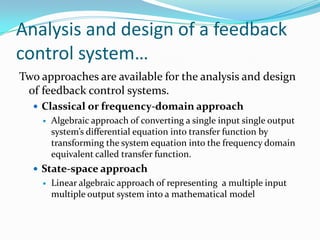
Analysis and design of a feedback
control system…
Two approaches are available for the analysis and design
 of feedback control systems.
   Classical or frequency-domain approach
       Algebraic approach of converting a single input single output
        system’s differential equation into transfer function by
        transforming the system equation into the frequency domain
        equivalent called transfer function.
   State-space approach
       Linear algebraic approach of representing a multiple input
        multiple output system into a mathematical model
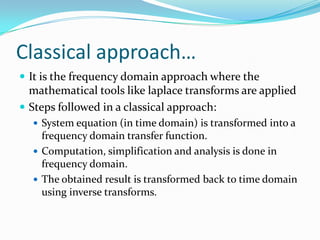
Classical approach…
 It is the frequency domain approach where the
  mathematical tools like laplace transforms are applied
 Steps followed in a classical approach:
   System equation (in time domain) is transformed into a
    frequency domain transfer function.
   Computation, simplification and analysis is done in
    frequency domain.
   The obtained result is transformed back to time domain
    using inverse transforms.
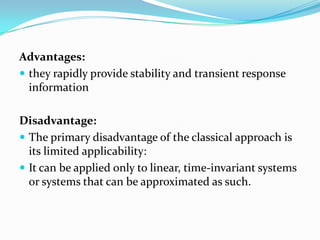
Advantages:
 they rapidly provide stability and transient response
  information

Disadvantage:
 The primary disadvantage of the classical approach is
  its limited applicability:
 It can be applied only to linear, time-invariant systems
  or systems that can be approximated as such.
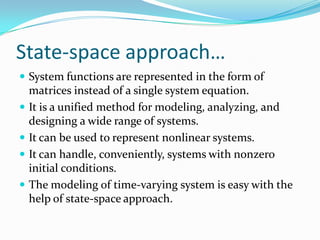
State-space approach…
 System functions are represented in the form of
    matrices instead of a single system equation.
   It is a unified method for modeling, analyzing, and
    designing a wide range of systems.
   It can be used to represent nonlinear systems.
   It can handle, conveniently, systems with nonzero
    initial conditions.
   The modeling of time-varying system is easy with the
    help of state-space approach.
STATE SPACE
   REPRESENTATION
• In control engineering, a state space representation is a
  mathematical model of a physical system as a set of input, output
  and state variables related by first-order differential equations


• To abstract from the number of inputs, outputs and states,
  the variables are expressed as vectors, and the differential
  and algebraic equations are written in matrix form
• When the complexity of the equation is more, it is very difficult
  to work in time domain


• So we decompose the higher-order differential equations into
  multiple first-order equations, and we solve them using
  state variables method

• State space refers to the space whose axes are the state variables.
  The state of the system can be represented as a vector within that space
STATE SPACE


• The state-space is the vector space that consists of all the
  possible internal states of the system

• In a state space system, the internal state of the system is
  explicitly accounted for by an equation known as the
 state equation
• The system output is given in terms of a combination of the
   current system state, and the current system input, through
   the output equation
• These two equations form a system of equations known
   collectively as state-space equations
STATE

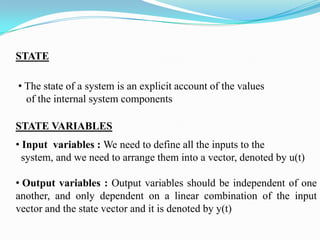
• The state of a system is an explicit account of the values
  of the internal system components

STATE VARIABLES
• Input variables : We need to define all the inputs to the
  system, and we need to arrange them into a vector, denoted by u(t)

• Output variables : Output variables should be independent of one
another, and only dependent on a linear combination of the input
vector and the state vector and it is denoted by y(t)
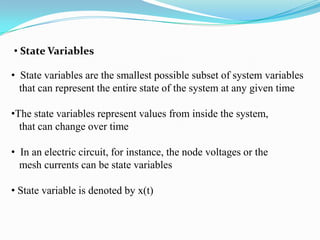
• State Variables

• State variables are the smallest possible subset of system variables
  that can represent the entire state of the system at any given time

•The state variables represent values from inside the system,
  that can change over time

• In an electric circuit, for instance, the node voltages or the
  mesh currents can be state variables

• State variable is denoted by x(t)
State-Space Equations

• In a state-space system representation, we have a system of two equations

    • equation for determining the state of the system
      x'(t) = g[t0,t,x(t),x(0),u(t)]

    • equation for determining the output of the system
      y(t) = h[t,x(t),u(t)]


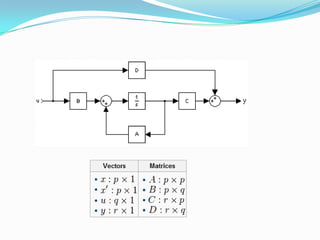
    • x‘(t) = A(t)x(t) + Bu(t)

    • y(t) = C(t)x(t) + Du(t)
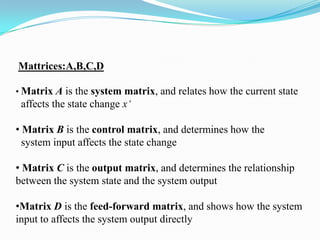
Mattrices:A,B,C,D

• Matrix A is the system matrix, and relates how the current state
 affects the state change x‘

• Matrix B is the control matrix, and determines how the
  system input affects the state change

• Matrix C is the output matrix, and determines the relationship
between the system state and the system output

•Matrix D is the feed-forward matrix, and shows how the system
input to affects the system output directly
State-Space Basis Theorem

Any system that can be described by a finite number of
nth order differential equations or nth order difference
equations, or any system that can be approximated by
them, can be described using state-space equations. The
general solutions to the state-space equations, therefore, are
solutions to all such sets of equations
Representing Systems By
State Space Approach
 Select a particular subset of all possible system
  variables and call it as state variables.

 For an nth-order system, write n simultaneous, first-
  order differential equations in terms of the state
  variables. We call this system of simultaneous
  differential equations state equations.
 We algebraically combine the state variables with the
 system's input to get output equation.

 State equations and output equations combined form
 a state-space representation.
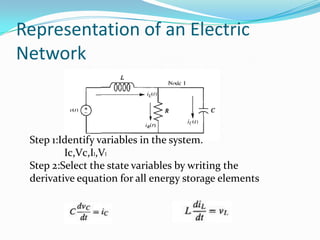
Representation of an Electric
Network


 Step 1:Identify variables in the system.
         Ic,Vc,Il,Vl
 Step 2:Select the state variables by writing the
 derivative equation for all energy storage elements
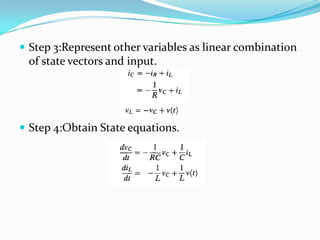
 Step 3:Represent other variables as linear combination
 of state vectors and input.


 Step 4:Obtain State equations.
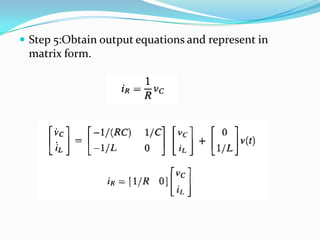
 Step 5:Obtain output equations and represent in
 matrix form.
Representing
Differential/difference equation in
State Space Model.
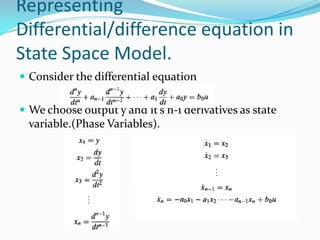
 Consider the differential equation


 We choose output y and it’s n-1 derivatives as state
  variable.(Phase Variables).
Representing Transfer Function to
State Space
 we first convert the transfer function to a differential
  equation

 Then we represent the differential equation in state
  space in phase variable form.
Stability of System
 A linear state space model is asymptotically stable if all
  real parts of eigenvalues of A are negative.

 Correspondingly, a time-discrete linear state
  space model is asymptotically stable if all
  the eigenvalues of A have a modulus smaller than one.
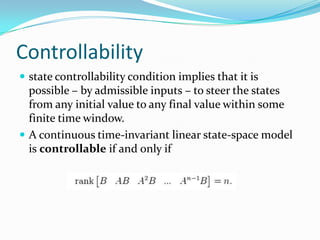
Controllability
 state controllability condition implies that it is
  possible – by admissible inputs – to steer the states
  from any initial value to any final value within some
  finite time window.
 A continuous time-invariant linear state-space model
  is controllable if and only if
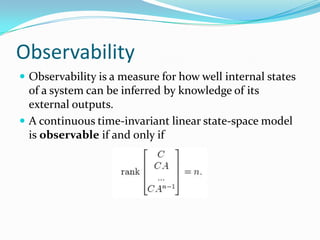
Observability
 Observability is a measure for how well internal states
  of a system can be inferred by knowledge of its
  external outputs.
 A continuous time-invariant linear state-space model
  is observable if and only if
linear algebra in control systems

linear algebra in control systems

  • 1.
    Aalok P Bhat(1rv09ec002) Ganesh V Bhat(1rv09ec027) Sujith Chandra P S(1rv09ec105)
  • 3.
    Control system…  Deviceor a set of devices that mange, command, direct or regulate the behavior of other device or system.  Control system can be thought of as having four functions; Measure, Compare, Compute, and Correct  These functions are completed by five elements: Detector, Transducer, Transmitter, Controller, and Final Control Element.  Practically a control system is implemented in embedded system using a microcontroller or a PLD’s
  • 4.
    Control theory…  Itis an interdisciplinary branch of engineering and mathematics that deals with the behavior of dynamical systems.  Usual objective of control theory is to calculate solutions for the proper corrective action from the controller that result in system stability.  Transfer function (also known as the system function or network function) is a mathematical tool to define the relation between input and the output.
  • 5.
    Classification…  Logicalor sequential controls  usually implemented using logic gates(combinational circuit)  Feedback or linear controls  Usually implemented using combinational circuit and flip flops(sequential circuit)  Fuzzy control  attempts to combine some of the design simplicity of logic with the utility of linear control. Some devices or systems are inherently not controllable.
  • 6.
    An example… Negative feed back control system
  • 7.
    Mathematical approach… y(s)=p(s)u(s) u(s)=c(s)e(s) e(s)=r(s)-f(s)y(s) C-controller P-plant F-sensor * All the transfer function(system) are assumed to by linearly time invariant
  • 8.
    Analysis and designof a feedback control system… Two approaches are available for the analysis and design of feedback control systems.  Classical or frequency-domain approach  Algebraic approach of converting a single input single output system’s differential equation into transfer function by transforming the system equation into the frequency domain equivalent called transfer function.  State-space approach  Linear algebraic approach of representing a multiple input multiple output system into a mathematical model
  • 9.
    Classical approach…  Itis the frequency domain approach where the mathematical tools like laplace transforms are applied  Steps followed in a classical approach:  System equation (in time domain) is transformed into a frequency domain transfer function.  Computation, simplification and analysis is done in frequency domain.  The obtained result is transformed back to time domain using inverse transforms.
  • 10.
    Advantages:  they rapidlyprovide stability and transient response information Disadvantage:  The primary disadvantage of the classical approach is its limited applicability:  It can be applied only to linear, time-invariant systems or systems that can be approximated as such.
  • 11.
    State-space approach…  Systemfunctions are represented in the form of matrices instead of a single system equation.  It is a unified method for modeling, analyzing, and designing a wide range of systems.  It can be used to represent nonlinear systems.  It can handle, conveniently, systems with nonzero initial conditions.  The modeling of time-varying system is easy with the help of state-space approach.
  • 12.
    STATE SPACE REPRESENTATION
  • 13.
    • In controlengineering, a state space representation is a mathematical model of a physical system as a set of input, output and state variables related by first-order differential equations • To abstract from the number of inputs, outputs and states, the variables are expressed as vectors, and the differential and algebraic equations are written in matrix form
  • 14.
    • When thecomplexity of the equation is more, it is very difficult to work in time domain • So we decompose the higher-order differential equations into multiple first-order equations, and we solve them using state variables method • State space refers to the space whose axes are the state variables. The state of the system can be represented as a vector within that space
  • 15.
    STATE SPACE • Thestate-space is the vector space that consists of all the possible internal states of the system • In a state space system, the internal state of the system is explicitly accounted for by an equation known as the state equation • The system output is given in terms of a combination of the current system state, and the current system input, through the output equation • These two equations form a system of equations known collectively as state-space equations
  • 16.
    STATE • The stateof a system is an explicit account of the values of the internal system components STATE VARIABLES • Input variables : We need to define all the inputs to the system, and we need to arrange them into a vector, denoted by u(t) • Output variables : Output variables should be independent of one another, and only dependent on a linear combination of the input vector and the state vector and it is denoted by y(t)
  • 17.
    • State Variables •State variables are the smallest possible subset of system variables that can represent the entire state of the system at any given time •The state variables represent values from inside the system, that can change over time • In an electric circuit, for instance, the node voltages or the mesh currents can be state variables • State variable is denoted by x(t)
  • 18.
    State-Space Equations • Ina state-space system representation, we have a system of two equations • equation for determining the state of the system x'(t) = g[t0,t,x(t),x(0),u(t)] • equation for determining the output of the system y(t) = h[t,x(t),u(t)] • x‘(t) = A(t)x(t) + Bu(t) • y(t) = C(t)x(t) + Du(t)
  • 19.
    Mattrices:A,B,C,D • Matrix Ais the system matrix, and relates how the current state affects the state change x‘ • Matrix B is the control matrix, and determines how the system input affects the state change • Matrix C is the output matrix, and determines the relationship between the system state and the system output •Matrix D is the feed-forward matrix, and shows how the system input to affects the system output directly
  • 21.
    State-Space Basis Theorem Anysystem that can be described by a finite number of nth order differential equations or nth order difference equations, or any system that can be approximated by them, can be described using state-space equations. The general solutions to the state-space equations, therefore, are solutions to all such sets of equations
  • 22.
    Representing Systems By StateSpace Approach  Select a particular subset of all possible system variables and call it as state variables.  For an nth-order system, write n simultaneous, first- order differential equations in terms of the state variables. We call this system of simultaneous differential equations state equations.
  • 23.
     We algebraicallycombine the state variables with the system's input to get output equation.  State equations and output equations combined form a state-space representation.
  • 24.
    Representation of anElectric Network Step 1:Identify variables in the system. Ic,Vc,Il,Vl Step 2:Select the state variables by writing the derivative equation for all energy storage elements
  • 25.
     Step 3:Representother variables as linear combination of state vectors and input.  Step 4:Obtain State equations.
  • 26.
     Step 5:Obtainoutput equations and represent in matrix form.
  • 27.
    Representing Differential/difference equation in StateSpace Model.  Consider the differential equation  We choose output y and it’s n-1 derivatives as state variable.(Phase Variables).
  • 29.
    Representing Transfer Functionto State Space  we first convert the transfer function to a differential equation  Then we represent the differential equation in state space in phase variable form.
  • 30.
    Stability of System A linear state space model is asymptotically stable if all real parts of eigenvalues of A are negative.  Correspondingly, a time-discrete linear state space model is asymptotically stable if all the eigenvalues of A have a modulus smaller than one.
  • 31.
    Controllability  state controllabilitycondition implies that it is possible – by admissible inputs – to steer the states from any initial value to any final value within some finite time window.  A continuous time-invariant linear state-space model is controllable if and only if
  • 32.
    Observability  Observability isa measure for how well internal states of a system can be inferred by knowledge of its external outputs.  A continuous time-invariant linear state-space model is observable if and only if

Editor's Notes

  • #7 The desired output of a system is called the reference. When one or more output variables of a system need to follow a certain reference over time, a controller manipulates the inputs to a system to obtain the desired effect on the output of the system. The whole control system is based on the feedback, and its type.
  • #12 Time- varying system: missiles with varying fuel levels or lift in an aircraft flying through varying altitude.MIMO- multiple input and multiple output: