Presented By:
Pathak Anish (130410117044)
Guided by:
Prof. Krupa Narwekar
Instrumentation & Control
ADVANCE CONTROL THEORY (2181705)
 A singular point is an equilibrium point in the phase
plane.
 Since an equilibrium point is defined as a point where the
system states can stay forever, this implies that ẋ = 0 .
 Consider a general time invariant system described by
the state equation
ẋ = f(x,u) …[1 ]
SINGULAR POINT
 If the input vector u is constant, it is possible to write the
above equation in the form
ẋ = F(X) …[2]
 A system represented by an equation of this form is called
autonomous system.
 For such system, consider the points in the phase-space at
which the derivate of the all state variable are zero. Such
points are called singular points.
 Singular points are very important features on the phase
plane.
 Consider a time invariant second order system described by
eq of the form
ẋ=X2 ; ẋ2 = f(x1,x2)
 Now using Taylor series expansion , eq can be
ẋ=X2
ẋ2 = ax1+bx2+g2(x1,x2)
Where g2(.) contains higher order terms
The higher ordered terms can be neglected and therefore,
the nonlinear system trajectories essentially satisfy the
linearized eq
ẋ=X2
ẋ2 = ax1+bx2
 Transforming these eq into a scalar second order eq
𝒙1 =ax1+bẋ1
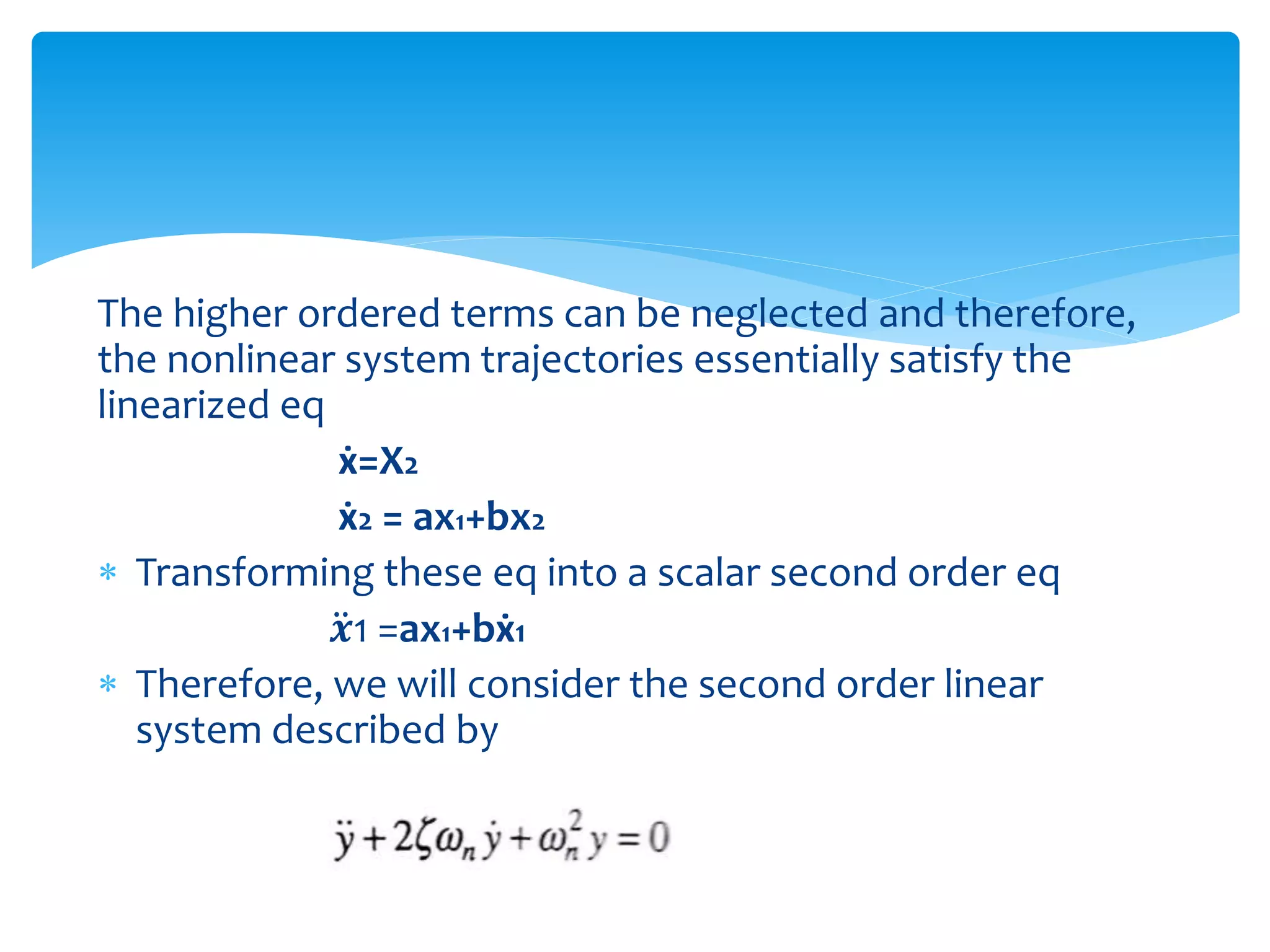
 Therefore, we will consider the second order linear
system described by
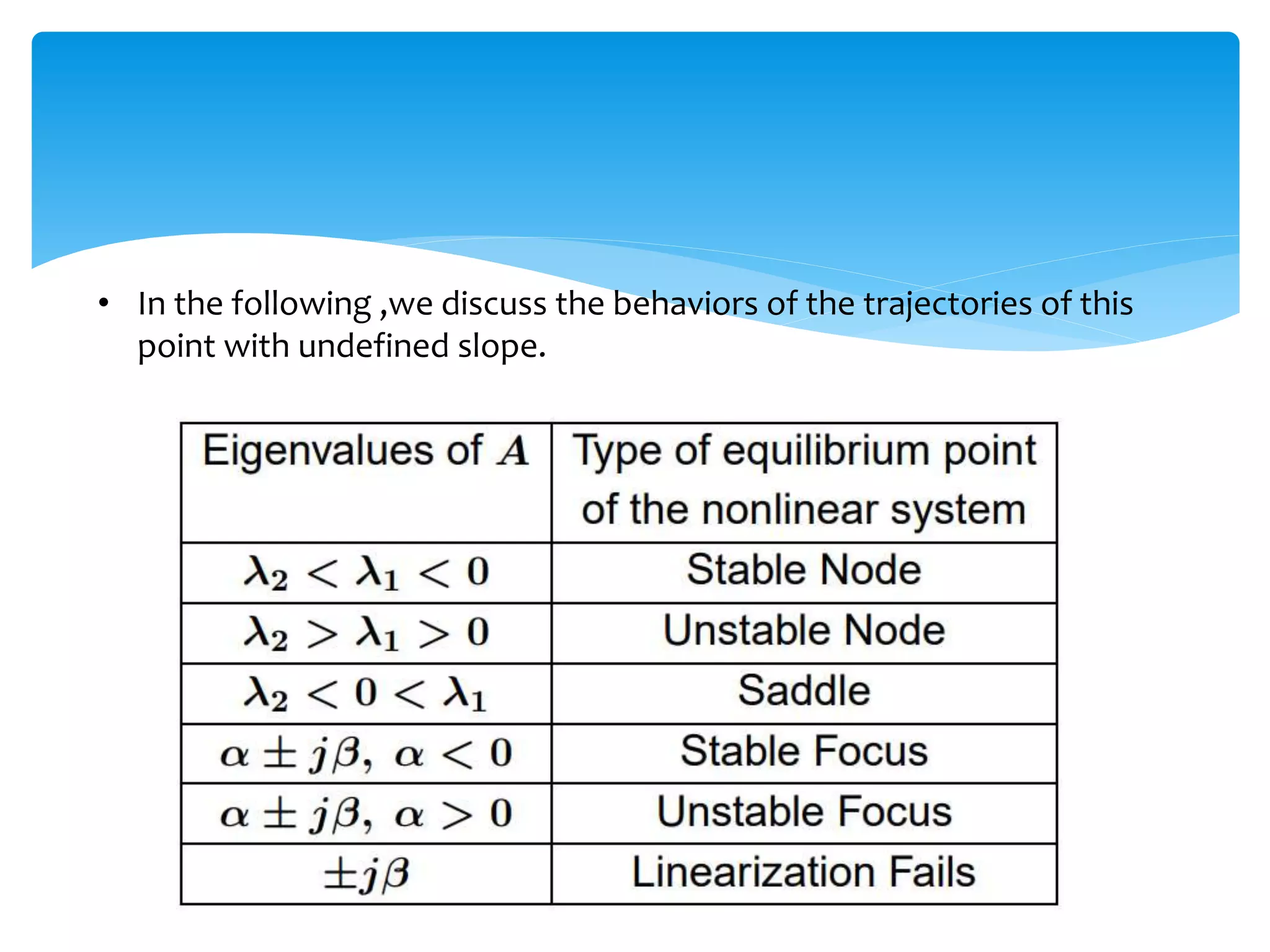
• In the following ,we discuss the behaviors of the trajectories of this
point with undefined slope.
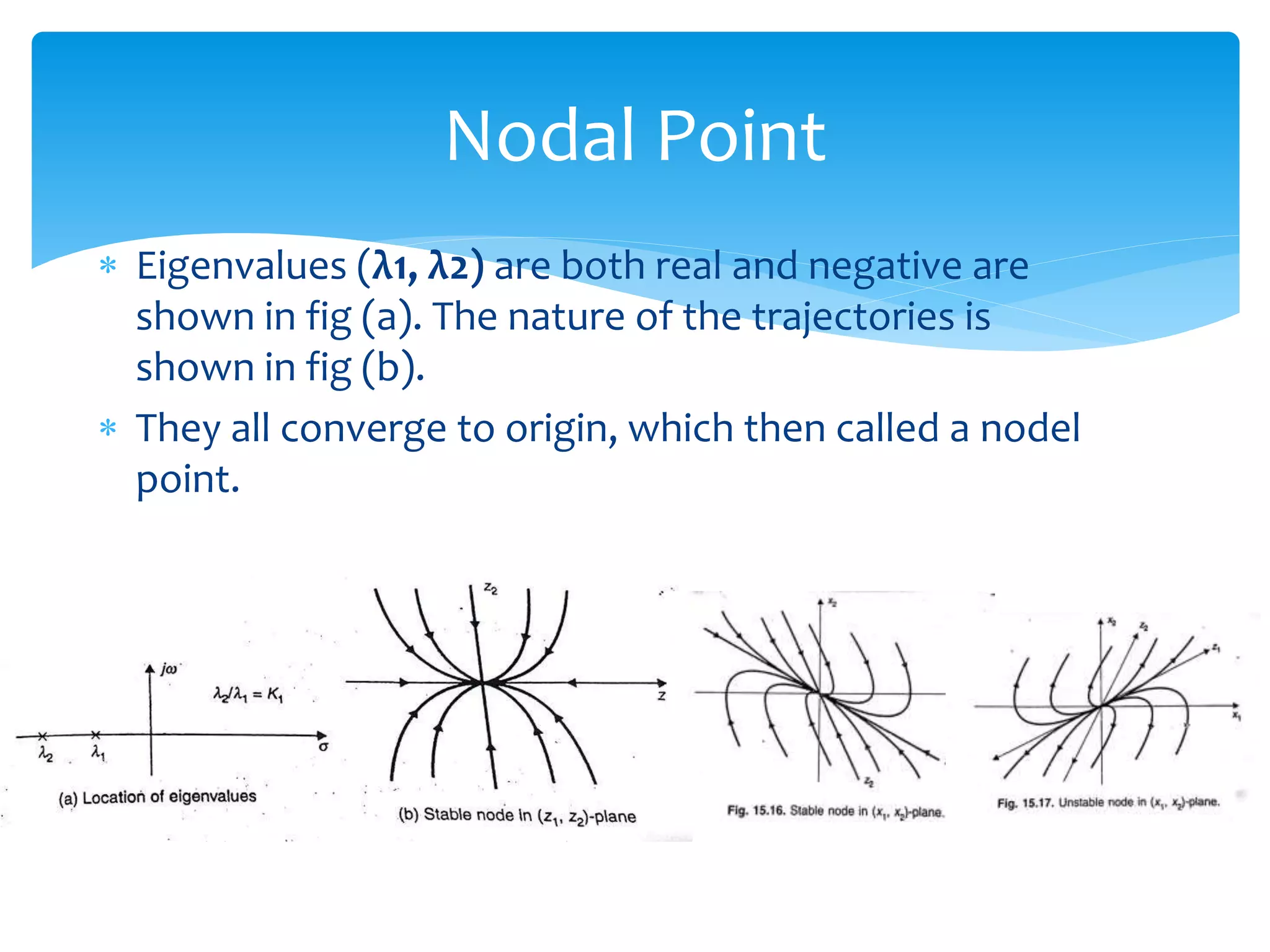
 Eigenvalues (λ1, λ2) are both real and negative are
shown in fig (a). The nature of the trajectories is
shown in fig (b).
 They all converge to origin, which then called a nodel
point.
Nodal Point
 Both eigenvalues are real, equal and negative of each
other shown in fig(a). The phase portraits are shown
(b) and (c).
 The origin in this case a saddle point which is always
unstable, one eigenvalues being negative.
Saddle Point
 The origin is the focus point and stable/unstable for
negative/positive real parts of the eigenvalues.
 Let the eigenvalues be
λ1, λ2 = σ ± j ω
= complex conjugate pair
Focus Point
 The phase portrait has closed paths trajectories
shown in fig (a) & (b) and the origin is called a Centre.
 The system is limitedly stable.
λ1, λ2 = ± j ω
= on the imaginary axis
Centre or Vortex Point
THANK YOU

SINGULAR POINT IN NON-LINEAR SYSTEM

  • 1.
    Presented By: Pathak Anish(130410117044) Guided by: Prof. Krupa Narwekar Instrumentation & Control ADVANCE CONTROL THEORY (2181705)
  • 2.
     A singularpoint is an equilibrium point in the phase plane.  Since an equilibrium point is defined as a point where the system states can stay forever, this implies that ẋ = 0 .  Consider a general time invariant system described by the state equation ẋ = f(x,u) …[1 ] SINGULAR POINT
  • 3.
     If theinput vector u is constant, it is possible to write the above equation in the form ẋ = F(X) …[2]  A system represented by an equation of this form is called autonomous system.  For such system, consider the points in the phase-space at which the derivate of the all state variable are zero. Such points are called singular points.
  • 4.
     Singular pointsare very important features on the phase plane.  Consider a time invariant second order system described by eq of the form ẋ=X2 ; ẋ2 = f(x1,x2)  Now using Taylor series expansion , eq can be ẋ=X2 ẋ2 = ax1+bx2+g2(x1,x2) Where g2(.) contains higher order terms
  • 5.
    The higher orderedterms can be neglected and therefore, the nonlinear system trajectories essentially satisfy the linearized eq ẋ=X2 ẋ2 = ax1+bx2  Transforming these eq into a scalar second order eq 𝒙1 =ax1+bẋ1  Therefore, we will consider the second order linear system described by
  • 7.
    • In thefollowing ,we discuss the behaviors of the trajectories of this point with undefined slope.
  • 8.
     Eigenvalues (λ1,λ2) are both real and negative are shown in fig (a). The nature of the trajectories is shown in fig (b).  They all converge to origin, which then called a nodel point. Nodal Point
  • 9.
     Both eigenvaluesare real, equal and negative of each other shown in fig(a). The phase portraits are shown (b) and (c).  The origin in this case a saddle point which is always unstable, one eigenvalues being negative. Saddle Point
  • 10.
     The originis the focus point and stable/unstable for negative/positive real parts of the eigenvalues.  Let the eigenvalues be λ1, λ2 = σ ± j ω = complex conjugate pair Focus Point
  • 11.
     The phaseportrait has closed paths trajectories shown in fig (a) & (b) and the origin is called a Centre.  The system is limitedly stable. λ1, λ2 = ± j ω = on the imaginary axis Centre or Vortex Point
  • 12.