State Space
1
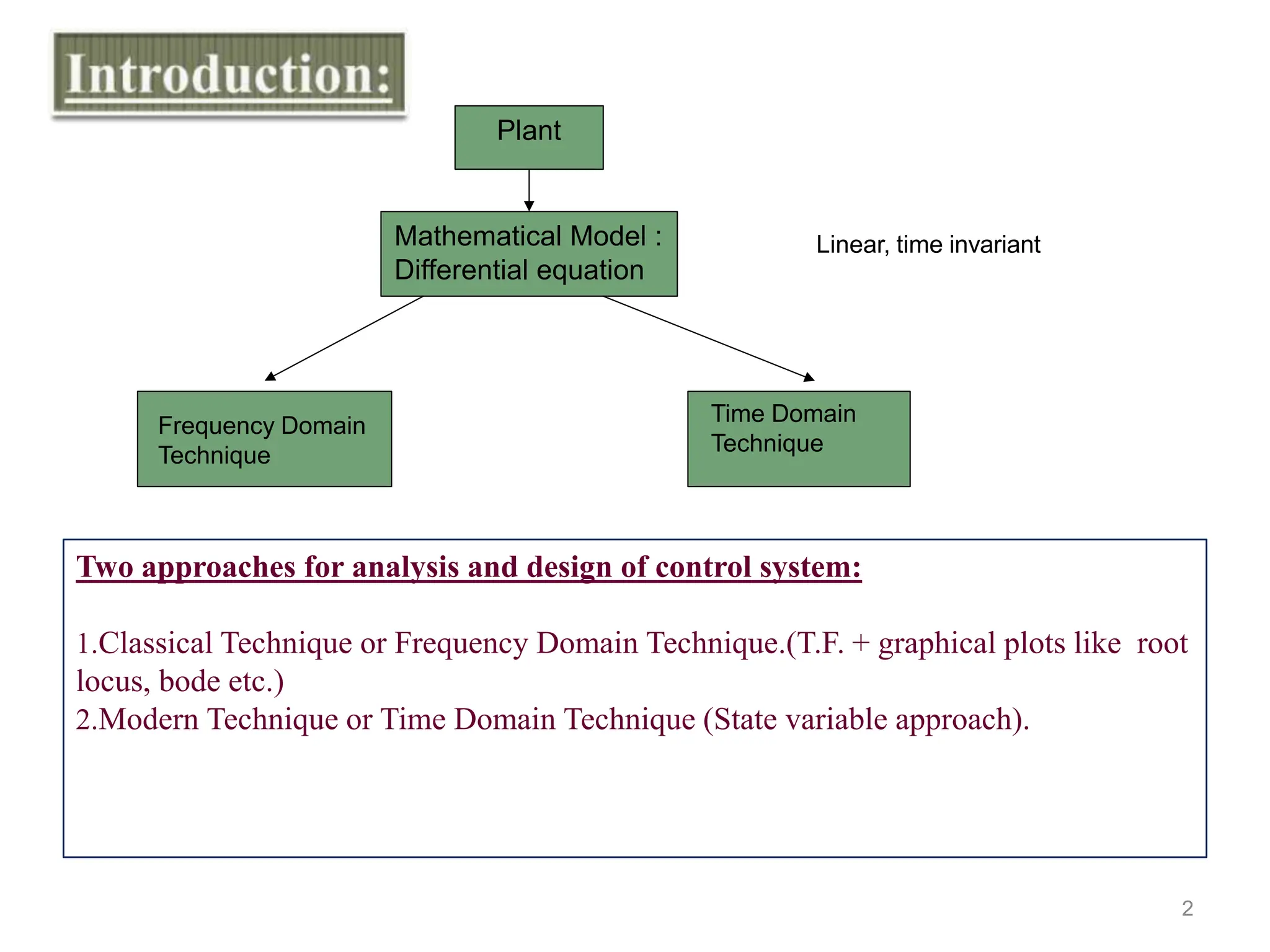
Plant
Mathematical Model :
Differential equation
Linear, time invariant
Frequency Domain
Technique
Time Domain
Technique
Two approaches for analysis and design of control system:
1.Classical Technique or Frequency Domain Technique.(T.F. + graphical plots like root
locus, bode etc.)
2.Modern Technique or Time Domain Technique (State variable approach).
2
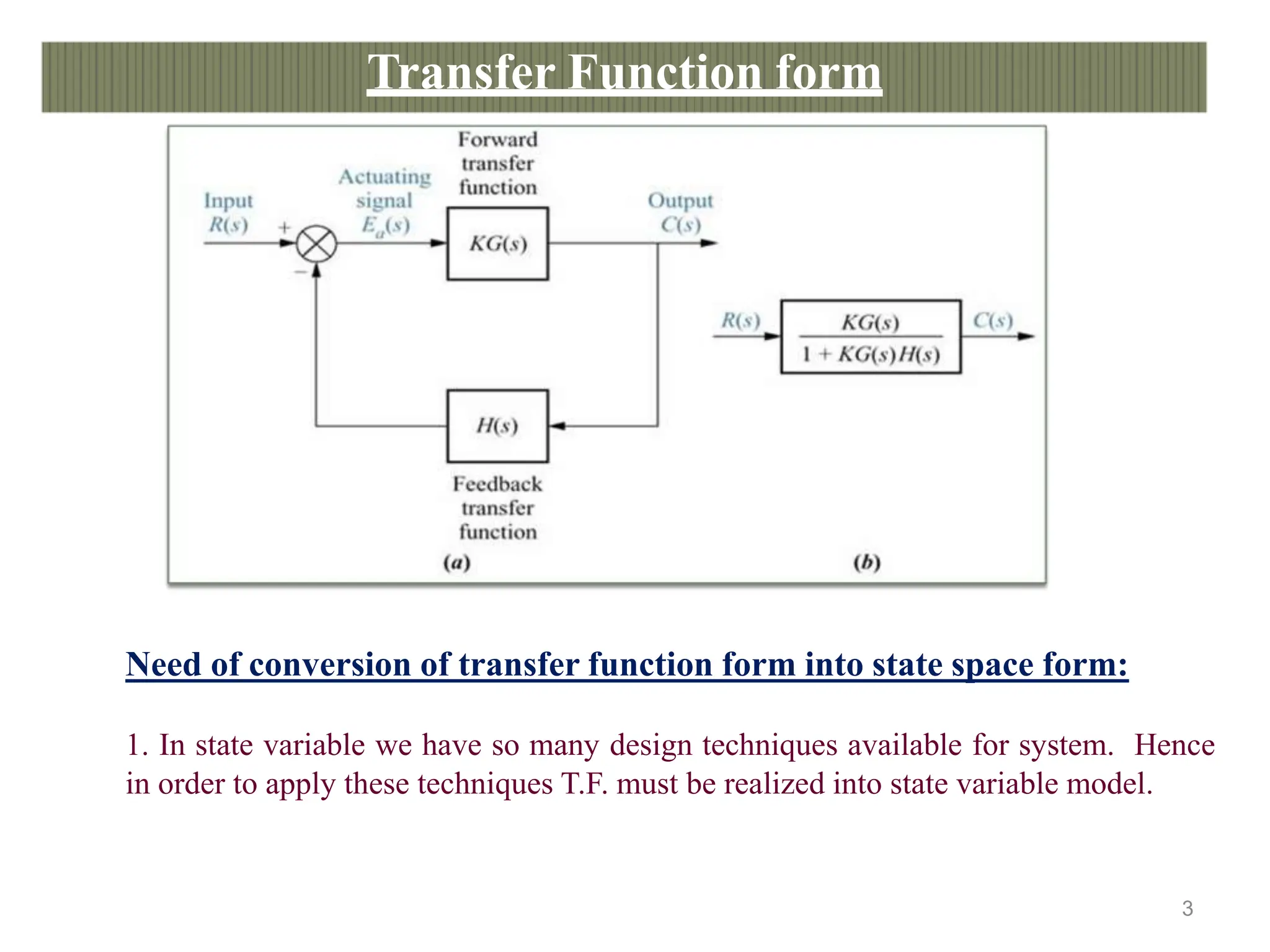
Transfer Function form
Need of conversion of transfer function form into state space form:
1. In state variable we have so many design techniques available for system. Hence
in order to apply these techniques T.F. must be realized into state variable model.
4
3
4
State-Space Modeling
• Uses matrices and vectors to represent the
system parameters and variables
• In control engineering, a state space
representation is a mathematical model of a
physical system as a set of input, output and state
variables related by first-order differential
equations.
5
Motivation for State-Space Modeling
Easier for computers to perform matrix
algebra
◦ e.g. MATLAB does all computations as matrix math
Handles multiple inputs and outputs
Provides more information about the system
◦ Provides knowledge of internal variables (states)
Primarily used in complicated, large-scale
systems
6
Definitions
• State: Is the smallest set of variables completely
determines the behavior of the system for any
time t.
• State Variables: Are the variables making up the
smallest set of variables.
7
State Space:
• The n-dimensional space whose coordinate
axes consist of the x1 axis, x2 axis, ….., xn axis,
where x1, x2,…… , xn are state variables, is
called a state space.
8
• State-Space Equations. In state-space analysis we
are concerned with three types of variables that
are involved in the modeling of dynamic systems:
input variables, output variables, and state
variables.
• The number of state variables to completely
define the dynamics of the system is equal to the
number of integrators involved in the system.
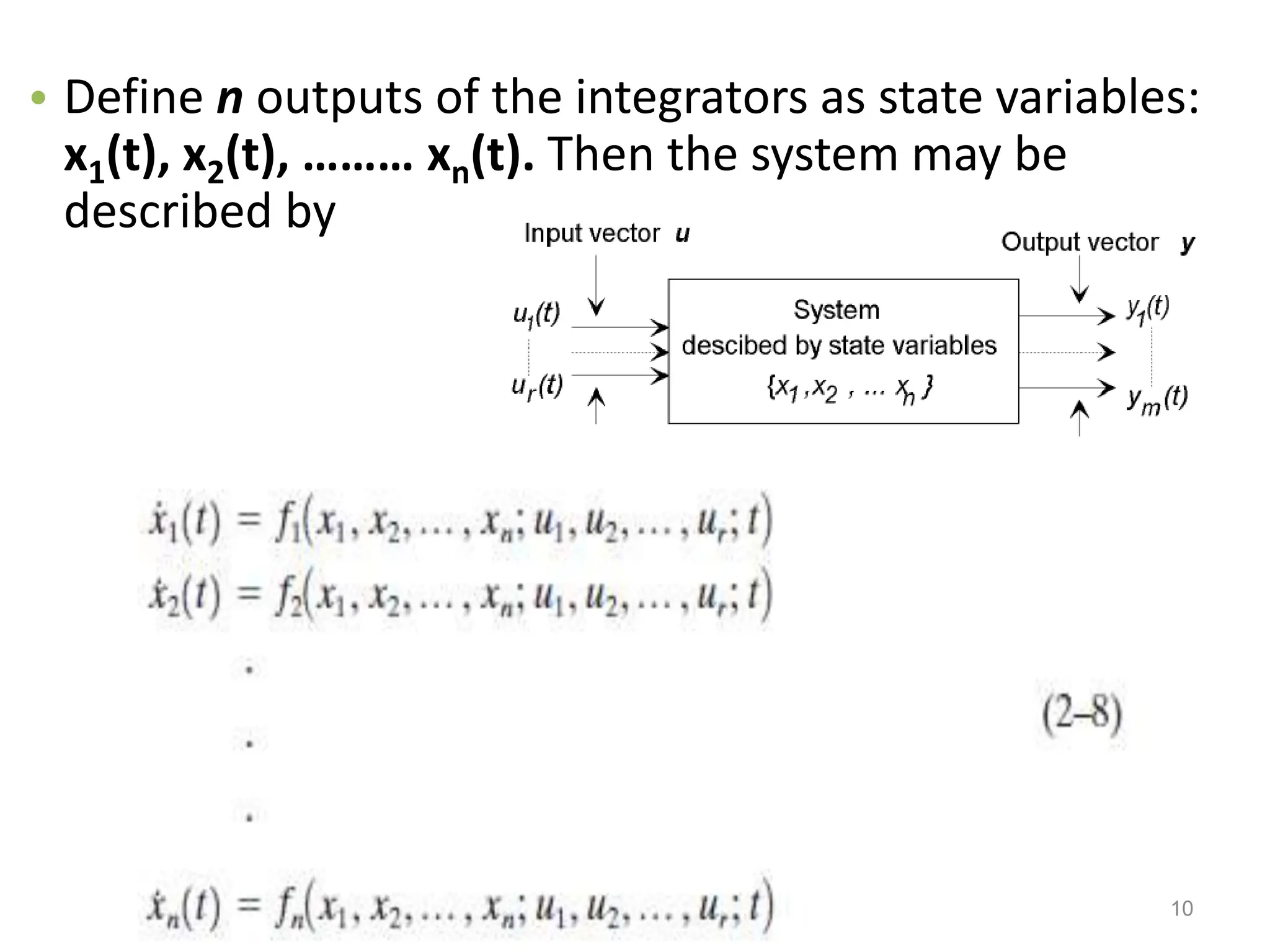
• Assume that a multiple-input, multiple-output
system involves n integrators. Assume also that
there are r inputs u1(t), u2(t),……. ur(t) and m
outputs y1(t), y2(t), …….. ym(t).
9
• Define n outputs of the integrators as state variables:
x1(t), x2(t), ……… xn(t). Then the system may be
described by
10
• The outputs y1(t), y2(t), ……… ym(t) of the
system may be given by
11
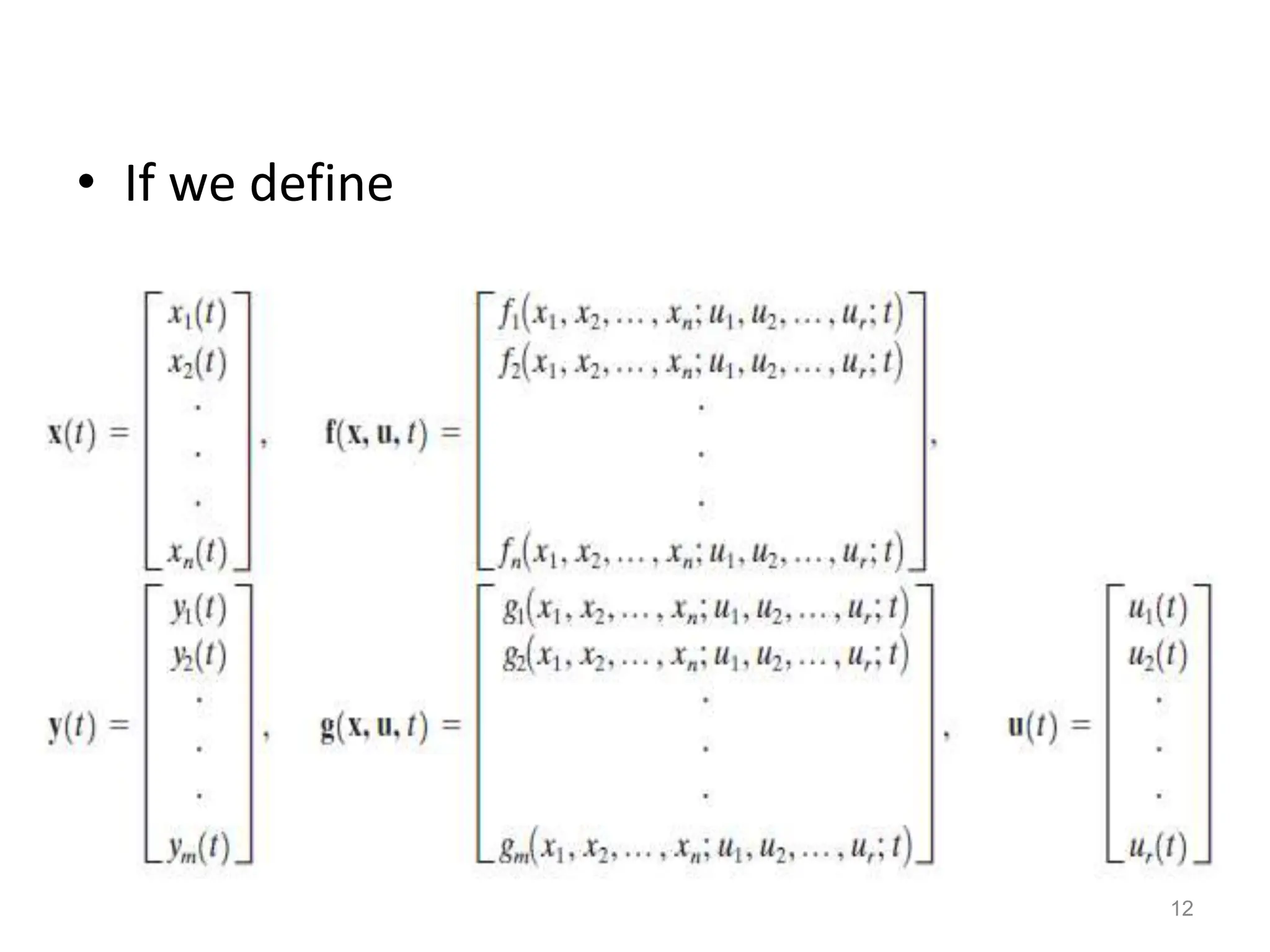
• If we define
12
• then Equations (2–8) and (2–9) become
• where Equation (2–10) is the state equation and
Equation (2–11) is the output equation. If vector
functions f and/or g involve time t explicitly, then the
system is called a time varying system.
13
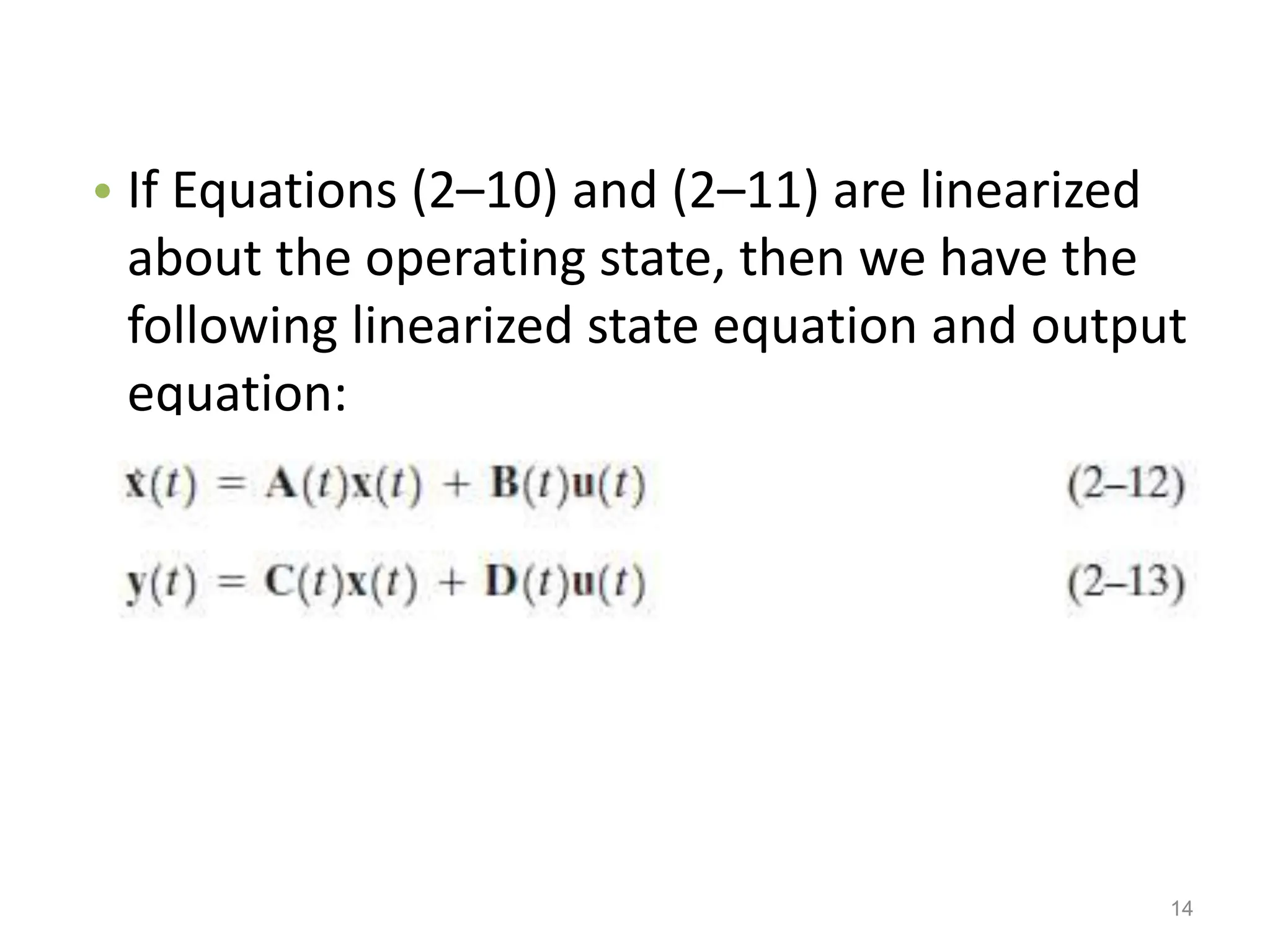
• If Equations (2–10) and (2–11) are linearized
about the operating state, then we have the
following linearized state equation and output
equation:
14
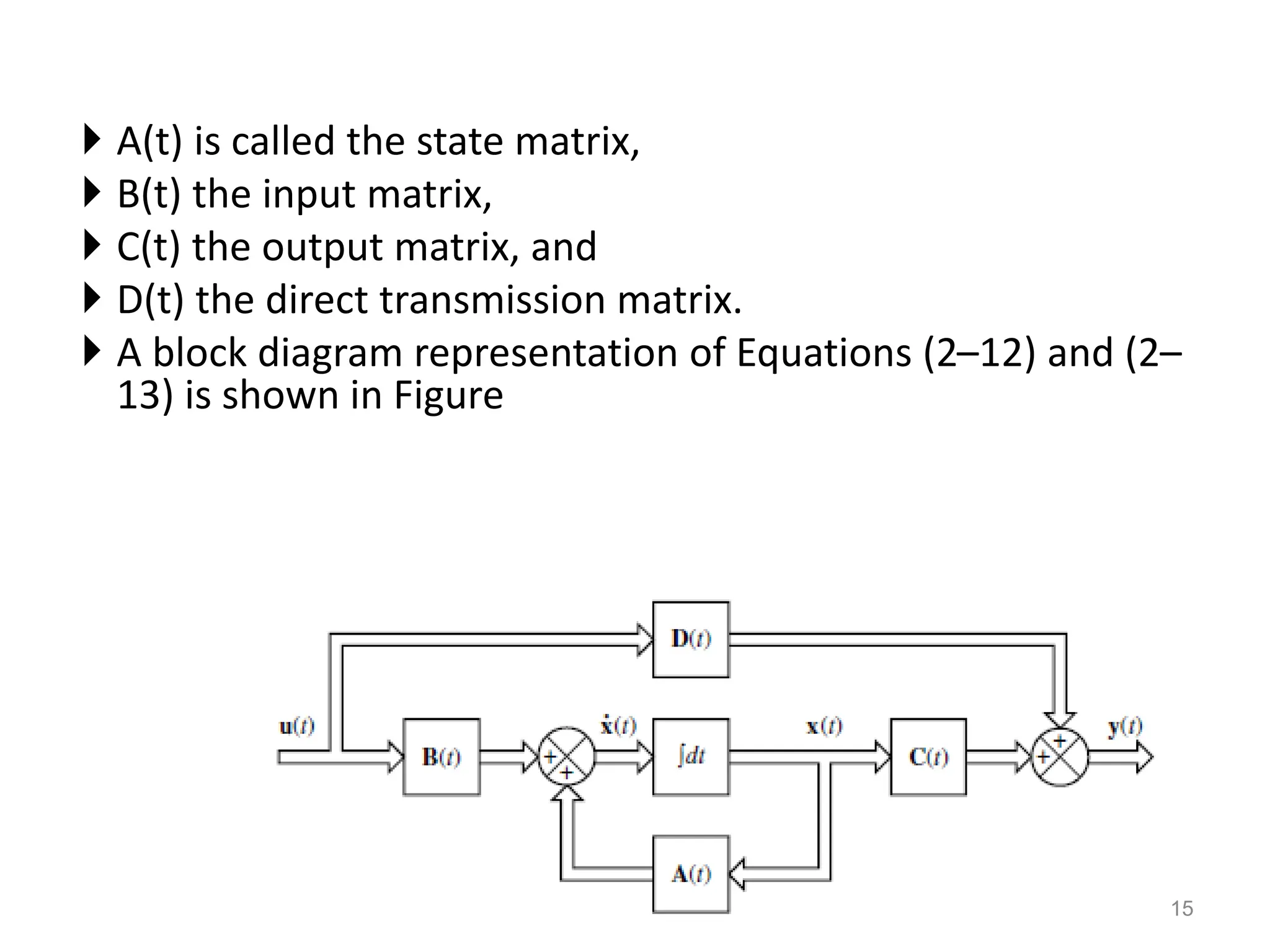
 A(t) is called the state matrix,
 B(t) the input matrix,
 C(t) the output matrix, and
 D(t) the direct transmission matrix.
 A block diagram representation of Equations (2–12) and (2–
13) is shown in Figure
15
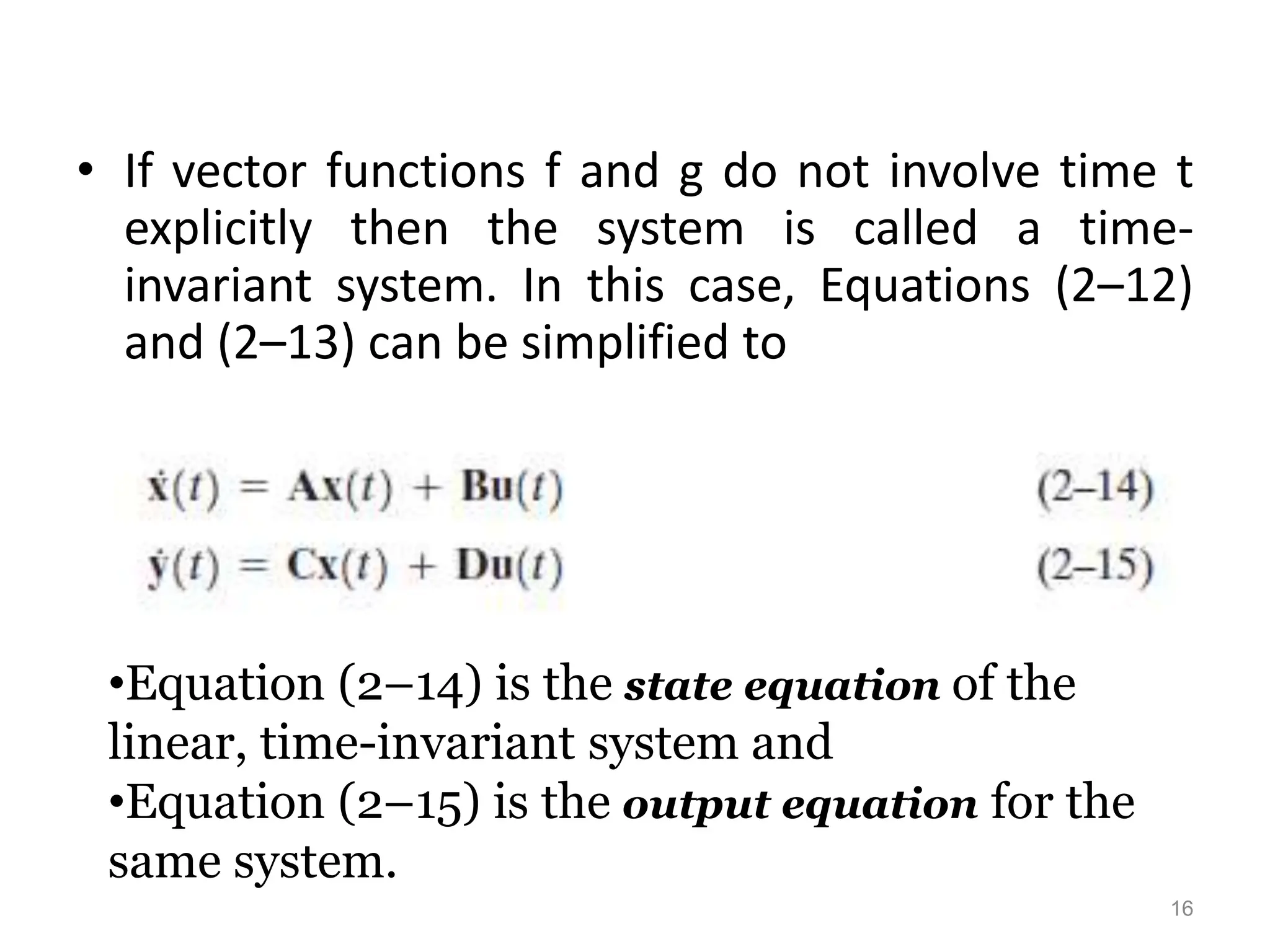
• If vector functions f and g do not involve time t
explicitly then the system is called a time-
invariant system. In this case, Equations (2–12)
and (2–13) can be simplified to
•Equation (2–14) is the state equation of the
linear, time-invariant system and
•Equation (2–15) is the output equation for the
same system.
16

UNIT-V-PPT state space of system model .ppt

  • 1.
  • 2.
    Plant Mathematical Model : Differentialequation Linear, time invariant Frequency Domain Technique Time Domain Technique Two approaches for analysis and design of control system: 1.Classical Technique or Frequency Domain Technique.(T.F. + graphical plots like root locus, bode etc.) 2.Modern Technique or Time Domain Technique (State variable approach). 2
  • 3.
    Transfer Function form Needof conversion of transfer function form into state space form: 1. In state variable we have so many design techniques available for system. Hence in order to apply these techniques T.F. must be realized into state variable model. 4 3
  • 4.
  • 5.
    State-Space Modeling • Usesmatrices and vectors to represent the system parameters and variables • In control engineering, a state space representation is a mathematical model of a physical system as a set of input, output and state variables related by first-order differential equations. 5
  • 6.
    Motivation for State-SpaceModeling Easier for computers to perform matrix algebra ◦ e.g. MATLAB does all computations as matrix math Handles multiple inputs and outputs Provides more information about the system ◦ Provides knowledge of internal variables (states) Primarily used in complicated, large-scale systems 6
  • 7.
    Definitions • State: Isthe smallest set of variables completely determines the behavior of the system for any time t. • State Variables: Are the variables making up the smallest set of variables. 7
  • 8.
    State Space: • Then-dimensional space whose coordinate axes consist of the x1 axis, x2 axis, ….., xn axis, where x1, x2,…… , xn are state variables, is called a state space. 8
  • 9.
    • State-Space Equations.In state-space analysis we are concerned with three types of variables that are involved in the modeling of dynamic systems: input variables, output variables, and state variables. • The number of state variables to completely define the dynamics of the system is equal to the number of integrators involved in the system. • Assume that a multiple-input, multiple-output system involves n integrators. Assume also that there are r inputs u1(t), u2(t),……. ur(t) and m outputs y1(t), y2(t), …….. ym(t). 9
  • 10.
    • Define noutputs of the integrators as state variables: x1(t), x2(t), ……… xn(t). Then the system may be described by 10
  • 11.
    • The outputsy1(t), y2(t), ……… ym(t) of the system may be given by 11
  • 12.
    • If wedefine 12
  • 13.
    • then Equations(2–8) and (2–9) become • where Equation (2–10) is the state equation and Equation (2–11) is the output equation. If vector functions f and/or g involve time t explicitly, then the system is called a time varying system. 13
  • 14.
    • If Equations(2–10) and (2–11) are linearized about the operating state, then we have the following linearized state equation and output equation: 14
  • 15.
     A(t) iscalled the state matrix,  B(t) the input matrix,  C(t) the output matrix, and  D(t) the direct transmission matrix.  A block diagram representation of Equations (2–12) and (2– 13) is shown in Figure 15
  • 16.
    • If vectorfunctions f and g do not involve time t explicitly then the system is called a time- invariant system. In this case, Equations (2–12) and (2–13) can be simplified to •Equation (2–14) is the state equation of the linear, time-invariant system and •Equation (2–15) is the output equation for the same system. 16