Final
Exam
Thursday, April 25,9am-noon
Surname A–G: Bahen (BA) 2159
Last names H–Z: Medical Sciences (MS) 2158
Covers all lectures, tutorials, homeworks, and
programming assignments
1/3 from the first half, 2/3 from the second
half Lectures 10, 11, 19, 22 not tested
If there’s a question on Lecture 21, it will be
easy
Emphasis on concepts covered in multiple of
the above
Similar in format and difficulty to the midterm, but about 2x
longer Practice exams are posted
Roger Grosse and Jimmy CSC421/2516 Lecture 21: Q- 2 /
3.
Overview
Second of 3lectures on reinforcement
learning Last time: policy gradient (e.g.
REINFORCE)
Optimize a policy directly, don’t represent anything
about the environment
Today: Q-learning
Learn an action-value function that predicts future
returns
Next time: AlphaGo uses both a policy network and a
value network
Roger Grosse and Jimmy CSC421/2516 Lecture 21: Q- 3 /
4.
Overview
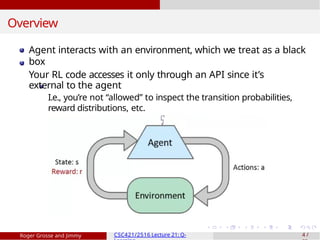
Agent interacts withan environment, which we treat as a black
box
Your RL code accesses it only through an API since it’s
external to the agent
I.e., you’re not “allowed” to inspect the transition probabilities,
reward distributions, etc.
Roger Grosse and Jimmy CSC421/2516 Lecture 21: Q- 4 /
5.
Recap: Markov Decision
Processes
Theenvironment is represented as a Markov decision process
(MDP)
M.
Markov assumption: all relevant information is encapsulated
in the current state
Components of an MDP:
initial state distribution p(s0)
transition distribution p(st+1 | st ,
at ) reward function r (st, at )
policy πθ (at | st ) parameterized by
θ
Assume a fully observable
environment, i.e. st can be
Roger Grosse and Jimmy CSC421/2516 Lecture 21: Q- 5 /
6.
Finite and InfiniteHorizon
Last time: finite horizon MDPs
Fixed number of steps T per episode
Maximize expected return R = Ep(τ )[r
(τ )]
Now: more convenient to assume
infinite horizon
We can’t sum infinitely many rewards,
so we need to discount them:
$100 a year from now is worth less than $100
today Discounted return
Gt = rt + γrt+1 + γ2
rt+2 + · · ·
Want to choose an action to maximize expected discounted
return The parameter γ < 1 is called the discount factor
small γ = myopic
large γ =
Roger Grosse and Jimmy CSC421/2516 Lecture 21: Q- 6 /
7.
Value Function
Value functionV π (s) of a state s under policy π: the
expected discounted return if we start in s and follow π
V π
(s) = E[Gt | st = s]
∞
Σ
= E γi
rt+i | st = s
i =0
"
#
Computing the value function is generally impractical, but we
can try to approximate (learn) it
The benefit is credit assignment: see directly how an action
affects future returns rather than wait for rollouts
Roger Grosse and Jimmy CSC421/2516 Lecture 21: Q- 7 /
8.
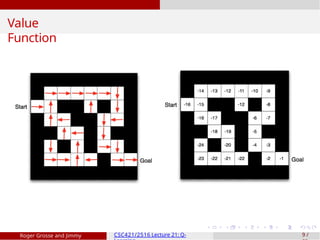
Value Function
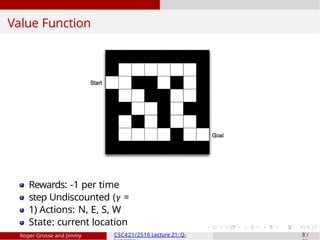
Rewards: -1per time
step Undiscounted (γ =
1) Actions: N, E, S, W
State: current location
Roger Grosse and Jimmy CSC421/2516 Lecture 21: Q- 8 /
Action-Value
Function
Can we usea value function to choose
actions?
a
arg max r (st, a) + γEp(s
t+1 t t
| s ,a )[V π
(st+1)]
Roger Grosse and Jimmy CSC421/2516 Lecture 21: Q- 10 /
11.
Action-Value
Function
Can we usea value function to choose
actions?
a
arg max r (st, a) + γEp(s
t+1 t t
| s ,a )[V π
(st+1)]
Problem: this requires taking the expectation with respect
to the environment’s dynamics, which we don’t have direct
access to!
Instead learn an action-value function, or Q-function:
expected returns if you take action a and then follow
your policy
Qπ
(s, a) = E[Gt | st = s, at = a]
Relationshi
p:
Σ
π π
V (s) = π(a | s)Q (s,
a) a
Optimal action:
arg max Qπ
(s,
a)
a
Roger Grosse and Jimmy CSC421/2516 Lecture 21: Q- 10 /
12.
Bellman
Equation
The Bellman Equationis a recursive formula for the action-
value function:
Qπ
(s, a) = r (s, a) + γEp(s′ | s,a) π(a′ | s′)[Qπ
(sr
, ar
)]
There are various Bellman equations, and most RL
algorithms are based on repeatedly applying one of them.
Roger Grosse and Jimmy CSC421/2516 Lecture 21: Q- 11 /
13.
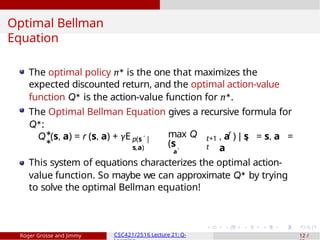
Optimal Bellman
Equation
Q (s,a) = r (s, a) + γE ′
p(s |
s,a)
∗
∗
max Q
(s
a′
r
t+1 t
t
, a ) | s = s, a =
a
The optimal policy π∗ is the one that maximizes the
expected discounted return, and the optimal action-value
function Q∗ is the action-value function for π∗.
The Optimal Bellman Equation gives a recursive formula for
Q∗:
This system of equations characterizes the optimal action-
value function. So maybe we can approximate Q∗ by trying
to solve the optimal Bellman equation!
Roger Grosse and Jimmy CSC421/2516 Lecture 21: Q- 12 /
14.
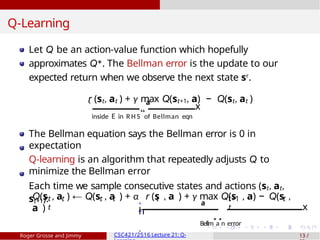
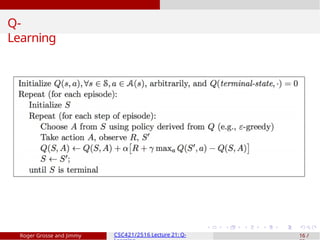
Q-Learning
a
` ˛¸ x
LetQ be an action-value function which hopefully
approximates Q∗. The Bellman error is the update to our
expected return when we observe the next state sr.
r (st, at ) + γ max Q(st+1, a) − Q(st, at )
t t t t t
t
a
t+1 t
t
Q(s , a ) ← Q(s , a ) + α r (s , a ) + γ max Q(s , a) − Q(s ,
a )
inside E in R H S of Bellman eqn
The Bellman equation says the Bellman error is 0 in
expectation
Q-learning is an algorithm that repeatedly adjusts Q to
minimize the Bellman error
Each time we sample consecutive states and actions (st, at,
st+1):
h
i
` x
Bellm
˛
a
¸
n error
Roger Grosse and Jimmy CSC421/2516 Lecture 21: Q- 13 /
15.
Exploration-Exploitation
Tradeoff
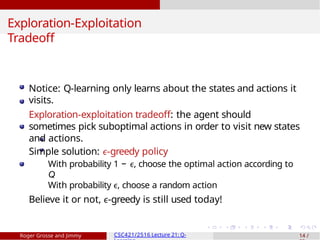
Notice: Q-learning onlylearns about the states and actions it
visits.
Exploration-exploitation tradeoff: the agent should
sometimes pick suboptimal actions in order to visit new states
and actions.
Simple solution: ϵ-greedy policy
With probability 1 − ϵ, choose the optimal action according to
Q
With probability ϵ, choose a random action
Believe it or not, ϵ-greedy is still used today!
Roger Grosse and Jimmy CSC421/2516 Lecture 21: Q- 14 /
16.
Exploration-Exploitation
Tradeoff
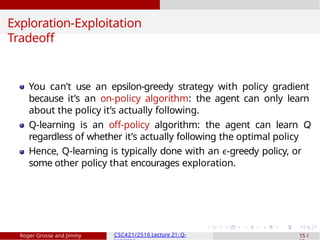
You can’t usean epsilon-greedy strategy with policy gradient
because it’s an on-policy algorithm: the agent can only learn
about the policy it’s actually following.
Q-learning is an off-policy algorithm: the agent can learn Q
regardless of whether it’s actually following the optimal policy
Hence, Q-learning is typically done with an ϵ-greedy policy, or
some other policy that encourages exploration.
Roger Grosse and Jimmy CSC421/2516 Lecture 21: Q- 15 /
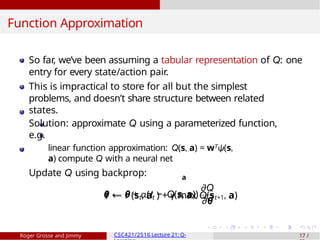
Function Approximation
a
So far,we’ve been assuming a tabular representation of Q: one
entry for every state/action pair.
This is impractical to store for all but the simplest
problems, and doesn’t share structure between related
states.
Solution: approximate Q using a parameterized function,
e.g.
linear function approximation: Q(s, a) = wTψ(s,
a) compute Q with a neural net
Update Q using backprop:
t ← r (st, at ) + γ max Q(st+1, a)
θ ← θ + α(t − Q(s, a))
∂Q
∂θ
Roger Grosse and Jimmy CSC421/2516 Lecture 21: Q- 17 /
19.
Function Approximation
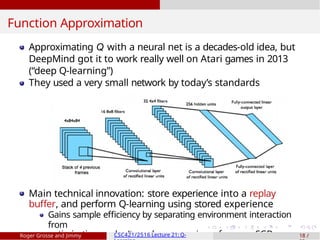
Approximating Qwith a neural net is a decades-old idea, but
DeepMind got it to work really well on Atari games in 2013
(“deep Q-learning”)
They used a very small network by today’s standards
Main technical innovation: store experience into a replay
buffer, and perform Q-learning using stored experience
Gains sample efficiency by separating environment interaction
from
optimization — don’t need new experience for every SGD up
Roger Grosse and Jimmy CSC421/2516 Lecture 21: Q- 18 /
20.
Atari
Mnih et al.,Nature 2015. Human-level control through
deep reinforcement learning
Network was given raw pixels as
observations Same architecture shared
between all games
Assume fully observable environment,
even though that’s not the case
After about a day of training on a particular game, often
beat “human-level” performance (number of points within 5
minutes of play)
Did very well on reactive games, poorly on ones that require
planning (e.g. Montezuma’s Revenge)
https://www.youtube.com/watch?v=V1eYniJ0Rnk
https://www.youtube.com/watch?v=4MlZncshy1Q
Roger Grosse and Jimmy CSC421/2516 Lecture 21: Q- 19 /
21.
Wireheading
If rats havea lever that causes an electrode to stimulate
certain “reward centers” in their brain, they’ll keep pressing
the lever at the expense of sleep, food, etc.
RL algorithms show this “wireheading” behavior if the
reward function isn’t designed carefully
https://blog.openai.com/faulty-reward-functions/
Roger Grosse and Jimmy CSC421/2516 Lecture 21: Q- 20 /
22.
Policy Gradient vs.Q-Learning
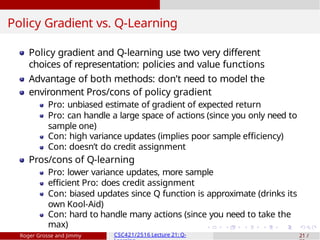
Policy gradient and Q-learning use two very different
choices of representation: policies and value functions
Advantage of both methods: don’t need to model the
environment Pros/cons of policy gradient
Pro: unbiased estimate of gradient of expected return
Pro: can handle a large space of actions (since you only need to
sample one)
Con: high variance updates (implies poor sample efficiency)
Con: doesn’t do credit assignment
Pros/cons of Q-learning
Pro: lower variance updates, more sample
efficient Pro: does credit assignment
Con: biased updates since Q function is approximate (drinks its
own Kool-Aid)
Con: hard to handle many actions (since you need to take the
max)
Roger Grosse and Jimmy CSC421/2516 Lecture 21: Q- 21 /
23.
Actor-Critic
(optional)
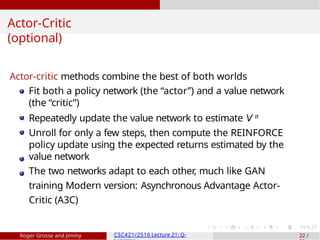
Actor-critic methods combinethe best of both worlds
Fit both a policy network (the “actor”) and a value network
(the “critic”)
Repeatedly update the value network to estimate V π
Unroll for only a few steps, then compute the REINFORCE
policy update using the expected returns estimated by the
value network
The two networks adapt to each other, much like GAN
training Modern version: Asynchronous Advantage Actor-
Critic (A3C)
Roger Grosse and Jimmy CSC421/2516 Lecture 21: Q- 22 /


![Finite and Infinite Horizon
Last time: finite horizon MDPs
Fixed number of steps T per episode
Maximize expected return R = Ep(τ )[r
(τ )]
Now: more convenient to assume
infinite horizon
We can’t sum infinitely many rewards,
so we need to discount them:
$100 a year from now is worth less than $100
today Discounted return
Gt = rt + γrt+1 + γ2
rt+2 + · · ·
Want to choose an action to maximize expected discounted
return The parameter γ < 1 is called the discount factor
small γ = myopic
large γ =
Roger Grosse and Jimmy CSC421/2516 Lecture 21: Q- 6 /](https://image.slidesharecdn.com/lec21-250719073323-51e34e76/85/Lecture-21-ppt-Q-learning-6-320.jpg)
![Value Function
Value function V π (s) of a state s under policy π: the
expected discounted return if we start in s and follow π
V π
(s) = E[Gt | st = s]
∞
Σ
= E γi
rt+i | st = s
i =0
"
#
Computing the value function is generally impractical, but we
can try to approximate (learn) it
The benefit is credit assignment: see directly how an action
affects future returns rather than wait for rollouts
Roger Grosse and Jimmy CSC421/2516 Lecture 21: Q- 7 /](https://image.slidesharecdn.com/lec21-250719073323-51e34e76/85/Lecture-21-ppt-Q-learning-7-320.jpg)
![Action-Value
Function
Can we use a value function to choose
actions?
a
arg max r (st, a) + γEp(s
t+1 t t
| s ,a )[V π
(st+1)]
Roger Grosse and Jimmy CSC421/2516 Lecture 21: Q- 10 /](https://image.slidesharecdn.com/lec21-250719073323-51e34e76/85/Lecture-21-ppt-Q-learning-10-320.jpg)
![Action-Value
Function
Can we use a value function to choose
actions?
a
arg max r (st, a) + γEp(s
t+1 t t
| s ,a )[V π
(st+1)]
Problem: this requires taking the expectation with respect
to the environment’s dynamics, which we don’t have direct
access to!
Instead learn an action-value function, or Q-function:
expected returns if you take action a and then follow
your policy
Qπ
(s, a) = E[Gt | st = s, at = a]
Relationshi
p:
Σ
π π
V (s) = π(a | s)Q (s,
a) a
Optimal action:
arg max Qπ
(s,
a)
a
Roger Grosse and Jimmy CSC421/2516 Lecture 21: Q- 10 /](https://image.slidesharecdn.com/lec21-250719073323-51e34e76/85/Lecture-21-ppt-Q-learning-11-320.jpg)
![Bellman
Equation
The Bellman Equation is a recursive formula for the action-
value function:
Qπ
(s, a) = r (s, a) + γEp(s′ | s,a) π(a′ | s′)[Qπ
(sr
, ar
)]
There are various Bellman equations, and most RL
algorithms are based on repeatedly applying one of them.
Roger Grosse and Jimmy CSC421/2516 Lecture 21: Q- 11 /](https://image.slidesharecdn.com/lec21-250719073323-51e34e76/85/Lecture-21-ppt-Q-learning-12-320.jpg)