ICE401: PROCESS INSTRUMENTATION
AND CONTROL
Process Instrumentation and Control (ICE 401)
Dr. S.Meenatchisundaram, MIT, Manipal,Aug – Nov 2015
Class 7: Mathematical Modeling of
Liquid-Level Systems
Dr. S. Meenatchisundaram
Email: meenasundar@gmail.com
Liquid-Level Systems:
Fluid-Flow Basics:
• In analysing systems involving fluid flow, it is necessary to
divide flow regimes into laminar flow and turbulent flow,
according to the magnitude of the Reynolds number.
• If the Reynolds number is greater than about 3000 to 4000,
then the flow is turbulent.
• The flow is laminar if the Reynolds number is less than about
2000.
• In the laminar case, fluid flow occurs in streamlines with no
turbulence.
• Systems involving laminar flow may be represented by linear
differential equations.
Process Instrumentation and Control (ICE 401)
Dr. S.Meenatchisundaram, MIT, Manipal,Aug – Nov 2015
Liquid-Level Systems:
• Industrial processes often involve flow of liquids through
connecting pipes and tanks.
• The flow in such processes is often turbulent and not laminar.
• Systems involving turbulent flow often have to be represented
by nonlinear differential equations.
• If the region of operation is limited, however, such nonlinear
differential equations can be linearized.
• We shall discuss such linearized mathematical models of liquid-
level systems in this section.
• Note that the introduction of concepts of resistance and
capacitance for such liquid-level systems enables us to describe
their dynamic characteristics in simple forms.
Process Instrumentation and Control (ICE 401)
Dr. S.Meenatchisundaram, MIT, Manipal,Aug – Nov 2015
Liquid-Level Systems:
Hydraulic Resistance:
• Figure shows liquid flow in a pipe, with a restricting device
(a valve) providing a hydraulic resistance (Rh) to the flow.
• Note that the walls of the pipe will also provide a small
amount of resistance to flow, depending on how rough they
are.
Process Instrumentation and Control (ICE 401)
Dr. S.Meenatchisundaram, MIT, Manipal,Aug – Nov 2015
Liquid-Level Systems:
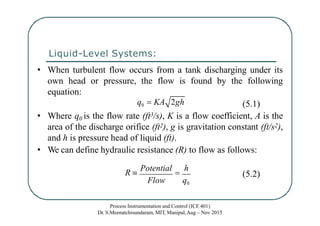
• When turbulent flow occurs from a tank discharging under its
own head or pressure, the flow is found by the following
equation:
(5.1)
• Where q0 is the flow rate (ft3/s), K is a flow coefficient, A is the
area of the discharge orifice (ft2), g is gravitation constant (ft/s2),
and h is pressure head of liquid (ft).
• We can define hydraulic resistance (R) to flow as follows:
(5.2)
q0  KA 2gh
R 
Potential

h
Flow q0
Process Instrumentation and Control (ICE 401)
Dr. S.Meenatchisundaram, MIT, Manipal,Aug – Nov 2015
Liquid-Level Systems:
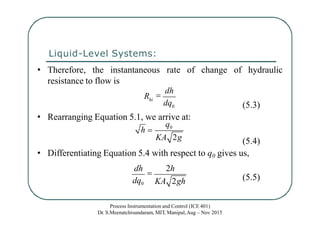
• Therefore, the instantaneous rate of change of hydraulic
resistance to flow is
(5.3)
• Rearranging Equation 5.1, we arrive at:
(5.4)
(5.5)
0
hi
R
dq

dh
q0
KA 2g
h 
dq0
Process Instrumentation and Control (ICE 401)
Dr. S.Meenatchisundaram, MIT, Manipal,Aug – Nov 2015
KA 2gh
• Differentiating Equation 5.4 with respect to q0 gives us,
dh

2h
Liquid-Level Systems:
(5.6)
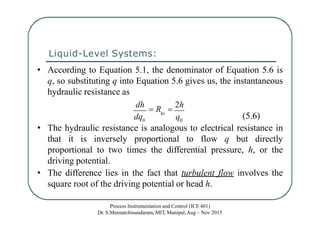
• The hydraulic resistance is analogous to electrical resistance in
that it is inversely proportional to flow q but directly
proportional to two times the differential pressure, h, or the
driving potential.
• The difference lies in the fact that turbulent flow involves the
square root of the driving potential or head h.
0 0
Process Instrumentation and Control (ICE 401)
Dr. S.Meenatchisundaram, MIT, Manipal,Aug – Nov 2015
hi
dq q
• According to Equation 5.1, the denominator of Equation 5.6 is
q, so substituting q into Equation 5.6 gives us, the instantaneous
hydraulic resistance as
dh
 R 
2h
Liquid-Level Systems:
Hydraulic Capacitance:
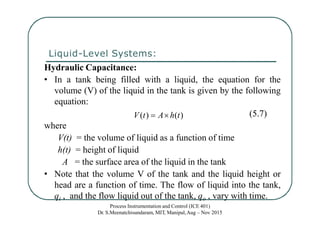
• In a tank being filled with a liquid, the equation for the
volume (V) of the liquid in the tank is given by the following
equation:
Process Instrumentation and Control (ICE 401)
Dr. S.Meenatchisundaram, MIT, Manipal,Aug – Nov 2015
(5.7)
where
V(t) = the volume of liquid as a function of time
h(t) = height of liquid
A = the surface area of the liquid in the tank
• Note that the volume V of the tank and the liquid height or
head are a function of time. The flow of liquid into the tank,
qi , and the flow liquid out of the tank, qo , vary with time.
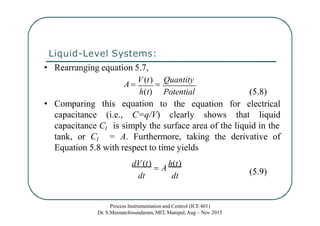
V(t)  Ah(t)
Liquid-Level Systems:
(5.8)
to the equation for electrical
• Comparing this
capacitance (i.e., C=q/V) clearly shows that liquid
capacitance Cl
tank, or Cl
is simply the surface area of the liquid in the
= A. Furthermore, taking the derivative of
Equation 5.8 with respect to time yields
(5.9)
h(t) Potential
equation
Process Instrumentation and Control (ICE 401)
Dr. S.Meenatchisundaram, MIT, Manipal,Aug – Nov 2015
• Rearranging equation 5.7,
A 
V(t)

Quantity
dV(t)
 A
h(t)
dt dt
Liquid-Level Systems:
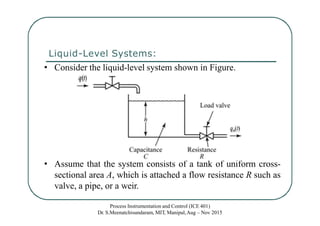
• Consider the liquid-level system shown in Figure.
• Assume that the system consists of a tank of uniform cross-
sectional area A, which is attached a flow resistance R such as
valve, a pipe, or a weir.
Process Instrumentation and Control (ICE 401)
Dr. S.Meenatchisundaram, MIT, Manipal,Aug – Nov 2015
Liquid-Level Systems:
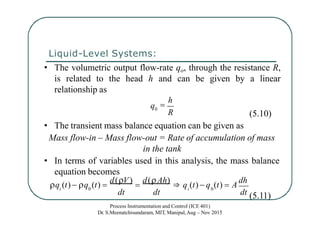
• The volumetric output flow-rate qo, through the resistance R,
is related to the head h and can be given by a linear
relationship as
(5.10)
• The transient mass balance equation can be given as
Mass flow-in – Mass flow-out = Rate of accumulation of mass
in the tank
• In terms of variables used in this analysis, the mass balance
equation becomes
(5.11)
0
q
R

h
i 0
Process Instrumentation and Control (ICE 401)
Dr. S.Meenatchisundaram, MIT, Manipal,Aug – Nov 2015
i 0
dt dt dt
q (t)  q (t) 
d(V)

d(Ah)
⇒ q (t)  q (t)  A
dh
Liquid-Level Systems:
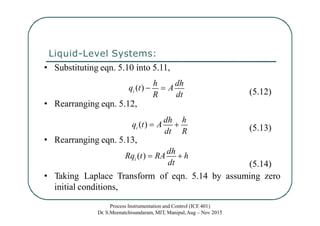
• Substituting eqn. 5.10 into 5.11,
(5.12)
• Rearranging eqn. 5.12,
(5.13)
• Rearranging eqn. 5.13,
(5.14)
• Taking Laplace Transform of eqn. 5.14 by assuming zero
initial conditions,
i
R dt
q (t) 
h
 A
dh
i
dt R
q (t)  A
dh

h
i
Process Instrumentation and Control (ICE 401)
Dr. S.Meenatchisundaram, MIT, Manipal,Aug – Nov 2015
dt
Rq (t)  RA
dh
 h
Liquid-Level Systems:
RAs 1H(s)  RQi (s)
Qi (s) RAs 1
Qi (s)
Process Instrumentation and Control (ICE 401)
Dr. S.Meenatchisundaram, MIT, Manipal,Aug – Nov 2015
RAs 1 0
R
Q (s) 
H(s)
(5.15)
• where,
H(s) = L[h(t)] and Qi(s) = L[qi(t)]
• Rearranging eqn. 5.15,
H (s)

R
(5.16)
• If however, q0 is taken as the output, the input being the
same, then the transfer function is
Q0 (s)

1
(5.17)
Liquid-Level Systems:
• To obtain the differential equation in terms of variable qo,
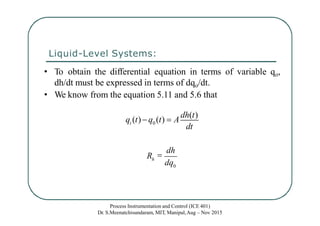
dh/dt must be expressed in terms of dqo/dt.
• We know from the equation 5.11 and 5.6 that
i 0
dt
q (t) q (t)  A
dh(t)
0
Process Instrumentation and Control (ICE 401)
Dr. S.Meenatchisundaram, MIT, Manipal,Aug – Nov 2015
h
R
dq

dh
Liquid-Level Systems:
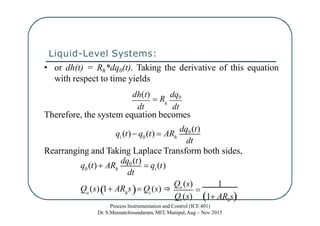
Therefore, the system equation becomes
Rearranging and Taking Laplace Transform both sides,
h
dt dt
• or dh(t) = Rh*dq0(t). Taking the derivative of this equation
with respect to time yields
dh(t)
 R
dq0
i 0 h
dt
q (t)  q (t)  AR
dq0 (t)
 
0 h
Process Instrumentation and Control (ICE 401)
Dr. S.Meenatchisundaram, MIT, Manipal,Aug – Nov 2015
i
o
o h i
i h
dt
Q (s) 1
Q (s)
q (t)  AR
dq0 (t)
 q (t)
Q (s) 1 AR s  Q (s) ⇒ 
1 AR s
Liquid-Level Systems:
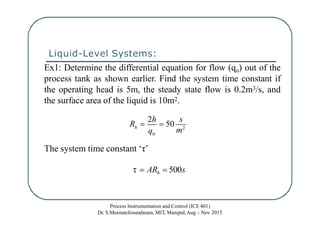
Ex1: Determine the differential equation for flow (qo) out of the
process tank as shown earlier. Find the system time constant if
the operating head is 5m, the steady state flow is 0.2m3/s, and
the surface area of the liquid is 10m2.
The system time constant ‘τ’
  ARh  500s
0
Process Instrumentation and Control (ICE 401)
Dr. S.Meenatchisundaram, MIT, Manipal,Aug – Nov 2015
h
q m2
R 
2h
 50
s
Liquid-Level Systems:
Assignment 1.3: A tank having a time constant of 1 min and a
resistance of (1/9) ft/cfm is operating at steady state with an
inlet flow of 10ft3/min. At time t=0, the flow is suddenly
increased to 100ft3/min for 0.1 min by adding an additional 9 ft3
of water to the tank uniformly over a period of 0.1 min. Plot the
response in tank level and compare with the impulse response.
Process Instrumentation and Control (ICE 401)
Dr. S.Meenatchisundaram, MIT, Manipal,Aug – Nov 2015
References:
Process Instrumentation and Control (ICE 401)
Dr. S.Meenatchisundaram, MIT, Manipal,Aug – Nov 2015
• Modern Control Engineering, 5th Edition, by Katsuhiko Ogata
• Measurement and Control Basics, 3rd Edition, by Thomas A.
Hughes.
• Process Control: Concepts Dynamics And Applications by Shio
Kumar Singh

mathematical modeling of liquid-level systems

  • 1.
    ICE401: PROCESS INSTRUMENTATION ANDCONTROL Process Instrumentation and Control (ICE 401) Dr. S.Meenatchisundaram, MIT, Manipal,Aug – Nov 2015 Class 7: Mathematical Modeling of Liquid-Level Systems Dr. S. Meenatchisundaram Email: meenasundar@gmail.com
  • 2.
    Liquid-Level Systems: Fluid-Flow Basics: •In analysing systems involving fluid flow, it is necessary to divide flow regimes into laminar flow and turbulent flow, according to the magnitude of the Reynolds number. • If the Reynolds number is greater than about 3000 to 4000, then the flow is turbulent. • The flow is laminar if the Reynolds number is less than about 2000. • In the laminar case, fluid flow occurs in streamlines with no turbulence. • Systems involving laminar flow may be represented by linear differential equations. Process Instrumentation and Control (ICE 401) Dr. S.Meenatchisundaram, MIT, Manipal,Aug – Nov 2015
  • 3.
    Liquid-Level Systems: • Industrialprocesses often involve flow of liquids through connecting pipes and tanks. • The flow in such processes is often turbulent and not laminar. • Systems involving turbulent flow often have to be represented by nonlinear differential equations. • If the region of operation is limited, however, such nonlinear differential equations can be linearized. • We shall discuss such linearized mathematical models of liquid- level systems in this section. • Note that the introduction of concepts of resistance and capacitance for such liquid-level systems enables us to describe their dynamic characteristics in simple forms. Process Instrumentation and Control (ICE 401) Dr. S.Meenatchisundaram, MIT, Manipal,Aug – Nov 2015
  • 4.
    Liquid-Level Systems: Hydraulic Resistance: •Figure shows liquid flow in a pipe, with a restricting device (a valve) providing a hydraulic resistance (Rh) to the flow. • Note that the walls of the pipe will also provide a small amount of resistance to flow, depending on how rough they are. Process Instrumentation and Control (ICE 401) Dr. S.Meenatchisundaram, MIT, Manipal,Aug – Nov 2015
  • 5.
    Liquid-Level Systems: • Whenturbulent flow occurs from a tank discharging under its own head or pressure, the flow is found by the following equation: (5.1) • Where q0 is the flow rate (ft3/s), K is a flow coefficient, A is the area of the discharge orifice (ft2), g is gravitation constant (ft/s2), and h is pressure head of liquid (ft). • We can define hydraulic resistance (R) to flow as follows: (5.2) q0  KA 2gh R  Potential  h Flow q0 Process Instrumentation and Control (ICE 401) Dr. S.Meenatchisundaram, MIT, Manipal,Aug – Nov 2015
  • 6.
    Liquid-Level Systems: • Therefore,the instantaneous rate of change of hydraulic resistance to flow is (5.3) • Rearranging Equation 5.1, we arrive at: (5.4) (5.5) 0 hi R dq  dh q0 KA 2g h  dq0 Process Instrumentation and Control (ICE 401) Dr. S.Meenatchisundaram, MIT, Manipal,Aug – Nov 2015 KA 2gh • Differentiating Equation 5.4 with respect to q0 gives us, dh  2h
  • 7.
    Liquid-Level Systems: (5.6) • Thehydraulic resistance is analogous to electrical resistance in that it is inversely proportional to flow q but directly proportional to two times the differential pressure, h, or the driving potential. • The difference lies in the fact that turbulent flow involves the square root of the driving potential or head h. 0 0 Process Instrumentation and Control (ICE 401) Dr. S.Meenatchisundaram, MIT, Manipal,Aug – Nov 2015 hi dq q • According to Equation 5.1, the denominator of Equation 5.6 is q, so substituting q into Equation 5.6 gives us, the instantaneous hydraulic resistance as dh  R  2h
  • 8.
    Liquid-Level Systems: Hydraulic Capacitance: •In a tank being filled with a liquid, the equation for the volume (V) of the liquid in the tank is given by the following equation: Process Instrumentation and Control (ICE 401) Dr. S.Meenatchisundaram, MIT, Manipal,Aug – Nov 2015 (5.7) where V(t) = the volume of liquid as a function of time h(t) = height of liquid A = the surface area of the liquid in the tank • Note that the volume V of the tank and the liquid height or head are a function of time. The flow of liquid into the tank, qi , and the flow liquid out of the tank, qo , vary with time. V(t)  Ah(t)
  • 9.
    Liquid-Level Systems: (5.8) to theequation for electrical • Comparing this capacitance (i.e., C=q/V) clearly shows that liquid capacitance Cl tank, or Cl is simply the surface area of the liquid in the = A. Furthermore, taking the derivative of Equation 5.8 with respect to time yields (5.9) h(t) Potential equation Process Instrumentation and Control (ICE 401) Dr. S.Meenatchisundaram, MIT, Manipal,Aug – Nov 2015 • Rearranging equation 5.7, A  V(t)  Quantity dV(t)  A h(t) dt dt
  • 10.
    Liquid-Level Systems: • Considerthe liquid-level system shown in Figure. • Assume that the system consists of a tank of uniform cross- sectional area A, which is attached a flow resistance R such as valve, a pipe, or a weir. Process Instrumentation and Control (ICE 401) Dr. S.Meenatchisundaram, MIT, Manipal,Aug – Nov 2015
  • 11.
    Liquid-Level Systems: • Thevolumetric output flow-rate qo, through the resistance R, is related to the head h and can be given by a linear relationship as (5.10) • The transient mass balance equation can be given as Mass flow-in – Mass flow-out = Rate of accumulation of mass in the tank • In terms of variables used in this analysis, the mass balance equation becomes (5.11) 0 q R  h i 0 Process Instrumentation and Control (ICE 401) Dr. S.Meenatchisundaram, MIT, Manipal,Aug – Nov 2015 i 0 dt dt dt q (t)  q (t)  d(V)  d(Ah) ⇒ q (t)  q (t)  A dh
  • 12.
    Liquid-Level Systems: • Substitutingeqn. 5.10 into 5.11, (5.12) • Rearranging eqn. 5.12, (5.13) • Rearranging eqn. 5.13, (5.14) • Taking Laplace Transform of eqn. 5.14 by assuming zero initial conditions, i R dt q (t)  h  A dh i dt R q (t)  A dh  h i Process Instrumentation and Control (ICE 401) Dr. S.Meenatchisundaram, MIT, Manipal,Aug – Nov 2015 dt Rq (t)  RA dh  h
  • 13.
    Liquid-Level Systems: RAs 1H(s) RQi (s) Qi (s) RAs 1 Qi (s) Process Instrumentation and Control (ICE 401) Dr. S.Meenatchisundaram, MIT, Manipal,Aug – Nov 2015 RAs 1 0 R Q (s)  H(s) (5.15) • where, H(s) = L[h(t)] and Qi(s) = L[qi(t)] • Rearranging eqn. 5.15, H (s)  R (5.16) • If however, q0 is taken as the output, the input being the same, then the transfer function is Q0 (s)  1 (5.17)
  • 14.
    Liquid-Level Systems: • Toobtain the differential equation in terms of variable qo, dh/dt must be expressed in terms of dqo/dt. • We know from the equation 5.11 and 5.6 that i 0 dt q (t) q (t)  A dh(t) 0 Process Instrumentation and Control (ICE 401) Dr. S.Meenatchisundaram, MIT, Manipal,Aug – Nov 2015 h R dq  dh
  • 15.
    Liquid-Level Systems: Therefore, thesystem equation becomes Rearranging and Taking Laplace Transform both sides, h dt dt • or dh(t) = Rh*dq0(t). Taking the derivative of this equation with respect to time yields dh(t)  R dq0 i 0 h dt q (t)  q (t)  AR dq0 (t)   0 h Process Instrumentation and Control (ICE 401) Dr. S.Meenatchisundaram, MIT, Manipal,Aug – Nov 2015 i o o h i i h dt Q (s) 1 Q (s) q (t)  AR dq0 (t)  q (t) Q (s) 1 AR s  Q (s) ⇒  1 AR s
  • 16.
    Liquid-Level Systems: Ex1: Determinethe differential equation for flow (qo) out of the process tank as shown earlier. Find the system time constant if the operating head is 5m, the steady state flow is 0.2m3/s, and the surface area of the liquid is 10m2. The system time constant ‘τ’   ARh  500s 0 Process Instrumentation and Control (ICE 401) Dr. S.Meenatchisundaram, MIT, Manipal,Aug – Nov 2015 h q m2 R  2h  50 s
  • 17.
    Liquid-Level Systems: Assignment 1.3:A tank having a time constant of 1 min and a resistance of (1/9) ft/cfm is operating at steady state with an inlet flow of 10ft3/min. At time t=0, the flow is suddenly increased to 100ft3/min for 0.1 min by adding an additional 9 ft3 of water to the tank uniformly over a period of 0.1 min. Plot the response in tank level and compare with the impulse response. Process Instrumentation and Control (ICE 401) Dr. S.Meenatchisundaram, MIT, Manipal,Aug – Nov 2015
  • 18.
    References: Process Instrumentation andControl (ICE 401) Dr. S.Meenatchisundaram, MIT, Manipal,Aug – Nov 2015 • Modern Control Engineering, 5th Edition, by Katsuhiko Ogata • Measurement and Control Basics, 3rd Edition, by Thomas A. Hughes. • Process Control: Concepts Dynamics And Applications by Shio Kumar Singh