ME407 MECHATRONICS
SUKESH O P
Assistant Professor
Dept. of Mechanical Engineering
JECC
7/19/2024
1
SUKESH O P/ APME/ME407- MR-2018
ME407 MECHATRONICS
 Course Objectives:
To introduce the features of various sensors used in CNC machines and
robots
To study the fabrication and functioning of MEMS pressure and inertial
sensors
To enable development of hydraulic/pneumatic circuit and PLC
programs for simple applications
7/19/2024
2
SUKESH O P/ APME/ME407- MR-2018
Expected outcome:
The students will be able to
i. Know the mechanical systems used in mechatronics ii. Integrate
mechanical, electronics, control and computer engineering in the
design of mechatronics systems
ME407 MECHATRONICS
7/19/2024
3
SUKESH O P/ APME/ME407- MR-2018
Expected outcome:
The students will be able to
i. Know the mechanical systems used in mechatronics ii. Integrate
mechanical, electronics, control and computer engineering in the
design of mechatronics systems
ME407 MECHATRONICS
7/19/2024
4
SUKESH O P/ APME/ME407- MR-2018
SYLLABUS
 Introduction to Mechatronics, sensors, Actuators, Micro Electro
Mechanical Systems (MEMS), Mechatronics in Computer Numerical
Control (CNC) machines, Mechatronics in Robotics-Electrical drives,
Force and tactile sensors, Image processing techniques, Case studies
of Mechatronics systems.
7/19/2024
5
SUKESH O P/ APME/ME407- MR-2018
MODULE-II
 Actuators: Hydraulic and Pneumatic actuators - Directional control
valves, pressure control valves, process control valves. Rotary
actuators. Development of simple hydraulic and pneumatic circuits
using standard Symbols.
7/19/2024
6
SUKESH O P/ APME/ME407- MR-2018
MODULE-II
Actuators: Hydraulic and Pneumatic actuators
7/19/2024
7
SUKESH O P/ APME/ME407- MR-2018
WHAT IS AN ACTUATOR?
 Actuators are devices used to produce action or motion.
 Input(mainly electrical signal , air, fluids)
 Electrical signal can be low power or high power.
 Actuators output can be position or rate i.e. linear displacement or vel
ocity.
 Actuation can be from few microns to few meters
7/19/2024
8
SUKESH O P/ APME/ME407- MR-2018
FLOW DIAGRAM OF AN
ACTUATOR
7/19/2024
9
SUKESH O P/ APME/ME407- MR-2018
TYPES OF ACTUATORS
 Hydraulic Actuators
 Pneumatic actuators
 Mechanical Actuators
 Electrical Actuators
 Linear actuator: solenoid, Hydraulic/Pneumatic.
 Rotary actuator: motor, Hydraulic/Pneumatic.
7/19/2024
10
SUKESH O P/ APME/ME407- MR-2018
 Devices which can be considered to be motion converters in that
they transform motion from one form to some other required
form.
 Eg: Transform linear motion into rotational motion and vice versa.
 Mechanical elements can include the use of linkages, cams, gears,
rack-and-pinion, chains, belt drives, etc.
 Eg: rack-and-pinion can be used to convert rotational motion to linear
motion.
 Many of the actions which previously were obtained by the use of
mechanism are, however, often nowadays being obtained, as a
result of a mechatronics approach by the use of microprocessor
systems.
SUKESH O P/ APME/ME407- MR-2018
 Mechanisms still, however, have a role in mechatronics systems.
For example, the mechatronics system in use in an automatic
camera for adjusting the aperture for correct exposures involves a
mechanism for adjusting the size of diaphragm.
 Others function:
 Force amplification – given by levers.
 Change of speed – given by gears.
 Transfer of rotation about one axis to rotation about another – timing belt.
 The term kinematics is used for the study of motion without
regard to forces. When we consider just the motions without any
consideration of the forces or energy involved then we are
carrying out a kinematic analysis of the mechanism.
SUKESH O P/ APME/ME407- MR-2018
Translation motion Rotational motion
Movement which can be
resolved into components
along one or more of the 3
axes.
Rotation which has
components rotating about
one or more of the axes.
SUKESH O P/ APME/ME407- MR-2018
 Each part of a mechanism which has motion relative to some
other part is termed a link.
 A rigid body which has two or more points of attachment to other
links is termed nodes.
 Each link is capable of moving relative to its neighboring links.
 A joint is a connection between the connected links at their nodes
and which allows some motion between the connected links.
 Levers, cranks, connecting rods and pistons, sliders, pulleys, belts
and shafts are all examples of links.
(a) with two
nodes
(c) with four nodes
(b) with three
nodes
SUKESH O P/ APME/ME407- MR-2018
 A sequence of joints and links is
known as kinematic chain.
 For a kinematic chain to transmit
motion, one link must be fixed.
Movement of one link will then
produce predictable relative
movements of the others.
 It is possible to obtain from one
kinematic chain a number of
different mechanisms by having a
different link as the fixed one.
 The design of many mechanisms
are based on two basic forms of
kinematic chains, the four-bar
chain and the slider-crank chain. The reciprocating motion of a piston
is transformed into rotational motion
of a crankshaft on bearings mounted
in a fixed frame.
Slider
Crankshaft
Connectin
g rod
Fixed
frame
SUKESH O P/ APME/ME407- MR-2018
Double-lever mechanism Lever-crank mechanism Double-crank mechanism
SUKESH O P/ APME/ME407- MR-2018
Cine film advance mechanism
SUKESH O P/ APME/ME407- MR-2018
The position sequence for the
links in a slider-crank
mechanism
SUKESH O P/ APME/ME407- MR-2018
 Cam is a body which rotates or oscillates and in doing so imparts a
reciprocating motion to a second body called follower, with which
it is in contact.
 The length of times spent for the rotation is depending on the
shape of the cam.
Part that lowers the
follower, its profile
determining how
quickly the cam
follower will fall.
Part that allows the
follower to remain at
the same lever for a
significant period of
time and where its
circular with a radius
that does not change.
Part that drives the
follower upwards, its
profile determining
how quickly the cam
follower will lifted.
SUKESH O P/ APME/ME407- MR-2018
 The cam shape required to produce a particular motion of the
follower will depend on the shape of the cam and the type of
follower used.
Displacement diagram for an eccentric cam
SUKESH O P/ APME/ME407- MR-2018
 Figure below shows the types of follower displacement diagrams
that can be produced with two other different shaped cams and
either point or knife followers.
Heart
shape
Pear
shape
(constant rate,
uniform speed)
(rise and fall
symmetrically)
SUKESH O P/ APME/ME407- MR-2018
 Figure below shows a number of examples of different types of
cam followers.
Point Roller
Knife
Lower friction than
sliding contact but
can be more
expensive
SUKESH O P/ APME/ME407- MR-2018
 Figure below shows a number of examples of different types of
cam followers.
Often used
because –
cheaper and can
be made smaller
than roller
follower.
Sliding and oscillating Flat Mushroom
SUKESH O P/ APME/ME407- MR-2018
 Gear trains are mechanisms which are very widely used to
transfer and transform rotational motion. They are used when a
change in speed or torque of a rotating device is needed. For
example, the car gearbox enables the driver to match the speed
and torque requirements of the terrain with the engine power
available.
(a) Parallel gear axes, (b) axes inclined to one another, (c) axial
teeth, (d) helical teeth, (e) double helical teeth
SUKESH O P/ APME/ME407- MR-2018
 Two meshed gears.
 Gear ratio,
ωA = number of teeth on B = dB
ωB number of teeth on A dA
Angular velocity Diameter
SUKESH O P/ APME/ME407- MR-2018
G = ωA = ωA ωB
ωC ωB ωC
x
SUKESH O P/ APME/ME407- MR-2018
 Compound gears trains – two wheels are mounted on a common
shaft.
 Ratio of the angular velocities,
 For the input and output shafts to be in line, we must also have for the
radii of the gears.
G = ωA = ωA ωB ωC = ωA ωC
ωD ωB ωC ωD ωB ωD
x
x x
rA + rB = rD + rC
SUKESH O P/ APME/ME407- MR-2018
v = nL / t = fL
Time
Distance moved parallel to the screw axis
Revolution
SUKESH O P/ APME/ME407- MR-2018
 Pair of rolling cylinders with the motion of one cylinder being transferred to
the other by a belt.
 Belt drives use the friction that develops between the pulleys attached to
the shaft and the belt around the arc of contact in order to transmit a
torque.
 The transmitted torque is due to the differences in tension that occur in the
belt during operation. This difference results in a tight side and a slack side
for the belt.
SUKESH O P/ APME/ME407- MR-2018
 If the tension on the tight side is T1, and a slack side is T2, then with pulley
A as a driver,
 Pulley B as a driver,
 Since the power transmitted is the produce of the torque and the angular
velocity, and since the angular velocity is v/rA for pulley A and v/rB for
pulley B, then for either pulley we have
Torque on A = (T1 – T2) rA
Power = (T1 –
T2) v
Torque on B = (T1 – T2) rB
SUKESH O P/ APME/ME407- MR-2018
 As a method of transmitting power between two shafts, belt drives have
the advantage that the length of the belt can easily be adjusted to suit a
wide range of shaft to shaft distance and the system is automatically
protected against overload because slipping occurs if the loading exceeds
the maximum tension that can be sustained by frictional forces.
 If the distance between shafts is large, a belt drive is more suitable than
gears, but over small distances gears are to be preferred.
 Different size pulleys can be used to give a gearing effect. However, the
gear ratio is limited to about 3 because of the need to maintain an
adequate arc of contact between the belt and pulleys.
SUKESH O P/ APME/ME407- MR-2018
 Figure below shows two types of reversing drives.
 With both forms of drive, both side of the belt comes into contact with the
wheels and so V-belts or timing belts cannot be used.
Cross belt
Open belt
SUKESH O P/ APME/ME407- MR-2018
 V
 V – belts are used with grooved pulleys and are less efficient that flat belts
but a number of them can be used on a single wheel and so give multiple
drive.
 Timing.
 Require toothed wheels, having teeth which fit into the grooves on the
wheel.
 Unlike the other belts, timing belt does not stretch or slip and consequently
transmits power at a constant angular velocity ratio.
 The teeth make it possible for the belt to be run at slow or fast speeds.
SUKESH O P/ APME/ME407- MR-2018
 Whenever there is relative motion of one surface in contact with another,
either by rotating or sliding, the resulting frictional forces generate heat
which wastes energy and results in wear.
 The function of bearing is to guide with minimum friction and maximum
accuracy the movement of one part relative to another.
 Give suitable support to rotating shaft.
 The term thrust bearing is used for bearings that are designed to withstand
forces along the axis of a shaft when the relative motion is primarily
rotation.
SUKESH O P/ APME/ME407- MR-2018
a) Deep-groove
b) Filling-slot
c) Angular contact
d) double-row
e) Self-aligning
e) Thrust, grooved
race
SUKESH O P/ APME/ME407- MR-2018
a) Straight roller
b) Taper roller
c) Needle roller
SUKESH O P/ APME/ME407- MR-2018
Electrical Actuators
7/19/2024
43
SUKESH O P/ APME/ME407- MR-2018
An actuator receiving electrical energy for motion is called
an electrical actuator.
1.Switching devices
1. Mechanical switches
1. Solenoids
2. Relays
2. Solid state switches
1. Diodes
2. Tyristors
3. Transistors
2.Drive system
1. DC motors
2. AC motors
SUKESH O P/ APME/ME407- MR-2018
Hydraulics and Pneumatics
7/19/2024
44
SUKESH O P/ APME/ME407- MR-2018
Hydraulics
 An actuator wherein hydraulic energy is used to impart motion is
called an hydraulic actuator.
 Hydraulic systems are power-transmitting assemblies employing
p r e s s u r i z e d l i q u i d a s a f l u i d
for transmitting energy from an energy-generating source to an
energy-using point to
accomplish useful work.
7/19/2024
45
SUKESH O P/ APME/ME407- MR-2018
HYDRAULIC SYSTEM
 The basic rule of using hydraulic power is Pascal's Principle.
 Pascal's Principle: pressure exerted on a fluid is distributed
equally throughout the fluid.
7/19/2024
46
SUKESH O P/ APME/ME407- MR-2018
Hydraulics uses incompresible liquids so the applied pressure from one end
(small arrow) is equal to the desired pressure on the other end (big arrow).
SUKESH O P/ APME/ME407- MR-2018
Hydraulics
1. Hydraulic pump unit : in an actual hydraulic system a pump converts
mechanical power into fluid power.
2. Control valve : the flow of pressurized liquid discharge by the pump is
controlled by valves.
 Pressure control valves- control the liquid pressure .
 Flow control valves : control the liquid flow rate.
 Directional control valve : control the direction of flow of the liquid.
7/19/2024
47
SUKESH O P/ APME/ME407- MR-2018
Hydraulics
3. hydraulic motor/cylinder
 The liquid discharged by the pump is directed to hydraulic motors or
cylinders by control valves.
 Motors are used where rotory motion is desired and cylinders are
used where linear motion is necessary.
7/19/2024
48
SUKESH O P/ APME/ME407- MR-2018
HYDRAULIC ACTUATOR
7/19/2024
SUKESH O P/ APME/ME407- MR-2018
49
Hydraulic systems are used to control & transmit power.
•A pump driven by prime mover (electric motor) creates flow of fluid
SUKESH O P/ APME/ME407- MR-2018
Hydraulic system
7/19/2024
SUKESH O P/ APME/ME407- MR-2018
50
SUKESH O P/ APME/ME407- MR-2018
7/19/2024
SUKESH O P/ APME/ME407- MR-2018
51
SUKESH O P/ APME/ME407- MR-2018
Functions of the components
1. The hydraulic actuator is a device used to
convert the fluid power into mechanical
power to do useful work. The actuator may
be of the linear type (e.g., hydraulic
cylinder) or rotary type(e.g., hydraulic motor)
to provide linear or rotary motion,
respectively.
7/19/2024
52
SUKESH O P/ APME/ME407- MR-2018
Functions of the components
2. The hydraulic pump is used to force the fluid from the reservoir to
r e s t o f t h e
hydraulic circuit by converting mechanical energy into hydraulic
energy.
3. Valves are used to control the direction, pressure and flow rate of a
f l u i d f l o w i n g
through the circuit.
4. External power supply (motor) is required to drive the pump.
5. Reservoir is used to hold the hydraulic liquid, usually hydraulic oil.
7/19/2024
53
SUKESH O P/ APME/ME407- MR-2018
Functions of the components
6. Piping system carries the hydraulic oil from one place to another.
7. Filters are used to remove any foreign particles so as keep the fluid
s y s t e m c l e a n a n d
efficient, as well as avoid damage to the actuator and valves.
8. Pressure regulator regulates (i.e., maintains) the required level of
p r e s s u r e i n t h e
hydraulic fluid.
7/19/2024
54
SUKESH O P/ APME/ME407- MR-2018
- Economic
- Reliable
- Resistant to overloads
- Able to support heavy loads
Hydraulic actuators
- Low working speed
- Hydraulic group noisy in operation
- Possible oil leakage
SUKESH O P/ APME/ME407- MR-2018
Pneumatics
Uses pressurised air to transmit and control power.
Air is used as the fluid because:-
 It is safe.
 It is less expensive and readily available
 It can be inducted and exhausted directly to the atmosphere and
return line is not necessary as with hydraulics.
7/19/2024
56
SUKESH O P/ APME/ME407- MR-2018
Pneumatics System
7/19/2024
57
SUKESH O P/ APME/ME407- MR-2018
Functions of the components
7/19/2024
SUKESH O P/ APME/ME407- MR-2018
58
SUKESH O P/ APME/ME407- MR-2018
Functions of the components
7/19/2024
59
SUKESH O P/ APME/ME407- MR-2018
Pneumatic systems are systems always
processing new air (where as hydraulic
systems are closed systems always
returning the oil)
SUKESH O P/ APME/ME407- MR-2018
Pneumatic actuators (cylinders)
- Economic
- Reliable
- High operation speed
- Resistant to overloads
- Operation at constant force
- No speed control
- Poor position speed
- Noisy operation
SUKESH O P/ APME/ME407- MR-2018
Comparison between Hydraulic and Pneumatic system
7/19/2024
61
SUKESH O P/ APME/ME407- MR-2018
S.
No.
Hydraulic System Pneumatic System
1. It employs a pressurized liquid as a
fluid
It employs a compressed gas,
usually air, as a fluid
2. An oil hydraulic system operates at
pressures up to 700 bar
A pneumatic system usually
operates at 5–10 bar
3. Generally designed as closed system Usually designed as open system
4. The system slows down when leakage
occurs
Leakage does not affect the system
much
5. Valve operations are difficult Valve operations are easy
6. Heavier in weight Lighter in weight
7. Pumps are used to provide
pressurized liquids
Compressors are used to provide
compressed gases
8. The system is unsafe to fire hazards The system is free from fire
hazards
9. Automatic lubrication is provided Special arrangements for
lubrication are needed
SUKESH O P/ APME/ME407- MR-2018
HYDRAULIC ACTUATOR
7/19/2024
62
SUKESH O P/ APME/ME407- MR-2018
Linear Actuators - CYLINDERS
7/19/2024
63
SUKESH O P/ APME/ME407- MR-2018
Parts of linear actuator
 Cylinder barrel Piston
 Cylinder base or cap Piston rod
 Cylinder head Rod gland
 Other parts : Cylinder base connection - Seals-Cushions
7/19/2024
SUKESH O P/ APME/ME407- MR-2018
64
SUKESH O P/ APME/ME407- MR-2018
7/19/2024
65
SUKESH O P/ APME/ME407- MR-2018
7/19/2024
66
SUKESH O P/ APME/ME407- MR-2018
Single acting cylinder
 In the case of a single acting cylinder, only the piston side is pressurize
d with hydraulic fluid. The cylinder can thus carry out work only in one
direction.
 The fluid which flows into the piston chamber causes a pressure to bui
ld up the surface of the piston.
 The piston travels into its forward end position. The return stroke is ef
fected by a spring, the dead eight of the piston rod or an external load
.
7/19/2024
67
SUKESH O P/ APME/ME407- MR-2018
7/19/2024
68
SUKESH O P/ APME/ME407- MR-2018
PLUNGER TYPE SINGLE
ACTING CYLINDER
 In the case of plunger cylinders, the piston and rod form a single comp
onent.
 Due to the design of the cylinder, the return stroke can only be effecte
d by external forces.
 The cylinders can therefore generally be installed only vertically.
7/19/2024
69
SUKESH O P/ APME/ME407- MR-2018
7/19/2024
70
SUKESH O P/ APME/ME407- MR-2018
7/19/2024
71
SUKESH O P/ APME/ME407- MR-2018
7/19/2024
72
SUKESH O P/ APME/ME407- MR-2018
7/19/2024
73
SUKESH O P/ APME/ME407- MR-2018
7/19/2024
74
SUKESH O P/ APME/ME407- MR-2018
DOUBLE ACTING CYLINDER
WITH
END POSITION CUSHIONING
 Cylinder with end position cushioning are used to brake high stroke sp
eeds smoothly and prevent hard impacts at the end of the stroke. Sho
rtly before the end position is reached, the cross- section for the outfl
ow of fluid is reduced by the built-in cushioning pistons and then finall
y closed. The hydraulic fluid is then forced to escape through a flow co
ntrol valve.
7/19/2024
75
SUKESH O P/ APME/ME407- MR-2018
7/19/2024
76
SUKESH O P/ APME/ME407- MR-2018
7/19/2024
77
SUKESH O P/ APME/ME407- MR-2018
Cylinder cushioning
7/19/2024
78
SUKESH O P/ APME/ME407- MR-2018
7/19/2024
79
SUKESH O P/ APME/ME407- MR-2018
7/19/2024
80
SUKESH O P/ APME/ME407- MR-2018
Through rod cylinder
7/19/2024
81
SUKESH O P/ APME/ME407- MR-2018
tandem cylinder
7/19/2024
82
SUKESH O P/ APME/ME407- MR-2018
ROTARY ACTUATORS
 ASSIGNMENT QUESTION
HYDRAULICS & PNEUMATICS: :
 Gear motor
 Vane motor
 Piston motor
 Turbine motors
 Gerotor type motors
7/19/2024
83
SUKESH O P/ APME/ME407- MR-2018
Module-II
 Directional control valves, pressure control valves, process
control valves.
7/19/2024
84
SUKESH O P/ APME/ME407- MR-2018
Control valves
 Fluid power is controlled primarily through the
use of control devices called valves.
 Hydraulic and pneumatic systems require
control valves to direct and regulate the flow of
fluid and regulate the flow of fluid from pump(or
compressor) to hydraulic cylinders or motors.
1. Direction control valves
2. Pressure control valves
3. Process control valves (flow)
7/19/2024
85
SUKESH O P/ APME/ME407- MR-2018
Flow control valves
 These valves are used to control the speed o
f hydraulic actuator by controlling the flow rat
e or discharge
1. Needle valve
2. Gate and globe valve
SUKESH O P/ APME/ME407- MR-2018
1. Needle valve
 It is the most common hydraulic flow control de
vice.
 It consists of a needle or pointed threaded ste
m that can be adjusted manually to control the
flow or discharge through the valve. It is made
of steel.
 This valve can also be used as a stop valve to
prevent the flow of fluid from one part of the hy
draulic circuit to another.
SUKESH O P/ APME/ME407- MR-2018
Needle valves
SUKESH O P/ APME/ME407- MR-2018
Globe valve
 In this valve the flow area is larger than that of a nee
dle valve. Hence globe valve will have a larger flow c
apacity at a lower pressure drop than a needle valve
of the same size.
 Globe valves have a round disk to control or stop
the fluid flow.
 Needle valves are suitable for throttling i.e., the flo
w area is slowly reduced as the valve is closed, grad
ually reducing the quantity of fluid passing through t
he valve. But the globe valves are not so suitable for
throttling function.
SUKESH O P/ APME/ME407- MR-2018
Gate valve
 Gate valves are not normally used as flow control v
alves. Most of the gate valves are used as stops to
shutoff fluid flow (or) to open the line to full flow.
 Gate valves provides a opening with minimum pres
sure drop.
SUKESH O P/ APME/ME407- MR-2018
Pressure control valves
 These valves control the pressure of flow medium requir
ed by the system..
 To regulate or reduce oil pressure in certain portions of
the circuit
 to unload system pressure.
 To limit maximum system pressure as a safety measure.
 To assist sequential operation of actuators in a circuit b
y pressure control.
 To perform any other pressure related functions by virt
ue of pressure control.
SUKESH O P/ APME/ME407- MR-2018
Types
1. Pressure relief valve.
2. Pressure sequencing valve.
3. Pressure reducing or regulating valve.
4. Pressure unloading valve.
5. Pressure brake valve.
SUKESH O P/ APME/ME407- MR-2018
1. Pressure relief valves
 These valves are found in every hydraulic system.
 It is normally closed valve, connected between the
pressure line and the oil reservoir.
 Its main purpose is to limit the presure in a system
to a prescribed maximum by diverting some or all
of the pump output to the tanks, when the desired
set pressure is reached.
SUKESH O P/ APME/ME407- MR-2018
PRV
SUKESH O P/ APME/ME407- MR-2018
2. Pressure sequencing valve
 Sequence valve is used to direct the flow to more
than one portion of a fluid circuit in sequence.
SUKESH O P/ APME/ME407- MR-2018
3.Pressure reducing valve
 This type of valves are normally open pressu
re control valves used to maintain reduced pr
essures in certain portions of the hydraulic s
ystem.
 These are actuated by the pressure sensed i
n the branch circuit and tend to close as it re
aches the pressure of the valve setting preve
nting further buildup of pressure.
SUKESH O P/ APME/ME407- MR-2018
4. Pressure unloading valve
 This type of valves is used to unload the energ
y in a system of a lower pressure.
 This valve allows pressure to build up to an adj
ustable setting and then bypasses the flow as l
ong as a remote source maintains the preset p
ressure on the pilot port.
 Unloading valves are normally used in double
pump applications. When the high speed and
more flow are not required.
SUKESH O P/ APME/ME407- MR-2018
Direction control valves
 The direction control valvea start, stop and control the di
rection of flow for reversing the direction of motion of th
e actuator.
SUKESH O P/ APME/ME407- MR-2018
Dcv
SUKESH O P/ APME/ME407- MR-2018
1. Check valve
 Check valve is a one way valve because it permits fl
ow in only one direction and prevents any flow in t
he opposite direction.
SUKESH O P/ APME/ME407- MR-2018
Pilot operated check valve
 The pilot operated check valve always permits free
flow in one direction but permits flow in the norm
ally blocked opposite direction only if pilot pressur
e pushes the pilot piston sownward.

SUKESH O P/ APME/ME407- MR-2018
2. Poppet valve
 It is a check valve that can be forced open to allow
reverse flow.
SUKESH O P/ APME/ME407- MR-2018
3. Spool valve
 It consists of a cylindrical spool with multiple lobes
moving within a cylindrical casing containing multi
ple ports.
 The spool can be moved back and fourth to align s
paces between the spool lobes with input and out
put ports in the housing to direct high pressure flo
w to different circuits in the system.
SUKESH O P/ APME/ME407- MR-2018
Spool valve
SUKESH O P/ APME/ME407- MR-2018
4. Shuttle valve
 This is the another type of direction control valve.
 It allows a system to operate from either of two flu
id power sources.
 It is also known as a double check valve. It is mostl
y used in pneumatic device and is rarely used in h
ydraulic circuits.
SUKESH O P/ APME/ME407- MR-2018
Shuttle valve
SUKESH O P/ APME/ME407- MR-2018
Two way valve
7/19/2024
114
SUKESH O P/ APME/ME407- MR-2018
(Normally Closed)
(Normally opened)
Two-way two-position directional c
ontrol valve
 Gate valve is example of 2W/2P directional control
valve which either turns on or off the flow in norm
al or working positions depending on need of appli
cation.
 Here arrow indicates that fluid flow is taking place
whereas other position shows cut-off position.
SUKESH O P/ APME/ME407- MR-2018
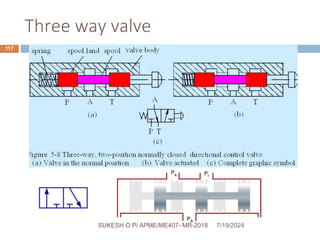
Three way valve
7/19/2024
117
SUKESH O P/ APME/ME407- MR-2018
Three-Way Direction Control
3/2-Way DCV
SUKESH O P/ APME/ME407- MR-2018
(Normally Closed)
(Normally opened)
SUKESH O P/ APME/ME407- MR-2018
Four way valves
Four way valves
SUKESH O P/ APME/ME407- MR-2018
Four-way two-position directional c
ontrol valve
 4/2 valve has four connections to it and two valve
positions. Normally, one port is open to flow from
the pump.
SUKESH O P/ APME/ME407- MR-2018
Four-way three-position directional
control valve
 It has one way for pump (P), one for reservoir (R) o
r tank (T) and two for the inlet to the actuator. And
it has 3 positions: one normal, one cross way, and
one straight way.
SUKESH O P/ APME/ME407- MR-2018
 2POSITION , 2WAY DCV
SINGLE ACTING HYDRAULIC CYLINDER
CIRCUIT
SUKESH O P/ APME/ME407- MR-2018
 Three position, four way DCV
Double ACTING HYDRAULIC CYLINDER
CIRCUIT
SUKESH O P/ APME/ME407- MR-2018

Mechatronics System for different function and controller design

  • 1.
    ME407 MECHATRONICS SUKESH OP Assistant Professor Dept. of Mechanical Engineering JECC 7/19/2024 1 SUKESH O P/ APME/ME407- MR-2018 SUKESH O P/ APME/ME407- MR-2018
  • 2.
    ME407 MECHATRONICS  CourseObjectives: To introduce the features of various sensors used in CNC machines and robots To study the fabrication and functioning of MEMS pressure and inertial sensors To enable development of hydraulic/pneumatic circuit and PLC programs for simple applications 7/19/2024 2 SUKESH O P/ APME/ME407- MR-2018 SUKESH O P/ APME/ME407- MR-2018
  • 3.
    Expected outcome: The studentswill be able to i. Know the mechanical systems used in mechatronics ii. Integrate mechanical, electronics, control and computer engineering in the design of mechatronics systems ME407 MECHATRONICS 7/19/2024 3 SUKESH O P/ APME/ME407- MR-2018 SUKESH O P/ APME/ME407- MR-2018
  • 4.
    Expected outcome: The studentswill be able to i. Know the mechanical systems used in mechatronics ii. Integrate mechanical, electronics, control and computer engineering in the design of mechatronics systems ME407 MECHATRONICS 7/19/2024 4 SUKESH O P/ APME/ME407- MR-2018 SUKESH O P/ APME/ME407- MR-2018
  • 5.
    SYLLABUS  Introduction toMechatronics, sensors, Actuators, Micro Electro Mechanical Systems (MEMS), Mechatronics in Computer Numerical Control (CNC) machines, Mechatronics in Robotics-Electrical drives, Force and tactile sensors, Image processing techniques, Case studies of Mechatronics systems. 7/19/2024 5 SUKESH O P/ APME/ME407- MR-2018 SUKESH O P/ APME/ME407- MR-2018
  • 6.
    MODULE-II  Actuators: Hydraulicand Pneumatic actuators - Directional control valves, pressure control valves, process control valves. Rotary actuators. Development of simple hydraulic and pneumatic circuits using standard Symbols. 7/19/2024 6 SUKESH O P/ APME/ME407- MR-2018 SUKESH O P/ APME/ME407- MR-2018
  • 7.
    MODULE-II Actuators: Hydraulic andPneumatic actuators 7/19/2024 7 SUKESH O P/ APME/ME407- MR-2018 SUKESH O P/ APME/ME407- MR-2018
  • 8.
    WHAT IS ANACTUATOR?  Actuators are devices used to produce action or motion.  Input(mainly electrical signal , air, fluids)  Electrical signal can be low power or high power.  Actuators output can be position or rate i.e. linear displacement or vel ocity.  Actuation can be from few microns to few meters 7/19/2024 8 SUKESH O P/ APME/ME407- MR-2018 SUKESH O P/ APME/ME407- MR-2018
  • 9.
    FLOW DIAGRAM OFAN ACTUATOR 7/19/2024 9 SUKESH O P/ APME/ME407- MR-2018 SUKESH O P/ APME/ME407- MR-2018
  • 10.
    TYPES OF ACTUATORS Hydraulic Actuators  Pneumatic actuators  Mechanical Actuators  Electrical Actuators  Linear actuator: solenoid, Hydraulic/Pneumatic.  Rotary actuator: motor, Hydraulic/Pneumatic. 7/19/2024 10 SUKESH O P/ APME/ME407- MR-2018 SUKESH O P/ APME/ME407- MR-2018
  • 11.
     Devices whichcan be considered to be motion converters in that they transform motion from one form to some other required form.  Eg: Transform linear motion into rotational motion and vice versa.  Mechanical elements can include the use of linkages, cams, gears, rack-and-pinion, chains, belt drives, etc.  Eg: rack-and-pinion can be used to convert rotational motion to linear motion.  Many of the actions which previously were obtained by the use of mechanism are, however, often nowadays being obtained, as a result of a mechatronics approach by the use of microprocessor systems. SUKESH O P/ APME/ME407- MR-2018
  • 12.
     Mechanisms still,however, have a role in mechatronics systems. For example, the mechatronics system in use in an automatic camera for adjusting the aperture for correct exposures involves a mechanism for adjusting the size of diaphragm.  Others function:  Force amplification – given by levers.  Change of speed – given by gears.  Transfer of rotation about one axis to rotation about another – timing belt.  The term kinematics is used for the study of motion without regard to forces. When we consider just the motions without any consideration of the forces or energy involved then we are carrying out a kinematic analysis of the mechanism. SUKESH O P/ APME/ME407- MR-2018
  • 13.
    Translation motion Rotationalmotion Movement which can be resolved into components along one or more of the 3 axes. Rotation which has components rotating about one or more of the axes. SUKESH O P/ APME/ME407- MR-2018
  • 14.
    SUKESH O P/APME/ME407- MR-2018
  • 15.
    SUKESH O P/APME/ME407- MR-2018
  • 16.
     Each partof a mechanism which has motion relative to some other part is termed a link.  A rigid body which has two or more points of attachment to other links is termed nodes.  Each link is capable of moving relative to its neighboring links.  A joint is a connection between the connected links at their nodes and which allows some motion between the connected links.  Levers, cranks, connecting rods and pistons, sliders, pulleys, belts and shafts are all examples of links. (a) with two nodes (c) with four nodes (b) with three nodes SUKESH O P/ APME/ME407- MR-2018
  • 17.
     A sequenceof joints and links is known as kinematic chain.  For a kinematic chain to transmit motion, one link must be fixed. Movement of one link will then produce predictable relative movements of the others.  It is possible to obtain from one kinematic chain a number of different mechanisms by having a different link as the fixed one.  The design of many mechanisms are based on two basic forms of kinematic chains, the four-bar chain and the slider-crank chain. The reciprocating motion of a piston is transformed into rotational motion of a crankshaft on bearings mounted in a fixed frame. Slider Crankshaft Connectin g rod Fixed frame SUKESH O P/ APME/ME407- MR-2018
  • 18.
    Double-lever mechanism Lever-crankmechanism Double-crank mechanism SUKESH O P/ APME/ME407- MR-2018
  • 19.
    Cine film advancemechanism SUKESH O P/ APME/ME407- MR-2018
  • 20.
    SUKESH O P/APME/ME407- MR-2018
  • 21.
    The position sequencefor the links in a slider-crank mechanism SUKESH O P/ APME/ME407- MR-2018
  • 22.
     Cam isa body which rotates or oscillates and in doing so imparts a reciprocating motion to a second body called follower, with which it is in contact.  The length of times spent for the rotation is depending on the shape of the cam. Part that lowers the follower, its profile determining how quickly the cam follower will fall. Part that allows the follower to remain at the same lever for a significant period of time and where its circular with a radius that does not change. Part that drives the follower upwards, its profile determining how quickly the cam follower will lifted. SUKESH O P/ APME/ME407- MR-2018
  • 23.
     The camshape required to produce a particular motion of the follower will depend on the shape of the cam and the type of follower used. Displacement diagram for an eccentric cam SUKESH O P/ APME/ME407- MR-2018
  • 24.
     Figure belowshows the types of follower displacement diagrams that can be produced with two other different shaped cams and either point or knife followers. Heart shape Pear shape (constant rate, uniform speed) (rise and fall symmetrically) SUKESH O P/ APME/ME407- MR-2018
  • 25.
     Figure belowshows a number of examples of different types of cam followers. Point Roller Knife Lower friction than sliding contact but can be more expensive SUKESH O P/ APME/ME407- MR-2018
  • 26.
     Figure belowshows a number of examples of different types of cam followers. Often used because – cheaper and can be made smaller than roller follower. Sliding and oscillating Flat Mushroom SUKESH O P/ APME/ME407- MR-2018
  • 27.
     Gear trainsare mechanisms which are very widely used to transfer and transform rotational motion. They are used when a change in speed or torque of a rotating device is needed. For example, the car gearbox enables the driver to match the speed and torque requirements of the terrain with the engine power available. (a) Parallel gear axes, (b) axes inclined to one another, (c) axial teeth, (d) helical teeth, (e) double helical teeth SUKESH O P/ APME/ME407- MR-2018
  • 28.
     Two meshedgears.  Gear ratio, ωA = number of teeth on B = dB ωB number of teeth on A dA Angular velocity Diameter SUKESH O P/ APME/ME407- MR-2018
  • 29.
    G = ωA= ωA ωB ωC ωB ωC x SUKESH O P/ APME/ME407- MR-2018
  • 30.
     Compound gearstrains – two wheels are mounted on a common shaft.  Ratio of the angular velocities,  For the input and output shafts to be in line, we must also have for the radii of the gears. G = ωA = ωA ωB ωC = ωA ωC ωD ωB ωC ωD ωB ωD x x x rA + rB = rD + rC SUKESH O P/ APME/ME407- MR-2018
  • 31.
    v = nL/ t = fL Time Distance moved parallel to the screw axis Revolution SUKESH O P/ APME/ME407- MR-2018
  • 32.
     Pair ofrolling cylinders with the motion of one cylinder being transferred to the other by a belt.  Belt drives use the friction that develops between the pulleys attached to the shaft and the belt around the arc of contact in order to transmit a torque.  The transmitted torque is due to the differences in tension that occur in the belt during operation. This difference results in a tight side and a slack side for the belt. SUKESH O P/ APME/ME407- MR-2018
  • 33.
     If thetension on the tight side is T1, and a slack side is T2, then with pulley A as a driver,  Pulley B as a driver,  Since the power transmitted is the produce of the torque and the angular velocity, and since the angular velocity is v/rA for pulley A and v/rB for pulley B, then for either pulley we have Torque on A = (T1 – T2) rA Power = (T1 – T2) v Torque on B = (T1 – T2) rB SUKESH O P/ APME/ME407- MR-2018
  • 34.
     As amethod of transmitting power between two shafts, belt drives have the advantage that the length of the belt can easily be adjusted to suit a wide range of shaft to shaft distance and the system is automatically protected against overload because slipping occurs if the loading exceeds the maximum tension that can be sustained by frictional forces.  If the distance between shafts is large, a belt drive is more suitable than gears, but over small distances gears are to be preferred.  Different size pulleys can be used to give a gearing effect. However, the gear ratio is limited to about 3 because of the need to maintain an adequate arc of contact between the belt and pulleys. SUKESH O P/ APME/ME407- MR-2018
  • 35.
     Figure belowshows two types of reversing drives.  With both forms of drive, both side of the belt comes into contact with the wheels and so V-belts or timing belts cannot be used. Cross belt Open belt SUKESH O P/ APME/ME407- MR-2018
  • 36.
    SUKESH O P/APME/ME407- MR-2018
  • 37.
     V  V– belts are used with grooved pulleys and are less efficient that flat belts but a number of them can be used on a single wheel and so give multiple drive.  Timing.  Require toothed wheels, having teeth which fit into the grooves on the wheel.  Unlike the other belts, timing belt does not stretch or slip and consequently transmits power at a constant angular velocity ratio.  The teeth make it possible for the belt to be run at slow or fast speeds. SUKESH O P/ APME/ME407- MR-2018
  • 38.
     Whenever thereis relative motion of one surface in contact with another, either by rotating or sliding, the resulting frictional forces generate heat which wastes energy and results in wear.  The function of bearing is to guide with minimum friction and maximum accuracy the movement of one part relative to another.  Give suitable support to rotating shaft.  The term thrust bearing is used for bearings that are designed to withstand forces along the axis of a shaft when the relative motion is primarily rotation. SUKESH O P/ APME/ME407- MR-2018
  • 39.
    SUKESH O P/APME/ME407- MR-2018
  • 40.
    SUKESH O P/APME/ME407- MR-2018
  • 41.
    a) Deep-groove b) Filling-slot c)Angular contact d) double-row e) Self-aligning e) Thrust, grooved race SUKESH O P/ APME/ME407- MR-2018
  • 42.
    a) Straight roller b)Taper roller c) Needle roller SUKESH O P/ APME/ME407- MR-2018
  • 43.
    Electrical Actuators 7/19/2024 43 SUKESH OP/ APME/ME407- MR-2018 An actuator receiving electrical energy for motion is called an electrical actuator. 1.Switching devices 1. Mechanical switches 1. Solenoids 2. Relays 2. Solid state switches 1. Diodes 2. Tyristors 3. Transistors 2.Drive system 1. DC motors 2. AC motors SUKESH O P/ APME/ME407- MR-2018
  • 44.
    Hydraulics and Pneumatics 7/19/2024 44 SUKESHO P/ APME/ME407- MR-2018 SUKESH O P/ APME/ME407- MR-2018
  • 45.
    Hydraulics  An actuatorwherein hydraulic energy is used to impart motion is called an hydraulic actuator.  Hydraulic systems are power-transmitting assemblies employing p r e s s u r i z e d l i q u i d a s a f l u i d for transmitting energy from an energy-generating source to an energy-using point to accomplish useful work. 7/19/2024 45 SUKESH O P/ APME/ME407- MR-2018 SUKESH O P/ APME/ME407- MR-2018
  • 46.
    HYDRAULIC SYSTEM  Thebasic rule of using hydraulic power is Pascal's Principle.  Pascal's Principle: pressure exerted on a fluid is distributed equally throughout the fluid. 7/19/2024 46 SUKESH O P/ APME/ME407- MR-2018 Hydraulics uses incompresible liquids so the applied pressure from one end (small arrow) is equal to the desired pressure on the other end (big arrow). SUKESH O P/ APME/ME407- MR-2018
  • 47.
    Hydraulics 1. Hydraulic pumpunit : in an actual hydraulic system a pump converts mechanical power into fluid power. 2. Control valve : the flow of pressurized liquid discharge by the pump is controlled by valves.  Pressure control valves- control the liquid pressure .  Flow control valves : control the liquid flow rate.  Directional control valve : control the direction of flow of the liquid. 7/19/2024 47 SUKESH O P/ APME/ME407- MR-2018 SUKESH O P/ APME/ME407- MR-2018
  • 48.
    Hydraulics 3. hydraulic motor/cylinder The liquid discharged by the pump is directed to hydraulic motors or cylinders by control valves.  Motors are used where rotory motion is desired and cylinders are used where linear motion is necessary. 7/19/2024 48 SUKESH O P/ APME/ME407- MR-2018 SUKESH O P/ APME/ME407- MR-2018
  • 49.
    HYDRAULIC ACTUATOR 7/19/2024 SUKESH OP/ APME/ME407- MR-2018 49 Hydraulic systems are used to control & transmit power. •A pump driven by prime mover (electric motor) creates flow of fluid SUKESH O P/ APME/ME407- MR-2018
  • 50.
    Hydraulic system 7/19/2024 SUKESH OP/ APME/ME407- MR-2018 50 SUKESH O P/ APME/ME407- MR-2018
  • 51.
    7/19/2024 SUKESH O P/APME/ME407- MR-2018 51 SUKESH O P/ APME/ME407- MR-2018
  • 52.
    Functions of thecomponents 1. The hydraulic actuator is a device used to convert the fluid power into mechanical power to do useful work. The actuator may be of the linear type (e.g., hydraulic cylinder) or rotary type(e.g., hydraulic motor) to provide linear or rotary motion, respectively. 7/19/2024 52 SUKESH O P/ APME/ME407- MR-2018 SUKESH O P/ APME/ME407- MR-2018
  • 53.
    Functions of thecomponents 2. The hydraulic pump is used to force the fluid from the reservoir to r e s t o f t h e hydraulic circuit by converting mechanical energy into hydraulic energy. 3. Valves are used to control the direction, pressure and flow rate of a f l u i d f l o w i n g through the circuit. 4. External power supply (motor) is required to drive the pump. 5. Reservoir is used to hold the hydraulic liquid, usually hydraulic oil. 7/19/2024 53 SUKESH O P/ APME/ME407- MR-2018 SUKESH O P/ APME/ME407- MR-2018
  • 54.
    Functions of thecomponents 6. Piping system carries the hydraulic oil from one place to another. 7. Filters are used to remove any foreign particles so as keep the fluid s y s t e m c l e a n a n d efficient, as well as avoid damage to the actuator and valves. 8. Pressure regulator regulates (i.e., maintains) the required level of p r e s s u r e i n t h e hydraulic fluid. 7/19/2024 54 SUKESH O P/ APME/ME407- MR-2018 SUKESH O P/ APME/ME407- MR-2018
  • 55.
    - Economic - Reliable -Resistant to overloads - Able to support heavy loads Hydraulic actuators - Low working speed - Hydraulic group noisy in operation - Possible oil leakage SUKESH O P/ APME/ME407- MR-2018
  • 56.
    Pneumatics Uses pressurised airto transmit and control power. Air is used as the fluid because:-  It is safe.  It is less expensive and readily available  It can be inducted and exhausted directly to the atmosphere and return line is not necessary as with hydraulics. 7/19/2024 56 SUKESH O P/ APME/ME407- MR-2018 SUKESH O P/ APME/ME407- MR-2018
  • 57.
    Pneumatics System 7/19/2024 57 SUKESH OP/ APME/ME407- MR-2018 SUKESH O P/ APME/ME407- MR-2018
  • 58.
    Functions of thecomponents 7/19/2024 SUKESH O P/ APME/ME407- MR-2018 58 SUKESH O P/ APME/ME407- MR-2018
  • 59.
    Functions of thecomponents 7/19/2024 59 SUKESH O P/ APME/ME407- MR-2018 Pneumatic systems are systems always processing new air (where as hydraulic systems are closed systems always returning the oil) SUKESH O P/ APME/ME407- MR-2018
  • 60.
    Pneumatic actuators (cylinders) -Economic - Reliable - High operation speed - Resistant to overloads - Operation at constant force - No speed control - Poor position speed - Noisy operation SUKESH O P/ APME/ME407- MR-2018
  • 61.
    Comparison between Hydraulicand Pneumatic system 7/19/2024 61 SUKESH O P/ APME/ME407- MR-2018 S. No. Hydraulic System Pneumatic System 1. It employs a pressurized liquid as a fluid It employs a compressed gas, usually air, as a fluid 2. An oil hydraulic system operates at pressures up to 700 bar A pneumatic system usually operates at 5–10 bar 3. Generally designed as closed system Usually designed as open system 4. The system slows down when leakage occurs Leakage does not affect the system much 5. Valve operations are difficult Valve operations are easy 6. Heavier in weight Lighter in weight 7. Pumps are used to provide pressurized liquids Compressors are used to provide compressed gases 8. The system is unsafe to fire hazards The system is free from fire hazards 9. Automatic lubrication is provided Special arrangements for lubrication are needed SUKESH O P/ APME/ME407- MR-2018
  • 62.
    HYDRAULIC ACTUATOR 7/19/2024 62 SUKESH OP/ APME/ME407- MR-2018 SUKESH O P/ APME/ME407- MR-2018
  • 63.
    Linear Actuators -CYLINDERS 7/19/2024 63 SUKESH O P/ APME/ME407- MR-2018 SUKESH O P/ APME/ME407- MR-2018
  • 64.
    Parts of linearactuator  Cylinder barrel Piston  Cylinder base or cap Piston rod  Cylinder head Rod gland  Other parts : Cylinder base connection - Seals-Cushions 7/19/2024 SUKESH O P/ APME/ME407- MR-2018 64 SUKESH O P/ APME/ME407- MR-2018
  • 65.
    7/19/2024 65 SUKESH O P/APME/ME407- MR-2018 SUKESH O P/ APME/ME407- MR-2018
  • 66.
    7/19/2024 66 SUKESH O P/APME/ME407- MR-2018 SUKESH O P/ APME/ME407- MR-2018
  • 67.
    Single acting cylinder In the case of a single acting cylinder, only the piston side is pressurize d with hydraulic fluid. The cylinder can thus carry out work only in one direction.  The fluid which flows into the piston chamber causes a pressure to bui ld up the surface of the piston.  The piston travels into its forward end position. The return stroke is ef fected by a spring, the dead eight of the piston rod or an external load . 7/19/2024 67 SUKESH O P/ APME/ME407- MR-2018 SUKESH O P/ APME/ME407- MR-2018
  • 68.
    7/19/2024 68 SUKESH O P/APME/ME407- MR-2018 SUKESH O P/ APME/ME407- MR-2018
  • 69.
    PLUNGER TYPE SINGLE ACTINGCYLINDER  In the case of plunger cylinders, the piston and rod form a single comp onent.  Due to the design of the cylinder, the return stroke can only be effecte d by external forces.  The cylinders can therefore generally be installed only vertically. 7/19/2024 69 SUKESH O P/ APME/ME407- MR-2018 SUKESH O P/ APME/ME407- MR-2018
  • 70.
    7/19/2024 70 SUKESH O P/APME/ME407- MR-2018 SUKESH O P/ APME/ME407- MR-2018
  • 71.
    7/19/2024 71 SUKESH O P/APME/ME407- MR-2018 SUKESH O P/ APME/ME407- MR-2018
  • 72.
    7/19/2024 72 SUKESH O P/APME/ME407- MR-2018 SUKESH O P/ APME/ME407- MR-2018
  • 73.
    7/19/2024 73 SUKESH O P/APME/ME407- MR-2018 SUKESH O P/ APME/ME407- MR-2018
  • 74.
    7/19/2024 74 SUKESH O P/APME/ME407- MR-2018 SUKESH O P/ APME/ME407- MR-2018
  • 75.
    DOUBLE ACTING CYLINDER WITH ENDPOSITION CUSHIONING  Cylinder with end position cushioning are used to brake high stroke sp eeds smoothly and prevent hard impacts at the end of the stroke. Sho rtly before the end position is reached, the cross- section for the outfl ow of fluid is reduced by the built-in cushioning pistons and then finall y closed. The hydraulic fluid is then forced to escape through a flow co ntrol valve. 7/19/2024 75 SUKESH O P/ APME/ME407- MR-2018 SUKESH O P/ APME/ME407- MR-2018
  • 76.
    7/19/2024 76 SUKESH O P/APME/ME407- MR-2018 SUKESH O P/ APME/ME407- MR-2018
  • 77.
    7/19/2024 77 SUKESH O P/APME/ME407- MR-2018 SUKESH O P/ APME/ME407- MR-2018
  • 78.
    Cylinder cushioning 7/19/2024 78 SUKESH OP/ APME/ME407- MR-2018 SUKESH O P/ APME/ME407- MR-2018
  • 79.
    7/19/2024 79 SUKESH O P/APME/ME407- MR-2018 SUKESH O P/ APME/ME407- MR-2018
  • 80.
    7/19/2024 80 SUKESH O P/APME/ME407- MR-2018 SUKESH O P/ APME/ME407- MR-2018
  • 81.
    Through rod cylinder 7/19/2024 81 SUKESHO P/ APME/ME407- MR-2018 SUKESH O P/ APME/ME407- MR-2018
  • 82.
    tandem cylinder 7/19/2024 82 SUKESH OP/ APME/ME407- MR-2018 SUKESH O P/ APME/ME407- MR-2018
  • 83.
    ROTARY ACTUATORS  ASSIGNMENTQUESTION HYDRAULICS & PNEUMATICS: :  Gear motor  Vane motor  Piston motor  Turbine motors  Gerotor type motors 7/19/2024 83 SUKESH O P/ APME/ME407- MR-2018 SUKESH O P/ APME/ME407- MR-2018
  • 84.
    Module-II  Directional controlvalves, pressure control valves, process control valves. 7/19/2024 84 SUKESH O P/ APME/ME407- MR-2018 SUKESH O P/ APME/ME407- MR-2018
  • 85.
    Control valves  Fluidpower is controlled primarily through the use of control devices called valves.  Hydraulic and pneumatic systems require control valves to direct and regulate the flow of fluid and regulate the flow of fluid from pump(or compressor) to hydraulic cylinders or motors. 1. Direction control valves 2. Pressure control valves 3. Process control valves (flow) 7/19/2024 85 SUKESH O P/ APME/ME407- MR-2018 SUKESH O P/ APME/ME407- MR-2018
  • 86.
    Flow control valves These valves are used to control the speed o f hydraulic actuator by controlling the flow rat e or discharge 1. Needle valve 2. Gate and globe valve SUKESH O P/ APME/ME407- MR-2018
  • 87.
    1. Needle valve It is the most common hydraulic flow control de vice.  It consists of a needle or pointed threaded ste m that can be adjusted manually to control the flow or discharge through the valve. It is made of steel.  This valve can also be used as a stop valve to prevent the flow of fluid from one part of the hy draulic circuit to another. SUKESH O P/ APME/ME407- MR-2018
  • 88.
    Needle valves SUKESH OP/ APME/ME407- MR-2018
  • 89.
    Globe valve  Inthis valve the flow area is larger than that of a nee dle valve. Hence globe valve will have a larger flow c apacity at a lower pressure drop than a needle valve of the same size.  Globe valves have a round disk to control or stop the fluid flow.  Needle valves are suitable for throttling i.e., the flo w area is slowly reduced as the valve is closed, grad ually reducing the quantity of fluid passing through t he valve. But the globe valves are not so suitable for throttling function. SUKESH O P/ APME/ME407- MR-2018
  • 90.
    SUKESH O P/APME/ME407- MR-2018
  • 91.
    Gate valve  Gatevalves are not normally used as flow control v alves. Most of the gate valves are used as stops to shutoff fluid flow (or) to open the line to full flow.  Gate valves provides a opening with minimum pres sure drop. SUKESH O P/ APME/ME407- MR-2018
  • 92.
    SUKESH O P/APME/ME407- MR-2018
  • 93.
    Pressure control valves These valves control the pressure of flow medium requir ed by the system..  To regulate or reduce oil pressure in certain portions of the circuit  to unload system pressure.  To limit maximum system pressure as a safety measure.  To assist sequential operation of actuators in a circuit b y pressure control.  To perform any other pressure related functions by virt ue of pressure control. SUKESH O P/ APME/ME407- MR-2018
  • 94.
    Types 1. Pressure reliefvalve. 2. Pressure sequencing valve. 3. Pressure reducing or regulating valve. 4. Pressure unloading valve. 5. Pressure brake valve. SUKESH O P/ APME/ME407- MR-2018
  • 95.
    1. Pressure reliefvalves  These valves are found in every hydraulic system.  It is normally closed valve, connected between the pressure line and the oil reservoir.  Its main purpose is to limit the presure in a system to a prescribed maximum by diverting some or all of the pump output to the tanks, when the desired set pressure is reached. SUKESH O P/ APME/ME407- MR-2018
  • 96.
    PRV SUKESH O P/APME/ME407- MR-2018
  • 97.
    2. Pressure sequencingvalve  Sequence valve is used to direct the flow to more than one portion of a fluid circuit in sequence. SUKESH O P/ APME/ME407- MR-2018
  • 98.
    SUKESH O P/APME/ME407- MR-2018
  • 99.
    3.Pressure reducing valve This type of valves are normally open pressu re control valves used to maintain reduced pr essures in certain portions of the hydraulic s ystem.  These are actuated by the pressure sensed i n the branch circuit and tend to close as it re aches the pressure of the valve setting preve nting further buildup of pressure. SUKESH O P/ APME/ME407- MR-2018
  • 100.
    SUKESH O P/APME/ME407- MR-2018
  • 101.
    4. Pressure unloadingvalve  This type of valves is used to unload the energ y in a system of a lower pressure.  This valve allows pressure to build up to an adj ustable setting and then bypasses the flow as l ong as a remote source maintains the preset p ressure on the pilot port.  Unloading valves are normally used in double pump applications. When the high speed and more flow are not required. SUKESH O P/ APME/ME407- MR-2018
  • 102.
    SUKESH O P/APME/ME407- MR-2018
  • 103.
    Direction control valves The direction control valvea start, stop and control the di rection of flow for reversing the direction of motion of th e actuator. SUKESH O P/ APME/ME407- MR-2018
  • 104.
    Dcv SUKESH O P/APME/ME407- MR-2018
  • 105.
    1. Check valve Check valve is a one way valve because it permits fl ow in only one direction and prevents any flow in t he opposite direction. SUKESH O P/ APME/ME407- MR-2018
  • 106.
    Pilot operated checkvalve  The pilot operated check valve always permits free flow in one direction but permits flow in the norm ally blocked opposite direction only if pilot pressur e pushes the pilot piston sownward.  SUKESH O P/ APME/ME407- MR-2018
  • 107.
    2. Poppet valve It is a check valve that can be forced open to allow reverse flow. SUKESH O P/ APME/ME407- MR-2018
  • 108.
    3. Spool valve It consists of a cylindrical spool with multiple lobes moving within a cylindrical casing containing multi ple ports.  The spool can be moved back and fourth to align s paces between the spool lobes with input and out put ports in the housing to direct high pressure flo w to different circuits in the system. SUKESH O P/ APME/ME407- MR-2018
  • 109.
    Spool valve SUKESH OP/ APME/ME407- MR-2018
  • 110.
    4. Shuttle valve This is the another type of direction control valve.  It allows a system to operate from either of two flu id power sources.  It is also known as a double check valve. It is mostl y used in pneumatic device and is rarely used in h ydraulic circuits. SUKESH O P/ APME/ME407- MR-2018
  • 111.
    Shuttle valve SUKESH OP/ APME/ME407- MR-2018
  • 112.
    SUKESH O P/APME/ME407- MR-2018
  • 113.
    SUKESH O P/APME/ME407- MR-2018
  • 114.
    Two way valve 7/19/2024 114 SUKESHO P/ APME/ME407- MR-2018 SUKESH O P/ APME/ME407- MR-2018
  • 115.
    SUKESH O P/APME/ME407- MR-2018 (Normally Closed) (Normally opened)
  • 116.
    Two-way two-position directionalc ontrol valve  Gate valve is example of 2W/2P directional control valve which either turns on or off the flow in norm al or working positions depending on need of appli cation.  Here arrow indicates that fluid flow is taking place whereas other position shows cut-off position. SUKESH O P/ APME/ME407- MR-2018
  • 117.
    Three way valve 7/19/2024 117 SUKESHO P/ APME/ME407- MR-2018 SUKESH O P/ APME/ME407- MR-2018
  • 118.
    Three-Way Direction Control 3/2-WayDCV SUKESH O P/ APME/ME407- MR-2018 (Normally Closed) (Normally opened)
  • 119.
    SUKESH O P/APME/ME407- MR-2018 Four way valves
  • 120.
    Four way valves SUKESHO P/ APME/ME407- MR-2018
  • 121.
    Four-way two-position directionalc ontrol valve  4/2 valve has four connections to it and two valve positions. Normally, one port is open to flow from the pump. SUKESH O P/ APME/ME407- MR-2018
  • 122.
    Four-way three-position directional controlvalve  It has one way for pump (P), one for reservoir (R) o r tank (T) and two for the inlet to the actuator. And it has 3 positions: one normal, one cross way, and one straight way. SUKESH O P/ APME/ME407- MR-2018
  • 123.
    SUKESH O P/APME/ME407- MR-2018  2POSITION , 2WAY DCV SINGLE ACTING HYDRAULIC CYLINDER CIRCUIT
  • 124.
    SUKESH O P/APME/ME407- MR-2018
  • 125.
    SUKESH O P/APME/ME407- MR-2018  Three position, four way DCV Double ACTING HYDRAULIC CYLINDER CIRCUIT
  • 126.
    SUKESH O P/APME/ME407- MR-2018
  • 127.
    SUKESH O P/APME/ME407- MR-2018
  • 128.
    SUKESH O P/APME/ME407- MR-2018
  • 129.
    SUKESH O P/APME/ME407- MR-2018