Bacteriological diagnosis of infections
caused by bacteria of
Staphylococcus and Streptococcus genera
- Part Two -
http://www.slideshare.net/DanaSinzianaBreharCi/
staphylococcus-streptococcus-bacteriological-diagnosisii-45259850
Gram positive cocci
• Family:
Micrococaceae
• Genera:
– Staphylococcus
– Micrococcus
– Stomatococcus
– Planococcus
• Family:
Streptococacceae
• Genera:
– Streptococcus
– Enterococcus
– Aerococcus
– Gemella
– Leuconostoc
– Pediococcus
– Lactococcus
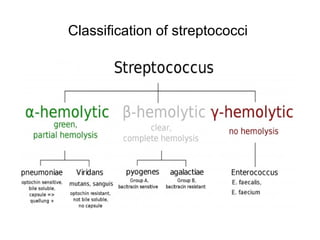
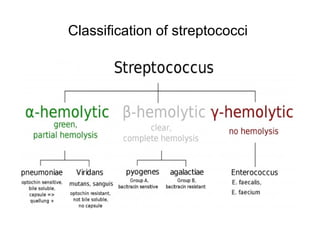
Classification of streptococci
Criteria:
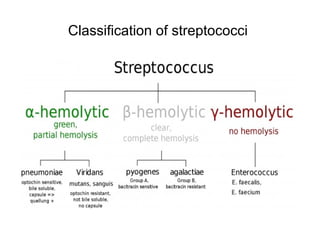
• I. Type of hemolysis produced by bacterial growth on
blood agar
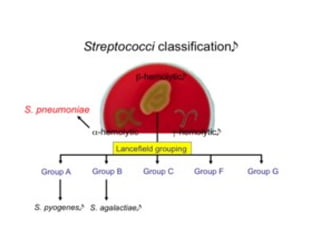
• II. Antigenic structure (Lancefield)
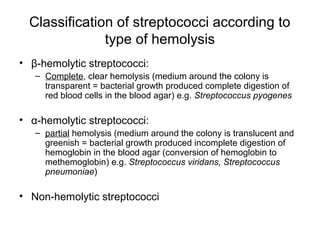
Classification of streptococci according to
type of hemolysis
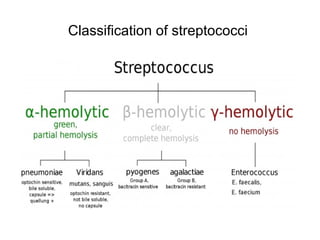
• β-hemolytic streptococci:
– Complete, clear hemolysis (medium around the colony is
transparent = bacterial growth produced complete digestion of
red blood cells in the blood agar) e.g. Streptococcus pyogenes
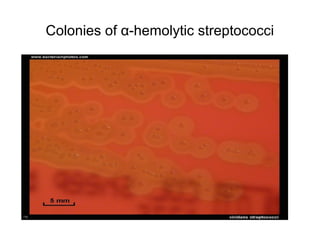
• α-hemolytic streptococci:
– partial hemolysis (medium around the colony is translucent and
greenish = bacterial growth produced incomplete digestion of
hemoglobin in the blood agar (conversion of hemoglobin to
methemoglobin) e.g. Streptococcus viridans, Streptococcus
pneumoniae)
• Non-hemolytic streptococci
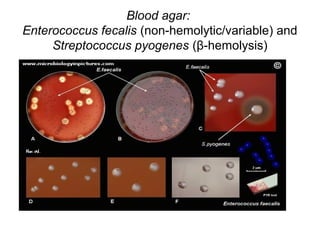
Blood agar:
Enterococcus fecalis (non-hemolytic/variable) and
Streptococcus pyogenes (β-hemolysis)
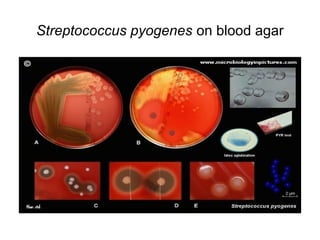
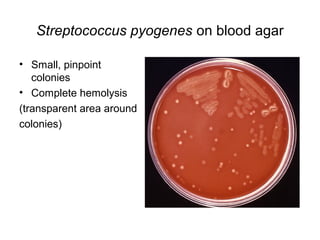
Streptococcus pyogenes on blood agar
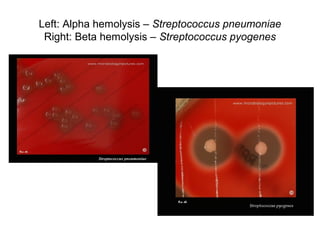
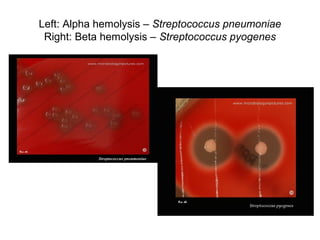
Left: Alpha hemolysis – Streptococcus pneumoniae
Right: Beta hemolysis – Streptococcus pyogenes
Colonies of α-hemolytic streptococci
Classification of streptococci according to
antigenic structure (Lancefield grouping)
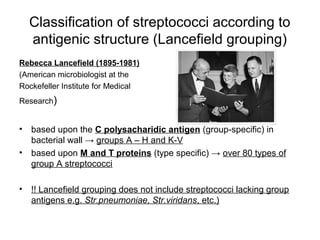
Rebecca Lancefield (1895-1981)
(American microbiologist at the
Rockefeller Institute for Medical
Research)
• based upon the C polysacharidic antigen (group-specific) in
bacterial wall → groups A – H and K-V
• based upon M and T proteins (type specific) → over 80 types of
group A streptococci
• !! Lancefield grouping does not include streptococci lacking group
antigens e.g. Str.pneumoniae, Str.viridans, etc.)
Classification of streptococci
Genus Streptococcus
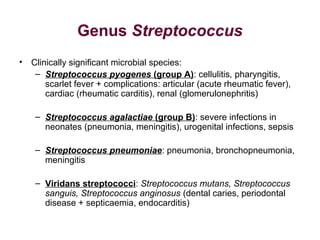
• Clinically significant microbial species:
– Streptococcus pyogenes (group A): cellulitis, pharyngitis,
scarlet fever + complications: articular (acute rheumatic fever),
cardiac (rheumatic carditis), renal (glomerulonephritis)
– Streptococcus agalactiae (group B): severe infections in
neonates (pneumonia, meningitis), urogenital infections, sepsis
– Streptococcus pneumoniae: pneumonia, bronchopneumonia,
meningitis
– Viridans streptococci: Streptococcus mutans, Streptococcus
sanguis, Streptococcus anginosus (dental caries, periodontal
disease + septicaemia, endocarditis)
Streptococcus pyogenes
(group A)
- clinical significance -
• Acute, respiratory infections: pharyngitis, scarlet fever +
complications: articular (acute rheumatic fever), cardiac
(rheumatic carditis), renal (glomerulonephritis)
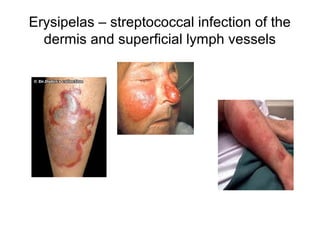
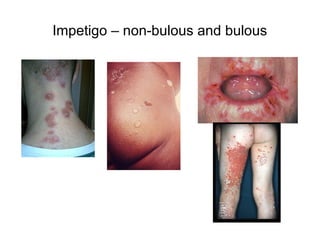
• Skin infections: erysipelas, impetigo, intertrigo, pemfigus,
celulitis, abscesses + complications: sepsis
Streptococcus pyogenes:
Steps of bacteriological diagnosis
• Collection of specimens (e.g. pus, pharyngeal exudate,
content of vesicles, CSF, urine, etc)
• Microscopic examination
• Inoculation of culture media
• Biochemical tests
• Agglutination tests
• Serological diagnosis
• Antimicrobial susceptibility tests (antibiogram)
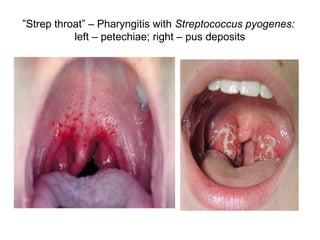
”Strep throat” – Pharyngitis with Streptococcus pyogenes:
left – petechiae; right – pus deposits
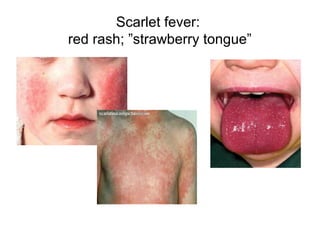
Scarlet fever:
red rash; ”strawberry tongue”
Erysipelas – streptococcal infection of the
dermis and superficial lymph vessels
Impetigo – non-bulous and bulous
Streptococcus pyogenes
– Microscopic examination -
Gram stained smears:
• Cocci:
– Round / ovoid shape; arranged in chains /
pairs
– Gram positive
– Aerobic growth (+anaerobic)
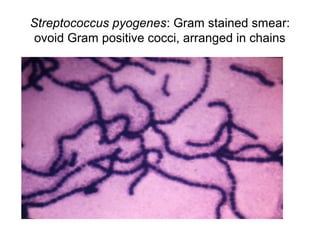
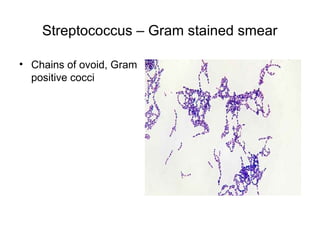
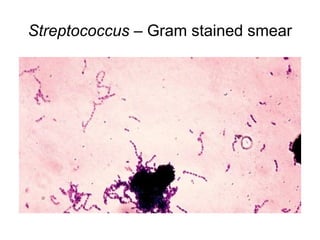
Streptococcus pyogenes: Gram stained smear:
ovoid Gram positive cocci, arranged in chains
Streptococcus – Gram stained smear
• Chains of ovoid, Gram
positive cocci
Streptococcus – Gram stained smear
Streptococcus pyogenes
- Cultivation & isolation -
• Blood containing media e.g. blood agar, Todd-Hewit
broth, SSP (selective medium for streptococci and
pneumococci)
• Most frequently:
– (Initial inoculation of selective medium (Pick) – favours growth
and multiplication of streptococci and inhibits other bacterial
species)
– ↓
– Reinoculation on 5% sheep blood agar
Streptococcus pyogenes
- identification -
• Colonial characters:
– small, pinpont, 0.5 µM diameter, transparent
– β-hemolysis - complete digestion of red blood cell contents
surrounding colony
• Group identification:
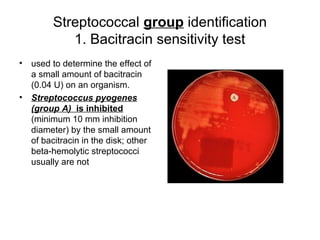
1. bacitracin sensitivity test – group A streptococci are bacitracin
sensitive / other streptococci are resistant
2. Immune-based tests (Ag-Ab) – agglutination/precipitation
Streptococcus pyogenes on blood agar
• Small, pinpoint
colonies
• Complete hemolysis
(transparent area around
colonies)
Streptococcal group identification
1. Bacitracin sensitivity test
• used to determine the effect of
a small amount of bacitracin
(0.04 U) on an organism.
• Streptococcus pyogenes
(group A) is inhibited
(minimum 10 mm inhibition
diameter) by the small amount
of bacitracin in the disk; other
beta-hemolytic streptococci
usually are not
Streptococcal group identification
2. Ag-Ac reactions
• Principle: contact between streptococcal group Ag (C
polysacharide) and homologous Ab (serum anti-group
A / B / C...= ”antisera”)
• the C polysacharide is located within the bacterial wall
• ↓
• Preliminary extraction is required
Streptococcal group identification
2. Ag-Ac reactions - Methods
1. ”Lancefield” precipitation
• extraction of the C polysacharide with HCl + heating
• contact with set of antisera (anti-group A/B...)
1. Agglutination
• enzymatic extraction of the C polysacharide
• contact with set of antisera (anti-group A/B...)
Streptococcal group identification
2. Ag-Ac reactions – Methods - continued
3. Co-agglutination
• enzymatic extraction of the C polysacharide
• slide agglutination with antisera adsorbed on protein A of
staphylococci
4. Latex agglutination
- Similar with co-agglutination; group specific Ab (antisera)
adsorbed on latex particles
Streptococcal type identification
Performed for epidemiologic purposes
• M typing:
– precipitation in capillary tubes with anti-M sera
– typing based upon M protein (virulence factor with anti-
phagocytic capacity)
• T typing:
– slide agglutination with anti-T sera
• PCR – for non-typable germs
Antimicrobial sensitivity
• Streptococcus pyogenes – sensitive to penicillin (no
antibiogram required);
• Final step of bacteriological diagnosis: perform the
bacitracin sensitivity test on a culture of β-hemolytic
streptococci – POSITIVE test = group A
Streptococcus pyogenes
- Serological diagnosis -
• Used in case of late complications – germs are difficult to
detect in culture
• Detection of serum antibodies against bacterial:
– products:
• streptolysin O (toxin responsible for hemolysis),
• streptokynase (enzyme responsible for fibrinolysis – clot lysis)
– components:
• M antigen, MAP (M antigen associated protein)
Streptococcus pyogenes
- Serological diagnosis - continued
• ASLO test = detection of serum anti-streptolysin O
antibodies in patient serum
• SLO present in streptococci of group A + C and G
• Principle: ASLO Ab neutralize the effect of streptolysin O
(SLO) on red blood cells (= annihilation of hemolysis)
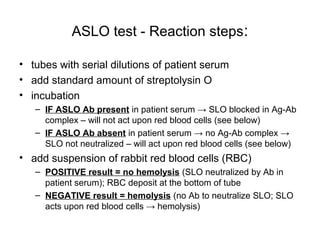
ASLO test - Reaction steps:
• tubes with serial dilutions of patient serum
• add standard amount of streptolysin O
• incubation
– IF ASLO Ab present in patient serum → SLO blocked in Ag-Ab
complex – will not act upon red blood cells (see below)
– IF ASLO Ab absent in patient serum → no Ag-Ab complex →
SLO not neutralized – will act upon red blood cells (see below)
• add suspension of rabbit red blood cells (RBC)
– POSITIVE result = no hemolysis (SLO neutralized by Ab in
patient serum); RBC deposit at the bottom of tube
– NEGATIVE result = hemolysis (no Ab to neutralize SLO; SLO
acts upon red blood cells → hemolysis)
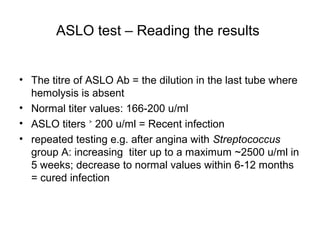
ASLO test – Reading the results
• The titre of ASLO Ab = the dilution in the last tube where
hemolysis is absent
• Normal titer values: 166-200 u/ml
• ASLO titers 200 u/ml = Recent infection˃
• repeated testing e.g. after angina with Streptococcus
group A: increasing titer up to a maximum ~2500 u/ml in
5 weeks; decrease to normal values within 6-12 months
= cured infection
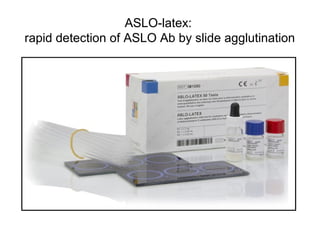
ASLO-latex:
rapid detection of ASLO Ab by slide agglutination
Streptococcus agalactiae (group B)
- clinical significance -
• Comensal: intestine, vagina, male urethra, upper airways
• Clinical significance: Severe infections:
– in newborns:
• pneumonia acquired during birth (maternal vaginal colonization
/infection)
• meninigitis – hospital acquired infection
– In immune-compromised adults/elderly:
• Meningitis, myocarditis, respiratory infections, sepsis
Streptococcus agalactiae (group B)
Steps of the bacteriological diagnosis
• Collection of specimens:
– Vaginal / cervical secretion, CSF
• Microscopic examination:
– Gram positive cocci, chains/pairs/isolated – no particular
diagnostic value
• Innoculation of culture media:
– blood agar, “chocolate” agar
– Colonial characters:
• colonies – slightly larger than group A streptococci,
• hemolysis – variable / partial / “foggy” (α´-hemolysis)
Not enough! Further tests required…
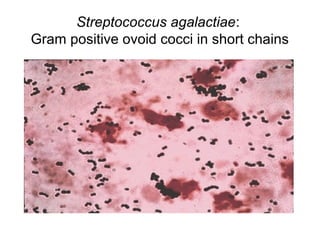
Streptococcus agalactiae:
Gram positive ovoid cocci in short chains
Streptococcus agalactiae (group B)
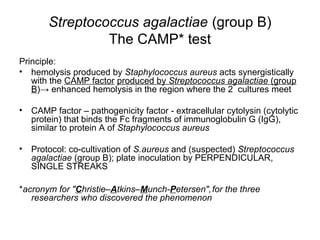
The CAMP* test
Principle:
• hemolysis produced by Staphylococcus aureus acts synergistically
with the CAMP factor produced by Streptococcus agalactiae (group
B)→ enhanced hemolysis in the region where the 2 cultures meet
• CAMP factor – pathogenicity factor - extracellular cytolysin (cytolytic
protein) that binds the Fc fragments of immunoglobulin G (IgG),
similar to protein A of Staphylococcus aureus
• Protocol: co-cultivation of S.aureus and (suspected) Streptococcus
agalactiae (group B); plate inoculation by PERPENDICULAR,
SINGLE STREAKS
*acronym for "Christie–Atkins–Munch-Petersen",for the three
researchers who discovered the phenomenon
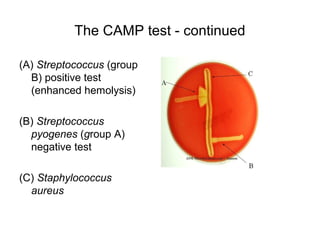
The CAMP test - continued
(A) Streptococcus (group
B) positive test
(enhanced hemolysis)
(B) Streptococcus
pyogenes (group A)
negative test
(C) Staphylococcus
aureus
Streptococcus agalactiae (group B)
Steps of the bacteriological diagnosis -
continued
• Antimicrobial susceptibility testing – mandatory!
• WHY?: Streptococcus agalactiae strains resistant to
penicillin have been isolated
Classification of streptococci
Viridans streptococci
• Group of streptococci which are comensal in:
– oral cavity (a.k.a. oral streptococci)
– Intestine
– Skin
– Genital tract
• Oral streptococci: Streptococcus mutans, Streptococcus
sanguis, Streptococcus anginosus (dental caries,
periodontal disease + septicaemia, endocarditis)
• No Lancefield antigens !!
Viridans streptococci - continued
• Sreptococcus mutans - etiologic agent of dental
caries
• Other streptococci may be involved in other mouth or
gingival infections
• If introduced into the bloodstream (e.g. following tooth
extraction) - potential of causing endocarditis,
particularly in individuals with damaged heart valves (the
most common causes of subacute bacterial
endocarditis)
Viridans streptococci:
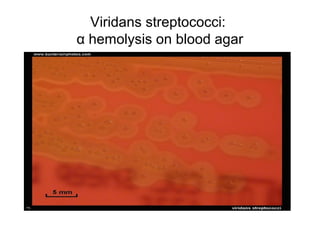
α hemolysis on blood agar
Classification of streptococci
Streptococcus pneumoniae
• Clinical significance:
• comensal germ of the upper airways; may become
pathogenic when encapsulated
• Meningitis, pneumonia, broncho-pneumonia
Streptococcus pneumoniae
Steps of bacteriological diagnosis
• Collection of specimens: sputum, CSF, blood, etc
• Macroscopic examination: “rusty” sputum
• Microscopic examination:
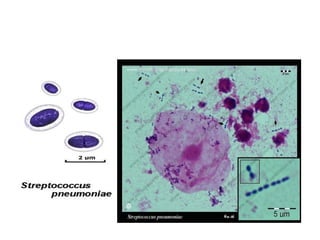
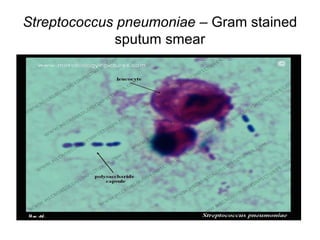
– Gram stained smears: white blood cells + Gram positive cocci, in
diplo/short chains; characteristic aspect: two candle flames ◄►
touching with their basis
• Cultivation:
– blood agar (in CO2 atmosphere), 37°C, 24 hrs;
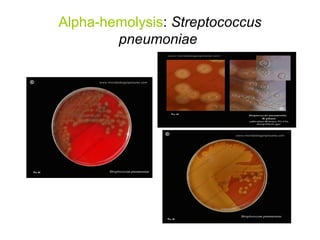
– colonial characters: small, smooth colonies with α-hemolysis
(green); colonies become depressed in time (autolysis) =
differentiation from viridans streptococci
Streptococcus pneumoniae – Gram stained
sputum smear
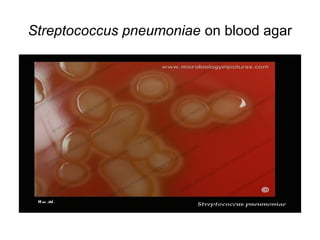
Streptococcus pneumoniae on blood agar
Left: Alpha hemolysis – Streptococcus pneumoniae
Right: Beta hemolysis – Streptococcus pyogenes
Alpha-hemolysis: Streptococcus
pneumoniae
How to differentiate between
α-hemolytic streptococci?
• Streptococcus pneumoniae ≠ Viridans streptococci
• Autolysis: self digestion of colonies in time (present in
Str.pneumoniae and absent in viridans str.) – see above
• Bile solubility test
• Optochin sensitivity test
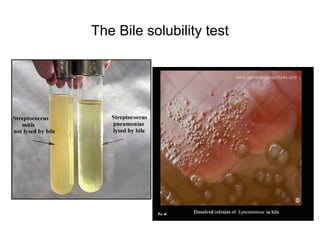
The Bile solubility test
• Principle: Bile salts selectively lyse Streptococcus
pneumoniae when added onto cultures on agar / broth
• POSITIVE TEST on agar: colony ”disappears” upon
addition of bile salts
• POSITIVE TEST in broth: turbidity of broth (reflecting
bacterial growth) clarifies upon addition of bile salts
• Negative test: Streptococcus viridans (bile-insoluble)
The Bile solubility test
Streptococcus pneumoniae
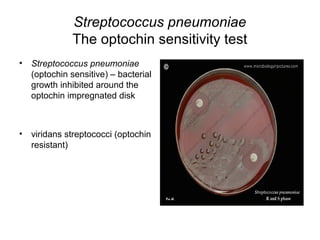
The optochin sensitivity test
• Streptococcus pneumoniae
(optochin sensitive) – bacterial
growth inhibited around the
optochin impregnated disk
• viridans streptococci (optochin
resistant)
Gram positive cocci
• Family:
Micrococaceae
• Genera:
– Staphylococcus
– Micrococcus
– Stomatococcus
– Planococcus
• Family:
Streptococacceae
• Genera:
– Streptococcus
– Enterococcus
– Aerococcus
– Gemella
– Leuconostoc
– Pediococcus
– Lactococcus
Classification of streptococci
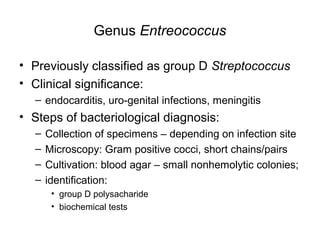
Genus Entreococcus
• Previously classified as group D Streptococcus
• Clinical significance:
– endocarditis, uro-genital infections, meningitis
• Steps of bacteriological diagnosis:
– Collection of specimens – depending on infection site
– Microscopy: Gram positive cocci, short chains/pairs
– Cultivation: blood agar – small nonhemolytic colonies;
– identification:
• group D polysacharide
• biochemical tests
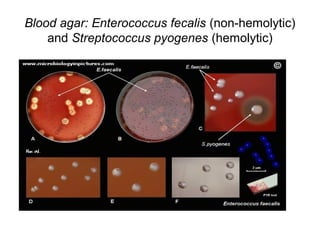
Blood agar: Enterococcus fecalis (non-hemolytic)
and Streptococcus pyogenes (hemolytic)
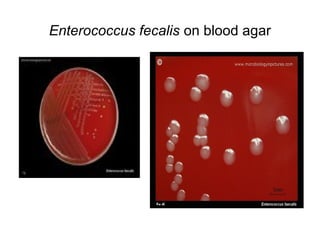
Enterococcus fecalis on blood agar
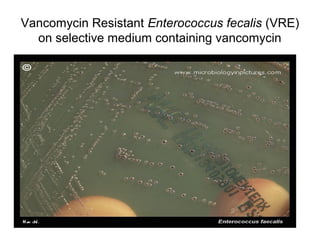
Vancomycin Resistant Enterococcus fecalis (VRE)
on selective medium containing vancomycin
To sum up:
• logical steps of the bacteriological diagnosis
↓
• Id. of Staphylococcus / Streptococcus infections
(similarities & differences)
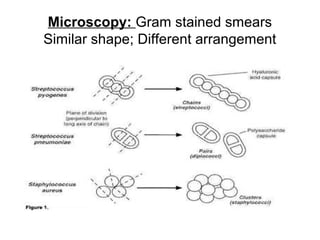
Microscopy: Gram stained smears
Similar shape; Different arrangement
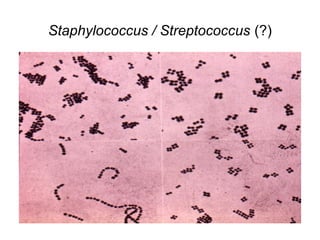
Staphylococcus / Streptococcus (?)
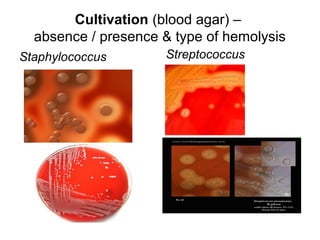
Cultivation (blood agar) –
absence / presence & type of hemolysis
Staphylococcus Streptococcus
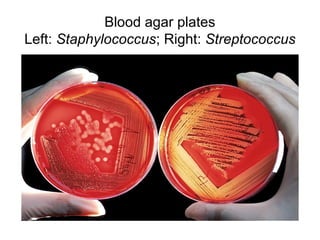
Blood agar plates
Left: Staphylococcus; Right: Streptococcus
Cultivation on selective media
• Chapman agar (mannitol salt):
– high salt content – inhibits Streptococcus, allows
Staphylococcus growth
– Mannitol fermentation – differentiates between:
• Staphylococcus aureus (manitol fermentation – changes the colour
of medium from pink to yellow) and
• Staphylococcus epidermidis (no manitol fermentation – medium
colour remains pink)
Biochemical differentiation
staphylococci / streptococci
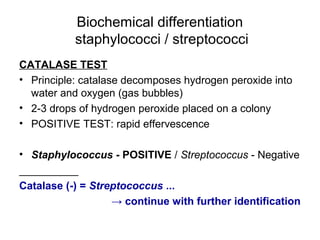
CATALASE TEST
• Principle: catalase decomposes hydrogen peroxide into
water and oxygen (gas bubbles)
• 2-3 drops of hydrogen peroxide placed on a colony
• POSITIVE TEST: rapid effervescence
• Staphylococcus - POSITIVE / Streptococcus - Negative
__________
Catalase (+) = Staphylococcus ...
→ continue with further identification
Differentiation between staphylococci i.e.
after positive catalase test
COAGULASE TEST
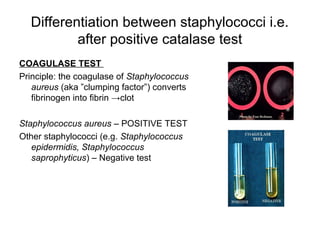
Principle: the coagulase of Staphylococcus
aureus (aka ”clumping factor”) converts
fibrinogen into fibrin →clot
Staphylococcus aureus – POSITIVE TEST
Other staphylococci (e.g. Staphylococcus
epidermidis, Staphylococcus
saprophyticus) – Negative test
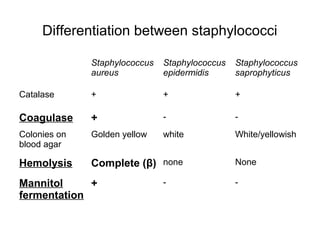
Differentiation between staphylococci
Staphylococcus
aureus
Staphylococcus
epidermidis
Staphylococcus
saprophyticus
Catalase + + +
Coagulase + - -
Colonies on
blood agar
Golden yellow white White/yellowish
Hemolysis Complete (β) none None
Mannitol
fermentation
+ - -
Biochemical differentiation
staphylococci / streptococci
CATALASE TEST
• Principle: catalase decomposes hydrogen peroxide into
water and oxygen (gas bubbles)
• 2-3 drops of hydrogen peroxide placed on a colony
• POSITIVE TEST: rapid effervescence
• Staphylococcus - POSITIVE / Streptococcus - Negative
__________
Catalase (-) = Streptococcus ...
→ continue with further identification
Differentiation between streptococci i.e. after
negative catalase test
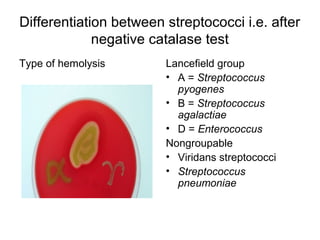
Type of hemolysis Lancefield group
• A = Streptococcus
pyogenes
• B = Streptococcus
agalactiae
• D = Enterococcus
Nongroupable
• Viridans streptococci
• Streptococcus
pneumoniae
Differentiation between streptococci i.e. after
negative catalase test - continued
BACITRACIN SENSITIVITY TEST
• (+) Streptococcus pyogenes / (-) Streptococcus
agalactiae
BILE SOLUBILITY TEST
• (+) Streptococcus pneumoniae / (-) Viridans streptococci
OPTOCHIN SENSITIVITY TEST
• (+) Streptococcus pneumoniae / (-) Viridans streptococci
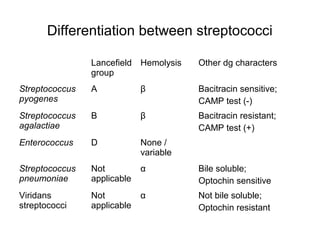
Differentiation between streptococci
Lancefield
group
Hemolysis Other dg characters
Streptococcus
pyogenes
A β Bacitracin sensitive;
CAMP test (-)
Streptococcus
agalactiae
B β Bacitracin resistant;
CAMP test (+)
Enterococcus D None /
variable
Streptococcus
pneumoniae
Not
applicable
α Bile soluble;
Optochin sensitive
Viridans
streptococci
Not
applicable
α Not bile soluble;
Optochin resistant
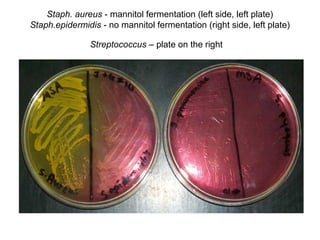
Staph. aureus - mannitol fermentation (left side, left plate)
Staph.epidermidis - no mannitol fermentation (right side, left plate)
Streptococcus – plate on the right

Staphylococcus streptococcus bacteriological diagnosis_ii

  • 1.
    Bacteriological diagnosis ofinfections caused by bacteria of Staphylococcus and Streptococcus genera - Part Two - http://www.slideshare.net/DanaSinzianaBreharCi/ staphylococcus-streptococcus-bacteriological-diagnosisii-45259850
  • 2.
    Gram positive cocci •Family: Micrococaceae • Genera: – Staphylococcus – Micrococcus – Stomatococcus – Planococcus • Family: Streptococacceae • Genera: – Streptococcus – Enterococcus – Aerococcus – Gemella – Leuconostoc – Pediococcus – Lactococcus
  • 3.
    Classification of streptococci Criteria: •I. Type of hemolysis produced by bacterial growth on blood agar • II. Antigenic structure (Lancefield)
  • 4.
    Classification of streptococciaccording to type of hemolysis • β-hemolytic streptococci: – Complete, clear hemolysis (medium around the colony is transparent = bacterial growth produced complete digestion of red blood cells in the blood agar) e.g. Streptococcus pyogenes • α-hemolytic streptococci: – partial hemolysis (medium around the colony is translucent and greenish = bacterial growth produced incomplete digestion of hemoglobin in the blood agar (conversion of hemoglobin to methemoglobin) e.g. Streptococcus viridans, Streptococcus pneumoniae) • Non-hemolytic streptococci
  • 5.
    Blood agar: Enterococcus fecalis(non-hemolytic/variable) and Streptococcus pyogenes (β-hemolysis)
  • 6.
  • 7.
    Left: Alpha hemolysis– Streptococcus pneumoniae Right: Beta hemolysis – Streptococcus pyogenes
  • 8.
  • 9.
    Classification of streptococciaccording to antigenic structure (Lancefield grouping) Rebecca Lancefield (1895-1981) (American microbiologist at the Rockefeller Institute for Medical Research) • based upon the C polysacharidic antigen (group-specific) in bacterial wall → groups A – H and K-V • based upon M and T proteins (type specific) → over 80 types of group A streptococci • !! Lancefield grouping does not include streptococci lacking group antigens e.g. Str.pneumoniae, Str.viridans, etc.)
  • 11.
  • 12.
    Genus Streptococcus • Clinicallysignificant microbial species: – Streptococcus pyogenes (group A): cellulitis, pharyngitis, scarlet fever + complications: articular (acute rheumatic fever), cardiac (rheumatic carditis), renal (glomerulonephritis) – Streptococcus agalactiae (group B): severe infections in neonates (pneumonia, meningitis), urogenital infections, sepsis – Streptococcus pneumoniae: pneumonia, bronchopneumonia, meningitis – Viridans streptococci: Streptococcus mutans, Streptococcus sanguis, Streptococcus anginosus (dental caries, periodontal disease + septicaemia, endocarditis)
  • 13.
    Streptococcus pyogenes (group A) -clinical significance - • Acute, respiratory infections: pharyngitis, scarlet fever + complications: articular (acute rheumatic fever), cardiac (rheumatic carditis), renal (glomerulonephritis) • Skin infections: erysipelas, impetigo, intertrigo, pemfigus, celulitis, abscesses + complications: sepsis
  • 14.
    Streptococcus pyogenes: Steps ofbacteriological diagnosis • Collection of specimens (e.g. pus, pharyngeal exudate, content of vesicles, CSF, urine, etc) • Microscopic examination • Inoculation of culture media • Biochemical tests • Agglutination tests • Serological diagnosis • Antimicrobial susceptibility tests (antibiogram)
  • 15.
    ”Strep throat” –Pharyngitis with Streptococcus pyogenes: left – petechiae; right – pus deposits
  • 16.
    Scarlet fever: red rash;”strawberry tongue”
  • 17.
    Erysipelas – streptococcalinfection of the dermis and superficial lymph vessels
  • 18.
  • 19.
    Streptococcus pyogenes – Microscopicexamination - Gram stained smears: • Cocci: – Round / ovoid shape; arranged in chains / pairs – Gram positive – Aerobic growth (+anaerobic)
  • 20.
    Streptococcus pyogenes: Gramstained smear: ovoid Gram positive cocci, arranged in chains
  • 21.
    Streptococcus – Gramstained smear • Chains of ovoid, Gram positive cocci
  • 22.
  • 23.
    Streptococcus pyogenes - Cultivation& isolation - • Blood containing media e.g. blood agar, Todd-Hewit broth, SSP (selective medium for streptococci and pneumococci) • Most frequently: – (Initial inoculation of selective medium (Pick) – favours growth and multiplication of streptococci and inhibits other bacterial species) – ↓ – Reinoculation on 5% sheep blood agar
  • 24.
    Streptococcus pyogenes - identification- • Colonial characters: – small, pinpont, 0.5 µM diameter, transparent – β-hemolysis - complete digestion of red blood cell contents surrounding colony • Group identification: 1. bacitracin sensitivity test – group A streptococci are bacitracin sensitive / other streptococci are resistant 2. Immune-based tests (Ag-Ab) – agglutination/precipitation
  • 25.
    Streptococcus pyogenes onblood agar • Small, pinpoint colonies • Complete hemolysis (transparent area around colonies)
  • 26.
    Streptococcal group identification 1.Bacitracin sensitivity test • used to determine the effect of a small amount of bacitracin (0.04 U) on an organism. • Streptococcus pyogenes (group A) is inhibited (minimum 10 mm inhibition diameter) by the small amount of bacitracin in the disk; other beta-hemolytic streptococci usually are not
  • 27.
    Streptococcal group identification 2.Ag-Ac reactions • Principle: contact between streptococcal group Ag (C polysacharide) and homologous Ab (serum anti-group A / B / C...= ”antisera”) • the C polysacharide is located within the bacterial wall • ↓ • Preliminary extraction is required
  • 28.
    Streptococcal group identification 2.Ag-Ac reactions - Methods 1. ”Lancefield” precipitation • extraction of the C polysacharide with HCl + heating • contact with set of antisera (anti-group A/B...) 1. Agglutination • enzymatic extraction of the C polysacharide • contact with set of antisera (anti-group A/B...)
  • 29.
    Streptococcal group identification 2.Ag-Ac reactions – Methods - continued 3. Co-agglutination • enzymatic extraction of the C polysacharide • slide agglutination with antisera adsorbed on protein A of staphylococci 4. Latex agglutination - Similar with co-agglutination; group specific Ab (antisera) adsorbed on latex particles
  • 30.
    Streptococcal type identification Performedfor epidemiologic purposes • M typing: – precipitation in capillary tubes with anti-M sera – typing based upon M protein (virulence factor with anti- phagocytic capacity) • T typing: – slide agglutination with anti-T sera • PCR – for non-typable germs
  • 31.
    Antimicrobial sensitivity • Streptococcuspyogenes – sensitive to penicillin (no antibiogram required); • Final step of bacteriological diagnosis: perform the bacitracin sensitivity test on a culture of β-hemolytic streptococci – POSITIVE test = group A
  • 32.
    Streptococcus pyogenes - Serologicaldiagnosis - • Used in case of late complications – germs are difficult to detect in culture • Detection of serum antibodies against bacterial: – products: • streptolysin O (toxin responsible for hemolysis), • streptokynase (enzyme responsible for fibrinolysis – clot lysis) – components: • M antigen, MAP (M antigen associated protein)
  • 33.
    Streptococcus pyogenes - Serologicaldiagnosis - continued • ASLO test = detection of serum anti-streptolysin O antibodies in patient serum • SLO present in streptococci of group A + C and G • Principle: ASLO Ab neutralize the effect of streptolysin O (SLO) on red blood cells (= annihilation of hemolysis)
  • 34.
    ASLO test -Reaction steps: • tubes with serial dilutions of patient serum • add standard amount of streptolysin O • incubation – IF ASLO Ab present in patient serum → SLO blocked in Ag-Ab complex – will not act upon red blood cells (see below) – IF ASLO Ab absent in patient serum → no Ag-Ab complex → SLO not neutralized – will act upon red blood cells (see below) • add suspension of rabbit red blood cells (RBC) – POSITIVE result = no hemolysis (SLO neutralized by Ab in patient serum); RBC deposit at the bottom of tube – NEGATIVE result = hemolysis (no Ab to neutralize SLO; SLO acts upon red blood cells → hemolysis)
  • 35.
    ASLO test –Reading the results • The titre of ASLO Ab = the dilution in the last tube where hemolysis is absent • Normal titer values: 166-200 u/ml • ASLO titers 200 u/ml = Recent infection˃ • repeated testing e.g. after angina with Streptococcus group A: increasing titer up to a maximum ~2500 u/ml in 5 weeks; decrease to normal values within 6-12 months = cured infection
  • 36.
    ASLO-latex: rapid detection ofASLO Ab by slide agglutination
  • 37.
    Streptococcus agalactiae (groupB) - clinical significance - • Comensal: intestine, vagina, male urethra, upper airways • Clinical significance: Severe infections: – in newborns: • pneumonia acquired during birth (maternal vaginal colonization /infection) • meninigitis – hospital acquired infection – In immune-compromised adults/elderly: • Meningitis, myocarditis, respiratory infections, sepsis
  • 38.
    Streptococcus agalactiae (groupB) Steps of the bacteriological diagnosis • Collection of specimens: – Vaginal / cervical secretion, CSF • Microscopic examination: – Gram positive cocci, chains/pairs/isolated – no particular diagnostic value • Innoculation of culture media: – blood agar, “chocolate” agar – Colonial characters: • colonies – slightly larger than group A streptococci, • hemolysis – variable / partial / “foggy” (α´-hemolysis) Not enough! Further tests required…
  • 39.
    Streptococcus agalactiae: Gram positiveovoid cocci in short chains
  • 40.
    Streptococcus agalactiae (groupB) The CAMP* test Principle: • hemolysis produced by Staphylococcus aureus acts synergistically with the CAMP factor produced by Streptococcus agalactiae (group B)→ enhanced hemolysis in the region where the 2 cultures meet • CAMP factor – pathogenicity factor - extracellular cytolysin (cytolytic protein) that binds the Fc fragments of immunoglobulin G (IgG), similar to protein A of Staphylococcus aureus • Protocol: co-cultivation of S.aureus and (suspected) Streptococcus agalactiae (group B); plate inoculation by PERPENDICULAR, SINGLE STREAKS *acronym for "Christie–Atkins–Munch-Petersen",for the three researchers who discovered the phenomenon
  • 41.
    The CAMP test- continued (A) Streptococcus (group B) positive test (enhanced hemolysis) (B) Streptococcus pyogenes (group A) negative test (C) Staphylococcus aureus
  • 42.
    Streptococcus agalactiae (groupB) Steps of the bacteriological diagnosis - continued • Antimicrobial susceptibility testing – mandatory! • WHY?: Streptococcus agalactiae strains resistant to penicillin have been isolated
  • 43.
  • 44.
    Viridans streptococci • Groupof streptococci which are comensal in: – oral cavity (a.k.a. oral streptococci) – Intestine – Skin – Genital tract • Oral streptococci: Streptococcus mutans, Streptococcus sanguis, Streptococcus anginosus (dental caries, periodontal disease + septicaemia, endocarditis) • No Lancefield antigens !!
  • 45.
    Viridans streptococci -continued • Sreptococcus mutans - etiologic agent of dental caries • Other streptococci may be involved in other mouth or gingival infections • If introduced into the bloodstream (e.g. following tooth extraction) - potential of causing endocarditis, particularly in individuals with damaged heart valves (the most common causes of subacute bacterial endocarditis)
  • 46.
  • 47.
  • 48.
    Streptococcus pneumoniae • Clinicalsignificance: • comensal germ of the upper airways; may become pathogenic when encapsulated • Meningitis, pneumonia, broncho-pneumonia
  • 49.
    Streptococcus pneumoniae Steps ofbacteriological diagnosis • Collection of specimens: sputum, CSF, blood, etc • Macroscopic examination: “rusty” sputum • Microscopic examination: – Gram stained smears: white blood cells + Gram positive cocci, in diplo/short chains; characteristic aspect: two candle flames ◄► touching with their basis • Cultivation: – blood agar (in CO2 atmosphere), 37°C, 24 hrs; – colonial characters: small, smooth colonies with α-hemolysis (green); colonies become depressed in time (autolysis) = differentiation from viridans streptococci
  • 51.
    Streptococcus pneumoniae –Gram stained sputum smear
  • 52.
  • 53.
    Left: Alpha hemolysis– Streptococcus pneumoniae Right: Beta hemolysis – Streptococcus pyogenes
  • 54.
  • 55.
    How to differentiatebetween α-hemolytic streptococci? • Streptococcus pneumoniae ≠ Viridans streptococci • Autolysis: self digestion of colonies in time (present in Str.pneumoniae and absent in viridans str.) – see above • Bile solubility test • Optochin sensitivity test
  • 56.
    The Bile solubilitytest • Principle: Bile salts selectively lyse Streptococcus pneumoniae when added onto cultures on agar / broth • POSITIVE TEST on agar: colony ”disappears” upon addition of bile salts • POSITIVE TEST in broth: turbidity of broth (reflecting bacterial growth) clarifies upon addition of bile salts • Negative test: Streptococcus viridans (bile-insoluble)
  • 57.
  • 58.
    Streptococcus pneumoniae The optochinsensitivity test • Streptococcus pneumoniae (optochin sensitive) – bacterial growth inhibited around the optochin impregnated disk • viridans streptococci (optochin resistant)
  • 59.
    Gram positive cocci •Family: Micrococaceae • Genera: – Staphylococcus – Micrococcus – Stomatococcus – Planococcus • Family: Streptococacceae • Genera: – Streptococcus – Enterococcus – Aerococcus – Gemella – Leuconostoc – Pediococcus – Lactococcus
  • 60.
  • 61.
    Genus Entreococcus • Previouslyclassified as group D Streptococcus • Clinical significance: – endocarditis, uro-genital infections, meningitis • Steps of bacteriological diagnosis: – Collection of specimens – depending on infection site – Microscopy: Gram positive cocci, short chains/pairs – Cultivation: blood agar – small nonhemolytic colonies; – identification: • group D polysacharide • biochemical tests
  • 62.
    Blood agar: Enterococcusfecalis (non-hemolytic) and Streptococcus pyogenes (hemolytic)
  • 63.
  • 64.
    Vancomycin Resistant Enterococcusfecalis (VRE) on selective medium containing vancomycin
  • 65.
    To sum up: •logical steps of the bacteriological diagnosis ↓ • Id. of Staphylococcus / Streptococcus infections (similarities & differences)
  • 66.
    Microscopy: Gram stainedsmears Similar shape; Different arrangement
  • 67.
  • 68.
    Cultivation (blood agar)– absence / presence & type of hemolysis Staphylococcus Streptococcus
  • 69.
    Blood agar plates Left:Staphylococcus; Right: Streptococcus
  • 70.
    Cultivation on selectivemedia • Chapman agar (mannitol salt): – high salt content – inhibits Streptococcus, allows Staphylococcus growth – Mannitol fermentation – differentiates between: • Staphylococcus aureus (manitol fermentation – changes the colour of medium from pink to yellow) and • Staphylococcus epidermidis (no manitol fermentation – medium colour remains pink)
  • 71.
    Biochemical differentiation staphylococci /streptococci CATALASE TEST • Principle: catalase decomposes hydrogen peroxide into water and oxygen (gas bubbles) • 2-3 drops of hydrogen peroxide placed on a colony • POSITIVE TEST: rapid effervescence • Staphylococcus - POSITIVE / Streptococcus - Negative __________ Catalase (+) = Staphylococcus ... → continue with further identification
  • 72.
    Differentiation between staphylococcii.e. after positive catalase test COAGULASE TEST Principle: the coagulase of Staphylococcus aureus (aka ”clumping factor”) converts fibrinogen into fibrin →clot Staphylococcus aureus – POSITIVE TEST Other staphylococci (e.g. Staphylococcus epidermidis, Staphylococcus saprophyticus) – Negative test
  • 73.
    Differentiation between staphylococci Staphylococcus aureus Staphylococcus epidermidis Staphylococcus saprophyticus Catalase+ + + Coagulase + - - Colonies on blood agar Golden yellow white White/yellowish Hemolysis Complete (β) none None Mannitol fermentation + - -
  • 74.
    Biochemical differentiation staphylococci /streptococci CATALASE TEST • Principle: catalase decomposes hydrogen peroxide into water and oxygen (gas bubbles) • 2-3 drops of hydrogen peroxide placed on a colony • POSITIVE TEST: rapid effervescence • Staphylococcus - POSITIVE / Streptococcus - Negative __________ Catalase (-) = Streptococcus ... → continue with further identification
  • 75.
    Differentiation between streptococcii.e. after negative catalase test Type of hemolysis Lancefield group • A = Streptococcus pyogenes • B = Streptococcus agalactiae • D = Enterococcus Nongroupable • Viridans streptococci • Streptococcus pneumoniae
  • 76.
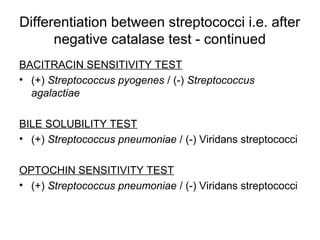
    Differentiation between streptococcii.e. after negative catalase test - continued BACITRACIN SENSITIVITY TEST • (+) Streptococcus pyogenes / (-) Streptococcus agalactiae BILE SOLUBILITY TEST • (+) Streptococcus pneumoniae / (-) Viridans streptococci OPTOCHIN SENSITIVITY TEST • (+) Streptococcus pneumoniae / (-) Viridans streptococci
  • 77.
    Differentiation between streptococci Lancefield group HemolysisOther dg characters Streptococcus pyogenes A β Bacitracin sensitive; CAMP test (-) Streptococcus agalactiae B β Bacitracin resistant; CAMP test (+) Enterococcus D None / variable Streptococcus pneumoniae Not applicable α Bile soluble; Optochin sensitive Viridans streptococci Not applicable α Not bile soluble; Optochin resistant
  • 78.
    Staph. aureus -mannitol fermentation (left side, left plate) Staph.epidermidis - no mannitol fermentation (right side, left plate) Streptococcus – plate on the right