Main Steps in Bacteriological 
Diagnosis
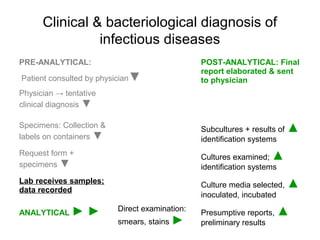
The diagnostic cycle 
Laboratory testing – series of events: 
I. Pre-analytical 
II. Analytical = observation & isolation & identification & 
enumeration 
III. Post-analytical 
Performance must be monitored throughout the entire cycle 
for quality assurance i.e. accurate, reliable results
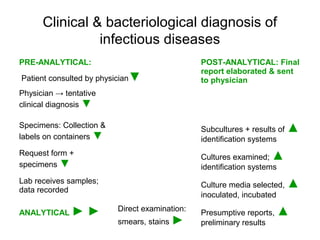
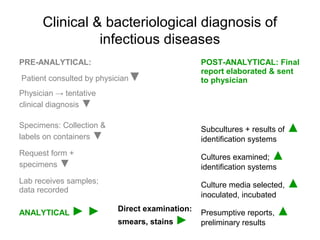
Clinical & bacteriological diagnosis of 
infectious diseases 
PRE-ANALYTICAL: 
Patient consulted by physician▼ 
POST-ANALYTICAL: Final 
report elaborated & sent 
to physician 
Physician → tentative 
clinical diagnosis ▼ 
Specimens: Collection & 
labels on containers ▼ Subcultures + results of ▲ 
identification systems 
Request form + 
specimens ▼ Cultures examined; ▲ 
identification systems 
Lab receives samples; 
data recorded Culture media selected, ▲ 
inoculated, incubated 
ANALYTICAL ► ► Direct examination: 
smears, stains ► Presumptive reports, ▲ 
preliminary results
Pre-analytic phase: Specimen collection 
• Crucial for confirming a certain microorganism as cause of the 
clinically suspected infectious disease 
• Improper specimen collection may cause: 
– Failure to recover the microorganism (no growth on culture medium) 
– Incorrect / harmful therapy e.g directed against a comensal / 
contaminant microorganism 
E.g. Klebsiella pneumoniae: 
- recovered from sputum of pneumonia patient; 
- recognised causative agent of pneumonia BUT also may colonize the 
naso-pharynx 
- If sputum sample consisted mostly of saliva then isolating 
K.pneumoniae might not reflect the true cause of the patient‘s 
pneumonia but saliva contamination of the sputum sample
Pre-analytic phase: Specimen collection 
(continued) 
Rules for correct specimen collection: 
1. Source: actual infection site; minimal contamination 
from adjacent tissues, organs, secretions e.g. throat 
swabs from peritonsillar fossae and posterior 
pharyngeal wall, avoiding contact with other oral areas 
2. Optimal moment: depending on the natural history 
and pathophysiology of the infectious process e.g. 
Typhoid fever: blood – 1st week; feces and urine – 
2nd-3rd week 
3. Sufficient quantity
Pre-analytic phase: Specimen collection 
(continued) 
Rules for correct specimen collection (continued): 
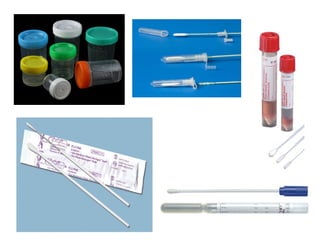
4. Appropriate collection devices, containers 
+ transport systems (container ± transport medium): main objective 
to decrease time between collection and inoculation to prevent lack 
of recovery of certain bacteria 
5. Sample collection before antibiotics (if possible) 
6. Smears performed to supplement culture (if possible) 
- Assessment of inflammatory nature of specimen → aid the clinical 
integration (meaningfulness) of the culture result 
- Gram smears e.g. Gram negative bacilli + no growth on aerobic culture 
(wrong atmosphere or wrong media i.e. fastidious microbes e.g. 
Legionella)
Pre-analytic phase: Specimen collection 
(continued) 
Rules for correct specimen collection (continued): 
7. Labeling of specimen containers & Request form: 
• Legible 
• Minimun information: 
– Patient name; identification number (hospital file, practice log book, etc) 
– Source of specimen; clinician + contact data (phone no) 
– Date and hour of collection 
– Clinical diagnosis (suspected infection) 
– Treatments (antibiotics?...)
Pre-analytic phase: Transport 
Main transport related objectives: 
- Sample related: Transport media 
- Maintain the sample as similar to its original state as possible 
- Human & environment related: Packaging and transport 
systems and regulations 
- Prevent contamination/infection of healthcare staff & 
environment & general population (biosafety)
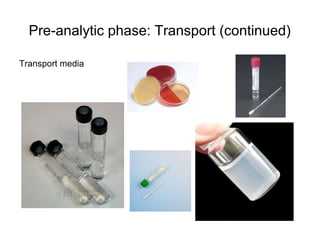
Pre-analytic phase: Transport (continued) 
Transport media
Pre-analytic phase: Transport (continued) 
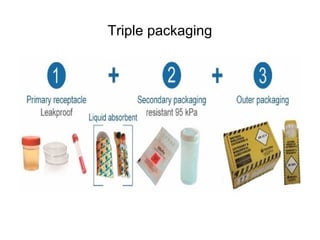
”Triple” Packaging of biological samples: 
- Outer box (usually cardboard, rigid, secure closure system, 
adequately labeled to state content) 
- Inner container (waterproof, resistant to pressure, usually plastic, 
securely closed by lid, contains additional materials to absorb 
shocks e.g. bubbled plastic bags and leackages e.g. absorbent 
material 
- Sample containers (tubes, plates) inserted in the inner plastic 
container, wrapped in above mentioned shock- and fluid absorbent 
materials 
- + request form and other documents inserted in sealed plastic bags, 
inserted in outer box or sticked to its exterior
Triple packaging
Pre-analytic phase: Transport (continued) 
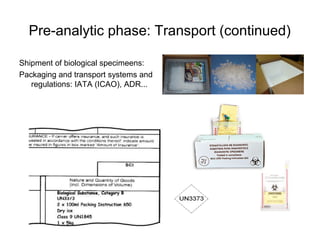
Shipment of biological specimeens: 
Packaging and transport systems and 
regulations: IATA (ICAO), ADR...
Clinical & bacteriological diagnosis of 
infectious diseases 
PRE-ANALYTICAL: 
Patient consulted by physician▼ 
POST-ANALYTICAL: Final 
report elaborated & sent 
to physician 
Physician → tentative 
clinical diagnosis ▼ 
Specimens: Collection & 
labels on containers ▼ Subcultures + results of ▲ 
identification systems 
Request form + 
specimens ▼ Cultures examined; ▲ 
identification systems 
Lab receives samples; 
data recorded Culture media selected, ▲ 
inoculated, incubated 
ANALYTICAL ► ► Direct examination: 
smears, stains ► Presumptive reports, ▲ 
preliminary results
Specimen receipt & preliminary 
observations (continued) 
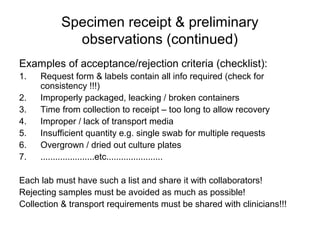
Examples of acceptance/rejection criteria (checklist): 
1. Request form & labels contain all info required (check for 
consistency !!!) 
2. Improperly packaged, leacking / broken containers 
3. Time from collection to receipt – too long to allow recovery 
4. Improper / lack of transport media 
5. Insufficient quantity e.g. single swab for multiple requests 
6. Overgrown / dried out culture plates 
7. ......................etc....................... 
Each lab must have such a list and share it with collaborators! 
Rejecting samples must be avoided as much as possible! 
Collection & transport requirements must be shared with clinicians!!!
Specimen receipt & preliminary 
observations 
• Specially designed area / room for receiving and 
recording samples 
• Rules for manipulating samples and accompanying 
documents (UNIVERSAL PRECAUTIONS): 
– Samples: biological safety cabinet (BSC), personal protective 
equipment (PPE): lab coat, gloves, eye&respiratory protection 
– Documents – handled by different person / at different stage e.g. 
either before or after preliminary examination/processing of 
sample (after removal of gloves & hand washing) – purpose: 
avoid cross contamination of objects (log record book, computer, 
pens, etc)
Specimen receipt & preliminary 
observations (continued) 
Preliminary actions upon receipt of specimens 
1. Data entry into lab log book/computer database 
2. (Unpacking and) visual examination – check for 
acceptance criteria (see next slide) 
+ 
3. Microscopic examination of direct mounts/stained 
smears → presumptive diagnosis 
4. Sample(s) taken to area/room where the analytical 
phase begins
Clinical & bacteriological diagnosis of 
infectious diseases 
PRE-ANALYTICAL: 
Patient consulted by physician▼ 
POST-ANALYTICAL: Final 
report elaborated & sent 
to physician 
Physician → tentative 
clinical diagnosis ▼ 
Specimens: Collection & 
labels on containers ▼ Subcultures + results of ▲ 
identification systems 
Request form + 
specimens ▼ Cultures examined; ▲ 
identification systems 
Lab receives samples; 
data recorded Culture media selected, ▲ 
inoculated, incubated 
ANALYTICAL ► ► Direct examination: 
smears, stains ► Presumptive reports, ▲ 
preliminary results
Bacterial infections: 
direct identification & characterization methods 
• Microscopy 
• Cultivation 
• Antimicrobial sensitivity
Microscopy 
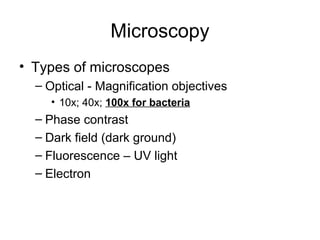
• Types of microscopes 
– Optical - Magnification objectives 
• 10x; 40x; 100x for bacteria 
– Phase contrast 
– Dark field (dark ground) 
– Fluorescence – UV light 
– Electron
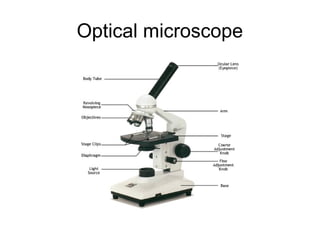
Optical microscope
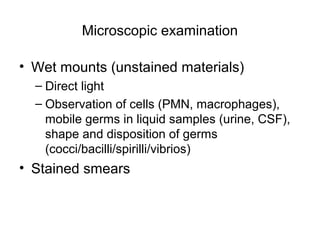
Microscopic examination 
• Wet mounts (unstained materials) 
– Direct light 
– Observation of cells (PMN, macrophages), 
mobile germs in liquid samples (urine, CSF), 
shape and disposition of germs 
(cocci/bacilli/spirilli/vibrios) 
• Stained smears
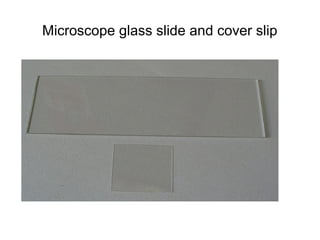
Microscope glass slide and cover slip
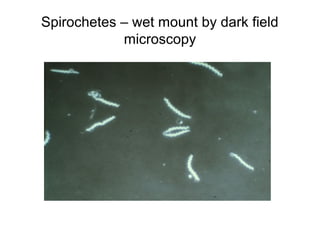
Spirochetes – wet mount by dark field 
microscopy
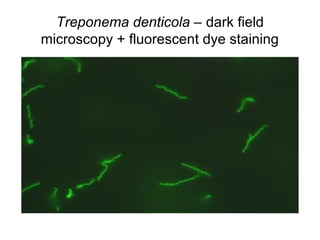
Treponema denticola – dark field 
microscopy + fluorescent dye staining
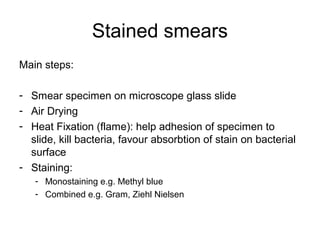
Stained smears 
Main steps: 
- Smear specimen on microscope glass slide 
- Air Drying 
- Heat Fixation (flame): help adhesion of specimen to 
slide, kill bacteria, favour absorbtion of stain on bacterial 
surface 
- Staining: 
- Monostaining e.g. Methyl blue 
- Combined e.g. Gram, Ziehl Nielsen
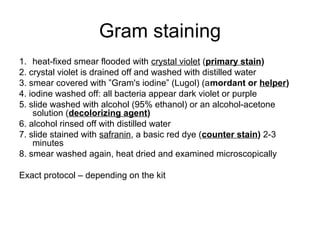
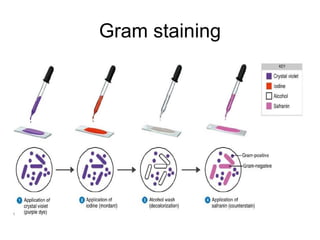
Gram staining 
1. heat-fixed smear flooded with crystal violet (primary stain) 
2. crystal violet is drained off and washed with distilled water 
3. smear covered with ”Gram's iodine” (Lugol) (amordant or helper) 
4. iodine washed off: all bacteria appear dark violet or purple 
5. slide washed with alcohol (95% ethanol) or an alcohol-acetone 
solution (decolorizing agent) 
6. alcohol rinsed off with distilled water 
7. slide stained with safranin, a basic red dye (counter stain) 2-3 
minutes 
8. smear washed again, heat dried and examined microscopically 
Exact protocol – depending on the kit
Gram staining
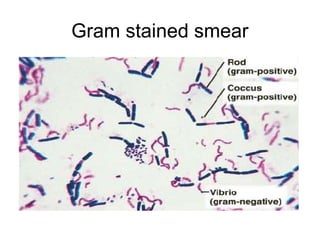
Gram stained smear
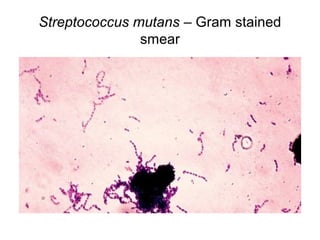
Streptococcus mutans – Gram stained 
smear
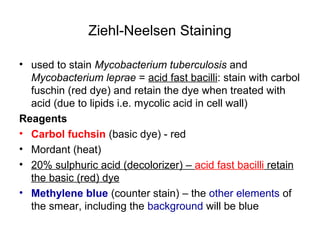
Ziehl-Neelsen Staining 
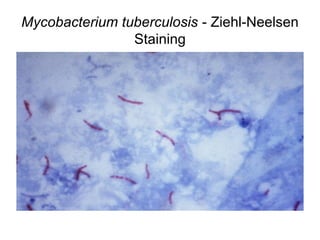
• used to stain Mycobacterium tuberculosis and 
Mycobacterium leprae = acid fast bacilli: stain with carbol 
fuschin (red dye) and retain the dye when treated with 
acid (due to lipids i.e. mycolic acid in cell wall) 
Reagents 
• Carbol fuchsin (basic dye) - red 
• Mordant (heat) 
• 20% sulphuric acid (decolorizer) – acid fast bacilli retain 
the basic (red) dye 
• Methylene blue (counter stain) – the other elements of 
the smear, including the background will be blue
Mycobacterium tuberculosis - Ziehl-Neelsen 
Staining
Giemsa staining 
• Smears from blood, vaginal / urethral secretion, bone 
marrow aspirate 
Steps: 
- Fixation with methanol (2-3 min) 
- Coloration with Giemsa solution 
- Washing – buffered water 
- Drying 
- Microscopic examination
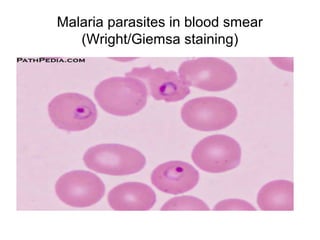
Malaria parasites in blood smear 
(Wright/Giemsa staining)
Microscopy for various biological specimens 
• CSF: 
– wet mounts – assess type & no of cells (white/red blood cells) 
– Stained smears from centrifugation sediment: Gram, Ziehl- 
Neelsen + aditional smear 
– Presumptive causative agents: 
• High no of PMN on wet mount→ bacterial meningitis Neisseria 
meningitidis, Haempohilus influenzae 
• Ziehl-Neelsen stained smear – very important in case 
M.tuberculosis is suspected (cultures take 2-3 weeks)
Microscopy for various biological specimens 
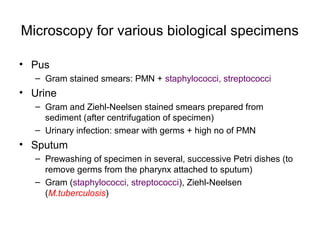
• Pus 
– Gram stained smears: PMN + staphylococci, streptococci 
• Urine 
– Gram and Ziehl-Neelsen stained smears prepared from 
sediment (after centrifugation of specimen) 
– Urinary infection: smear with germs + high no of PMN 
• Sputum 
– Prewashing of specimen in several, successive Petri dishes (to 
remove germs from the pharynx attached to sputum) 
– Gram (staphylococci, streptococci), Ziehl-Neelsen 
(M.tuberculosis)
Bacterial infections: 
direct identification & characterization methods 
• Microscopy 
• Cultivation (see presentation on culture media) 
• Antimicrobial sensitivity
Cultivation of bacteria on culture media 
• Purpose: isolated colonies (single microbial species) 
• Identification: 
– Gram stained smears (from colonies) 
– Morphology of colonies (shape, dimensions, margins, colour, ...) 
– Changes in the culture medium (e.g. Hemolysis) 
– Biochemical characters: 
• Enzyme secretion (coagulase, catalase, oxydase) 
• Fermentation of sugars 
• Production of H2S 
– Immune assays: agglutination, immune fluorescence, ELISA
Bacterial infections: 
direct identification & characterization methods 
• Microscopy 
• Cultivation 
• Antimicrobial sensitivity
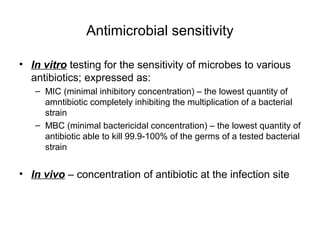
Antimicrobial sensitivity 
• In vitro testing for the sensitivity of microbes to various 
antibiotics; expressed as: 
– MIC (minimal inhibitory concentration) – the lowest quantity of 
amntibiotic completely inhibiting the multiplication of a bacterial 
strain 
– MBC (minimal bactericidal concentration) – the lowest quantity of 
antibiotic able to kill 99.9-100% of the germs of a tested bacterial 
strain 
• In vivo – concentration of antibiotic at the infection site

Main steps in bacteriological diagnosis

  • 1.
    Main Steps inBacteriological Diagnosis
  • 2.
    The diagnostic cycle Laboratory testing – series of events: I. Pre-analytical II. Analytical = observation & isolation & identification & enumeration III. Post-analytical Performance must be monitored throughout the entire cycle for quality assurance i.e. accurate, reliable results
  • 3.
    Clinical & bacteriologicaldiagnosis of infectious diseases PRE-ANALYTICAL: Patient consulted by physician▼ POST-ANALYTICAL: Final report elaborated & sent to physician Physician → tentative clinical diagnosis ▼ Specimens: Collection & labels on containers ▼ Subcultures + results of ▲ identification systems Request form + specimens ▼ Cultures examined; ▲ identification systems Lab receives samples; data recorded Culture media selected, ▲ inoculated, incubated ANALYTICAL ► ► Direct examination: smears, stains ► Presumptive reports, ▲ preliminary results
  • 4.
    Pre-analytic phase: Specimencollection • Crucial for confirming a certain microorganism as cause of the clinically suspected infectious disease • Improper specimen collection may cause: – Failure to recover the microorganism (no growth on culture medium) – Incorrect / harmful therapy e.g directed against a comensal / contaminant microorganism E.g. Klebsiella pneumoniae: - recovered from sputum of pneumonia patient; - recognised causative agent of pneumonia BUT also may colonize the naso-pharynx - If sputum sample consisted mostly of saliva then isolating K.pneumoniae might not reflect the true cause of the patient‘s pneumonia but saliva contamination of the sputum sample
  • 5.
    Pre-analytic phase: Specimencollection (continued) Rules for correct specimen collection: 1. Source: actual infection site; minimal contamination from adjacent tissues, organs, secretions e.g. throat swabs from peritonsillar fossae and posterior pharyngeal wall, avoiding contact with other oral areas 2. Optimal moment: depending on the natural history and pathophysiology of the infectious process e.g. Typhoid fever: blood – 1st week; feces and urine – 2nd-3rd week 3. Sufficient quantity
  • 7.
    Pre-analytic phase: Specimencollection (continued) Rules for correct specimen collection (continued): 4. Appropriate collection devices, containers + transport systems (container ± transport medium): main objective to decrease time between collection and inoculation to prevent lack of recovery of certain bacteria 5. Sample collection before antibiotics (if possible) 6. Smears performed to supplement culture (if possible) - Assessment of inflammatory nature of specimen → aid the clinical integration (meaningfulness) of the culture result - Gram smears e.g. Gram negative bacilli + no growth on aerobic culture (wrong atmosphere or wrong media i.e. fastidious microbes e.g. Legionella)
  • 8.
    Pre-analytic phase: Specimencollection (continued) Rules for correct specimen collection (continued): 7. Labeling of specimen containers & Request form: • Legible • Minimun information: – Patient name; identification number (hospital file, practice log book, etc) – Source of specimen; clinician + contact data (phone no) – Date and hour of collection – Clinical diagnosis (suspected infection) – Treatments (antibiotics?...)
  • 9.
    Pre-analytic phase: Transport Main transport related objectives: - Sample related: Transport media - Maintain the sample as similar to its original state as possible - Human & environment related: Packaging and transport systems and regulations - Prevent contamination/infection of healthcare staff & environment & general population (biosafety)
  • 10.
    Pre-analytic phase: Transport(continued) Transport media
  • 11.
    Pre-analytic phase: Transport(continued) ”Triple” Packaging of biological samples: - Outer box (usually cardboard, rigid, secure closure system, adequately labeled to state content) - Inner container (waterproof, resistant to pressure, usually plastic, securely closed by lid, contains additional materials to absorb shocks e.g. bubbled plastic bags and leackages e.g. absorbent material - Sample containers (tubes, plates) inserted in the inner plastic container, wrapped in above mentioned shock- and fluid absorbent materials - + request form and other documents inserted in sealed plastic bags, inserted in outer box or sticked to its exterior
  • 12.
  • 13.
    Pre-analytic phase: Transport(continued) Shipment of biological specimeens: Packaging and transport systems and regulations: IATA (ICAO), ADR...
  • 14.
    Clinical & bacteriologicaldiagnosis of infectious diseases PRE-ANALYTICAL: Patient consulted by physician▼ POST-ANALYTICAL: Final report elaborated & sent to physician Physician → tentative clinical diagnosis ▼ Specimens: Collection & labels on containers ▼ Subcultures + results of ▲ identification systems Request form + specimens ▼ Cultures examined; ▲ identification systems Lab receives samples; data recorded Culture media selected, ▲ inoculated, incubated ANALYTICAL ► ► Direct examination: smears, stains ► Presumptive reports, ▲ preliminary results
  • 15.
    Specimen receipt &preliminary observations (continued) Examples of acceptance/rejection criteria (checklist): 1. Request form & labels contain all info required (check for consistency !!!) 2. Improperly packaged, leacking / broken containers 3. Time from collection to receipt – too long to allow recovery 4. Improper / lack of transport media 5. Insufficient quantity e.g. single swab for multiple requests 6. Overgrown / dried out culture plates 7. ......................etc....................... Each lab must have such a list and share it with collaborators! Rejecting samples must be avoided as much as possible! Collection & transport requirements must be shared with clinicians!!!
  • 16.
    Specimen receipt &preliminary observations • Specially designed area / room for receiving and recording samples • Rules for manipulating samples and accompanying documents (UNIVERSAL PRECAUTIONS): – Samples: biological safety cabinet (BSC), personal protective equipment (PPE): lab coat, gloves, eye&respiratory protection – Documents – handled by different person / at different stage e.g. either before or after preliminary examination/processing of sample (after removal of gloves & hand washing) – purpose: avoid cross contamination of objects (log record book, computer, pens, etc)
  • 17.
    Specimen receipt &preliminary observations (continued) Preliminary actions upon receipt of specimens 1. Data entry into lab log book/computer database 2. (Unpacking and) visual examination – check for acceptance criteria (see next slide) + 3. Microscopic examination of direct mounts/stained smears → presumptive diagnosis 4. Sample(s) taken to area/room where the analytical phase begins
  • 18.
    Clinical & bacteriologicaldiagnosis of infectious diseases PRE-ANALYTICAL: Patient consulted by physician▼ POST-ANALYTICAL: Final report elaborated & sent to physician Physician → tentative clinical diagnosis ▼ Specimens: Collection & labels on containers ▼ Subcultures + results of ▲ identification systems Request form + specimens ▼ Cultures examined; ▲ identification systems Lab receives samples; data recorded Culture media selected, ▲ inoculated, incubated ANALYTICAL ► ► Direct examination: smears, stains ► Presumptive reports, ▲ preliminary results
  • 19.
    Bacterial infections: directidentification & characterization methods • Microscopy • Cultivation • Antimicrobial sensitivity
  • 20.
    Microscopy • Typesof microscopes – Optical - Magnification objectives • 10x; 40x; 100x for bacteria – Phase contrast – Dark field (dark ground) – Fluorescence – UV light – Electron
  • 21.
  • 22.
    Microscopic examination •Wet mounts (unstained materials) – Direct light – Observation of cells (PMN, macrophages), mobile germs in liquid samples (urine, CSF), shape and disposition of germs (cocci/bacilli/spirilli/vibrios) • Stained smears
  • 23.
    Microscope glass slideand cover slip
  • 24.
    Spirochetes – wetmount by dark field microscopy
  • 25.
    Treponema denticola –dark field microscopy + fluorescent dye staining
  • 26.
    Stained smears Mainsteps: - Smear specimen on microscope glass slide - Air Drying - Heat Fixation (flame): help adhesion of specimen to slide, kill bacteria, favour absorbtion of stain on bacterial surface - Staining: - Monostaining e.g. Methyl blue - Combined e.g. Gram, Ziehl Nielsen
  • 27.
    Gram staining 1.heat-fixed smear flooded with crystal violet (primary stain) 2. crystal violet is drained off and washed with distilled water 3. smear covered with ”Gram's iodine” (Lugol) (amordant or helper) 4. iodine washed off: all bacteria appear dark violet or purple 5. slide washed with alcohol (95% ethanol) or an alcohol-acetone solution (decolorizing agent) 6. alcohol rinsed off with distilled water 7. slide stained with safranin, a basic red dye (counter stain) 2-3 minutes 8. smear washed again, heat dried and examined microscopically Exact protocol – depending on the kit
  • 28.
  • 29.
  • 30.
    Streptococcus mutans –Gram stained smear
  • 31.
    Ziehl-Neelsen Staining •used to stain Mycobacterium tuberculosis and Mycobacterium leprae = acid fast bacilli: stain with carbol fuschin (red dye) and retain the dye when treated with acid (due to lipids i.e. mycolic acid in cell wall) Reagents • Carbol fuchsin (basic dye) - red • Mordant (heat) • 20% sulphuric acid (decolorizer) – acid fast bacilli retain the basic (red) dye • Methylene blue (counter stain) – the other elements of the smear, including the background will be blue
  • 32.
    Mycobacterium tuberculosis -Ziehl-Neelsen Staining
  • 33.
    Giemsa staining •Smears from blood, vaginal / urethral secretion, bone marrow aspirate Steps: - Fixation with methanol (2-3 min) - Coloration with Giemsa solution - Washing – buffered water - Drying - Microscopic examination
  • 34.
    Malaria parasites inblood smear (Wright/Giemsa staining)
  • 35.
    Microscopy for variousbiological specimens • CSF: – wet mounts – assess type & no of cells (white/red blood cells) – Stained smears from centrifugation sediment: Gram, Ziehl- Neelsen + aditional smear – Presumptive causative agents: • High no of PMN on wet mount→ bacterial meningitis Neisseria meningitidis, Haempohilus influenzae • Ziehl-Neelsen stained smear – very important in case M.tuberculosis is suspected (cultures take 2-3 weeks)
  • 36.
    Microscopy for variousbiological specimens • Pus – Gram stained smears: PMN + staphylococci, streptococci • Urine – Gram and Ziehl-Neelsen stained smears prepared from sediment (after centrifugation of specimen) – Urinary infection: smear with germs + high no of PMN • Sputum – Prewashing of specimen in several, successive Petri dishes (to remove germs from the pharynx attached to sputum) – Gram (staphylococci, streptococci), Ziehl-Neelsen (M.tuberculosis)
  • 37.
    Bacterial infections: directidentification & characterization methods • Microscopy • Cultivation (see presentation on culture media) • Antimicrobial sensitivity
  • 38.
    Cultivation of bacteriaon culture media • Purpose: isolated colonies (single microbial species) • Identification: – Gram stained smears (from colonies) – Morphology of colonies (shape, dimensions, margins, colour, ...) – Changes in the culture medium (e.g. Hemolysis) – Biochemical characters: • Enzyme secretion (coagulase, catalase, oxydase) • Fermentation of sugars • Production of H2S – Immune assays: agglutination, immune fluorescence, ELISA
  • 39.
    Bacterial infections: directidentification & characterization methods • Microscopy • Cultivation • Antimicrobial sensitivity
  • 40.
    Antimicrobial sensitivity •In vitro testing for the sensitivity of microbes to various antibiotics; expressed as: – MIC (minimal inhibitory concentration) – the lowest quantity of amntibiotic completely inhibiting the multiplication of a bacterial strain – MBC (minimal bactericidal concentration) – the lowest quantity of antibiotic able to kill 99.9-100% of the germs of a tested bacterial strain • In vivo – concentration of antibiotic at the infection site

Editor's Notes

  • #5 This would not lead to severe consequences IF the true causative agent would have the same antimicrobial sensitivity pattern as K.pneumoniae, but if for instance the patient has pneumonia with Pseudomonas aeruginosa, then the antibiotic treatment would be wrong. Such a scenario actually took place in 1976 in Pensylvania: the atendees at the Pensylvania American Legion Convention became infected while staying in a hotel and became ill after arriving at their homes. Some of them were treated with antibiotics against bacilli colonizing the upper respiratory tract. The causative agent was not known at that time: Legionella pneumophila.