Medical Microbiology Laboratory
Gram Positive Cocci
(Streptococcus spp.)
Hussein A. Abid
Medical Laboratory Scientist
Member at American Society of Microbiology
Chairman of Iraqi Medical Laboratory Association
Teacher at Middle Technical University
2
OVERVIEW
 Streptococcus is a genus of coccus
(spherical) Gram-positive bacteria.
 Cell division in this genus occurs
along a single axis in these bacteria,
thus they grow in chains or pairs.
 Currently, over 50 species are
recognized in this genus.
 This genus has been found to be
part of the salivary microbiome.
3
GENERAL CHARACTERISTICS
 Gram +ve bacteria arranged in chains or pairs.
 Facultative anaerobes.
 Fastidious growth requirements.
 Catalase negative.
 Have beta, alpha or gamma hemolytic colonies on blood
agar.
 In humans, it is major normal flora in oral cavity.
 In 1984, many bacteria formerly considered Streptococcus
were separated out into the genera Enterococcus and
Lactococcus.
4
STREPTOCOCCAL DISEASES
DiseasesPathogen
Pharyngitis, scarlet fever, pyoderma, erysipelas,
cellulitis, necrotizing fasciitis, streptococcal toxic
shock syndrome, bacteremia, rheumatic fever,
glomerulonephritis
S. pyogenes
(Group A)
Neonatal infections (meningitis, pneumonia,
bacteremia), urinary tract infections, amnionitis,
endometritis, wound infections
S. agalactiae
(Group B)
Pharyngitis, abscess formation and bacteremia
Other beta-hemolytic
group B
Bacteremia, endocarditis, abscess formation and
dental caries
Viridans group
Streptococci
Pneumonia, meningitis, sinusitis, otitis media,
bacteremia
S. pneumonia
5
TAXONOMY
Scientific nameRank
• StreptococcaceaeFamily
• StreptococcusGenus
• S. pyogenes
• S. agalactiae
• S. dysgalactiae
• S. bovis
• S. anginosus
• S. sanguinis
• S. mitis
• S. mutans
• S. pneumoniae
Species
(medically important spp.)
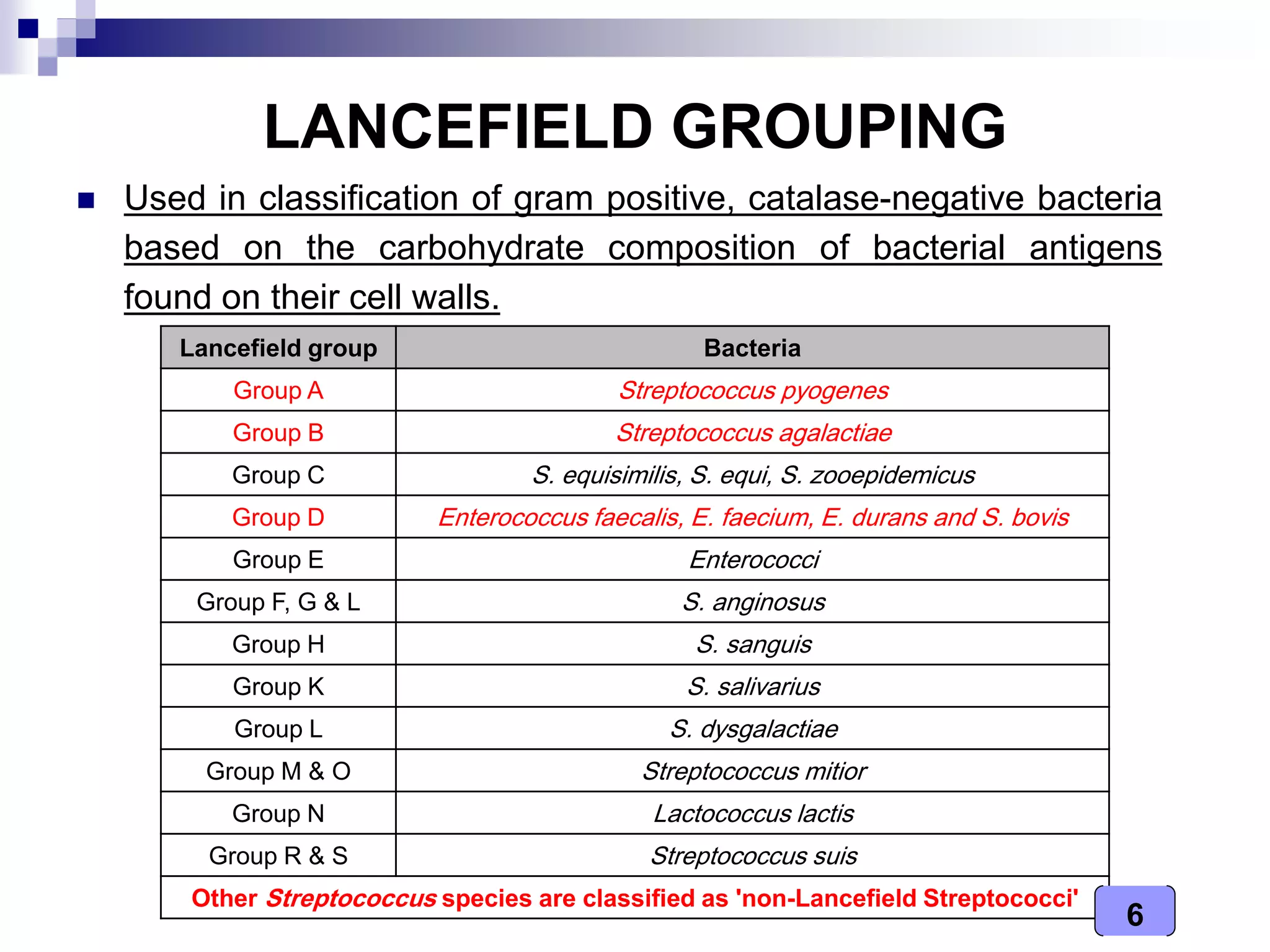
BacteriaLancefield group
Streptococcus pyogenesGroup A
Streptococcus agalactiaeGroup B
S. equisimilis, S. equi, S. zooepidemicusGroup C
Enterococcus faecalis, E. faecium, E. durans and S. bovisGroup D
EnterococciGroup E
S. anginosusGroup F, G & L
S. sanguisGroup H
S. salivariusGroup K
S. dysgalactiaeGroup L
Streptococcus mitiorGroup M & O
Lactococcus lactisGroup N
Streptococcus suisGroup R & S
Other Streptococcus species are classified as 'non-Lancefield Streptococci'
6
LANCEFIELD GROUPING
 Used in classification of gram positive, catalase-negative bacteria
based on the carbohydrate composition of bacterial antigens
found on their cell walls.
7
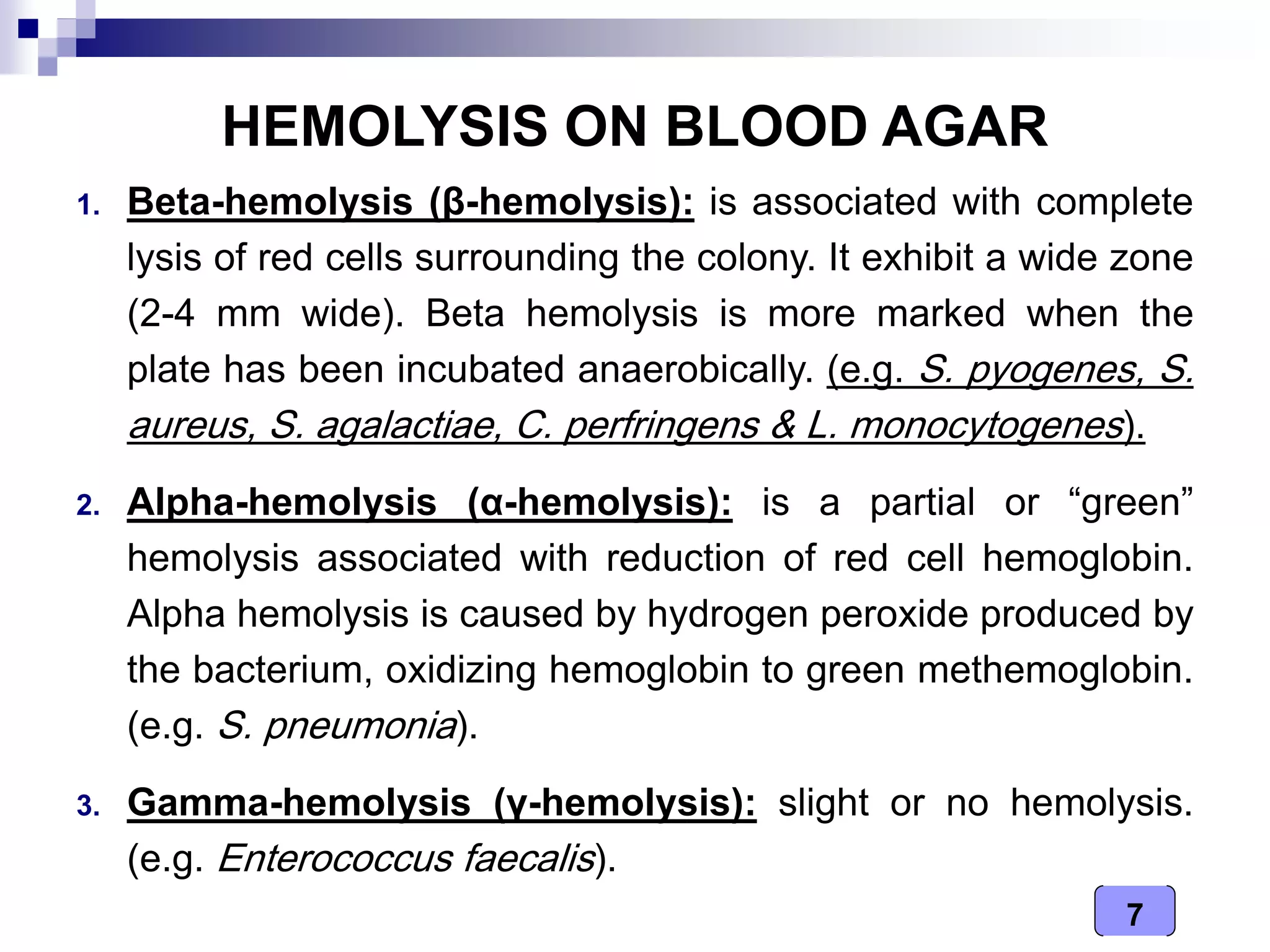
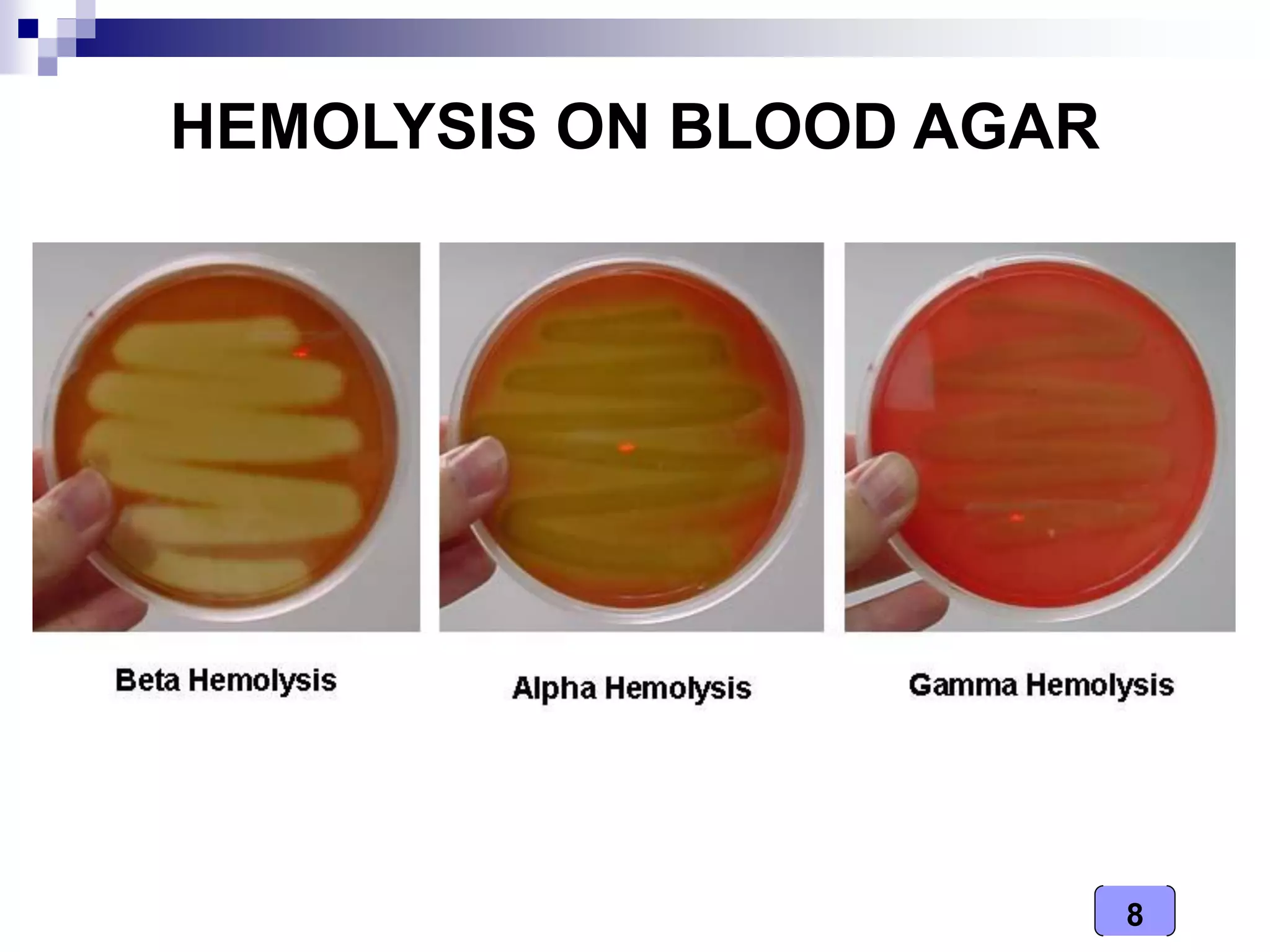
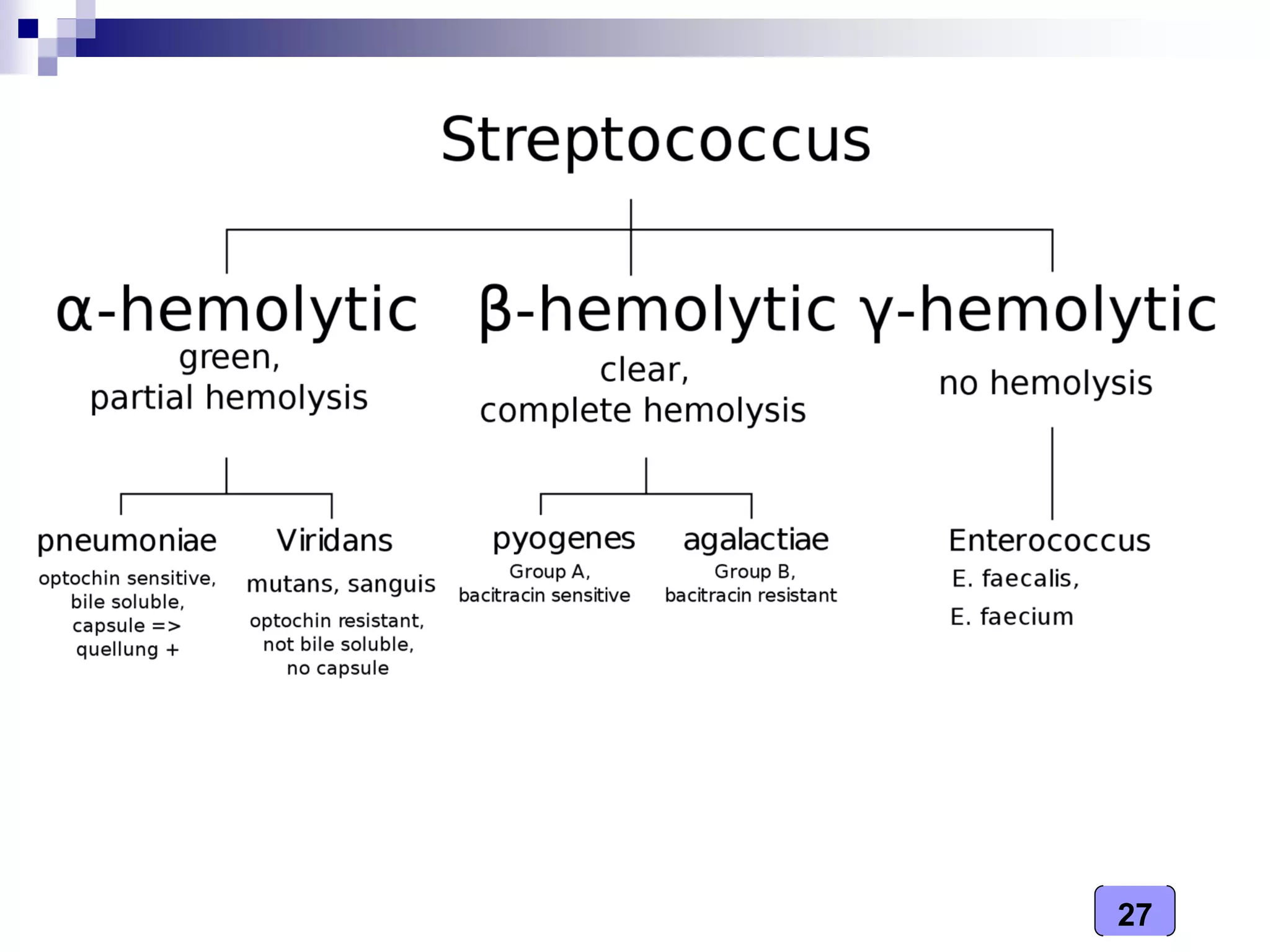
HEMOLYSIS ON BLOOD AGAR
1. Beta-hemolysis (β-hemolysis): is associated with complete
lysis of red cells surrounding the colony. It exhibit a wide zone
(2-4 mm wide). Beta hemolysis is more marked when the
plate has been incubated anaerobically. (e.g. S. pyogenes, S.
aureus, S. agalactiae, C. perfringens & L. monocytogenes).
2. Alpha-hemolysis (α-hemolysis): is a partial or “green”
hemolysis associated with reduction of red cell hemoglobin.
Alpha hemolysis is caused by hydrogen peroxide produced by
the bacterium, oxidizing hemoglobin to green methemoglobin.
(e.g. S. pneumonia).
3. Gamma-hemolysis (γ-hemolysis): slight or no hemolysis.
(e.g. Enterococcus faecalis).
8
HEMOLYSIS ON BLOOD AGAR
9
Streptococcus spp.
 Samples
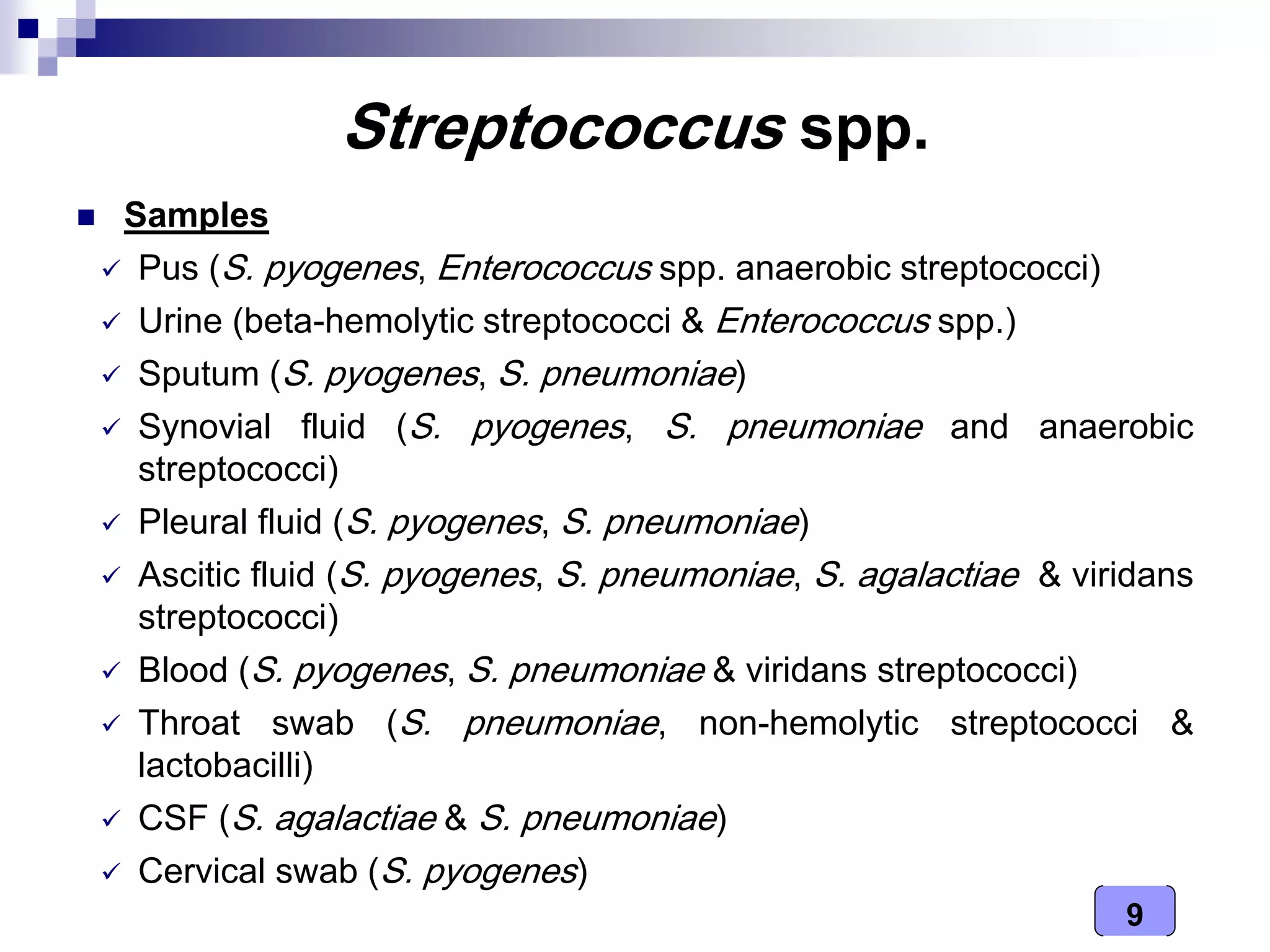
 Pus (S. pyogenes, Enterococcus spp. anaerobic streptococci)
 Urine (beta-hemolytic streptococci & Enterococcus spp.)
 Sputum (S. pyogenes, S. pneumoniae)
 Synovial fluid (S. pyogenes, S. pneumoniae and anaerobic
streptococci)
 Pleural fluid (S. pyogenes, S. pneumoniae)
 Ascitic fluid (S. pyogenes, S. pneumoniae, S. agalactiae & viridans
streptococci)
 Blood (S. pyogenes, S. pneumoniae & viridans streptococci)
 Throat swab (S. pneumoniae, non-hemolytic streptococci &
lactobacilli)
 CSF (S. agalactiae & S. pneumoniae)
 Cervical swab (S. pyogenes)
10
Streptococcus spp.
 Microscopic feature
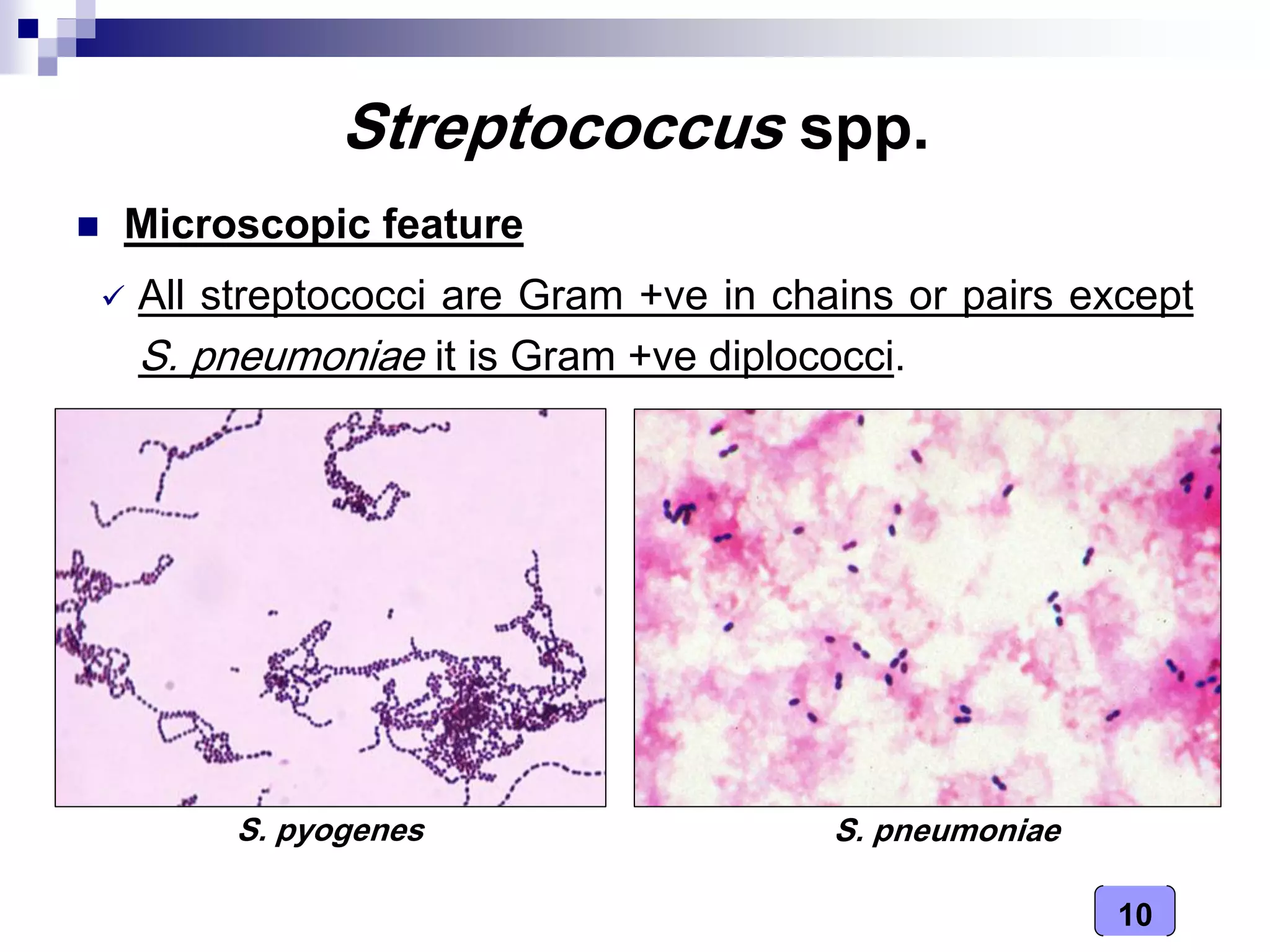
 All streptococci are Gram +ve in chains or pairs except
S. pneumoniae it is Gram +ve diplococci.
S. pyogenes S. pneumoniae
11
Streptococcus spp.
 Culture: using sterile cotton swab, make a bacterial
lawn on TWO blood agar plates (aerobically &
anaerobically).
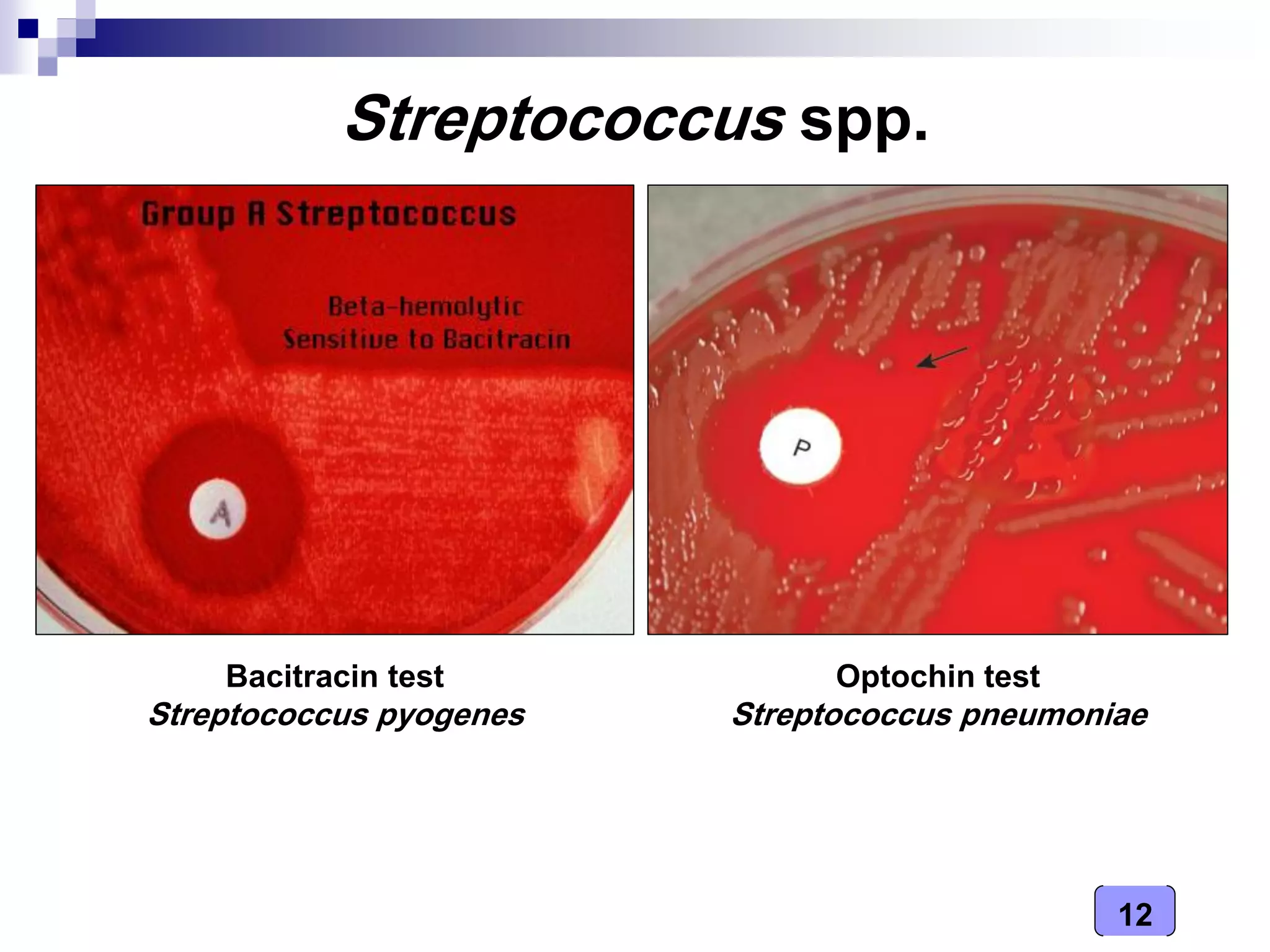
1. When S. pyogenes is suspected (as in sore throat
cases), a unit of 0.05 “Bacitracin” disc should be add
after cultivation of sample on plate. This will help in
identification of S. pyogenes.
2. When S. pneumoniae is suspected (as in respiratory
tract infection), a unit of “Optochin” disc should be add
after cultivation of sample on plate. This will help in
identification of S. pneumoniae.
12
Streptococcus spp.
Bacitracin test
Streptococcus pyogenes
Optochin test
Streptococcus pneumoniae
13
Streptococcus spp.
 Description of colonies on BAP
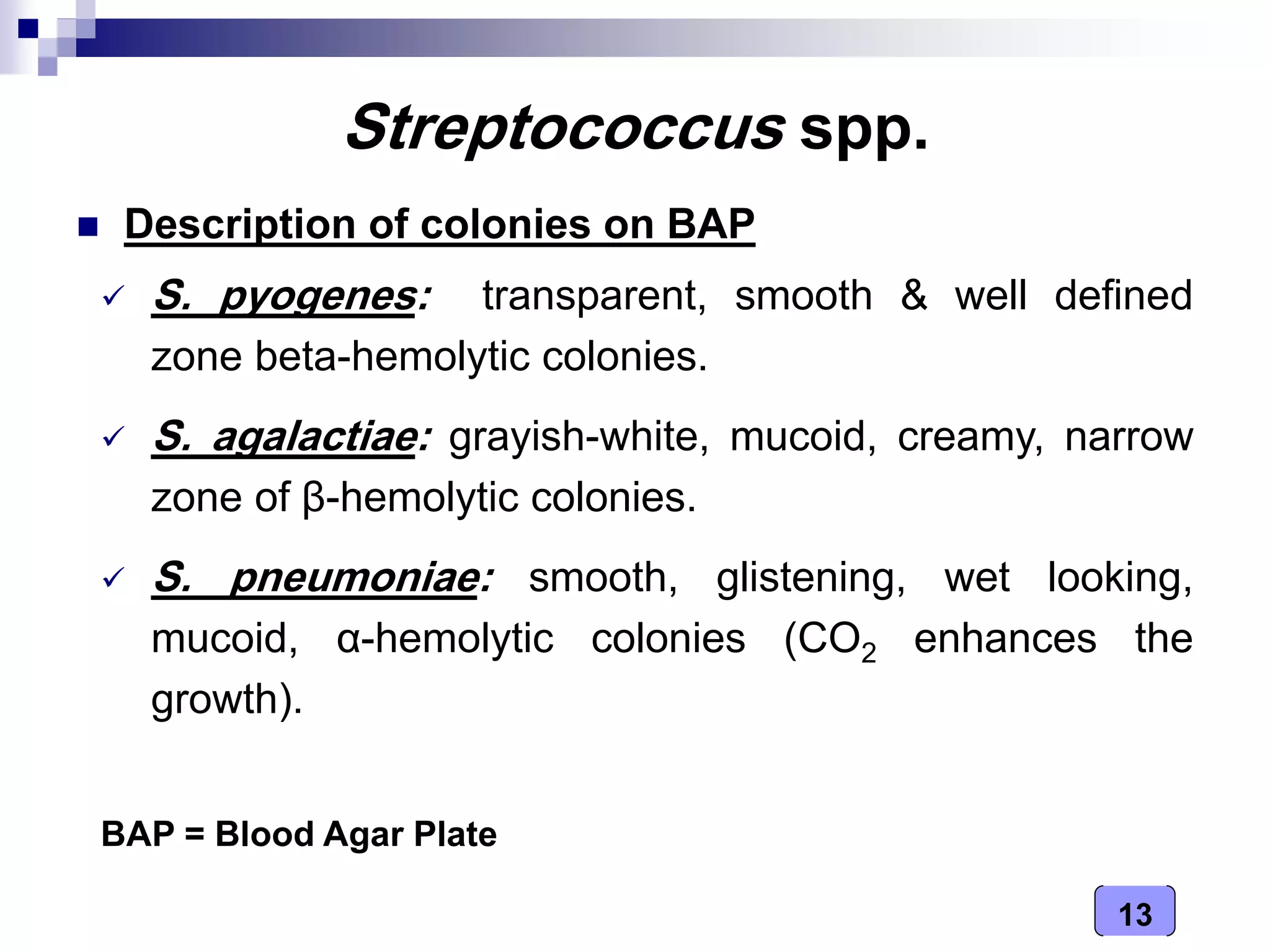
 S. pyogenes: transparent, smooth & well defined
zone beta-hemolytic colonies.
 S. agalactiae: grayish-white, mucoid, creamy, narrow
zone of β-hemolytic colonies.
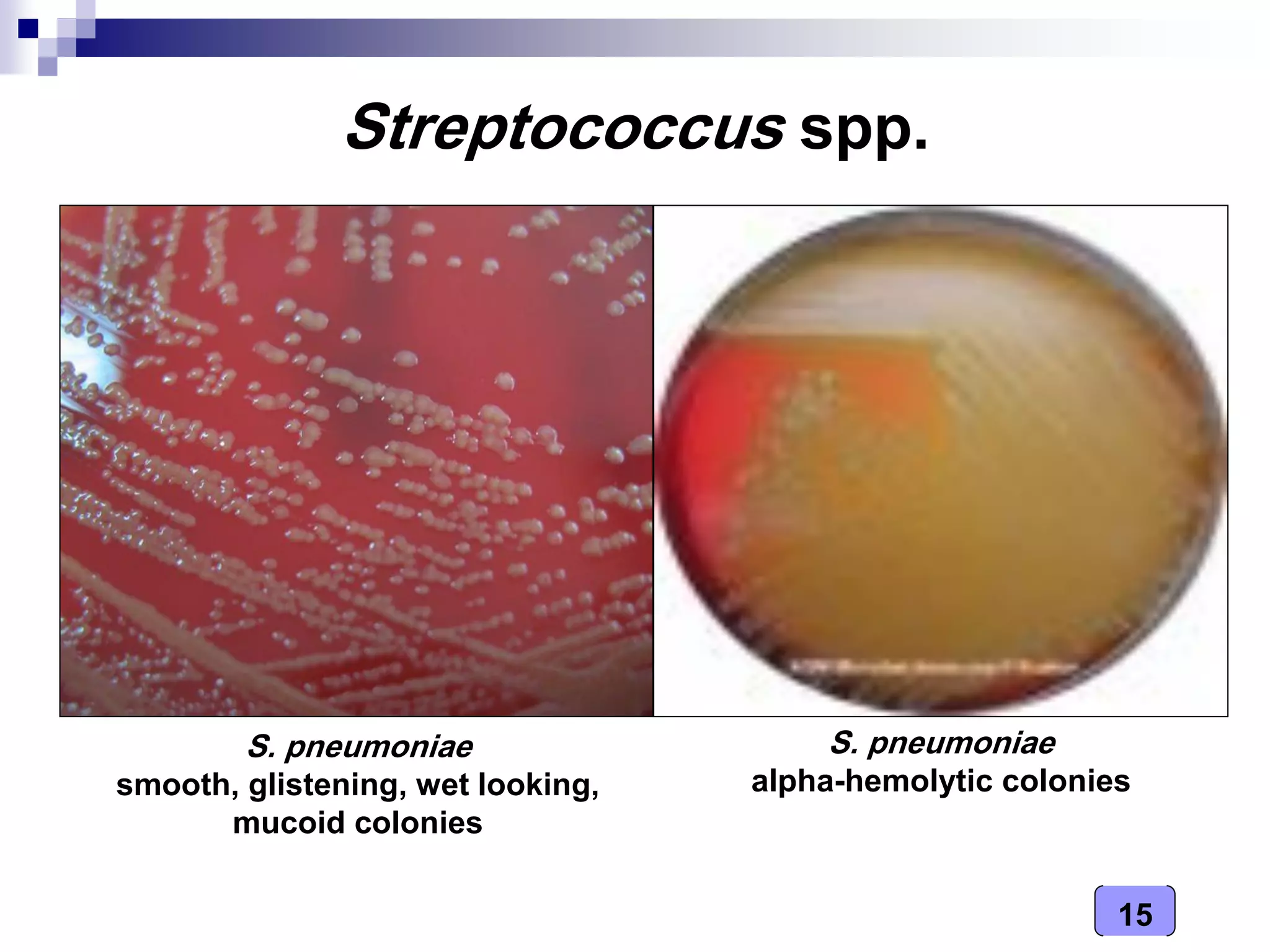
 S. pneumoniae: smooth, glistening, wet looking,
mucoid, α-hemolytic colonies (CO2 enhances the
growth).
BAP = Blood Agar Plate
14
Streptococcus spp.
S. pyogenes
0.5 – 1 mm in diameter, colorless,
dry, shiny or mucoid, beta-hemolytic
colonies
S. pneumoniae
2 mm in diameter, grey mucoid
colonies, small zone of beta-
hemolysis.
15
Streptococcus spp.
S. pneumoniae
smooth, glistening, wet looking,
mucoid colonies
S. pneumoniae
alpha-hemolytic colonies
16
Enterococcus faecalis
Colonial morphology:
 Non-hemolytic colonies
are produced.
17
BIOCHEMICAL TESTS
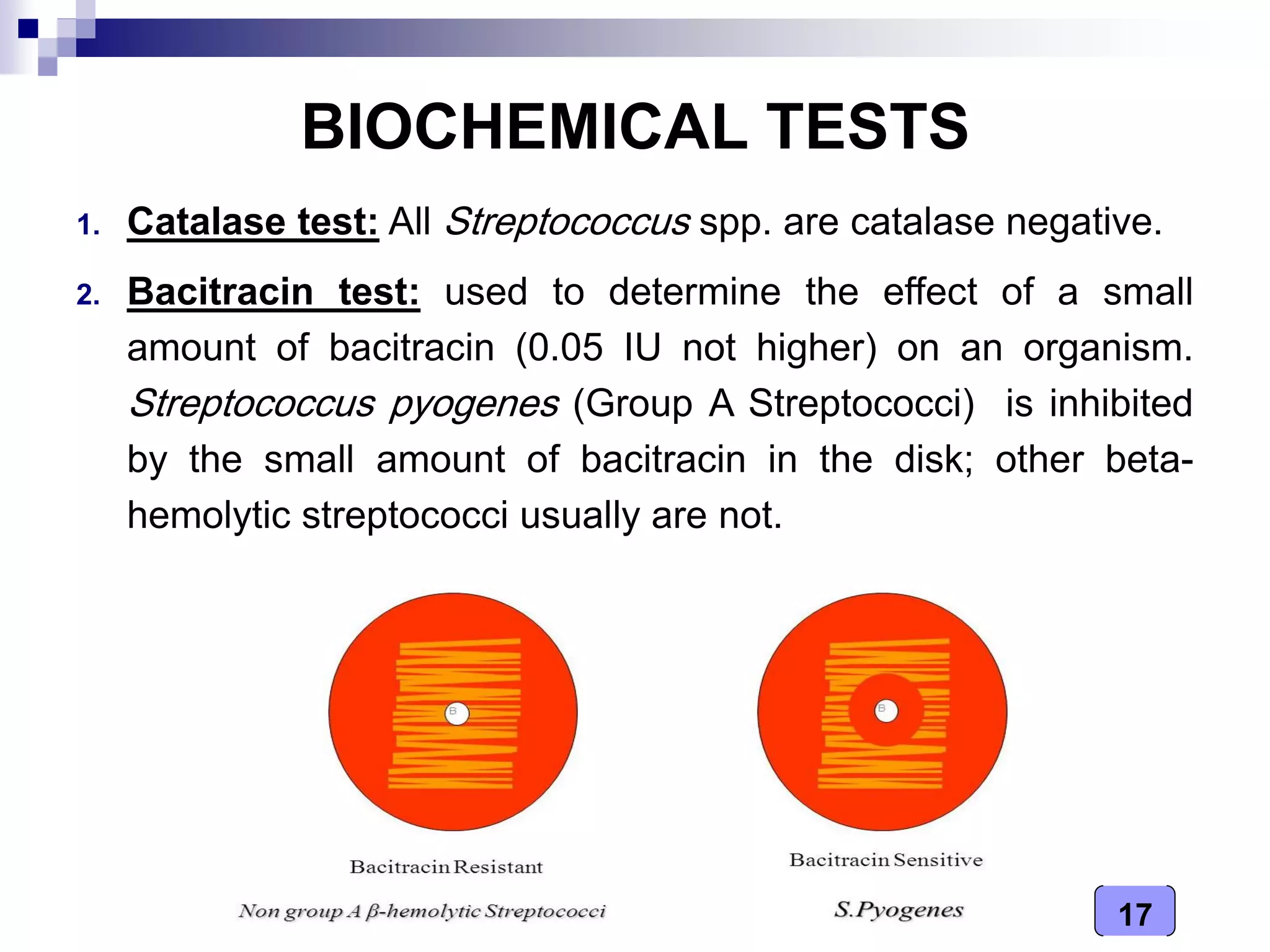
1. Catalase test: All Streptococcus spp. are catalase negative.
2. Bacitracin test: used to determine the effect of a small
amount of bacitracin (0.05 IU not higher) on an organism.
Streptococcus pyogenes (Group A Streptococci) is inhibited
by the small amount of bacitracin in the disk; other beta-
hemolytic streptococci usually are not.
18
BIOCHEMICAL TESTS
3. Optochin test: S. pneumoniae strains are sensitive to
optochin so that it is used to differentiate S. pneumoniae from
other alpha-hemolytic streptococci.
Optochin resistant
streptococci
Optochin sensitive
streptococci
19
BIOCHEMICAL TESTS
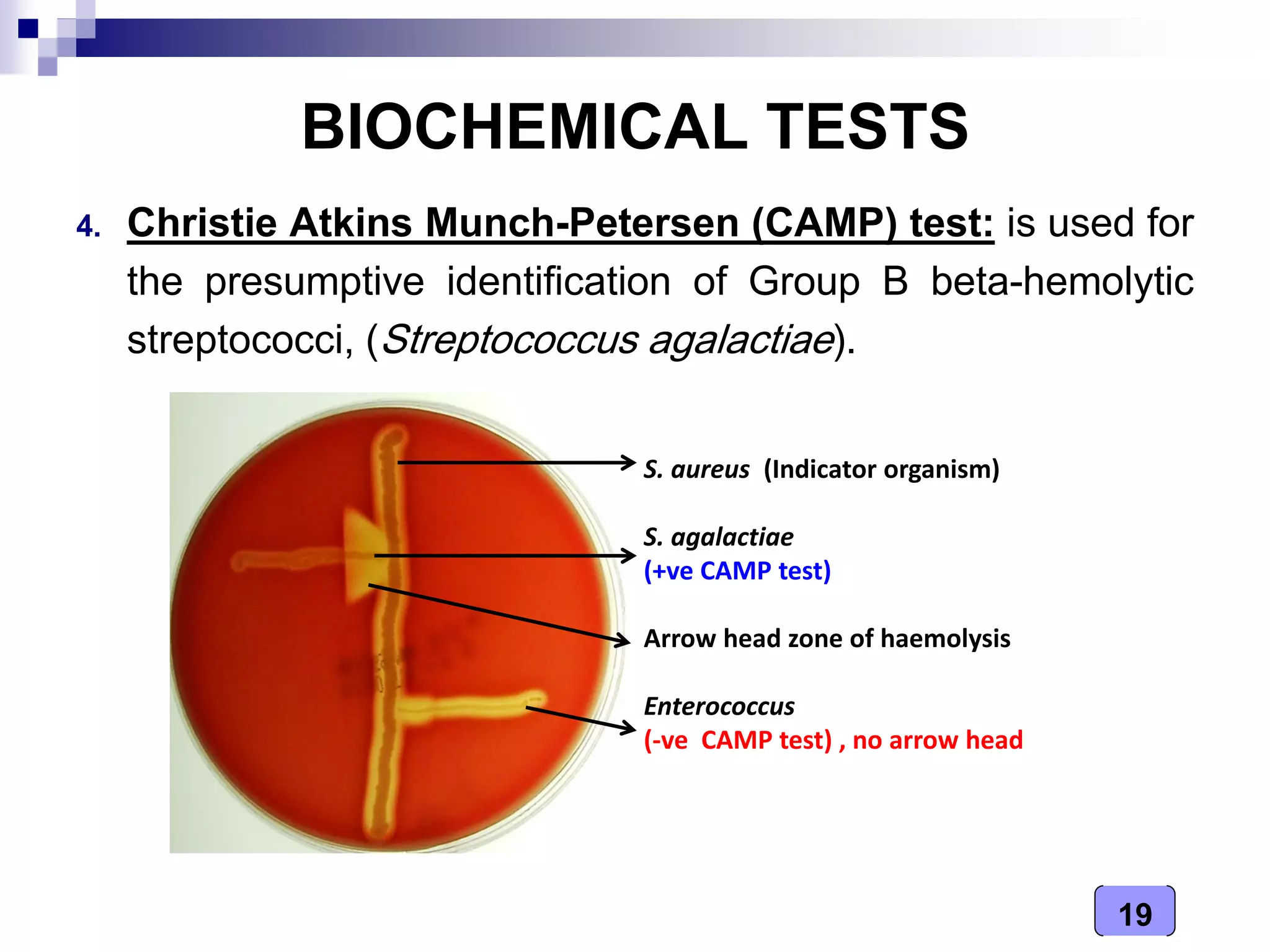
4. Christie Atkins Munch-Petersen (CAMP) test: is used for
the presumptive identification of Group B beta-hemolytic
streptococci, (Streptococcus agalactiae).
S. aureus (Indicator organism)
S. agalactiae
(+ve CAMP test)
Arrow head zone of haemolysis
Enterococcus
(-ve CAMP test) , no arrow head
20
BIOCHEMICAL TESTS
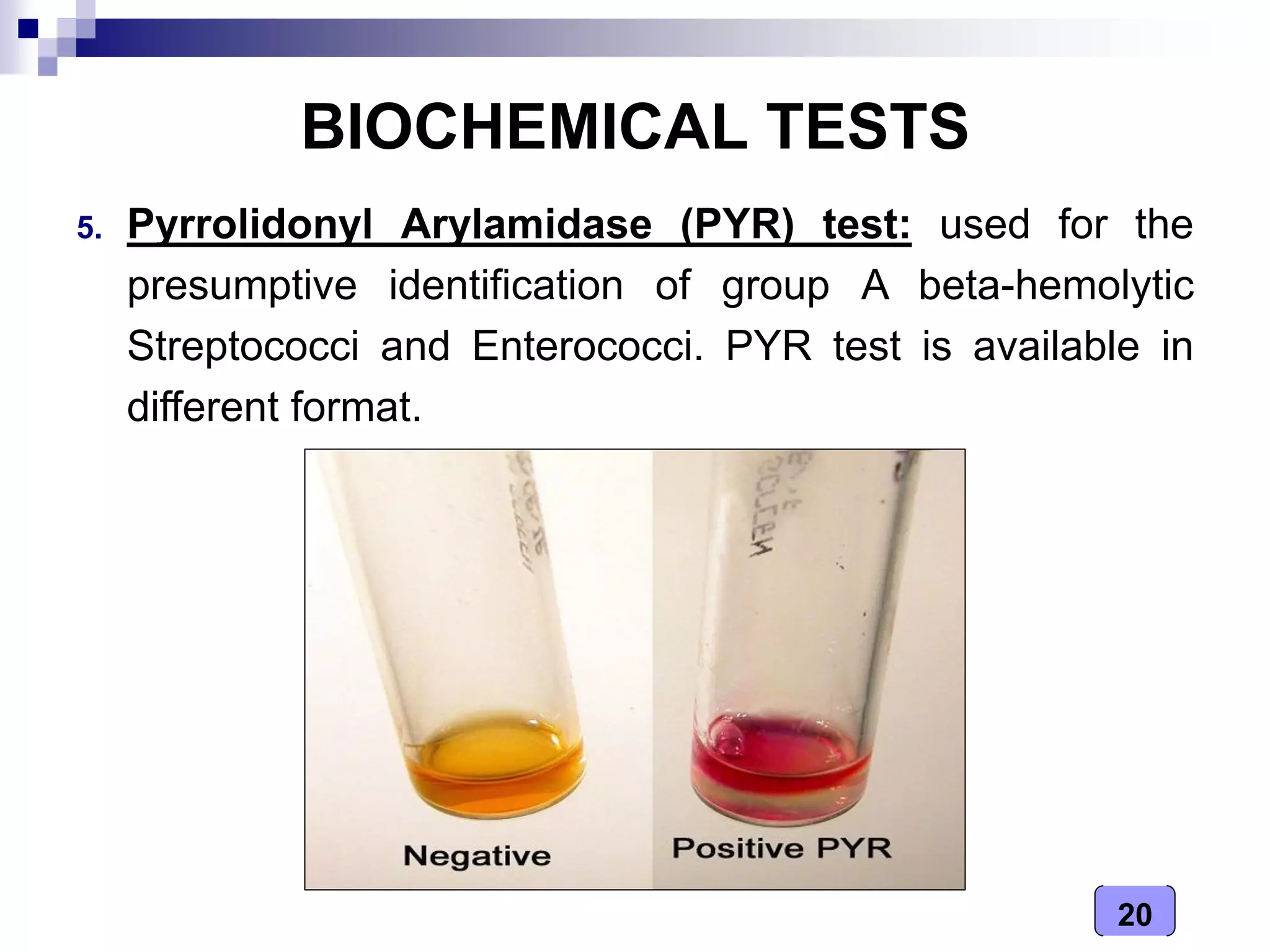
5. Pyrrolidonyl Arylamidase (PYR) test: used for the
presumptive identification of group A beta-hemolytic
Streptococci and Enterococci. PYR test is available in
different format.
21
BIOCHEMICAL TESTS
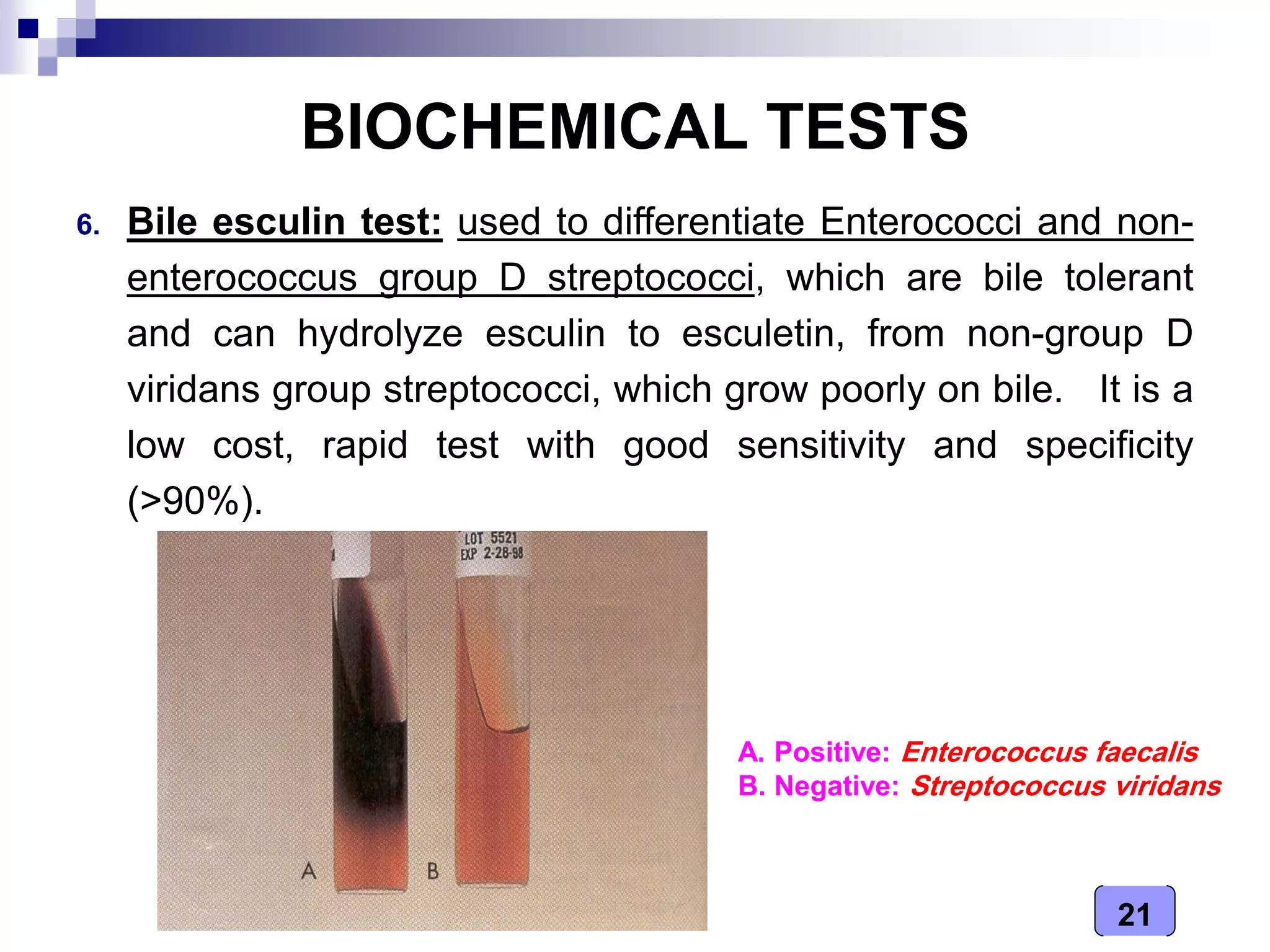
6. Bile esculin test: used to differentiate Enterococci and non-
enterococcus group D streptococci, which are bile tolerant
and can hydrolyze esculin to esculetin, from non-group D
viridans group streptococci, which grow poorly on bile. It is a
low cost, rapid test with good sensitivity and specificity
(>90%).
A. Positive: Enterococcus faecalis
B. Negative: Streptococcus viridans
22
BIOCHEMICAL TESTS
 Positive test
• Dark brown or black
colour around colonies
• E. faecalis.
 Negative test
• No blackening
• Streptococcus spp.
Bile esculin hydrolysis testing
23
BIOCHEMICAL TESTS
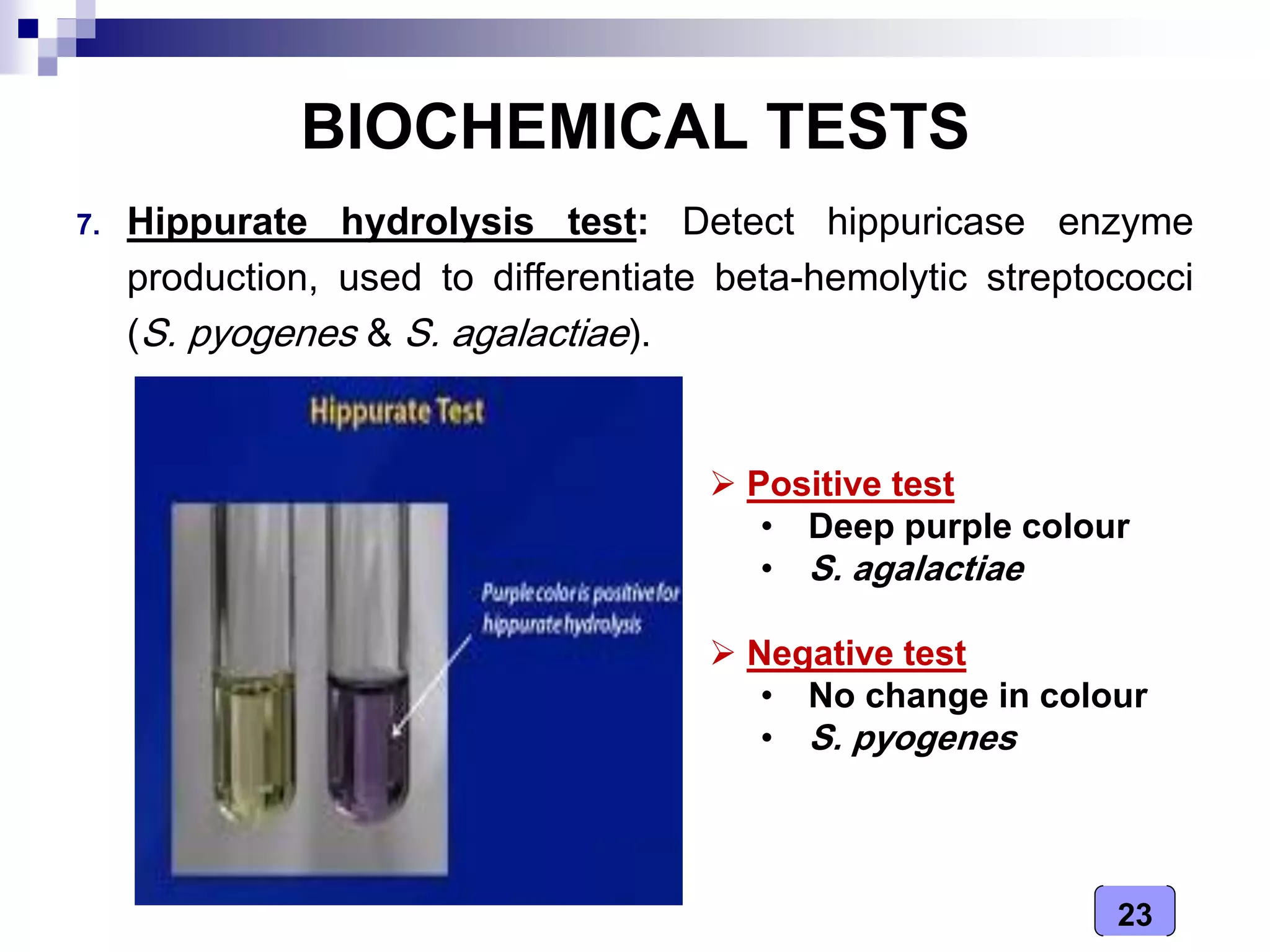
7. Hippurate hydrolysis test: Detect hippuricase enzyme
production, used to differentiate beta-hemolytic streptococci
(S. pyogenes & S. agalactiae).
 Positive test
• Deep purple colour
• S. agalactiae
 Negative test
• No change in colour
• S. pyogenes
24
BIOCHEMICAL TESTS
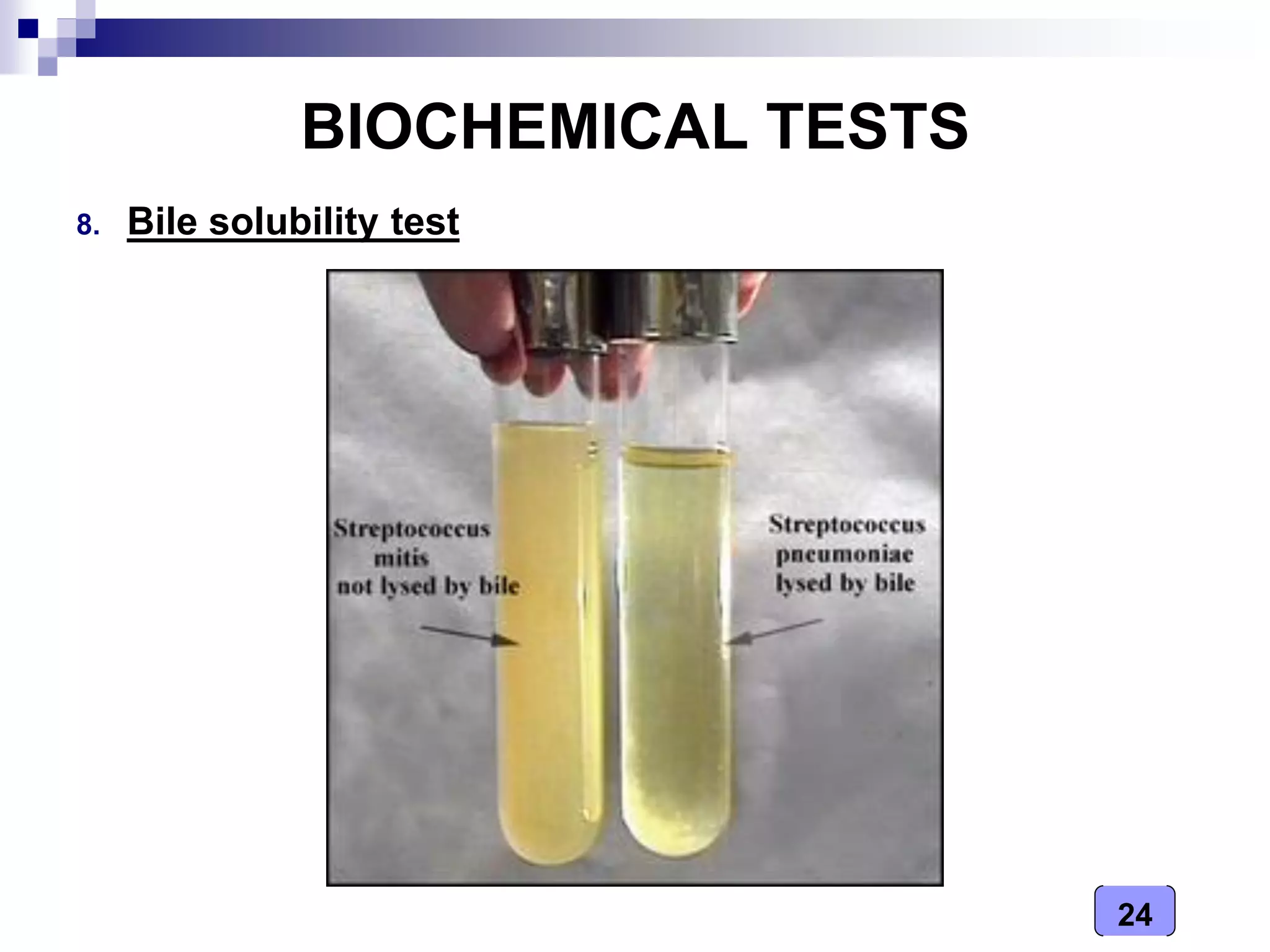
8. Bile solubility test
25
SEROLOGICAL TEST (LANCEFIELD
GROUPING)
26
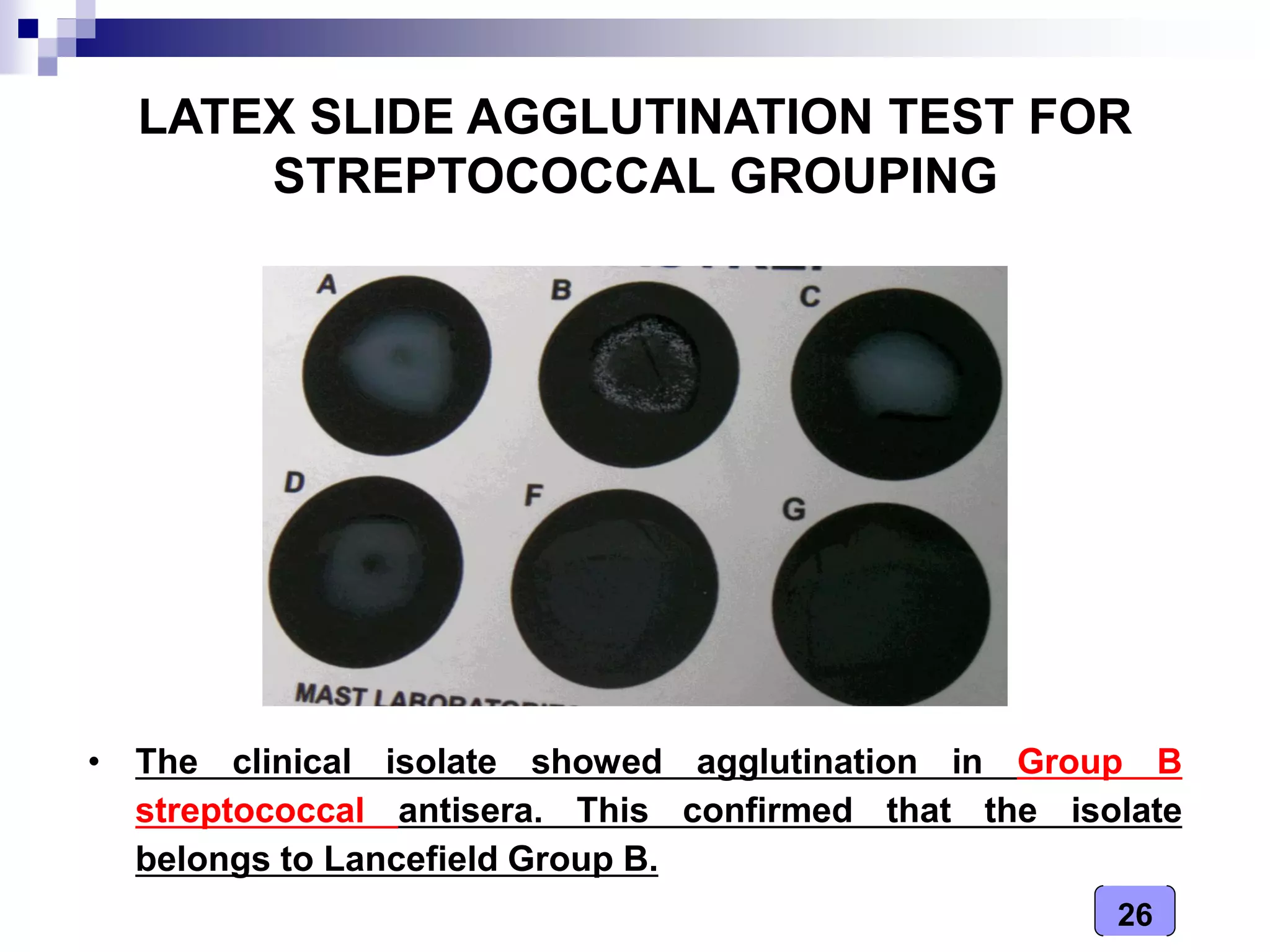
LATEX SLIDE AGGLUTINATION TEST FOR
STREPTOCOCCAL GROUPING
• The clinical isolate showed agglutination in Group B
streptococcal antisera. This confirmed that the isolate
belongs to Lancefield Group B.
27
28

Medical Microbiology Laboratory (streptococcus spp.)

  • 1.
    Medical Microbiology Laboratory GramPositive Cocci (Streptococcus spp.) Hussein A. Abid Medical Laboratory Scientist Member at American Society of Microbiology Chairman of Iraqi Medical Laboratory Association Teacher at Middle Technical University
  • 2.
    2 OVERVIEW  Streptococcus isa genus of coccus (spherical) Gram-positive bacteria.  Cell division in this genus occurs along a single axis in these bacteria, thus they grow in chains or pairs.  Currently, over 50 species are recognized in this genus.  This genus has been found to be part of the salivary microbiome.
  • 3.
    3 GENERAL CHARACTERISTICS  Gram+ve bacteria arranged in chains or pairs.  Facultative anaerobes.  Fastidious growth requirements.  Catalase negative.  Have beta, alpha or gamma hemolytic colonies on blood agar.  In humans, it is major normal flora in oral cavity.  In 1984, many bacteria formerly considered Streptococcus were separated out into the genera Enterococcus and Lactococcus.
  • 4.
    4 STREPTOCOCCAL DISEASES DiseasesPathogen Pharyngitis, scarletfever, pyoderma, erysipelas, cellulitis, necrotizing fasciitis, streptococcal toxic shock syndrome, bacteremia, rheumatic fever, glomerulonephritis S. pyogenes (Group A) Neonatal infections (meningitis, pneumonia, bacteremia), urinary tract infections, amnionitis, endometritis, wound infections S. agalactiae (Group B) Pharyngitis, abscess formation and bacteremia Other beta-hemolytic group B Bacteremia, endocarditis, abscess formation and dental caries Viridans group Streptococci Pneumonia, meningitis, sinusitis, otitis media, bacteremia S. pneumonia
  • 5.
    5 TAXONOMY Scientific nameRank • StreptococcaceaeFamily •StreptococcusGenus • S. pyogenes • S. agalactiae • S. dysgalactiae • S. bovis • S. anginosus • S. sanguinis • S. mitis • S. mutans • S. pneumoniae Species (medically important spp.)
  • 6.
    BacteriaLancefield group Streptococcus pyogenesGroupA Streptococcus agalactiaeGroup B S. equisimilis, S. equi, S. zooepidemicusGroup C Enterococcus faecalis, E. faecium, E. durans and S. bovisGroup D EnterococciGroup E S. anginosusGroup F, G & L S. sanguisGroup H S. salivariusGroup K S. dysgalactiaeGroup L Streptococcus mitiorGroup M & O Lactococcus lactisGroup N Streptococcus suisGroup R & S Other Streptococcus species are classified as 'non-Lancefield Streptococci' 6 LANCEFIELD GROUPING  Used in classification of gram positive, catalase-negative bacteria based on the carbohydrate composition of bacterial antigens found on their cell walls.
  • 7.
    7 HEMOLYSIS ON BLOODAGAR 1. Beta-hemolysis (β-hemolysis): is associated with complete lysis of red cells surrounding the colony. It exhibit a wide zone (2-4 mm wide). Beta hemolysis is more marked when the plate has been incubated anaerobically. (e.g. S. pyogenes, S. aureus, S. agalactiae, C. perfringens & L. monocytogenes). 2. Alpha-hemolysis (α-hemolysis): is a partial or “green” hemolysis associated with reduction of red cell hemoglobin. Alpha hemolysis is caused by hydrogen peroxide produced by the bacterium, oxidizing hemoglobin to green methemoglobin. (e.g. S. pneumonia). 3. Gamma-hemolysis (γ-hemolysis): slight or no hemolysis. (e.g. Enterococcus faecalis).
  • 8.
  • 9.
    9 Streptococcus spp.  Samples Pus (S. pyogenes, Enterococcus spp. anaerobic streptococci)  Urine (beta-hemolytic streptococci & Enterococcus spp.)  Sputum (S. pyogenes, S. pneumoniae)  Synovial fluid (S. pyogenes, S. pneumoniae and anaerobic streptococci)  Pleural fluid (S. pyogenes, S. pneumoniae)  Ascitic fluid (S. pyogenes, S. pneumoniae, S. agalactiae & viridans streptococci)  Blood (S. pyogenes, S. pneumoniae & viridans streptococci)  Throat swab (S. pneumoniae, non-hemolytic streptococci & lactobacilli)  CSF (S. agalactiae & S. pneumoniae)  Cervical swab (S. pyogenes)
  • 10.
    10 Streptococcus spp.  Microscopicfeature  All streptococci are Gram +ve in chains or pairs except S. pneumoniae it is Gram +ve diplococci. S. pyogenes S. pneumoniae
  • 11.
    11 Streptococcus spp.  Culture:using sterile cotton swab, make a bacterial lawn on TWO blood agar plates (aerobically & anaerobically). 1. When S. pyogenes is suspected (as in sore throat cases), a unit of 0.05 “Bacitracin” disc should be add after cultivation of sample on plate. This will help in identification of S. pyogenes. 2. When S. pneumoniae is suspected (as in respiratory tract infection), a unit of “Optochin” disc should be add after cultivation of sample on plate. This will help in identification of S. pneumoniae.
  • 12.
    12 Streptococcus spp. Bacitracin test Streptococcuspyogenes Optochin test Streptococcus pneumoniae
  • 13.
    13 Streptococcus spp.  Descriptionof colonies on BAP  S. pyogenes: transparent, smooth & well defined zone beta-hemolytic colonies.  S. agalactiae: grayish-white, mucoid, creamy, narrow zone of β-hemolytic colonies.  S. pneumoniae: smooth, glistening, wet looking, mucoid, α-hemolytic colonies (CO2 enhances the growth). BAP = Blood Agar Plate
  • 14.
    14 Streptococcus spp. S. pyogenes 0.5– 1 mm in diameter, colorless, dry, shiny or mucoid, beta-hemolytic colonies S. pneumoniae 2 mm in diameter, grey mucoid colonies, small zone of beta- hemolysis.
  • 15.
    15 Streptococcus spp. S. pneumoniae smooth,glistening, wet looking, mucoid colonies S. pneumoniae alpha-hemolytic colonies
  • 16.
    16 Enterococcus faecalis Colonial morphology: Non-hemolytic colonies are produced.
  • 17.
    17 BIOCHEMICAL TESTS 1. Catalasetest: All Streptococcus spp. are catalase negative. 2. Bacitracin test: used to determine the effect of a small amount of bacitracin (0.05 IU not higher) on an organism. Streptococcus pyogenes (Group A Streptococci) is inhibited by the small amount of bacitracin in the disk; other beta- hemolytic streptococci usually are not.
  • 18.
    18 BIOCHEMICAL TESTS 3. Optochintest: S. pneumoniae strains are sensitive to optochin so that it is used to differentiate S. pneumoniae from other alpha-hemolytic streptococci. Optochin resistant streptococci Optochin sensitive streptococci
  • 19.
    19 BIOCHEMICAL TESTS 4. ChristieAtkins Munch-Petersen (CAMP) test: is used for the presumptive identification of Group B beta-hemolytic streptococci, (Streptococcus agalactiae). S. aureus (Indicator organism) S. agalactiae (+ve CAMP test) Arrow head zone of haemolysis Enterococcus (-ve CAMP test) , no arrow head
  • 20.
    20 BIOCHEMICAL TESTS 5. PyrrolidonylArylamidase (PYR) test: used for the presumptive identification of group A beta-hemolytic Streptococci and Enterococci. PYR test is available in different format.
  • 21.
    21 BIOCHEMICAL TESTS 6. Bileesculin test: used to differentiate Enterococci and non- enterococcus group D streptococci, which are bile tolerant and can hydrolyze esculin to esculetin, from non-group D viridans group streptococci, which grow poorly on bile. It is a low cost, rapid test with good sensitivity and specificity (>90%). A. Positive: Enterococcus faecalis B. Negative: Streptococcus viridans
  • 22.
    22 BIOCHEMICAL TESTS  Positivetest • Dark brown or black colour around colonies • E. faecalis.  Negative test • No blackening • Streptococcus spp. Bile esculin hydrolysis testing
  • 23.
    23 BIOCHEMICAL TESTS 7. Hippuratehydrolysis test: Detect hippuricase enzyme production, used to differentiate beta-hemolytic streptococci (S. pyogenes & S. agalactiae).  Positive test • Deep purple colour • S. agalactiae  Negative test • No change in colour • S. pyogenes
  • 24.
  • 25.
  • 26.
    26 LATEX SLIDE AGGLUTINATIONTEST FOR STREPTOCOCCAL GROUPING • The clinical isolate showed agglutination in Group B streptococcal antisera. This confirmed that the isolate belongs to Lancefield Group B.
  • 27.
  • 28.