Pavithra. G. Palan.Pavithra. G. Palan.
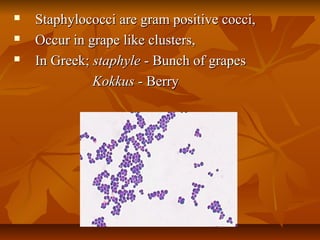
 Staphylococci are gram positive cocci,Staphylococci are gram positive cocci,
 Occur in grape like clusters,Occur in grape like clusters,
 In Greek;In Greek; staphylestaphyle -- Bunch of grapesBunch of grapes
KokkusKokkus - Berry- Berry
CLASSIFICATION:CLASSIFICATION:
A) Based on coagulase production:A) Based on coagulase production:
1. Coagulase positive: Eg- S. aureus1. Coagulase positive: Eg- S. aureus
2. Coagulase negative: Eg- S. epidermidis2. Coagulase negative: Eg- S. epidermidis
S. saprophyticusS. saprophyticus
B) Based on pathogenicity:B) Based on pathogenicity:
1.1. Common pathogen: Eg- S. aureusCommon pathogen: Eg- S. aureus
2. Opportunistic pathogens: Eg- S. epidermidis2. Opportunistic pathogens: Eg- S. epidermidis
S. saprophyticusS. saprophyticus
3. Non pathogen: Eg- S. homonis3. Non pathogen: Eg- S. homonis
STAPHYLOCOCCUSSTAPHYLOCOCCUS AUREUSAUREUS
MORPHOLOGY:MORPHOLOGY:
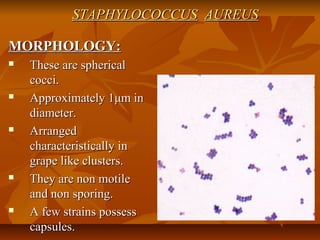
 These are sphericalThese are spherical
cocci.cocci.
 Approximately 1Approximately 1μμm inm in
diameter.diameter.
 ArrangedArranged
characteristically incharacteristically in
grape like clusters.grape like clusters.
 They are non motileThey are non motile
and non sporing.and non sporing.
 A few strains possessA few strains possess
capsules.capsules.
CULTURECULTURE::
Media usedMedia used :-:-
i) Non selective media: Nutrient agar,i) Non selective media: Nutrient agar,
Blood agar,Blood agar,
MacConkey’s agar.MacConkey’s agar.
ii) Selective media: Salt-milk agar,ii) Selective media: Salt-milk agar,
Ludlam’s mediumLudlam’s medium
Cultural Characteristics:Cultural Characteristics:
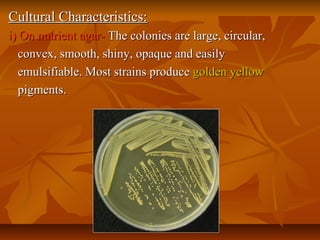
i) On nutrient agar-i) On nutrient agar- The colonies are large, circular,The colonies are large, circular,
convex, smooth, shiny, opaque and easilyconvex, smooth, shiny, opaque and easily
emulsifiable. Most strains produceemulsifiable. Most strains produce golden yellowgolden yellow
pigments.pigments.
ii) On MacConkey’s agar-ii) On MacConkey’s agar- The colonies are smallThe colonies are small
& pink in colour.& pink in colour.
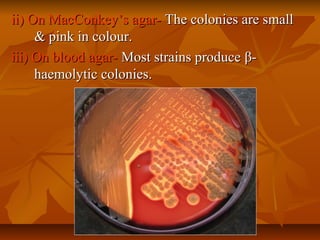
iii) On blood agar-iii) On blood agar- Most strains produceMost strains produce ββ--
haemolytic colonies.haemolytic colonies.
Biochemical reactions:Biochemical reactions:
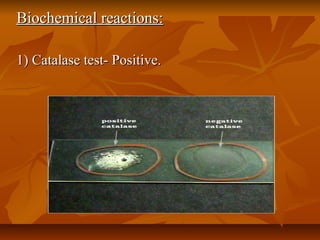
1) Catalase test- Positive.1) Catalase test- Positive.
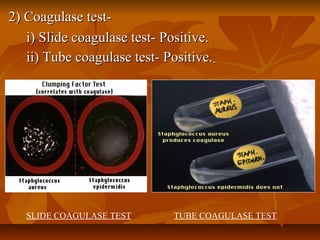
2) Coagulase test-2) Coagulase test-
i) Slide coagulase test- Positive.i) Slide coagulase test- Positive.
ii) Tube coagulase test- Positive.ii) Tube coagulase test- Positive.
SLIDE COAGULASE TEST TUBE COAGULASE TEST
3) Reduces nitrate to nitrite.3) Reduces nitrate to nitrite.
4) Ferments mannitol anaerobically with acid only.4) Ferments mannitol anaerobically with acid only.
5) Urea hydrolysis test- Positive.5) Urea hydrolysis test- Positive.
6) Gelatin liquefaction test- Positive.6) Gelatin liquefaction test- Positive.
7) Produces Lipase.7) Produces Lipase.
8) Produces Phosphatase.8) Produces Phosphatase.
9) Produces Thermostable nuclease.9) Produces Thermostable nuclease.
PATHOGENICITYPATHOGENICITY::
Source of infection:Source of infection:
A) Exogenous: patients or carriersA) Exogenous: patients or carriers
B) Endogenous: From colonized siteB) Endogenous: From colonized site
Mode of transmission:Mode of transmission:
A) Contact: direct or indirect( through fomites)A) Contact: direct or indirect( through fomites)
B) Inhalation of air borne dropletsB) Inhalation of air borne droplets
Virulence factorsVirulence factors::
These includeThese include
A) Cell associated factorsA) Cell associated factors
B) Extracellular factorsB) Extracellular factors
A)A) CELL ASSOCIATED FACTORSCELL ASSOCIATED FACTORS::
a) Cell associated polymersa) Cell associated polymers
b) Cell surface proteinsb) Cell surface proteins
a) CELL ASSOCIATED POLYMERSa) CELL ASSOCIATED POLYMERS
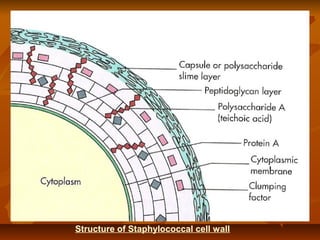
1. Cell wall polysaccharide1. Cell wall polysaccharide
2. Teichoic acid2. Teichoic acid
3. Capsular polysaccharide3. Capsular polysaccharide
b) CELL SURFACE PROTEINS:b) CELL SURFACE PROTEINS:
1. Protein A1. Protein A
2. Clumping factor (bound coagulase)2. Clumping factor (bound coagulase)
Structure of Staphylococcal cell wall
B)B) EXTRACELLULAR FACTORSEXTRACELLULAR FACTORS
a) Enzymesa) Enzymes
b) Toxinsb) Toxins
a)a) EnzymesEnzymes::
1. Free coagulase1. Free coagulase
2. Catalase2. Catalase
3. Lipase3. Lipase
4. Hyaluronidase4. Hyaluronidase
5. DNAase5. DNAase
6. Thermonuclease6. Thermonuclease
7. Staphylokinase (Fibrinolysin)7. Staphylokinase (Fibrinolysin)
8. Phosphatase8. Phosphatase
b)b) ToxinsToxins::
1. Cytolytic toxins1. Cytolytic toxins
i) Haemolysinsi) Haemolysins
Alpha haemolysinAlpha haemolysin
Beta haemolysinBeta haemolysin
Gamma haemolysinGamma haemolysin
Delta haemolysinDelta haemolysin
ii) Leucocidin (Panton-Valentine toxin)ii) Leucocidin (Panton-Valentine toxin)
2. Enterotoxin2. Enterotoxin
3.3. Toxic shock syndrome toxin (TSST)Toxic shock syndrome toxin (TSST)
44.. .. Exfoliative (epidermolytic toxin)Exfoliative (epidermolytic toxin)
Disease:Disease:
Diseases produced by Staphylococcus aureusDiseases produced by Staphylococcus aureus
is studied under 2 groups:is studied under 2 groups:
A) InfectionsA) Infections
B) IntoxicationsB) Intoxications
A)A) INFECTIONS:INFECTIONS:
Mechanism of pathogenesisMechanism of pathogenesis::
Cocci gain access to damaged skin, mucosal orCocci gain access to damaged skin, mucosal or
tissue sitetissue site
Colonize by adhering to cells or extracellular matrixColonize by adhering to cells or extracellular matrix
Evade the host defense mechanisms and multiplyEvade the host defense mechanisms and multiply
Cause tissue damageCause tissue damage
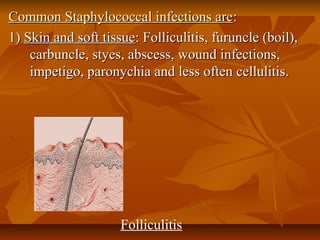
Common Staphylococcal infections areCommon Staphylococcal infections are::
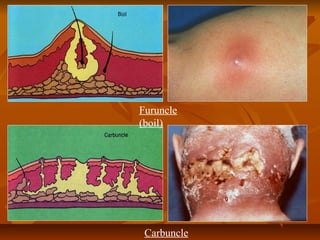
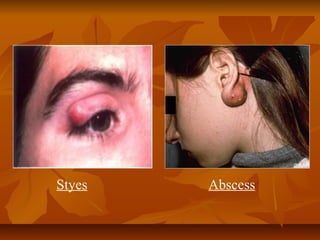
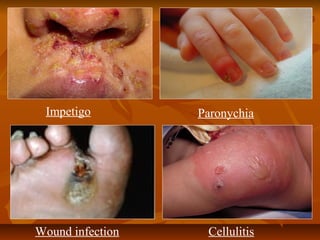
1)1) Skin and soft tissueSkin and soft tissue: Folliculitis, furuncle (boil),: Folliculitis, furuncle (boil),
carbuncle, styes, abscess, wound infections,carbuncle, styes, abscess, wound infections,
impetigo, paronychia and less often cellulitis.impetigo, paronychia and less often cellulitis.
Folliculitis
Furuncle
(boil)
Carbuncle
Styes Abscess
Impetigo Paronychia
CellulitisWound infection
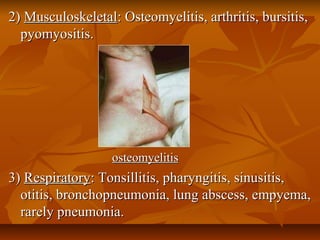
2)2) MusculoskeletalMusculoskeletal: Osteomyelitis, arthritis, bursitis,: Osteomyelitis, arthritis, bursitis,
pyomyositis.pyomyositis.
osteomyelitisosteomyelitis
3)3) RespiratoryRespiratory: Tonsillitis, pharyngitis, sinusitis,: Tonsillitis, pharyngitis, sinusitis,
otitis, bronchopneumonia, lung abscess, empyema,otitis, bronchopneumonia, lung abscess, empyema,
rarely pneumonia.rarely pneumonia.
4)4) Central nervous systemCentral nervous system: Abscess, meningitis, intracranial: Abscess, meningitis, intracranial
thrombophlebitis.thrombophlebitis.
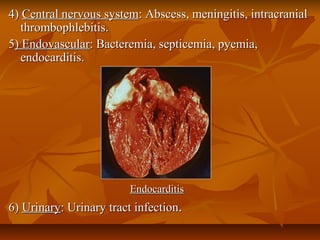
55) Endovascular) Endovascular: Bacteremia, septicemia, pyemia,: Bacteremia, septicemia, pyemia,
endocarditis.endocarditis.
EndocarditisEndocarditis
6)6) UrinaryUrinary: Urinary tract infection: Urinary tract infection..
B)B) INTOXICATIOINS:INTOXICATIOINS:
The disease is caused by the bacterial exotoxins,The disease is caused by the bacterial exotoxins,
which are produced either in the infected hostwhich are produced either in the infected host
or preformed in vitro.or preformed in vitro.
There are 3 types-There are 3 types-
1.1. Food poisoningFood poisoning
2.2. Toxic shock syndromeToxic shock syndrome
3.3. Staphylococcal scalded skin syndromeStaphylococcal scalded skin syndrome
1)1) Food poisoning:Food poisoning:
 Enterotoxin is responsible for manifestations ofEnterotoxin is responsible for manifestations of
staphylococcal food poisoning.staphylococcal food poisoning.
 Eight types of enterotoxin are currently known, namedEight types of enterotoxin are currently known, named
A, B, C1-3, D, E, and H.A, B, C1-3, D, E, and H.
 It usually occurs when preformed toxin is ingested withIt usually occurs when preformed toxin is ingested with
contaminated food.contaminated food.
 The toxin acts directly on the autonomic nervousThe toxin acts directly on the autonomic nervous
system to cause the illness, rather than gut mucosa.system to cause the illness, rather than gut mucosa.
 The common food items responsible are - milkThe common food items responsible are - milk
and milk products, meat, fish and ice cream.and milk products, meat, fish and ice cream.
 Source of infection- food handler who is a carrier.Source of infection- food handler who is a carrier.
 Incubation period- 2 to 6 hours.Incubation period- 2 to 6 hours.
 Clinical symptoms- nausea, vomiting andClinical symptoms- nausea, vomiting and
diarrhoea.diarrhoea.
 The illness is usually self limited, with recovery inThe illness is usually self limited, with recovery in
a day or so.a day or so.
2)2) Staphylococcal Toxic shock syndrome (STSS):Staphylococcal Toxic shock syndrome (STSS):
 STSS is associated with infection of mucosal orSTSS is associated with infection of mucosal or
sequestered sites by TSST( formerly known assequestered sites by TSST( formerly known as
enterotoxin type F) producing S.aureus.enterotoxin type F) producing S.aureus.
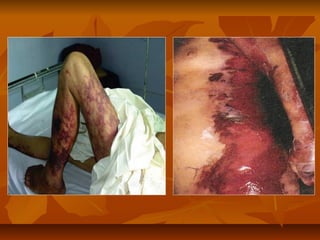
 It is fatal multisystem disease presenting withIt is fatal multisystem disease presenting with
fever, hypotension, myalgia, vomiting, diarrhoea,fever, hypotension, myalgia, vomiting, diarrhoea,
mucosal hyperemia and erythematous rash whichmucosal hyperemia and erythematous rash which
desquamates subsequently.desquamates subsequently.
2 types of STSS known2 types of STSS known::
i) Menstrual associated STSS: Here colonization ofi) Menstrual associated STSS: Here colonization of
S.aureus occurs in the vagina of menstruatingS.aureus occurs in the vagina of menstruating
woman who uses highly absorbent vaginalwoman who uses highly absorbent vaginal
tampons.tampons.
ii) Non menstrual associated STSS: Hereii) Non menstrual associated STSS: Here
colonization of S.aureus occurs in other sites likecolonization of S.aureus occurs in other sites like
surgical wound.surgical wound.
3)3) Staphylococcal scalded skin syndromeStaphylococcal scalded skin syndrome
(SSSS):(SSSS):
 Exfoliative toxin produced by S.aureus isExfoliative toxin produced by S.aureus is
responsible for this.responsible for this.
 It is a skin disease in which outer layer ofIt is a skin disease in which outer layer of
epidermis gets separated from the underlyingepidermis gets separated from the underlying
tissues.tissues.
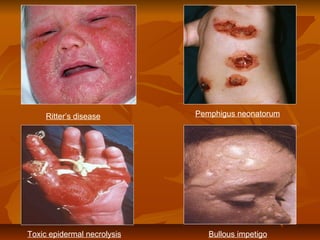
Types of SSSSTypes of SSSS::
Severe formSevere form Milder formMilder form
In new born - Ritter’s disease - PemphigusIn new born - Ritter’s disease - Pemphigus
neonatorumneonatorum
In older patients - Toxic epidermal - BullousIn older patients - Toxic epidermal - Bullous
necrolysis impetigonecrolysis impetigo
Toxic epidermal necrolysis
Ritter’s disease
Bullous impetigo
Pemphigus neonatorum
LAB DIAGNOSIS:LAB DIAGNOSIS:
Specimens collectedSpecimens collected:: Depends on the type of infection.Depends on the type of infection.
 Suppurative lesion- Pus,Suppurative lesion- Pus,
 Respiratory infection- Sputum,Respiratory infection- Sputum,
 Bacteremia & septicemia- Blood,Bacteremia & septicemia- Blood,
 Food poisoning- Feces, vomit & the remains of suspectedFood poisoning- Feces, vomit & the remains of suspected
food,food,
 For the detection of carriers- Nasal swab.For the detection of carriers- Nasal swab.
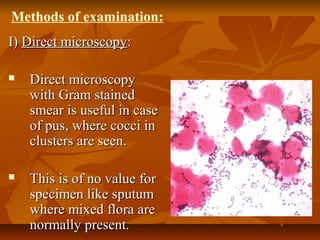
I)I) Direct microscopyDirect microscopy::
 Direct microscopyDirect microscopy
with Gram stainedwith Gram stained
smear is useful in casesmear is useful in case
of pus, where cocci inof pus, where cocci in
clusters are seen.clusters are seen.
 This is of no value forThis is of no value for
specimen like sputumspecimen like sputum
where mixed flora arewhere mixed flora are
normally present.normally present.
Methods of examination:
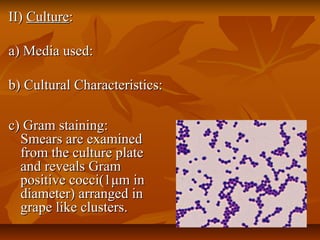
c) Gram staining:c) Gram staining:
Smears are examinedSmears are examined
from the culture platefrom the culture plate
and reveals Gramand reveals Gram
positive cocci(1positive cocci(1μμm inm in
diameter) arranged indiameter) arranged in
grape like clusters.grape like clusters.
II)II) CultureCulture::
a) Media used:a) Media used:
b) Cultural Characteristics:b) Cultural Characteristics:
d) Biochemical reactions:d) Biochemical reactions:
III) Antibiotic sensitivity tests done as a guide toIII) Antibiotic sensitivity tests done as a guide to
treatment.treatment.
IV) Bacteriophage typing is done forIV) Bacteriophage typing is done for
epidemiological purposes.epidemiological purposes.
V) Serological tests are not useful.V) Serological tests are not useful.
TREATMENT:TREATMENT:
 Drug resistance is common.Drug resistance is common.
 Benzyl penicillin is the most effective antibiotic,Benzyl penicillin is the most effective antibiotic,
if the strain is sensitive.if the strain is sensitive.
 Cloxacillin or Methicillin is used againstCloxacillin or Methicillin is used against
beta-lactamase producing strains.beta-lactamase producing strains.
 MMethicillinethicillin RResistantesistant SStaphylococcustaphylococcus aaureusureus
((MRSAMRSA) strains have become common.) strains have become common.
 Vancomycin is used in treatment of infectionsVancomycin is used in treatment of infections
with MRSA strains.with MRSA strains.
EPIDEMIOLOGY:EPIDEMIOLOGY:
 Staphylococci are primary parasites of humanStaphylococci are primary parasites of human
beings and animals.beings and animals.
 Hospital infections caused by staphylococciHospital infections caused by staphylococci
deserve special attention because of theirdeserve special attention because of their
frequency & they are caused by strains resistant tofrequency & they are caused by strains resistant to
various antibiotics.various antibiotics.
 Staphylococci are the common cause ofStaphylococci are the common cause of
postoperative wound infection and other hospitalpostoperative wound infection and other hospital
cross infections.cross infections.
PREVENTION:PREVENTION:
 Isolation & treatment of MRSA patients.Isolation & treatment of MRSA patients.
 Detection of carriers among hospital staff, theirDetection of carriers among hospital staff, their
isolation & treatment.isolation & treatment.
 Avoid indiscriminate usage of antibiotics.Avoid indiscriminate usage of antibiotics.
CoCoagulaseagulase NNegativeegative SStaphylococci(taphylococci( CoNSCoNS ):):
Two species of coagulase negativeTwo species of coagulase negative
Staphylococci can cause human infections-Staphylococci can cause human infections-
1. Staphylococcus epidermidis1. Staphylococcus epidermidis
2.2. Staphylococcus saprophyticusStaphylococcus saprophyticus
S. EpidermidisS. Epidermidis::
 It is a common cause of stitch abscesses.It is a common cause of stitch abscesses.
 It has predilection for growth on implanted foreign bodiesIt has predilection for growth on implanted foreign bodies
such as artificial valves, shunts, intravascular catheterssuch as artificial valves, shunts, intravascular catheters
and prosthetic appliances leading to bacteraemia.and prosthetic appliances leading to bacteraemia.
 In persons with structural abnormalities of urinary tract, itIn persons with structural abnormalities of urinary tract, it
can cause cystitis.can cause cystitis.
 Endocarditis may be caused, particularly in drug addicts.Endocarditis may be caused, particularly in drug addicts.
S.saprophyticusS.saprophyticus::
 It causes urinary tract infections, mostly inIt causes urinary tract infections, mostly in
sexually active young women.sexually active young women.
 The infection is symptomatic and may involve theThe infection is symptomatic and may involve the
upper urinary tract also.upper urinary tract also.
 Men are infected much less often.Men are infected much less often.
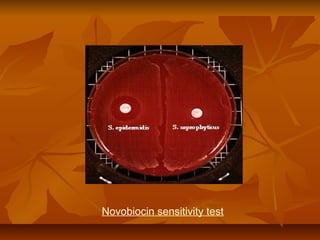
 It is one of the few frequently isolated CoNS thatIt is one of the few frequently isolated CoNS that
isis resistantresistant toto NovobiocinNovobiocin..
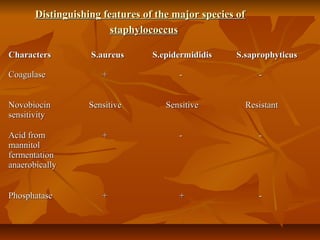
Distinguishing features of the major species ofDistinguishing features of the major species of
staphylococcusstaphylococcus
CharactersCharacters S.aureusS.aureus S.epidermididisS.epidermididis S.saprophyticusS.saprophyticus
CoagulaseCoagulase ++ -- --
NovobiocinNovobiocin
sensitivitysensitivity
SensitiveSensitive SensitiveSensitive ResistantResistant
Acid fromAcid from
mannitolmannitol
fermentationfermentation
anaerobicallyanaerobically
++ -- --
PhosphatasePhosphatase ++ ++ --
Novobiocin sensitivity test
THANK YOU

Staphylococcus

  • 1.
  • 2.
     Staphylococci aregram positive cocci,Staphylococci are gram positive cocci,  Occur in grape like clusters,Occur in grape like clusters,  In Greek;In Greek; staphylestaphyle -- Bunch of grapesBunch of grapes KokkusKokkus - Berry- Berry
  • 3.
    CLASSIFICATION:CLASSIFICATION: A) Based oncoagulase production:A) Based on coagulase production: 1. Coagulase positive: Eg- S. aureus1. Coagulase positive: Eg- S. aureus 2. Coagulase negative: Eg- S. epidermidis2. Coagulase negative: Eg- S. epidermidis S. saprophyticusS. saprophyticus B) Based on pathogenicity:B) Based on pathogenicity: 1.1. Common pathogen: Eg- S. aureusCommon pathogen: Eg- S. aureus 2. Opportunistic pathogens: Eg- S. epidermidis2. Opportunistic pathogens: Eg- S. epidermidis S. saprophyticusS. saprophyticus 3. Non pathogen: Eg- S. homonis3. Non pathogen: Eg- S. homonis
  • 4.
    STAPHYLOCOCCUSSTAPHYLOCOCCUS AUREUSAUREUS MORPHOLOGY:MORPHOLOGY:  Theseare sphericalThese are spherical cocci.cocci.  Approximately 1Approximately 1μμm inm in diameter.diameter.  ArrangedArranged characteristically incharacteristically in grape like clusters.grape like clusters.  They are non motileThey are non motile and non sporing.and non sporing.  A few strains possessA few strains possess capsules.capsules.
  • 5.
    CULTURECULTURE:: Media usedMedia used:-:- i) Non selective media: Nutrient agar,i) Non selective media: Nutrient agar, Blood agar,Blood agar, MacConkey’s agar.MacConkey’s agar. ii) Selective media: Salt-milk agar,ii) Selective media: Salt-milk agar, Ludlam’s mediumLudlam’s medium
  • 6.
    Cultural Characteristics:Cultural Characteristics: i)On nutrient agar-i) On nutrient agar- The colonies are large, circular,The colonies are large, circular, convex, smooth, shiny, opaque and easilyconvex, smooth, shiny, opaque and easily emulsifiable. Most strains produceemulsifiable. Most strains produce golden yellowgolden yellow pigments.pigments.
  • 7.
    ii) On MacConkey’sagar-ii) On MacConkey’s agar- The colonies are smallThe colonies are small & pink in colour.& pink in colour. iii) On blood agar-iii) On blood agar- Most strains produceMost strains produce ββ-- haemolytic colonies.haemolytic colonies.
  • 8.
    Biochemical reactions:Biochemical reactions: 1)Catalase test- Positive.1) Catalase test- Positive.
  • 9.
    2) Coagulase test-2)Coagulase test- i) Slide coagulase test- Positive.i) Slide coagulase test- Positive. ii) Tube coagulase test- Positive.ii) Tube coagulase test- Positive. SLIDE COAGULASE TEST TUBE COAGULASE TEST
  • 10.
    3) Reduces nitrateto nitrite.3) Reduces nitrate to nitrite. 4) Ferments mannitol anaerobically with acid only.4) Ferments mannitol anaerobically with acid only. 5) Urea hydrolysis test- Positive.5) Urea hydrolysis test- Positive. 6) Gelatin liquefaction test- Positive.6) Gelatin liquefaction test- Positive. 7) Produces Lipase.7) Produces Lipase. 8) Produces Phosphatase.8) Produces Phosphatase. 9) Produces Thermostable nuclease.9) Produces Thermostable nuclease.
  • 11.
    PATHOGENICITYPATHOGENICITY:: Source of infection:Sourceof infection: A) Exogenous: patients or carriersA) Exogenous: patients or carriers B) Endogenous: From colonized siteB) Endogenous: From colonized site Mode of transmission:Mode of transmission: A) Contact: direct or indirect( through fomites)A) Contact: direct or indirect( through fomites) B) Inhalation of air borne dropletsB) Inhalation of air borne droplets
  • 12.
    Virulence factorsVirulence factors:: TheseincludeThese include A) Cell associated factorsA) Cell associated factors B) Extracellular factorsB) Extracellular factors
  • 13.
    A)A) CELL ASSOCIATEDFACTORSCELL ASSOCIATED FACTORS:: a) Cell associated polymersa) Cell associated polymers b) Cell surface proteinsb) Cell surface proteins a) CELL ASSOCIATED POLYMERSa) CELL ASSOCIATED POLYMERS 1. Cell wall polysaccharide1. Cell wall polysaccharide 2. Teichoic acid2. Teichoic acid 3. Capsular polysaccharide3. Capsular polysaccharide b) CELL SURFACE PROTEINS:b) CELL SURFACE PROTEINS: 1. Protein A1. Protein A 2. Clumping factor (bound coagulase)2. Clumping factor (bound coagulase)
  • 14.
  • 15.
    B)B) EXTRACELLULAR FACTORSEXTRACELLULARFACTORS a) Enzymesa) Enzymes b) Toxinsb) Toxins
  • 16.
    a)a) EnzymesEnzymes:: 1. Freecoagulase1. Free coagulase 2. Catalase2. Catalase 3. Lipase3. Lipase 4. Hyaluronidase4. Hyaluronidase 5. DNAase5. DNAase 6. Thermonuclease6. Thermonuclease 7. Staphylokinase (Fibrinolysin)7. Staphylokinase (Fibrinolysin) 8. Phosphatase8. Phosphatase
  • 17.
    b)b) ToxinsToxins:: 1. Cytolytictoxins1. Cytolytic toxins i) Haemolysinsi) Haemolysins Alpha haemolysinAlpha haemolysin Beta haemolysinBeta haemolysin Gamma haemolysinGamma haemolysin Delta haemolysinDelta haemolysin ii) Leucocidin (Panton-Valentine toxin)ii) Leucocidin (Panton-Valentine toxin) 2. Enterotoxin2. Enterotoxin 3.3. Toxic shock syndrome toxin (TSST)Toxic shock syndrome toxin (TSST) 44.. .. Exfoliative (epidermolytic toxin)Exfoliative (epidermolytic toxin)
  • 18.
    Disease:Disease: Diseases produced byStaphylococcus aureusDiseases produced by Staphylococcus aureus is studied under 2 groups:is studied under 2 groups: A) InfectionsA) Infections B) IntoxicationsB) Intoxications
  • 19.
    A)A) INFECTIONS:INFECTIONS: Mechanism ofpathogenesisMechanism of pathogenesis:: Cocci gain access to damaged skin, mucosal orCocci gain access to damaged skin, mucosal or tissue sitetissue site Colonize by adhering to cells or extracellular matrixColonize by adhering to cells or extracellular matrix Evade the host defense mechanisms and multiplyEvade the host defense mechanisms and multiply Cause tissue damageCause tissue damage
  • 20.
    Common Staphylococcal infectionsareCommon Staphylococcal infections are:: 1)1) Skin and soft tissueSkin and soft tissue: Folliculitis, furuncle (boil),: Folliculitis, furuncle (boil), carbuncle, styes, abscess, wound infections,carbuncle, styes, abscess, wound infections, impetigo, paronychia and less often cellulitis.impetigo, paronychia and less often cellulitis. Folliculitis
  • 21.
  • 22.
  • 23.
  • 24.
    2)2) MusculoskeletalMusculoskeletal: Osteomyelitis,arthritis, bursitis,: Osteomyelitis, arthritis, bursitis, pyomyositis.pyomyositis. osteomyelitisosteomyelitis 3)3) RespiratoryRespiratory: Tonsillitis, pharyngitis, sinusitis,: Tonsillitis, pharyngitis, sinusitis, otitis, bronchopneumonia, lung abscess, empyema,otitis, bronchopneumonia, lung abscess, empyema, rarely pneumonia.rarely pneumonia.
  • 25.
    4)4) Central nervoussystemCentral nervous system: Abscess, meningitis, intracranial: Abscess, meningitis, intracranial thrombophlebitis.thrombophlebitis. 55) Endovascular) Endovascular: Bacteremia, septicemia, pyemia,: Bacteremia, septicemia, pyemia, endocarditis.endocarditis. EndocarditisEndocarditis 6)6) UrinaryUrinary: Urinary tract infection: Urinary tract infection..
  • 26.
    B)B) INTOXICATIOINS:INTOXICATIOINS: The diseaseis caused by the bacterial exotoxins,The disease is caused by the bacterial exotoxins, which are produced either in the infected hostwhich are produced either in the infected host or preformed in vitro.or preformed in vitro. There are 3 types-There are 3 types- 1.1. Food poisoningFood poisoning 2.2. Toxic shock syndromeToxic shock syndrome 3.3. Staphylococcal scalded skin syndromeStaphylococcal scalded skin syndrome
  • 27.
    1)1) Food poisoning:Foodpoisoning:  Enterotoxin is responsible for manifestations ofEnterotoxin is responsible for manifestations of staphylococcal food poisoning.staphylococcal food poisoning.  Eight types of enterotoxin are currently known, namedEight types of enterotoxin are currently known, named A, B, C1-3, D, E, and H.A, B, C1-3, D, E, and H.  It usually occurs when preformed toxin is ingested withIt usually occurs when preformed toxin is ingested with contaminated food.contaminated food.  The toxin acts directly on the autonomic nervousThe toxin acts directly on the autonomic nervous system to cause the illness, rather than gut mucosa.system to cause the illness, rather than gut mucosa.
  • 28.
     The commonfood items responsible are - milkThe common food items responsible are - milk and milk products, meat, fish and ice cream.and milk products, meat, fish and ice cream.  Source of infection- food handler who is a carrier.Source of infection- food handler who is a carrier.  Incubation period- 2 to 6 hours.Incubation period- 2 to 6 hours.  Clinical symptoms- nausea, vomiting andClinical symptoms- nausea, vomiting and diarrhoea.diarrhoea.  The illness is usually self limited, with recovery inThe illness is usually self limited, with recovery in a day or so.a day or so.
  • 29.
    2)2) Staphylococcal Toxicshock syndrome (STSS):Staphylococcal Toxic shock syndrome (STSS):  STSS is associated with infection of mucosal orSTSS is associated with infection of mucosal or sequestered sites by TSST( formerly known assequestered sites by TSST( formerly known as enterotoxin type F) producing S.aureus.enterotoxin type F) producing S.aureus.  It is fatal multisystem disease presenting withIt is fatal multisystem disease presenting with fever, hypotension, myalgia, vomiting, diarrhoea,fever, hypotension, myalgia, vomiting, diarrhoea, mucosal hyperemia and erythematous rash whichmucosal hyperemia and erythematous rash which desquamates subsequently.desquamates subsequently.
  • 31.
    2 types ofSTSS known2 types of STSS known:: i) Menstrual associated STSS: Here colonization ofi) Menstrual associated STSS: Here colonization of S.aureus occurs in the vagina of menstruatingS.aureus occurs in the vagina of menstruating woman who uses highly absorbent vaginalwoman who uses highly absorbent vaginal tampons.tampons. ii) Non menstrual associated STSS: Hereii) Non menstrual associated STSS: Here colonization of S.aureus occurs in other sites likecolonization of S.aureus occurs in other sites like surgical wound.surgical wound.
  • 32.
    3)3) Staphylococcal scaldedskin syndromeStaphylococcal scalded skin syndrome (SSSS):(SSSS):  Exfoliative toxin produced by S.aureus isExfoliative toxin produced by S.aureus is responsible for this.responsible for this.  It is a skin disease in which outer layer ofIt is a skin disease in which outer layer of epidermis gets separated from the underlyingepidermis gets separated from the underlying tissues.tissues.
  • 33.
    Types of SSSSTypesof SSSS:: Severe formSevere form Milder formMilder form In new born - Ritter’s disease - PemphigusIn new born - Ritter’s disease - Pemphigus neonatorumneonatorum In older patients - Toxic epidermal - BullousIn older patients - Toxic epidermal - Bullous necrolysis impetigonecrolysis impetigo
  • 34.
    Toxic epidermal necrolysis Ritter’sdisease Bullous impetigo Pemphigus neonatorum
  • 35.
    LAB DIAGNOSIS:LAB DIAGNOSIS: SpecimenscollectedSpecimens collected:: Depends on the type of infection.Depends on the type of infection.  Suppurative lesion- Pus,Suppurative lesion- Pus,  Respiratory infection- Sputum,Respiratory infection- Sputum,  Bacteremia & septicemia- Blood,Bacteremia & septicemia- Blood,  Food poisoning- Feces, vomit & the remains of suspectedFood poisoning- Feces, vomit & the remains of suspected food,food,  For the detection of carriers- Nasal swab.For the detection of carriers- Nasal swab.
  • 36.
    I)I) Direct microscopyDirectmicroscopy::  Direct microscopyDirect microscopy with Gram stainedwith Gram stained smear is useful in casesmear is useful in case of pus, where cocci inof pus, where cocci in clusters are seen.clusters are seen.  This is of no value forThis is of no value for specimen like sputumspecimen like sputum where mixed flora arewhere mixed flora are normally present.normally present. Methods of examination:
  • 37.
    c) Gram staining:c)Gram staining: Smears are examinedSmears are examined from the culture platefrom the culture plate and reveals Gramand reveals Gram positive cocci(1positive cocci(1μμm inm in diameter) arranged indiameter) arranged in grape like clusters.grape like clusters. II)II) CultureCulture:: a) Media used:a) Media used: b) Cultural Characteristics:b) Cultural Characteristics:
  • 38.
    d) Biochemical reactions:d)Biochemical reactions: III) Antibiotic sensitivity tests done as a guide toIII) Antibiotic sensitivity tests done as a guide to treatment.treatment. IV) Bacteriophage typing is done forIV) Bacteriophage typing is done for epidemiological purposes.epidemiological purposes. V) Serological tests are not useful.V) Serological tests are not useful.
  • 39.
    TREATMENT:TREATMENT:  Drug resistanceis common.Drug resistance is common.  Benzyl penicillin is the most effective antibiotic,Benzyl penicillin is the most effective antibiotic, if the strain is sensitive.if the strain is sensitive.  Cloxacillin or Methicillin is used againstCloxacillin or Methicillin is used against beta-lactamase producing strains.beta-lactamase producing strains.  MMethicillinethicillin RResistantesistant SStaphylococcustaphylococcus aaureusureus ((MRSAMRSA) strains have become common.) strains have become common.  Vancomycin is used in treatment of infectionsVancomycin is used in treatment of infections with MRSA strains.with MRSA strains.
  • 40.
    EPIDEMIOLOGY:EPIDEMIOLOGY:  Staphylococci areprimary parasites of humanStaphylococci are primary parasites of human beings and animals.beings and animals.  Hospital infections caused by staphylococciHospital infections caused by staphylococci deserve special attention because of theirdeserve special attention because of their frequency & they are caused by strains resistant tofrequency & they are caused by strains resistant to various antibiotics.various antibiotics.  Staphylococci are the common cause ofStaphylococci are the common cause of postoperative wound infection and other hospitalpostoperative wound infection and other hospital cross infections.cross infections.
  • 41.
    PREVENTION:PREVENTION:  Isolation &treatment of MRSA patients.Isolation & treatment of MRSA patients.  Detection of carriers among hospital staff, theirDetection of carriers among hospital staff, their isolation & treatment.isolation & treatment.  Avoid indiscriminate usage of antibiotics.Avoid indiscriminate usage of antibiotics.
  • 42.
    CoCoagulaseagulase NNegativeegative SStaphylococci(taphylococci(CoNSCoNS ):): Two species of coagulase negativeTwo species of coagulase negative Staphylococci can cause human infections-Staphylococci can cause human infections- 1. Staphylococcus epidermidis1. Staphylococcus epidermidis 2.2. Staphylococcus saprophyticusStaphylococcus saprophyticus
  • 43.
    S. EpidermidisS. Epidermidis:: It is a common cause of stitch abscesses.It is a common cause of stitch abscesses.  It has predilection for growth on implanted foreign bodiesIt has predilection for growth on implanted foreign bodies such as artificial valves, shunts, intravascular catheterssuch as artificial valves, shunts, intravascular catheters and prosthetic appliances leading to bacteraemia.and prosthetic appliances leading to bacteraemia.  In persons with structural abnormalities of urinary tract, itIn persons with structural abnormalities of urinary tract, it can cause cystitis.can cause cystitis.  Endocarditis may be caused, particularly in drug addicts.Endocarditis may be caused, particularly in drug addicts.
  • 44.
    S.saprophyticusS.saprophyticus::  It causesurinary tract infections, mostly inIt causes urinary tract infections, mostly in sexually active young women.sexually active young women.  The infection is symptomatic and may involve theThe infection is symptomatic and may involve the upper urinary tract also.upper urinary tract also.  Men are infected much less often.Men are infected much less often.  It is one of the few frequently isolated CoNS thatIt is one of the few frequently isolated CoNS that isis resistantresistant toto NovobiocinNovobiocin..
  • 45.
    Distinguishing features ofthe major species ofDistinguishing features of the major species of staphylococcusstaphylococcus CharactersCharacters S.aureusS.aureus S.epidermididisS.epidermididis S.saprophyticusS.saprophyticus CoagulaseCoagulase ++ -- -- NovobiocinNovobiocin sensitivitysensitivity SensitiveSensitive SensitiveSensitive ResistantResistant Acid fromAcid from mannitolmannitol fermentationfermentation anaerobicallyanaerobically ++ -- -- PhosphatasePhosphatase ++ ++ --
  • 46.
  • 47.

Editor's Notes