IMMUNO-
HAEMATOLOGY
GROUP 6
OBJECTIVES
OVERVIEW OF IMMUNOHAEMATOLOGY.
PRINCIPLES OF ANTIGENS AND ANTIBODIES.
THE ABO BLOOD GROUP SYSTEM.
HAEMOLYTIC DISEASES.
CROSS MATCHING.
OVERVIEW OF
IMMUNOHAEMATOLOGY.
– WHAT IS IMMUNOHEMATOLOGY?
Immunohematology is commonly known as blood banking. It studies
antigen-antibody reactions, pathogenesis and clinical manifestations of
blood disorders.
• It involves blood typing, cross-matching and antibody identification
and transfusion therapy.
• Immunohematology is one of the specialized branches of medical
science.
PRINCIPLES OF ANTIGEN AND
ANTIBODIES.
– ANTIGEN: It is a substance which stimulates antibody production when
introduced into an individual.
– ANTIBODIES: are mainly proteins produced in response to stimulation by a
foreign antigen capable of reacting specifically with that antigen.
– There are five major classes of immunoglobulins.
• IgG
• IgA
• IgM
• IgE
• IgD
– Each is unique and has its own characteristics.
– Blood group antibodies are almost exclusively IgG, IgM and IgA.
TYPES OF ANTIBODIES
– NATURAL : Red blood cell antibodies in the serum of an individual that are not
provoked by previous red cell sensitization.
– IMMUNE : They are antibodies evoked by previous antigen stimulation either by
transfusion or pregnancy.
THE ABO SYSTEM
• A PERSON’S ABO BLOOD GROUP DEPENDS ON THE ANTIGEN PRESENT ON
THE RED BLOOD CELLS.
o Individuals who express the A antigen on their red cell belong to group A.
o Individuals who express the B antigen on their red cell belong to group B.
THE ABO SYSTEM CONTINUED…
o Individuals that lack both the A and B antigen on their red cells that is their red cell
show no agglutination either with anti-A and anti-B belong to group O.
o Individuals who express both A and B antigens on their red cells that is their red
cells show agglutination with both anti-A and anti-B belong to AB.
– THE DISTRIBUTION OF ABO BLOOD GROUPS DIFFER FOR VARIOUS
POPULATIONS.
HAEMOLYTIC DISEASES
– Autoimmune hemolytic anemia (AIHA) is a group of rare but serious blood
disorders. It is brought through the interaction of red cells and autoantibodies
where the body destroys red cells more than it is produced.
– Hemolytic Disease of the new born (HDN) also known as erythroblastosis
fetalis results from blood group incompatibility in which maternal antibodies
destruct fetal red cells.
– This can occur due to Rh blood group incompatibility or ABO blood group
incompatibility.
HDN DUE TO RH BLOOD GROUP
INCOMPATIBILITY.
– This occurs due to Rh blood group incompatibility where the mother Rh
(D)negative and the infant Rh (D) positive since it inherited it from the father.
HDN DUE TO ABO BLOOD GROUP
INCOMPATIBILITY.
This usually occurs when the mother is invariably group O, the infant is group A or B and
when the mother and infant are Rh compatible.
CROSS-MATCHING
– Cross-match also known as compatibility testing is a procedure performed
before transfusion to select donor’s blood that will not cause any adverse
reaction like hemolysis or agglutination in the recipient.
– It also helps the patient to receive maximum benefit from transfusion of red
cells.
– There are two types of cross-matching namely: MAJOR and MINOR cross-
match.
– MAJOR CROSS-MATCH: Includes mixing recipient’s serum with the
donor’s red cells.
– MINOR CROSS-MATCH: Involves mixing the donor’s serum with the
patients red cells. It is usually thought that any antibody in the donor’s
serum will be diluted by the large volume of the recipient’s blood. This
causes relatively less problem and so called minor cross-match.
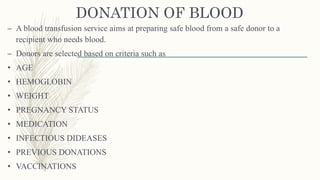
DONATION OF BLOOD
– A blood transfusion service aims at preparing safe blood from a safe donor to a
recipient who needs blood.
– Donors are selected based on criteria such as
• AGE
• HEMOGLOBIN
• WEIGHT
• PREGNANCY STATUS
• MEDICATION
• INFECTIOUS DIDEASES
• PREVIOUS DONATIONS
• VACCINATIONS
REFRENCES
• Lee S. Molecular basis of Kell blood group phenotypes. Vox sang
1997;73:1-41.
• Wagner FF, Gassner C, Muller TH, et al. Molecular basis of weak D
phenotypes. Blood 1999:358-93.
• Hadley TJ, Pelper SC. From malaria to chemokine receptors: the
emerging physiologic role of the Duff blood group antigen. Blood
1997:89:3077-91

Immuno haematology

  • 1.
  • 2.
    OBJECTIVES OVERVIEW OF IMMUNOHAEMATOLOGY. PRINCIPLESOF ANTIGENS AND ANTIBODIES. THE ABO BLOOD GROUP SYSTEM. HAEMOLYTIC DISEASES. CROSS MATCHING.
  • 3.
    OVERVIEW OF IMMUNOHAEMATOLOGY. – WHATIS IMMUNOHEMATOLOGY? Immunohematology is commonly known as blood banking. It studies antigen-antibody reactions, pathogenesis and clinical manifestations of blood disorders. • It involves blood typing, cross-matching and antibody identification and transfusion therapy. • Immunohematology is one of the specialized branches of medical science.
  • 4.
    PRINCIPLES OF ANTIGENAND ANTIBODIES. – ANTIGEN: It is a substance which stimulates antibody production when introduced into an individual. – ANTIBODIES: are mainly proteins produced in response to stimulation by a foreign antigen capable of reacting specifically with that antigen.
  • 5.
    – There arefive major classes of immunoglobulins. • IgG • IgA • IgM • IgE • IgD – Each is unique and has its own characteristics. – Blood group antibodies are almost exclusively IgG, IgM and IgA.
  • 6.
    TYPES OF ANTIBODIES –NATURAL : Red blood cell antibodies in the serum of an individual that are not provoked by previous red cell sensitization. – IMMUNE : They are antibodies evoked by previous antigen stimulation either by transfusion or pregnancy.
  • 7.
    THE ABO SYSTEM •A PERSON’S ABO BLOOD GROUP DEPENDS ON THE ANTIGEN PRESENT ON THE RED BLOOD CELLS. o Individuals who express the A antigen on their red cell belong to group A. o Individuals who express the B antigen on their red cell belong to group B.
  • 8.
    THE ABO SYSTEMCONTINUED… o Individuals that lack both the A and B antigen on their red cells that is their red cell show no agglutination either with anti-A and anti-B belong to group O. o Individuals who express both A and B antigens on their red cells that is their red cells show agglutination with both anti-A and anti-B belong to AB. – THE DISTRIBUTION OF ABO BLOOD GROUPS DIFFER FOR VARIOUS POPULATIONS.
  • 9.
    HAEMOLYTIC DISEASES – Autoimmunehemolytic anemia (AIHA) is a group of rare but serious blood disorders. It is brought through the interaction of red cells and autoantibodies where the body destroys red cells more than it is produced. – Hemolytic Disease of the new born (HDN) also known as erythroblastosis fetalis results from blood group incompatibility in which maternal antibodies destruct fetal red cells. – This can occur due to Rh blood group incompatibility or ABO blood group incompatibility.
  • 10.
    HDN DUE TORH BLOOD GROUP INCOMPATIBILITY. – This occurs due to Rh blood group incompatibility where the mother Rh (D)negative and the infant Rh (D) positive since it inherited it from the father. HDN DUE TO ABO BLOOD GROUP INCOMPATIBILITY. This usually occurs when the mother is invariably group O, the infant is group A or B and when the mother and infant are Rh compatible.
  • 11.
    CROSS-MATCHING – Cross-match alsoknown as compatibility testing is a procedure performed before transfusion to select donor’s blood that will not cause any adverse reaction like hemolysis or agglutination in the recipient. – It also helps the patient to receive maximum benefit from transfusion of red cells. – There are two types of cross-matching namely: MAJOR and MINOR cross- match.
  • 12.
    – MAJOR CROSS-MATCH:Includes mixing recipient’s serum with the donor’s red cells. – MINOR CROSS-MATCH: Involves mixing the donor’s serum with the patients red cells. It is usually thought that any antibody in the donor’s serum will be diluted by the large volume of the recipient’s blood. This causes relatively less problem and so called minor cross-match.
  • 13.
    DONATION OF BLOOD –A blood transfusion service aims at preparing safe blood from a safe donor to a recipient who needs blood. – Donors are selected based on criteria such as • AGE • HEMOGLOBIN • WEIGHT • PREGNANCY STATUS • MEDICATION • INFECTIOUS DIDEASES • PREVIOUS DONATIONS • VACCINATIONS
  • 14.
    REFRENCES • Lee S.Molecular basis of Kell blood group phenotypes. Vox sang 1997;73:1-41. • Wagner FF, Gassner C, Muller TH, et al. Molecular basis of weak D phenotypes. Blood 1999:358-93. • Hadley TJ, Pelper SC. From malaria to chemokine receptors: the emerging physiologic role of the Duff blood group antigen. Blood 1997:89:3077-91