Escherichia coli
(E. coli)
Prepared by
Prashant Dahal
BSc. Microbiology Final Year
Sunsari Technical College
TABLE OF CONTENT
Table of Contents
1. Introduction
2. Morphology
3. Serotypes
4. Cultural characters
5. Biochemistry
6. Clinical significances
a. Virulence factors
b. Pathotypes of E. coli
c. Pathogenesis
d. Disease causing
7. Diagnosis
8. Treatment
9. Positive roles
10. Summary & Sources
INTRODUCTION
• Gram-negative, Rod shaped, Facultative
anaerobic, non-sporing motile/non-motile
coliform bacteria of genus Escherichia in
Enterobacteriaceae family.
• Named after discoverer, German physician
:Theodor Escherich, in 1886
• Commensal / pathogenic; found in GIT of warm-
blodded, hence in Enteric bacteria
• One of the most studied bacetria
MORPHOLOGY
• Rod shaped, around 2 𝜇m (1–3) X 0.4–0.7 𝜇m in size, 0.7
cubic 𝜇m volume
• Peritrichous flagella, fimbriae/pilli presence
• Some contains, polysaccharide capsule
• Mostly singular form or in pair
Serotypes
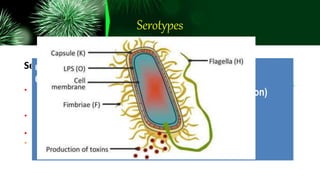
Serotyping is based on 3 major
antigens:
• somatic lipopolysaccharide (LPS) (O),
heat stable, common to Enterobacteriaceae,
173 types
• flagellar (H) heat & alcohol labile, genus
specific proteins, 75 types
• capsular (K) heat-labile, acidic, 103 types
• Beside there is another antigenic
structure, fimbrial (F) : heat labile, 2
types(K88, K99)
SEROTYPES
• More than 200 serotypes
Eg: 1. E. coli O104:H4 (caused diarrhoeal outbreak in
Germany ,2011)
2. E. coli O157:H7 (STEC, diarrhoeal, UTI infection)
3. E. coli O121
4. E. coli O103, O128
CULTURE
• Aerobic / Facultative , pH: 7.2, Temp.: 10-49 with
optm.temp. 37, generation time 20 min
• Common specimens for clinical culture: Urine, Stool, Blood,
CSF, Aspirates
• Common media: MAC, CLED, NA, BA, CAP, TSA, EMB, VRBA,
m-Endo
MEDIA CHARACTERS
MAC circular, moist, smooth, non-mucoid, 2-3mm, convex , pink with darker
pink halo, (mucoid if capsulated)
CLED Opaque yellow colonies with a slightly deeper yellow center, circular,
moist, smooth, non-mucoid, 2mm, convex
BAP big, circular, 1-4mm, gray and moist, 𝛽-haemolytic
EMB Blue-black centered, green metallic sheen, circular, 2-3mm, convex,
smooth
NA large, 2-4mm, circular, low convex, grayish, white, moist, smooth, and
opaque
XLD Yellow, circular, large, flat
BIOCHEMICAL CHARACTERS
TEST RESULT
Gm.Stain -ve (Red/ pink) Rod
IMViC + + - -
TSI Acid / Acid (Y /Y )
Urease -ve
Catalase +ve
Oxidase -ve
Nitrate +ve
H2S -ve
Motility +ve (-ve absent flagella)
CLINICAL SIGNIFICANCE
VIRULENCE FACTORS BIOLOGICAL ROLE
Fimbriae Adherence of bacteria, mannose-resistant
hemagglutination
Adhesins firm adhesion, prevent flushing in GIT, GUT
Endotoxin manifestations of endotoxic shock, protect from
phagocytosis & bactericidal effects of complement
Capsule Protect from serum killing & phagocytosis
Hemolysins pathogenesis of disease caused by uropathogenic strains
(Enterotoxins )
1. Shiga toxins
2. Heat stable toxin
3. Heat labile toxin
Cytotoxins
Causes increased secretion of fluids
Watery diarrhea due to hypersecretion of fluid into the
lumen
Sequestration of growth
factors
Compete for nutrition in host cell
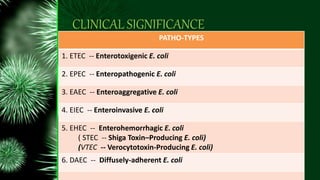
PATHO-TYPES
1. ETEC -- Enterotoxigenic E. coli
2. EPEC -- Enteropathogenic E. coli
3. EAEC -- Enteroaggregative E. coli
4. EIEC -- Enteroinvasive E. coli
5. EHEC -- Enterohemorrhagic E. coli
( STEC -- Shiga Toxin–Producing E. coli)
(VTEC -- Verocytotoxin-Producing E. coli)
6. DAEC -- Diffusely-adherent E. coli
PATHOGENESIS
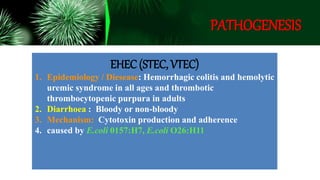
EHEC (STEC, VTEC)
1. Epidemiology / Diesease: Hemorrhagic colitis and hemolytic
uremic syndrome in all ages and thrombotic
thrombocytopenic purpura in adults
2. Diarrhoea : Bloody or non-bloody
3. Mechanism: Cytotoxin production and adherence
4. caused by E.coli 0157:H7, E.coli O26:H11
EPEC
1. Epidemiology/Disease: Acute and chronic endemic and epidemic diarrhea
in infants
2. Diarrhoea: Watery
3. Mechanism: Adherence effacement, adhere to intestinal mucosa and
produce a characteristic lesion in the gastrointestinal tract via. plasmid
coded bundle-forming pill, which form cup-like projections called
pedestals.
4. Do not produce ENTEROTOXIN and NON - INVASIVE
5. Fecal-oral exposure
6. O44, O55, O86, O111, O114, O119, O125, O126, O127, O128, O142 and
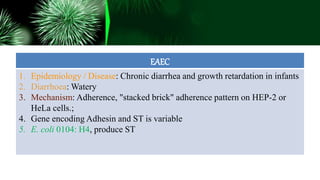
EAEC
1. Epidemiology / Disease: Chronic diarrhea and growth retardation in infants
2. Diarrhoea: Watery
3. Mechanism: Adherence, "stacked brick" adherence pattern on HEP-2 or
HeLa cells.;
4. Gene encoding Adhesin and ST is variable
5. E. coli 0104: H4, produce ST
ETEC
1. Disease/ Epidemiology: Traveler’s Diarrhoea, & Infantile diarrhea in
developing countries
2. Diarrhoea: Watery
3. Mechanism: Adherence (mediated by fimbrial protein called CFA
(colorlization factor antigen)) , enterotoxin production (both heat-labile
and/or heat-stable enterotoxins.)
4. one of the most common causes of bacterial diarrheal disease in developing
countries (estimated 840 million cases annually)
5. (O6:H16, O8:H9 or O8:H-, O15:H11) E. coli-06, 08, 0 15, 025, 0 27, 0 153, 0
159
EIEC
1. Epidemiology / Disease: Diarrhea with fever in all ages,
2. Diarrhoea: Bloody or non-bloody
3. Mechanism: invade and destroy the colonic epithelium,
plasmid mediated Adherence & invasion of mucosa
4. rare in both developed and developing countries
5. Few serotypes; O28, O112, O115, O124, O136, O143, O144,
O147, O152, O164 and O167
DAEC
1. Epidemiology: Age dependent diarrhoea in Children (2-6 yr)
2. Diarrhoea: Watery
3. Mechanism: adherence by fimbriae
4. Less known
Disease caused
1. UTI (bacteriuria)
2. Gastroenteritis (Diarrhoea, ulcer)
3. Septicemia
4. Neonatal sepsis
5. Meningitis
Laboratory Diagnosis
A. Sample: Urine for UTI, Stool for gastroenteritis, Blood
for speticemia/sepsis, CSF for meningitidis
B. Microscopy
C. Culture & Biochemical tests
D. To separate PATHO-TYPES
1. Commercially available immunoassay (ETEC)
2. culture and adherence on Hep-2, HeLa cells (EPEC, EAEC)
3. ELISA, latex-agglitunation, SMAC culture (STEC)
4. Sereny test , HeLa (EIEC)
E. PCR and Gene coding for serotyping
A. E. coli O157:H7, non-sorbitol fermenter
B. Sorbitol fermenter bacteria
TREATMENT
• Generally, adult need none in diarrhoea
• UTI - antibacterial agents, including ampicillin,
cephalosporins, tetracyclines, quinolones,
aminoglycosides, trimethoprim and
sulphonamides
• Enteric E. coli: Fluid + ORS supplement,
antibiotics are used in severe cases
• Meningititis and sepsis: Compulsory
antibiotics
However there is a huge obstacle developing in
treatment of E. coli : ABR pathogenic strains of E. coli
WHO has listed ABR E. coli as pathogen of concern
Resistance is mainly by production of Beta-lactamases
ESBL, ABL, CBL are most commonly associated in
human infection
POSITIVE ROLES OF E. COLI
• Commensal of GIT, producing Vit.K and
preventing colonization of other enteric pathogens
like Cholera, Shigella, Pseudo.., Staph
• Production of Insulin commercially
• Tools of bio-technology in gene cloning and
transfer
• Used as probiotics
• Indicator organism of Water, milk and juices
contamination
SUMMARY
• Gm(-ve), rod, facultative, flagellate, most
studied
• Commensal in GIT of all vertebrates
• Occasionally cause disease
• Pathogens are classified as EIEC, EPEC, EAEC,
EHEC, ETEC, DAEC
• EMB, m-Endo selective media
• MAC, SMAC, CLED, BA – used in clinical
culture
REFERENCES
• Greenwood Medical Microbiology
• Textbook of Diagnostic Microbiology by Connie R Mahon, Donald C. Lehman &
George Mansuseli
• Textbook of Microbiology & Immunology by Subash Chandra Parija
• Escherichia coli (E. coli)- An Overview/ Microbenotes.com
• E. coli Pathotypes / Microbenotes.com
• Murray, P. R., Rosenthal, K. S., & Pfaller, M. A. (2013). Medical microbiology.
Philadelphia: Elsevier/Saunders
• Sastry A.S. & Bhat S.K. (2016). Essentials of Medical Microbiology. New Delhi :
Jaypee Brothers Medical Publishers.
• Wikipedia source
THANK YOU !!

E. coli

  • 1.
    Escherichia coli (E. coli) Preparedby Prashant Dahal BSc. Microbiology Final Year Sunsari Technical College
  • 2.
    TABLE OF CONTENT Tableof Contents 1. Introduction 2. Morphology 3. Serotypes 4. Cultural characters 5. Biochemistry 6. Clinical significances a. Virulence factors b. Pathotypes of E. coli c. Pathogenesis d. Disease causing 7. Diagnosis 8. Treatment 9. Positive roles 10. Summary & Sources
  • 3.
    INTRODUCTION • Gram-negative, Rodshaped, Facultative anaerobic, non-sporing motile/non-motile coliform bacteria of genus Escherichia in Enterobacteriaceae family. • Named after discoverer, German physician :Theodor Escherich, in 1886 • Commensal / pathogenic; found in GIT of warm- blodded, hence in Enteric bacteria • One of the most studied bacetria
  • 4.
    MORPHOLOGY • Rod shaped,around 2 𝜇m (1–3) X 0.4–0.7 𝜇m in size, 0.7 cubic 𝜇m volume • Peritrichous flagella, fimbriae/pilli presence • Some contains, polysaccharide capsule • Mostly singular form or in pair
  • 5.
    Serotypes Serotyping is basedon 3 major antigens: • somatic lipopolysaccharide (LPS) (O), heat stable, common to Enterobacteriaceae, 173 types • flagellar (H) heat & alcohol labile, genus specific proteins, 75 types • capsular (K) heat-labile, acidic, 103 types • Beside there is another antigenic structure, fimbrial (F) : heat labile, 2 types(K88, K99) SEROTYPES • More than 200 serotypes Eg: 1. E. coli O104:H4 (caused diarrhoeal outbreak in Germany ,2011) 2. E. coli O157:H7 (STEC, diarrhoeal, UTI infection) 3. E. coli O121 4. E. coli O103, O128
  • 6.
    CULTURE • Aerobic /Facultative , pH: 7.2, Temp.: 10-49 with optm.temp. 37, generation time 20 min • Common specimens for clinical culture: Urine, Stool, Blood, CSF, Aspirates • Common media: MAC, CLED, NA, BA, CAP, TSA, EMB, VRBA, m-Endo MEDIA CHARACTERS MAC circular, moist, smooth, non-mucoid, 2-3mm, convex , pink with darker pink halo, (mucoid if capsulated) CLED Opaque yellow colonies with a slightly deeper yellow center, circular, moist, smooth, non-mucoid, 2mm, convex BAP big, circular, 1-4mm, gray and moist, 𝛽-haemolytic EMB Blue-black centered, green metallic sheen, circular, 2-3mm, convex, smooth NA large, 2-4mm, circular, low convex, grayish, white, moist, smooth, and opaque XLD Yellow, circular, large, flat
  • 7.
    BIOCHEMICAL CHARACTERS TEST RESULT Gm.Stain-ve (Red/ pink) Rod IMViC + + - - TSI Acid / Acid (Y /Y ) Urease -ve Catalase +ve Oxidase -ve Nitrate +ve H2S -ve Motility +ve (-ve absent flagella)
  • 8.
    CLINICAL SIGNIFICANCE VIRULENCE FACTORSBIOLOGICAL ROLE Fimbriae Adherence of bacteria, mannose-resistant hemagglutination Adhesins firm adhesion, prevent flushing in GIT, GUT Endotoxin manifestations of endotoxic shock, protect from phagocytosis & bactericidal effects of complement Capsule Protect from serum killing & phagocytosis Hemolysins pathogenesis of disease caused by uropathogenic strains (Enterotoxins ) 1. Shiga toxins 2. Heat stable toxin 3. Heat labile toxin Cytotoxins Causes increased secretion of fluids Watery diarrhea due to hypersecretion of fluid into the lumen Sequestration of growth factors Compete for nutrition in host cell PATHO-TYPES 1. ETEC -- Enterotoxigenic E. coli 2. EPEC -- Enteropathogenic E. coli 3. EAEC -- Enteroaggregative E. coli 4. EIEC -- Enteroinvasive E. coli 5. EHEC -- Enterohemorrhagic E. coli ( STEC -- Shiga Toxin–Producing E. coli) (VTEC -- Verocytotoxin-Producing E. coli) 6. DAEC -- Diffusely-adherent E. coli
  • 9.
    PATHOGENESIS EHEC (STEC, VTEC) 1.Epidemiology / Diesease: Hemorrhagic colitis and hemolytic uremic syndrome in all ages and thrombotic thrombocytopenic purpura in adults 2. Diarrhoea : Bloody or non-bloody 3. Mechanism: Cytotoxin production and adherence 4. caused by E.coli 0157:H7, E.coli O26:H11
  • 10.
    EPEC 1. Epidemiology/Disease: Acuteand chronic endemic and epidemic diarrhea in infants 2. Diarrhoea: Watery 3. Mechanism: Adherence effacement, adhere to intestinal mucosa and produce a characteristic lesion in the gastrointestinal tract via. plasmid coded bundle-forming pill, which form cup-like projections called pedestals. 4. Do not produce ENTEROTOXIN and NON - INVASIVE 5. Fecal-oral exposure 6. O44, O55, O86, O111, O114, O119, O125, O126, O127, O128, O142 and
  • 11.
    EAEC 1. Epidemiology /Disease: Chronic diarrhea and growth retardation in infants 2. Diarrhoea: Watery 3. Mechanism: Adherence, "stacked brick" adherence pattern on HEP-2 or HeLa cells.; 4. Gene encoding Adhesin and ST is variable 5. E. coli 0104: H4, produce ST
  • 12.
    ETEC 1. Disease/ Epidemiology:Traveler’s Diarrhoea, & Infantile diarrhea in developing countries 2. Diarrhoea: Watery 3. Mechanism: Adherence (mediated by fimbrial protein called CFA (colorlization factor antigen)) , enterotoxin production (both heat-labile and/or heat-stable enterotoxins.) 4. one of the most common causes of bacterial diarrheal disease in developing countries (estimated 840 million cases annually) 5. (O6:H16, O8:H9 or O8:H-, O15:H11) E. coli-06, 08, 0 15, 025, 0 27, 0 153, 0 159
  • 13.
    EIEC 1. Epidemiology /Disease: Diarrhea with fever in all ages, 2. Diarrhoea: Bloody or non-bloody 3. Mechanism: invade and destroy the colonic epithelium, plasmid mediated Adherence & invasion of mucosa 4. rare in both developed and developing countries 5. Few serotypes; O28, O112, O115, O124, O136, O143, O144, O147, O152, O164 and O167
  • 14.
    DAEC 1. Epidemiology: Agedependent diarrhoea in Children (2-6 yr) 2. Diarrhoea: Watery 3. Mechanism: adherence by fimbriae 4. Less known
  • 16.
    Disease caused 1. UTI(bacteriuria) 2. Gastroenteritis (Diarrhoea, ulcer) 3. Septicemia 4. Neonatal sepsis 5. Meningitis
  • 17.
    Laboratory Diagnosis A. Sample:Urine for UTI, Stool for gastroenteritis, Blood for speticemia/sepsis, CSF for meningitidis B. Microscopy C. Culture & Biochemical tests D. To separate PATHO-TYPES 1. Commercially available immunoassay (ETEC) 2. culture and adherence on Hep-2, HeLa cells (EPEC, EAEC) 3. ELISA, latex-agglitunation, SMAC culture (STEC) 4. Sereny test , HeLa (EIEC) E. PCR and Gene coding for serotyping
  • 18.
    A. E. coliO157:H7, non-sorbitol fermenter B. Sorbitol fermenter bacteria
  • 19.
    TREATMENT • Generally, adultneed none in diarrhoea • UTI - antibacterial agents, including ampicillin, cephalosporins, tetracyclines, quinolones, aminoglycosides, trimethoprim and sulphonamides • Enteric E. coli: Fluid + ORS supplement, antibiotics are used in severe cases • Meningititis and sepsis: Compulsory antibiotics However there is a huge obstacle developing in treatment of E. coli : ABR pathogenic strains of E. coli WHO has listed ABR E. coli as pathogen of concern Resistance is mainly by production of Beta-lactamases ESBL, ABL, CBL are most commonly associated in human infection
  • 20.
    POSITIVE ROLES OFE. COLI • Commensal of GIT, producing Vit.K and preventing colonization of other enteric pathogens like Cholera, Shigella, Pseudo.., Staph • Production of Insulin commercially • Tools of bio-technology in gene cloning and transfer • Used as probiotics • Indicator organism of Water, milk and juices contamination
  • 21.
    SUMMARY • Gm(-ve), rod,facultative, flagellate, most studied • Commensal in GIT of all vertebrates • Occasionally cause disease • Pathogens are classified as EIEC, EPEC, EAEC, EHEC, ETEC, DAEC • EMB, m-Endo selective media • MAC, SMAC, CLED, BA – used in clinical culture
  • 22.
    REFERENCES • Greenwood MedicalMicrobiology • Textbook of Diagnostic Microbiology by Connie R Mahon, Donald C. Lehman & George Mansuseli • Textbook of Microbiology & Immunology by Subash Chandra Parija • Escherichia coli (E. coli)- An Overview/ Microbenotes.com • E. coli Pathotypes / Microbenotes.com • Murray, P. R., Rosenthal, K. S., & Pfaller, M. A. (2013). Medical microbiology. Philadelphia: Elsevier/Saunders • Sastry A.S. & Bhat S.K. (2016). Essentials of Medical Microbiology. New Delhi : Jaypee Brothers Medical Publishers. • Wikipedia source
  • 23.