Laboratory diagnosis of infections
produced by germs of the family
Enterobateriaceae
Family Enterobacteriaceae
- Clinical significance -
• Intestinal and extraintestinal infections
• Highly pathogenic species of the genera:
– Yersinia
– Salmonella
– Shigella
• Facultatively pathogenic species of the genera:
– Escherichia coli
– Klebsiella
– Enterobacter
– Proteus
– Serratia
– Citrobacter
Family Enterobacteriaceae
- Common characters -
• Gram negative bacilli, nonsporulating, non-fastidious
• Glucose-fermenters;
• Lactose is only fermented by some genera – good
differential criterion
• Oxidase-negative
• Catalase-positive
• Habitat:
– soil, plants, human & animal intestines, mucous membranes;
– Particular situation: Salmonella typhi (causative agent of typhoid
fever) – only present in humans (diseased / asymptomatic
carriers)
Family Enterobacteriaceae
- Collection of specimens -
• Extraintestinal infections:
– urine, respiratory/digestive samples, wound secretions, blood,
CSF, etc)
• Intestinal infections:
– Faeces: collection close to onset / depending on pathogenesis of
infection
– Transport media: Stuart, Cary-Blair, Amies
Collection of urine
When?:
- in the morning (first miction)
How?:
- clean uro-genital area
- eliminate first flow
- collect middle flow in
sterile container
Send to lab immediately or store
at 2-8°C
Collection of stool (faeces)
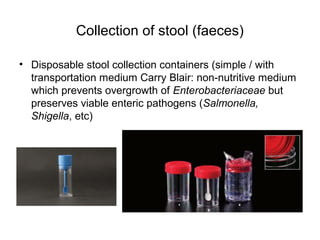
• Disposable stool collection containers (simple / with
transportation medium Carry Blair: non-nutritive medium
which prevents overgrowth of Enterobacteriaceae but
preserves viable enteric pathogens (Salmonella,
Shigella, etc)
Family Enterobacteriaceae
- Isolation (inoculation of culture media) -
• Extraintestinal specimens from normally sterile sites:
– Blood agar
• Extraintestinal specimens with moderate bacterial load
(e.g. pus, sputum):
– Blood agar + MacConkey
• Highly contaminated specimens (faeces):
– MacConkey (low selectivity)
– ADCL, Hektoen agar, XLD agar (medium selectivity)
– High selective media e.g. S-S (for Salmonella and Shigella),
Wilson-Blair (for Salmonella)
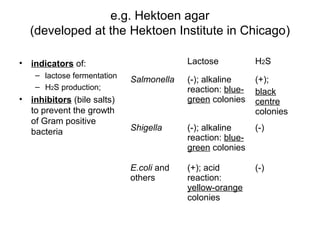
e.g. Hektoen agar
(developed at the Hektoen Institute in Chicago)
• indicators of:
– lactose fermentation
– H2S production;
• inhibitors (bile salts)
to prevent the growth
of Gram positive
bacteria
Lactose H2S
Salmonella (-); alkaline
reaction: blue-
green colonies
(+);
black
centre
colonies
Shigella (-); alkaline
reaction: blue-
green colonies
(-)
E.coli and
others
(+); acid
reaction:
yellow-orange
colonies
(-)
Left: lactose (+) = yellow-orange
Right: lactose (-) = blue-green, H2S (+) = black
centre
E.coli / others (definitely not
Salmonella, not Shigella)
• Salmonella (not Shigella
because of H2S production –
black centre colonies)
Family Enterobacteriaceae
- Identification -
• Biochemical tests:
– TSI (triple sugar iron) agar
– MIU (motility, indol, urea) agar
– Simmons agar (use of citrate as unique carbon source)
– PAD (phenylalanine deaminase) test
– Fermentation of sugars
• Antigenic structure-based identification:
– Agglutination with antisera
Family Enterobacteriaceae
Biochemical tests = testing for enzyme systems
• characterization of bacterial isolate by testing for
characteristic enzyme systems
• Method: re-inoculation of isolated colony (primary
culture) into a series tubes with culture media containing
specific substrates and chemical indicators
• Principle: detection of
– pH changes produced by utilization of substrates /
– colour / other changes produced by specific by-
products
Family Enterobacteriaceae
Biochemical tests (continued)
TSI (triple sugar iron) agar – assessment of bacterial
capacity to:
a. metabolize lactose and/or sucrose
b. conduct fermentation to produce acid
c. produce gas during fermentation
d. generate H2S
TSI agar:
sucrose, lactose, glucose + mehyl red + ferrous
sulfate
IF:
• only glucose fermented →acid production in the butt of tube →
yellow, but insufficient acid to affect the methyl red in the slant
• either sucrose or lactose fermented → sufficient fermentation
products → both the butt and the slant yellow
• gas during fermentation → gas bubbles/cracking of agar
• no fermentation → slant and butt remain red
• If bacterium forms H2S, this chemical will react with the iron to form
ferrous sulfide = black precipitate in the butt (black butt)
TSI agar (continued)
• R = red = no fermentation
(obligate aerobe)
• Y = yellow = some
fermentation (facultative
anaerobe)
• YG = fermentation + gas
• ”+” = Black = H2S
Family Enterobacteriaceae
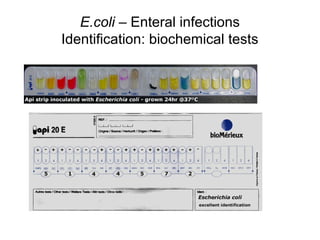
Identification – biochemical tests
• API (Analytical Profile Index)
Escherichia coli
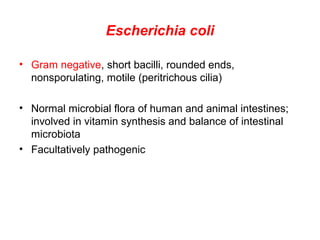
• Gram negative, short bacilli, rounded ends,
nonsporulating, motile (peritrichous cilia)
• Normal microbial flora of human and animal intestines;
involved in vitamin synthesis and balance of intestinal
microbiota
• Facultatively pathogenic
Escherichia coli
- Clinical significance -
• Enteral infections (5 groups):
– EPEC (enteropathogenic E.coli)
– ETEC (enterotoxigenic E.coli)
– EIEC (enteroinvasive E.coli)
– EHEC (enterohemorrhagic E.coli) – produce verotoxins* (bloody
severe diarrhoea resembling dysentery!)
– EAEC (enteroadherent E.coli)
• Extraenteral infections:
– Urinary, respiratory, wounds & burns, sepsis , meningitis, etc.
*Verotoxins (Shiga-like toxins)
• toxins produced by certain strains of E.coli (EHEC)
which disrupt the function of the ribosome
• Action similar to the toxin produced by Shigella
disenteriae strains (Sh.shiga) – see below
• causes the hemolytic uremic syndrome
• Term “verotoxin” related to the effect on “vero” cell
cultures (lineages of kidney epithelial cells extracted from
African green monkeys; name: abbreviation from “verda
reno” = green kidney in Esperanto)
E.coli – Enteral infections
Specimen: stool
• Culture media: MacConkey:
pH indicator = neutral red (red
in acid medium; colourless in
basic medium):
• RED colonies (lactose-
positive), round, shiny, 2-3 mm
E.coli colonies on blood agar
E.coli colonies on MacConkey:
lactose positive (red) colonies
E.coli on medium containing lactose and bile
salts: lactose positive (red) colonies
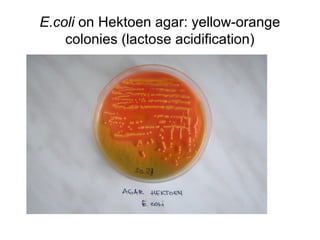
E.coli on Hektoen agar: yellow-orange
colonies (lactose acidification)
E.coli – Enteral infections
Identification: biochemical tests
E.coli – Enteral infections
Identification on antigenic structure
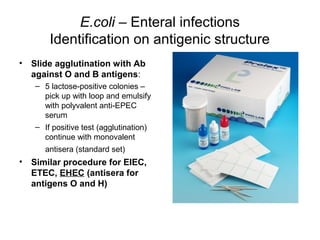
• Slide agglutination with Ab
against O and B antigens:
– 5 lactose-positive colonies –
pick up with loop and emulsify
with polyvalent anti-EPEC
serum
– If positive test (agglutination)
continue with monovalent
antisera (standard set)
• Similar procedure for EIEC,
ETEC, EHEC (antisera for
antigens O and H)
Escherichia coli
- Clinical significance -
• Enteral infections (5 groups):
– EPEC (enteropathogenic E.coli)
– ETEC (enterotoxigenic E.coli)
– EIEC (enteroinvasive E.coli)
– EHEC (enterohemorrhagic E.coli) – produce verotoxins (bloody
severe diarrhoea resembling disenteria!)
– EAEC (enteroadherent E.coli)
• Extraenteral infections:
– Urinary, respiratory, wounds & burns, sepsis , meningitis, etc.
E.coli – Urinary tract infections (UTI)
• Collection of urine for bacterial culture (see above)
• Gram stained smear from urine sediment (after
centrifugation): high no of PMNs + Gram negative bacilli
• Quantitative urine culture:
– A. Dilutions technique
– B. Calibrated loop technique
E.coli – Gram stained smear
E.coli – Urinary tract infections (continued)
Quantitative urine culture
• Colony counts: method to determine number of viable
bacterial cells in urine specimen
• 1 colony = 1 viable bacterial cell (colony-forming unit =
CFU) → after inoculation: division by binary fission i.e. 1
cell to 2; 2 to 4; 4 to 8; 8 to 16....and so on (at least a
million cells must be present in order to be seen as a
colony with the naked eye!)
• Results reported as: number of bacterial cells per mL of
urine
Quantitative urine culture (continued)
A. The dilutions technique:
• 2 dilutions (1/100 and 1/1000) in sterile saline solution
• Inoculate 0.1 mL of each dilution onto blood agar and
MacConkey (lactose containing medium)
• Spread inoculum to obtain isolated colonies (L-shaped
loop); Incubate overnight at 37°C
• Calculate the no of germs / mL urine i.e. multiply:
– No of colonies (CFU) x
– dilution factor (100 or 1000) x
– 10 (we inoculated 0.1 mL of each dilution)
Quantitative urine culture (continued)
B. The calibrated loop technique: (nondiluted sample)
• 5 mm loop → 0.01 mL urine (dilution: 1/100) →
MacConkey
• 2.5 mm loop → 0.001 mL urine (dilution: 1/1000) →
blood agar
• Incubate overnight at 37°C
• Calculation: (for each plate)
• No. of colonies (CFU) x dilution = no of germs / mL
• Calculate the arithmetic mean between the 2 counts
(on the 2 plates)
Quantitative urine culture (continued)
• Interpretation of results:
• Under 10,000 germs/mL = nonsignificant bacteriuria
(probably contamination from lower urethra)
• 10,000–100,000 germs/mL = nonconclusive; repeat test
• Over 100,000 germs/mL = UTI
• Next steps: identification of causative agent i.e.
– colonial characters, biochemical tests
– Antimicrobial susceptibility testing
Genus Salmonella
• The most complex of all Enterobacteriaceae
• over 2400 serotypes – Classification: Kauffmann-White
scheme based on bacterial antigens:
– O (somatic)
– H (flagellar)
– Vi (virulence) – derived from the K (capsular) antigen
• Clinical significance:
– Food poisoning
– Systemic infections (the germs cross the intestinal barrier) –
”enteric fevers”
• Transmission: fecal-oral (via contaminated water, foods)
Genus Salmonella
- The Kauffmann-White classification -
• E.g. Based on the “O”
antigens: groups A – I (+
others)
• some examples given in
table →
“O” group A S.paratyphi A
“O” group B S.paratyphi B
S.typhimurium
“O” group C S.paratyphi C
“O” group D S.typhi
S.enteritidis
Salmonella typhi
• Prototype agent of ”enteric fevers” (other enteric fevers
caused by Salomnella paratyphi A, B, C – less severe)
• Typhoid fever - fever in plateau (39-40°C), headache,
muscle ache, vomit, diarrhoea /constipation, skin rush
(lenticular maculae; “rose spots”), mental confusion,
hepato-splenomegaly
• Complications: internal bleeding, intestinal perforation +
peritonitis
• Laboratory diagnosis:
– Bacteriology
– Serology
Salmonella typhi (+ paratyphi)
- Bacteriological diagnosis -
• Collection of specimens depends on:
– Patient status: diseased / chronic carrier
– Clinical stage (time from onset)
• Secimens:
– Blood for blood culture (best collected during 1st week; percent
of isolation decreases to 25% in the 4th week)
– Bone marrow (in late stages) – lower patient compliance
– Faeces for coproculture (low isolation during 1st week; percent
increases progressively to ~75% in 4th week); also collected
from suspected chronic carriers
– Urine for culture (same isolation curve as for faeces)
Salmonella typhi (+ paratyphi)
- Bacteriological diagnosis - continued
Blood culture:
• inoculated media examined daily for 7-10 days; negative
result only if liquid media remain sterile for 10 days!
• Gram stained smear from turbid tubes: Gram negative
bacilli
• Subculture on agar slant
• Identification based on:
– colonial characters,
– biochemical tests,
– antigenic structure – slide agglutination with anti-O and anti-H
sera (Kauffmann-White classification)
Salmonella typhi (+ paratyphi)
- Bacteriological diagnosis - continued
Coproculture:
• Both in diseased patients and in chronic carrires
• Inoculation in liquid enrichment media (favour
multiplication of salmonellae and inhibit other microbial
flora) e.g.
– Leifson (nutrient broth with acid sodium selenite);
– Muller-Kauffmann (broth with tetrationate and bile)
• Incubate overnight at 37°C
• Reinoculate on selective solid media (nutrients + sugars
+ pH indicator + substances which inhibit other germs)
Salmonella typhi (+ paratyphi)
- Bacteriological diagnosis - continued
Coproculture: (continued)
Colonial characters on selective solid media:
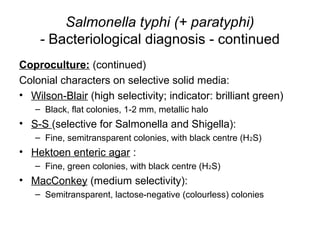
• Wilson-Blair (high selectivity; indicator: brilliant green)
– Black, flat colonies, 1-2 mm, metallic halo
• S-S (selective for Salmonella and Shigella):
– Fine, semitransparent colonies, with black centre (H2S)
• Hektoen enteric agar :
– Fine, green colonies, with black centre (H2S)
• MacConkey (medium selectivity):
– Semitransparent, lactose-negative (colourless) colonies
Salmonella on S-S agar: fine, semitransparent
colonies, black centre (H2S)
Salmonella on MacConkey agar
• Semitransparent, lactose-
negative (colourless)
colonies
Salmonella on agar with lactose and bile salts:
lactose negative (colourless) colonies with black
centre (H2S)
Salmonella on Hektoen agar
• black centre
colonies (H2S)
Salmonella – Coproculture - continued
• Identification based on:
– colonial characters (see above),
– biochemical tests (API 20E),
– antigenic structure – slide agglutination with anti-O and anti-H
sera (Kauffmann-White classification)
– Phage typing – see next slide
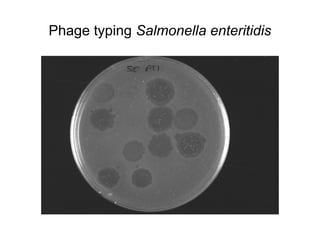
(Bacterio)phage typing for Salmonella
• Bacteriophage = virus which specifically attacks bacteria
• Banks of phages developed for Salmonella serotypes
Procedure:
• agar plates flooded with liquid culture of the bacterial
isolate; remove excess liquid; leave culture film to dry;
• inoculate set of phage suspensions onto plate surface;
incubate overnight at 37°C
• Interpretation: phage lysis reactions recorded and
compared to a set of standards (developed by Public
Health England, formerly PHLS, Colindale, England)
Phage typing Salmonella enteritidis
Salmonella typhi
- Serological diagnosis -
The Widal test:
• Principle: reaction between antibodies in patient serum
and specific antigens of S. typhi → clumping
(agglutination) visible to the naked eye
• easy to perform BUT less reliable than bacteriology:
– cross-reactivity with other Salmonella species,
– the test cannot distinguish between a current infection
and a previous infection or vaccination status
• Still used in low resource areas with high
prevalence of typhoid fever (endemic areas e.g.
India, Pakistan)
Genus Shigella
Clinical significance:
• dysentery – diarrhoea with multiple stools with mucus
and blood + general symptoms: dehydration, fever,
abdominal pain + neurologic symptoms (neurotoxin
secreted by Shigella shiga)
Common characters:
• Gram negative bacilli, nonmotile, nonsporulating
Genus Shigella - classification
4 serological subgroups (based on biochemical characters
and antigenic structure):
• Subgroup A: Shigella dysenteriae
– Types: Sh. shiga, Sh. Schmitzi, Sh. Large-Sachs
• Subgroup B: Shigella flexneri
• Subgroup C: Shigella boydii
• Subgroup D: Shigella sonnei
_______________
• Shigella shiga: the most severe disease (secretion of
neurotoxin)
Kiyoshi Shiga (1871-1957)
• Discovered Shigella dysenteriae during severe
epidemic in 1897: over 90,000 cases
• “shiga” toxin named after him
Genus Shigella – Bacteriological diagnosis
• Collection of specimens: faeces (especially portions with
mucus and blood)
• Transport: Cary Blair medium
• Cultivation and isolation: endo-agar, MacConkey, S-S,
Hektoen, XLD
• Colonial characters:
– small, 1-2 mm, transparent, round / irregular contour, convex,
lactose-negative (colourless i.e. colour of the culture medium)
– No H2S production
Hektoen agar:
Shigella – colourless colonies;
Salmonella - green colonies with black centre
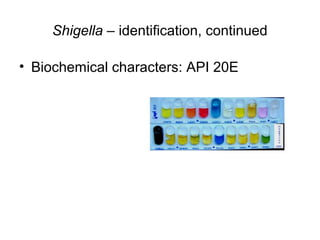
Shigella – identification, continued
• Biochemical characters: API 20E
Genus Shigella – Bacteriological diagnosis
- continued -
• Antigenic structure based
identification:
– Agglutination with sets of anti-
sera (polyvalent + monovalent:
subgroups + typing)
Genus Klebsiella
• Comensal/Facultatively pathogenic: Colonizes the
respiratory mucosa and the intestine
• In immunosuppressed patients (premature infants,
elderly people) – potential for severe infections
(pneumonia, sepsis, meningitis)
• Hospital acquired infections: surgical wound infections,
urinary infections, sepsis
• Involvement in diarrhoeic diseasae - debated
Genus Klebsiella
4 species important for human pathology:
• Klebsiella pneumoniae – comensal of human airways
and intestinal mucosa; facultatively pathogenic
• Klebsiella oxytoca - idem
• Klebsiella ozenae – ozena = chronic inflammatory
infection of the nasal mucosa; mucosal atrophia, crusts
& purulent secretions with unpleasant odour
• Klebsiella rhinoscleromatis – rhinoscleroma = chronic
hypertrophic rhinitis with granulomatous lesions
Genus Klebsiella
Common characters:
• Gram negative, short bacilli,
rounded ends, nonsporulating,
arranged in diplo (in pairs) on
the long axis, enacpsulated
• Sometimes bipolar staining
(ends more intensly stained
than middle of rod)
Genus Kelbsiella
Isolation:
• Specimens from normally sterile sites (blood, CSF, etc):
– Nutrient broth + reinoculation on blood agar
• Specimens from highly contaminates sites (e.g. faeces):
– Media for enterobacteria: MacConkey, XLD
• Identification:
– Blood agar – large, white-grey colonies, mucous, aspect of
”pouring culture” – in time the colour changes to brown
(”chameleoning” phenomenon)
– MacConkey – large, mucoid colonies, red/pink (lactose positive)
– in time colour changes to yellow (lactose negative) –
“chameleoning” by alkalinisation of the medium
Klebsiella – blood agar (non hemolytic
mucoid colonies)
Klebsiella: Mucous colonies
Klebsiella – pink colonies (Lactose positive)
on MacConkey agar
Klebsiella colonies on MacConkey: colour starts to
change - Lactose positive (red/pink) colonies start
to change to lactose negative (yellow) –
alkalinisation
Klebsiella – identification – continued
Biochemical characters
Genus Proteus
• 4 species:
– P.vulgaris, P.mirabilis, P.penneri, P. myxofaciens
• Common characters:
– Gram negative, short bacilli, rounded ends, high polymorphism,
high motility (peritrichous cili), nonsporulating, nonencapsulated
• Habitat:
– soil, trash, sewage, altered meat, etc. – involved in putrefaction
processes
• Clinical significance:
– comensal of human and animal digestive flora;
– facultatively pathogenic: UTI, otitis, synusitis, meningitis, sepsis
(community or hospital acquired infections)
Genus Proteus
• Collection of specimens:
– urine, faeces, pus, sputum, CSF, blood, etc
• Direct microscopy:
– only for naturally sterile specimens e.g. CSF
– PMNs + Gram negative bacilli, noncharacteristic arrangement +
filamentous bacilli (high polymorphism of Proteus spp)
• Isolation and identification:
– Blood agar: swarming phenomenon (concentric growth waves
invading the entire plate after overnight incubation); invades
other bacterial colonies; no isolated colonies
– Selective media: round colonies, same colour as the
medium/transparent, black centre (”cat‘s eye”) – H2S production
Proteus
• Swarming
phenomenon on
tryptic soy agar
Genera Morganella and Providencia
• Previously classified as species of the genus Proteus
• Morganella morganii (formerly: Proteus morganii)
• Providencia (formerly: Proteus rettgeri)
• Involved in UTI especially in urinary catheterized patients
Genera Proteus, Morganella, Providencia
Genus Yersinia
3 species important for human pathology:
1. Y. enterocolitica:
– intestinal pathogen (some strains produce an enterotoxin similar
to E.coli; may infect abdominal lymph nodes – apendicitis-like
symptoms)
• Isolation: faeces inoculated on selective media:
– MacConkey – colonies much smaller than of other
enterobacteria
– CIN (cefsulodin, irgasan, novobiocin): overnight incubation at
32°C/48 hours at 25°C: transparent colonies→ (at 48 hours):
larger, pink colonies (increased motility at room temperature)
Genus Yersinia
3 species important for human pathology (continued):
2. Y.pseudotuberculosis
• Enteric infection involving also abdominal lymph vessels
and nodes
• Collection of specimens, Isolation and identification
similar with Y.enterocolitica
• Differential diagnosis based on biochemcal tests
Genus Yersinia
3 species important for human pathology (continued):
3. Y.pestis – Plague:
– reservoir of germs: rodents (rats)
– interpersonal transmission (human to human)
– Routes of infection:
• Vectors: Flea bites →skin lesions (inflammation,
necrosis, purulent secretion) + swollen lymph
nodes (buboes) = bubonic plague →sepsis
• Airborne: Inhalation →pneumonia = pulmonary
plague
Left: Oriental rat flea (vector of Y.pestis)
Right, upper image: Y.pestis infected flea bite
Right, lower image: swollen lymph nodes (buboes)
Yersinia on blood agar
Yersinia on MacConkey
Yersinia – medium with lactose and bile
salts
Yersinia on Hektoen agar
Yersinia agar
Yersinia – identification: API 20E gallery
Hektoen agar inoculated with stool sample
• E.coli – red arrow
• Salmonella – blue
arrow
• Proteus – yellow
arrow
S-S agar:
A = Klebsiella; B = E.coli; C = Salmonella; D = Proteus;
E = Ps.aeruginosa
• Klebsiella and E.coli –
ferment sugars (red
colonies)
• Salmonella and
Proteus – H2S
production (black
centre)
• Pseudomonas
aeruginosa –
colourless colonies

Enterobacteriaceae

  • 1.
    Laboratory diagnosis ofinfections produced by germs of the family Enterobateriaceae
  • 2.
    Family Enterobacteriaceae - Clinicalsignificance - • Intestinal and extraintestinal infections • Highly pathogenic species of the genera: – Yersinia – Salmonella – Shigella • Facultatively pathogenic species of the genera: – Escherichia coli – Klebsiella – Enterobacter – Proteus – Serratia – Citrobacter
  • 3.
    Family Enterobacteriaceae - Commoncharacters - • Gram negative bacilli, nonsporulating, non-fastidious • Glucose-fermenters; • Lactose is only fermented by some genera – good differential criterion • Oxidase-negative • Catalase-positive • Habitat: – soil, plants, human & animal intestines, mucous membranes; – Particular situation: Salmonella typhi (causative agent of typhoid fever) – only present in humans (diseased / asymptomatic carriers)
  • 4.
    Family Enterobacteriaceae - Collectionof specimens - • Extraintestinal infections: – urine, respiratory/digestive samples, wound secretions, blood, CSF, etc) • Intestinal infections: – Faeces: collection close to onset / depending on pathogenesis of infection – Transport media: Stuart, Cary-Blair, Amies
  • 5.
    Collection of urine When?: -in the morning (first miction) How?: - clean uro-genital area - eliminate first flow - collect middle flow in sterile container Send to lab immediately or store at 2-8°C
  • 6.
    Collection of stool(faeces) • Disposable stool collection containers (simple / with transportation medium Carry Blair: non-nutritive medium which prevents overgrowth of Enterobacteriaceae but preserves viable enteric pathogens (Salmonella, Shigella, etc)
  • 7.
    Family Enterobacteriaceae - Isolation(inoculation of culture media) - • Extraintestinal specimens from normally sterile sites: – Blood agar • Extraintestinal specimens with moderate bacterial load (e.g. pus, sputum): – Blood agar + MacConkey • Highly contaminated specimens (faeces): – MacConkey (low selectivity) – ADCL, Hektoen agar, XLD agar (medium selectivity) – High selective media e.g. S-S (for Salmonella and Shigella), Wilson-Blair (for Salmonella)
  • 8.
    e.g. Hektoen agar (developedat the Hektoen Institute in Chicago) • indicators of: – lactose fermentation – H2S production; • inhibitors (bile salts) to prevent the growth of Gram positive bacteria Lactose H2S Salmonella (-); alkaline reaction: blue- green colonies (+); black centre colonies Shigella (-); alkaline reaction: blue- green colonies (-) E.coli and others (+); acid reaction: yellow-orange colonies (-)
  • 9.
    Left: lactose (+)= yellow-orange Right: lactose (-) = blue-green, H2S (+) = black centre E.coli / others (definitely not Salmonella, not Shigella) • Salmonella (not Shigella because of H2S production – black centre colonies)
  • 10.
    Family Enterobacteriaceae - Identification- • Biochemical tests: – TSI (triple sugar iron) agar – MIU (motility, indol, urea) agar – Simmons agar (use of citrate as unique carbon source) – PAD (phenylalanine deaminase) test – Fermentation of sugars • Antigenic structure-based identification: – Agglutination with antisera
  • 11.
    Family Enterobacteriaceae Biochemical tests= testing for enzyme systems • characterization of bacterial isolate by testing for characteristic enzyme systems • Method: re-inoculation of isolated colony (primary culture) into a series tubes with culture media containing specific substrates and chemical indicators • Principle: detection of – pH changes produced by utilization of substrates / – colour / other changes produced by specific by- products
  • 12.
    Family Enterobacteriaceae Biochemical tests(continued) TSI (triple sugar iron) agar – assessment of bacterial capacity to: a. metabolize lactose and/or sucrose b. conduct fermentation to produce acid c. produce gas during fermentation d. generate H2S
  • 13.
    TSI agar: sucrose, lactose,glucose + mehyl red + ferrous sulfate IF: • only glucose fermented →acid production in the butt of tube → yellow, but insufficient acid to affect the methyl red in the slant • either sucrose or lactose fermented → sufficient fermentation products → both the butt and the slant yellow • gas during fermentation → gas bubbles/cracking of agar • no fermentation → slant and butt remain red • If bacterium forms H2S, this chemical will react with the iron to form ferrous sulfide = black precipitate in the butt (black butt)
  • 14.
    TSI agar (continued) •R = red = no fermentation (obligate aerobe) • Y = yellow = some fermentation (facultative anaerobe) • YG = fermentation + gas • ”+” = Black = H2S
  • 15.
    Family Enterobacteriaceae Identification –biochemical tests • API (Analytical Profile Index)
  • 16.
    Escherichia coli • Gramnegative, short bacilli, rounded ends, nonsporulating, motile (peritrichous cilia) • Normal microbial flora of human and animal intestines; involved in vitamin synthesis and balance of intestinal microbiota • Facultatively pathogenic
  • 17.
    Escherichia coli - Clinicalsignificance - • Enteral infections (5 groups): – EPEC (enteropathogenic E.coli) – ETEC (enterotoxigenic E.coli) – EIEC (enteroinvasive E.coli) – EHEC (enterohemorrhagic E.coli) – produce verotoxins* (bloody severe diarrhoea resembling dysentery!) – EAEC (enteroadherent E.coli) • Extraenteral infections: – Urinary, respiratory, wounds & burns, sepsis , meningitis, etc.
  • 18.
    *Verotoxins (Shiga-like toxins) •toxins produced by certain strains of E.coli (EHEC) which disrupt the function of the ribosome • Action similar to the toxin produced by Shigella disenteriae strains (Sh.shiga) – see below • causes the hemolytic uremic syndrome • Term “verotoxin” related to the effect on “vero” cell cultures (lineages of kidney epithelial cells extracted from African green monkeys; name: abbreviation from “verda reno” = green kidney in Esperanto)
  • 19.
    E.coli – Enteralinfections Specimen: stool • Culture media: MacConkey: pH indicator = neutral red (red in acid medium; colourless in basic medium): • RED colonies (lactose- positive), round, shiny, 2-3 mm
  • 20.
  • 21.
    E.coli colonies onMacConkey: lactose positive (red) colonies
  • 22.
    E.coli on mediumcontaining lactose and bile salts: lactose positive (red) colonies
  • 23.
    E.coli on Hektoenagar: yellow-orange colonies (lactose acidification)
  • 24.
    E.coli – Enteralinfections Identification: biochemical tests
  • 25.
    E.coli – Enteralinfections Identification on antigenic structure • Slide agglutination with Ab against O and B antigens: – 5 lactose-positive colonies – pick up with loop and emulsify with polyvalent anti-EPEC serum – If positive test (agglutination) continue with monovalent antisera (standard set) • Similar procedure for EIEC, ETEC, EHEC (antisera for antigens O and H)
  • 27.
    Escherichia coli - Clinicalsignificance - • Enteral infections (5 groups): – EPEC (enteropathogenic E.coli) – ETEC (enterotoxigenic E.coli) – EIEC (enteroinvasive E.coli) – EHEC (enterohemorrhagic E.coli) – produce verotoxins (bloody severe diarrhoea resembling disenteria!) – EAEC (enteroadherent E.coli) • Extraenteral infections: – Urinary, respiratory, wounds & burns, sepsis , meningitis, etc.
  • 28.
    E.coli – Urinarytract infections (UTI) • Collection of urine for bacterial culture (see above) • Gram stained smear from urine sediment (after centrifugation): high no of PMNs + Gram negative bacilli • Quantitative urine culture: – A. Dilutions technique – B. Calibrated loop technique
  • 29.
    E.coli – Gramstained smear
  • 30.
    E.coli – Urinarytract infections (continued) Quantitative urine culture • Colony counts: method to determine number of viable bacterial cells in urine specimen • 1 colony = 1 viable bacterial cell (colony-forming unit = CFU) → after inoculation: division by binary fission i.e. 1 cell to 2; 2 to 4; 4 to 8; 8 to 16....and so on (at least a million cells must be present in order to be seen as a colony with the naked eye!) • Results reported as: number of bacterial cells per mL of urine
  • 31.
    Quantitative urine culture(continued) A. The dilutions technique: • 2 dilutions (1/100 and 1/1000) in sterile saline solution • Inoculate 0.1 mL of each dilution onto blood agar and MacConkey (lactose containing medium) • Spread inoculum to obtain isolated colonies (L-shaped loop); Incubate overnight at 37°C • Calculate the no of germs / mL urine i.e. multiply: – No of colonies (CFU) x – dilution factor (100 or 1000) x – 10 (we inoculated 0.1 mL of each dilution)
  • 32.
    Quantitative urine culture(continued) B. The calibrated loop technique: (nondiluted sample) • 5 mm loop → 0.01 mL urine (dilution: 1/100) → MacConkey • 2.5 mm loop → 0.001 mL urine (dilution: 1/1000) → blood agar • Incubate overnight at 37°C • Calculation: (for each plate) • No. of colonies (CFU) x dilution = no of germs / mL • Calculate the arithmetic mean between the 2 counts (on the 2 plates)
  • 33.
    Quantitative urine culture(continued) • Interpretation of results: • Under 10,000 germs/mL = nonsignificant bacteriuria (probably contamination from lower urethra) • 10,000–100,000 germs/mL = nonconclusive; repeat test • Over 100,000 germs/mL = UTI • Next steps: identification of causative agent i.e. – colonial characters, biochemical tests – Antimicrobial susceptibility testing
  • 34.
    Genus Salmonella • Themost complex of all Enterobacteriaceae • over 2400 serotypes – Classification: Kauffmann-White scheme based on bacterial antigens: – O (somatic) – H (flagellar) – Vi (virulence) – derived from the K (capsular) antigen • Clinical significance: – Food poisoning – Systemic infections (the germs cross the intestinal barrier) – ”enteric fevers” • Transmission: fecal-oral (via contaminated water, foods)
  • 35.
    Genus Salmonella - TheKauffmann-White classification - • E.g. Based on the “O” antigens: groups A – I (+ others) • some examples given in table → “O” group A S.paratyphi A “O” group B S.paratyphi B S.typhimurium “O” group C S.paratyphi C “O” group D S.typhi S.enteritidis
  • 36.
    Salmonella typhi • Prototypeagent of ”enteric fevers” (other enteric fevers caused by Salomnella paratyphi A, B, C – less severe) • Typhoid fever - fever in plateau (39-40°C), headache, muscle ache, vomit, diarrhoea /constipation, skin rush (lenticular maculae; “rose spots”), mental confusion, hepato-splenomegaly • Complications: internal bleeding, intestinal perforation + peritonitis • Laboratory diagnosis: – Bacteriology – Serology
  • 37.
    Salmonella typhi (+paratyphi) - Bacteriological diagnosis - • Collection of specimens depends on: – Patient status: diseased / chronic carrier – Clinical stage (time from onset) • Secimens: – Blood for blood culture (best collected during 1st week; percent of isolation decreases to 25% in the 4th week) – Bone marrow (in late stages) – lower patient compliance – Faeces for coproculture (low isolation during 1st week; percent increases progressively to ~75% in 4th week); also collected from suspected chronic carriers – Urine for culture (same isolation curve as for faeces)
  • 38.
    Salmonella typhi (+paratyphi) - Bacteriological diagnosis - continued Blood culture: • inoculated media examined daily for 7-10 days; negative result only if liquid media remain sterile for 10 days! • Gram stained smear from turbid tubes: Gram negative bacilli • Subculture on agar slant • Identification based on: – colonial characters, – biochemical tests, – antigenic structure – slide agglutination with anti-O and anti-H sera (Kauffmann-White classification)
  • 39.
    Salmonella typhi (+paratyphi) - Bacteriological diagnosis - continued Coproculture: • Both in diseased patients and in chronic carrires • Inoculation in liquid enrichment media (favour multiplication of salmonellae and inhibit other microbial flora) e.g. – Leifson (nutrient broth with acid sodium selenite); – Muller-Kauffmann (broth with tetrationate and bile) • Incubate overnight at 37°C • Reinoculate on selective solid media (nutrients + sugars + pH indicator + substances which inhibit other germs)
  • 40.
    Salmonella typhi (+paratyphi) - Bacteriological diagnosis - continued Coproculture: (continued) Colonial characters on selective solid media: • Wilson-Blair (high selectivity; indicator: brilliant green) – Black, flat colonies, 1-2 mm, metallic halo • S-S (selective for Salmonella and Shigella): – Fine, semitransparent colonies, with black centre (H2S) • Hektoen enteric agar : – Fine, green colonies, with black centre (H2S) • MacConkey (medium selectivity): – Semitransparent, lactose-negative (colourless) colonies
  • 41.
    Salmonella on S-Sagar: fine, semitransparent colonies, black centre (H2S)
  • 42.
    Salmonella on MacConkeyagar • Semitransparent, lactose- negative (colourless) colonies
  • 43.
    Salmonella on agarwith lactose and bile salts: lactose negative (colourless) colonies with black centre (H2S)
  • 44.
    Salmonella on Hektoenagar • black centre colonies (H2S)
  • 45.
    Salmonella – Coproculture- continued • Identification based on: – colonial characters (see above), – biochemical tests (API 20E), – antigenic structure – slide agglutination with anti-O and anti-H sera (Kauffmann-White classification) – Phage typing – see next slide
  • 46.
    (Bacterio)phage typing forSalmonella • Bacteriophage = virus which specifically attacks bacteria • Banks of phages developed for Salmonella serotypes Procedure: • agar plates flooded with liquid culture of the bacterial isolate; remove excess liquid; leave culture film to dry; • inoculate set of phage suspensions onto plate surface; incubate overnight at 37°C • Interpretation: phage lysis reactions recorded and compared to a set of standards (developed by Public Health England, formerly PHLS, Colindale, England)
  • 47.
  • 48.
    Salmonella typhi - Serologicaldiagnosis - The Widal test: • Principle: reaction between antibodies in patient serum and specific antigens of S. typhi → clumping (agglutination) visible to the naked eye • easy to perform BUT less reliable than bacteriology: – cross-reactivity with other Salmonella species, – the test cannot distinguish between a current infection and a previous infection or vaccination status • Still used in low resource areas with high prevalence of typhoid fever (endemic areas e.g. India, Pakistan)
  • 49.
    Genus Shigella Clinical significance: •dysentery – diarrhoea with multiple stools with mucus and blood + general symptoms: dehydration, fever, abdominal pain + neurologic symptoms (neurotoxin secreted by Shigella shiga) Common characters: • Gram negative bacilli, nonmotile, nonsporulating
  • 50.
    Genus Shigella -classification 4 serological subgroups (based on biochemical characters and antigenic structure): • Subgroup A: Shigella dysenteriae – Types: Sh. shiga, Sh. Schmitzi, Sh. Large-Sachs • Subgroup B: Shigella flexneri • Subgroup C: Shigella boydii • Subgroup D: Shigella sonnei _______________ • Shigella shiga: the most severe disease (secretion of neurotoxin)
  • 51.
    Kiyoshi Shiga (1871-1957) •Discovered Shigella dysenteriae during severe epidemic in 1897: over 90,000 cases • “shiga” toxin named after him
  • 52.
    Genus Shigella –Bacteriological diagnosis • Collection of specimens: faeces (especially portions with mucus and blood) • Transport: Cary Blair medium • Cultivation and isolation: endo-agar, MacConkey, S-S, Hektoen, XLD • Colonial characters: – small, 1-2 mm, transparent, round / irregular contour, convex, lactose-negative (colourless i.e. colour of the culture medium) – No H2S production
  • 54.
    Hektoen agar: Shigella –colourless colonies; Salmonella - green colonies with black centre
  • 55.
    Shigella – identification,continued • Biochemical characters: API 20E
  • 56.
    Genus Shigella –Bacteriological diagnosis - continued - • Antigenic structure based identification: – Agglutination with sets of anti- sera (polyvalent + monovalent: subgroups + typing)
  • 57.
    Genus Klebsiella • Comensal/Facultativelypathogenic: Colonizes the respiratory mucosa and the intestine • In immunosuppressed patients (premature infants, elderly people) – potential for severe infections (pneumonia, sepsis, meningitis) • Hospital acquired infections: surgical wound infections, urinary infections, sepsis • Involvement in diarrhoeic diseasae - debated
  • 58.
    Genus Klebsiella 4 speciesimportant for human pathology: • Klebsiella pneumoniae – comensal of human airways and intestinal mucosa; facultatively pathogenic • Klebsiella oxytoca - idem • Klebsiella ozenae – ozena = chronic inflammatory infection of the nasal mucosa; mucosal atrophia, crusts & purulent secretions with unpleasant odour • Klebsiella rhinoscleromatis – rhinoscleroma = chronic hypertrophic rhinitis with granulomatous lesions
  • 59.
    Genus Klebsiella Common characters: •Gram negative, short bacilli, rounded ends, nonsporulating, arranged in diplo (in pairs) on the long axis, enacpsulated • Sometimes bipolar staining (ends more intensly stained than middle of rod)
  • 60.
    Genus Kelbsiella Isolation: • Specimensfrom normally sterile sites (blood, CSF, etc): – Nutrient broth + reinoculation on blood agar • Specimens from highly contaminates sites (e.g. faeces): – Media for enterobacteria: MacConkey, XLD • Identification: – Blood agar – large, white-grey colonies, mucous, aspect of ”pouring culture” – in time the colour changes to brown (”chameleoning” phenomenon) – MacConkey – large, mucoid colonies, red/pink (lactose positive) – in time colour changes to yellow (lactose negative) – “chameleoning” by alkalinisation of the medium
  • 61.
    Klebsiella – bloodagar (non hemolytic mucoid colonies)
  • 62.
  • 63.
    Klebsiella – pinkcolonies (Lactose positive) on MacConkey agar
  • 64.
    Klebsiella colonies onMacConkey: colour starts to change - Lactose positive (red/pink) colonies start to change to lactose negative (yellow) – alkalinisation
  • 65.
    Klebsiella – identification– continued Biochemical characters
  • 66.
    Genus Proteus • 4species: – P.vulgaris, P.mirabilis, P.penneri, P. myxofaciens • Common characters: – Gram negative, short bacilli, rounded ends, high polymorphism, high motility (peritrichous cili), nonsporulating, nonencapsulated • Habitat: – soil, trash, sewage, altered meat, etc. – involved in putrefaction processes • Clinical significance: – comensal of human and animal digestive flora; – facultatively pathogenic: UTI, otitis, synusitis, meningitis, sepsis (community or hospital acquired infections)
  • 67.
    Genus Proteus • Collectionof specimens: – urine, faeces, pus, sputum, CSF, blood, etc • Direct microscopy: – only for naturally sterile specimens e.g. CSF – PMNs + Gram negative bacilli, noncharacteristic arrangement + filamentous bacilli (high polymorphism of Proteus spp) • Isolation and identification: – Blood agar: swarming phenomenon (concentric growth waves invading the entire plate after overnight incubation); invades other bacterial colonies; no isolated colonies – Selective media: round colonies, same colour as the medium/transparent, black centre (”cat‘s eye”) – H2S production
  • 69.
  • 70.
    Genera Morganella andProvidencia • Previously classified as species of the genus Proteus • Morganella morganii (formerly: Proteus morganii) • Providencia (formerly: Proteus rettgeri) • Involved in UTI especially in urinary catheterized patients
  • 71.
  • 72.
    Genus Yersinia 3 speciesimportant for human pathology: 1. Y. enterocolitica: – intestinal pathogen (some strains produce an enterotoxin similar to E.coli; may infect abdominal lymph nodes – apendicitis-like symptoms) • Isolation: faeces inoculated on selective media: – MacConkey – colonies much smaller than of other enterobacteria – CIN (cefsulodin, irgasan, novobiocin): overnight incubation at 32°C/48 hours at 25°C: transparent colonies→ (at 48 hours): larger, pink colonies (increased motility at room temperature)
  • 73.
    Genus Yersinia 3 speciesimportant for human pathology (continued): 2. Y.pseudotuberculosis • Enteric infection involving also abdominal lymph vessels and nodes • Collection of specimens, Isolation and identification similar with Y.enterocolitica • Differential diagnosis based on biochemcal tests
  • 74.
    Genus Yersinia 3 speciesimportant for human pathology (continued): 3. Y.pestis – Plague: – reservoir of germs: rodents (rats) – interpersonal transmission (human to human) – Routes of infection: • Vectors: Flea bites →skin lesions (inflammation, necrosis, purulent secretion) + swollen lymph nodes (buboes) = bubonic plague →sepsis • Airborne: Inhalation →pneumonia = pulmonary plague
  • 75.
    Left: Oriental ratflea (vector of Y.pestis) Right, upper image: Y.pestis infected flea bite Right, lower image: swollen lymph nodes (buboes)
  • 76.
  • 77.
  • 78.
    Yersinia – mediumwith lactose and bile salts
  • 79.
  • 80.
  • 81.
  • 82.
    Hektoen agar inoculatedwith stool sample • E.coli – red arrow • Salmonella – blue arrow • Proteus – yellow arrow
  • 83.
    S-S agar: A =Klebsiella; B = E.coli; C = Salmonella; D = Proteus; E = Ps.aeruginosa • Klebsiella and E.coli – ferment sugars (red colonies) • Salmonella and Proteus – H2S production (black centre) • Pseudomonas aeruginosa – colourless colonies