Lecture 2
Agglutination tests
Prepared by
DHuda Muharram
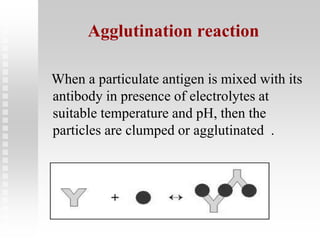
Agglutination reaction
When a particulate antigen is mixed with its
antibody in presence of electrolytes at
suitable temperature and pH, then the
particles are clumped or agglutinated .
Agglutination test
 Qualitative agglutination test - to assay
for the presence of an antigen or an
antibody.
 Quantitative agglutination test - to
quantitative the level of antibodies to
particulate antigens.
Uses
1. Identification of bacteria, e.g. serotyping
of salmonella and shigella with known
antisera.
2. Serological diagnosis of infection e.g.
widal test for typhoid
3. Haemagglutination test.
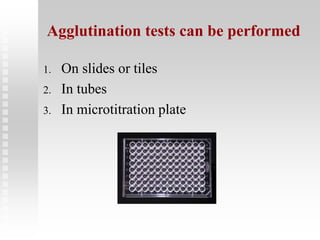
Agglutination tests can be performed
1. On slides or tiles
2. In tubes
3. In microtitration plate
The type of agglutination
 Active agglutination:- These are tests in which
there is a direct agglutination of Ag on the surface
of large insoluble particles ( as bacteria ) with it's
corresponding Ab.
 Passive agglutination :- These are tests in which
the specific Ab or known Ag is attached to inert
particles or cells (carriers ).
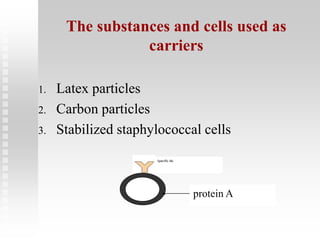
The substances and cells used as
carriers
1. Latex particles
2. Carbon particles
3. Stabilized staphylococcal cells
Specific Ab
protein A
Examples of latex agglutination tests
ASO latex slide agglutination test
Rheumatoid factors (RF) latex slide agglutination test
C- reactive protein (CRP) latex slide agglutination test
Pregnancy latex slide agglutination tests
Hepatitis surface antigen (HBsAg)
ASO latex slide agglutination test
Intended use
It is a rapid latex agglutination test for the
qualitative and semi-quantitative
determination of anti-streptolysin-O
antibodies (ASO) in serum.
Causative agent
 β-haemolytic Streptococci group A (Strept.
pyogenes )
 Streptolysin-O is one of the exotoxins liberated
from the bacteria that stimulates production
of ASO antibodies.
Diseases
 Sore throat
 Skin infection
 Scarlet fever
 Otitis media
 Complications
 Rheumatic fever (after sore throat)
 Acute glomerulonephritis (after skin infection)
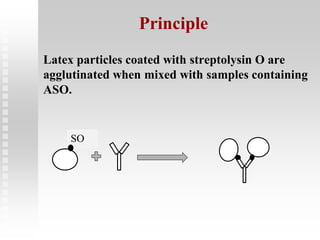
SO
Principle
Latex particles coated with streptolysin O are
agglutinated when mixed with samples containing
ASO.
Reagents and material
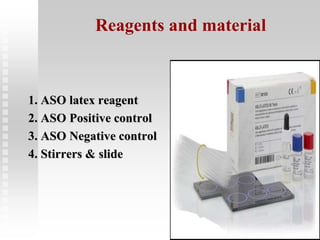
1. ASO latex reagent
2. ASO Positive control
3. ASO Negative control
4. Stirrers & slide
Sample
 Fresh serum. Stable 8 days at 2-8ºC or 3 months
at –20ºC.
 Do not use highly hemolized or lipemic samples.
Procedure
 Qualitative method
 Semi-quantitative method
Qualitative
method
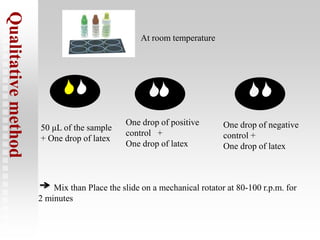
50 μL of the sample
+ One drop of latex
One drop of positive
control +
One drop of latex
One drop of negative
control +
One drop of latex
At room temperature
Mix than Place the slide on a mechanical rotator at 80-100 r.p.m. for
2 minutes
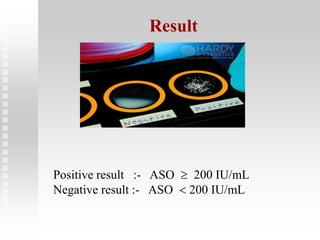
Result
Positive result :- ASO  200 IU/mL
Negative result :- ASO  200 IU/mL
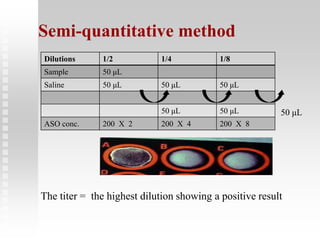
Semi-quantitative method
1/8
1/4
1/2
Dilutions
50 μL
Sample
50 μL
50 μL
50 μL
Saline
50 μL
50 μL
200 X 8
200 X 4
200 X 2
ASO conc.
50 μL
The titer = the highest dilution showing a positive result
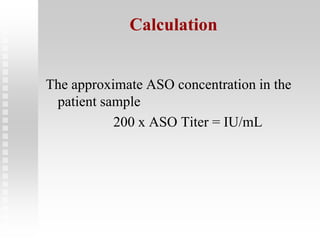
The approximate ASO concentration in the
patient sample
200 x ASO Titer = IU/mL
Calculation
End of lecture

ASO test.ppt

  • 1.
  • 2.
    Agglutination reaction When aparticulate antigen is mixed with its antibody in presence of electrolytes at suitable temperature and pH, then the particles are clumped or agglutinated .
  • 3.
    Agglutination test  Qualitativeagglutination test - to assay for the presence of an antigen or an antibody.  Quantitative agglutination test - to quantitative the level of antibodies to particulate antigens.
  • 4.
    Uses 1. Identification ofbacteria, e.g. serotyping of salmonella and shigella with known antisera. 2. Serological diagnosis of infection e.g. widal test for typhoid 3. Haemagglutination test.
  • 5.
    Agglutination tests canbe performed 1. On slides or tiles 2. In tubes 3. In microtitration plate
  • 6.
    The type ofagglutination  Active agglutination:- These are tests in which there is a direct agglutination of Ag on the surface of large insoluble particles ( as bacteria ) with it's corresponding Ab.  Passive agglutination :- These are tests in which the specific Ab or known Ag is attached to inert particles or cells (carriers ).
  • 7.
    The substances andcells used as carriers 1. Latex particles 2. Carbon particles 3. Stabilized staphylococcal cells Specific Ab protein A
  • 8.
    Examples of latexagglutination tests ASO latex slide agglutination test Rheumatoid factors (RF) latex slide agglutination test C- reactive protein (CRP) latex slide agglutination test Pregnancy latex slide agglutination tests Hepatitis surface antigen (HBsAg)
  • 9.
    ASO latex slideagglutination test
  • 10.
    Intended use It isa rapid latex agglutination test for the qualitative and semi-quantitative determination of anti-streptolysin-O antibodies (ASO) in serum.
  • 11.
    Causative agent  β-haemolyticStreptococci group A (Strept. pyogenes )  Streptolysin-O is one of the exotoxins liberated from the bacteria that stimulates production of ASO antibodies.
  • 12.
    Diseases  Sore throat Skin infection  Scarlet fever  Otitis media  Complications  Rheumatic fever (after sore throat)  Acute glomerulonephritis (after skin infection)
  • 13.
    SO Principle Latex particles coatedwith streptolysin O are agglutinated when mixed with samples containing ASO.
  • 14.
    Reagents and material 1.ASO latex reagent 2. ASO Positive control 3. ASO Negative control 4. Stirrers & slide
  • 15.
    Sample  Fresh serum.Stable 8 days at 2-8ºC or 3 months at –20ºC.  Do not use highly hemolized or lipemic samples.
  • 16.
    Procedure  Qualitative method Semi-quantitative method
  • 17.
    Qualitative method 50 μL ofthe sample + One drop of latex One drop of positive control + One drop of latex One drop of negative control + One drop of latex At room temperature Mix than Place the slide on a mechanical rotator at 80-100 r.p.m. for 2 minutes
  • 18.
    Result Positive result :-ASO  200 IU/mL Negative result :- ASO  200 IU/mL
  • 19.
    Semi-quantitative method 1/8 1/4 1/2 Dilutions 50 μL Sample 50μL 50 μL 50 μL Saline 50 μL 50 μL 200 X 8 200 X 4 200 X 2 ASO conc. 50 μL The titer = the highest dilution showing a positive result
  • 20.
    The approximate ASOconcentration in the patient sample 200 x ASO Titer = IU/mL Calculation
  • 21.