Sterilization and Disinfection 
(control of microorgansisms by 
nonselective methods)
Contents 
• Definition of terms 
• Methods 
• Equipments and agents 
• Applicability in medicine and other fields 
• How to choose the most appropriate 
methods/agents
Definition of terms 
• Sterilization = process that eliminates or kills 
What? - all forms of life including microbial agents: 
– bacteria (vegetative forms and spores), 
– viruses, 
– fungi 
Where? - on surfaces, in fluids, in medication, in culture media, 
How? - by use of heat, chemical agents, irradiation, vacuum & high 
pressure, filtration or combinations thereof.
Definition of terms (II) 
• Disinfection = cleansing techniques that: 
– destroy or 
– decrease the number or 
– remove or 
– prevent the growth 
of infectious microorganisms on surfaces which cannot be 
subjected to sterilization i.e. furniture, rooms, skin, water in 
swimming pools
Sterilization Methods 
I. Physical Methods & agents: 
A. Heat ± vacuum ± high pressure 
a. Dry (red heat, flame, heat in vacuum – Poupinel oven) 
b. Moist (boiling, autoclavation, pasteurization, tyndallization) 
B. Filtration 
C. Irradiation 
a. UV light, 
b. ionizing radiation: gamma, electron, X-ray 
I. Chemical Methods & agents: 
A. Ethylene oxide 
B. Formaldehide
Sterilization Methods (II) 
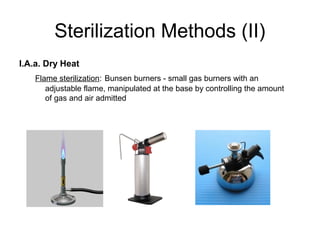
I.A.a. Dry Heat 
Flame sterilization: Bunsen burners - small gas burners with an 
adjustable flame, manipulated at the base by controlling the amount 
of gas and air admitted
Sterilization Methods (III) 
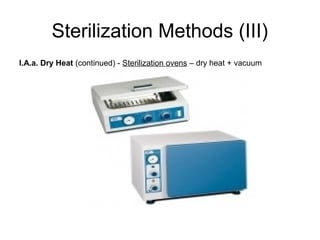
I.A.a. Dry Heat (continued) - Sterilization ovens – dry heat + vacuum
Sterilization Methods (IV) 
Sterilization ovens (Poupinel) (Continued) 
- e.g. 180°C, 1 hour → destruction of all microorganisms incl. spores 
- Components: 
- Sterilization chamber 
- Electrical heating system 
- Thermal insulation (azbestos) 
- Thermometer + thermostate 
- Fan (mechanical air convection)
Sterilization Methods (IV) 
Sterilization ovens (Poupinel) (Continued) 
- Pre-sterilization procedures: 
- Objects must be thoroughly cleaned, dried, packaged/wrapped 
- Packaging: petri dishes, test tubes, small jars, stainless steel 
trays or pans with lids + cotton / paper wrappers or aluminum foil 
may be used, if the temperature does not exceed 204°C 
- overloading must be avoided !
Sterilization Methods (IV) 
- Sterilization ovens (Poupinel) (Continued) 
Advantages: 
- Usable for items that cannot be sterilized by moist heat or chemical 
methods e.g. powdres, oils, items prone to rust 
- Usable for equipments with many parts that cannot be 
disassembled 
- Non-corrosive 
Disadvantages: 
- Slow and uneven penetration → longer time required 
- Less effective than hot steam sterilization (autoclave) – see below 
- Higher temperatures required → harmful to some materials, special 
packaging materials
Sterilization Methods (V) 
- Sterilization ovens (Poupinel) (Continued) 
Suitable for: 
- laboratory glassware, ceramics, surgical instruments (stainless 
steel), powders, olis 
Not suitable for: 
- watery solutions, rubber items, cotton, biological waste (materials 
contaminated with biological fluids e.g. cotton swabs, latex gloves, 
laboratory gowns)
Sterilization Methods (VI) 
- Sterilization ovens (Poupinel) (Continued) 
Control methods: 
– indicators for reaching the high temperatures: 
- white paper used for packaging must change its colour to yellowish / 
brown due to caramelization of sugars (e.g. sacharosis is caramelized 
at 170°C) 
- Coton caps used to close tubes, flasks appear dark brown (carbonized) 
- paper strips impregnated in non toxigenic strains of Clostridium 
tetani subjected to the sterilization process and checked for 
bacterial growth
Sterilization Methods (VI) 
I.A.b. Moist heat – Boiling 
- 100°C, 30 minutes → all vegetative forms of bacteria are killed (BUT 
spores survive) 
- Used in emergencies, when no other method is available e.g. 
medical emergencies in low resource settings, natural disasters 
(floods, earthquakes) causing collapse of power supply 
- Boiling water during epidemics of water borne diseases
Sterilization Methods (VI) 
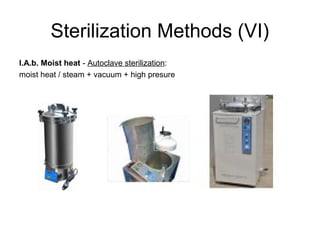
I.A.b. Moist heat - Autoclave sterilization: 
moist heat / steam + vacuum + high presure
Sterilization Methods (VI) 
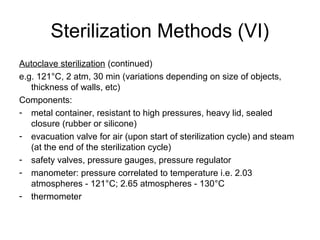
Autoclave sterilization (continued) 
e.g. 121°C, 2 atm, 30 min (variations depending on size of objects, 
thickness of walls, etc) 
Components: 
- metal container, resistant to high pressures, heavy lid, sealed 
closure (rubber or silicone) 
- evacuation valve for air (upon start of sterilization cycle) and steam 
(at the end of the sterilization cycle) 
- safety valves, pressure gauges, pressure regulator 
- manometer: pressure correlated to temperature i.e. 2.03 
atmospheres - 121°C; 2.65 atmospheres - 130°C 
- thermometer
Sterilization Methods (VIII) 
Autoclave sterilization (continued) 
Advantages: 
- More rapid and even penetration 
- better bactericidal/virulicidal effect (denaturation and coagulation of 
proteins) 
Disadvantages: 
- May corrode or cause rusting of some instruments 
...
Sterilization Methods (VIII) 
Autoclave sterilization (continued) - Control methods: 
Chemical tests: based on the melting point of certain substances e.g. 
120°C for benzoic acid 
Bands of filter paper impregnated with thermochromic substances 
- colour change indicates the required temperature has been 
reached 
(no indicator on how much time was the temperature maintained) 
Biological tests: cotton fibers impregnated with spores e.g. 
B.subtilis/B.stearothermophylus subjected to autoclavation and 
then inoculated in culture media – lack of bacterial growth means 
the sterilization has been effective
Sterilization Methods (VIII) 
Autoclave sterilization (continued) 
Suitable for: 
- biological waste (hospitals, laboratories) 
- Culture media 
- Oral/nasal swabs 
- Items made of autoclavable rubber (caps, tubes) 
- Cotton items (laboratory gowns, surgical cloth)
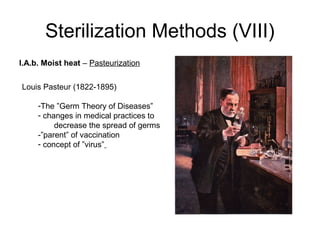
Sterilization Methods (VIII) 
I.A.b. Moist heat – Pasteurization 
Louis Pasteur (1822-1895) 
-The ”Germ Theory of Diseases” 
- changes in medical practices to 
decrease the spread of germs 
-”parent” of vaccination 
- concept of ”virus”
Sterilization Methods (VIII) 
I.A.b. Moist heat – Pasteurization 
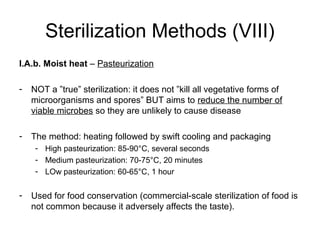
- NOT a ”true” sterilization: it does not ”kill all vegetative forms of 
microorganisms and spores” BUT aims to reduce the number of 
viable microbes so they are unlikely to cause disease 
- The method: heating followed by swift cooling and packaging 
- High pasteurization: 85-90°C, several seconds 
- Medium pasteurization: 70-75°C, 20 minutes 
- LOw pasteurization: 60-65°C, 1 hour 
- Used for food conservation (commercial-scale sterilization of food is 
not common because it adversely affects the taste).
Sterilization Methods (VIII) 
I.A.b. Moist heat – Tyndallization 
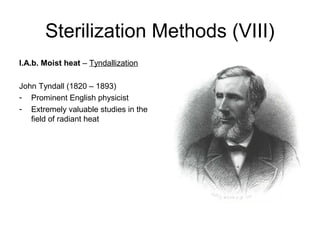
John Tyndall (1820 – 1893) 
- Prominent English physicist 
- Extremely valuable studies in the 
field of radiant heat
Sterilization Methods (VIII) 
I.A.b. Moist heat – Tyndallization (continued) 
The method: staged heating (boiling) for 15 minutes/day during 3 days 
Day 1: after the 15 minutes of boiling all vegetative forms of bacteria 
are killed BUT the spores survive 
Day 2: some of the surviving spores, in favourable conditions 
(moisture, warmth) have turned into vegetative forms; the second 
round of boiling kills them 
Day 3: late germinating spores have survived the second stage of 
boiling as they were still in a sporulated condition but upon the 3rd 
boiling round they have already generated vegetative bacteria which 
will be killed by the 3rd boiling round 
Used for items that cannot withstand autoclavation e.g. plant seeds
Sterilization Methods 
I. Physical Methods & agents: 
A. Heat ± vacuum ± high pressure 
a. Dry (red heat, flame, heat in vacuum – Poupinel oven) 
b. Moist (boiling, autoclavation, pasteurization, tyndallization) 
B. Filtration 
C. Irradiation 
a. UV light, 
b. ionizing radiation: gamma, electron, X-ray 
I. Chemical Methods & agents: 
A. Ethylene oxide 
B. Formaldehide
Sterilization Methods 
I.B. Filtration 
- Mechanical retention of microorganisms from fluids by 
passing them through special membrane filters with 
adequate pore size 
- Used for fluids which would be damaged by heat or other 
sterilization agents (radiations, chemicals) e.g. heat 
labile pharmaceutic substances, wine, beer, etc. 
- microfiltration, pore size 0.2 μm for bacteria 
- nanofiltration, pore size 20-50 nm for viruses 
The smaller the pore size the higher the retaining 
effectiveness.
Sterilization Methods 
I. Physical Methods & agents: 
A. Heat ± vacuum ± high pressure 
a. Dry (red heat, flame, heat in vacuum – Poupinel oven) 
b. Moist (boiling, autoclavation, pasteurization, tyndallization) 
B. Filtration 
C. Irradiation 
a. UV light, 
b. ionizing radiation: gamma, electron beam, X-ray 
I. Chemical Methods & agents: 
A. Ethylene oxide 
B. Formaldehide
Sterilization Methods 
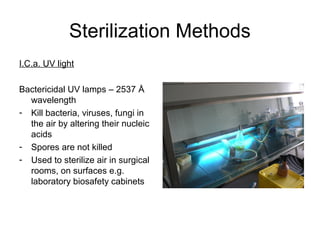
I.C.a. UV light 
Bactericidal UV lamps – 2537 Å 
wavelength 
- Kill bacteria, viruses, fungi in 
the air by altering their nucleic 
acids 
- Spores are not killed 
- Used to sterilize air in surgical 
rooms, on surfaces e.g. 
laboratory biosafety cabinets
Sterilization Methods 
I.C.b. Ionizing radiations 
• Gamma irradiation: Co-60 – industrial sterilization of disposable, 
single use, medical devices e.g. syringes, pipette tips, surgical 
wires, implants, etc.; causes microbial death as a direct effect of the 
destruction of a vital molecule or by an indirect chemical reaction. 
• Electron beam (e-beam sterilization) – industrial sterilization of 
disposable medical devices; same mechanism and dose as in 
gamma irradiation; advanced electronics precisely control the use of 
electron beams in the sterilization of medical devices; less material 
degradation than with gamma irradiation. 
• X-ray – alternative for sterilizing large packages and pallet loads of 
medical devices; no toxic residues; no high temperature rises → 
more suitable for plastics
Sterilization Methods 
I. Physical Methods & agents: 
A. Heat ± vacuum ± high pressure 
a. Dry (red heat, flame, heat in vacuum – Poupinel oven) 
b. Moist (boiling, autoclavation, pasteurization, tyndallization) 
B. Filtration 
C. Irradiation 
a. UV light, 
b. ionizing radiation: gamma, electron beam, X-ray 
I. Chemical Methods & agents: 
A. Ethylene oxide 
B. Formaldehide
Chemical Sterilization Methods 
II.A. Ethylene oxide (CH2OCH2) 
- bacteria killed under the action of highly active oxygene at relatively 
low temperatures (20-60°C) 
- Suitable for medical devices that cannot be subjected to high 
temperatures, moisture or abrasive chemicals e.g. Electronics, 
optical equipment, paper, non-autoclavable rubber and plastics 
- Highly toxic, irritant, explosive – can only be used in strictly 
controled conditions
Chemical Sterilization Methods 
II.B. Formaldehide - liquid sterilizing agent 
- by immersion, provided that the immersion time is sufficiently 
long e.g. over 24 hours to kill all spores in a clear liquid 
- by spraying e.g. closed rooms 
- highly volatile, and toxic by both skin contact and inhalation 
- Many vaccines, such as the original Salk polio vaccine, are 
sterilized with formaldehyd.
Definition of terms 
• Disinfection = cleansing techniques that: 
– destroy or 
– decrease the number or 
– remove or 
– prevent the growth 
of infectious microorganisms on surfaces which cannot be 
subjected to sterilization i.e. furniture, rooms, skin, water in 
swimming pools 
See further presentation on ”Antiseptics & Disinfectants”

Sterilisation and disinfection - control of microorganisms by nonselective methods

  • 1.
    Sterilization and Disinfection (control of microorgansisms by nonselective methods)
  • 2.
    Contents • Definitionof terms • Methods • Equipments and agents • Applicability in medicine and other fields • How to choose the most appropriate methods/agents
  • 3.
    Definition of terms • Sterilization = process that eliminates or kills What? - all forms of life including microbial agents: – bacteria (vegetative forms and spores), – viruses, – fungi Where? - on surfaces, in fluids, in medication, in culture media, How? - by use of heat, chemical agents, irradiation, vacuum & high pressure, filtration or combinations thereof.
  • 4.
    Definition of terms(II) • Disinfection = cleansing techniques that: – destroy or – decrease the number or – remove or – prevent the growth of infectious microorganisms on surfaces which cannot be subjected to sterilization i.e. furniture, rooms, skin, water in swimming pools
  • 5.
    Sterilization Methods I.Physical Methods & agents: A. Heat ± vacuum ± high pressure a. Dry (red heat, flame, heat in vacuum – Poupinel oven) b. Moist (boiling, autoclavation, pasteurization, tyndallization) B. Filtration C. Irradiation a. UV light, b. ionizing radiation: gamma, electron, X-ray I. Chemical Methods & agents: A. Ethylene oxide B. Formaldehide
  • 6.
    Sterilization Methods (II) I.A.a. Dry Heat Flame sterilization: Bunsen burners - small gas burners with an adjustable flame, manipulated at the base by controlling the amount of gas and air admitted
  • 7.
    Sterilization Methods (III) I.A.a. Dry Heat (continued) - Sterilization ovens – dry heat + vacuum
  • 8.
    Sterilization Methods (IV) Sterilization ovens (Poupinel) (Continued) - e.g. 180°C, 1 hour → destruction of all microorganisms incl. spores - Components: - Sterilization chamber - Electrical heating system - Thermal insulation (azbestos) - Thermometer + thermostate - Fan (mechanical air convection)
  • 9.
    Sterilization Methods (IV) Sterilization ovens (Poupinel) (Continued) - Pre-sterilization procedures: - Objects must be thoroughly cleaned, dried, packaged/wrapped - Packaging: petri dishes, test tubes, small jars, stainless steel trays or pans with lids + cotton / paper wrappers or aluminum foil may be used, if the temperature does not exceed 204°C - overloading must be avoided !
  • 10.
    Sterilization Methods (IV) - Sterilization ovens (Poupinel) (Continued) Advantages: - Usable for items that cannot be sterilized by moist heat or chemical methods e.g. powdres, oils, items prone to rust - Usable for equipments with many parts that cannot be disassembled - Non-corrosive Disadvantages: - Slow and uneven penetration → longer time required - Less effective than hot steam sterilization (autoclave) – see below - Higher temperatures required → harmful to some materials, special packaging materials
  • 11.
    Sterilization Methods (V) - Sterilization ovens (Poupinel) (Continued) Suitable for: - laboratory glassware, ceramics, surgical instruments (stainless steel), powders, olis Not suitable for: - watery solutions, rubber items, cotton, biological waste (materials contaminated with biological fluids e.g. cotton swabs, latex gloves, laboratory gowns)
  • 12.
    Sterilization Methods (VI) - Sterilization ovens (Poupinel) (Continued) Control methods: – indicators for reaching the high temperatures: - white paper used for packaging must change its colour to yellowish / brown due to caramelization of sugars (e.g. sacharosis is caramelized at 170°C) - Coton caps used to close tubes, flasks appear dark brown (carbonized) - paper strips impregnated in non toxigenic strains of Clostridium tetani subjected to the sterilization process and checked for bacterial growth
  • 13.
    Sterilization Methods (VI) I.A.b. Moist heat – Boiling - 100°C, 30 minutes → all vegetative forms of bacteria are killed (BUT spores survive) - Used in emergencies, when no other method is available e.g. medical emergencies in low resource settings, natural disasters (floods, earthquakes) causing collapse of power supply - Boiling water during epidemics of water borne diseases
  • 14.
    Sterilization Methods (VI) I.A.b. Moist heat - Autoclave sterilization: moist heat / steam + vacuum + high presure
  • 15.
    Sterilization Methods (VI) Autoclave sterilization (continued) e.g. 121°C, 2 atm, 30 min (variations depending on size of objects, thickness of walls, etc) Components: - metal container, resistant to high pressures, heavy lid, sealed closure (rubber or silicone) - evacuation valve for air (upon start of sterilization cycle) and steam (at the end of the sterilization cycle) - safety valves, pressure gauges, pressure regulator - manometer: pressure correlated to temperature i.e. 2.03 atmospheres - 121°C; 2.65 atmospheres - 130°C - thermometer
  • 16.
    Sterilization Methods (VIII) Autoclave sterilization (continued) Advantages: - More rapid and even penetration - better bactericidal/virulicidal effect (denaturation and coagulation of proteins) Disadvantages: - May corrode or cause rusting of some instruments ...
  • 17.
    Sterilization Methods (VIII) Autoclave sterilization (continued) - Control methods: Chemical tests: based on the melting point of certain substances e.g. 120°C for benzoic acid Bands of filter paper impregnated with thermochromic substances - colour change indicates the required temperature has been reached (no indicator on how much time was the temperature maintained) Biological tests: cotton fibers impregnated with spores e.g. B.subtilis/B.stearothermophylus subjected to autoclavation and then inoculated in culture media – lack of bacterial growth means the sterilization has been effective
  • 18.
    Sterilization Methods (VIII) Autoclave sterilization (continued) Suitable for: - biological waste (hospitals, laboratories) - Culture media - Oral/nasal swabs - Items made of autoclavable rubber (caps, tubes) - Cotton items (laboratory gowns, surgical cloth)
  • 19.
    Sterilization Methods (VIII) I.A.b. Moist heat – Pasteurization Louis Pasteur (1822-1895) -The ”Germ Theory of Diseases” - changes in medical practices to decrease the spread of germs -”parent” of vaccination - concept of ”virus”
  • 20.
    Sterilization Methods (VIII) I.A.b. Moist heat – Pasteurization - NOT a ”true” sterilization: it does not ”kill all vegetative forms of microorganisms and spores” BUT aims to reduce the number of viable microbes so they are unlikely to cause disease - The method: heating followed by swift cooling and packaging - High pasteurization: 85-90°C, several seconds - Medium pasteurization: 70-75°C, 20 minutes - LOw pasteurization: 60-65°C, 1 hour - Used for food conservation (commercial-scale sterilization of food is not common because it adversely affects the taste).
  • 21.
    Sterilization Methods (VIII) I.A.b. Moist heat – Tyndallization John Tyndall (1820 – 1893) - Prominent English physicist - Extremely valuable studies in the field of radiant heat
  • 22.
    Sterilization Methods (VIII) I.A.b. Moist heat – Tyndallization (continued) The method: staged heating (boiling) for 15 minutes/day during 3 days Day 1: after the 15 minutes of boiling all vegetative forms of bacteria are killed BUT the spores survive Day 2: some of the surviving spores, in favourable conditions (moisture, warmth) have turned into vegetative forms; the second round of boiling kills them Day 3: late germinating spores have survived the second stage of boiling as they were still in a sporulated condition but upon the 3rd boiling round they have already generated vegetative bacteria which will be killed by the 3rd boiling round Used for items that cannot withstand autoclavation e.g. plant seeds
  • 23.
    Sterilization Methods I.Physical Methods & agents: A. Heat ± vacuum ± high pressure a. Dry (red heat, flame, heat in vacuum – Poupinel oven) b. Moist (boiling, autoclavation, pasteurization, tyndallization) B. Filtration C. Irradiation a. UV light, b. ionizing radiation: gamma, electron, X-ray I. Chemical Methods & agents: A. Ethylene oxide B. Formaldehide
  • 24.
    Sterilization Methods I.B.Filtration - Mechanical retention of microorganisms from fluids by passing them through special membrane filters with adequate pore size - Used for fluids which would be damaged by heat or other sterilization agents (radiations, chemicals) e.g. heat labile pharmaceutic substances, wine, beer, etc. - microfiltration, pore size 0.2 μm for bacteria - nanofiltration, pore size 20-50 nm for viruses The smaller the pore size the higher the retaining effectiveness.
  • 25.
    Sterilization Methods I.Physical Methods & agents: A. Heat ± vacuum ± high pressure a. Dry (red heat, flame, heat in vacuum – Poupinel oven) b. Moist (boiling, autoclavation, pasteurization, tyndallization) B. Filtration C. Irradiation a. UV light, b. ionizing radiation: gamma, electron beam, X-ray I. Chemical Methods & agents: A. Ethylene oxide B. Formaldehide
  • 26.
    Sterilization Methods I.C.a.UV light Bactericidal UV lamps – 2537 Å wavelength - Kill bacteria, viruses, fungi in the air by altering their nucleic acids - Spores are not killed - Used to sterilize air in surgical rooms, on surfaces e.g. laboratory biosafety cabinets
  • 27.
    Sterilization Methods I.C.b.Ionizing radiations • Gamma irradiation: Co-60 – industrial sterilization of disposable, single use, medical devices e.g. syringes, pipette tips, surgical wires, implants, etc.; causes microbial death as a direct effect of the destruction of a vital molecule or by an indirect chemical reaction. • Electron beam (e-beam sterilization) – industrial sterilization of disposable medical devices; same mechanism and dose as in gamma irradiation; advanced electronics precisely control the use of electron beams in the sterilization of medical devices; less material degradation than with gamma irradiation. • X-ray – alternative for sterilizing large packages and pallet loads of medical devices; no toxic residues; no high temperature rises → more suitable for plastics
  • 28.
    Sterilization Methods I.Physical Methods & agents: A. Heat ± vacuum ± high pressure a. Dry (red heat, flame, heat in vacuum – Poupinel oven) b. Moist (boiling, autoclavation, pasteurization, tyndallization) B. Filtration C. Irradiation a. UV light, b. ionizing radiation: gamma, electron beam, X-ray I. Chemical Methods & agents: A. Ethylene oxide B. Formaldehide
  • 29.
    Chemical Sterilization Methods II.A. Ethylene oxide (CH2OCH2) - bacteria killed under the action of highly active oxygene at relatively low temperatures (20-60°C) - Suitable for medical devices that cannot be subjected to high temperatures, moisture or abrasive chemicals e.g. Electronics, optical equipment, paper, non-autoclavable rubber and plastics - Highly toxic, irritant, explosive – can only be used in strictly controled conditions
  • 30.
    Chemical Sterilization Methods II.B. Formaldehide - liquid sterilizing agent - by immersion, provided that the immersion time is sufficiently long e.g. over 24 hours to kill all spores in a clear liquid - by spraying e.g. closed rooms - highly volatile, and toxic by both skin contact and inhalation - Many vaccines, such as the original Salk polio vaccine, are sterilized with formaldehyd.
  • 31.
    Definition of terms • Disinfection = cleansing techniques that: – destroy or – decrease the number or – remove or – prevent the growth of infectious microorganisms on surfaces which cannot be subjected to sterilization i.e. furniture, rooms, skin, water in swimming pools See further presentation on ”Antiseptics & Disinfectants”