SCIENCE DURING
RENAISSANCE
https://www.google.com.ph/search?q=renaissance+background+powerpoint&biw=1366&bih=657&source=lnms&tbm=isch&sa=X&ved=0ahUKEwjZ8Jjr-
b_KAhVEE5QKHUvWDwUQ_AUIBigB#tbm=isch&q=renaissance+ppt+background&imgdii=_EIJQwBgMljGOM%3A%3B_EIJQwBgMljGOM%3A%3BQbpwdM66CMD2tM%3A&imgrc=_EIJQwBgMljGOM%3A
The Renaissance
Renaissance:
.
Renaissance:
Renaissance:
Science and Art
Important scientific developments
•Alchemy
•Alchemy is the study of the transmutation
of materials through obscure processes. It
is sometimes described as an early form of
chemistry.
•Paracelsus was an alchemist and physician
of the Renaissance. The Paracelsians
added a third element, salt, to make a
trinity of alchemical elements.
•Astronomy
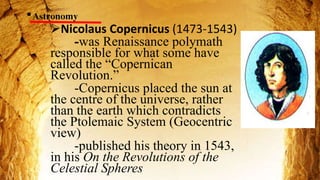
Nicolaus Copernicus (1473-1543)
-was Renaissance polymath
responsible for what some have
called the “Copernican
Revolution.”
-Copernicus placed the sun at
the centre of the universe, rather
than the earth which contradicts
the Ptolemaic System (Geocentric
view)
-published his theory in 1543,
in his On the Revolutions of the
Celestial Spheres
Johannes Kepler (1571-1630)
-is responsible for creating
Kepler’s laws of planetary motion.
These laws include that the orbit of
every planet is an ellipse with the Sun
at one of the two foci, that a line
joining a planet and the Sun sweeps
out equal areas during equal
intervals of time, and that the square
of the orbital period of a planet is
directly proportional to the cube of a
semi-major axis of its orbit.
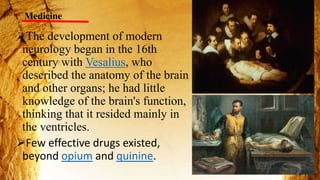
Medicine
The development of modern
neurology began in the 16th
century with Vesalius, who
described the anatomy of the brain
and other organs; he had little
knowledge of the brain's function,
thinking that it resided mainly in
the ventricles.
Few effective drugs existed,
beyond opium and quinine.
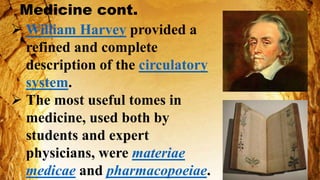
Medicine cont.
 William Harvey provided a
refined and complete
description of the circulatory
system.
 The most useful tomes in
medicine, used both by
students and expert
physicians, were materiae
medicae and pharmacopoeiae.
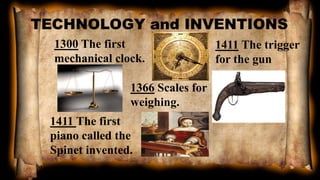
TECHNOLOGY and INVENTIONS
1300 The first
mechanical clock.
1366 Scales for
weighing.
1411 The trigger
for the gun
1411 The first
piano called the
Spinet invented.
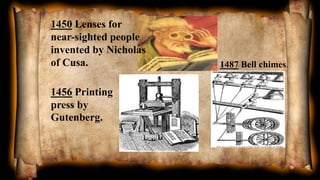
1450 Lenses for
near-sighted people
invented by Nicholas
of Cusa.
1456 Printing
press by
Gutenberg.
1487 Bell chimes.
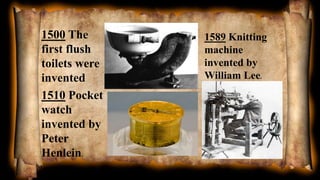
1500 The
first flush
toilets were
invented
1510 Pocket
watch
invented by
Peter
Henlein.
1589 Knitting
machine
invented by
William Lee.
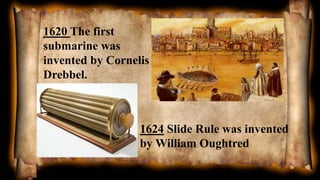
1620 The first
submarine was
invented by Cornelis
Drebbel.
1624 Slide Rule was invented
by William Oughtred
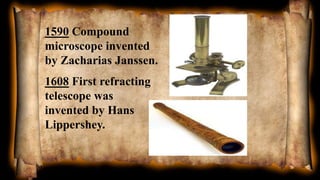
1590 Compound
microscope invented
by Zacharias Janssen.
1608 First refracting
telescope was
invented by Hans
Lippershey.
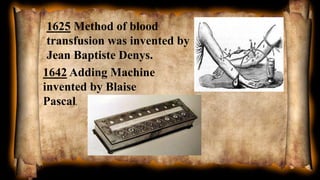
1625 Method of blood
transfusion was invented by
Jean Baptiste Denys.
1642 Adding Machine
invented by Blaise
Pascal.
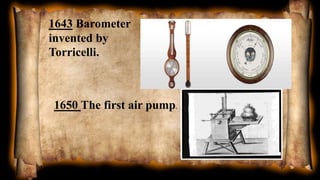
1643 Barometer
invented by
Torricelli.
1650 The first air pump.
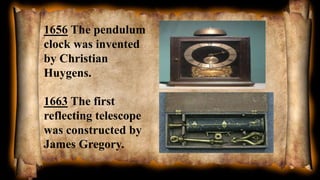
1656 The pendulum
clock was invented
by Christian
Huygens.
1663 The first
reflecting telescope
was constructed by
James Gregory.
•1671 The first calculating machine
invented by Gottfried Wilhelm
Leibniz.
•1679 Pressure cooker invented by
Denis Papin.
•1698 Steam pump invented by
Thomas Savery.
•
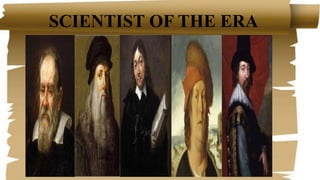
SCIENTIST OF THE ERA
Galileo Galilei (1564-1642)
•The Telescope
-Galileo did not invent the telescope (Dutch
spectacle makers receive that credit), but he
was the first to use the telescope to study the
heavens systematically.
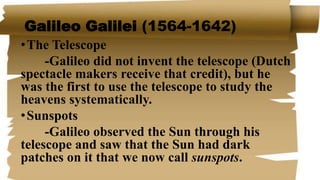
•Sunspots
-Galileo observed the Sun through his
telescope and saw that the Sun had dark
patches on it that we now call sunspots.
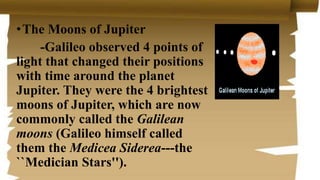
•The Moons of Jupiter
-Galileo observed 4 points of
light that changed their positions
with time around the planet
Jupiter. They were the 4 brightest
moons of Jupiter, which are now
commonly called the Galilean
moons (Galileo himself called
them the Medicea Siderea---the
``Medician Stars'').
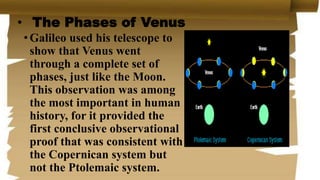
• The Phases of Venus
•Galileo used his telescope to
show that Venus went
through a complete set of
phases, just like the Moon.
This observation was among
the most important in human
history, for it provided the
first conclusive observational
proof that was consistent with
the Copernican system but
not the Ptolemaic system.
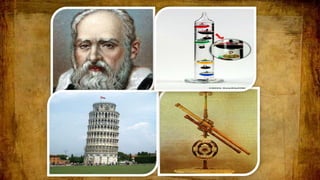
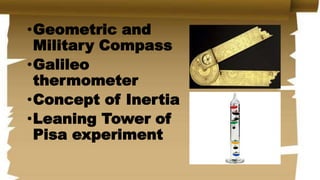
•Geometric and
Military Compass
•Galileo
thermometer
•Concept of Inertia
•Leaning Tower of
Pisa experiment
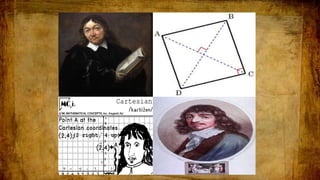
RENE DESCARTES(March 31, 1569),
•Father of Modern Philosophy
•Analytical Geometry
•Used of reasoning that contribute to scientific
method
•Believed that everything should be doubted
until proven by reason.
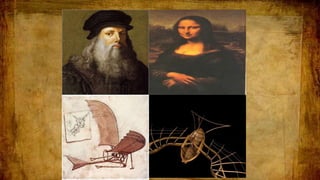
Leonardo da Vinci (1452–1519)
-Leonardo was an Italian polymath,
regarded as the epitome of the "Renaissance
Man", displaying skills in numerous diverse
areas of study.
-Aside from his famous paintings he is
also renowned in other fields like
hydrodynamics, mathematics, mechanical
engineering, optics, physics, pyrotechnics, and
zoology.
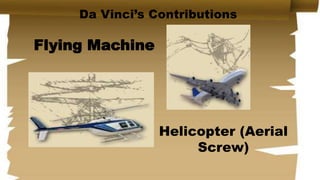
Da Vinci’s Contributions
Flying Machine
Helicopter (Aerial
Screw)
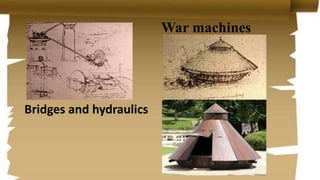
Bridges and hydraulics
War machines
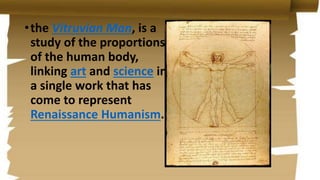
•the Vitruvian Man, is a
study of the proportions
of the human body,
linking art and science in
a single work that has
come to represent
Renaissance Humanism.
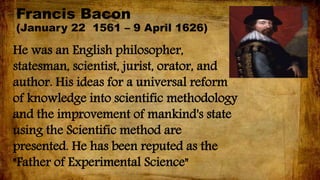
Francis Bacon
(January 22 1561 – 9 April 1626)
He was an English philosopher,
statesman, scientist, jurist, orator, and
author. His ideas for a universal reform
of knowledge into scientific methodology
and the improvement of mankind's state
using the Scientific method are
presented. He has been reputed as the
"Father of Experimental Science"
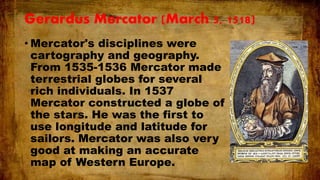
Gerardus Mercator (March 5, 1518)
• Mercator's disciplines were
cartography and geography.
From 1535-1536 Mercator made
terrestrial globes for several
rich individuals. In 1537
Mercator constructed a globe of
the stars. He was the first to
use longitude and latitude for
sailors. Mercator was also very
good at making an accurate
map of Western Europe.
Merci d'avoir écouté
REFERENCES:
• Renaissance and Scientific Revolution, retrieved
from:https://blogs.umass.edu/p139ell/2012/11/19/the-renaissance-and-the-
scientific-revolution/ dated: January 20, 2016
• The Renaissance and the Scientific Revolution: The Age of Growth, retrieved
from: http://www.ducksters.com/history/renaissance_science.php/ dated:
November 19, 2012
•
• Niccolas Copernicus, retrieved from:
http://www.yesnet.yk.ca/schools/projects/renaissance/main/copernicus.html
/
• Renaissance-Reformation, retrieved from:
https://www.khanacademy.org/humanities/renaissance-reformation/high-
ren-florence-rome/beginners-guide-high-ren/a/galileo-galilei
• Martyn Shuttleworth (May 21, 2011). Science and the Enlightenment.
Retrieved Jan 18, 2016 from Explorable.com: https://explorable.com/science-
and-enlightenment
• http://www.buzzle.com/articles/inventions-of-the-
renaissance-timeline.html
• Pictures:
Google images
• Video:
Website: Youtube
Link: https://www.youtube.com/watch?v=o7tk1uuyEow

Science during renaissance period

  • 1.
  • 2.
  • 3.
  • 4.
  • 5.
  • 6.
  • 7.
    Important scientific developments •Alchemy •Alchemyis the study of the transmutation of materials through obscure processes. It is sometimes described as an early form of chemistry. •Paracelsus was an alchemist and physician of the Renaissance. The Paracelsians added a third element, salt, to make a trinity of alchemical elements.

  • 8.
    •Astronomy Nicolaus Copernicus (1473-1543) -wasRenaissance polymath responsible for what some have called the “Copernican Revolution.” -Copernicus placed the sun at the centre of the universe, rather than the earth which contradicts the Ptolemaic System (Geocentric view) -published his theory in 1543, in his On the Revolutions of the Celestial Spheres
  • 9.
    Johannes Kepler (1571-1630) -isresponsible for creating Kepler’s laws of planetary motion. These laws include that the orbit of every planet is an ellipse with the Sun at one of the two foci, that a line joining a planet and the Sun sweeps out equal areas during equal intervals of time, and that the square of the orbital period of a planet is directly proportional to the cube of a semi-major axis of its orbit.
  • 10.
    Medicine The development ofmodern neurology began in the 16th century with Vesalius, who described the anatomy of the brain and other organs; he had little knowledge of the brain's function, thinking that it resided mainly in the ventricles. Few effective drugs existed, beyond opium and quinine.
  • 11.
    Medicine cont.  WilliamHarvey provided a refined and complete description of the circulatory system.  The most useful tomes in medicine, used both by students and expert physicians, were materiae medicae and pharmacopoeiae.
  • 12.
    TECHNOLOGY and INVENTIONS 1300The first mechanical clock. 1366 Scales for weighing. 1411 The trigger for the gun 1411 The first piano called the Spinet invented.
  • 13.
    1450 Lenses for near-sightedpeople invented by Nicholas of Cusa. 1456 Printing press by Gutenberg. 1487 Bell chimes.
  • 14.
    1500 The first flush toiletswere invented 1510 Pocket watch invented by Peter Henlein. 1589 Knitting machine invented by William Lee.
  • 15.
    1620 The first submarinewas invented by Cornelis Drebbel. 1624 Slide Rule was invented by William Oughtred
  • 16.
    1590 Compound microscope invented byZacharias Janssen. 1608 First refracting telescope was invented by Hans Lippershey.
  • 17.
    1625 Method ofblood transfusion was invented by Jean Baptiste Denys. 1642 Adding Machine invented by Blaise Pascal.
  • 18.
  • 19.
    1656 The pendulum clockwas invented by Christian Huygens. 1663 The first reflecting telescope was constructed by James Gregory.
  • 20.
    •1671 The firstcalculating machine invented by Gottfried Wilhelm Leibniz. •1679 Pressure cooker invented by Denis Papin. •1698 Steam pump invented by Thomas Savery. •
  • 21.
  • 23.
    Galileo Galilei (1564-1642) •TheTelescope -Galileo did not invent the telescope (Dutch spectacle makers receive that credit), but he was the first to use the telescope to study the heavens systematically. •Sunspots -Galileo observed the Sun through his telescope and saw that the Sun had dark patches on it that we now call sunspots.
  • 24.
    •The Moons ofJupiter -Galileo observed 4 points of light that changed their positions with time around the planet Jupiter. They were the 4 brightest moons of Jupiter, which are now commonly called the Galilean moons (Galileo himself called them the Medicea Siderea---the ``Medician Stars'').
  • 25.
    • The Phasesof Venus •Galileo used his telescope to show that Venus went through a complete set of phases, just like the Moon. This observation was among the most important in human history, for it provided the first conclusive observational proof that was consistent with the Copernican system but not the Ptolemaic system.
  • 26.
    •Geometric and Military Compass •Galileo thermometer •Conceptof Inertia •Leaning Tower of Pisa experiment
  • 28.
    RENE DESCARTES(March 31,1569), •Father of Modern Philosophy •Analytical Geometry •Used of reasoning that contribute to scientific method •Believed that everything should be doubted until proven by reason.
  • 30.
    Leonardo da Vinci(1452–1519) -Leonardo was an Italian polymath, regarded as the epitome of the "Renaissance Man", displaying skills in numerous diverse areas of study. -Aside from his famous paintings he is also renowned in other fields like hydrodynamics, mathematics, mechanical engineering, optics, physics, pyrotechnics, and zoology.
  • 31.
    Da Vinci’s Contributions FlyingMachine Helicopter (Aerial Screw)
  • 32.
  • 33.
    •the Vitruvian Man,is a study of the proportions of the human body, linking art and science in a single work that has come to represent Renaissance Humanism.
  • 34.
    Francis Bacon (January 221561 – 9 April 1626) He was an English philosopher, statesman, scientist, jurist, orator, and author. His ideas for a universal reform of knowledge into scientific methodology and the improvement of mankind's state using the Scientific method are presented. He has been reputed as the "Father of Experimental Science"
  • 35.
    Gerardus Mercator (March5, 1518) • Mercator's disciplines were cartography and geography. From 1535-1536 Mercator made terrestrial globes for several rich individuals. In 1537 Mercator constructed a globe of the stars. He was the first to use longitude and latitude for sailors. Mercator was also very good at making an accurate map of Western Europe.
  • 36.
  • 37.
    REFERENCES: • Renaissance andScientific Revolution, retrieved from:https://blogs.umass.edu/p139ell/2012/11/19/the-renaissance-and-the- scientific-revolution/ dated: January 20, 2016 • The Renaissance and the Scientific Revolution: The Age of Growth, retrieved from: http://www.ducksters.com/history/renaissance_science.php/ dated: November 19, 2012 • • Niccolas Copernicus, retrieved from: http://www.yesnet.yk.ca/schools/projects/renaissance/main/copernicus.html / • Renaissance-Reformation, retrieved from: https://www.khanacademy.org/humanities/renaissance-reformation/high- ren-florence-rome/beginners-guide-high-ren/a/galileo-galilei • Martyn Shuttleworth (May 21, 2011). Science and the Enlightenment. Retrieved Jan 18, 2016 from Explorable.com: https://explorable.com/science- and-enlightenment
  • 38.
    • http://www.buzzle.com/articles/inventions-of-the- renaissance-timeline.html • Pictures: Googleimages • Video: Website: Youtube Link: https://www.youtube.com/watch?v=o7tk1uuyEow