THE SCIENTIFIC REVOLUTION
Causes of the Scientific Revolution
•  Before 1500, scholars decided what was
true or false by referring to ancient
authorities or to the Bible
•  The Renaissance’s rebirth in learning
inspired curiosity in many fields
•  Reformation prompted followers to
challenge accepted ways of thinking about
God
•  By the mid-1500s, scholars begin to
challenge the ideas of ancient thinkers and
the church
•  Scientific Revolution was based upon
careful observation of the world and a
willingness to challenge accepted beliefs
Causes of the Scientific Revolution
•  New inventions made careful observations and
accurate measurements possible
–  Telescope, microscope, printing press, chronometer
•  Mathematics played a key role in the
achievements during the 1600-1700s
–  Francois Viete – used letters to represent unknown
quantities and laid the foundation for trigonometry
–  Simon Stevin – introduced the decimal system
–  John Napier – invented a table of logarithms, making
calculations much easier
•  Ancient mathematicians believed the secrets of
nature were written in the language of math
–  the rediscovery of their works made proving abstract
theories with clear logical evidence (algebra,
geometry, trigonometry) much easier.
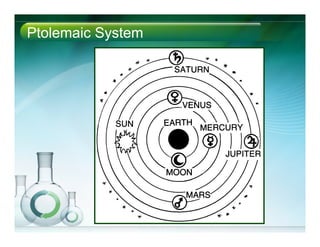
Ptolemaic System
•  An early challenge to accepted scientific
thought came in the field of astronomy
•  Ptolemy (100s), the greatest ancient
astronomer, in addition to Aristotle and
Christianity, constructed the universe in
a geocentric model (Ptolemaic System).
–  Is a series of concentric circles where the
heavenly bodies are embedded in crystal-
like, transparent spheres.
–  The moon is embedded in the first sphere,
Mercury the second, Venus the third, and the
Sun in the fourth.
–  The tenth sphere is the “prime mover” that
gives motion to the other spheres.
–  Beyond the prime mover is Heaven and God
•  God at one end and humans at the center.
Ptolemaic System
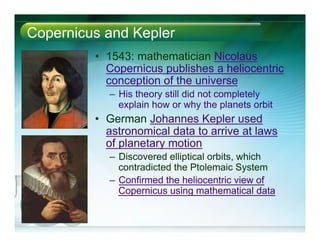
Copernicus and Kepler
•  1543: mathematician Nicolaus
Copernicus publishes a heliocentric
conception of the universe
–  His theory still did not completely
explain how or why the planets orbit
•  German Johannes Kepler used
astronomical data to arrive at laws
of planetary motion
–  Discovered elliptical orbits, which
contradicted the Ptolemaic System
–  Confirmed the heliocentric view of
Copernicus using mathematical data
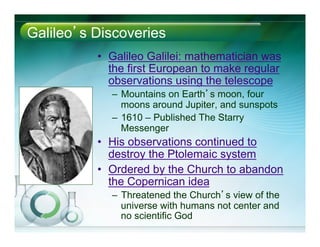
Galileo’s Discoveries
•  Galileo Galilei: mathematician was
the first European to make regular
observations using the telescope
–  Mountains on Earth’s moon, four
moons around Jupiter, and sunspots
–  1610 – Published The Starry
Messenger
•  His observations continued to
destroy the Ptolemaic system
•  Ordered by the Church to abandon
the Copernican idea
–  Threatened the Church’s view of the
universe with humans not center and
no scientific God
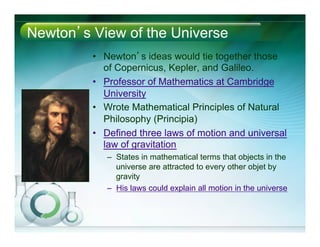
Newton’s View of the Universe
•  Newton’s ideas would tie together those
of Copernicus, Kepler, and Galileo.
•  Professor of Mathematics at Cambridge
University
•  Wrote Mathematical Principles of Natural
Philosophy (Principia)
•  Defined three laws of motion and universal
law of gravitation
–  States in mathematical terms that objects in the
universe are attracted to every other objet by
gravity
–  His laws could explain all motion in the universe
Women’s Contributions
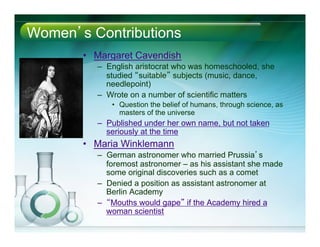
•  Margaret Cavendish
–  English aristocrat who was homeschooled, she
studied “suitable” subjects (music, dance,
needlepoint)
–  Wrote on a number of scientific matters
•  Question the belief of humans, through science, as
masters of the universe
–  Published under her own name, but not taken
seriously at the time
•  Maria Winklemann
–  German astronomer who married Prussia’s
foremost astronomer – as his assistant she made
some original discoveries such as a comet
–  Denied a position as assistant astronomer at
Berlin Academy
–  “Mouths would gape” if the Academy hired a
woman scientist
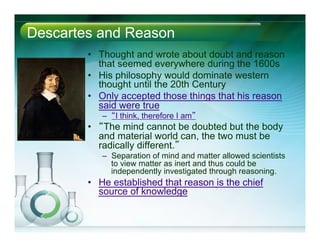
Descartes and Reason
•  Thought and wrote about doubt and reason
that seemed everywhere during the 1600s
•  His philosophy would dominate western
thought until the 20th Century
•  Only accepted those things that his reason
said were true
–  “I think, therefore I am”
•  “The mind cannot be doubted but the body
and material world can, the two must be
radically different.”
–  Separation of mind and matter allowed scientists
to view matter as inert and thus could be
independently investigated through reasoning.
•  He established that reason is the chief
source of knowledge
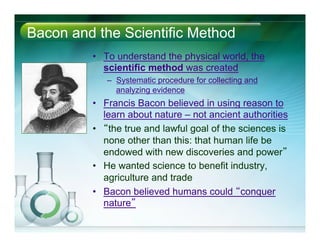
Bacon and the Scientific Method
•  To understand the physical world, the
scientific method was created
–  Systematic procedure for collecting and
analyzing evidence
•  Francis Bacon believed in using reason to
learn about nature – not ancient authorities
•  “the true and lawful goal of the sciences is
none other than this: that human life be
endowed with new discoveries and power”
•  He wanted science to benefit industry,
agriculture and trade
•  Bacon believed humans could “conquer
nature”

Scientific revolution ppt 2

  • 1.
  • 2.
    Causes of theScientific Revolution •  Before 1500, scholars decided what was true or false by referring to ancient authorities or to the Bible •  The Renaissance’s rebirth in learning inspired curiosity in many fields •  Reformation prompted followers to challenge accepted ways of thinking about God •  By the mid-1500s, scholars begin to challenge the ideas of ancient thinkers and the church •  Scientific Revolution was based upon careful observation of the world and a willingness to challenge accepted beliefs
  • 3.
    Causes of theScientific Revolution •  New inventions made careful observations and accurate measurements possible –  Telescope, microscope, printing press, chronometer •  Mathematics played a key role in the achievements during the 1600-1700s –  Francois Viete – used letters to represent unknown quantities and laid the foundation for trigonometry –  Simon Stevin – introduced the decimal system –  John Napier – invented a table of logarithms, making calculations much easier •  Ancient mathematicians believed the secrets of nature were written in the language of math –  the rediscovery of their works made proving abstract theories with clear logical evidence (algebra, geometry, trigonometry) much easier.
  • 4.
    Ptolemaic System •  Anearly challenge to accepted scientific thought came in the field of astronomy •  Ptolemy (100s), the greatest ancient astronomer, in addition to Aristotle and Christianity, constructed the universe in a geocentric model (Ptolemaic System). –  Is a series of concentric circles where the heavenly bodies are embedded in crystal- like, transparent spheres. –  The moon is embedded in the first sphere, Mercury the second, Venus the third, and the Sun in the fourth. –  The tenth sphere is the “prime mover” that gives motion to the other spheres. –  Beyond the prime mover is Heaven and God •  God at one end and humans at the center.
  • 5.
  • 6.
    Copernicus and Kepler • 1543: mathematician Nicolaus Copernicus publishes a heliocentric conception of the universe –  His theory still did not completely explain how or why the planets orbit •  German Johannes Kepler used astronomical data to arrive at laws of planetary motion –  Discovered elliptical orbits, which contradicted the Ptolemaic System –  Confirmed the heliocentric view of Copernicus using mathematical data
  • 7.
    Galileo’s Discoveries •  GalileoGalilei: mathematician was the first European to make regular observations using the telescope –  Mountains on Earth’s moon, four moons around Jupiter, and sunspots –  1610 – Published The Starry Messenger •  His observations continued to destroy the Ptolemaic system •  Ordered by the Church to abandon the Copernican idea –  Threatened the Church’s view of the universe with humans not center and no scientific God
  • 8.
    Newton’s View ofthe Universe •  Newton’s ideas would tie together those of Copernicus, Kepler, and Galileo. •  Professor of Mathematics at Cambridge University •  Wrote Mathematical Principles of Natural Philosophy (Principia) •  Defined three laws of motion and universal law of gravitation –  States in mathematical terms that objects in the universe are attracted to every other objet by gravity –  His laws could explain all motion in the universe
  • 9.
    Women’s Contributions •  MargaretCavendish –  English aristocrat who was homeschooled, she studied “suitable” subjects (music, dance, needlepoint) –  Wrote on a number of scientific matters •  Question the belief of humans, through science, as masters of the universe –  Published under her own name, but not taken seriously at the time •  Maria Winklemann –  German astronomer who married Prussia’s foremost astronomer – as his assistant she made some original discoveries such as a comet –  Denied a position as assistant astronomer at Berlin Academy –  “Mouths would gape” if the Academy hired a woman scientist
  • 10.
    Descartes and Reason • Thought and wrote about doubt and reason that seemed everywhere during the 1600s •  His philosophy would dominate western thought until the 20th Century •  Only accepted those things that his reason said were true –  “I think, therefore I am” •  “The mind cannot be doubted but the body and material world can, the two must be radically different.” –  Separation of mind and matter allowed scientists to view matter as inert and thus could be independently investigated through reasoning. •  He established that reason is the chief source of knowledge
  • 11.
    Bacon and theScientific Method •  To understand the physical world, the scientific method was created –  Systematic procedure for collecting and analyzing evidence •  Francis Bacon believed in using reason to learn about nature – not ancient authorities •  “the true and lawful goal of the sciences is none other than this: that human life be endowed with new discoveries and power” •  He wanted science to benefit industry, agriculture and trade •  Bacon believed humans could “conquer nature”