Presentation
on
Renaissance
Prepared by:
Alok Roy
Sociology Discipline
Khulna University
Khulna-9208
Bangladesh.
History of Renaissance
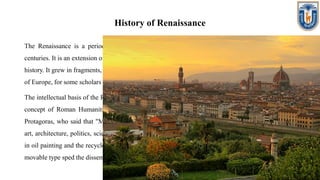
The Renaissance is a period in European history, covering the span between the 14th and 17th
centuries. It is an extension of the Middle Ages and is bridged by the Age of Enlightenment to modern
history. It grew in fragments, with the very first traces found seemingly in Italy, coming to cover much
of Europe, for some scholars marking the beginning of the modern age.
The intellectual basis of the Renaissance was its own invented version of humanism, derived from the
concept of Roman Humanities and the rediscovery of classical Greek philosophy, such as that of
Protagoras, who said that "Man is the measure of all things." This new thinking became manifest in
art, architecture, politics, science and literature. Early examples were the development of perspective
in oil painting and the recycled knowledge of how to make concrete. Although the invention of metal
movable type sped the dissemination of ideas from the later 15th century.
Renaissance
Many argue that the ideas characterizing the Renaissance had their origin in late 13th-century Florence,
in particular with the writings of Dante Alighieri (1265–1321) and Petrarch (1304–1374), as well as the
paintings of Giotto di Bondone (1267–1337).
The renaissance was a time of renewal. Renaissance means rebirth and Europe was discovering from
the dark ages and the plague. People had lost their faith in the church and began to put more focus on
human being. The Renaissance was a cultural movement that profoundly affected European intellectual
life in the early modern period. Beginning in Italy, and spreading to the rest of Europe by the 16th
century, its influence was felt in literature, philosophy, art, music, politics, science, religion, and other
aspects of intellectual inquiry. Renaissance scholars employed the humanist method in study, and
searched for realism and human emotion in art
Characteristics of Renaissance
 Humanism
Humanist scholars shaped the intellectual landscape throughout the early modern period. Political philosophers such as
Niccolò Machiavelli and Thomas More revived the ideas of Greek and Roman thinkers and applied them in critiques of
contemporary government . The humanists believed that it is important to transcend to the afterlife with a perfect mind
and body, which could be attained with education. The purpose of humanism was to create a universal man whose person
combined intellectual and physical excellence and who was capable of functioning honourably in virtually any situation.
Above all, humanists asserted "the genius of man ... the unique and extraordinary ability of the human mind".
 Humanism and Libraries
A unique characteristic of some Renaissance libraries is that they were open to the public. These libraries were places
where ideas were exchanged and where scholarship and reading were considered both pleasurable and beneficial to the
mind and soul. A number of libraries appeared as manifestations of immense wealth joined with a love of books.
Prominent aristocrats and princes of the Church created great libraries for the use of their courts, called "court libraries”.
These informal associations of intellectuals profoundly influenced Renaissance culture.
Art
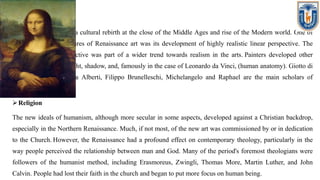
Renaissance art marks a cultural rebirth at the close of the Middle Ages and rise of the Modern world. One of
the distinguishing features of Renaissance art was its development of highly realistic linear perspective. The
development of perspective was part of a wider trend towards realism in the arts. Painters developed other
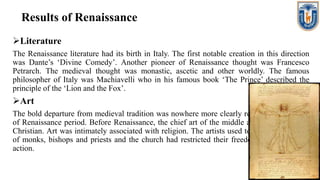
techniques, studying light, shadow, and, famously in the case of Leonardo da Vinci, (human anatomy). Giotto di
Bondone, Leon Battista Alberti, Filippo Brunelleschi, Michelangelo and Raphael are the main scholars of
renaissance.
Religion
The new ideals of humanism, although more secular in some aspects, developed against a Christian backdrop,
especially in the Northern Renaissance. Much, if not most, of the new art was commissioned by or in dedication
to the Church. However, the Renaissance had a profound effect on contemporary theology, particularly in the
way people perceived the relationship between man and God. Many of the period's foremost theologians were
followers of the humanist method, including Erasmoreus, Zwingli, Thomas More, Martin Luther, and John
Calvin. People had lost their faith in the church and began to put more focus on human being.
Science
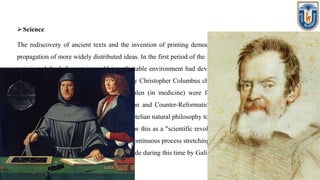
The rediscovery of ancient texts and the invention of printing democratized learning and allowed a faster
propagation of more widely distributed ideas. In the first period of the Italian Renaissance. Nicholas Cusanus
anticipated the heliocentric worldview. Suitable environment had developed to question scientific doctrine.
The discovery in 1492 of the New World by Christopher Columbus challenged the classical worldview. The
works of Ptolemy (in geography) and Galen (in medicine) were found to not always match everyday
observations. As the Protestant Reformation and Counter-Reformation clashed, the Northern Renaissance
showed a decisive shift in focus from Aristotelian natural philosophy to chemistry and the biological sciences
(botany, anatomy, and medicine). Some view this as a "scientific revolution", heralding the beginning of the
modern age, others as an acceleration of a continuous process stretching from the ancient world to the present
day. Significant scientific advances were made during this time by Galileo Galilei, Tycho Brahe and Johannes
Kepler.
Music
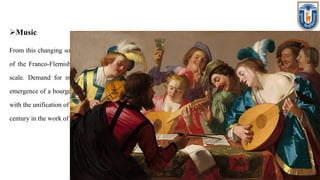
From this changing society emerged a common, unifying musical language, in particular the polyphonic style
of the Franco-Flemish school. The development of printing made distribution of music possible on a wide
scale. Demand for music as entertainment and as an activity for educated amateurs increased with the
emergence of a bourgeois class. Dissemination of chansons, motets, and masses throughout Europe coincided
with the unification of polyphonic practice into the fluid style that culminated in the second half of the sixteenth
century in the work of composers such as Palestrina, Lassus, Victoria and William Byrd.
Self-awareness
By the 15th century, writers, artists, and architects in Italy were well aware of the transformations that
were taking place and were using phrases such as modi antichi (in the antique manner) or alle romana et
alla antica (in the manner of the Romans and the ancients) to describe their work. In the 1330s Petrarch
referred to pre-Christian times as antiqua (ancient) and to the Christian period as nova (new). Humanist
historians argued that contemporary scholarship restored direct links to the classical period. the age into
three phases: the first phase contains Cimabue, Giotto, and Arnolfo di Cambio; the second phase contains
Masaccio, Brunelleschi, and Donatello; the third centers on Leonardo da Vinci and culminates with
Michelangelo. It was not just the growing awareness of classical antiquity that drove this development.
Causes of Renaissance
• There were many causes behind ‘Renaissance’. The fall of Constantinople was its main
cause. It was the center of learning. Although, it was under the clutches of the Christians,
many Greek scholars were living there. They became famous by teaching Greek language
and literature to the people. Although historians still debate some causes of the Renaissance,
they agree on a few basic points.
 A Hunger for Discovery
The courts and monasteries of Europe had long been repositories of old manuscripts and
texts, but a change in how scholars viewed them stimulated a massive reappraisal of classical
works in the Renaissance. Fourteenth-century writer Petrarch typified this, writing about his
own lust for discovering texts that had previously been ignored. As literacy spread and a
middle class began to emerge, seeking out, reading, and spreading classical texts became
commonplace.
Reintroduction of Classical Works
During the Dark Ages, many of the classical texts of Europe were lost or destroyed. Those
that survived were hidden in the churches and monasteries of the Byzantine Empire or in the
capitals of the Middle East. During the Renaissance, many of these texts were slowly
reintroduced into Europe by merchants and scholars. For instance, in 1396 an official
academic post for teaching Greek was created in Florence.
The Printing Press
• The invention of the printing press in 1440 was the game-changer. Finally, books could be
mass produced for far less money and time than the old handwritten methods. Ideas could
be spread through libraries, booksellers, and schools in a way that wasn't possible before.
The spread of books also encouraged the study of literature itself, allowing new ideas to
spread and grow as many cities and nations began to establish universities and other
schools.
Humanism Emerges
Renaissance humanism was a new manner of thinking and approaching the world, based on
a new form of curriculum for those learning. It has been called the earliest expression of
the Renaissance and is described as both a product and a cause of the movement.
Art and Politics
As the arts grew, artists needed wealthy patrons to support them, and Renaissance Italy was
especially fertile ground. Political changes in the ruling class of Italy shortly before this
period had led to the rulers of most of the major city-states being “new men” without much
of a political history. They attempted to legitimize themselves with conspicuous investment
in and public flaunting of art and architecture. "The Prince," Machiavelli’s guide for rulers,
is a work of Renaissance political theory. A new political and economic class began to
emerge.
Death and Life
In the middle of the 14th century, the Black Death swept across Europe, killing perhaps a
third of the population. While devastating, the survivors found themselves better off
financially and socially, with the same wealth spread among fewer people. This was
especially true in Italy, where social mobility was much greater. This new wealth was often
was spent lavishly on arts, culture, and artisanal goods, much like the rulers above them had
done before them. In addition, the merchant classes of regional powers like Italy saw a great
increase in their wealth from their role in trade.
War and Peace
Periods of both peace and war have been credited with allowing the Renaissance to spread
and become a European phenomenon. The end of the Hundred Years War between England
and France in 1453 allowed Renaissance ideas to penetrate these nations as resources once
consumed by war instead were funneled into the arts and sciences. By contrast, the Great
Italian Wars of the early 16th century allowed Renaissance ideas to spread to France as its
armies invaded Italy repeatedly over a 50-year period.
Decline of Feudalism
The Renaissance was able to flourish because the Feudalism was declining. The cause of
decline of feudalism was the rise of middle class and their support to the kings. It was this
middle class which promoted Renaissance only when the feudalism declined.
Crusades
Crusaders brought new thoughts and beliefs, which replaced the old thoughts, beliefs and
institutions. The crusades took pace in 1095 and 1291. As a result the Europeans came in
contact with the people of East.
Emergence of new Cities
New Cities like Milan, Venice, Florence, Lisbon, Amherstdom etc flourished. They had
more democratic set up which afforded more freedom to their citizens. These cities had
risen with the efforts of the middle class which was open to new thoughts and despised the
clogging of intellectual development under the suffocating control of Pope and his church.
Results of Renaissance
Literature
The Renaissance literature had its birth in Italy. The first notable creation in this direction
was Dante’s ‘Divine Comedy’. Another pioneer of Renaissance thought was Francesco
Petrarch. The medieval thought was monastic, ascetic and other worldly. The famous
philosopher of Italy was Machiavelli who in his famous book ‘The Prince’ described the
principle of the ‘Lion and the Fox’.
Art
The bold departure from medieval tradition was nowhere more clearly revealed than in Art
of Renaissance period. Before Renaissance, the chief art of the middle age was essentially
Christian. Art was intimately associated with religion. The artists used to draw the pictures
of monks, bishops and priests and the church had restricted their freedom of thought and
action.
Architecture
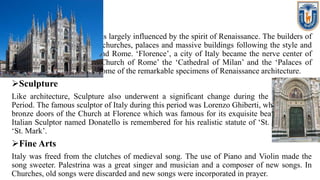
The Architecture of Italy was largely influenced by the spirit of Renaissance. The builders of
this time constructed many churches, palaces and massive buildings following the style and
pattern of ancient Greece and Rome. ‘Florence’, a city of Italy became the nerve center of
art-world. The ‘St Peter’s Church of Rome’ the ‘Cathedral of Milan’ and the ‘Palaces of
Venice and Florence’ were some of the remarkable specimens of Renaissance architecture.
Sculpture
Like architecture, Sculpture also underwent a significant change during the Renaissance
Period. The famous sculptor of Italy during this period was Lorenzo Ghiberti, who carved the
bronze doors of the Church at Florence which was famous for its exquisite beauty. Another
Italian Sculptor named Donatello is remembered for his realistic statute of ‘St. George’ and
‘St. Mark’.
Fine Arts
Italy was freed from the clutches of medieval song. The use of Piano and Violin made the
song sweeter. Palestrina was a great singer and musician and a composer of new songs. In
Churches, old songs were discarded and new songs were incorporated in prayer.
Painting
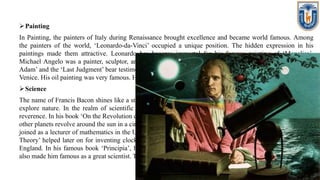
In Painting, the painters of Italy during Renaissance brought excellence and became world famous. Among
the painters of the world, ‘Leonardo-da-Vinci’ occupied a unique position. The hidden expression in his
paintings made them attractive. Leonardo has become immortal for his famous painting of ‘Monalisa’.
Michael Angelo was a painter, sculptor, architect, poet and engineer in one. His paintings like ‘Creation of
Adam’ and the ‘Last Judgment’ bear testimony of his superb skill. Titian was the official painter of the city of
Venice. His oil painting was very famous. His painting ‘Christ Carrying the Cross’ appeared real and lively.
Science
The name of Francis Bacon shines like a star in the realm of science. He was a great scientist who advised to
explore nature. In the realm of scientific discoveries, the name of Copernicus of Poland is chanted with
reverence. In his book ‘On the Revolution of the Celestial Bodies’, he opined that Sun is static. The Earth and
other planets revolve around the sun in a circle. Another great scientist of this age was Galileo of Italy. He had
joined as a lecturer of mathematics in the University of Pisa and there he became a professor. His “Pendulum
Theory’ helped later on for inventing clock. A great Scientist of repute of that age was Sir Issac Newton of
England. In his famous book ‘Principia’, he stated about the ‘Law of Gravitation’. His ‘Theory of Motion’
also made him famous as a great scientist. The ‘Causes of tide’ were also discovered by him.
Improvement in the condition of Women
The condition of women, especially from the upper class improved due to Renaissance. They
started taking education and showed interest in social, economic and political life. The period
saw the rise of women scholars like Cassandra, Varano, Vittoria etc.
Manners and Etiquette
Under the influence of Renaissance, people developed new table manners. They also made
spices indispensable part of their food. They also developed Etiquette of Conversation. The
people interacted with the scholars, poets and musician with more intimacy.
Decline in Morality
One of the negative impact of Renaissance was that the society experience in the decline in
the moral standard of the people. The people had started questioning the ways of church and
became more materialists.
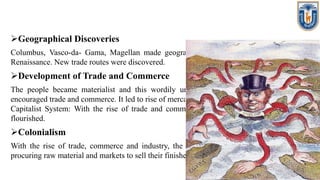
Geographical Discoveries
Columbus, Vasco-da- Gama, Magellan made geographical discoveries under the spirit of
Renaissance. New trade routes were discovered.
Development of Trade and Commerce
The people became materialist and this wordily under the influence of Renaissance. It
encouraged trade and commerce. It led to rise of mercantilism in Europe. Rise of Industry and
Capitalist System: With the rise of trade and commerce, the industry and capitalism also
flourished.
Colonialism
With the rise of trade, commerce and industry, the Europeans countries needed areas for
procuring raw material and markets to sell their finished goods. It led to rise of colonialism.
Rise of Strong Monarchies
Renaissance brought forth the ideal of strong Roman Monarchs. It led to the rise of strong
monarchies in Europe.
Change in Warfare
With the discovery of gun powders and invention of guns and mortars the scene of battle field
changed. The forts lost its importance as the secured places as they could not stand the barge
of gun fires.
Encouragement to Virtue Less Politics
It brought to the forth the ideal of opportunism in the field of politics. The Prince of
Machiavelli became the bible of the kings who adopted all the wrong and right means to
maintain their rule. It led to anarchy when the monarchies became oppressive.
Reference
• Burke, Peter. The Italian Renaissance: Culture and Society in Italy
Princeton, Princeton University Press, 1999, p. 6.
• Burkhardt, Jacob (1990) The Civilization of the Renaissance in
Italy.(Hammondsworth, Penguin Classics, 1990) p. 78
• Celenza, Christopher and Kenneth Gouvens, Editors. Humanism and
Creativity in the Renaissance (Longmans, Leiden 2006),pp. 295–326
• Duffy, Eamon. Saints and Sinners: A History of the Popes.Yale
University Press, 1997), p. 211

Renaissance causes-and-consequences

  • 1.
    Presentation on Renaissance Prepared by: Alok Roy SociologyDiscipline Khulna University Khulna-9208 Bangladesh.
  • 2.
    History of Renaissance TheRenaissance is a period in European history, covering the span between the 14th and 17th centuries. It is an extension of the Middle Ages and is bridged by the Age of Enlightenment to modern history. It grew in fragments, with the very first traces found seemingly in Italy, coming to cover much of Europe, for some scholars marking the beginning of the modern age. The intellectual basis of the Renaissance was its own invented version of humanism, derived from the concept of Roman Humanities and the rediscovery of classical Greek philosophy, such as that of Protagoras, who said that "Man is the measure of all things." This new thinking became manifest in art, architecture, politics, science and literature. Early examples were the development of perspective in oil painting and the recycled knowledge of how to make concrete. Although the invention of metal movable type sped the dissemination of ideas from the later 15th century.
  • 3.
    Renaissance Many argue thatthe ideas characterizing the Renaissance had their origin in late 13th-century Florence, in particular with the writings of Dante Alighieri (1265–1321) and Petrarch (1304–1374), as well as the paintings of Giotto di Bondone (1267–1337). The renaissance was a time of renewal. Renaissance means rebirth and Europe was discovering from the dark ages and the plague. People had lost their faith in the church and began to put more focus on human being. The Renaissance was a cultural movement that profoundly affected European intellectual life in the early modern period. Beginning in Italy, and spreading to the rest of Europe by the 16th century, its influence was felt in literature, philosophy, art, music, politics, science, religion, and other aspects of intellectual inquiry. Renaissance scholars employed the humanist method in study, and searched for realism and human emotion in art
  • 4.
    Characteristics of Renaissance Humanism Humanist scholars shaped the intellectual landscape throughout the early modern period. Political philosophers such as Niccolò Machiavelli and Thomas More revived the ideas of Greek and Roman thinkers and applied them in critiques of contemporary government . The humanists believed that it is important to transcend to the afterlife with a perfect mind and body, which could be attained with education. The purpose of humanism was to create a universal man whose person combined intellectual and physical excellence and who was capable of functioning honourably in virtually any situation. Above all, humanists asserted "the genius of man ... the unique and extraordinary ability of the human mind".  Humanism and Libraries A unique characteristic of some Renaissance libraries is that they were open to the public. These libraries were places where ideas were exchanged and where scholarship and reading were considered both pleasurable and beneficial to the mind and soul. A number of libraries appeared as manifestations of immense wealth joined with a love of books. Prominent aristocrats and princes of the Church created great libraries for the use of their courts, called "court libraries”. These informal associations of intellectuals profoundly influenced Renaissance culture.
  • 5.
    Art Renaissance art marksa cultural rebirth at the close of the Middle Ages and rise of the Modern world. One of the distinguishing features of Renaissance art was its development of highly realistic linear perspective. The development of perspective was part of a wider trend towards realism in the arts. Painters developed other techniques, studying light, shadow, and, famously in the case of Leonardo da Vinci, (human anatomy). Giotto di Bondone, Leon Battista Alberti, Filippo Brunelleschi, Michelangelo and Raphael are the main scholars of renaissance. Religion The new ideals of humanism, although more secular in some aspects, developed against a Christian backdrop, especially in the Northern Renaissance. Much, if not most, of the new art was commissioned by or in dedication to the Church. However, the Renaissance had a profound effect on contemporary theology, particularly in the way people perceived the relationship between man and God. Many of the period's foremost theologians were followers of the humanist method, including Erasmoreus, Zwingli, Thomas More, Martin Luther, and John Calvin. People had lost their faith in the church and began to put more focus on human being.
  • 6.
    Science The rediscovery ofancient texts and the invention of printing democratized learning and allowed a faster propagation of more widely distributed ideas. In the first period of the Italian Renaissance. Nicholas Cusanus anticipated the heliocentric worldview. Suitable environment had developed to question scientific doctrine. The discovery in 1492 of the New World by Christopher Columbus challenged the classical worldview. The works of Ptolemy (in geography) and Galen (in medicine) were found to not always match everyday observations. As the Protestant Reformation and Counter-Reformation clashed, the Northern Renaissance showed a decisive shift in focus from Aristotelian natural philosophy to chemistry and the biological sciences (botany, anatomy, and medicine). Some view this as a "scientific revolution", heralding the beginning of the modern age, others as an acceleration of a continuous process stretching from the ancient world to the present day. Significant scientific advances were made during this time by Galileo Galilei, Tycho Brahe and Johannes Kepler.
  • 7.
    Music From this changingsociety emerged a common, unifying musical language, in particular the polyphonic style of the Franco-Flemish school. The development of printing made distribution of music possible on a wide scale. Demand for music as entertainment and as an activity for educated amateurs increased with the emergence of a bourgeois class. Dissemination of chansons, motets, and masses throughout Europe coincided with the unification of polyphonic practice into the fluid style that culminated in the second half of the sixteenth century in the work of composers such as Palestrina, Lassus, Victoria and William Byrd.
  • 8.
    Self-awareness By the 15thcentury, writers, artists, and architects in Italy were well aware of the transformations that were taking place and were using phrases such as modi antichi (in the antique manner) or alle romana et alla antica (in the manner of the Romans and the ancients) to describe their work. In the 1330s Petrarch referred to pre-Christian times as antiqua (ancient) and to the Christian period as nova (new). Humanist historians argued that contemporary scholarship restored direct links to the classical period. the age into three phases: the first phase contains Cimabue, Giotto, and Arnolfo di Cambio; the second phase contains Masaccio, Brunelleschi, and Donatello; the third centers on Leonardo da Vinci and culminates with Michelangelo. It was not just the growing awareness of classical antiquity that drove this development.
  • 9.
    Causes of Renaissance •There were many causes behind ‘Renaissance’. The fall of Constantinople was its main cause. It was the center of learning. Although, it was under the clutches of the Christians, many Greek scholars were living there. They became famous by teaching Greek language and literature to the people. Although historians still debate some causes of the Renaissance, they agree on a few basic points.  A Hunger for Discovery The courts and monasteries of Europe had long been repositories of old manuscripts and texts, but a change in how scholars viewed them stimulated a massive reappraisal of classical works in the Renaissance. Fourteenth-century writer Petrarch typified this, writing about his own lust for discovering texts that had previously been ignored. As literacy spread and a middle class began to emerge, seeking out, reading, and spreading classical texts became commonplace.
  • 10.
    Reintroduction of ClassicalWorks During the Dark Ages, many of the classical texts of Europe were lost or destroyed. Those that survived were hidden in the churches and monasteries of the Byzantine Empire or in the capitals of the Middle East. During the Renaissance, many of these texts were slowly reintroduced into Europe by merchants and scholars. For instance, in 1396 an official academic post for teaching Greek was created in Florence. The Printing Press • The invention of the printing press in 1440 was the game-changer. Finally, books could be mass produced for far less money and time than the old handwritten methods. Ideas could be spread through libraries, booksellers, and schools in a way that wasn't possible before. The spread of books also encouraged the study of literature itself, allowing new ideas to spread and grow as many cities and nations began to establish universities and other schools.
  • 11.
    Humanism Emerges Renaissance humanismwas a new manner of thinking and approaching the world, based on a new form of curriculum for those learning. It has been called the earliest expression of the Renaissance and is described as both a product and a cause of the movement. Art and Politics As the arts grew, artists needed wealthy patrons to support them, and Renaissance Italy was especially fertile ground. Political changes in the ruling class of Italy shortly before this period had led to the rulers of most of the major city-states being “new men” without much of a political history. They attempted to legitimize themselves with conspicuous investment in and public flaunting of art and architecture. "The Prince," Machiavelli’s guide for rulers, is a work of Renaissance political theory. A new political and economic class began to emerge.
  • 12.
    Death and Life Inthe middle of the 14th century, the Black Death swept across Europe, killing perhaps a third of the population. While devastating, the survivors found themselves better off financially and socially, with the same wealth spread among fewer people. This was especially true in Italy, where social mobility was much greater. This new wealth was often was spent lavishly on arts, culture, and artisanal goods, much like the rulers above them had done before them. In addition, the merchant classes of regional powers like Italy saw a great increase in their wealth from their role in trade. War and Peace Periods of both peace and war have been credited with allowing the Renaissance to spread and become a European phenomenon. The end of the Hundred Years War between England and France in 1453 allowed Renaissance ideas to penetrate these nations as resources once consumed by war instead were funneled into the arts and sciences. By contrast, the Great Italian Wars of the early 16th century allowed Renaissance ideas to spread to France as its armies invaded Italy repeatedly over a 50-year period.
  • 13.
    Decline of Feudalism TheRenaissance was able to flourish because the Feudalism was declining. The cause of decline of feudalism was the rise of middle class and their support to the kings. It was this middle class which promoted Renaissance only when the feudalism declined. Crusades Crusaders brought new thoughts and beliefs, which replaced the old thoughts, beliefs and institutions. The crusades took pace in 1095 and 1291. As a result the Europeans came in contact with the people of East. Emergence of new Cities New Cities like Milan, Venice, Florence, Lisbon, Amherstdom etc flourished. They had more democratic set up which afforded more freedom to their citizens. These cities had risen with the efforts of the middle class which was open to new thoughts and despised the clogging of intellectual development under the suffocating control of Pope and his church.
  • 14.
    Results of Renaissance Literature TheRenaissance literature had its birth in Italy. The first notable creation in this direction was Dante’s ‘Divine Comedy’. Another pioneer of Renaissance thought was Francesco Petrarch. The medieval thought was monastic, ascetic and other worldly. The famous philosopher of Italy was Machiavelli who in his famous book ‘The Prince’ described the principle of the ‘Lion and the Fox’. Art The bold departure from medieval tradition was nowhere more clearly revealed than in Art of Renaissance period. Before Renaissance, the chief art of the middle age was essentially Christian. Art was intimately associated with religion. The artists used to draw the pictures of monks, bishops and priests and the church had restricted their freedom of thought and action.
  • 15.
    Architecture The Architecture ofItaly was largely influenced by the spirit of Renaissance. The builders of this time constructed many churches, palaces and massive buildings following the style and pattern of ancient Greece and Rome. ‘Florence’, a city of Italy became the nerve center of art-world. The ‘St Peter’s Church of Rome’ the ‘Cathedral of Milan’ and the ‘Palaces of Venice and Florence’ were some of the remarkable specimens of Renaissance architecture. Sculpture Like architecture, Sculpture also underwent a significant change during the Renaissance Period. The famous sculptor of Italy during this period was Lorenzo Ghiberti, who carved the bronze doors of the Church at Florence which was famous for its exquisite beauty. Another Italian Sculptor named Donatello is remembered for his realistic statute of ‘St. George’ and ‘St. Mark’. Fine Arts Italy was freed from the clutches of medieval song. The use of Piano and Violin made the song sweeter. Palestrina was a great singer and musician and a composer of new songs. In Churches, old songs were discarded and new songs were incorporated in prayer.
  • 16.
    Painting In Painting, thepainters of Italy during Renaissance brought excellence and became world famous. Among the painters of the world, ‘Leonardo-da-Vinci’ occupied a unique position. The hidden expression in his paintings made them attractive. Leonardo has become immortal for his famous painting of ‘Monalisa’. Michael Angelo was a painter, sculptor, architect, poet and engineer in one. His paintings like ‘Creation of Adam’ and the ‘Last Judgment’ bear testimony of his superb skill. Titian was the official painter of the city of Venice. His oil painting was very famous. His painting ‘Christ Carrying the Cross’ appeared real and lively. Science The name of Francis Bacon shines like a star in the realm of science. He was a great scientist who advised to explore nature. In the realm of scientific discoveries, the name of Copernicus of Poland is chanted with reverence. In his book ‘On the Revolution of the Celestial Bodies’, he opined that Sun is static. The Earth and other planets revolve around the sun in a circle. Another great scientist of this age was Galileo of Italy. He had joined as a lecturer of mathematics in the University of Pisa and there he became a professor. His “Pendulum Theory’ helped later on for inventing clock. A great Scientist of repute of that age was Sir Issac Newton of England. In his famous book ‘Principia’, he stated about the ‘Law of Gravitation’. His ‘Theory of Motion’ also made him famous as a great scientist. The ‘Causes of tide’ were also discovered by him.
  • 17.
    Improvement in thecondition of Women The condition of women, especially from the upper class improved due to Renaissance. They started taking education and showed interest in social, economic and political life. The period saw the rise of women scholars like Cassandra, Varano, Vittoria etc. Manners and Etiquette Under the influence of Renaissance, people developed new table manners. They also made spices indispensable part of their food. They also developed Etiquette of Conversation. The people interacted with the scholars, poets and musician with more intimacy. Decline in Morality One of the negative impact of Renaissance was that the society experience in the decline in the moral standard of the people. The people had started questioning the ways of church and became more materialists.
  • 18.
    Geographical Discoveries Columbus, Vasco-da-Gama, Magellan made geographical discoveries under the spirit of Renaissance. New trade routes were discovered. Development of Trade and Commerce The people became materialist and this wordily under the influence of Renaissance. It encouraged trade and commerce. It led to rise of mercantilism in Europe. Rise of Industry and Capitalist System: With the rise of trade and commerce, the industry and capitalism also flourished. Colonialism With the rise of trade, commerce and industry, the Europeans countries needed areas for procuring raw material and markets to sell their finished goods. It led to rise of colonialism.
  • 19.
    Rise of StrongMonarchies Renaissance brought forth the ideal of strong Roman Monarchs. It led to the rise of strong monarchies in Europe. Change in Warfare With the discovery of gun powders and invention of guns and mortars the scene of battle field changed. The forts lost its importance as the secured places as they could not stand the barge of gun fires. Encouragement to Virtue Less Politics It brought to the forth the ideal of opportunism in the field of politics. The Prince of Machiavelli became the bible of the kings who adopted all the wrong and right means to maintain their rule. It led to anarchy when the monarchies became oppressive.
  • 20.
    Reference • Burke, Peter.The Italian Renaissance: Culture and Society in Italy Princeton, Princeton University Press, 1999, p. 6. • Burkhardt, Jacob (1990) The Civilization of the Renaissance in Italy.(Hammondsworth, Penguin Classics, 1990) p. 78 • Celenza, Christopher and Kenneth Gouvens, Editors. Humanism and Creativity in the Renaissance (Longmans, Leiden 2006),pp. 295–326 • Duffy, Eamon. Saints and Sinners: A History of the Popes.Yale University Press, 1997), p. 211